Exellius vs Minelead: Which Email Finder Wins in 2026?
Exellius and Minelead both promise cheap B2B emails, but they solve different problems. Here's how their data, pricing, and verification actually compare in 2026 — plus when neither is the right call.
TL;DR
- Exellius positions itself as an AI-assisted B2B contact and lead-intelligence layer — broader records, more filtering, higher price per seat.
- Minelead is the cheap, fast, developer-friendly domain-to-email lookup — generous free tier, thin enrichment, minimal verification depth.
- Neither tool wins on verification the way a dedicated stack does. Both surface addresses; neither closes the catch-all gap cleanly.
- Pick Minelead if you need volume lookups on a budget and will verify elsewhere. Pick Exellius if you need filters, firmographics, and account-level context in one place.
- If your bounce rate is the metric that actually matters, run finding and verification as separate, auditable steps — that's where a purpose-built email verifier earns its keep.
What are Exellius and Minelead, and why are they compared?#
They land in the same search results because both answer one question: "What is this person's work email?" But they answer it from opposite ends of the market.
Minelead (minelead.io) is a lightweight email-finding service built around domain search. You feed it a domain, it returns the addresses it knows about plus the inferred pattern. It has an API, a Chrome extension, and a free tier that's unusually generous for the category. The pitch is speed and price, not depth.
Exellius (exellius.com) sits closer to the sales-intelligence side. The product wraps contact discovery in filters, list-building, and AI-assisted targeting — the sort of thing you'd otherwise assemble from a database tool plus a finder. The pitch is that you don't leave the platform between "who should I target" and "here's their email."
That difference explains most of what follows. One is a lookup utility. The other is a workflow. Comparing them on "accuracy" alone misses the point — they're not competing for the same job.
Sorry — corrected placement below.

How do Exellius and Minelead compare head-to-head?#
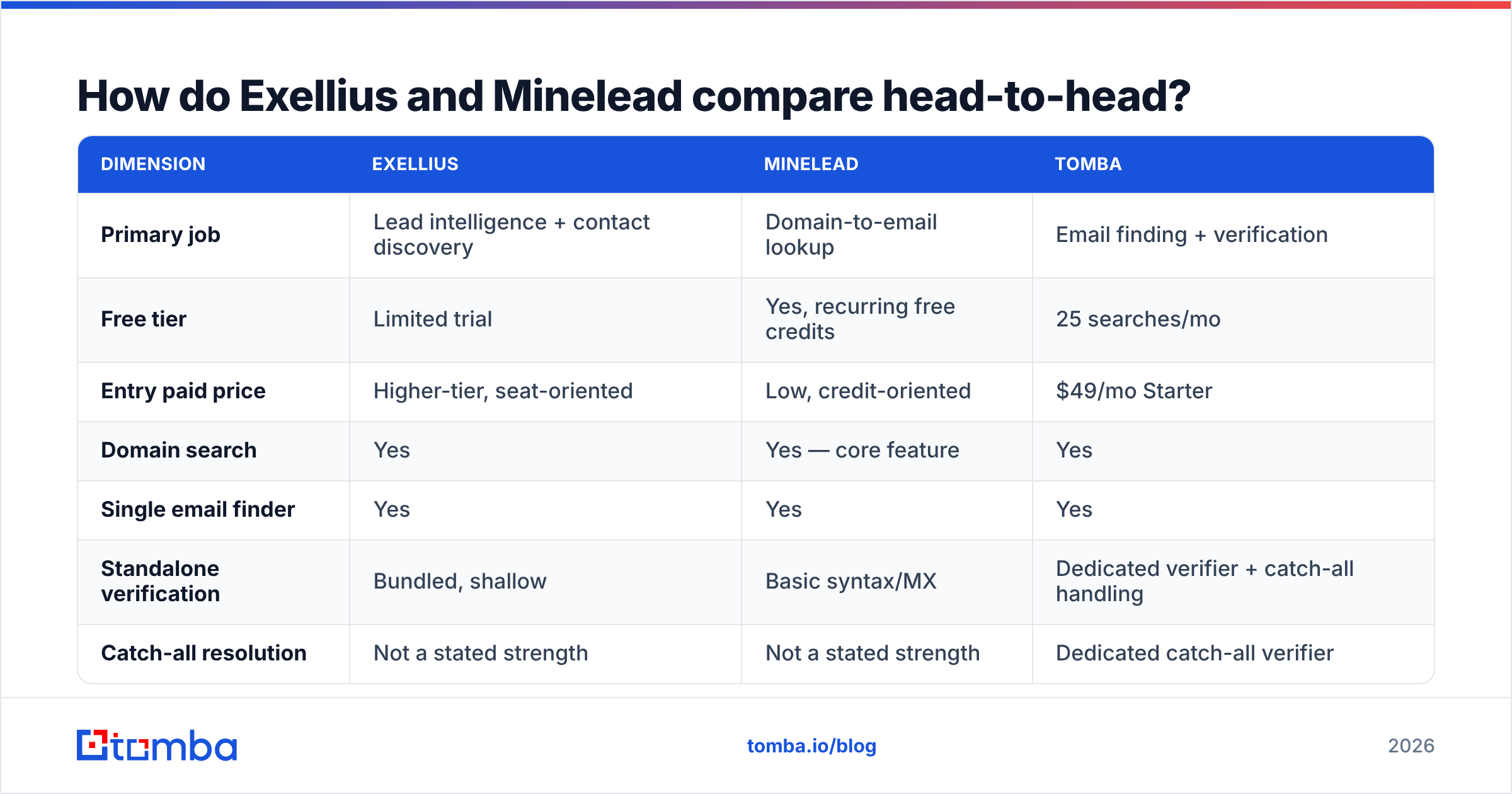
Here's the practical breakdown. Treat vendor-published numbers as marketing claims until you test them on your own domain list — accuracy varies wildly by geography and company size, and no vendor publishes a segmented breakdown.
| Dimension | Exellius | Minelead | Tomba |
|---|---|---|---|
| Primary job | Lead intelligence + contact discovery | Domain-to-email lookup | Email finding + verification |
| Free tier | Limited trial | Yes, recurring free credits | 25 searches/mo |
| Entry paid price | Higher-tier, seat-oriented | Low, credit-oriented | $49/mo Starter |
| Domain search | Yes | Yes — core feature | Yes |
| Single email finder | Yes | Yes | Yes |
| Standalone verification | Bundled, shallow | Basic syntax/MX | Dedicated verifier + catch-all handling |
| Catch-all resolution | Not a stated strength | Not a stated strength | Dedicated catch-all verifier |
| Bulk processing | Yes | Yes | Bulk finder + bulk verify |
| API depth | Available | Available, developer-friendly | Full REST API, CLI, MCP server |
| Phone numbers | Some records | No | Phone finder + validator |
| Spreadsheet add-ons | Limited | Limited | Sheets, Excel, Airtable |
| Best for | ICP filtering + outreach in one tool | Cheap high-volume lookups | Accuracy-first outbound at scale |
The row that decides most evaluations is catch-all resolution. Roughly a third of B2B domains are configured to accept mail at any address, which means a naive "valid" response tells you nothing. Tools that don't explicitly handle catch-alls are handing you a coin flip and calling it a lead.
Which one has better data accuracy?#
Short answer: Exellius tends to win on coverage of enriched fields; Minelead wins on cost-per-lookup. Neither is a verification tool.
Accuracy in this category breaks into three separate things people wrongly bundle together:
- Discovery rate — of the 100 people you searched, how many returned any address? Minelead's pattern-inference approach keeps this number high, because it will happily generate
first.last@domain.comwhen it recognises the pattern. High discovery, variable truth. - Deliverability — of the addresses returned, how many actually accept mail? This is where inferred patterns collapse. A pattern-generated address on a catch-all domain will pass a basic SMTP check and still bounce or, worse, land in a spam trap.
- Freshness — how recently was the record confirmed? B2B contact data decays at roughly 20–30% per year as people change jobs, which means a two-year-old record is closer to a guess than a fact. Both tools are opaque about record age.
Vendors quote a single blended "accuracy" figure that conflates all three. When you run your own test, split them: take 100 known-good contacts from your CRM, run them through each tool, and score discovery separately from deliverability. The gap between the two numbers is the real story.

This is also the argument for decoupling. When your finder and your verifier are the same black box, you can't audit either. Running discovery in one tool and validation in a dedicated email verification layer gives you a number you can actually defend in a pipeline review.
Is Exellius better than Minelead for cold outbound?#
It depends entirely on whether your bottleneck is targeting or volume.
Use this decision frame:
- You already know exactly who to contact (a scraped list, a conference roster, a set of target domains) — Minelead is the cheaper fit. You're paying only for the lookup, not for filtering you won't use.
- You need to build the list first — Exellius earns its premium. Firmographic filters, ICP definition, and contact discovery in one place beats stitching three tools together, and the seat price is cheaper than the hours.
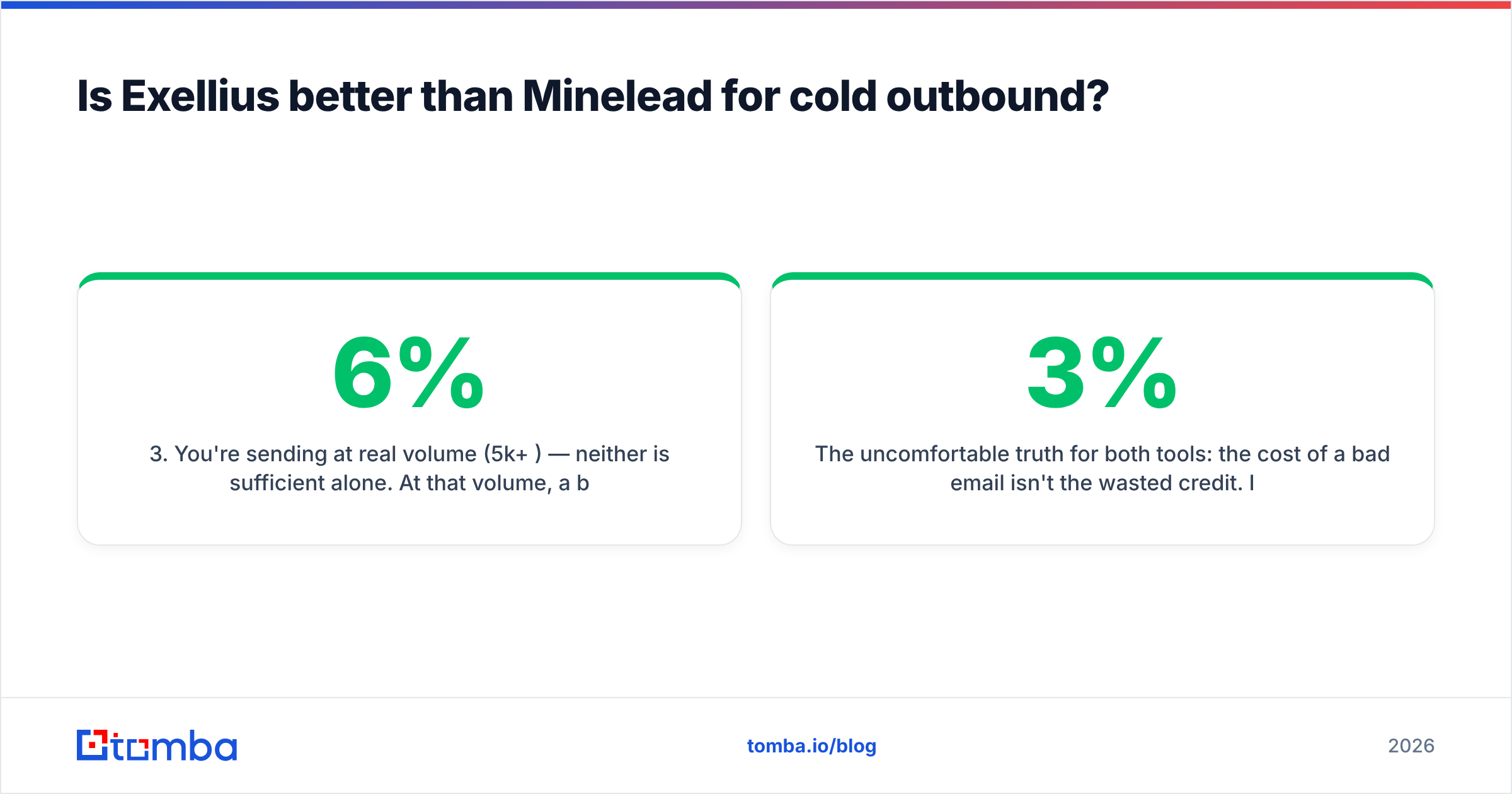
- You're sending at real volume (5k+/month) — neither is sufficient alone. At that volume, a 6% bounce rate is a domain-reputation problem, not a data-quality annoyance. You need a verification step you control.
- You're building a product on top of the data — Minelead's API is the friendlier starting point, but check rate limits and per-call cost at your projected scale before committing. Cheap per lookup gets expensive at 100k lookups.
- You need phone numbers too — neither tool leads here. A dedicated phone finder is the cleaner add-on.
- You're operating in the EU — check each vendor's stated legal basis and opt-out handling. GDPR compliance for B2B contact data is a real constraint, not a checkbox, and it varies by provider.

The uncomfortable truth for both tools: the cost of a bad email isn't the wasted credit. It's the reply-rate damage from sending to dead addresses, which compounds across every subsequent campaign from that domain. A hard bounce rate above 3% is enough to get you throttled by major mailbox providers, and above 5% you're in genuine deliverability trouble. Google and Microsoft both tightened bulk-sender requirements over the last two years, and neither is loosening them.
What does each tool cost in practice?#
Published pricing shifts, so verify on each vendor's page before you commit budget. The structural difference matters more than the specific numbers:
- Minelead prices on credits with a real free tier. Low commitment, easy to trial, cost scales linearly with lookups. Attractive for spiky usage.
- Exellius prices closer to a seat/platform model. Higher floor, but the price includes the targeting layer, so the comparison isn't apples-to-apples.
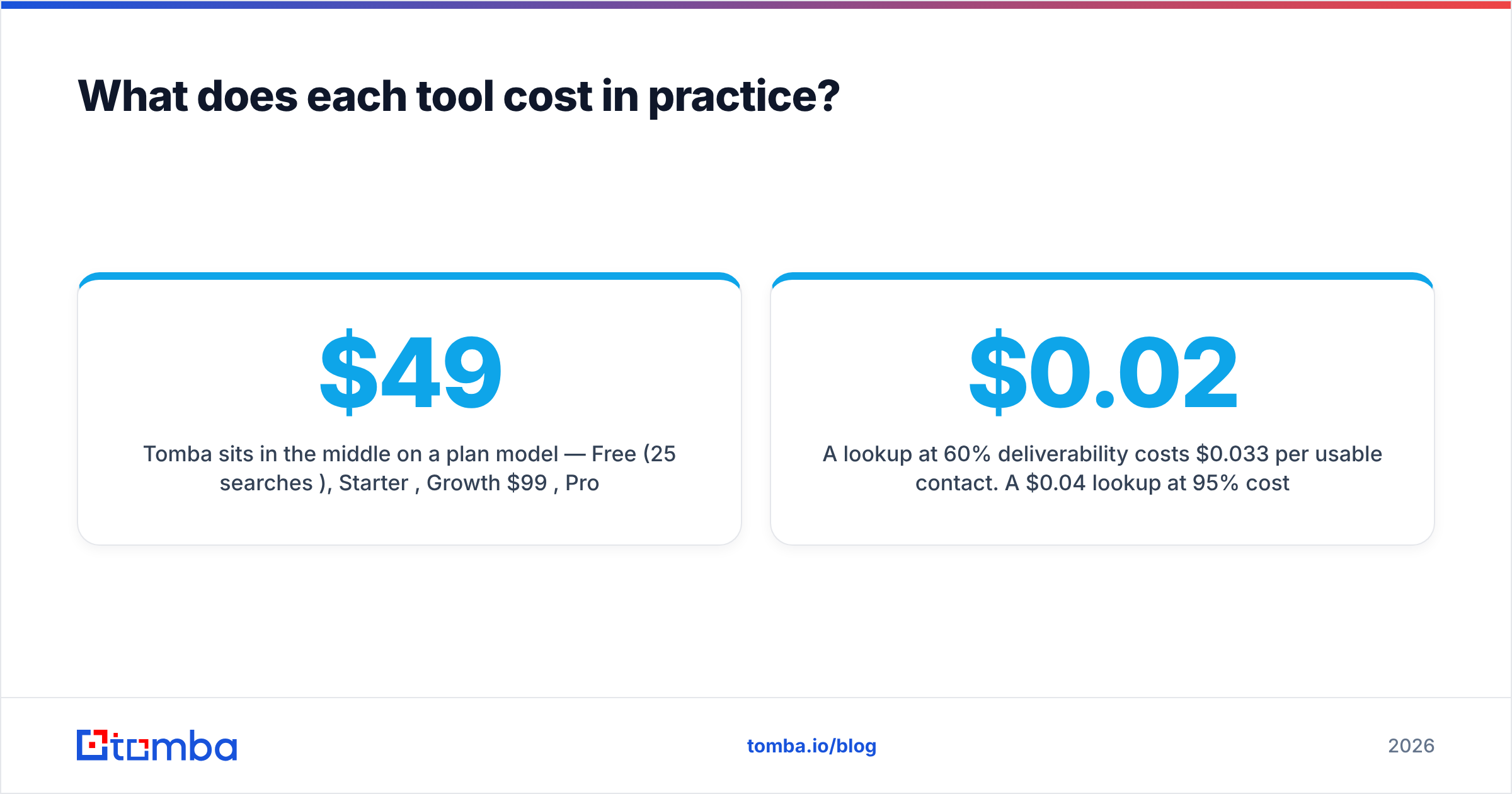
- Tomba sits in the middle on a plan model — Free (25 searches/mo), Starter $49/mo, Growth $99/mo, Pro $249/mo, Enterprise custom. See current Tomba pricing for what's included at each tier.
The mistake teams make is optimising for cost-per-credit. Model cost per usable contact instead:
cost per usable contact = (plan cost / credits used) / (deliverability rate)A $0.02 lookup at 60% deliverability costs $0.033 per usable contact. A $0.04 lookup at 95% costs $0.042 — and saves you the bounce damage, the list-cleaning time, and the reputation hit. The cheap tool is rarely the cheap option once you account for what you throw away.
What about alternatives worth testing alongside these two?#
Don't run a two-horse race when the category has a dozen credible entrants. A few worth putting on the shortlist:
- BookYourData — pay-as-you-go B2B contact lists with a strong accuracy guarantee. Different model from both Exellius and Minelead: you're buying pre-built list segments rather than doing lookups. Genuinely good if you want data without a subscription commitment.
- Hunter — the category default for domain search; solid, well-documented, priced accordingly.
- Apollo — database plus sequencing; heavier, and you'll pay for the parts you don't use. If that's your concern, an Apollo alternative comparison is worth reading before you sign.
- Tomba — finder plus a real verification stack, including catch-all verification, which is the piece most competitors gloss over.
When you evaluate, run the same 50-domain test list through every candidate on the same day. Vendor-supplied demos are cherry-picked; your own list is not. Score three columns: found, verified-deliverable, and confirmed-correct (you'll only know the third after you send). Independent review sites like G2 are useful for spotting support and billing complaints that never appear on a pricing page — but treat aggregate star ratings as noise. Read the 3-star reviews; they're the honest ones.
How should you structure a finder + verifier stack?#
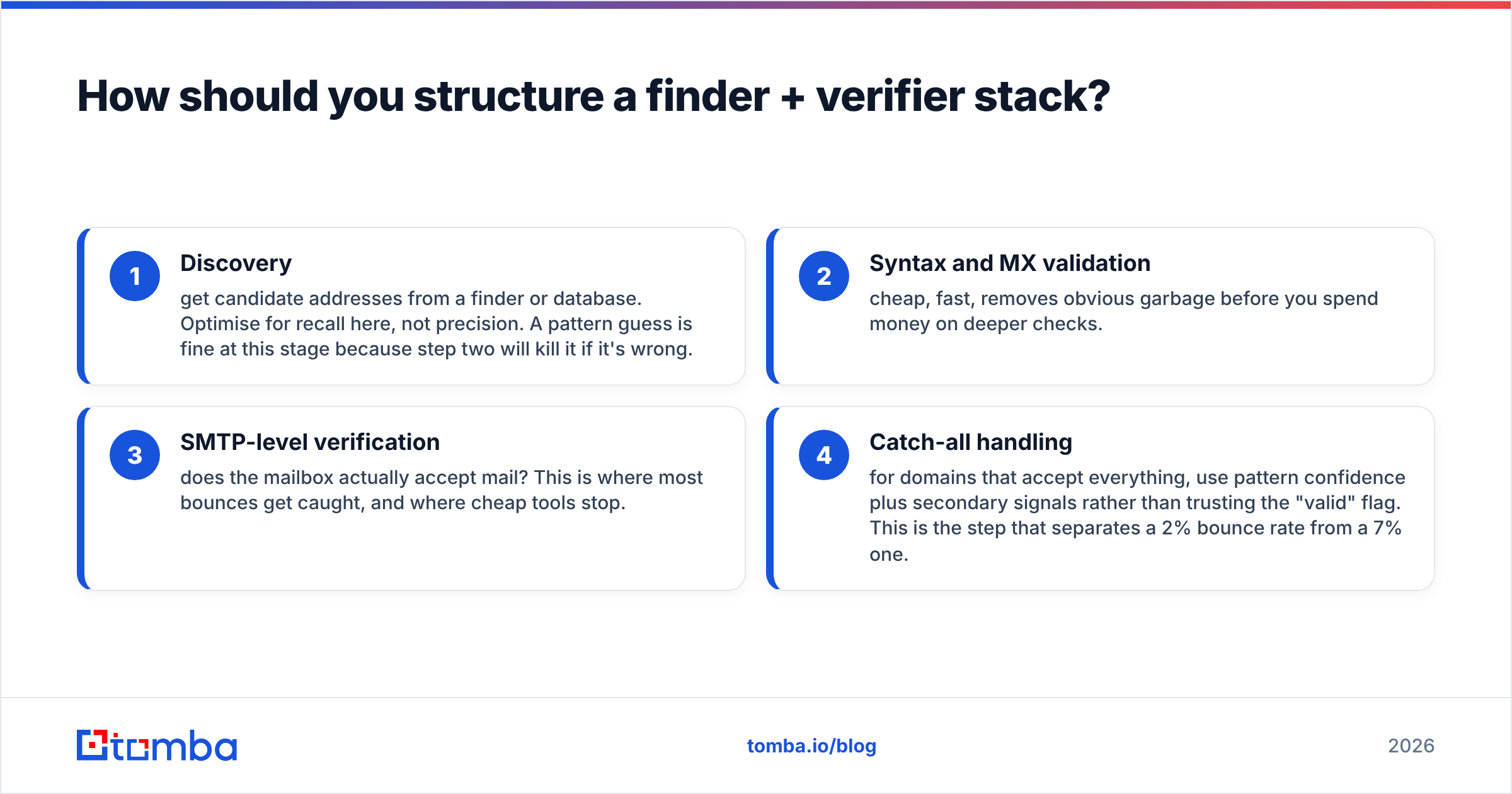
The architecture that holds up under volume separates four steps:
- Discovery — get candidate addresses from a finder or database. Optimise for recall here, not precision. A pattern guess is fine at this stage because step two will kill it if it's wrong.
- Syntax and MX validation — cheap, fast, removes obvious garbage before you spend money on deeper checks.
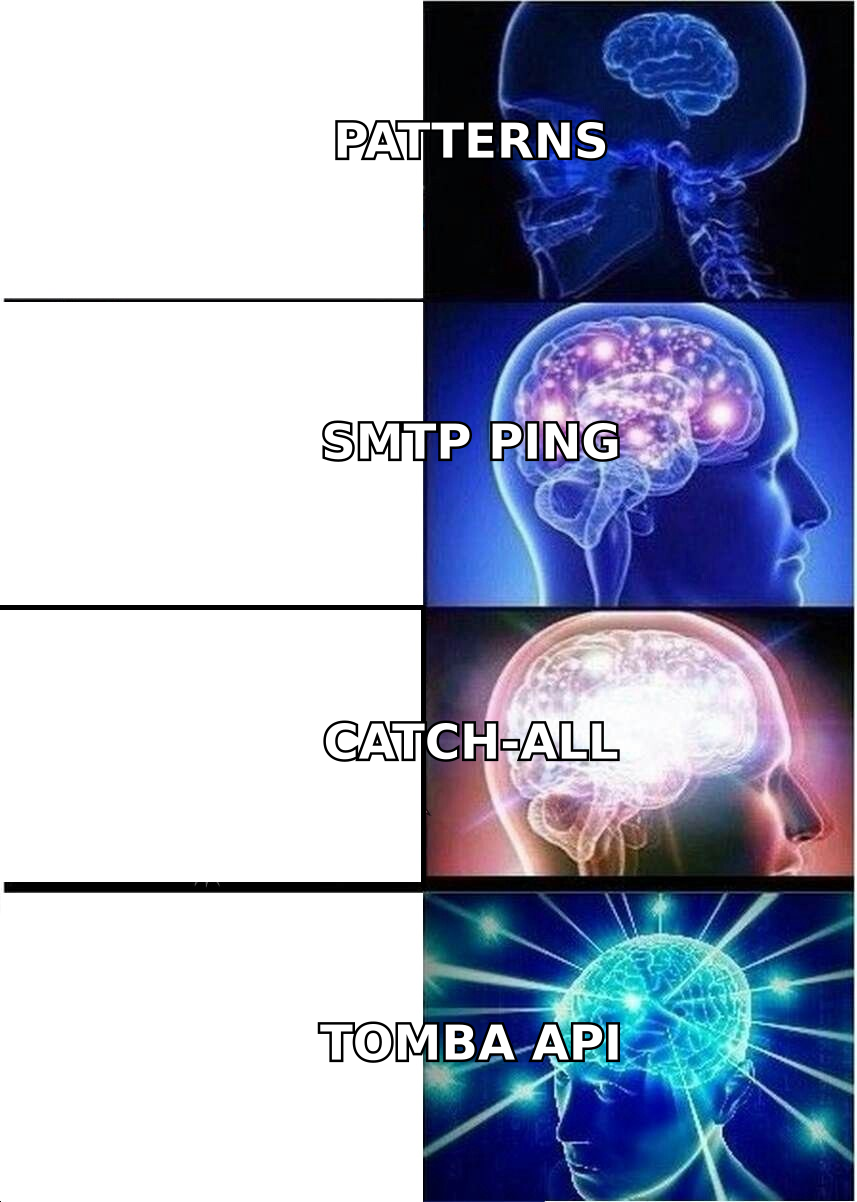
- SMTP-level verification — does the mailbox actually accept mail? This is where most bounces get caught, and where cheap tools stop.
- Catch-all handling — for domains that accept everything, use pattern confidence plus secondary signals rather than trusting the "valid" flag. This is the step that separates a 2% bounce rate from a 7% one.
Most teams skip step four entirely, then wonder why their verified list still bounces. If you're building this programmatically, the Tomba API exposes each step as a distinct call, so you can log confidence at every stage instead of accepting one opaque verdict. For non-technical workflows, the Google Sheets add-on runs the same pipeline over a column of names and domains.
One more operational note: whatever stack you choose, re-verify before every send, not once at list-build time. A list verified 90 days ago is meaningfully stale — job changes alone will have invalidated a chunk of it. Verification is a per-campaign step, not a one-time cleanup.
The verdict: which should you actually buy?#
Buy Minelead if you're an individual, a small team, or a developer who needs cheap high-volume domain lookups and already has a verification step. The free tier makes it near-zero-risk to test.
Buy Exellius if your bottleneck is who to contact, not how to reach them. The targeting layer justifies the higher price when it replaces a separate database subscription.
Buy neither if deliverability is your primary metric. Both tools optimise for discovery; neither is built as a verification-first platform, and catch-all domains will expose that gap fast.
The honest framing: this isn't a fight one tool wins. It's a question of which failure mode you can tolerate. Minelead's failure mode is bad addresses that look fine. Exellius's is paying for filtering you might not need. Know which one costs you more.
Ready to stop guessing at deliverability? Try the Tomba Email Finder — find verified professional emails by name, domain, or company, with catch-all detection and confidence scoring built into the same workflow. Start on the free tier (25 searches/month, no card), test it against your current list, and compare the bounce rates yourself. That's the only benchmark that matters.
Related guides#
Ready to find emails that actually work?
Join 150,000+ professionals who stopped guessing and started sending. Free credits on signup — no credit card required.
Get the Tomba newsletter
Practical outbound tactics and product updates — once every two weeks.
About the author