Exellius vs Seamlessai (2026): Which B2B Data Tool Wins?
Exellius sells curated, human-verified B2B lists. Seamless.AI sells an AI-powered contact search engine. We compare accuracy, pricing, credits, and support to find which one actually fits your outbound motion.
Exellius vs Seamlessai comes down to one trade: a done-for-you list service against a self-serve AI search tool. Here is the short version.
TL;DR
- Exellius is a curated, human-in-the-loop B2B list provider — you brief a target profile, their team builds and verifies the list. Strong for niche ICPs, weak for self-serve speed.
- Seamless.AI is a self-serve AI search engine over a very large contact index, with a Chrome extension and CRM pushes. Strong for volume, notorious for credit rules and hard-to-cancel annual contracts.
- Neither is a pure email-verification layer. Both benefit from an independent verifier before you send.
- If you need API-first, pay-as-you-scale email discovery instead of a seat-based data subscription, a dedicated email finder is usually 3–5x cheaper per usable contact.
- Our pick: Exellius for narrow, high-ACV ICP lists. Seamless.AI for high-volume SDR teams that already have a verification step. Tomba if you want the data programmatically.
Most teams weigh Exellius vs Seamlessai for the same reason. One promises hand-curated quality. The other promises infinite scale. You cannot tell which claim holds up until the data lands in your CRM. Both claims are partly true. The difference shows up in your bounce rate, your renewal invoice, and the cleanup your SDRs do before Monday's sends.
What is Exellius and who is it actually for?#
Exellius positions itself as a B2B lead generation and data partner rather than a database you log into. The model is closer to a managed service. You define your ideal customer profile — industry, headcount, geography, tech stack, seniority. Their team then builds a contact list against it, with a human check before delivery.
That matters for two kinds of buyers:
- Niche ICPs that databases index badly. If your buyers are plant managers at mid-market injection-molding firms in Ohio, generic databases return noise. A curated build wins.
- Teams without a data ops person. You are buying the filtering labor, not just the rows.
The tradeoffs are equally clear. There is no instant self-serve search — turnaround is measured in days, not seconds. Pricing is quote-based, so you cannot benchmark cost-per-contact without a sales call. And because lists are built to a brief, changing your ICP means going back to the vendor instead of changing a filter.
What is Seamless.AI and how does its data actually work?#
Seamless.AI is a self-serve sales intelligence platform. You search by title, company, industry, or location and it returns contact records — emails, direct dials, LinkedIn profiles — that it assembles in real time from public web sources, then scores for confidence.
The "AI search engine" framing is meaningful. Rather than serving only pre-stored rows, Seamless crawls and infers at query time. That is why it returns a record for almost any search you run. It helps coverage. It also hurts accuracy. A record that exists is not the same as a record that is right.
Practical mechanics worth knowing before you buy:
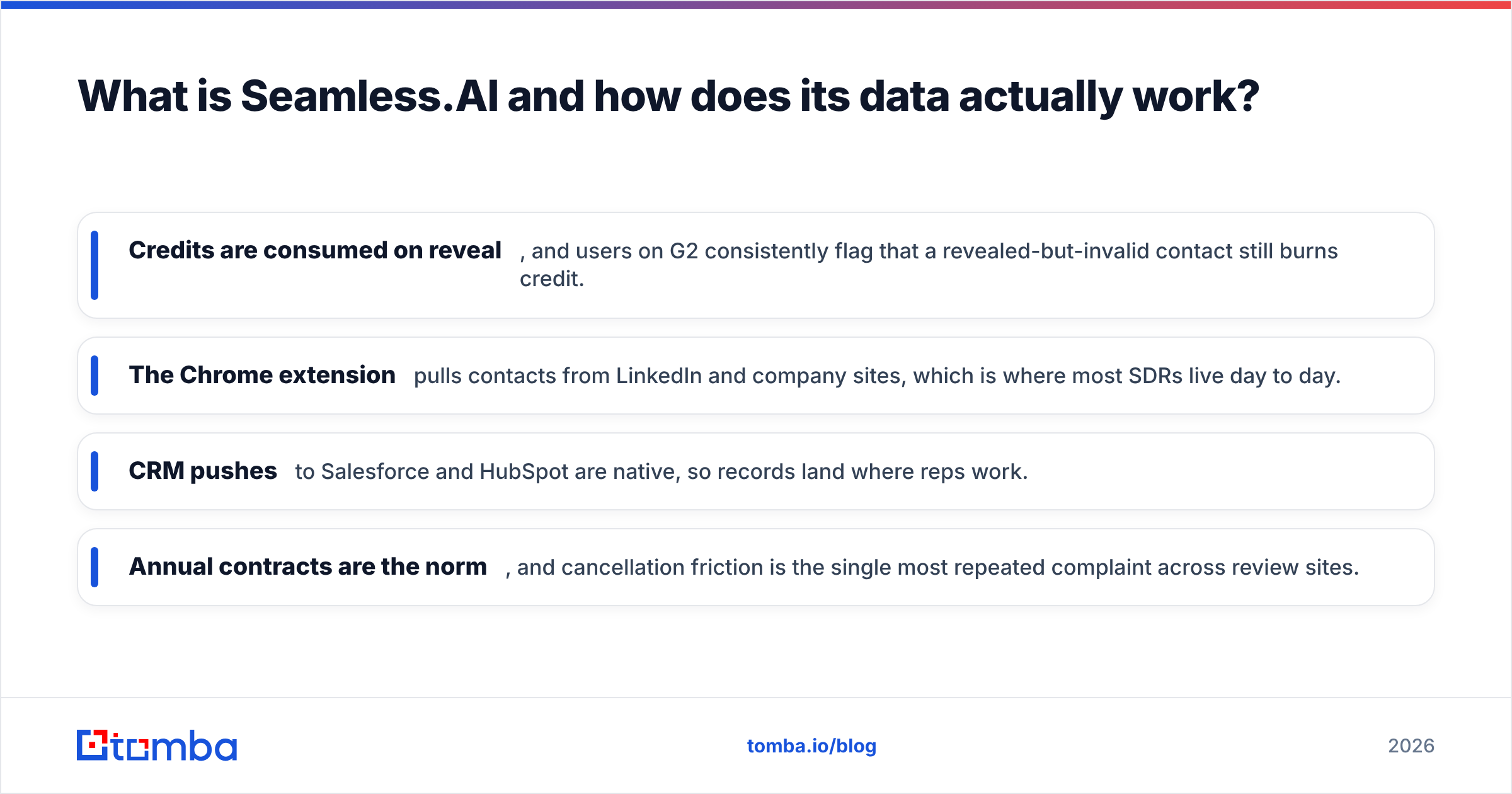
- Credits are consumed on reveal, and users on G2 consistently flag that a revealed-but-invalid contact still burns credit.
- The Chrome extension pulls contacts from LinkedIn and company sites, which is where most SDRs live day to day.
- CRM pushes to Salesforce and HubSpot are native, so records land where reps work.
- Annual contracts are the norm, and cancellation friction is the single most repeated complaint across review sites.

Exellius vs Seamlessai: how do they compare head to head?#
Here is the honest side-by-side. Pricing for both is quote-gated, so figures reflect commonly reported ranges rather than published rate cards. Always confirm in writing before signing.
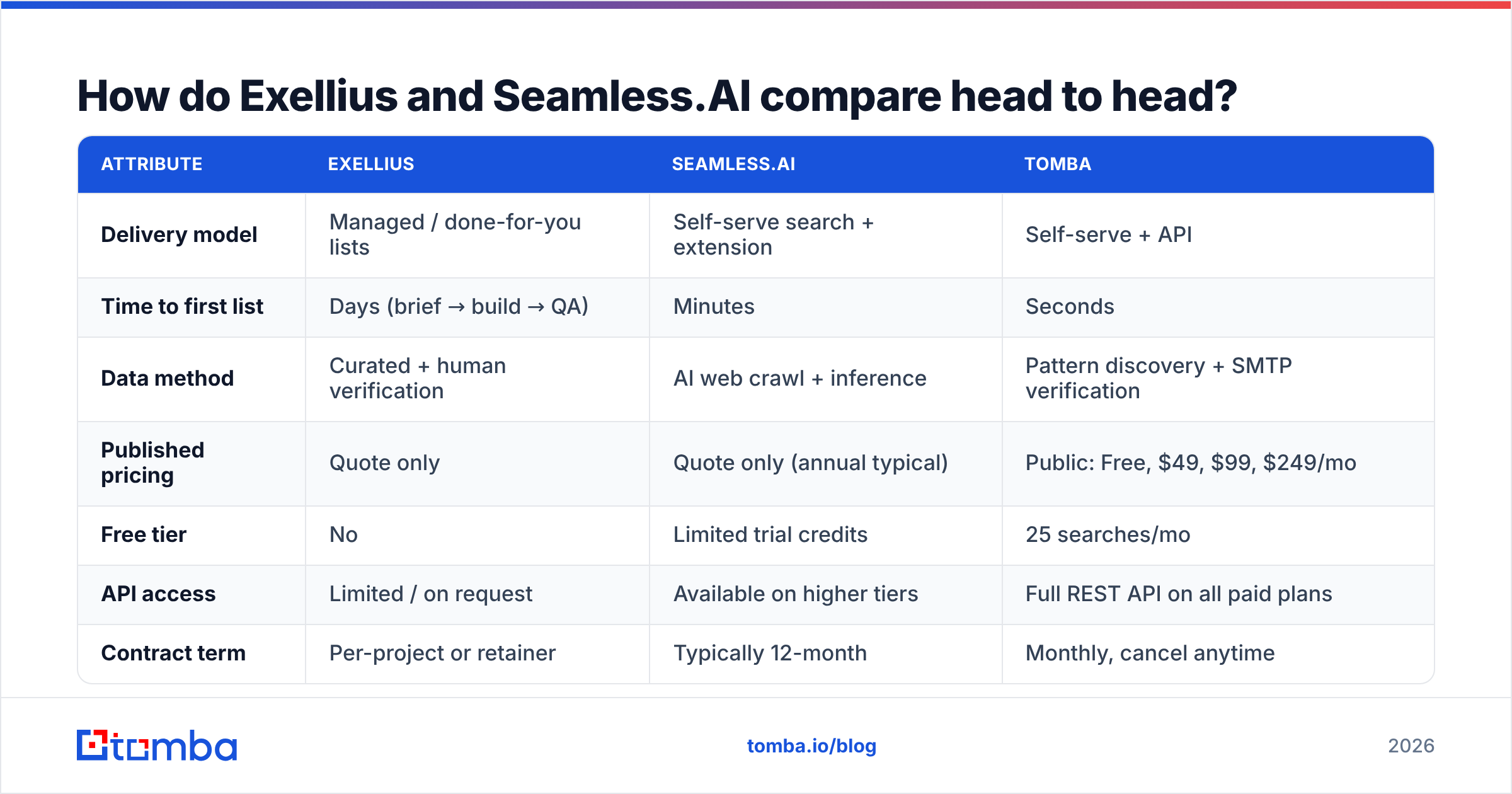
| Attribute | Exellius | Seamless.AI | Tomba |
|---|---|---|---|
| Delivery model | Managed / done-for-you lists | Self-serve search + extension | Self-serve + API |
| Time to first list | Days (brief → build → QA) | Minutes | Seconds |
| Data method | Curated + human verification | AI web crawl + inference | Pattern discovery + SMTP verification |
| Published pricing | Quote only | Quote only (annual typical) | Public: Free, $49, $99, $249/mo |
| Free tier | No | Limited trial credits | 25 searches/mo |
| API access | Limited / on request | Available on higher tiers | Full REST API on all paid plans |
| Contract term | Per-project or retainer | Typically 12-month | Monthly, cancel anytime |
| Best for | Niche, high-ACV ICPs | High-volume SDR prospecting | Programmatic enrichment at scale |
| Weakest at | Speed, iteration, transparency | Accuracy variance, contract exit | Managed list-building service |
The pattern: Exellius sells you labor, Seamless.AI sells you volume, and an API-first tool sells you infrastructure. Those are three different purchases that happen to share a category page.
Which one has better data accuracy?#
Neither publishes an audited accuracy figure, so treat vendor claims as marketing until you run your own test. What we can say from how each system works:
Exellius should win on precision. Human verification against a defined brief produces fewer irrelevant rows. The failure mode is staleness. A list checked in March is a different asset in September. Job-change churn in B2B runs roughly 20–25% a year, according to LinkedIn's own workforce data.
Seamless.AI should win on recall. It will find a record where curated sources return nothing. The failure mode is confidence inflation: inferred emails that match a pattern but were never confirmed to accept mail. This is where teams report bounce rates well above the 2–3% ceiling that keeps sender reputation healthy.
The fix for both is the same, and it is not optional. Run every list through an independent email verifier before it touches your sequencer. Catch-all domains need extra handling. A standard SMTP check returns "accept" for everything, which is why a catch-all verifier exists as a separate step.

How should you run a fair accuracy test before buying?#
Do not accept a curated demo list. Build your own control set and score both vendors against it. Five steps:
- Pick 100 contacts you already know are correct — existing customers, closed-won contacts, people who have replied to you. This is your ground truth.
- Ask each vendor to find those same 100 people from name + company only. Do not hand over the emails.
- Score three metrics separately: match rate (did they return anything?), accuracy (is the email the right one?), and freshness (is the person still there?).
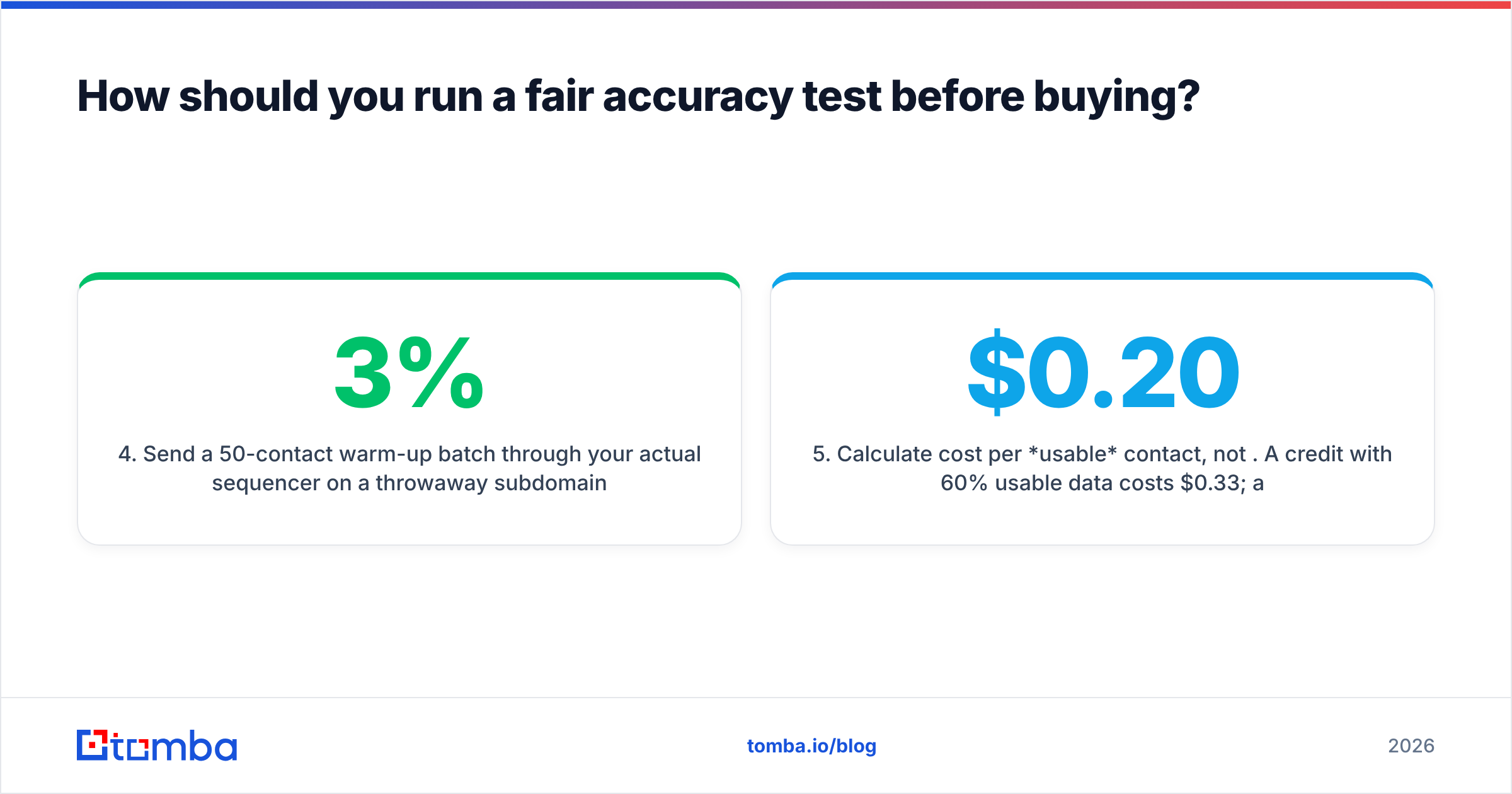
- Send a 50-contact warm-up batch through your actual sequencer on a throwaway subdomain and record hard bounces. Anything over 3% is a red flag, whatever the dashboard claimed.
- Calculate cost per usable contact, not per credit. A $0.20 credit with 60% usable data costs $0.33. A $0.40 credit at 95% costs $0.42, but it ships fewer bounces and less reputation damage.
That last number is the only one that should drive the decision. Vendors quote credits because credits flatter them. You buy outcomes.
What about pricing and hidden costs?#
Both vendors gate pricing behind a call. That is itself a signal: pricing is negotiated per account, so there is room to push. Three cost traps to raise on that call:
- Credit rollover. Ask explicitly whether unused credits expire monthly. Most seat-based tools reset, which turns a "500,000 credit" headline into 41,666 per month you cannot bank.
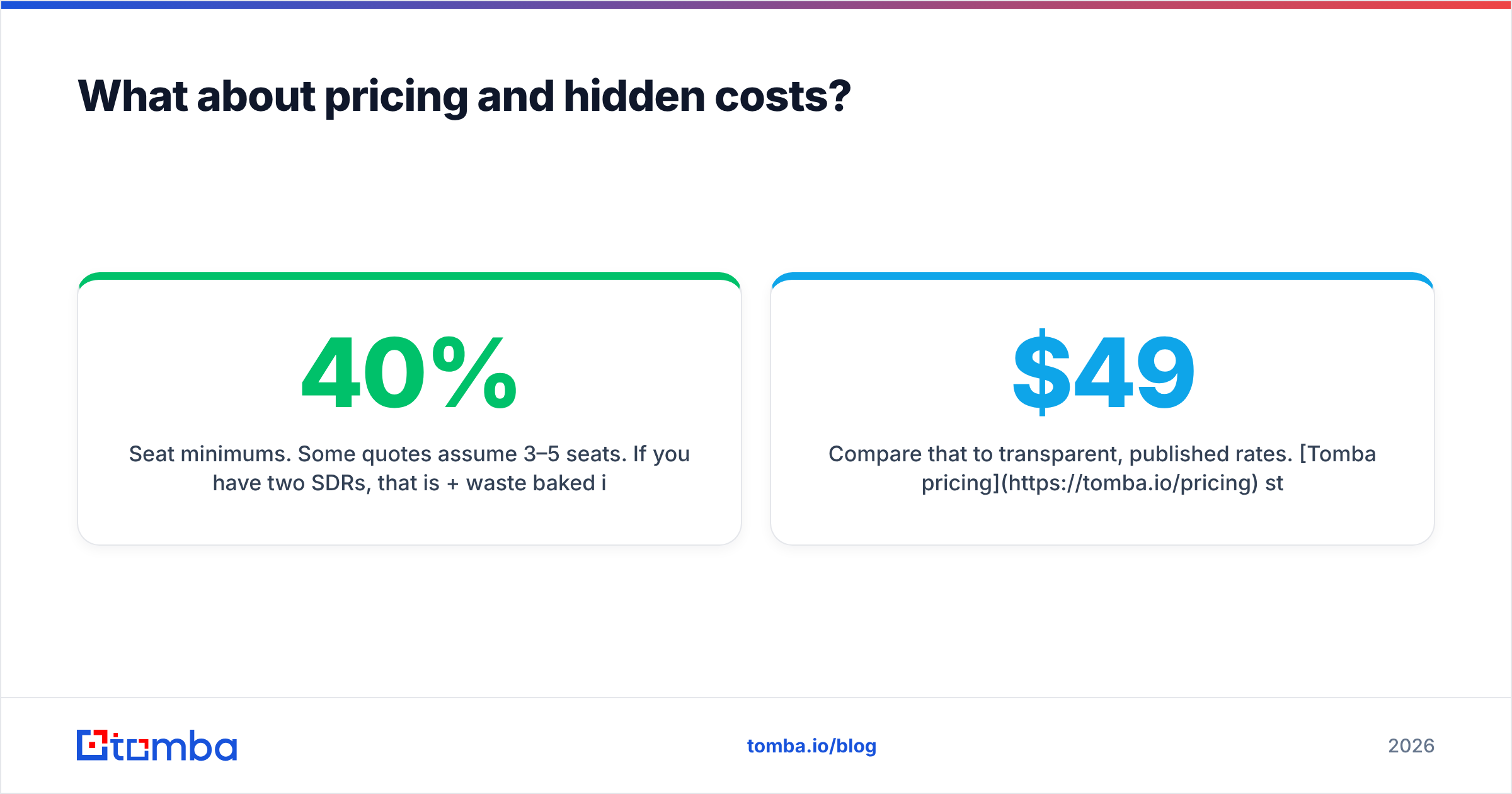
- Seat minimums. Some quotes assume 3–5 seats. If you have two SDRs, that is 40%+ waste baked into year one.
- Auto-renewal windows. Seamless.AI users on review sites report 30-to-60-day cancellation notice requirements. Get the exact window in the contract, in writing, before signing.
Compare that to transparent, published rates. Tomba pricing starts free at 25 searches per month, then $49/mo (Starter), $99/mo (Growth), and $249/mo (Pro), with Enterprise quoted. Everything is monthly and cancellable, and every paid tier includes the Tomba API rather than reserving it for the top plan. That is not automatically the right choice. A managed list build is worth paying for when your ICP is obscure. But it does mean you can benchmark the alternatives against a public number instead of a sales narrative.
Worth noting for completeness: if you want a pre-built, bulk-download list rather than search-as-you-go, providers like BookYourData occupy a useful middle ground — pay-as-you-go list purchase with a bounce guarantee and no annual commitment. It solves a different problem than either tool here, but it is often the honest answer when someone asks "I just need 5,000 verified contacts once."
What are the strongest alternatives to both?#
Depending on what you are actually optimizing for:
- You want the data in your product or workflow, not a UI. An API-first email finder is the right shape. Pull emails at signup, enrich CRM records on write, or run bulk enrichment as a scheduled job.
- You want to work inside LinkedIn. A LinkedIn finder or browser extension keeps prospecting in the tab where you already are — see how a Seamless.AI alternative stacks up on that specific workflow.
- You want whole-company coverage, not one person. Domain search returns every discoverable email at a company plus the pattern, which is faster than searching people one at a time.
- You want phone numbers alongside email. Multi-channel outbound needs a phone finder, and Seamless.AI's direct dials are one of its genuinely strong features here.
- You want managed list building. Exellius's model is the closest fit. The alternative is hiring a data ops contractor, which usually costs more than the retainer.
So which should you pick?#
Choose Exellius if your ICP is narrow enough that database filters return junk, your deal sizes justify per-list cost, you buy in campaigns rather than continuously, and you would rather review a finished list than build one.
Choose Seamless.AI if you have 3+ SDRs prospecting daily, you need direct dials alongside emails, you already run a verification step before sending, and you can negotiate the contract term down from 12 months or get an out clause in writing.
Choose neither if what you actually need is programmatic email discovery. If your requirement is "given a name and a domain, return a verified email, 10,000 times a month, from code," you are buying infrastructure, not sales intelligence — and paying sales-intelligence prices for it. Check where the data comes from on any vendor you shortlist. A provider that will not explain sourcing is a provider you cannot audit.
The most common mistake in the Exellius vs Seamlessai debate is treating it as a two-horse race. Many teams end up with a curated list for their top 200 target accounts, a self-serve tool for the long tail, and a verification API in front of both. That stack costs less than a single mid-tier annual contract and fails in fewer places.
Ready to test the data yourself?#
Before you sign anything annual, run the ground-truth test above against a free option. The Tomba Email Finder gives you 25 searches per month at no cost — enough to score match rate and accuracy on a real sample of your own known-good contacts. If the numbers hold, paid plans start at $49/mo with full API access, monthly billing, and no cancellation window to negotiate. If they do not, you will at least walk into the Exellius or Seamless.AI call with a benchmark instead of a hunch.
Related guides#
Ready to find emails that actually work?
Join 150,000+ professionals who stopped guessing and started sending. Free credits on signup — no credit card required.
Get the Tomba newsletter
Practical outbound tactics and product updates — once every two weeks.
About the author