Exellius vs Tami AI (2026): Which B2B Data Engine Wins?
Exellius sells outsourced pipeline. Tami AI sells self-serve market intelligence. They solve different problems at very different price points — here is how to pick, and where a cheaper data layer beats both.
Exellius vs Tami AI is a choice between two very different things. One sells you a team. The other sells you a database. Here is how to pick the right one.
TL;DR
- Exellius (Exellius Systems) is a managed B2B lead service. You buy outcomes — booked meetings, MQLs, custom contact lists — not software seats.
- Tami AI (TAMI) is a self-serve sales intelligence platform. You search companies, filter by tech stack and firmographics, and export contacts yourself.
- They are not really rivals. The real question is simple: do you want to rent a team or rent a database? The answer usually depends on your SDR headcount.
Two more things to know before you book a demo:
- Neither one posts a full price list. Expect a demo call and a yearly contract from both. Budget four figures a month, not $49.
- If you just need verified email addresses at volume, a dedicated email finder with an API costs far less. It also plugs into the sequencer you already run.
What is Exellius?#
Exellius Systems is a B2B demand-generation agency. The model is service-first. You hand over an ideal customer profile. Their team builds the list, researches the accounts, and runs the outreach. You get back qualified meetings or MQLs. Typical work covers appointment setting, content-syndication leads, intent-qualified accounts, and custom list building for one vertical.
The upside is leverage. You do not learn a tool. You do not hire. You do not babysit deliverability. You approve an ICP, and a team you do not employ works the top of the funnel. Say a European SaaS firm wants to test US mid-market manufacturing. That move skips six weeks of setup and a lot of guessing.
The trade-off is just as clear. You do not own the data pipeline. Lists usually arrive as files tied to one campaign. They are not a live database you can query at 2 a.m. when a new segment idea hits. Turnaround takes days, not seconds. Quality also shifts with the researcher on your account. That is normal for human work, but hard to audit from the outside.
Check the current service menu at exellius.com before you assume a deliverable is in scope. Agencies reshuffle their offers often.
What is Tami AI?#
TAMI — the platform at tami.ai — takes the opposite path. It is software you log into. Its core feature is total addressable market mapping. You start from a market definition: industry, geography, size, tech stack, hiring signals. TAMI then shows how many companies really match. From there you drill into the contacts inside them.
That order matters more than it sounds. Most prospecting tools make you guess your market, then hunt inside it. TAMI flips the flow. You size the market first. You may find 1,400 real accounts instead of the 40,000 in your board deck. Then you plan territory and headcount from a real number. Account-based teams and agency researchers get genuine value here.
Every self-serve platform shares one catch: the work is still yours. TAMI hands you a filtered universe and contact records. Someone on your team still writes the sequences, warms the domains, verifies the exports, and follows up. It replaces a data vendor, not an SDR.
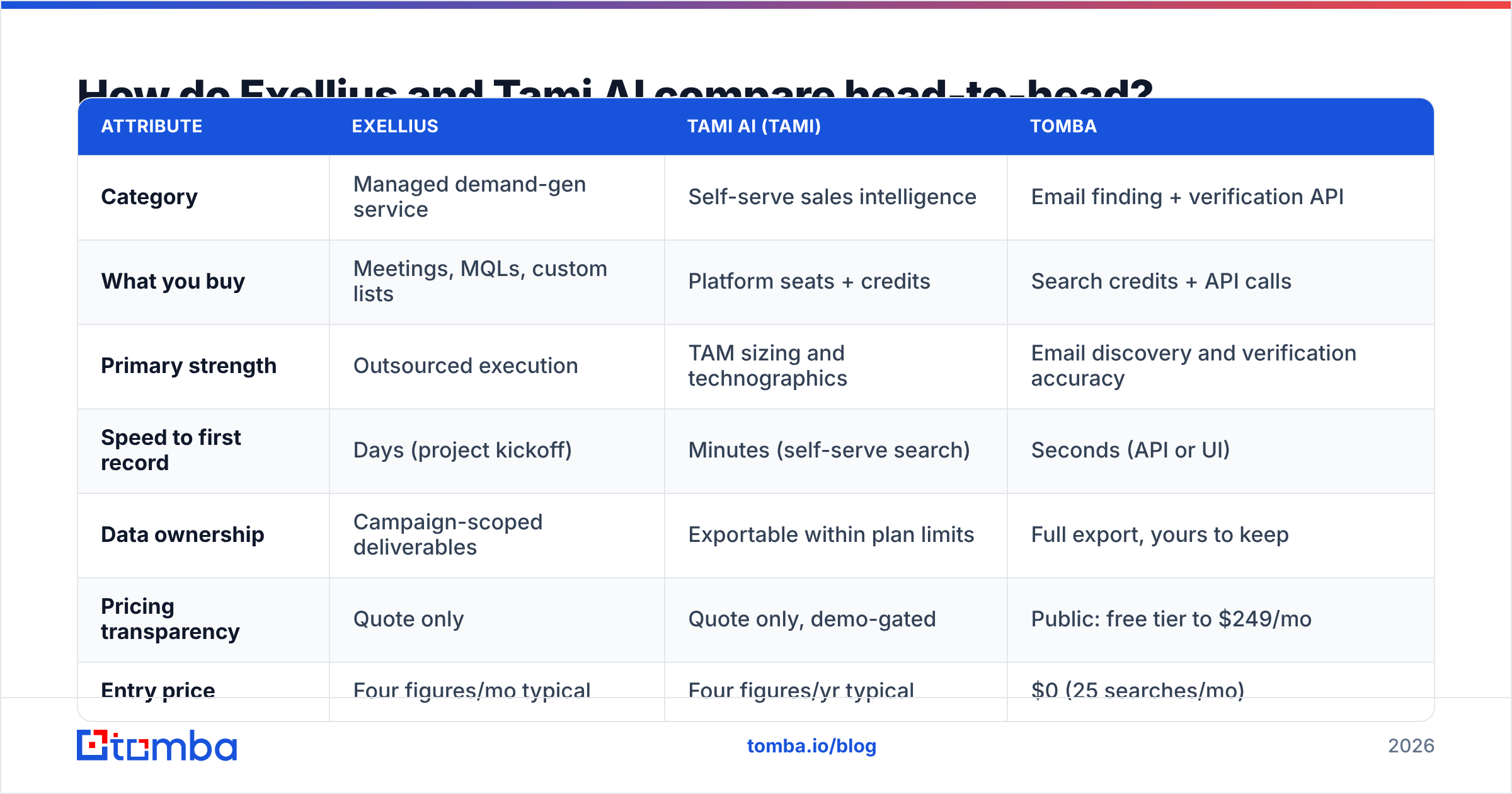
Exellius vs Tami AI: how do they compare head-to-head?#
| Attribute | Exellius | Tami AI (TAMI) | Tomba |
|---|---|---|---|
| Category | Managed demand-gen service | Self-serve sales intelligence | Email finding + verification API |
| What you buy | Meetings, MQLs, custom lists | Platform seats + credits | Search credits + API calls |
| Primary strength | Outsourced execution | TAM sizing and technographics | Email discovery and verification accuracy |
| Speed to first record | Days (project kickoff) | Minutes (self-serve search) | Seconds (API or UI) |
| Data ownership | Campaign-scoped deliverables | Exportable within plan limits | Full export, yours to keep |
| Pricing transparency | Quote only | Quote only, demo-gated | Public: free tier to $249/mo |
| Entry price | Four figures/mo typical | Four figures/yr typical | $0 (25 searches/mo) |
| API access | Not the core model | Available on higher tiers | Core product, all paid tiers |
| Best for | No in-house SDR capacity | ABM and market research teams | Teams with a sequencer already running |
| Weakness | Vendor dependency, slow iteration | You still do all the outreach | Not a full-funnel service |
The table shows the real split. Exellius sells labor. TAMI sells access. A pure email-finding layer sells throughput. Teams that mix up these three pay agency rates for work a $99 per month API would have done.
Which one has better data accuracy?#
Accuracy claims usually collapse into marketing copy. So judge the mechanism, not the number on the homepage. Here is what to ask on a demo call:
- Where does the record come from? Contributed contact networks, web crawling, public filings, and licensed partner data all decay at different speeds. Ask for the mix, not one accuracy percentage. Tomba publishes its data sources because the question is fair.
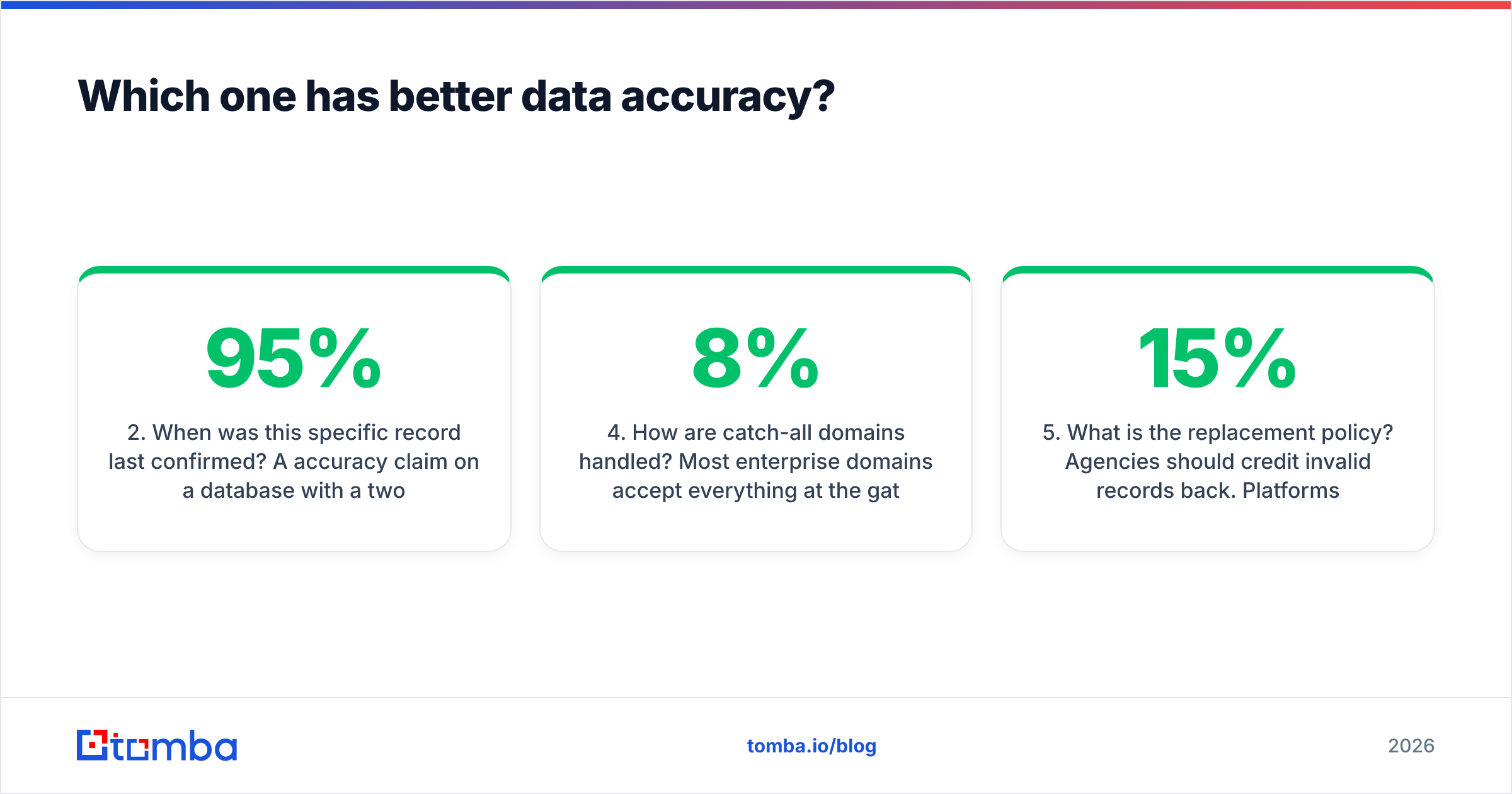
- When was this record last confirmed? A 95% claim on a database with two-year-old records is worse than 88% on one refreshed monthly. Ask for the median last-verified date on records that match your ICP.
- Is verification included or billed on top? Some vendors ship unverified records and let your sequencer find the bounces. Run every list through an email verifier before it touches a sending domain.
Three more to settle before you sign:
- How are catch-all domains handled? Most large domains accept everything at the gateway. A naive SMTP check returns "valid" for addresses that later hard-bounce. A dedicated catch-all verifier is the gap between an 8% bounce rate and a 1.5% one.
- What is the replacement policy? Agencies should credit bad records back. Platforms should refund credits. If neither will put that in writing, price the risk yourself. Assume 15% waste and negotiate from there.
- Can you sample before you sign? Test 100 records against accounts you already know. That beats every case study on the site. Both vendors will usually agree. A refusal is your answer.
Ask those six questions at both vendors. The difference stops being a slogan and becomes a spreadsheet. In practice, service providers win on niche, hard-to-source verticals. A human researcher can find the plant manager at a 40-person industrial firm that no database has indexed. Platforms win on speed and breadth in well-covered segments like SaaS, fintech, and mid-market tech.
What do Exellius and Tami AI actually cost?#
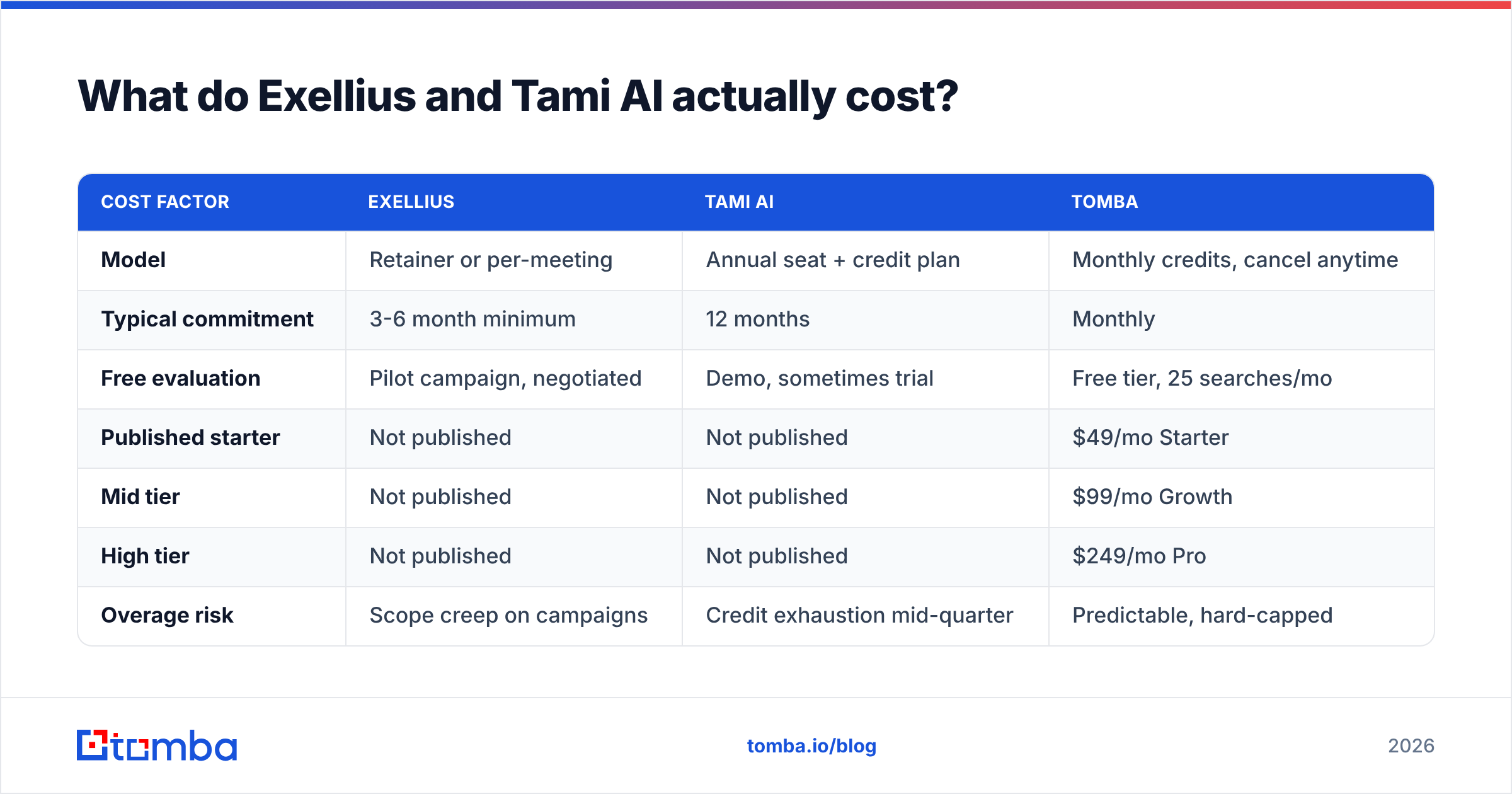
Pricing is where the Exellius vs Tami AI comparison gets vague. Neither one publishes a full price list. That is normal for demo-gated tools and for agencies. Here is what you can plan around:
| Cost factor | Exellius | Tami AI | Tomba |
|---|---|---|---|
| Model | Retainer or per-meeting | Annual seat + credit plan | Monthly credits, cancel anytime |
| Typical commitment | 3-6 month minimum | 12 months | Monthly |
| Free evaluation | Pilot campaign, negotiated | Demo, sometimes trial | Free tier, 25 searches/mo |
| Published starter | Not published | Not published | $49/mo Starter |
| Mid tier | Not published | Not published | $99/mo Growth |
| High tier | Not published | Not published | $249/mo Pro |
| Overage risk | Scope creep on campaigns | Credit exhaustion mid-quarter | Predictable, hard-capped |
| Hidden cost | Ramp time, briefing loops | Verification + sequencer on top | None material |
Two budget realities are worth naming. First, do the meeting math before you sign. A $4,000 retainer that books eight meetings a month costs $500 per meeting. That is a bargain or a disaster, depending on your deal size.
Second, a platform subscription is only the first line item. You will still pay for a sending tool, a warmup service, and verification. Compare fully loaded stacks, not sticker prices. Full Tomba pricing is public for that reason. You can model the data line without a call.
Is Exellius better than Tami AI for outbound?#
It hangs on one variable: do you have people to run the outreach?
Say you have no SDR capacity and no plan to hire. TAMI will sell you a beautiful market map that nobody acts on. Data without execution is a very expensive PDF. Exellius, or any solid managed provider, is the better call. You are buying the thing you lack, which is human hours.
Now say you already have two or more reps sending daily. The math flips. Your bottleneck is not effort. It is targeting and record quality. A platform lets a rep define a segment at 9 a.m. and start sending at 9:20. That beats a vendor with a five-day list turnaround.
There is also a middle path. Most teams land there after a year. Keep a lean self-serve data stack for the 80% of segments that are well covered. Buy managed research only for the obscure verticals where databases go thin. That hybrid costs less than either extreme. It also keeps knowledge in-house.
One more note for revenue operations leaders. Agency-sourced leads rarely arrive with clean CRM mapping. Budget for enrichment and dedupe on your side. Skip it, and the handoff will poison your attribution within a quarter.
Where does a dedicated email finder fit?#
Both vendors solve a layer above raw contact discovery. One sells the whole motion. The other sells market intelligence. Underneath both sits a plain question. For this person at this company, what is the working email address?
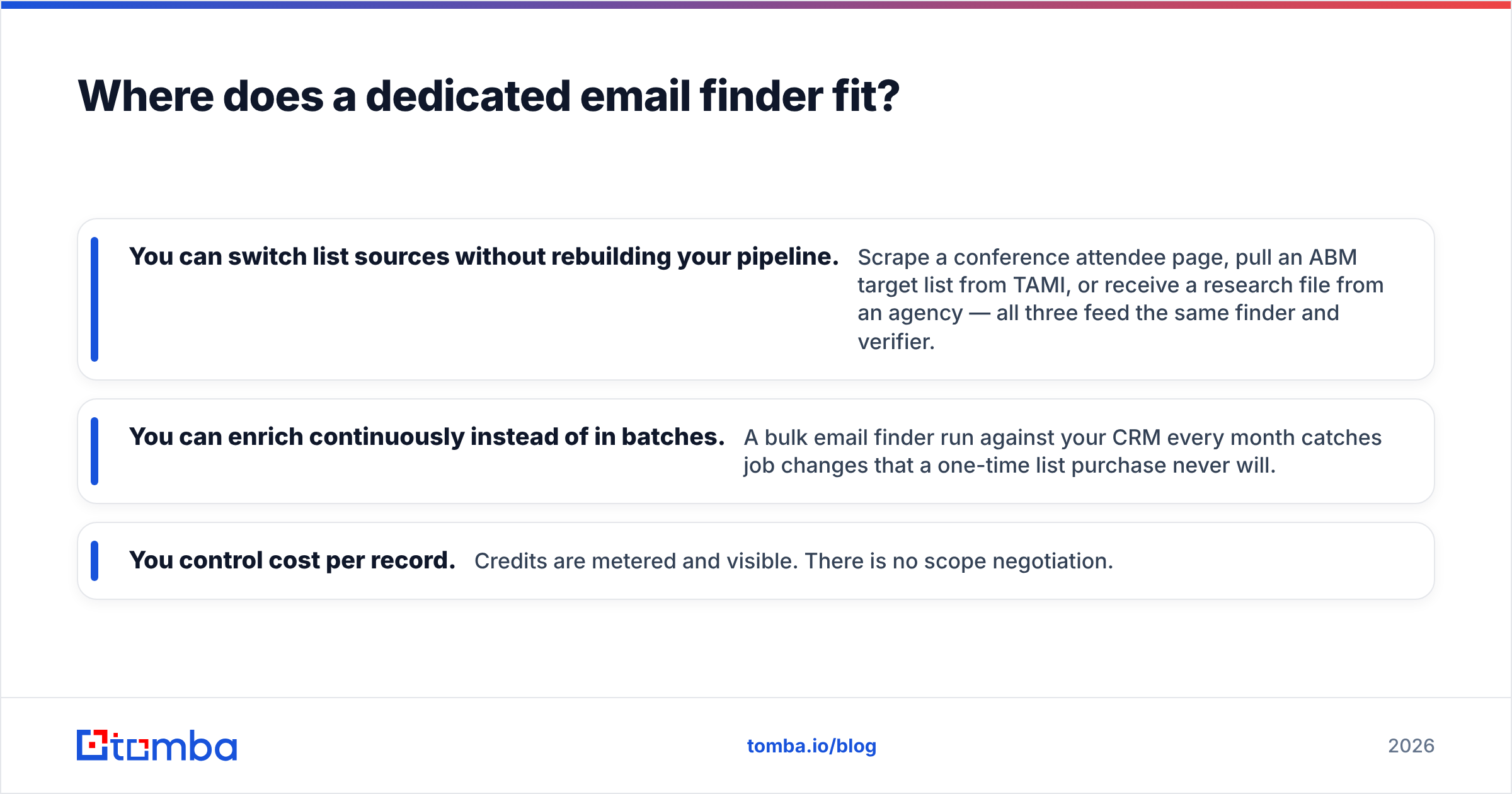
That is an API-shaped problem. It is worth splitting out from your strategy vendor. When email discovery lives in its own layer, three things get easier:
- You can swap list sources without rebuilding the pipeline. Scrape a conference page, pull an ABM list from TAMI, or take a research file from an agency. All three feed the same finder and verifier.
- You can enrich all the time, not in batches. A bulk email finder run against your CRM each month catches job changes. A one-time list purchase never will.
- You control cost per record. Credits are metered and visible. There is no scope to negotiate.
The workflow is short. Define the segment in TAMI, Sales Navigator, or a conference site. Pull the company and contact names. Resolve emails with domain search or a name-plus-domain lookup. Verify every address, catch-alls included. Then push to your sequencer. For a few thousand contacts a month, the data cost lands in the double or low triple digits. That is well under any managed retainer.
Which should you choose in 2026?#
The Exellius vs Tami AI decision comes down to three simple cases.
Choose Exellius if you have no in-house prospecting capacity. It also fits when you enter an unfamiliar market, your deal size absorbs a few hundred dollars per meeting, and you would rather manage a vendor than a hiring process.
Choose Tami AI if your team runs account-based plays. It fits when you need honest TAM numbers for planning, tech-stack filtering is central to your ICP, and your reps will work the accounts the platform surfaces.
Choose neither, yet if half your outbound email bounces. No amount of market intelligence fixes a broken data layer. Get discovery and verification right first. Measure your response rate against a clean list for four weeks. Only then decide whether you are missing accounts or missing execution.
Most teams that run this sequence find the same thing. They did not have a targeting problem or a headcount problem. They had a deliverability problem wearing a strategy costume.
Ready to fix the data layer first?#
Start with the cheapest test available. The Tomba Email Finder has a free tier with 25 searches a month. That is enough to check 25 accounts you already know and judge the accuracy yourself. Paid plans start at $49/mo. You get the same verification engine, catch-all handling, and API access that power enterprise workloads, and you can cancel any month. Compare that with a quote from either vendor above. You will negotiate from a real number.
Related guides#
Ready to find emails that actually work?
Join 150,000+ professionals who stopped guessing and started sending. Free credits on signup — no credit card required.
Get the Tomba newsletter
Practical outbound tactics and product updates — once every two weeks.
About the author