Exellius vs Verimail: Which Email Tool Wins in 2026?
Exellius finds contacts. Verimail cleans them. They are not the same product, and picking wrong costs you a quarter of your pipeline. Here is the honest breakdown, plus the stack most teams actually end up running.
TL;DR
- Exellius and Verimail solve different halves of the same problem. Exellius leans discovery (finding contacts and building lists), Verimail leans validation (proving those addresses accept mail). Comparing them like-for-like is only fair on the overlap.
- If your bottleneck is "I have no contacts," a verifier will not fix it. If your bottleneck is "my bounce rate is 9%," a finder will not fix it either.
- Both are credit-metered. The real cost driver is not the sticker price, it is how many credits get burned on catch-all domains and unusable results.
- Running two vendors means two logins, two billing cycles, two API integrations, and two support queues for what is one workflow.
- Most outbound teams end up consolidating. A single platform that does find + verify + enrich on one credit pool is usually cheaper and materially simpler to operate.
What are Exellius and Verimail, exactly?#
They are not competitors in the way "Coke vs Pepsi" is. They are more like "flour vs oven."
Exellius positions itself around B2B lead generation: building targeted prospect lists, surfacing business contact data, and handing you something you can push into a sequencer. The value proposition is discovery — you start with a company, an industry, or a role, and you end with names and addresses.
Verimail sits at the other end of the pipe. It is an email verification service: you feed it addresses you already have, and it tells you which ones are deliverable, which will hard bounce, which are role accounts (info@, sales@), and which sit behind a catch-all server that accepts everything and reveals nothing. Real-time API for form capture, bulk upload for list hygiene.
So the honest framing of Exellius vs Verimail is not "which is better." It is:
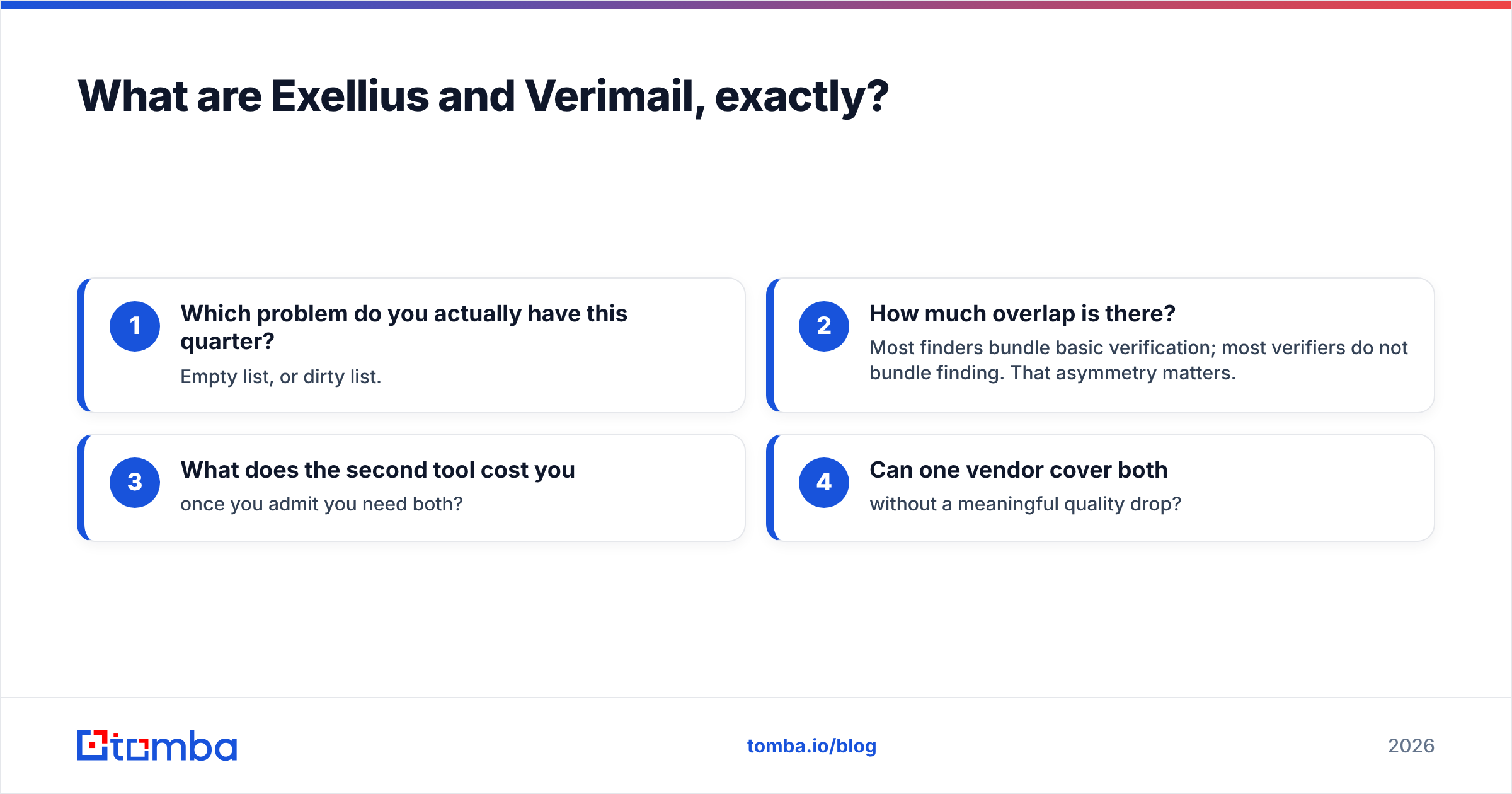
- Which problem do you actually have this quarter? Empty list, or dirty list.
- How much overlap is there? Most finders bundle basic verification; most verifiers do not bundle finding. That asymmetry matters.
- What does the second tool cost you once you admit you need both?
- Can one vendor cover both without a meaningful quality drop?
That last question is where this post spends most of its time, because it is the one that changes your budget.
How do Exellius and Verimail compare head-to-head?#
Here is the practical comparison across the dimensions that show up in real procurement conversations. Vendor plans change often, so treat pricing bands as directional and confirm on each vendor's own page before you commit.
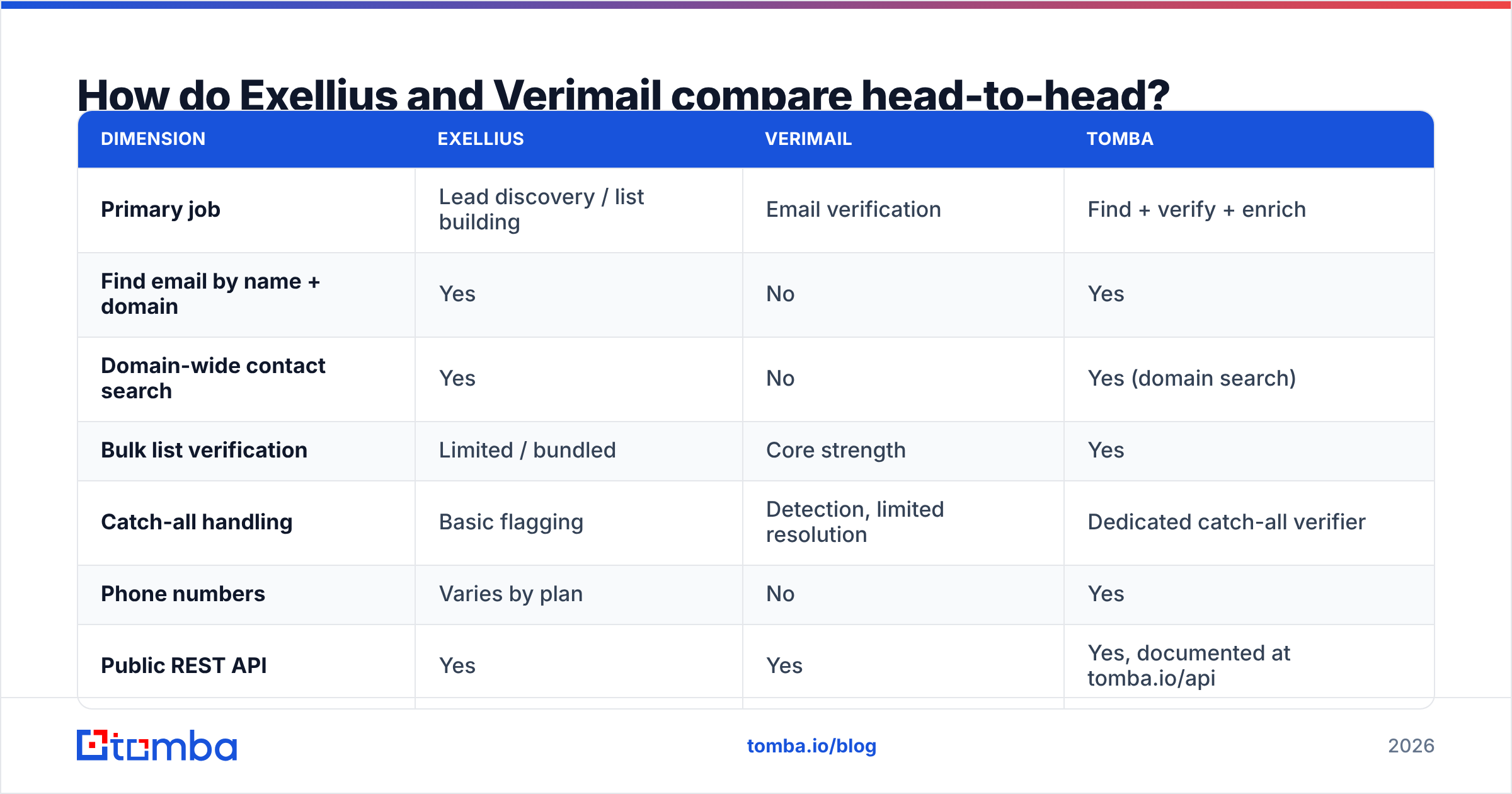
| Dimension | Exellius | Verimail | Tomba |
|---|---|---|---|
| Primary job | Lead discovery / list building | Email verification | Find + verify + enrich |
| Find email by name + domain | Yes | No | Yes |
| Domain-wide contact search | Yes | No | Yes (domain search) |
| Bulk list verification | Limited / bundled | Core strength | Yes |
| Catch-all handling | Basic flagging | Detection, limited resolution | Dedicated catch-all verifier |
| Phone numbers | Varies by plan | No | Yes |
| Public REST API | Yes | Yes | Yes, documented at tomba.io/api |
| Free tier | Trial credits | Trial credits | 25 searches/mo, no card |
| Entry paid plan | Mid-double-digit $/mo band | Low-to-mid $/mo band, volume-based | $49/mo Starter |
| Credit model | Per lead / per reveal | Per email verified | Shared pool across all tools |
| Best fit | Teams with no list | Teams with a stale list | Teams that need both |
Two things jump out of that table.
First, the feature sets barely collide. Exellius does almost nothing Verimail does, and Verimail does almost nothing Exellius does. If you are genuinely evaluating them against each other, one of two things is true: either you have not yet defined your bottleneck, or you are hoping one of them quietly covers the other's territory. Usually it does not.
Second, the credit models are incompatible. Exellius bills per contact revealed. Verimail bills per address checked. Buy both and you pay twice for the same lead — once to find it, once to prove it exists. That is not a scam, it is just how two-vendor stacks work, and it is the single most common reason teams consolidate in year two.
Sorry, correct embed:
Which one is more accurate, and how would you even know?#
Accuracy claims in this category are close to meaningless without a definition, because vendors measure different things:
- Match rate — of the prospects you asked about, how many got an address back? A finder can inflate this by guessing patterns.
- Bounce rate — of the addresses returned, how many actually failed on send? This is the number your deliverability depends on.
- Precision on catch-alls — a domain that accepts all mail cannot be resolved by SMTP ping alone. Vendors either flag it "unknown" (honest, less useful) or guess (useful when right, expensive when wrong).
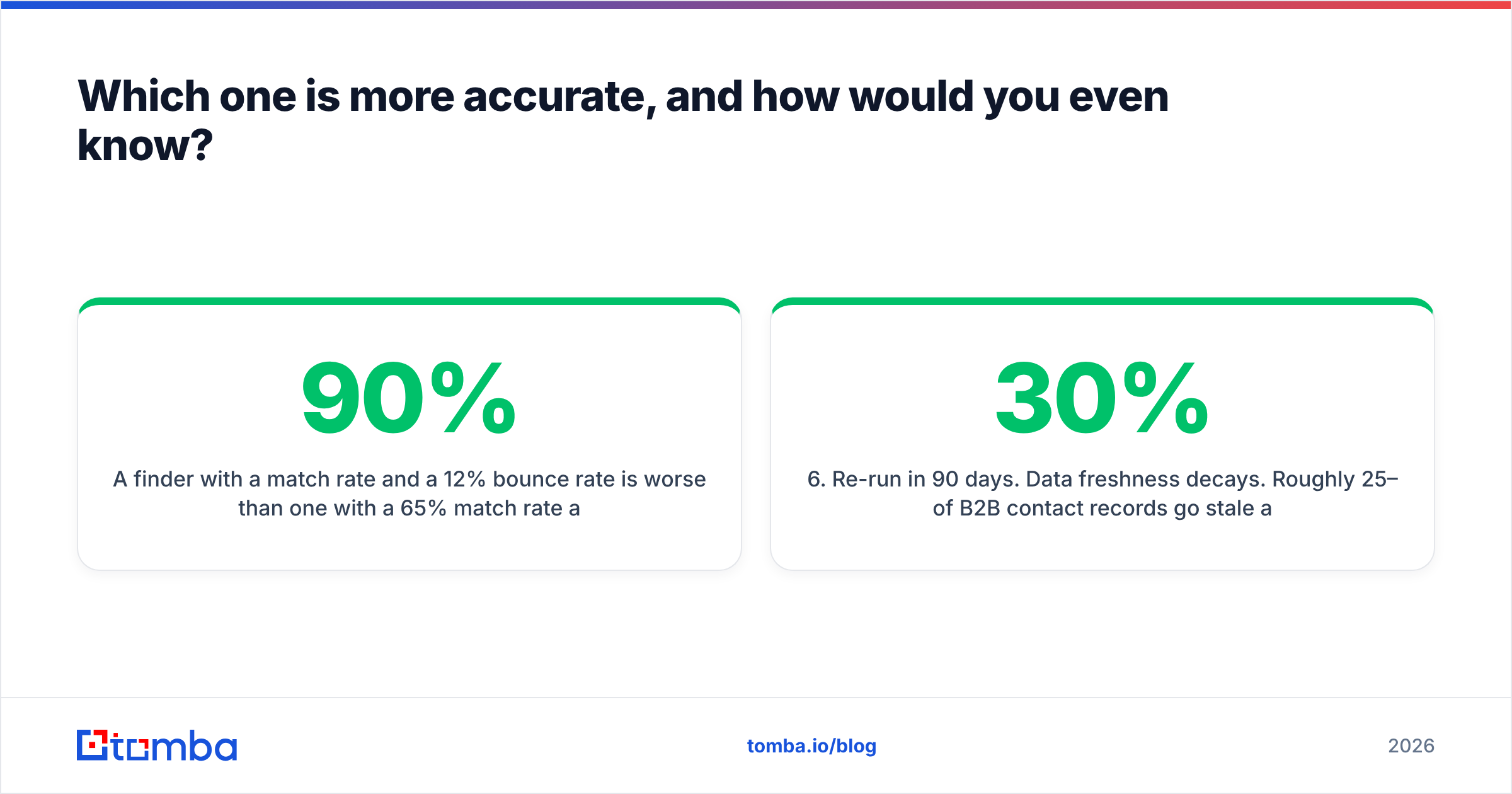
A finder with a 90% match rate and a 12% bounce rate is worse than one with a 65% match rate and a 1% bounce rate. The second one is telling you the truth about what it does not know.

The only test that settles it is your own. Run this before you sign anything longer than a month:
- Build a 200-row control list. Real prospects, in your actual ICP, spread across at least 40 domains. Include some SMB, some enterprise, some catch-all-heavy sectors like finance and healthcare.
- Run the same list through every candidate on the same day. Vendor indexes drift; a two-week gap invalidates the comparison.
- Record three columns per vendor: found / not found, confidence score, and cost in credits.
- Send a real, low-volume campaign from a warmed, throwaway-but-legitimate domain. Nothing else measures bounces.
- Score it as cost per delivered inbox, not cost per credit. This is the metric that survives contact with your CFO.
- Re-run in 90 days. Data freshness decays. Roughly 25–30% of B2B contact records go stale annually as people change roles, so a vendor that was best in Q1 may not be best in Q4.
That evaluation takes about two hours and it routinely overturns whatever the G2 review grid suggested. Vendor-reported accuracy is a marketing number; your bounce log is a fact.
What do Exellius and Verimail actually cost in practice?#
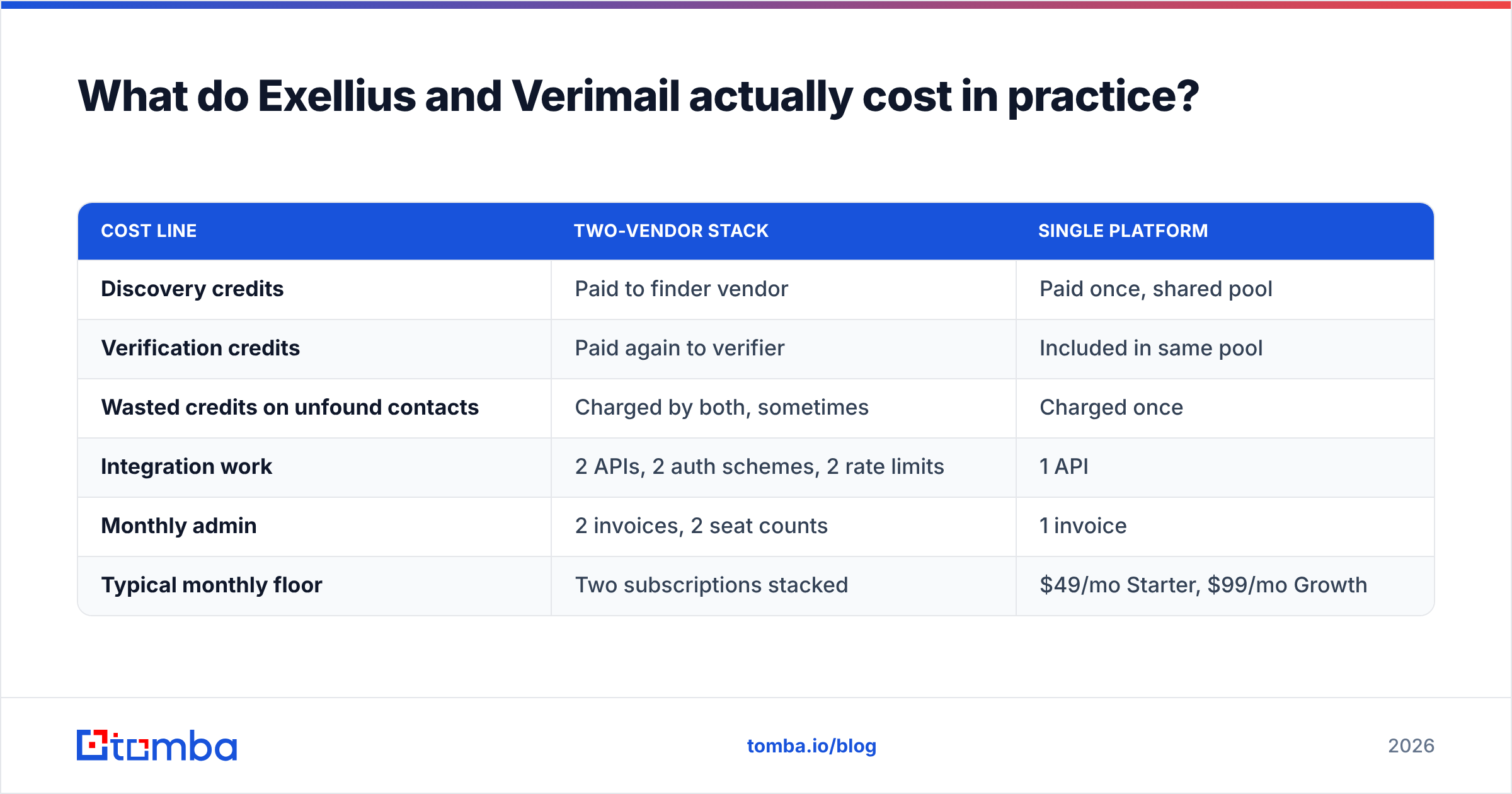
Sticker price is the least interesting part of the bill. Here is where the money actually goes on a two-vendor setup versus a consolidated one, using a team that needs 5,000 verified contacts a month:
| Cost line | Two-vendor stack | Single platform |
|---|---|---|
| Discovery credits | Paid to finder vendor | Paid once, shared pool |
| Verification credits | Paid again to verifier | Included in same pool |
| Wasted credits on unfound contacts | Charged by both, sometimes | Charged once |
| Integration work | 2 APIs, 2 auth schemes, 2 rate limits | 1 API |
| Monthly admin | 2 invoices, 2 seat counts | 1 invoice |
| Typical monthly floor | Two subscriptions stacked | $49/mo Starter, $99/mo Growth |
For reference, Tomba pricing runs a free tier at 25 searches/month, Starter at $49/mo, Growth at $99/mo, Pro at $249/mo, and custom Enterprise. Credits are shared across the finder, verifier, domain search, catch-all tools, and enrichment, which is the part that changes the math. You are not choosing in advance how many of your credits go to "finding" versus "checking" — you spend them as the workflow demands.
The subtler cost is credit waste on unresolvable records. If a vendor charges you for a lookup that returns "unknown," you are paying for the absence of an answer. Ask every vendor on your shortlist one question in writing: are unfound or unresolved lookups billed? The answers vary a lot, and the difference compounds fast at 5,000 rows a month.
Who should pick Exellius?#
Pick a discovery-first tool like Exellius when:
- You are starting from zero. No list, no CRM history worth mining, no inbound. You need names before you need hygiene.
- Your ICP is defined by firmographics, not by a known account list. "Series B fintechs in DACH with 50–200 employees" is a discovery problem.
- Your reps build their own lists. Self-serve prospecting tools live or die on UI, and discovery platforms invest there.
- Volume is moderate and predictable. Per-lead pricing is fine until it is not.
Where it gets awkward: bundled verification in discovery tools is usually a light SMTP check, not a full validation engine. It will catch obvious syntax and dead-domain failures. It will not save you on a catch-all-heavy list. If your bounce rate stays above 3% after using a finder's built-in check, you need a real verifier in the loop.
Who should pick Verimail?#
Pick a verification-first tool like Verimail when:
- You already own the data. Years of CRM records, event scans, webinar signups, a newsletter list you inherited.
- You are repairing deliverability. Bounces above 3–5% put your sender reputation at risk, and mailbox providers are less forgiving than they were two years ago. Cleaning a list is the fastest fix available.
- You need real-time API validation at the point of capture — signup forms, lead-gen forms, checkout. Stopping bad addresses at entry is cheaper than cleaning them later.
- Compliance or IT requires an audit trail on data quality.
Where it gets awkward: a verifier cannot tell you about the 400 prospects you have never heard of. It is a filter, not a source. Teams that buy verification hoping it solves pipeline are solving the wrong constraint, and they usually find out about six weeks in.

Is there a better option that does both?#
For most teams under 50 reps, yes — and it is not a close call once you price the integration work.
The argument for consolidation is not "one vendor is always better." It is that find and verify are one workflow, artificially split across two invoices. Every time you move a record between vendors you add latency, a failure point, a rate limit, and a reconciliation problem. In practice, the split shows up as CSV exports moving between browser tabs.
A combined platform closes that loop. Tomba's email finder returns an address with a confidence score, the email verifier validates it in the same call chain, the catch-all tooling handles the domains that ordinarily get dumped into an "unknown" bucket, and enrichment fills in the role, company, and phone data your sequencer needs for personalization. One API key, one credit pool, one bill.

Where a specialist still wins:
- Extreme verification volume. If you are cleaning 500,000+ addresses a month as a standalone business process, a dedicated verifier's per-unit pricing may beat a bundled pool.
- A niche data source you cannot get elsewhere. If one vendor has unique coverage in your specific vertical or geography, coverage beats convenience. Test it, do not assume it.
- Existing contractual lock-in. Do not eat a termination fee to save $40 a month.
Outside those cases, the consolidated stack wins on total cost of ownership almost every time.
How should you actually run the evaluation?#
Keep it boring and evidence-driven:
- Name the bottleneck in one sentence. "We cannot find enough qualified contacts" or "our bounce rate is killing deliverability." Not both. Pick the one costing you more this quarter.
- Shortlist three tools, not seven. One discovery-first, one verification-first, one combined. More than three and you will never finish the test.
- Run the 200-row control list described above through all three on the same day.
- Measure cost per delivered inbox, then cost per reply if you can wait long enough for data.
- Check the API before you check the UI. Read the docs, look at rate limits, check whether webhooks exist. The UI is where you evaluate; the API is where you live at scale.
- Start on the smallest paid plan. Annual commitments buy you a discount and cost you optionality. In a category where indexes shift quarterly, optionality is worth more.
One more thing worth saying plainly: no vendor in this space has complete data. Anyone claiming 99% coverage across all industries and geographies is describing an ambition. The good vendors are the ones that tell you clearly when they do not know — because an honest "unknown" costs you one skipped prospect, while a confident wrong answer costs you a bounce, and enough bounces cost you the domain.
Where does that leave you?#
If you only have a list problem, buy a verifier. If you only have a pipeline problem, buy a finder. If you have both — and after six months of outbound, almost everyone does — stop paying two vendors to split one workflow.
Start with the Tomba Email Finder. The free tier gives you 25 searches a month with no card, which is enough to run the control-list test against whatever you are using today. If the numbers hold up, Starter is $49/mo with credits that work across finding, verifying, catch-all resolution, and enrichment on a single API. If they do not hold up, you have lost an afternoon and gained a benchmark you can point at in your next vendor call.
Related guides#
Ready to find emails that actually work?
Join 150,000+ professionals who stopped guessing and started sending. Free credits on signup — no credit card required.
Get the Tomba newsletter
Practical outbound tactics and product updates — once every two weeks.
About the author