Exellius vs Zintlr (2026): Which B2B Data Tool Wins?
Exellius sells managed B2B data services; Zintlr sells self-serve contact intelligence. They solve different problems at very different price points. Here is how they compare on accuracy, coverage, pricing model, and workflow fit in 2026.
TL;DR
- Exellius and Zintlr are not really the same category. Exellius Systems is a managed B2B data and demand-generation provider (custom-built lists, quote-based projects). Zintlr is a self-serve contact intelligence platform with a database, browser extension, and personality-profiling layer.
- Pick Exellius if you want someone else to build and validate a targeted list for a specific campaign, and you have budget for a project-based engagement.
- Pick Zintlr if you want SDRs to self-serve contacts inside a UI or Chrome extension, at seat-based SaaS pricing.
- Neither replaces verification. Any list, custom-built or database-pulled, decays roughly 2–3% per month. You still need a verification pass before sending.
- The cheaper hybrid most teams land on: a self-serve finder + verifier with API access (Tomba starts at $49/mo with a free 25-search tier) layered on whatever database or list vendor you already use.
What are Exellius and Zintlr, actually?#
The most common mistake in an Exellius vs Zintlr evaluation is treating them as two versions of the same thing. They sit at opposite ends of the B2B data spectrum.
Exellius Systems operates as a B2B data and demand-generation services company. The model is closer to an agency than a SaaS tool: you describe an ideal customer profile — industry, employee count, geography, tech stack, job titles — and the vendor assembles and validates a list to that spec, often bundled with intent data, appointment setting, or content-syndication services. Pricing is quote-based, delivery is typically CSV or CRM push, and there is no meaningful "log in and search" experience. You buy an outcome, not a seat.
Zintlr is a self-serve B2B contact intelligence platform. It gives you a searchable database of companies and contacts, a Chrome extension for pulling emails and phone numbers while you browse LinkedIn or company sites, and a differentiating "personality intelligence" layer that infers behavioral profiles for prospects so reps can tailor their tone. It sells like normal SaaS: free tier, paid plans, per-user seats, credit allowances. You buy access, then do the work yourself.
That structural difference drives almost every other comparison point below.
How do the two models differ in practice?#
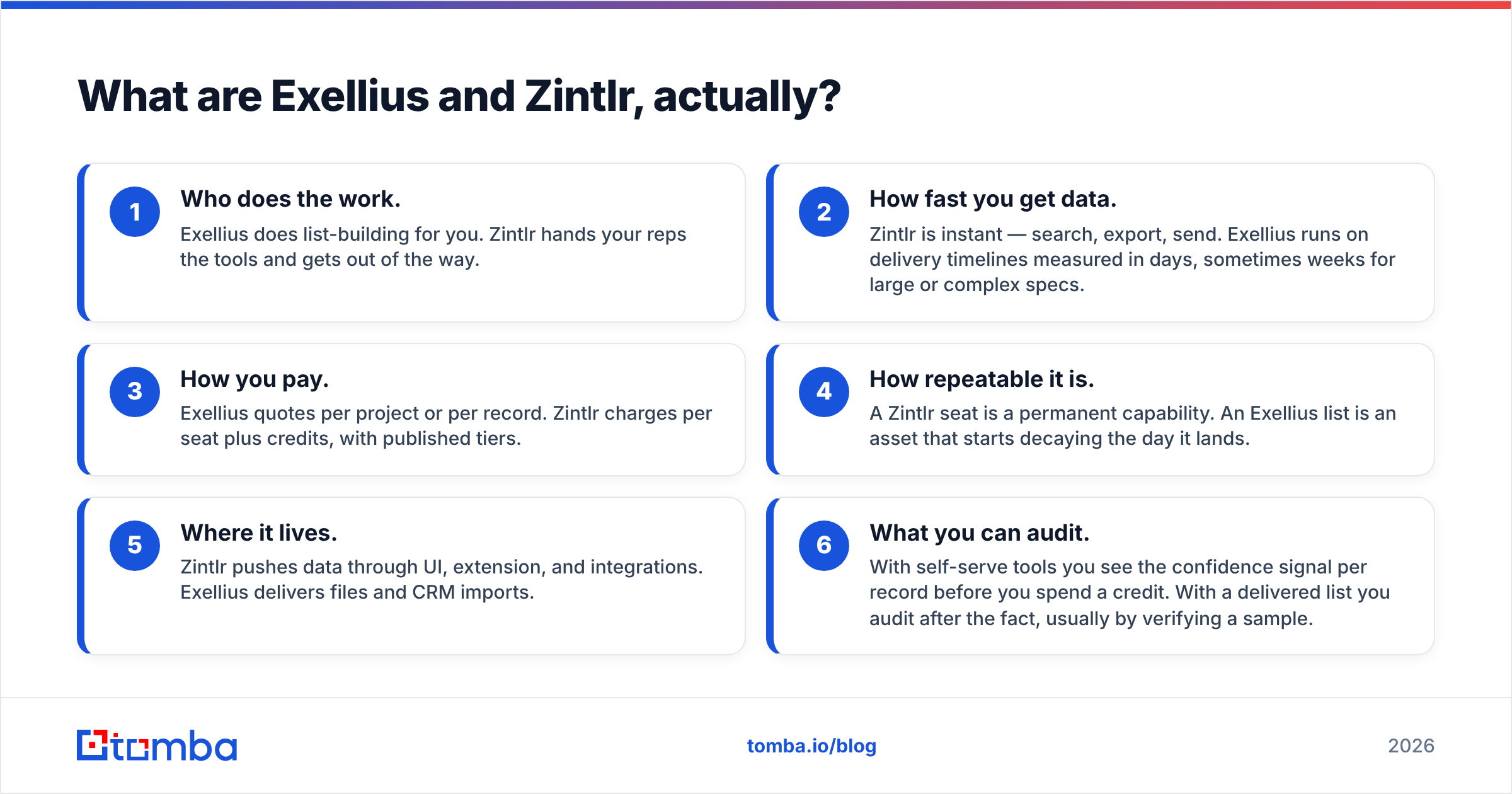
- Who does the work. Exellius does list-building for you. Zintlr hands your reps the tools and gets out of the way.
- How fast you get data. Zintlr is instant — search, export, send. Exellius runs on delivery timelines measured in days, sometimes weeks for large or complex specs.
- How you pay. Exellius quotes per project or per record. Zintlr charges per seat plus credits, with published tiers.
- How repeatable it is. A Zintlr seat is a permanent capability. An Exellius list is an asset that starts decaying the day it lands.
- Where it lives. Zintlr pushes data through UI, extension, and integrations. Exellius delivers files and CRM imports.
- What you can audit. With self-serve tools you see the confidence signal per record before you spend a credit. With a delivered list you audit after the fact, usually by verifying a sample.
Sorry — that renders correctly as:

How do Exellius and Zintlr compare head-to-head?#
Here is the practical comparison. Treat every price as "at the time of writing" — both vendors change packaging, and Exellius quotes are negotiated per deal, so confirm directly before you sign anything.
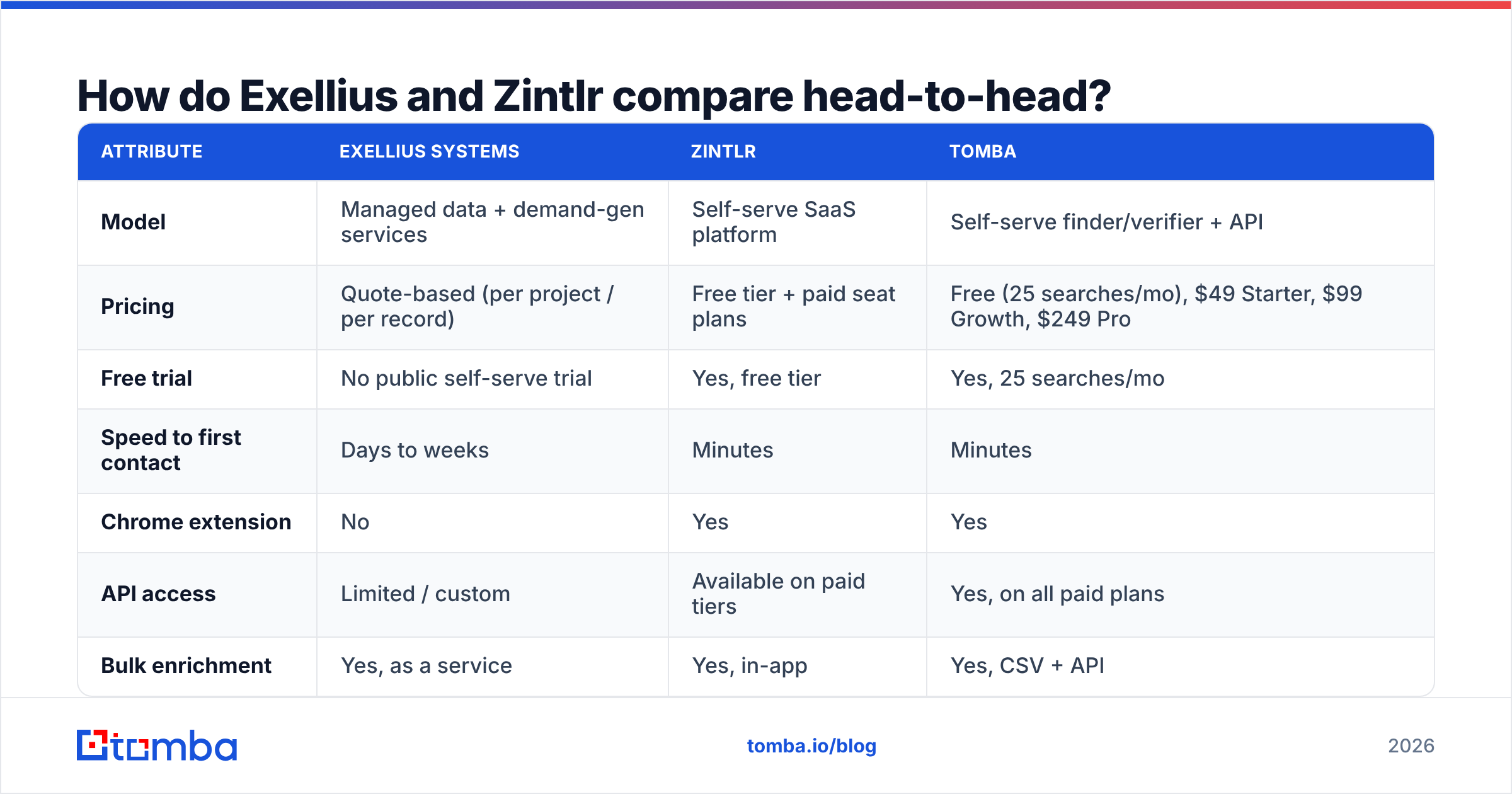
| Attribute | Exellius Systems | Zintlr | Tomba |
|---|---|---|---|
| Model | Managed data + demand-gen services | Self-serve SaaS platform | Self-serve finder/verifier + API |
| Pricing | Quote-based (per project / per record) | Free tier + paid seat plans | Free (25 searches/mo), $49 Starter, $99 Growth, $249 Pro |
| Free trial | No public self-serve trial | Yes, free tier | Yes, 25 searches/mo |
| Speed to first contact | Days to weeks | Minutes | Minutes |
| Chrome extension | No | Yes | Yes |
| API access | Limited / custom | Available on paid tiers | Yes, on all paid plans |
| Bulk enrichment | Yes, as a service | Yes, in-app | Yes, CSV + API |
| Built-in email verification | Vendor-side, opaque | Basic | Dedicated verifier + catch-all handling |
| Personality / behavioral data | No | Yes (core differentiator) | No |
| Phone numbers | Yes | Yes | Yes |
| Best for | One-off targeted campaigns, ABM list builds | SDR teams doing daily self-serve prospecting | Teams that need accurate emails at low cost, in-workflow |

The table exposes the real decision. If your bottleneck is "we don't have anyone to build lists," Exellius removes that bottleneck. If your bottleneck is "our reps burn two hours a day hunting contacts," Zintlr removes that one. If your bottleneck is "our bounce rate is killing our domain," neither vendor is the answer on its own.
Which one has better data accuracy?#
Neither vendor publishes an independently audited accuracy figure, so anyone claiming a hard winner here is guessing. What you can compare is how each one arrives at accuracy.
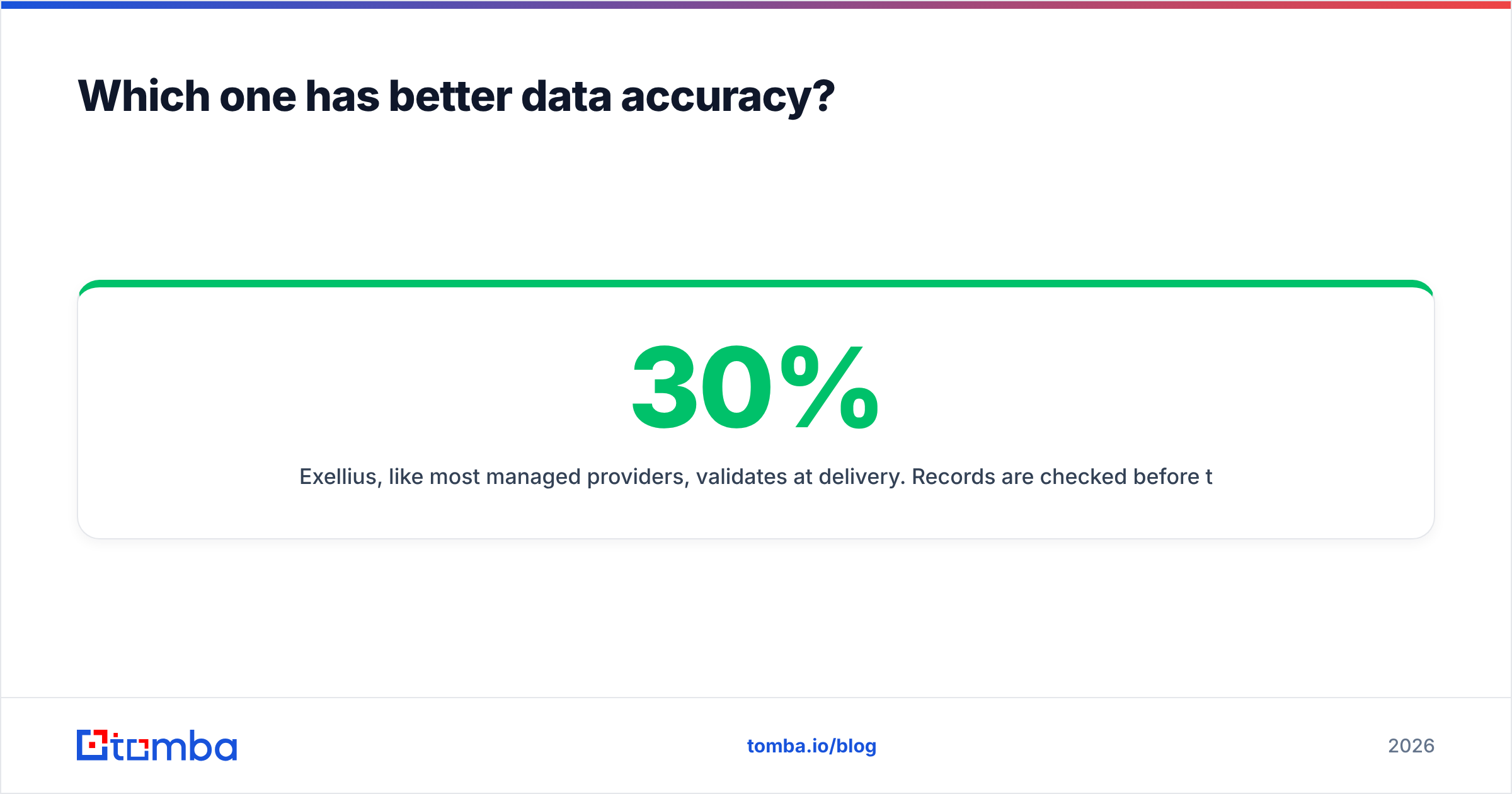
Exellius, like most managed providers, validates at delivery. Records are checked before the file reaches you, which means the list is usually clean on day one. The catch is what happens next: B2B contact data decays fast because people change jobs. Industry estimates put annual decay in the 25–30% range, which works out to roughly 2–3% per month. A custom list that is 95% accurate on delivery is meaningfully worse three months later, and you have no re-validation mechanism unless you buy one.
Zintlr validates at query time against its database. That means freshness depends on how recently that specific record was crawled or refreshed — good for well-covered segments (US/EU tech, mid-market and up), thinner for niche verticals, non-English markets, and very small companies. Coverage gaps in self-serve databases show up as "no result" rather than "wrong result," which is the safer failure mode but still costs your reps time.

The honest conclusion: accuracy is a workflow property, not a vendor property. Whichever source you buy from, the deliverability outcome depends on whether you run a verification pass immediately before sending. That is why most mature outbound teams decouple the two jobs — one vendor to source contacts, a dedicated email verifier to validate them right before a send. Running a source list through verification catches job-change decay, typos in scraped records, and role accounts that will damage your sender reputation.
If a meaningful chunk of your target accounts use catch-all domains — common in enterprise and in agencies — you also need a catch-all verifier, because standard SMTP checks return "accept all" and tell you nothing useful. Neither Exellius nor Zintlr is built to solve that specific problem well.
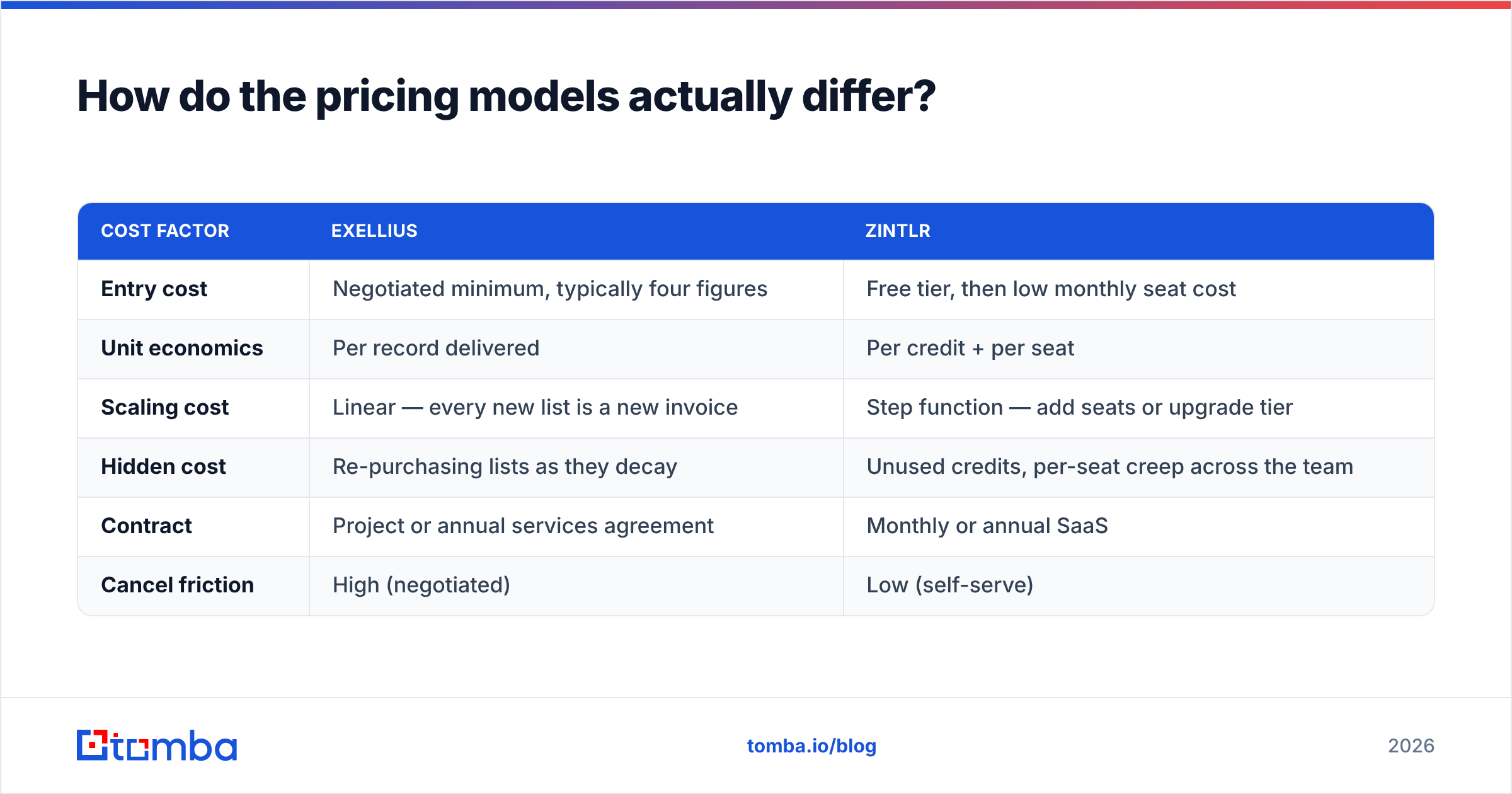
How do the pricing models actually differ?#
This is where the comparison gets uncomfortable, because you are comparing a quote to a price list.
| Cost factor | Exellius | Zintlr |
|---|---|---|
| Entry cost | Negotiated minimum, typically four figures | Free tier, then low monthly seat cost |
| Unit economics | Per record delivered | Per credit + per seat |
| Scaling cost | Linear — every new list is a new invoice | Step function — add seats or upgrade tier |
| Hidden cost | Re-purchasing lists as they decay | Unused credits, per-seat creep across the team |
| Contract | Project or annual services agreement | Monthly or annual SaaS |
| Cancel friction | High (negotiated) | Low (self-serve) |
Two practical warnings.
On Exellius-style buying: per-record pricing looks cheap at small volumes and gets expensive when you need the same segment refreshed quarterly. Ask explicitly what the replacement policy is for bounced records, and get the bounce threshold in writing. A "95% deliverability guarantee" that credits you records rather than refunding cash is a very different deal from one that refunds.
On Zintlr-style buying: seat pricing punishes teams that grow. Five SDRs at a mid-tier seat price plus credit overages routinely lands north of what a flat-rate API plan costs. Before you scale seats, check whether an API-first tool can serve the same data into your existing sequencer or CRM without a seat for every user. That is the single biggest cost lever in most stacks — see Tomba pricing for a flat-rate comparison point.

Who should pick Exellius?#
Exellius is the better fit when the following are true:
- You have a defined, finite campaign. An ABM push into 400 named accounts, a conference follow-up, a new-market test. You want the list once, not a permanent capability.
- You have no ops resource. Nobody on the team wants to learn a prospecting tool, build filters, or manage credits.
- Your ICP is hard to filter. If your targeting depends on signals that standard databases do not index well — specific certifications, regulatory status, equipment ownership — a human-assembled list can beat a query.
- You want bundled services. Content syndication, appointment setting, and intent data attached to the same engagement.
Where it goes wrong: teams that buy a list, run it once, get mediocre results, and have no way to iterate without another invoice. Managed data buys you a snapshot. Outbound is an iterative discipline, and snapshots go stale.
Who should pick Zintlr?#
Zintlr is the better fit when:
- You have reps who prospect daily. Self-serve tools pay for themselves when they are used every day, not once a quarter.
- You work LinkedIn heavily. The extension workflow — profile open, contact pulled, sequence added — is where these tools earn their keep. Compare it against a dedicated LinkedIn finder before committing.
- You value the personality layer. Zintlr's behavioral profiling is genuinely differentiated. Whether it moves your reply rate is an empirical question for your market, but nobody else in this comparison offers it.
- You want to start free. The free tier lets you test coverage against your actual ICP before spending anything. Do this. Pull 50 real target accounts, not the demo list.
Where it goes wrong: coverage gaps outside core markets, and cost creep as headcount grows. Also worth noting that reviews on aggregators like G2's sales intelligence category skew toward whichever vendor ran the most recent review campaign, so read the two-star reviews specifically — they tell you where coverage actually breaks.
Where do both tools leave a gap?#
Three gaps show up in almost every stack built on either vendor.
1. Verification is treated as someone else's job. Sourcing tools optimize for finding a plausible address. They are not optimizing for whether your ESP will accept it today. Gmail and Yahoo's bulk-sender requirements enforce a spam complaint rate under 0.3%, and high bounce rates compound the damage to sender reputation. Verify immediately before send, not at purchase time.
2. Programmatic access is an afterthought. If you want to enrich a form submission in real time, or backfill a CRM nightly, you want a documented API on your entry-level plan — not a call with sales. Check whether the plan you can actually afford includes the email finder API.
3. Bulk workflows are clunky. Sooner or later you will have a spreadsheet of 5,000 names and domains and no emails. That job wants a purpose-built bulk email finder, not a UI you click 5,000 times or a services quote you wait a week for.
For a broader view of how sourcing, sequencing and verification fit together, HubSpot's sales blog covers the process side well, and it is vendor-agnostic enough to be useful when you are mid-evaluation.
What is the practical verdict?#
Exellius wins on done-for-you list building for finite, hard-to-filter campaigns. Zintlr wins on daily self-serve prospecting with a genuinely different behavioral data angle. Most teams need neither to be their only vendor.
The stack that actually performs looks like this: one source of contacts appropriate to your motion (a database, a scraper, a managed list, or all three), plus a dedicated finder and verifier sitting between sourcing and sending. Splitting those roles means you can swap a data vendor without rebuilding your outbound machine, and it keeps the verification layer honest because it has no incentive to mark its own homework.
If you are evaluating alternatives more broadly, note that vendors like BookYourData occupy a useful middle ground — self-serve, pay-as-you-go contact lists with a deliverability guarantee — which suits teams that want list-buying economics without the services engagement.
Run the test before you buy. Take 100 real target accounts. Push them through each vendor's free or trial path. Verify the output independently. Compare match rate, bounce rate, and cost per usable contact. That single exercise beats every comparison article, including this one.
Start with the layer that makes every other vendor better. The Tomba Email Finder finds professional email addresses by domain, name, or company, with a free tier at 25 searches/month and paid plans from $49/mo — including API access on every paid tier, so you can wire it into your CRM, sequencer, or spreadsheet instead of paying per seat. Test it against whatever list you are about to buy, and see how many of those records survive.
Related guides#
Ready to find emails that actually work?
Join 150,000+ professionals who stopped guessing and started sending. Free credits on signup — no credit card required.
Get the Tomba newsletter
Practical outbound tactics and product updates — once every two weeks.
About the author