Exotel Pricing Reviews Pros and Cons: A 2026 Breakdown
Exotel bills like a telecom carrier, not a SaaS tool — rental, per-minute, and add-on fees stack fast. Here is what teams actually pay, what reviewers praise, and where the platform falls short.
Exotel pricing reviews pros and cons, all in one place: what the plans cost, what users like, and where the platform lets teams down. Here is the short version first.
TL;DR
- Exotel prices like a telecom carrier, not a SaaS product. You pay a platform fee, then per-minute voice charges, then per-number rental, then add-ons. The sticker price is never the invoice.
- Reviewers praise uptime, Indian carrier coverage, and fast number setup. The common gripes: unclear billing, slow support on low tiers, and thin analytics.
- Exotel fits best when your calling sits in India or Southeast Asia. You get call masking, IVR, and recording that meet local rules out of the box.
- It fits worst for small outbound teams in North America or Europe. You pay for carrier muscle you barely touch. Twilio, Aircall, or a dialer inside your CRM will land cheaper.
- Telephony is only half the cost of outbound. Stale contact data means you pay per minute to dial dead numbers. Check the number and the person before the dialer runs.
What is Exotel and who actually uses it?#
Exotel is a cloud calling platform. Analysts call this CPaaS. It sells voice, SMS, WhatsApp, and contact-center tools on top of carrier networks. It started in India, and that is still its home base. Ola, Swiggy, Flipkart, and a long tail of Indian fintech and healthcare firms route customer calls through it. It has since grown across Southeast Asia and the Middle East.
The product splits into roughly three things people buy:
- Virtual numbers and call routing — a pool of numbers, IVR menus, call distribution, and recording. This is where most buyers start.
- Number masking and call connect — the marketplace use case. A driver and a rider talk, and neither sees a real number. Exotel is genuinely strong here, and it is why several large Indian platforms picked it.
- Contact center (the Ameyo-lineage stack) — after Exotel bought Ameyo, it sells a fuller agent desktop, dialer, and omnichannel queueing. That competes with Genesys and Five9 at the mid-market end.
The split matters for pricing. A few numbers with IVR is cheap. Agent seats with a predictive dialer and quality monitoring cost far more. Reviews mix the two, which is why customer cost reports vary so wildly.

How does Exotel pricing actually work in 2026?#
Exotel does not publish a clean per-seat price list. That is the loudest complaint in reviews. Pricing is quoted, usage-based, and shifts by country, plan term, and volume commitment. Check the official Exotel pricing page before you budget. The structure below holds even when the numbers move.
Two fixed costs show up every month:
- Platform / rental fee — a recurring subscription that unlocks your feature tier: IVR depth, API access, dashboards, SLA. Pay monthly, quarterly, or yearly. Annual prepay cuts the rate.
- Per-number charges — every virtual, toll-free, or DID number carries its own monthly rental. A toll-free number costs several times a local one.
Then the usage meters run:
- Per-minute voice charges — billed in pulses, often 30 or 60 seconds. Inbound, outbound, mobile, and landline all price differently. On short calls, the rounding rule costs you more than the headline rate.
- Messaging charges — SMS and WhatsApp are metered on their own. In India you also pay DLT and operator pass-through fees. They land on the invoice, not in the quote.
- Add-ons — recording storage, advanced analytics, dedicated infrastructure, premium support, and contact-center agent seats.
The result: two companies on the same plan can spend 5x apart. When you request a quote, ask for a modeled invoice at your expected minute volume. A rate card is not enough.
What do the tiers look like side by side?#
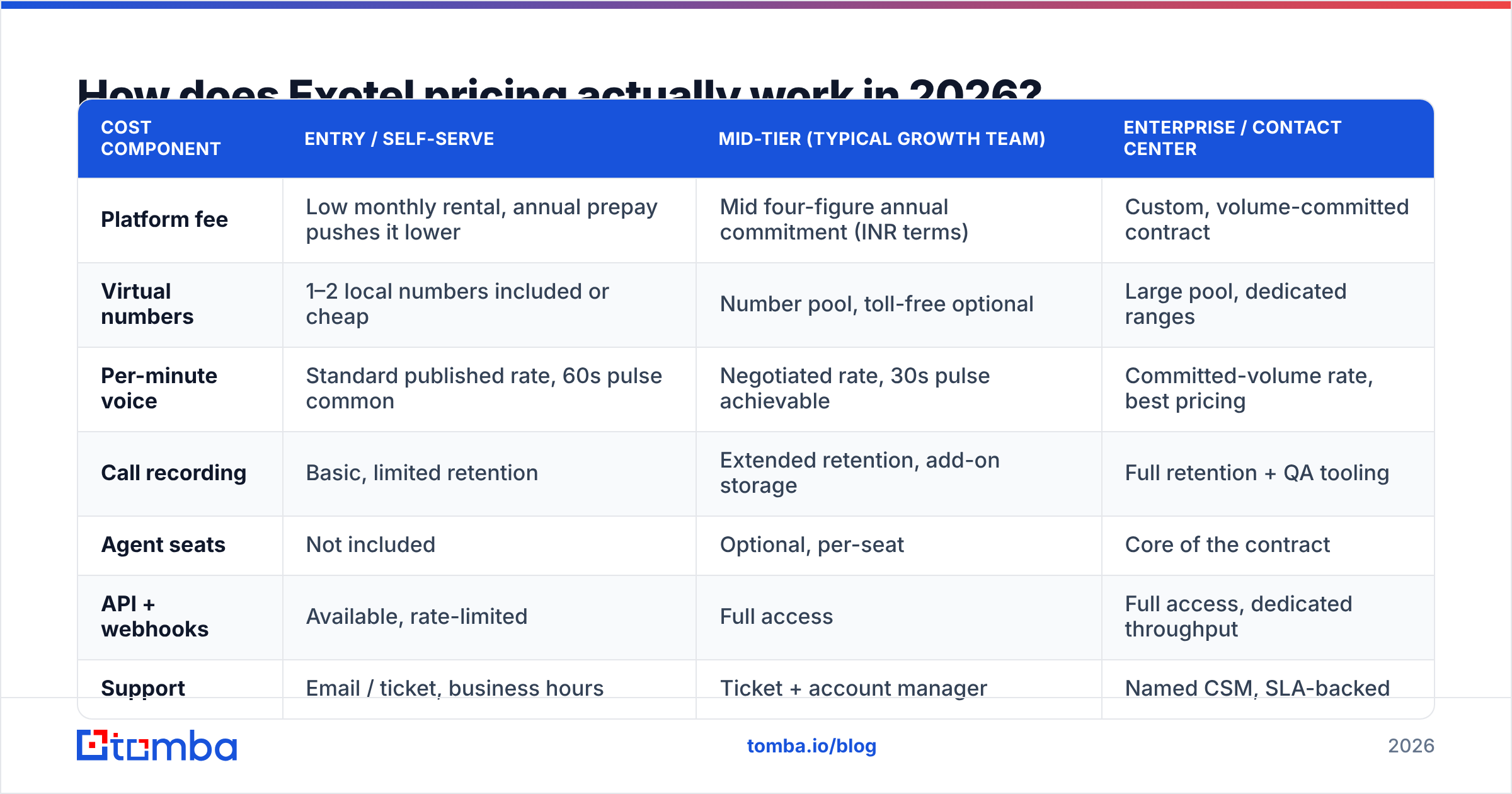
| Cost component | Entry / self-serve | Mid-tier (typical growth team) | Enterprise / contact center |
|---|---|---|---|
| Platform fee | Low monthly rental, annual prepay pushes it lower | Mid four-figure annual commitment (INR terms) | Custom, volume-committed contract |
| Virtual numbers | 1–2 local numbers included or cheap | Number pool, toll-free optional | Large pool, dedicated ranges |
| Per-minute voice | Standard published rate, 60s pulse common | Negotiated rate, 30s pulse achievable | Committed-volume rate, best pricing |
| Call recording | Basic, limited retention | Extended retention, add-on storage | Full retention + QA tooling |
| Agent seats | Not included | Optional, per-seat | Core of the contract |
| API + webhooks | Available, rate-limited | Full access | Full access, dedicated throughput |
| Support | Email / ticket, business hours | Ticket + account manager | Named CSM, SLA-backed |
| Realistic time-to-live | Same-day to 48 hours | 1–2 weeks with KYC | 4–8 weeks with integration |
Two things stand out here. First, moving from self-serve to a real contact center is not a price bump. It is a different purchase, with procurement, KYC paperwork, and a rollout window. Second, the numbers that decide your bill sit in the fine print: pulse rounding, number rental, storage retention.
What do Exotel reviews actually say?#
Review scores on G2 and similar directories put Exotel in the plain-infrastructure bucket. Reliability and regional coverage score well. Ease of use and value for money score softer. Here is what the Exotel pricing reviews pros and cons picture looks like once you read past the stars.
What reviewers consistently praise:
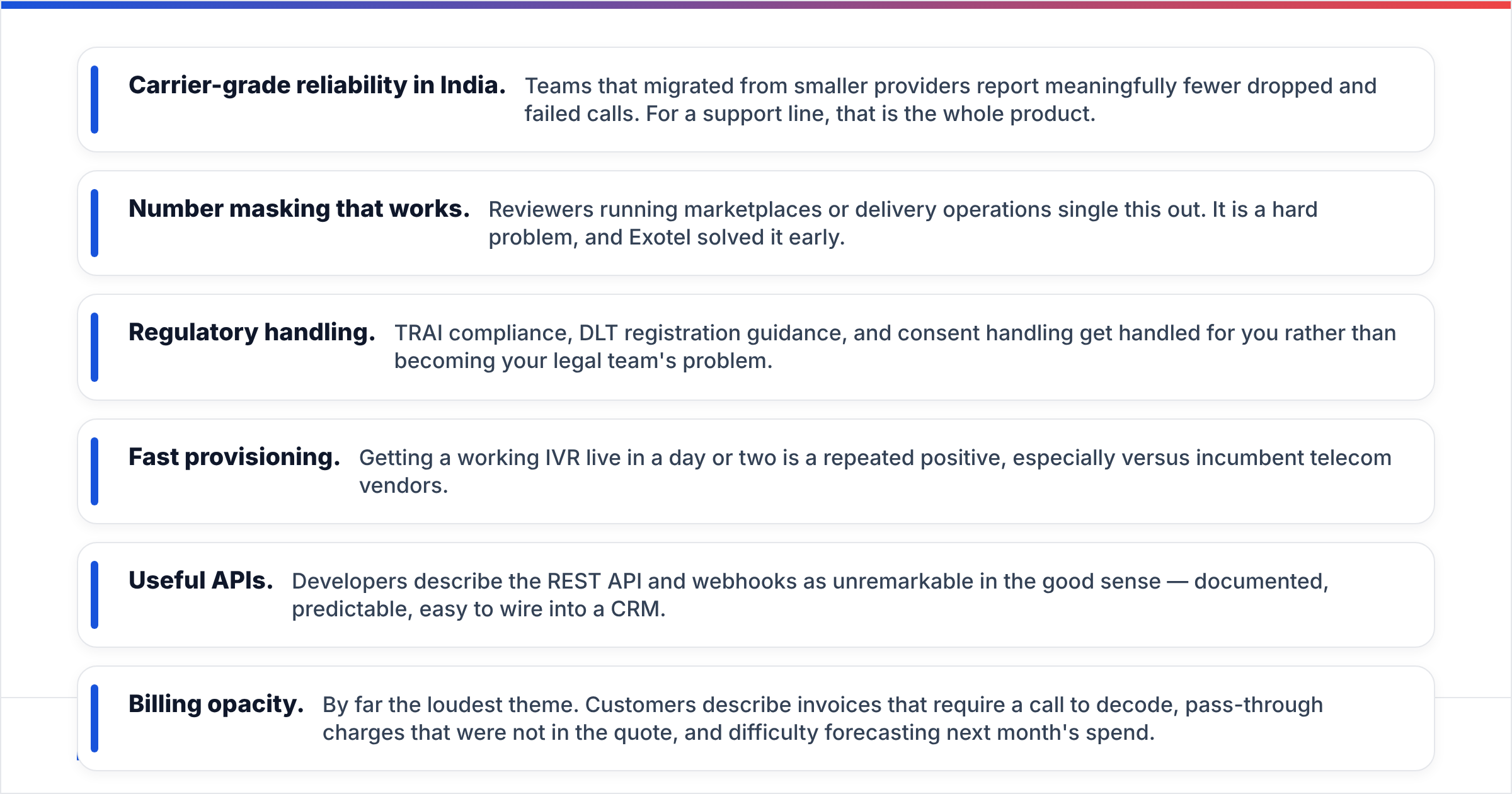
- Carrier-grade reliability in India. Teams that moved from smaller providers report far fewer dropped and failed calls. For a support line, that is the whole product.
- Number masking that works. Marketplace and delivery teams single this out. It is a hard problem, and Exotel solved it early.
- Rules handled for you. TRAI compliance, DLT registration, and consent handling are built in, so they never reach your legal team.
- Fast setup. A working IVR live in a day or two is a repeated win, especially next to old telecom vendors.
- Useful APIs. Developers call the REST API and webhooks boring in the good way: documented, predictable, easy to wire into a CRM.
What reviewers consistently complain about:
- Billing opacity. The loudest theme by far. Invoices need a phone call to decode. Pass-through charges appear that were never quoted. Next month's spend is hard to forecast.
- Slow support on small accounts. Enterprise accounts report good service. Self-serve users wait days on non-urgent tickets.
- Shallow analytics. Fine for day-to-day monitoring. Thin for the cohort reporting a RevOps lead wants. Most serious users export to a warehouse.
- Dated screens. The post-acquisition contact-center views and the core dashboard do not feel like one product.
- Weak fit outside core markets. Reviewers elsewhere report worse rates and slower number provisioning than a global CPaaS gives them.
The honest summary: nobody buys Exotel because it delights them. They buy it because it works in a market where many rivals do not. They stay because moving telephony hurts.
Is Exotel better than Twilio, Knowlarity, or a CRM dialer?#
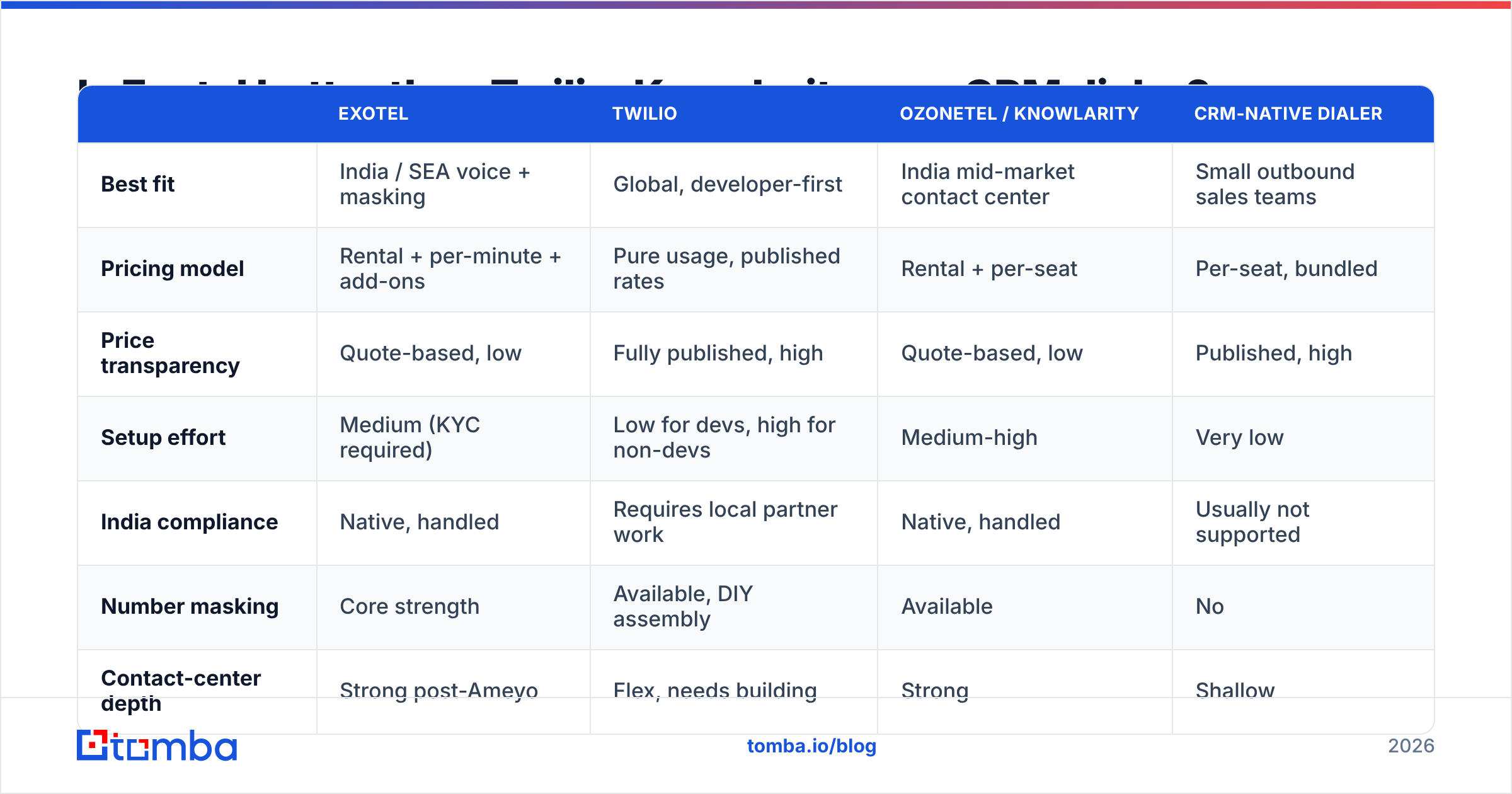
It depends on two things: where you call, and whether you need telephony as plumbing or as a sales tool. The table below settles most deals.
| Exotel | Twilio | Ozonetel / Knowlarity | CRM-native dialer | |
|---|---|---|---|---|
| Best fit | India / SEA voice + masking | Global, developer-first | India mid-market contact center | Small outbound sales teams |
| Pricing model | Rental + per-minute + add-ons | Pure usage, published rates | Rental + per-seat | Per-seat, bundled |
| Price transparency | Quote-based, low | Fully published, high | Quote-based, low | Published, high |
| Setup effort | Medium (KYC required) | Low for devs, high for non-devs | Medium-high | Very low |
| India compliance | Native, handled | Requires local partner work | Native, handled | Usually not supported |
| Number masking | Core strength | Available, DIY assembly | Available | No |
| Contact-center depth | Strong post-Ameyo | Flex, needs building | Strong | Shallow |
| Global coverage | Regional | Broadest available | Regional | Depends on host CRM |
| Who it frustrates | Finance teams forecasting spend | Non-technical buyers | Buyers wanting self-serve | Anyone needing routing logic |
Read it this way. If you call Indian consumers and a compliance slip could sink you, Exotel is a safe default. The alternatives need more assembly. If you run a 12-person SaaS sales team in Austin dialing US prospects, Exotel is the wrong shape. You want Twilio's published rates behind a dialer, or a dialer already bundled into your CRM.
Exotel pricing reviews pros and cons: what to weigh before you sign#
Pros
- Reliability where it is hardest to get. Indian mobile termination is messy. Exotel's carrier deals and routing absorb that mess for you.
- Compliance as a feature, not a project. DLT, consent, recording notices, and number masking arrive configured, not as a legal checklist.
- Genuinely fast to first call. Days, not quarters. That is rare in telephony buying.
- One vendor for voice, SMS, and WhatsApp. Fewer integration seams and one invoice, if you can read the invoice.
- Contact-center depth after the Ameyo deal. You can grow from three numbers to two hundred agents without replatforming.
Cons
- You cannot forecast the bill from the website. Every serious buyer ends up on a sales call. Pass-through charges surprise finance in month two.
- Support quality tracks contract size. Small accounts wait in line.
- Analytics need a warehouse. Native reports will not tell you which campaign drove connected calls that converted.
- Weak fit outside core geographies. Rates and provisioning speed both slip.
- Wasted minutes stay invisible. The platform will happily bill you for calling numbers that died two years ago. That is not Exotel's fault, but it is your money.

How do you stop overpaying for calls you should never have placed?#
The cheapest telephony fix has nothing to do with your telephony vendor.
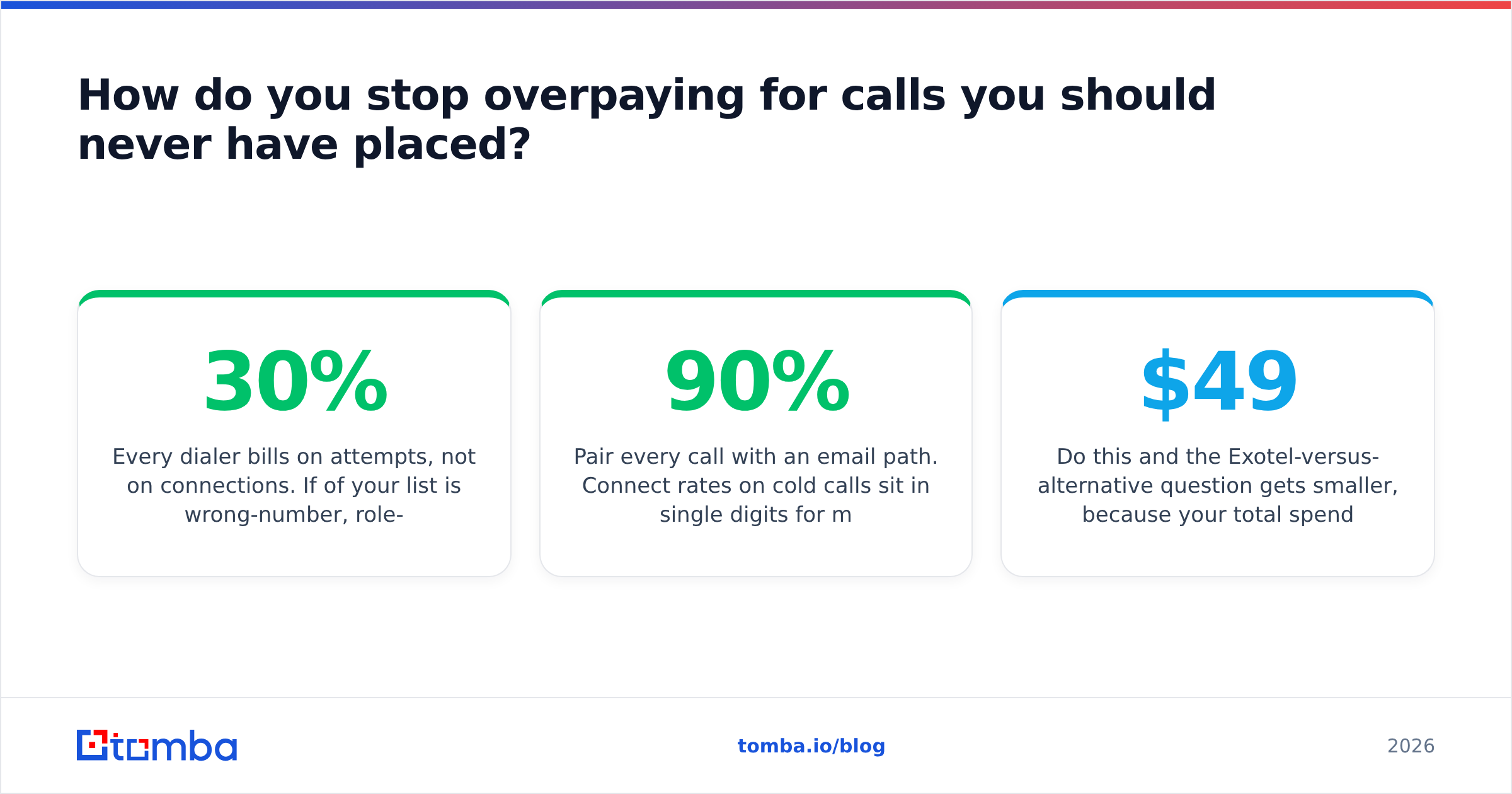
Every dialer bills attempts, not connections. Say 30% of your list is wrong numbers, job changes, or dead lines. You still pay platform fees, per-minute charges, and SDR salary to reach voicemail. Teams that audit this find their real cost per conversation is double what the rate card implies.
Clean the input side first:
- Validate the number before it enters the dialer. A phone validator catches bad formats, invalid ranges, and dead lines before a single minute is billed.
- Source direct numbers, not switchboards. A main line costs the same per minute as a decision-maker's direct dial and converts far worse. A phone finder that returns verified direct dials moves the connect-rate math more than any dialer setting.
- Suppress before you dial. Deduplicate, drop DNC entries, and remove accounts already in an active sequence. Dull list hygiene, real savings.
Then fix how you measure:
- Pair every call with an email path. Cold-call connect rates sit in single digits in most B2B markets. The follow-up email converts the 90% who never picked up. That needs a deliverable address, not a guess.
- Track cost per connected conversation, not cost per minute. Vendors optimize the metric you report. Report minutes and you get cheaper minutes, not more meetings.
Do that, and the Exotel-versus-alternative debate shrinks. Wasted dials stop driving your total spend. Compare it with Tomba pricing: a $49/mo Starter plan that cleans the list is cheap next to the per-minute charges it prevents.
So should you buy Exotel?#
Buy it if: your calling sits in India or Southeast Asia. You need number masking or regulated call flows. You have a technical team to wire the API into your stack. You can commit volume for a negotiated rate. Ask for a modeled invoice at 1x and 3x your expected volume before signing, and get pulse rounding in writing.
Skip it if: you run a Western outbound team under 50 seats. Or you want self-serve pricing you can approve without procurement. Or you mainly need a sales dialer, not customer-facing phone infrastructure. A published-rate provider or a CRM-native dialer gets you there faster and cheaper.
Either way: that is the core trade-off in any Exotel pricing reviews pros and cons check. The platform sets what a call costs. Your data decides whether the call was worth placing.
Before your next outbound cycle, run your target accounts through the Tomba Email Finder. You get verified email addresses, matched people, and clean records. Then the numbers you feed into Exotel — or any other dialer — belong to real humans at the companies you target. Start free with 25 searches, measure the lift on one campaign, and scale from there.
Related guides#
Ready to find emails that actually work?
Join 150,000+ professionals who stopped guessing and started sending. Free credits on signup — no credit card required.
Get the Tomba newsletter
Practical outbound tactics and product updates — once every two weeks.
About the author