Expand the Pie Negotiation: How to Grow Deal Value in 2026
Discounting is the laziest close in B2B. Here's how expand the pie negotiation trades low-cost variables for higher contract value, with scripts, a claiming-vs-creating table, and the cases where it backfires.
TL;DR
- Expand the pie negotiation means creating new value in a deal before you argue over who gets what slice. The value comes from term length, scope, timing, references, and data access.
- Most B2B negotiations collapse into pure price haggling. Reps show up with exactly one variable to trade: the discount.
- The five reliable pie-expanding levers are contract term, payment timing, scope and seats, mutual marketing, and implementation commitments.
- Expanding the pie is not "being nice." You still claim aggressively — you just claim from a bigger deal, and you trade things that cost you little for things the buyer values a lot.
- It backfires in three predictable situations: procurement-led reverse auctions, one-shot transactional deals, and any negotiation where you haven't done the research to know what the other side wants.
What does expand the pie negotiation mean?#
Expanding the pie means increasing the total value available in a deal before you split it.
Think of it like ordering dinner with a friend where you both want the last slice of pizza. The distributive move is to argue about who gets it. The integrative move is to notice that one of you only wants the crust and the other only wants the toppings — and that there's a second pizza in the freezer nobody mentioned. Same table, more food.
In negotiation theory, this is the difference between claiming value (distributive bargaining, fixed pie, my gain is your loss) and creating value (integrative bargaining, variable pie, trades that leave both sides better off). The framing dates back to Getting to Yes and the Harvard negotiation tradition. It survives because it holds up under pressure. Real deals have far more than one variable, even when both sides talk as if price is the only one.
The B2B sales version is blunt. When your buyer says "we need 20% off," you have two options:
- Give some or all of it, and shrink the deal.
- Ask what they'd trade for it, and reshape the deal.
Option two is expand the pie negotiation. It only works if you have inventory — a list of things you can give that cost you less than they're worth to the buyer, and a list of things you want that cost them less than they're worth to you.

Why do most B2B negotiations shrink the pie instead?#
Because single-variable negotiation is the default, and the default is price.
Three specific failures show up over and over in deal reviews:
You never built a trade list. If the only lever in your head is the discount percentage, every conversation converges there. Reps who close well walk in with six to ten variables written down — and at least three they're happy to give away.
You mistook positions for interests. The buyer's position is "20% off." Their interest might be "my budget for this fiscal year is $60K and I can't exceed it, but next year's is already approved." Those are wildly different problems. The first has one solution. The second has five — deferred start date, split invoicing, a smaller year-one scope that ramps, a January renewal date, a multi-year deal with year-one weighted low.
You negotiated before you understood the account. The variables that expand a pie are account-specific. A Series B startup values cash-flow timing. A public company values predictability and audit-friendly terms. A marketing agency values seat flexibility. You cannot guess which one you're facing from a discovery call transcript alone. You need the org chart, the funding stage, the tech stack, and who else in the building touches this decision.
That last point is why pipeline hygiene and negotiation outcomes are more connected than most teams admit. Deals negotiated on thin account data get negotiated on price, because price is the only variable both sides definitely understand.
What are the five levers that actually expand the pie?#
These five cover the overwhelming majority of value-creating trades in B2B software and services deals. Work through them in order — the earlier ones are cheaper for you and heavier for the buyer.
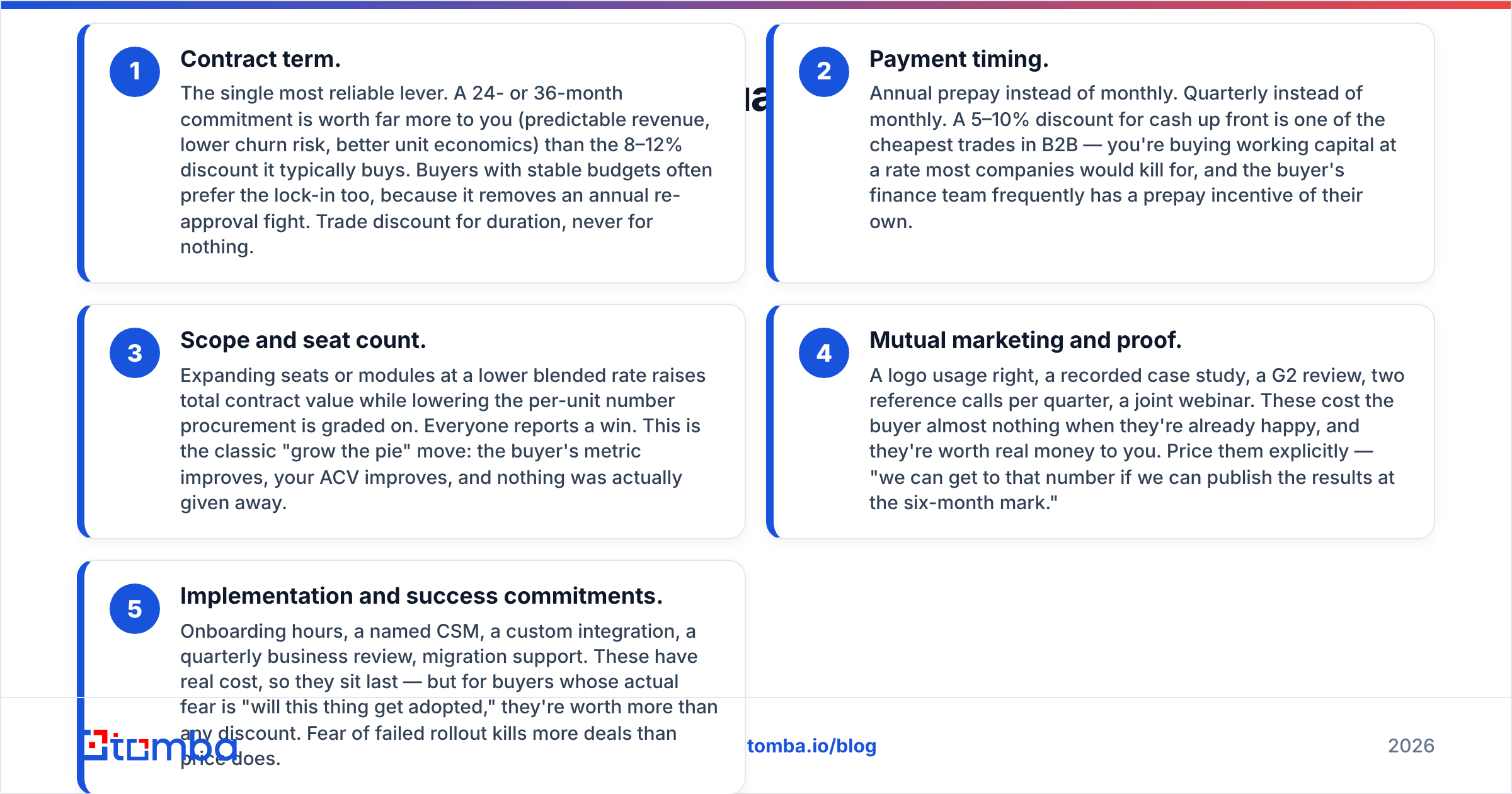
Contract term. The single most reliable lever. A 24- or 36-month commitment is worth far more to you (predictable revenue, lower churn risk, better unit economics) than the 8–12% discount it typically buys. Buyers with stable budgets often prefer the lock-in too, because it removes an annual re-approval fight. Trade discount for duration, never for nothing.
Payment timing. Annual prepay instead of monthly. Quarterly instead of monthly. A 5–10% discount for cash up front is one of the cheapest trades in B2B. You're buying working capital at a rate most companies would kill for, and the buyer's finance team frequently has a prepay incentive of their own.
Scope and seat count. Expanding seats or modules at a lower blended rate raises total contract value while lowering the per-unit number procurement is graded on. Everyone reports a win. This is the classic "grow the pie" move: the buyer's metric improves, your ACV improves, and nothing was actually given away.
Mutual marketing and proof. A logo usage right, a recorded case study, a G2 review, two reference calls per quarter, a joint webinar. These cost the buyer almost nothing when they're already happy, and they're worth real money to you. Price them explicitly — "we can get to that number if we can publish the results at the six-month mark."
Implementation and success commitments. Onboarding hours, a named CSM, a custom integration, a quarterly business review, migration support. These have real cost, so they sit last. But for buyers whose actual fear is "will this thing get adopted," they're worth more than any discount. Fear of failed rollout kills more deals than price does.
The discipline is simple: never give a concession without naming the trade in the same sentence. "I can do X if you can do Y." The moment you concede unilaterally, you've taught the buyer that asking is free, and the rest of the negotiation is just repeated asking.
Is expanding the pie better than claiming value?#
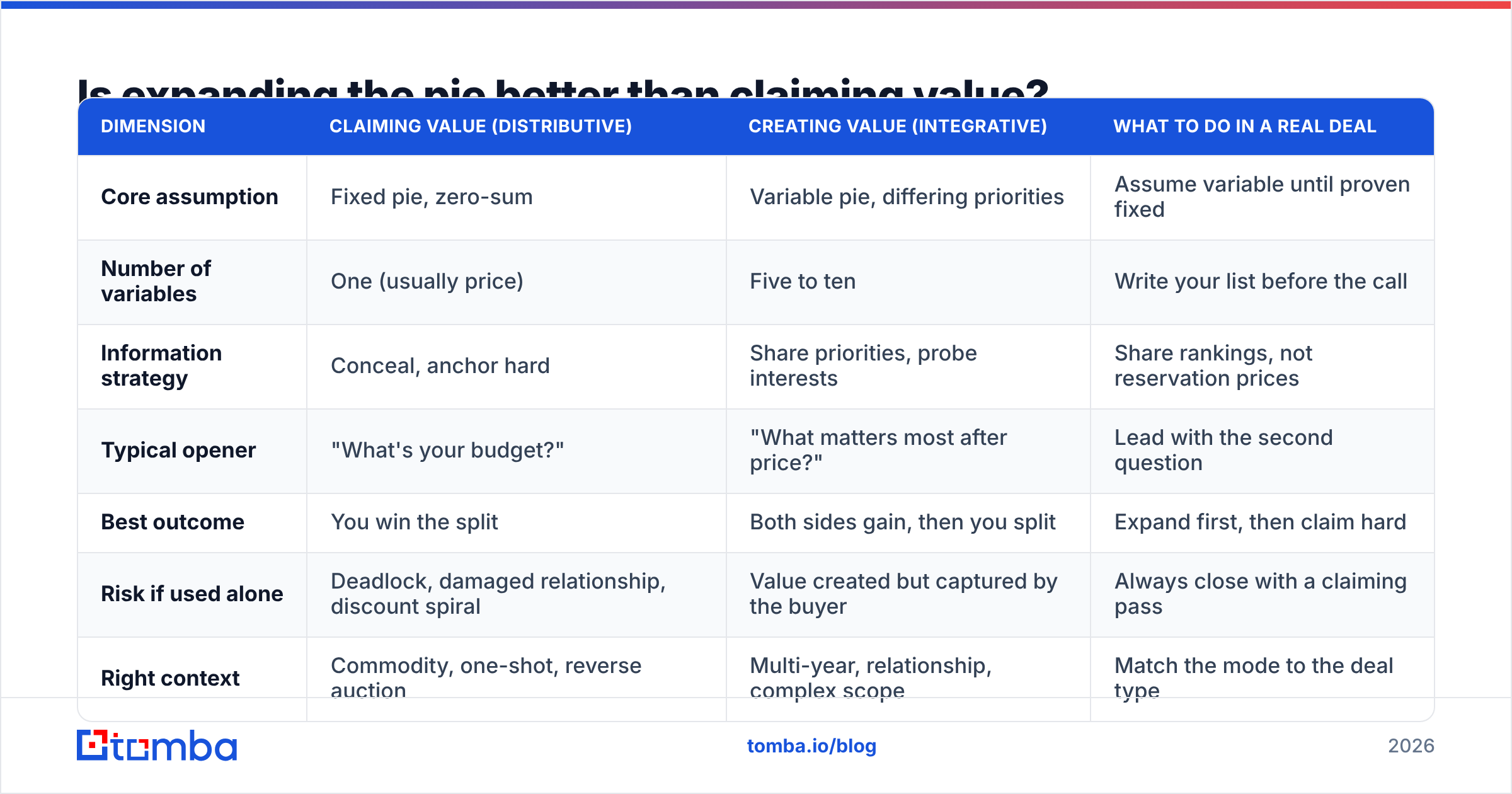
Neither one wins alone. The strong negotiators do both, in sequence — create first, claim second — and the table below is how to tell which mode you're actually in.
| Dimension | Claiming value (distributive) | Creating value (integrative) | What to do in a real deal |
|---|---|---|---|
| Core assumption | Fixed pie, zero-sum | Variable pie, differing priorities | Assume variable until proven fixed |
| Number of variables | One (usually price) | Five to ten | Write your list before the call |
| Information strategy | Conceal, anchor hard | Share priorities, probe interests | Share rankings, not reservation prices |
| Typical opener | "What's your budget?" | "What matters most after price?" | Lead with the second question |
| Best outcome | You win the split | Both sides gain, then you split | Expand first, then claim hard |
| Risk if used alone | Deadlock, damaged relationship, discount spiral | Value created but captured by the buyer | Always close with a claiming pass |
| Right context | Commodity, one-shot, reverse auction | Multi-year, relationship, complex scope | Match the mode to the deal type |
| Effect on ACV | Flat to down | Flat to significantly up | Track ACV per concession given |
The last row is the one to hold onto. Track your discount rate and your average contract value together. A team that reduced discounts by two points while ACV fell 15% did not negotiate better — it just sold less product to the same people.
Research from the negotiation literature keeps finding the same thing, including decades of work summarized by Harvard's Program on Negotiation. Negotiators who assume a fixed pie leave joint value unclaimed. The integrative trades were available the whole time, and obvious in hindsight. The bias is called the "fixed-pie perception," and it's the default state of most reps under quota pressure.
How do you find the trade variables before the negotiation starts?#
You research them. This is the unglamorous half of expand the pie negotiation, and it's the half that decides the outcome.
Before a pricing conversation, you want to know:
- Who else is in the room. Not just your champion — the finance approver, the security reviewer, the department head whose team will actually use the product. Each one has a different currency. Finance wants timing. Security wants documentation. The department head wants adoption support.
- The company's fiscal calendar. A deal that's impossible in October is easy on January 3rd. Term-and-timing trades depend entirely on this.
- Funding stage and headcount trajectory. A company that just raised trades cash for speed. A company that just cut headcount trades everything for a lower year-one number.
- What they're replacing. Switching costs are leverage — for them if the switch is painful, for you if the incumbent is failing.
- Whether other stakeholders can be reached directly. Multi-threading is a pie-expanding activity, not just a risk-reduction one. The second contact often names a variable your champion never mentioned.
Most of this comes from the same prospecting motion that fills your pipeline. Get verified contacts for the CFO and the head of IT before the negotiation, not after it stalls. That's what turns a single-threaded price fight into a multi-variable conversation. A data enrichment pass over the account gives you titles, seniority, department, and company size, so you know whose budget you're actually negotiating against. If the negotiation needs a live conversation rather than another email thread, a phone finder gets you the direct line instead of the switchboard.
The rule of thumb: if you can't name three things the buyer wants besides a lower price, you're not ready to negotiate. You're ready to discount.

What does an expand-the-pie script actually sound like?#
Here's the pattern, in the order it plays out.
1. Acknowledge without conceding.
"Twenty percent is a big number, and I'd rather solve the real constraint than argue about the percentage. What's driving it — is it the total, the timing, or the per-seat rate?"
This question alone reframes half of all discount demands. "The total" means budget cap. "The timing" means cash flow. "The per-seat rate" means procurement is being graded on a benchmark. Three different problems, three different solutions.
2. Rank their priorities out loud.
"If you had to rank these — lower total cost, faster rollout, and flexibility to add seats mid-year — what's first and what's last?"
The last-place item is your gift. It costs them nothing to give up and it may be worth a lot to you.
3. Name the trade explicitly.
"I can get you to that number. To do it, I need either a 24-month term or annual prepay. Which is easier on your side?"
Two options, both acceptable to you. This is the difference between a concession and a trade. You're not asking whether — you're asking which.
4. Bundle rather than shave.
"Instead of cutting the rate on 40 seats, what if we do 60 seats at a lower blended rate? Your per-seat number drops below the benchmark, and you've got room for the Q3 hires you mentioned."
Procurement's metric improves. Your ACV improves. Nobody lost.
5. Close the loop in writing, same day. Ambiguous trades get renegotiated. Send the summary before the meeting ends: what they get, what you get, what happens if either side doesn't deliver.
For teams building this into a repeatable motion, the summary email is worth templating. The cold email templates library is a reasonable starting point for the follow-up structure, though negotiation summaries need heavier customization than outbound sequences.
When does expanding the pie backfire?#
Three situations, and they're worth memorizing. Trying to expand the pie in the wrong context makes you look naive.
Reverse auctions and RFP price sheets. When procurement has structured the process as a sealed-bid comparison on a fixed spec, there is no room to trade. The spec is the spec. Your only levers are price and the parts of the spec you can genuinely differentiate on. Creative trades here read as non-compliance, and non-compliant bids get disqualified. Fight this earlier — at the spec-writing stage — or accept that this deal is distributive.
Genuinely one-shot transactions. If there's no renewal, no expansion path, and no reference value, the relationship-based trades evaporate. A single implementation project for a company being acquired next quarter is a fixed pie. Treat it as one.
When you haven't earned the information. Expand the pie negotiation requires the buyer to tell you what they value. If trust is low — you've been pushy, you missed a deadline, your champion got burned by a previous vendor — they'll treat your questions as manipulation and answer with "just give us your best price." At that point, the honest move is to fix the relationship or take the distributive outcome.
There's also a subtler failure: creating value and then failing to claim any of it. Reps who love this framework sometimes generate enormous joint value and walk away with a deal that's great for the customer and mediocre for the company. Analyst coverage of sales negotiation from firms like Gartner has flagged the same pattern for years. Buyers are more organized, more committee-driven, and better coached than sellers assume. Create first, but always run a claiming pass before signature.
How do you measure whether it worked?#
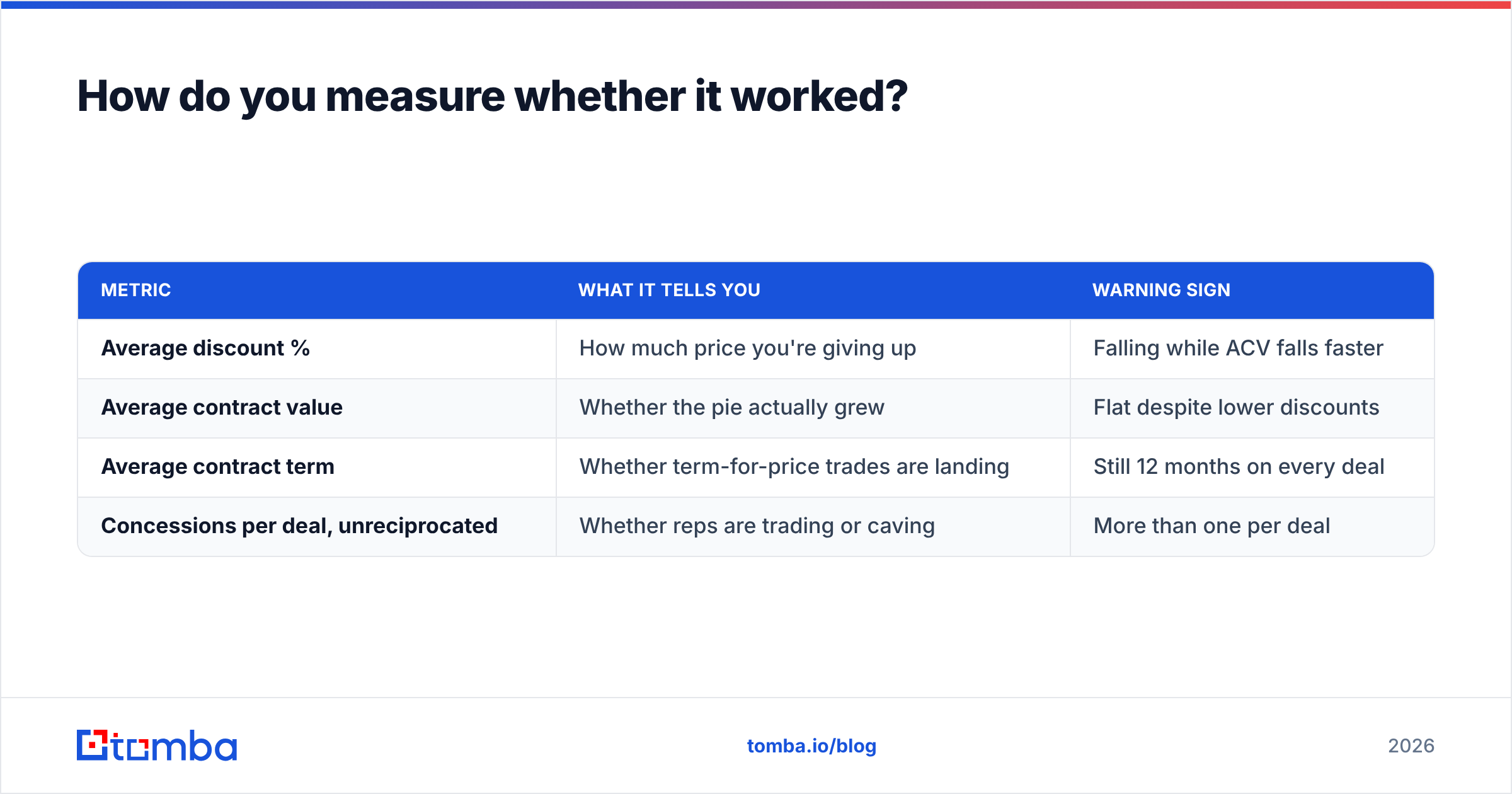
Four metrics, tracked at the team level, over at least one full quarter:
| Metric | What it tells you | Warning sign |
|---|---|---|
| Average discount % | How much price you're giving up | Falling while ACV falls faster |
| Average contract value | Whether the pie actually grew | Flat despite lower discounts |
| Average contract term | Whether term-for-price trades are landing | Still 12 months on every deal |
| Concessions per deal, unreciprocated | Whether reps are trading or caving | More than one per deal |
That last row is the one nobody tracks and everybody should. Count concessions given without anything received in return. If the number is above one per closed deal, your team isn't negotiating — it's processing discount requests. That number is also a leading indicator of your win rate, because deals where the seller concedes unilaterally tend to attract more asks, not fewer.
Review these alongside pipeline quality. A team that expands the pie well on good-fit accounts and gets shredded on bad-fit accounts doesn't have a negotiation problem. It has a targeting problem, and no script fixes that.
Where should you start this quarter?#
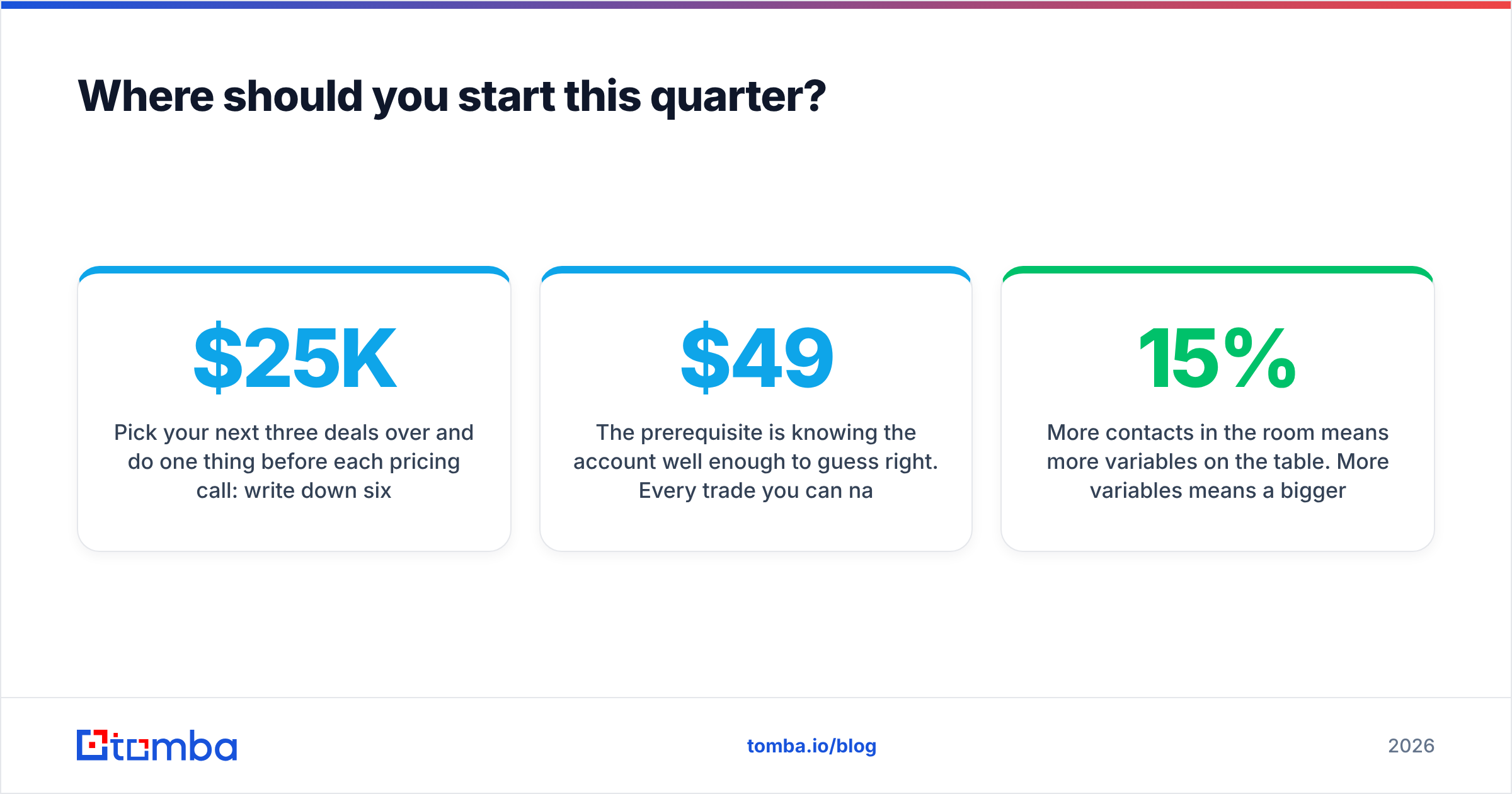
Pick your next three deals over $25K and do one thing before each pricing call: write down six variables you can trade, and rank them by what they cost you. Then write down three you want from the buyer. That's the whole discipline. Everything above is elaboration on having a list instead of a number.
The prerequisite is knowing the account well enough to guess right. Every trade you can name depends on knowing who the stakeholders are, what their titles imply about their incentives, and how to reach the ones your champion hasn't introduced you to yet. If your negotiations keep collapsing into single-threaded price fights, start upstream. Tomba Email Finder gets you verified contacts for the finance approver, the security reviewer, and the department head before the negotiation starts. The free tier covers 25 searches a month, so you can test it on one account first. The Starter plan is $49/mo when you're ready to run it across the whole pipeline. See Tomba pricing for the full breakdown.
More contacts in the room means more variables on the table. More variables means a bigger pie — and a bigger pie is the only honest way to stop losing the same 15% every quarter.
Related guides#
Ready to find emails that actually work?
Join 150,000+ professionals who stopped guessing and started sending. Free credits on signup — no credit card required.
Get the Tomba newsletter
Practical outbound tactics and product updates — once every two weeks.
About the author