Expansion Revenue in SaaS: The 2026 Guide to Growing NRR
New logos got expensive. Expansion revenue is where SaaS growth actually comes from in 2026 — here are the benchmarks, motions, and the org design that makes NRR compound instead of leak.
TL;DR
- Expansion revenue is new money from existing customers — seats, usage, upgrades, and cross-sells — and in 2026 it accounts for the majority of net new ARR at most SaaS companies above $10M.
- Net revenue retention (NRR) is the scoreboard. Below 100% you are running up a down escalator; 110-120% is healthy for mid-market; 130%+ is usually usage-based pricing doing the work.
- There are four expansion motions (seat, usage, tier, cross-sell). Picking the wrong one for your pricing model is the most common reason expansion programs stall.
- Expansion is a pipeline, not a renewal side effect. It needs triggers, contact data on the new buying unit, and an owner with a number.
- The cheapest expansion lever nobody runs: finding the champions who left for another company and selling them again.
What is expansion revenue in SaaS?#
Expansion revenue is any recurring revenue you earn from a customer after the initial contract, excluding renewal of the original amount. If a customer signs at $2,000/month and twelve months later is paying $3,200/month, the extra $1,200 is expansion.
Think of it like a restaurant. New logos are getting people through the door. Expansion revenue is dessert, the second bottle, and the customer who now books the private room for their whole team. The kitchen is already paid for. The margin on that second bottle is almost pure.
Four things count as expansion:
- Seat expansion — the same product, more users. Classic for collaboration and CRM tools.
- Usage expansion — the same seats, more consumption. API calls, credits, contacts stored, GB processed.
- Tier upgrades — Starter to Growth to Enterprise. Driven by feature gates, security requirements, or support SLAs.
- Cross-sell — a second product line sold into the same account.
What does not count: renewals at the same price, one-off services, and price increases you would have taken anyway on the existing footprint (some teams count CPI-linked uplift as expansion; most investors discount it).
The reason this distinction matters is that acquisition costs have not come down. Paid channels are more expensive, outbound reply rates are lower than they were three years ago, and buying committees are larger. Selling into an account that already trusts you skips most of that cost. Analyst coverage from firms like Gartner has been pointing at the same shift for several cycles: growth budgets are moving from acquisition to retention and expansion because the payback math is simply better.

How do you calculate expansion revenue and NRR?#
Start with the raw number, then move to the ratio.
Expansion MRR = (upgrade MRR + seat-add MRR + usage-overage MRR + cross-sell MRR) for the period.
Net revenue retention (NRR) takes a cohort of customers at the start of a period and measures what that same cohort is worth at the end:
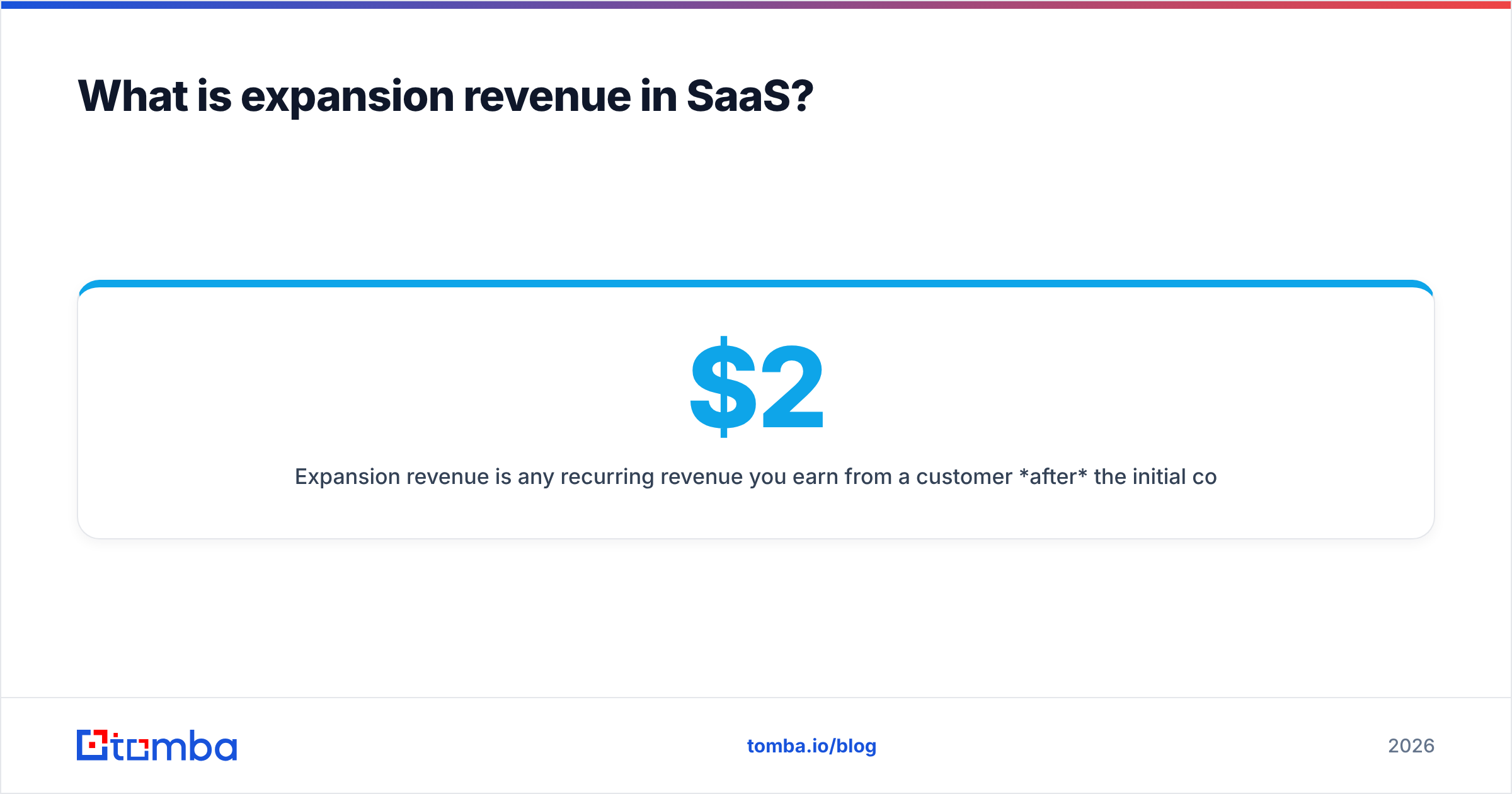
NRR = (Starting MRR + Expansion − Contraction − Churn) / Starting MRRIf you started the year with $1,000,000 in MRR from a cohort, added $220,000 in expansion, lost $60,000 to downgrades and $90,000 to churn, your NRR is ($1,000,000 + $220,000 − $60,000 − $90,000) / $1,000,000 = 107%.
Two traps here. First, do not mix new-logo revenue into the cohort — that inflates the number and hides churn. Second, measure NRR on a trailing twelve-month basis for annual contracts. Monthly NRR on annual deals is noise, because expansion clusters at renewal dates.
Gross revenue retention (GRR) strips out expansion entirely: (Starting − Contraction − Churn) / Starting. GRR can never exceed 100%. Investors look at both because a company with 118% NRR and 82% GRR is quietly leaking — a handful of whale accounts are masking a broad churn problem. If your NRR and GRR are more than 30 points apart, fix retention before you fund an expansion team.
Related metrics worth tracking alongside: net dollar retention by segment, expansion ARR per CSM, and time-to-first-expansion (days from close to first upgrade). The last one is underrated — it tells you whether onboarding is actually creating expansion surface area or just closing tickets. If you want the definitions in one place, our B2B glossary covers the retention and revenue operations terms in plain language.
What do good expansion revenue benchmarks look like in 2026?#
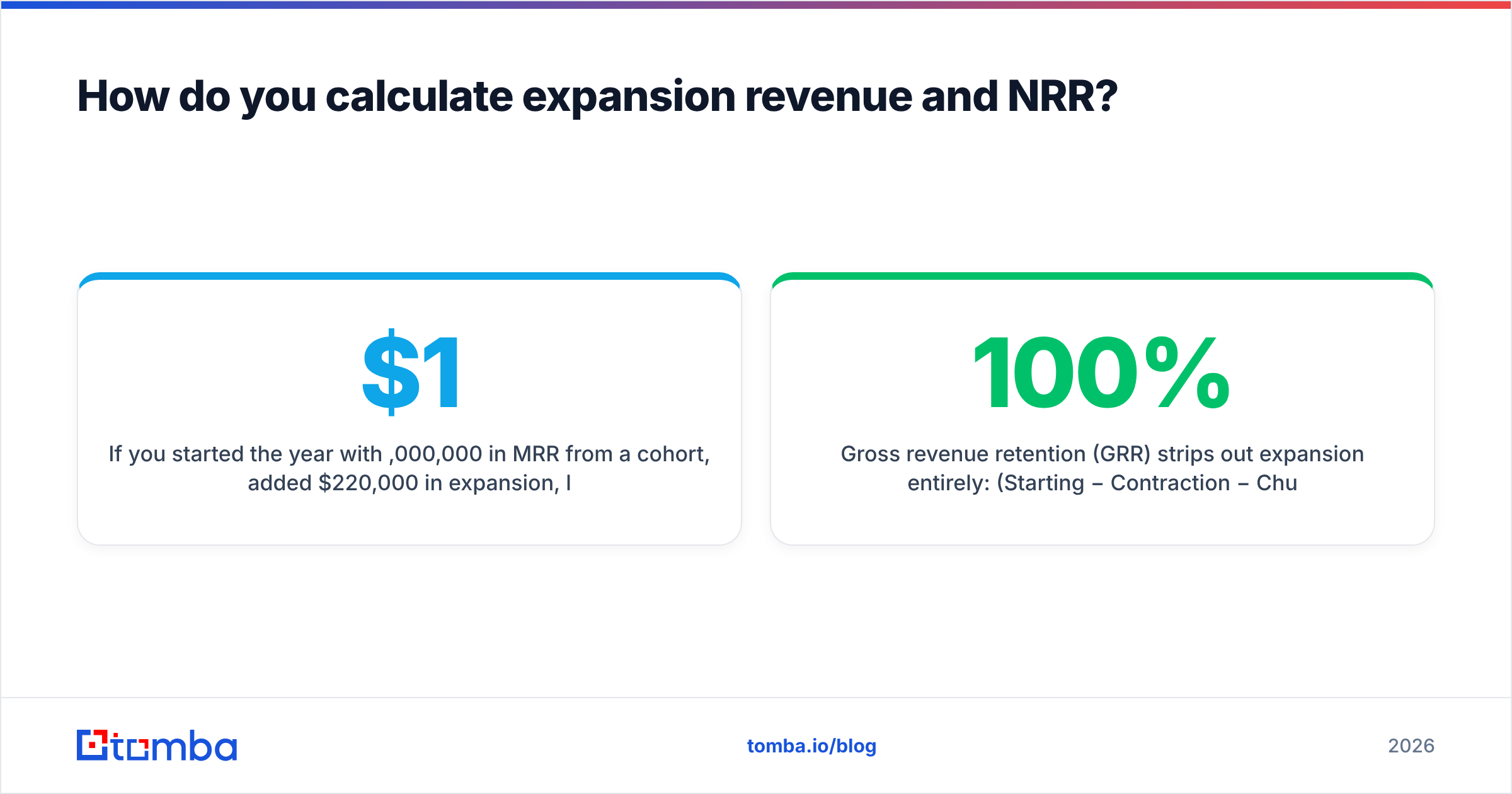
Benchmarks vary wildly by ACV and pricing model, so compare yourself to your own segment, not to the public-company median.
| Segment | Typical ACV | Healthy NRR | Median NRR | Primary expansion motion |
|---|---|---|---|---|
| SMB / self-serve | $500 – $5K | 95 – 105% | ~98% | Seat adds, tier upgrade |
| Mid-market | $5K – $50K | 108 – 118% | ~106% | Seats + usage overage |
| Enterprise | $50K – $500K | 115 – 130% | ~112% | Cross-sell, multi-year tiers |
| Usage-based infra / API | Variable | 125 – 140% | ~120% | Consumption growth |
| Vertical SaaS | $10K – $100K | 105 – 115% | ~104% | Module cross-sell |
Read the table as a diagnostic, not a target. An SMB tool with 98% NRR is not broken — SMB churn is structural, because the customers themselves go out of business. An enterprise product at 98% NRR is broken, because those accounts grow headcount and budget every year and you are capturing none of it.
The single biggest structural driver is pricing. Seat-based products cap out at the customer's headcount growth, roughly 5-15% a year for a healthy company. Usage-based products ride the customer's own growth curve with no ceiling. That is most of the gap between the 105% row and the 130% row — it is not that infra sales teams are better, it is that the meter keeps running.
Which expansion motion actually fits your product?#
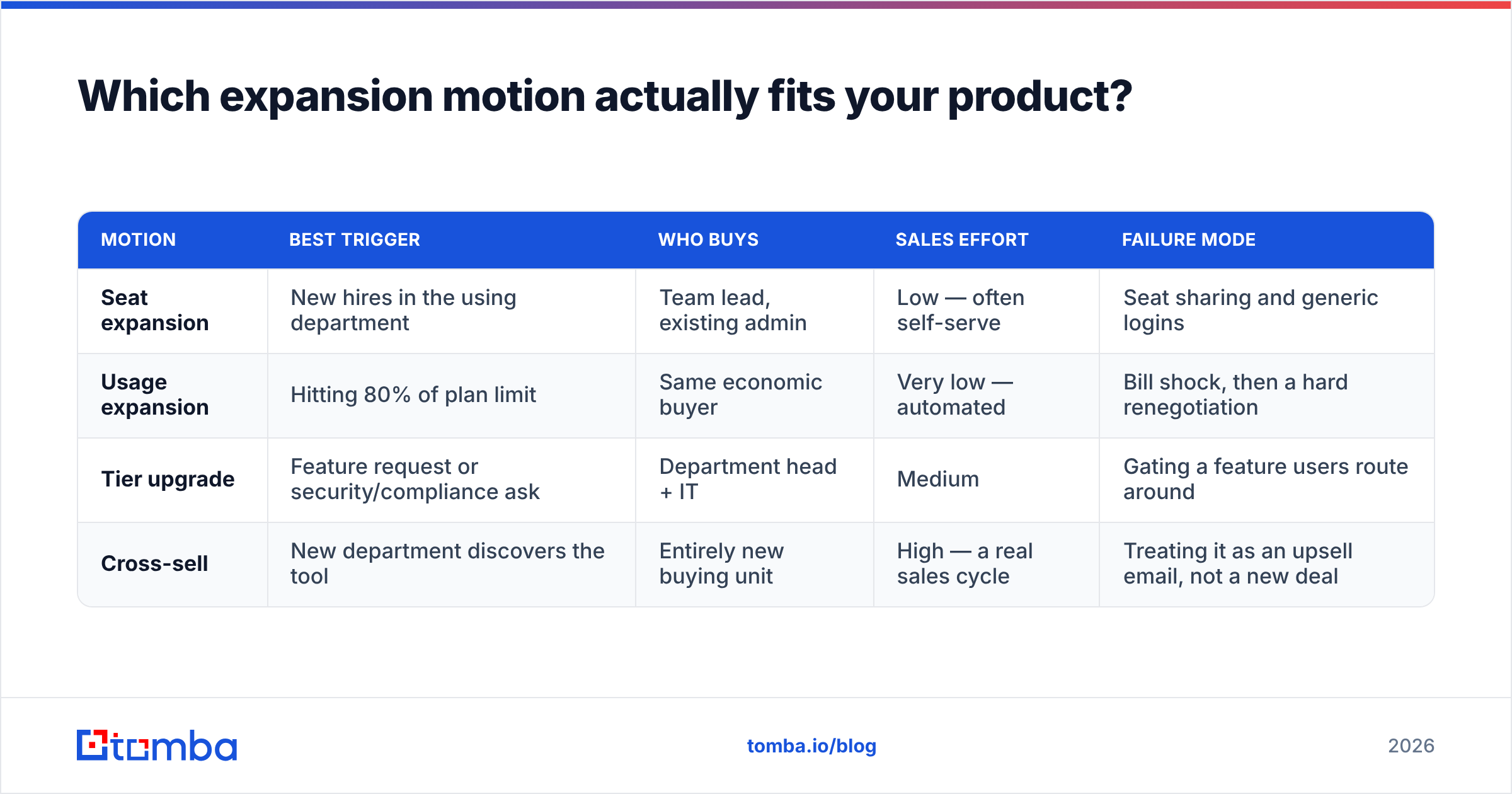
Each motion has a different trigger, a different buyer, and a different failure mode. Running the wrong one is why expansion programs produce activity without revenue.
| Motion | Best trigger | Who buys | Sales effort | Failure mode |
|---|---|---|---|---|
| Seat expansion | New hires in the using department | Team lead, existing admin | Low — often self-serve | Seat sharing and generic logins |
| Usage expansion | Hitting 80% of plan limit | Same economic buyer | Very low — automated | Bill shock, then a hard renegotiation |
| Tier upgrade | Feature request or security/compliance ask | Department head + IT | Medium | Gating a feature users route around |
| Cross-sell | New department discovers the tool | Entirely new buying unit | High — a real sales cycle | Treating it as an upsell email, not a new deal |
Cross-sell is the one teams consistently misprice in effort. Selling your analytics module to the marketing team of an existing customer is a new deal: different buyer, different budget line, different evaluation criteria, often a different procurement path. The only thing you inherit is credibility. Sending that new department a "since you already use us" email and expecting a signature is the number-one reason cross-sell programs report a 2% conversion rate.
The practical fix is to treat cross-sell targets as prospects with a warm reference. That means you need actual contact data on people inside the account you have never spoken to — the VP of Marketing when your relationship is with Engineering. Most CRMs hold the three contacts from the original deal and nothing else. A domain search across the customer's domain, filtered by department, turns a one-thread account into a mapped org chart, and data enrichment fills in titles and seniority so you know who actually signs.

How do you build an expansion pipeline instead of hoping for it?#
Expansion that "just happens" is a tax you are paying on the accounts that were going to grow anyway. A real program has five parts.
- Define expansion-qualified accounts (EQAs). Same rigor as an MQL, different inputs: product usage above a threshold, a support ticket asking for a gated feature, a headcount jump on LinkedIn, or a new executive in the using department. Score them like you would any marketing qualified lead.
- Instrument the triggers. Usage at 80% of plan, a second department signing up with a company email domain, a champion's job-title change, a competitor's tool disappearing from the account's tech stack. Each trigger needs a destination — a task, a play, an owner.
- Map the buying unit beyond your champion. Enterprise expansion fails on org blindness. You need names, titles, and reachable contacts in the departments you have never sold to. Build that map before the trigger fires, not after.
- Write the play, not the email. For each trigger: who reaches out, in what channel, with what proof (their own usage data beats any case study), and what the ask is. Vague check-ins convert nothing.
- Give it a number and an owner. Expansion ARR belongs on someone's comp plan. Split targets — CS owns renewal and seat adds, AEs own tier and cross-sell — but never leave it unowned.
- Review it weekly like new-business pipeline. Stage, amount, close date, next step. If your expansion "pipeline" lives in a spreadsheet reviewed at QBR time, it is a forecast, not a pipeline.
The data layer under all of this is where most programs actually break. Contacts go stale at roughly 25-30% a year through job changes alone. Your 2024 champion at a key account may now be three companies away — which is either a churn risk you cannot see or the warmest new-logo lead in your database, depending on whether you noticed. Running your customer-contact table through an email verifier each quarter surfaces both. Bounced work addresses on named champions are the earliest churn signal most companies have, and they are sitting in your CRM for free.
Who should own expansion revenue — sales, CS, or RevOps?#
Short answer: RevOps owns the system, and a named revenue role owns the number. Splitting it by motion works better than splitting it by team.
- Customer Success owns low-friction motions: seat adds, usage upgrades, plan-limit conversations. These are service interactions with a price tag, and CS already has the relationship. Compensate on expansion ARR, not on "health score."
- Account Executives own anything requiring a new budget line: tier jumps with procurement involvement, multi-year commitments, cross-sell into a new department.
- RevOps owns trigger instrumentation, account mapping, data hygiene, and reporting. If nobody owns the plumbing, both teams end up working from stale lists and blaming each other's forecast.
The failure pattern to avoid is the "expansion team" with no book of business, no product access, and no comp on the outcome. It becomes a reporting function within two quarters. Companies like HubSpot have written extensively about tying CS compensation to net revenue rather than to renewal-only quotas, and the pattern holds broadly: what gets comped gets expanded.
One more structural note. Expansion revenue is the numerator of customer lifetime value, which means a 10-point NRR improvement raises the CAC you can profitably afford on new logos too. Expansion is not the opposite of acquisition — it is what funds it.
What quietly kills expansion revenue?#
Five things, in rough order of how often they show up:
Pricing with no expansion path. Unlimited-everything plans feel generous and cap your NRR at 100% minus churn. Every plan needs at least one dimension that grows with the customer's success.
Onboarding that only trains one team. If a single department ever learns the product, that is your permanent ceiling. Land-and-expand requires landing in a way that is visible to adjacent teams.
Contract terms that block it. Multi-year deals locked at year-one seat counts with no true-up clause are three years of frozen revenue. Negotiate annual true-ups even when you discount for the commitment.
Champion turnover you don't track. The person who bought is the person who defends the renewal. When they leave, both your renewal risk and your best new-logo lead walk out at the same time. Neither gets actioned unless someone is watching for it — a quarterly pass over champion contacts, plus a reverse email lookup on the ones that bounce, catches most of it.
Reporting expansion as one blended number. "NRR is 112%" tells you nothing actionable. Segment it: by ACV band, by acquisition channel, by onboarding cohort, by whether the account has more than one department active. The last cut usually explains most of the variance and tells you exactly what to fix.
Start with a complete map of the accounts you already have#
Expansion revenue is mostly a data problem wearing a strategy costume. The motions are not complicated — seats, usage, tier, cross-sell — and every SaaS team knows them. What separates 105% NRR from 125% is whether you can see the trigger and reach the right person in the account before the moment passes.
That means knowing every department in your customer's org, having reachable contacts in each of them, and keeping those contacts fresh as people change jobs. If your CRM holds three stale contacts per account, you cannot run a cross-sell play no matter how good the deck is.
The Tomba Email Finder is built for exactly that gap: search a customer's domain, pull verified professional email addresses by department and seniority, and turn a single-thread account into a mapped buying committee. The free tier gives you 25 searches a month to test it against your top accounts; paid plans start at $49/mo. Run it against your ten largest customers this week and count how many decision-makers you have never contacted. That number is your expansion pipeline.
Related guides#
Ready to find emails that actually work?
Join 150,000+ professionals who stopped guessing and started sending. Free credits on signup — no credit card required.
Get the Tomba newsletter
Practical outbound tactics and product updates — once every two weeks.
About the author