Explicit vs Implicit Lead Scoring: How to Build a Model That Works
Explicit scoring rates who a lead is. Implicit scoring rates what they do. Run either one alone and your reps chase the wrong accounts. Here is how the two models differ, where each breaks, and how to combine them into one score sales actually trusts.
TL;DR
- Explicit lead scoring rates who someone is — job title, company size, industry, tech stack, region. It comes from form fields and enrichment data.
- Implicit lead scoring rates what someone does — pricing page visits, demo requests, email replies, product trials. It comes from behavioural tracking.
- Explicit alone floods your pipeline with a perfect-fit VP who has never opened an email. Implicit alone hands your AE a curious intern from a 4-person agency.
- The models that actually work are hybrid: a fit score (explicit) crossed with an engagement score (implicit), rendered as an A1–D4 grid rather than one blended number.
- Your scoring model is only as good as the firmographic data behind it. Decayed titles and missing company size quietly break explicit scoring within 12–18 months.
What is explicit lead scoring?#
Explicit lead scoring assigns points based on attributes a lead states or that you can verify about them. Nothing is inferred from behaviour. If the record says "VP of Engineering at a 500-person SaaS company in the US," explicit scoring rates that profile against your ideal customer profile and returns a number.
Typical explicit inputs:
- Job title and seniority — Director+ scores higher than IC, because they hold budget.
- Company size — headcount or revenue band, weighted toward the segment where you win deals.
- Industry / vertical — your top three verticals score high, out-of-scope verticals score negative.
- Geography — regions you can legally sell and support in.
- Technographics — a lead running Salesforce scores higher if you're a Salesforce-native tool.
- Lead source — a referral scores higher than a gated-ebook download.
Two things make explicit scoring attractive. It works from the very first touch, before a lead has done anything at all. And it's explainable — when an AE asks why a lead scored 78, you can point at four fields.
Two things make it fragile. Self-reported data is often wrong (people type "Manager" when they mean "individual contributor," or use a personal Gmail on a B2B form). And attributes go stale. A Gartner rule of thumb that circulates widely in RevOps: B2B contact data decays somewhere around 25–30% a year through job changes alone. Whatever the exact number in your market, the direction is not in dispute.
What is implicit lead scoring?#
Implicit lead scoring assigns points based on observed behaviour. The lead never tells you they're interested; they show you.
Typical implicit signals:
- High-intent page views — pricing, comparison pages, integration docs, security/compliance pages.
- Email engagement — replies score far higher than opens, and opens have become close to worthless since Apple Mail Privacy Protection started pre-fetching images.
- Content depth — three blog posts is browsing; a bottom-of-funnel ROI calculator is buying.
- Product signals — free trial started, second seat invited, API key generated.
- Recency and frequency — five visits this week outrank fifty visits last quarter.
- Negative signals — careers page views, unsubscribes, 90 days of silence.
Implicit scoring catches the thing explicit scoring can't: timing. Fit tells you whether to sell. Behaviour tells you when.
Its weakness is context. Behaviour without firmographics produces false positives at scale. A student researching a paper for class can outscore a CTO who read one page and forwarded it to procurement. And behavioural data only exists after someone shows up — it's useless for cold outbound, where you're picking targets before any interaction has happened.

Explicit vs implicit lead scoring: what's the real difference?#
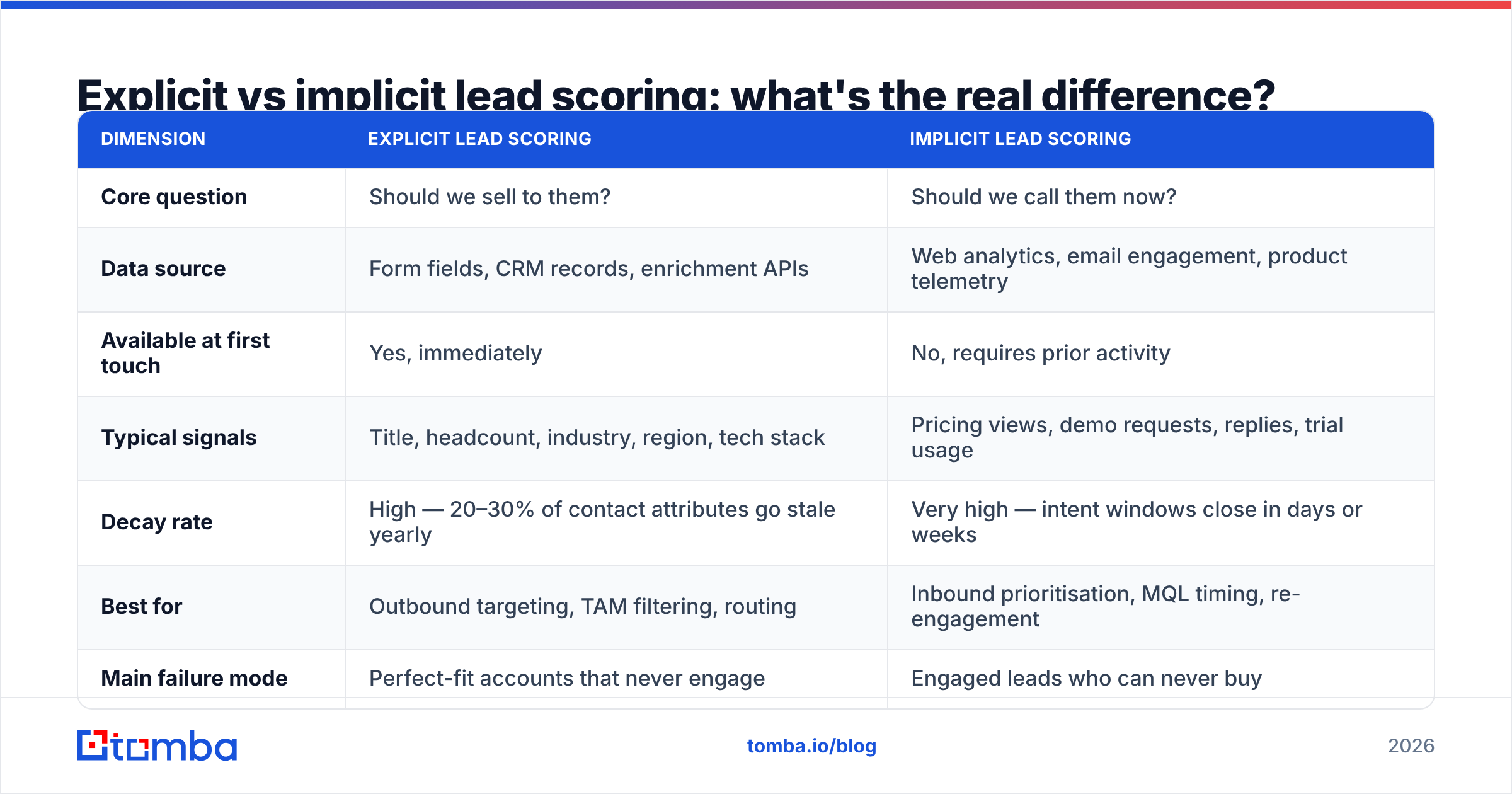
| Dimension | Explicit lead scoring | Implicit lead scoring |
|---|---|---|
| Core question | Should we sell to them? | Should we call them now? |
| Data source | Form fields, CRM records, enrichment APIs | Web analytics, email engagement, product telemetry |
| Available at first touch | Yes, immediately | No, requires prior activity |
| Typical signals | Title, headcount, industry, region, tech stack | Pricing views, demo requests, replies, trial usage |
| Decay rate | High — 20–30% of contact attributes go stale yearly | Very high — intent windows close in days or weeks |
| Best for | Outbound targeting, TAM filtering, routing | Inbound prioritisation, MQL timing, re-engagement |
| Main failure mode | Perfect-fit accounts that never engage | Engaged leads who can never buy |
| Who usually owns it | Marketing ops / RevOps | Marketing automation / growth |
| Gameable by lead? | Yes, via self-reported form fields | Rarely, but bots and competitors inflate it |
Read the table as one sentence: explicit scoring is a filter, implicit scoring is a trigger. Filters don't expire quickly. Triggers do. That difference is why blending them into a single number is usually a mistake.
Is one more accurate than the other?#
Neither, on its own. Accuracy depends on your motion.
If you're inbound-heavy (product-led SaaS, high-traffic content engine, self-serve trial), implicit signals carry more predictive weight. You already have thousands of fitting companies in your funnel; the scarce information is who's in-market this week. Weight behaviour at roughly 60–70% of the total.
If you're outbound-heavy (enterprise ACV, small TAM, low web traffic), explicit dominates by default — you often have zero behavioural data on a target account. Fit is the score. Behaviour becomes a tiebreaker once a sequence starts generating replies.
If you're PLG with a sales-assist layer, product usage beats both. A workspace with 12 active users and an admin who just hit a plan limit outranks every marketing signal you have.
The one universal finding across the G2 and HubSpot practitioner literature is unglamorous: models with fewer, sharper criteria beat models with forty weighted rules. If your scoring doc has more than a dozen inputs, half of them are noise and nobody on the sales team believes the output.
How do you combine explicit and implicit into one model?#
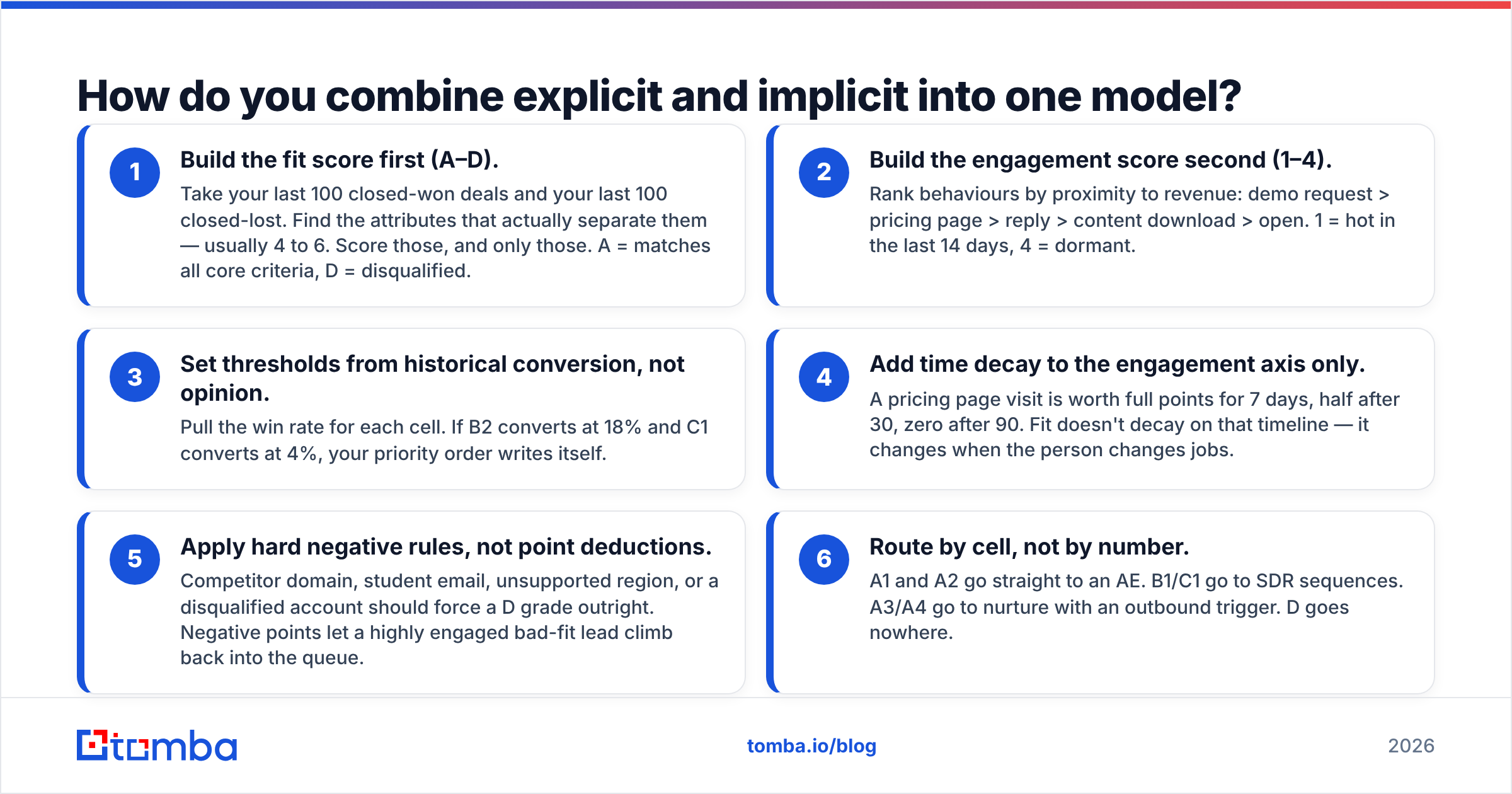
Don't sum them. Grid them. Keep two independent axes and let reps read the intersection.
- Build the fit score first (A–D). Take your last 100 closed-won deals and your last 100 closed-lost. Find the attributes that actually separate them — usually 4 to 6. Score those, and only those. A = matches all core criteria, D = disqualified.
- Build the engagement score second (1–4). Rank behaviours by proximity to revenue: demo request > pricing page > reply > content download > open. 1 = hot in the last 14 days, 4 = dormant.
- Set thresholds from historical conversion, not opinion. Pull the win rate for each cell. If B2 converts at 18% and C1 converts at 4%, your priority order writes itself.
- Add time decay to the engagement axis only. A pricing page visit is worth full points for 7 days, half after 30, zero after 90. Fit doesn't decay on that timeline — it changes when the person changes jobs.
- Apply hard negative rules, not point deductions. Competitor domain, student email, unsupported region, or a disqualified account should force a D grade outright. Negative points let a highly engaged bad-fit lead climb back into the queue.
- Route by cell, not by number. A1 and A2 go straight to an AE. B1/C1 go to SDR sequences. A3/A4 go to nurture with an outbound trigger. D goes nowhere.
This is the same logic behind the classic marketing qualified lead definition, just made two-dimensional so a single blended score can't hide the tradeoff.
What does a working hybrid model look like in practice?#
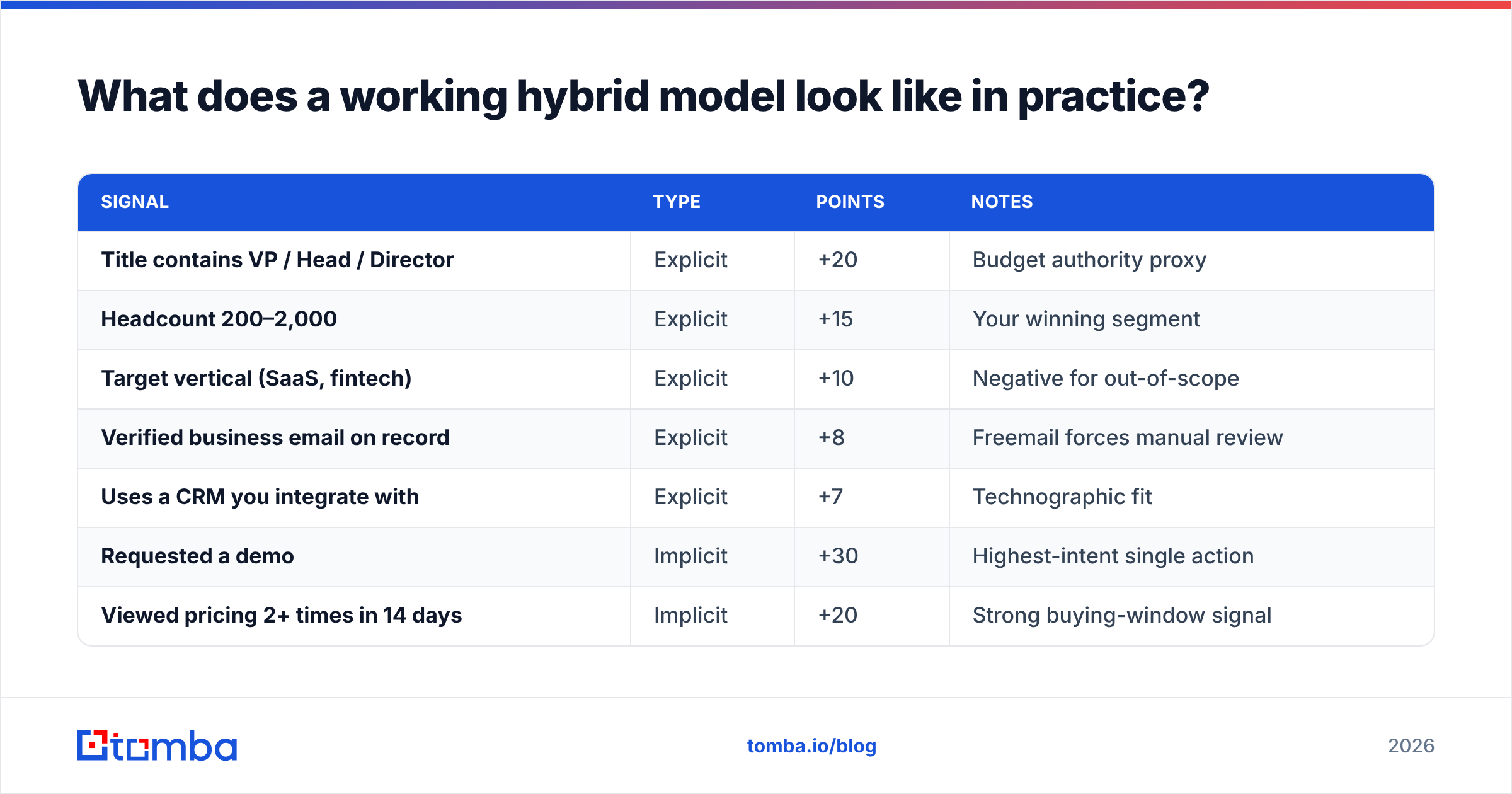
Here's a compact starting matrix for a mid-market B2B SaaS motion. Adjust the weights to your own closed-won data before you ship it.
| Signal | Type | Points | Notes |
|---|---|---|---|
| Title contains VP / Head / Director | Explicit | +20 | Budget authority proxy |
| Headcount 200–2,000 | Explicit | +15 | Your winning segment |
| Target vertical (SaaS, fintech) | Explicit | +10 | Negative for out-of-scope |
| Verified business email on record | Explicit | +8 | Freemail forces manual review |
| Uses a CRM you integrate with | Explicit | +7 | Technographic fit |
| Requested a demo | Implicit | +30 | Highest-intent single action |
| Viewed pricing 2+ times in 14 days | Implicit | +20 | Strong buying-window signal |
| Replied to a cold email | Implicit | +18 | Beats any open metric |
| Downloaded a bottom-funnel asset | Implicit | +10 | ROI calc, security whitepaper |
| Visited careers page | Implicit | −15 | Job seeker, not buyer |
| No activity in 90 days | Implicit | reset to 0 | Decay rule, not a deduction |
| Competitor or student domain | Explicit | disqualify | Hard rule, overrides all points |
Two details do most of the work here. First, replies outrank opens by a wide margin — since open tracking became unreliable, teams that still weight opens heavily are scoring pixel pre-fetches. Second, the disqualify row is a rule, not a score. Anything you'd never sell to should exit the model entirely rather than sit at a low number waiting for enough engagement to resurface.

Where do lead scoring models actually break?#
Rarely in the maths. Almost always in the plumbing.
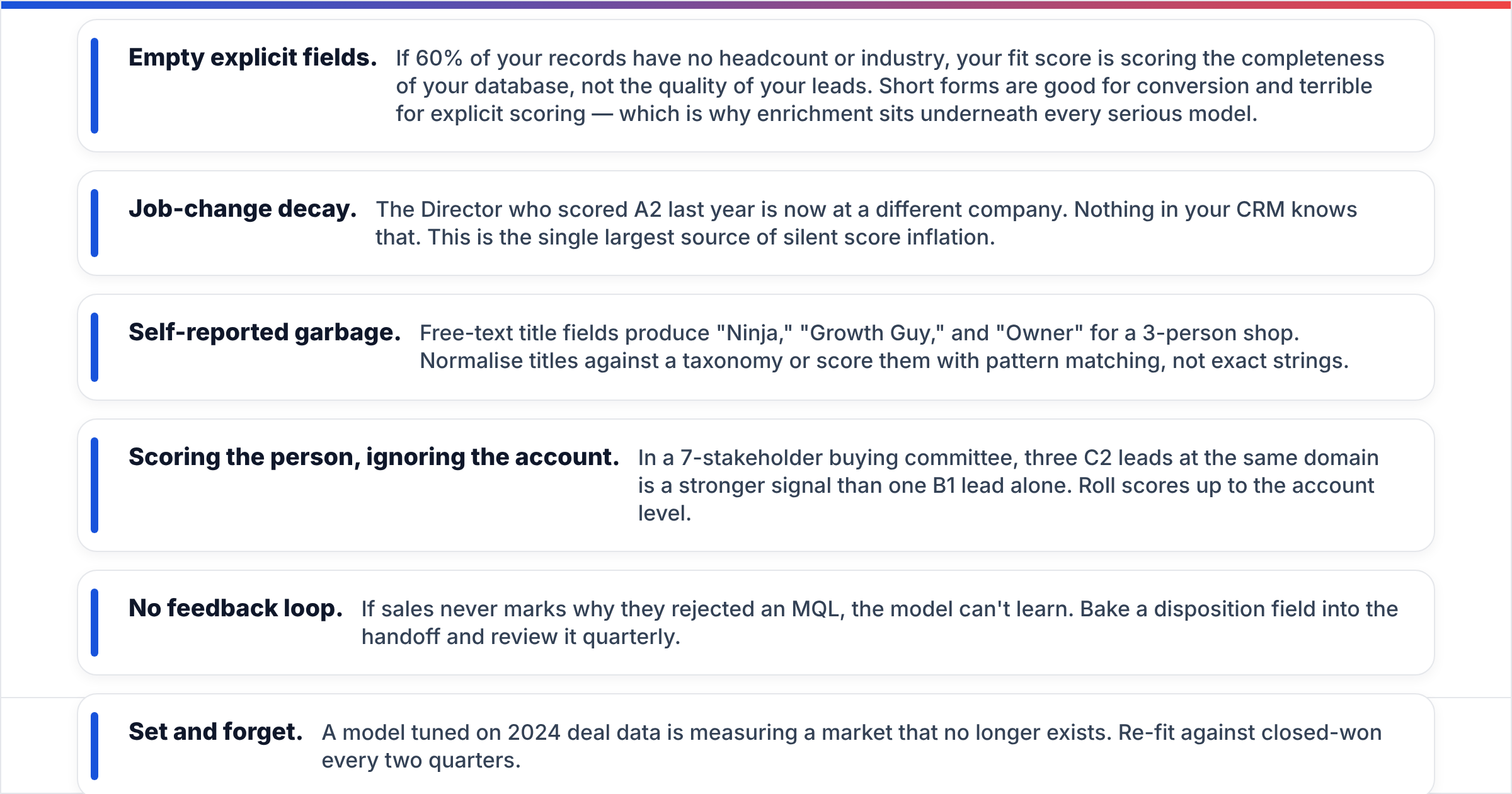
- Empty explicit fields. If 60% of your records have no headcount or industry, your fit score is scoring the completeness of your database, not the quality of your leads. Short forms are good for conversion and terrible for explicit scoring — which is why enrichment sits underneath every serious model.
- Job-change decay. The Director who scored A2 last year is now at a different company. Nothing in your CRM knows that. This is the single largest source of silent score inflation.
- Self-reported garbage. Free-text title fields produce "Ninja," "Growth Guy," and "Owner" for a 3-person shop. Normalise titles against a taxonomy or score them with pattern matching, not exact strings.
- Scoring the person, ignoring the account. In a 7-stakeholder buying committee, three C2 leads at the same domain is a stronger signal than one B1 lead alone. Roll scores up to the account level.
- No feedback loop. If sales never marks why they rejected an MQL, the model can't learn. Bake a disposition field into the handoff and review it quarterly.
- Set and forget. A model tuned on 2024 deal data is measuring a market that no longer exists. Re-fit against closed-won every two quarters.
The fix for the first three is the same: enrich the record instead of asking the lead for it. Cutting your form from nine fields to three and filling the rest from a data enrichment call raises conversion and improves explicit scoring at the same time. You get verified headcount, industry, and normalised title without asking anyone to type them.
Should you just use AI predictive scoring instead?#
Eventually, maybe. Not first.
Predictive scoring — the kind bundled into Salesforce Einstein, HubSpot's predictive tiers, and most modern RevOps platforms — trains a model on your historical outcomes and finds correlations a human wouldn't write as rules. It works well, with three preconditions:
- Volume. Most vendors want a few thousand scored records and several hundred closed-won deals. Below that, the model overfits to noise.
- Clean labels. If your "closed-won" flag includes renewals, pilots, and internal test deals, the model learns your CRM hygiene, not your buyers.
- Complete features. Predictive models degrade hard on sparse firmographics. Same enrichment dependency as rules-based scoring, just less visible.
There's also an adoption cost. Rules-based scoring is explainable to a skeptical AE in one sentence. A predictive score is a black box, and black boxes lose arguments with quota-carrying reps. Most teams should run a transparent hybrid grid for two to four quarters, accumulate clean outcome data, and only then layer prediction on top of it.
How do you keep the explicit half of the score accurate?#
Treat firmographic data as a maintained asset, not a one-time import.
- Enrich at capture. Fire an enrichment call the moment a form is submitted or a contact is created, so the record is complete before it ever hits a scoring rule.
- Verify the email before scoring the lead. A record you can't reach isn't a lead. Running your list through an email verifier removes the invalid and role-based addresses that inflate MQL counts without producing conversations.
- Re-verify on a schedule. Quarterly for your active pipeline, semi-annually for nurture. Job-change churn is why a score from 14 months ago means very little.
- Backfill outbound targets before you score them. For accounts with zero inbound history, explicit data is the entire model. Pulling verified contacts by domain through domain search gives you the titles and patterns you need to grade fit before the first touch.
- Deduplicate before rollup. Account-level scores break when three variants of the same company exist as separate records.
None of this is exciting work. It's also the difference between a scoring model your sales team routes off and a scoring model your sales team ignores.
The short answer#
Explicit lead scoring tells you whether a lead is worth selling to. Implicit lead scoring tells you whether now is the moment. Running one without the other guarantees a specific, predictable failure: wasted reps chasing perfect-fit ghosts, or wasted reps chasing engaged tire-kickers. Build both axes, keep them separate, route on the intersection, and re-fit against closed-won data every couple of quarters.
Then fix the data underneath it, because a scoring model built on 40% empty fields is just an elaborate coin flip.
Start with the explicit half. If your CRM is missing verified emails, titles, or company data on the records you're trying to grade, the Tomba Email Finder fills those gaps by domain, name, or company — with verification built in, so the contacts feeding your fit score are real. The free tier covers 25 searches a month for testing your model against a sample; paid plans start at $49/mo on Tomba pricing when you're ready to enrich the whole database.
Related guides#
Ready to find emails that actually work?
Join 150,000+ professionals who stopped guessing and started sending. Free credits on signup — no credit card required.
Get the Tomba newsletter
Practical outbound tactics and product updates — once every two weeks.
About the author