Extruct AI vs Jet Leads Pro: Which B2B Data Tool Wins?
One tool researches companies with AI agents, the other builds lead lists fast. Here is how Extruct AI and Jet Leads Pro actually differ on data, pricing, and workflow fit — plus where a dedicated email layer beats both.
TL;DR
- Extruct AI is an AI research agent for companies: you describe the kind of account you want, it crawls public sources and returns structured company data with citations. It is strongest at finding and qualifying accounts.
- Jet Leads Pro sits in the classic list-building bucket: search a database, filter, export contacts. It is strongest at volume and speed once you already know your ICP.
- Neither category solves the same problem. Account research answers "who should I talk to?"; list tools answer "how do I reach 5,000 of them by Friday?"
- Both leave the same gap: contact-level accuracy. Company data ages slowly; people data ages fast. Budget for a dedicated finder and verifier either way.
- If you only buy one thing this quarter, buy the layer that touches deliverability. Bad emails cost you domain reputation, and no amount of AI research fixes a burned sending domain.
What is Extruct AI, and what problem does it actually solve?#
Extruct AI is an agentic company-research platform. Instead of querying a static database with checkbox filters, you write a prompt — "Series A fintechs in the EU that publish an API and hired a compliance lead in the last six months" — and the agent goes out to the live web, pulls evidence from company sites, job boards, news, and filings, then returns a table with a column per attribute and a source link per cell.
That distinction matters more than the marketing copy suggests. Traditional B2B databases answer questions somebody anticipated when the schema was designed: industry, headcount, revenue band, tech stack. Agentic research answers questions nobody anticipated: "does this company run a partner program?", "did they mention SOC 2 on their trust page?", "is their pricing usage-based?" Those are the attributes that make a cold email land, because they let you write a first line that could only apply to one account.
The trade-offs are real, and you should price them in:
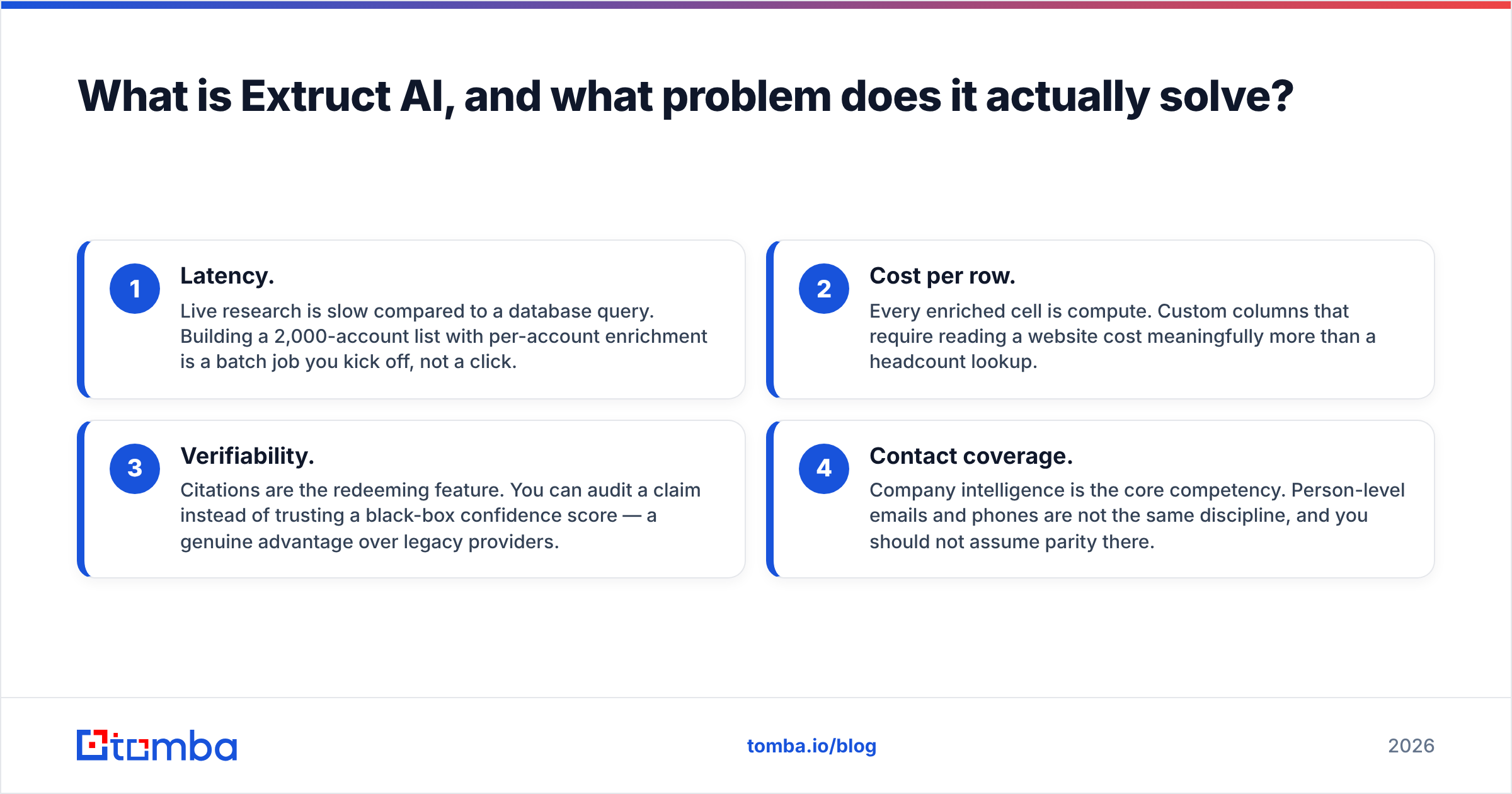
- Latency. Live research is slow compared to a database query. Building a 2,000-account list with per-account enrichment is a batch job you kick off, not a click.
- Cost per row. Every enriched cell is compute. Custom columns that require reading a website cost meaningfully more than a headcount lookup.
- Verifiability. Citations are the redeeming feature. You can audit a claim instead of trusting a black-box confidence score — a genuine advantage over legacy providers.
- Contact coverage. Company intelligence is the core competency. Person-level emails and phones are not the same discipline, and you should not assume parity there.
You can see the current product scope on the Extruct AI site directly; the category is moving fast enough that any screenshot in a blog post is stale within a quarter.

What is Jet Leads Pro, and who is it built for?#
Jet Leads Pro belongs to the list-building and contact-export family — the same shelf as dozens of tools that wrap a B2B contact database in filters and a CSV button. The pitch is throughput: pick a title, pick a geography, pick a company size, export.
Be careful with the research here. Tools in this bracket often publish thin documentation, change pricing without a changelog, and license data from the same handful of upstream aggregators as their competitors. Before you commit budget, do three things:
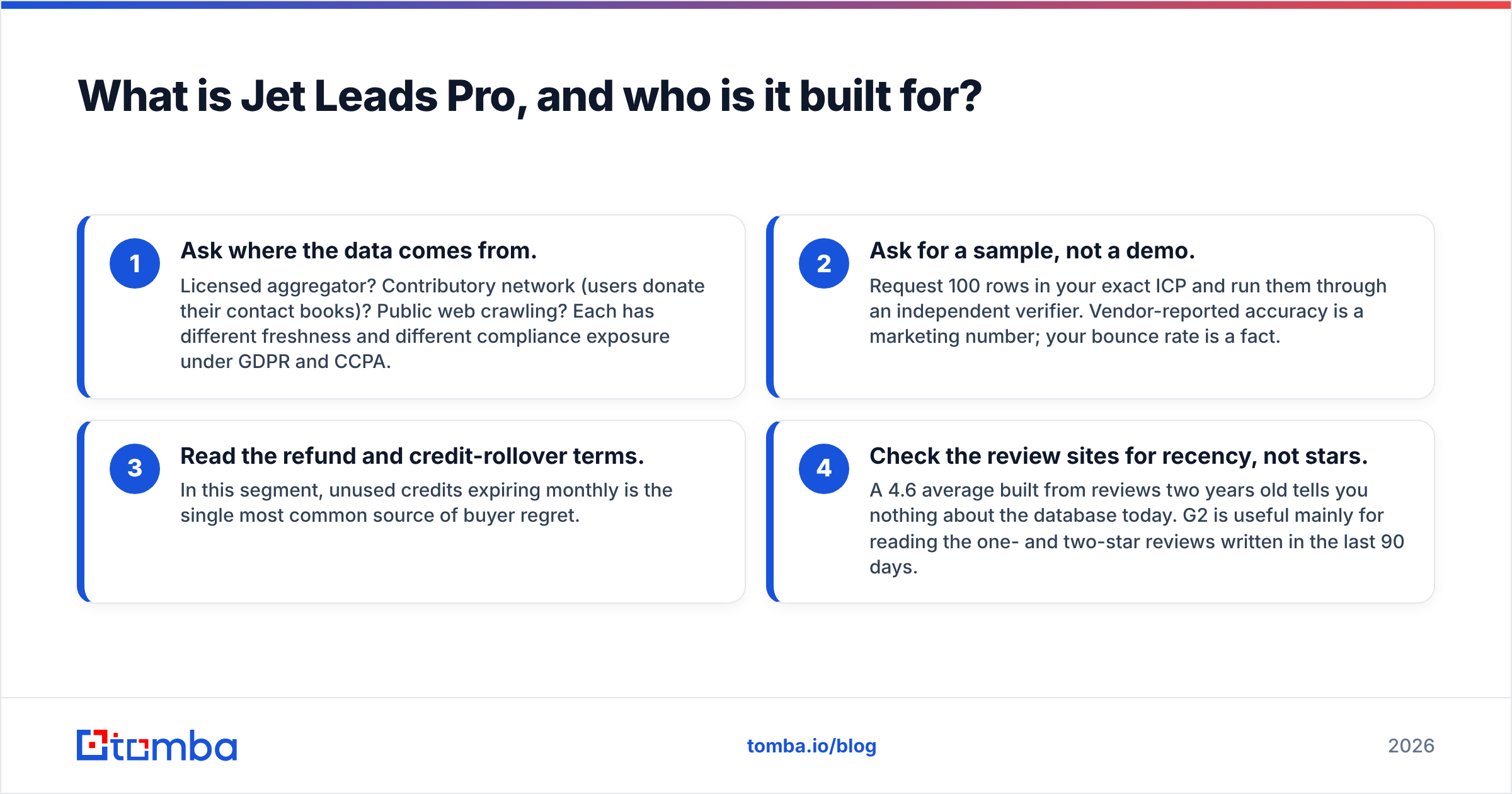
- Ask where the data comes from. Licensed aggregator? Contributory network (users donate their contact books)? Public web crawling? Each has different freshness and different compliance exposure under GDPR and CCPA.
- Ask for a sample, not a demo. Request 100 rows in your exact ICP and run them through an independent verifier. Vendor-reported accuracy is a marketing number; your bounce rate is a fact.
- Read the refund and credit-rollover terms. In this segment, unused credits expiring monthly is the single most common source of buyer regret.
- Check the review sites for recency, not stars. A 4.6 average built from reviews two years old tells you nothing about the database today. G2 is useful mainly for reading the one- and two-star reviews written in the last 90 days.
None of this is a knock on Jet Leads Pro specifically. It is the standard diligence for any tool in the segment, and the vendors that pass it cleanly deserve credit for it.
Extruct AI vs Jet Leads Pro: how do they compare head to head?#
Here is the honest structural comparison. Where a vendor does not publish a hard number, this table says so rather than inventing one — check the vendor's own pricing page before you sign anything.
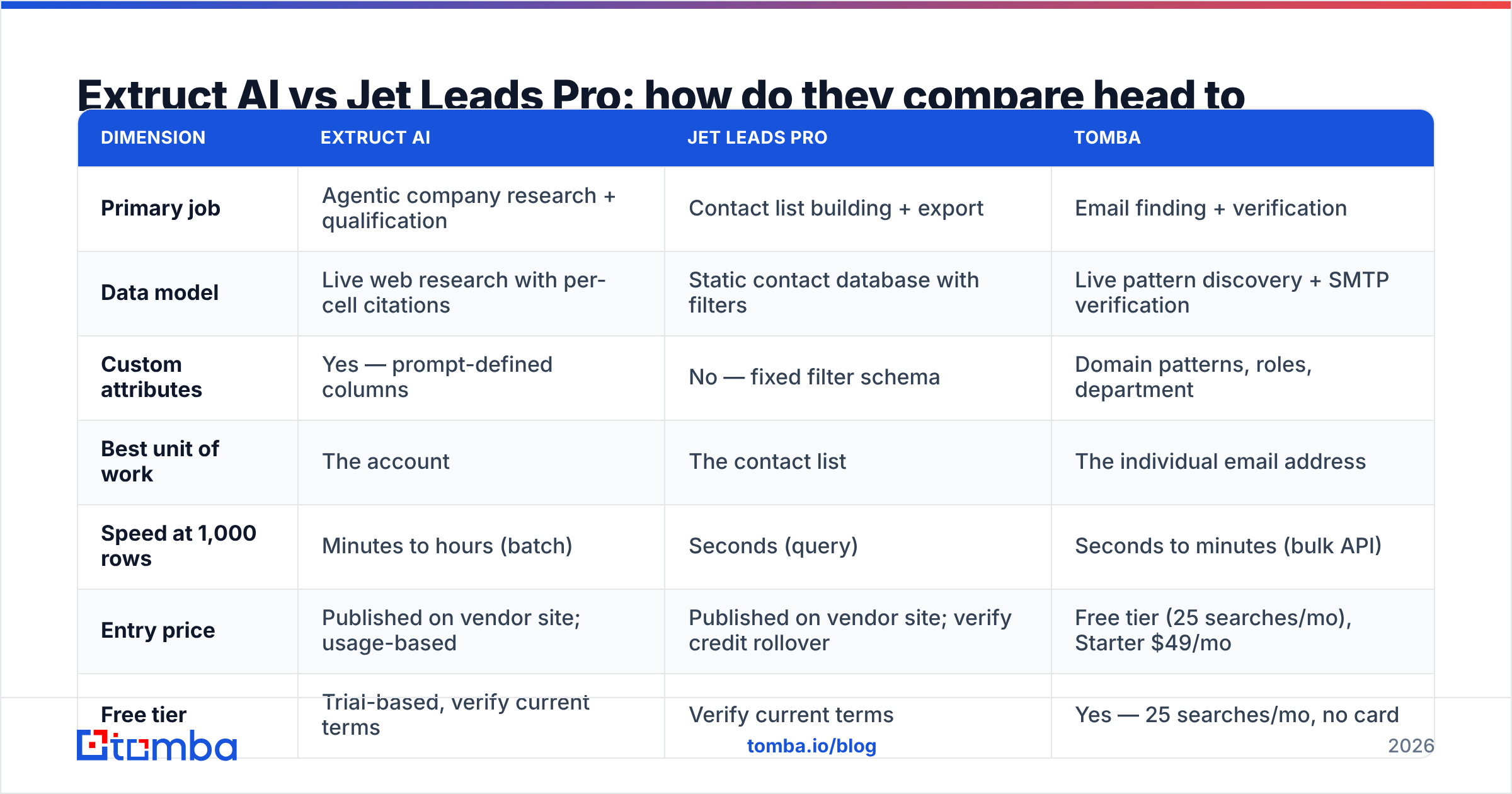
| Dimension | Extruct AI | Jet Leads Pro | Tomba |
|---|---|---|---|
| Primary job | Agentic company research + qualification | Contact list building + export | Email finding + verification |
| Data model | Live web research with per-cell citations | Static contact database with filters | Live pattern discovery + SMTP verification |
| Custom attributes | Yes — prompt-defined columns | No — fixed filter schema | Domain patterns, roles, department |
| Best unit of work | The account | The contact list | The individual email address |
| Speed at 1,000 rows | Minutes to hours (batch) | Seconds (query) | Seconds to minutes (bulk API) |
| Entry price | Published on vendor site; usage-based | Published on vendor site; verify credit rollover | Free tier (25 searches/mo), Starter $49/mo |
| Free tier | Trial-based, verify current terms | Verify current terms | Yes — 25 searches/mo, no card |
| API access | Yes | Verify tier availability | Yes on all paid plans |
| Verification included | Not the core product | Typically basic or none | Core product |
| Where it breaks down | Cost per enriched cell at scale | Data freshness on job changes | Not an account-research engine |
Read the table as three different purchases, not three competitors. The row that decides most deals is "best unit of work." If your GTM motion is 200 named accounts and a researcher writing bespoke sequences, agentic research is the higher-leverage buy. If your motion is 8,000 sends a month at a 1.5% reply rate, throughput wins and you optimise for cost per usable contact.
Which one fits your go-to-market motion?#
Use these five signals to pick without a three-week bake-off:
- Deal size above $25k ACV → lean Extruct AI. Research depth pays for itself when one closed deal covers a year of tooling. Per-account cost is irrelevant at that contract value.
- Deal size under $5k ACV → lean list-building. You need volume economics, and per-row research costs will eat the unit margin on a self-serve motion.
- Your ICP is defined by behaviour, not firmographics ("companies that just launched a marketplace", "teams hiring their first RevOps lead") → agentic research is the only thing that answers the question at all.
- Your ICP is a standard filter ("VP Marketing, 200-1000 employees, SaaS, US") → a database tool does this in one query and you should not pay research prices for it.
- You already have the account list and just need contacts → skip both categories and buy a dedicated finder. This is the most common situation and the most commonly over-solved one.
That fifth case is worth dwelling on. A large share of teams evaluating "Extruct AI vs Jet Leads Pro" already know exactly which 400 companies they want. They do not need an account discovery engine or a database subscription — they need working email addresses for named people at known domains, which is a narrower and cheaper problem.
Where do both tools leave a gap?#
Contact-level freshness. Roughly 25-30% of B2B contact records decay per year through job changes, rebrands, and domain migrations, and the decay is concentrated exactly where you care: senior titles at growing companies. That is why lead generation programs that look healthy on paper post 8% bounce rates in production.
Three failure modes show up repeatedly:
- The exported email is a pattern guess. Many databases store
first.last@domain.combecause that is the company's dominant pattern, not because that mailbox was ever confirmed to exist. It bounces, and the bounce is charged against your domain. - The domain is catch-all. Catch-all servers accept everything, so naive verification returns "valid" for addresses that route straight to a black hole — or worse, to a spam trap. You need a catch-all verifier that scores risk rather than a binary check.
- The record is real but the person left. No verifier catches this. Only recency of the underlying source does, which is why "when was this row last confirmed?" is a better vendor question than "what is your accuracy percentage?"

How should you build the stack instead of picking a winner?#
Treat it as three layers, and buy the cheapest adequate option at each:
- Account layer — who is worth contacting. Agentic research (Extruct AI) if your targeting is non-obvious; a firmographic database if it is standard; your own CRM and closed-lost list if you are honest about how many accounts you already own.
- Contact layer — who at that account, and what is their address. This is where a dedicated email finder does the work, and where domain search turns a company URL into every discoverable mailbox and pattern at that domain.
- Hygiene layer — will this send land. An email verifier run immediately before the send, not at export time. Lists verified six weeks ago are not verified lists.
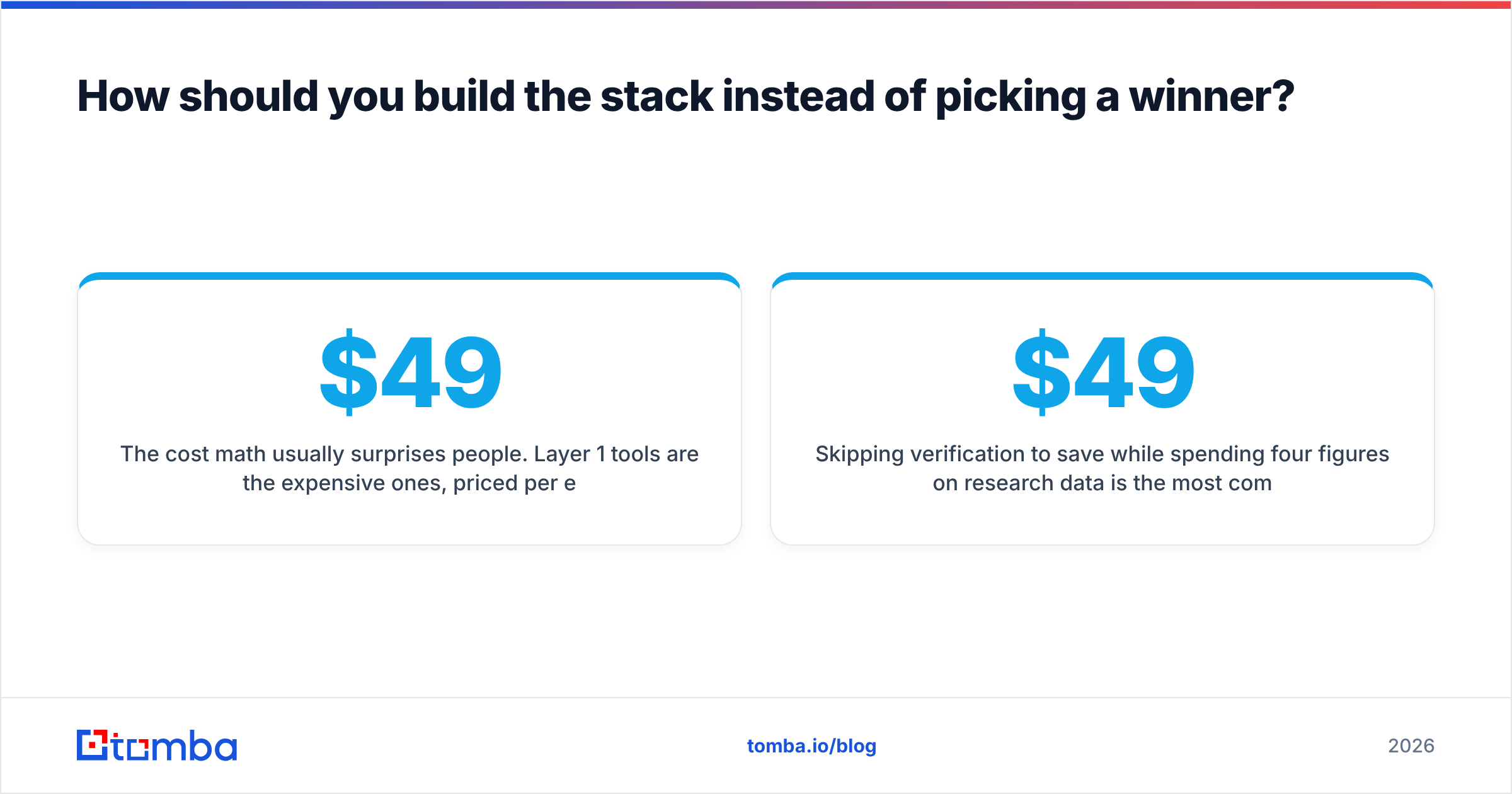
The cost math usually surprises people. Layer 1 tools are the expensive ones, priced per enriched account. Layer 3 tools are the cheap ones — Tomba pricing starts free at 25 searches a month, with Starter at $49/mo, Growth at $99/mo, and Pro at $249/mo — and yet layer 3 has the highest marginal impact on reply rate, because it is the only layer that protects deliverability.
Skipping verification to save $49 while spending four figures on research data is the most common budgeting mistake in this stack. A 10% bounce rate does not cost you 10% of your pipeline; it costs you inbox placement for the other 90%.
What should you actually do this week?#
Run a controlled test instead of reading more comparison pages:
- Pull 100 accounts from your real ICP.
- Run them through whichever account tool you are evaluating on a trial.
- Take the resulting company domains and run bulk email finding against them for your target titles.
- Verify every result, send to a 50-address subset, and record bounce rate, open rate, and reply rate separately.
- Compare cost per replied contact — not cost per row, not cost per credit. Cost per row is the number vendors optimise for; cost per reply is the number your board asks about.
If bounce rate is above 3%, your problem is the contact and hygiene layers, and no amount of account research will fix it. If bounce rate is clean but reply rate is under 1%, your problem is targeting or copy, and that is where an agentic research tool genuinely earns its price.
The verdict#
There is no single winner, because these tools are not solving the same problem. Extruct AI wins when your differentiation comes from knowing something specific about an account before you write the first line. Jet Leads Pro and its category win when your differentiation comes from volume executed cleanly. Both are reasonable purchases for the right motion, and both are expensive mistakes for the wrong one.
What is not optional in either scenario is the contact layer underneath. Whichever account tool you pick, you will end up holding a list of domains and names that still needs a real, verified mailbox attached to it.
Start there. Tomba's Email Finder turns a name and domain into a verified professional address, with a free tier of 25 searches a month so you can benchmark it against whatever your current provider exports — before you renew anything. Run 50 of your existing records through it, compare bounce rates, and let the numbers decide the rest of your stack.
Related guides#
Ready to find emails that actually work?
Join 150,000+ professionals who stopped guessing and started sending. Free credits on signup — no credit card required.
Get the Tomba newsletter
Practical outbound tactics and product updates — once every two weeks.
About the author