Extruct AI vs Kaspr: Which B2B Data Tool Wins in 2026?
Extruct AI researches companies with AI agents. Kaspr pulls mobile numbers off LinkedIn. They solve different halves of the same pipeline problem. Here is which one your team actually needs, and where a dedicated email finder beats both.
TL;DR
- They are not actually competitors. Extruct AI is an AI research agent that builds and enriches company lists. Kaspr is a LinkedIn-first contact data tool that surfaces people's mobile numbers and emails. Comparing them head-to-head only makes sense because both get pitched as "GTM data."
- Pick Extruct AI if your bottleneck is account selection: you need to find, score, and qualify companies against fuzzy criteria that no static firmographic filter can express.
- Pick Kaspr if your bottleneck is reaching a named human: you already know who to call, and you need their direct dial today.
- Neither is a complete prospecting stack. Extruct gives you accounts with no contacts. Kaspr gives you contacts one LinkedIn profile at a time. Most teams end up bolting a dedicated email finder onto whichever one they buy.
- Budget reality: both sit in the $50–$150 per-user-per-month band once you leave the free tier, and both meter usage in credits. Read the credit definitions before you sign anything.
What is Extruct AI, and what problem does it solve?#
Extruct AI is an AI research agent for company data. Instead of filtering a fixed database by industry code and headcount, you describe the kind of company you want in plain language, and its agents go out, read websites, filings, job boards, and news, then return a structured table.
The unlock is the custom column. You can ask questions a traditional B2B database has no field for: "Does this company run a partner program?", "Are they hiring a RevOps lead right now?", "Do they use Shopify Plus?" Extruct's agents research each row and fill the answer with a citation, which means you can audit the output instead of trusting a black box.
That makes it a genuinely different category from the ZoomInfo/Apollo lineage. Those tools ship you a snapshot of a database. Extruct ships you a researcher that builds the snapshot on demand. The trade-off is speed and cost per row: agentic research takes seconds to minutes per company, not milliseconds, and you pay for the compute.
What Extruct does not do well is people. It is account-level by design. You finish a run with 400 beautifully qualified companies and zero email addresses.

What is Kaspr, and where does it fit?#
Kaspr sits at the opposite end of the funnel. It is a Chrome extension that overlays LinkedIn, LinkedIn Sales Navigator, and Recruiter, and reveals a prospect's phone number and email while you are looking at their profile. It was acquired by Cognism in 2022, which gave it a serious European data backbone and a compliance story that matters if you sell into the EU.
Kaspr's reputation is built on mobile numbers, particularly in France, the UK, DACH, and the Benelux region. If your motion is cold calling and your SDRs live inside Sales Navigator, that workflow is hard to beat: open profile, click, get a dial, log the activity.
Its constraints are equally clear:
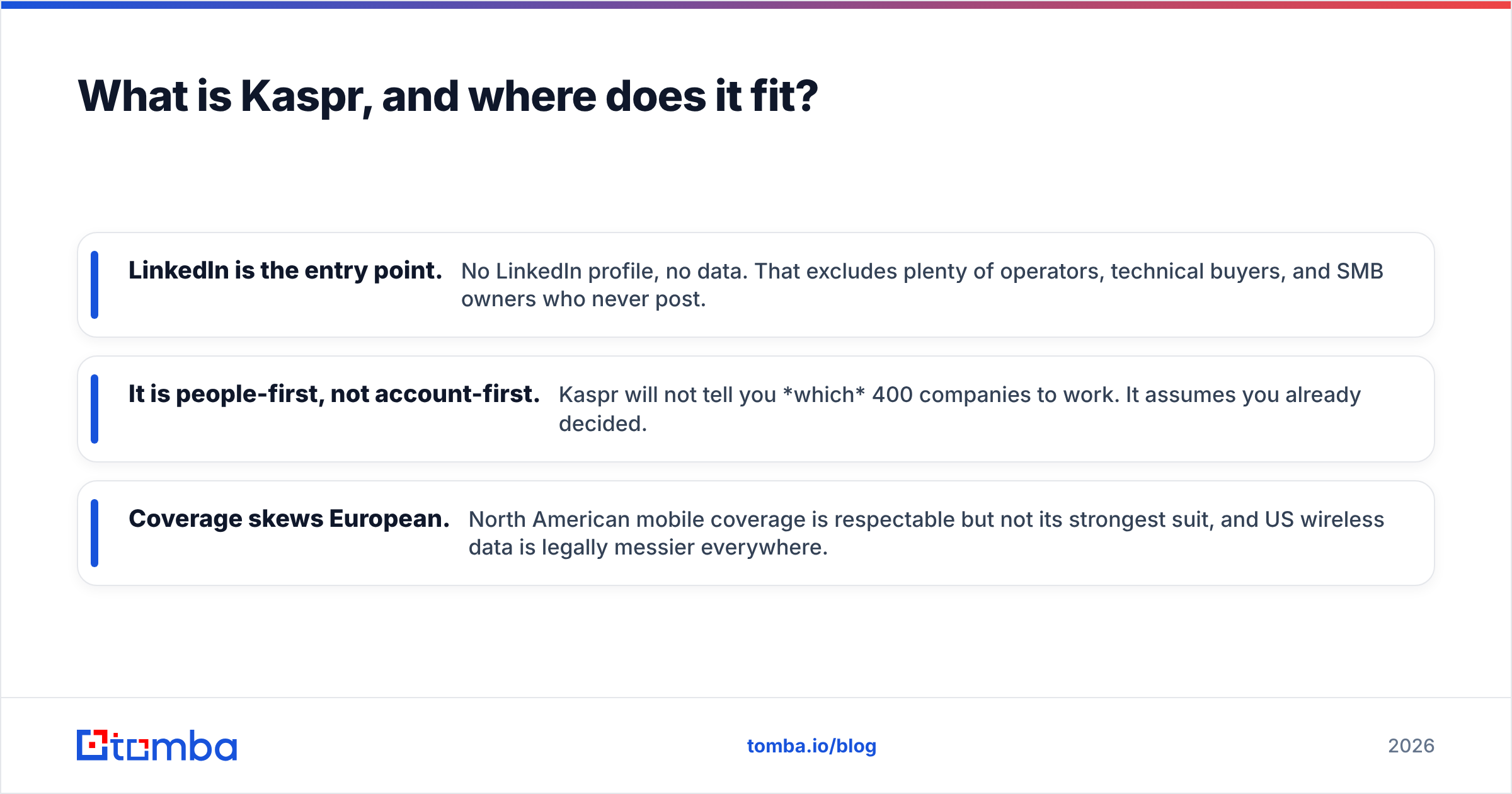
- LinkedIn is the entry point. No LinkedIn profile, no data. That excludes plenty of operators, technical buyers, and SMB owners who never post.
- It is people-first, not account-first. Kaspr will not tell you which 400 companies to work. It assumes you already decided.
- Coverage skews European. North American mobile coverage is respectable but not its strongest suit, and US wireless data is legally messier everywhere.
You can read Kaspr's own positioning on kaspr.io and cross-check the review distribution on G2, which is where the phone-accuracy complaints and praise both cluster.
How do Extruct AI and Kaspr compare head-to-head?#
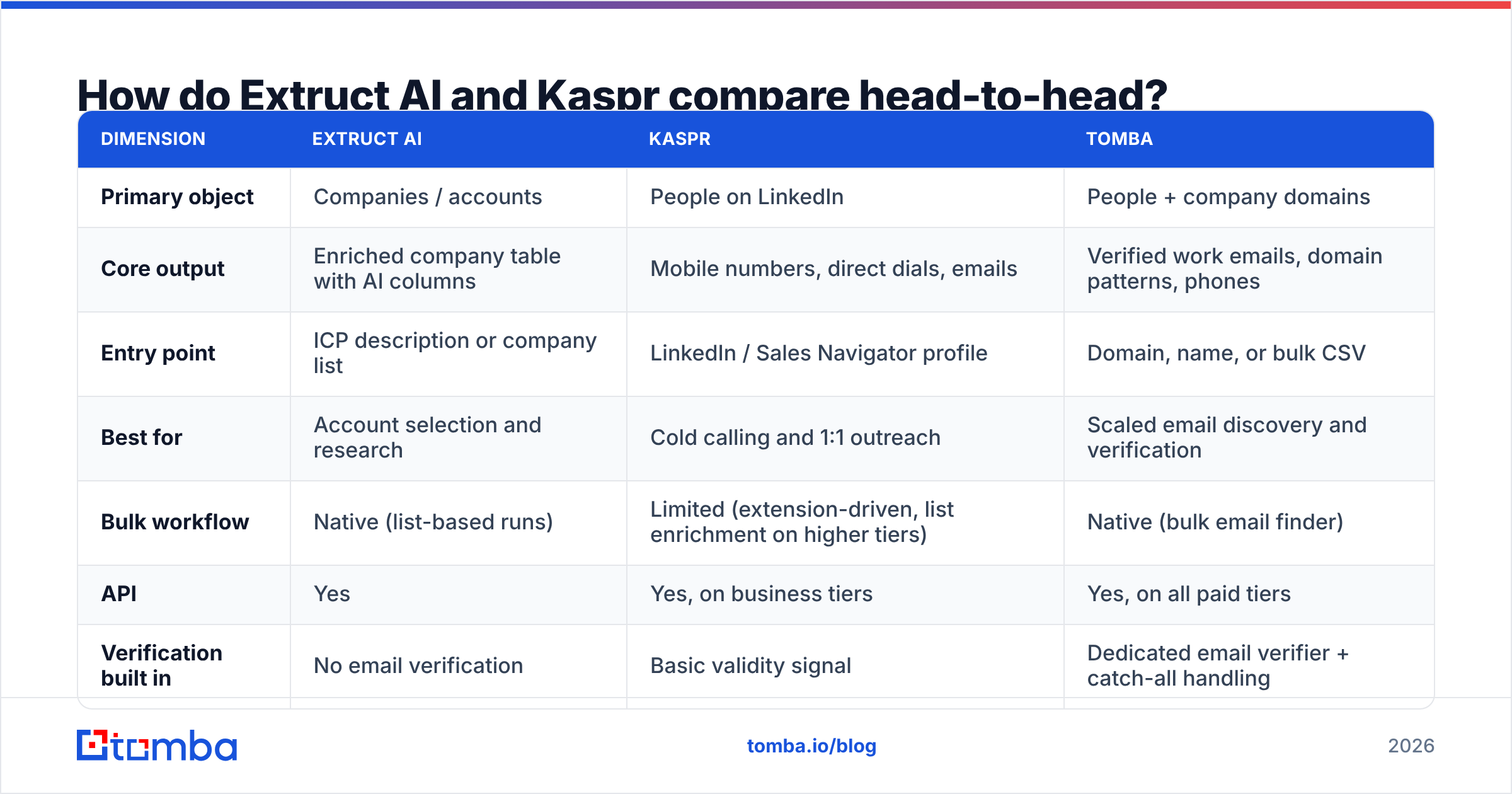
| Dimension | Extruct AI | Kaspr | Tomba |
|---|---|---|---|
| Primary object | Companies / accounts | People on LinkedIn | People + company domains |
| Core output | Enriched company table with AI columns | Mobile numbers, direct dials, emails | Verified work emails, domain patterns, phones |
| Entry point | ICP description or company list | LinkedIn / Sales Navigator profile | Domain, name, or bulk CSV |
| Best for | Account selection and research | Cold calling and 1:1 outreach | Scaled email discovery and verification |
| Bulk workflow | Native (list-based runs) | Limited (extension-driven, list enrichment on higher tiers) | Native (bulk email finder) |
| API | Yes | Yes, on business tiers | Yes, on all paid tiers |
| Verification built in | No email verification | Basic validity signal | Dedicated email verifier + catch-all handling |
| Free tier | Limited trial credits | Free plan with a small monthly credit allowance | 25 searches/month |
| Geographic strength | Global (web-sourced) | Europe-first, strong FR/UK/DACH | Global, domain-driven |
The important read on that table is not "who wins" — it is that the three columns barely overlap. Extruct answers which companies. Kaspr answers this person's number. An email finder answers how do I reach 400 of them by Tuesday.
What does each one actually cost in 2026?#
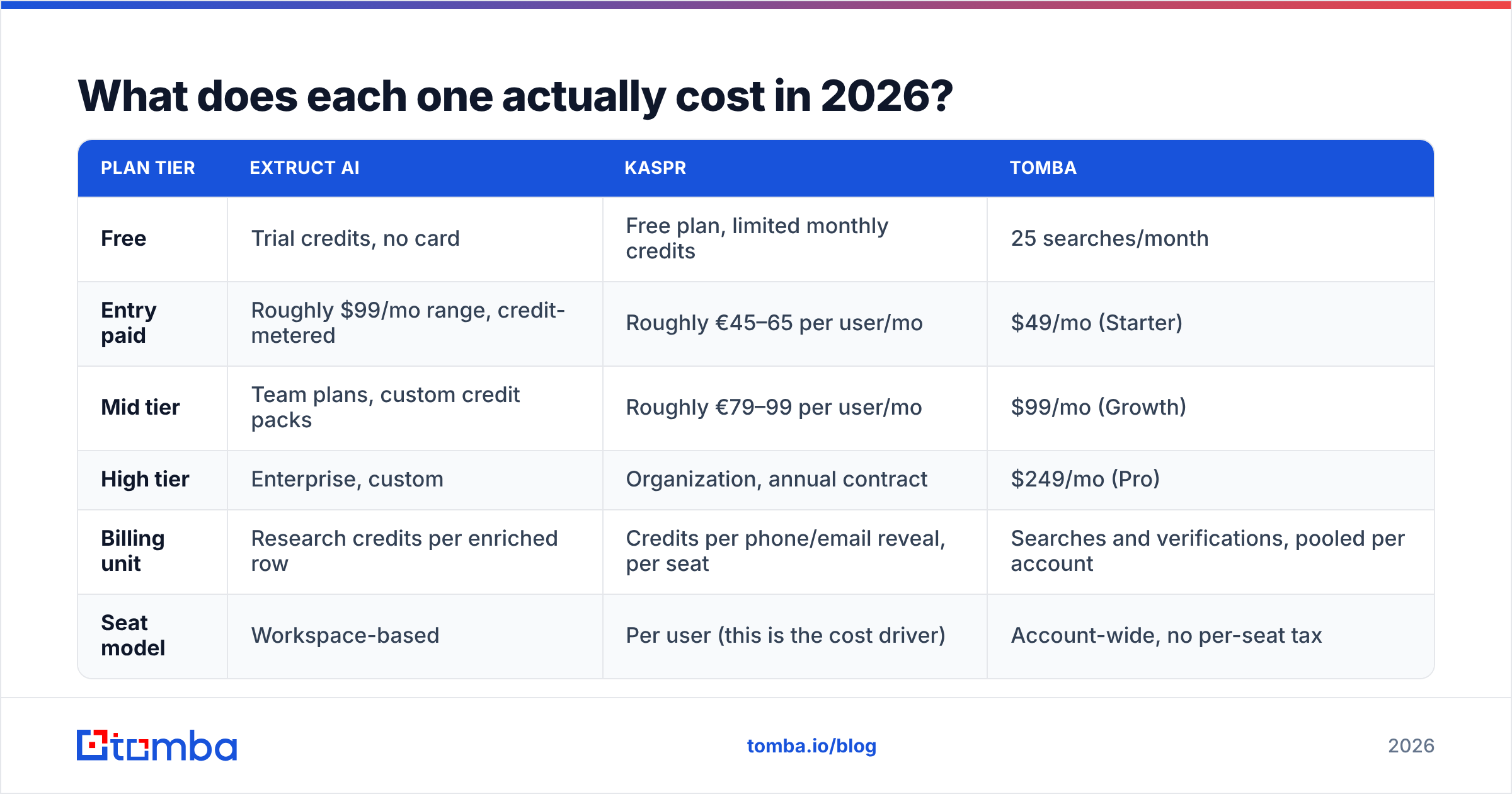
Pricing on both platforms moves, and both use credit metering that makes headline prices misleading. Treat the numbers below as a shape, not a quote, and confirm on the vendor's own page before you budget.
| Plan tier | Extruct AI | Kaspr | Tomba |
|---|---|---|---|
| Free | Trial credits, no card | Free plan, limited monthly credits | 25 searches/month |
| Entry paid | Roughly $99/mo range, credit-metered | Roughly €45–65 per user/mo | $49/mo (Starter) |
| Mid tier | Team plans, custom credit packs | Roughly €79–99 per user/mo | $99/mo (Growth) |
| High tier | Enterprise, custom | Organization, annual contract | $249/mo (Pro) |
| Billing unit | Research credits per enriched row | Credits per phone/email reveal, per seat | Searches and verifications, pooled per account |
| Seat model | Workspace-based | Per user (this is the cost driver) | Account-wide, no per-seat tax |
Three cost traps to watch:
- Per-seat multiplication. Kaspr's per-user model means a five-SDR team at €79 is €395/month before anyone finds a single account to call. Tools that pool credits at the account level, like Tomba's plans, scale differently.
- Credit definition drift. On Extruct, one "credit" can mean one AI column on one company, so a 500-row list with six custom columns is 3,000 credits, not 500.
- Failed lookups. Ask every vendor explicitly whether a reveal that returns nothing still burns a credit. The answers vary, and it changes effective cost per usable record by 20–40%.
Which one has better data quality?#
Wrong question — they are measuring different things, so there is no shared benchmark.
Kaspr's quality question is: is this the right person's current mobile? Its data comes largely from a contributory network plus licensed sources, which means freshness is excellent for actively-worked profiles and patchier for people nobody has looked up in two years. Expect strong hit rates in Europe, mixed results for US mobile, and a meaningful bounce rate on emails, because a phone-first provider's email records are usually a secondary asset.
Extruct's quality question is: is this AI-generated answer correct? Because the agents cite sources, you can spot-check, and you should. Agentic research is very good at "does this site mention SOC 2" and much weaker at anything requiring judgement about private companies with thin web footprints. Budget a manual QA pass on 10% of every list until you trust a given prompt.
The practical implication for outbound: verify everything before you send. Whatever provider hands you an email, run it through a real verification pass. A 6% bounce rate on a cold domain will damage your sender reputation faster than any subject line can repair it. That is why a lot of teams run Extruct or Kaspr for discovery and a separate verification layer before the sequencer.
When should you pick Extruct AI?#
Choose Extruct when your list-building is the constraint, not your contact data. Specific signals:
- Your ICP is not expressible in filters. "Mid-market logistics companies that just opened a US entity and run their own fleet" is an Extruct problem, not a database problem.
- You run account-based motions. ABM programs live or die on account selection quality, and 200 correct accounts beat 20,000 filtered ones.
- You need research columns in the CRM. Feeding AI-researched attributes into scoring is genuinely useful for lead management and scoring workflows.
- You already have contact data. If your team has Cognism, Apollo, or a solid B2B database, Extruct slots in cleanly above it.
Skip Extruct if you are a two-person team that just needs 500 emails this month. It is a research layer, and research layers only pay off when the downstream execution is already working.
When should you pick Kaspr?#
Choose Kaspr when the phone is your primary channel and Europe is your primary market:
- Cold calling is a real motion, not a checkbox. Kaspr's mobile coverage is the whole value proposition.
- Your reps work inside Sales Navigator all day. The extension's workflow friction is close to zero, which matters more than feature lists for daily adoption.
- You sell into France, UK, DACH, or Benelux. This is where Kaspr consistently outperforms US-centric providers.
- GDPR posture matters to your legal team. Kaspr publishes a clear compliance stance and handles notification obligations, which is not universal in this category.
Skip Kaspr if you need bulk lists, if your buyers are not active on LinkedIn, or if per-seat pricing across a large team blows your budget. Also skip it if email — not phone — is 90% of your outreach; you would be paying a phone premium for a secondary dataset.
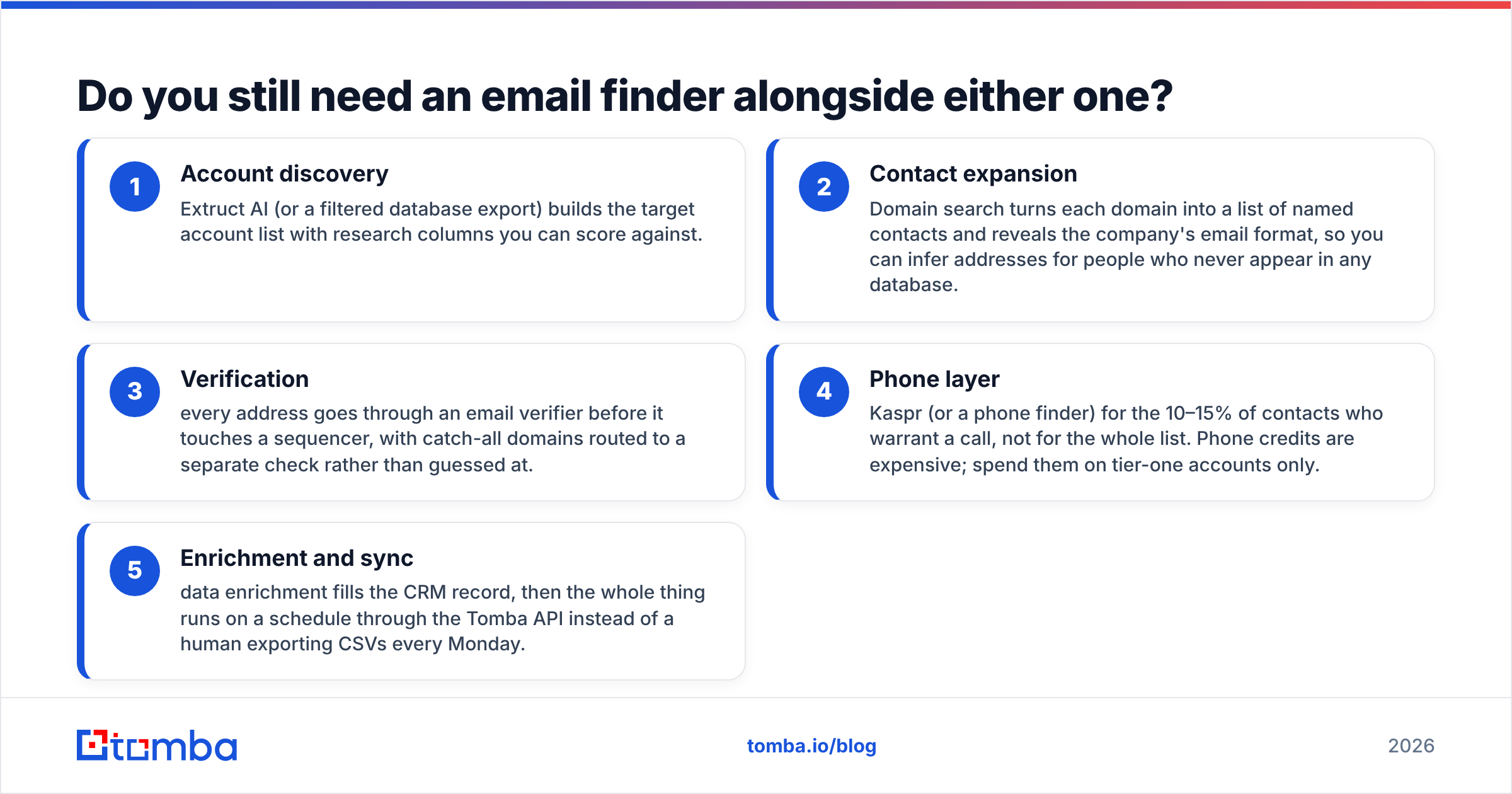
Do you still need an email finder alongside either one?#
Almost certainly yes, and this is the part most comparison posts skip.
Run the workflow end to end. Extruct hands you 400 qualified accounts with domains. Now you need three named contacts at each, with verified work emails. Extruct does not do that. So you either export to another tool or you do it manually.
Now run it the other way. Kaspr gives you Anna's mobile and one email. You want the other four people on her buying committee, plus the generic ops alias. Kaspr wants you to open four more LinkedIn profiles and spend four more credits — and only if all four have profiles.
A domain-driven email finder closes both gaps in one step. Give it a domain, get every discoverable mailbox with confidence scores and the company's email pattern. Here is what a realistic 2026 stack looks like:
- Account discovery — Extruct AI (or a filtered database export) builds the target account list with research columns you can score against.
- Contact expansion — Domain search turns each domain into a list of named contacts and reveals the company's email format, so you can infer addresses for people who never appear in any database.
- Verification — every address goes through an email verifier before it touches a sequencer, with catch-all domains routed to a separate check rather than guessed at.
- Phone layer — Kaspr (or a phone finder) for the 10–15% of contacts who warrant a call, not for the whole list. Phone credits are expensive; spend them on tier-one accounts only.
- Enrichment and sync — data enrichment fills the CRM record, then the whole thing runs on a schedule through the Tomba API instead of a human exporting CSVs every Monday.
That sequencing matters more than which vendor you pick. Teams that lose money in this category usually bought two overlapping tools and used 20% of each, rather than buying three complementary ones and automating the handoffs.
Are there alternatives worth shortlisting?#
Both tools have credible neighbours, and you should price at least one from each column:
- Against Extruct AI: Clay (broader waterfall enrichment, steeper learning curve), Ocean.io and Vainu (lookalike and signal-based account discovery), and plain LLM research pipelines if you have engineering time. See also the Vainu alternative breakdown.
- Against Kaspr: Cognism (same parent, upmarket), Lusha, ContactOut, and BookYourData, which takes a different and well-regarded route by selling verified, pay-as-you-go B2B lists rather than a per-seat extension — worth a look if you dislike subscription seat math.
- For the email layer specifically: Hunter, Findymail, and Tomba all solve domain-to-email discovery; the differentiators are catch-all handling, bulk throughput, and whether pricing is per-seat or pooled. Vendor documentation from HubSpot on data hygiene is a decent neutral primer on what "verified" should actually mean before you compare claims.
What is the verdict on Extruct AI vs Kaspr?#
If you must choose one: pick Extruct AI when you do not know who to sell to, and Kaspr when you know exactly who to sell to but cannot reach them. That is the whole decision, compressed.
If you can choose two: Extruct for account selection plus a domain-driven email finder for contact coverage is the higher-leverage pair for most B2B teams, because email still carries the volume in outbound and account quality still determines whether any of it works. Add Kaspr later, scoped to your top accounts, when calling becomes a real channel rather than an aspiration.
What not to do: do not buy either one expecting a complete prospecting stack, and do not push unverified addresses into a sequencer because a tool labelled them "found." Deliverability debt compounds quietly and costs more to fix than any of these subscriptions.
Ready to close the contact gap in your stack? Whichever side of this comparison you land on, you will still need verified work emails at scale. Tomba's Email Finder turns a domain or a name into a verified address with a confidence score, handles catch-all domains explicitly instead of guessing, and pools credits across your whole account rather than charging per seat. Start on the free tier with 25 searches a month, or run 1,000+ contacts through the bulk workflow on Starter at $49/month — no per-rep multiplier, no credit surprises.
Related guides#
Ready to find emails that actually work?
Join 150,000+ professionals who stopped guessing and started sending. Free credits on signup — no credit card required.
Get the Tomba newsletter
Practical outbound tactics and product updates — once every two weeks.
About the author