Extruct AI vs LeadsForge: Which AI Lead Tool Wins in 2026
Extruct AI builds researched company lists with AI agents. LeadsForge builds contact lists from a chat prompt. They solve different halves of the same problem — here's which one belongs in your stack.
TL;DR
- Extruct AI is a company research agent. You describe an ideal customer profile in natural language, and AI agents crawl the web to build and enrich a structured company list with custom columns you define.
- LeadsForge is a contact list builder. You describe who you want to reach in a chat interface, and it returns people with emails, drawn from a large B2B contact database.
- They overlap less than the "AI lead gen" label suggests. Extruct answers which accounts. LeadsForge answers which people. Teams doing serious outbound often need both halves.
- Neither is a replacement for a dedicated email finder or verifier. Bounce rates are decided at the contact layer, and both tools hand you a list you should still verify before it touches your sending domain.
- Pick Extruct if your ICP is weird and hard to filter. Pick LeadsForge if your ICP is standard and you mostly need volume and speed.
What is Extruct AI?#
Extruct AI is a company research platform built around AI agents rather than a static database. Instead of picking filters from a dropdown — industry, headcount, geography — you write a description of the companies you want, and the system goes out and researches them.
The interesting part is the column model. You build a table where each column is a research question the agent answers per company: "Do they run a partner program?", "Which cloud provider do they mention in job posts?", "Have they raised in the last 18 months?" The agent reads websites, job boards, news, and public filings to fill each cell, and it cites where it got the answer.
That design solves a specific pain. Traditional B2B databases only let you segment by fields somebody already decided to store. If your ICP is "manufacturing companies that recently opened a US distribution warehouse and use SAP," no SIC code captures that. Extruct's pitch is that agentic research reaches criteria a filter panel never will.
The trade-off is speed and cost per row. Researching 5,000 companies with eight custom columns is thousands of individual web lookups, not a database query. It is slower and more expensive per record than a filter-based tool, and the accuracy of any given cell depends on whether the answer is publicly discoverable at all.
What is LeadsForge?#
LeadsForge attacks a different bottleneck: getting from "I know who I want" to "I have their email address" without learning a filter UI.
You type something like "heads of RevOps at Series B SaaS companies in the UK" into a chat box, and it translates that into a query against a large B2B contact database, returning names, titles, companies, and work emails. It positions itself as an AI search engine for leads — conversational input, list output, with verification claims on the email side.
Where Extruct is depth-first, LeadsForge is speed-first. The workflow is minutes, not hours. For teams whose ICP maps cleanly onto standard firmographic attributes — job title, company size, industry, location — that conversational shortcut removes real friction, especially for founders and small teams who do not have a dedicated data person.
The limits are the limits of any database-backed tool. If the attribute you care about is not in the database, no phrasing of the prompt conjures it. And database coverage is uneven by region and by company size: coverage of US mid-market tech tends to be strong, coverage of, say, mid-sized European manufacturers or non-English-speaking markets tends to be thinner across the entire category.
How do Extruct AI and LeadsForge actually differ?#
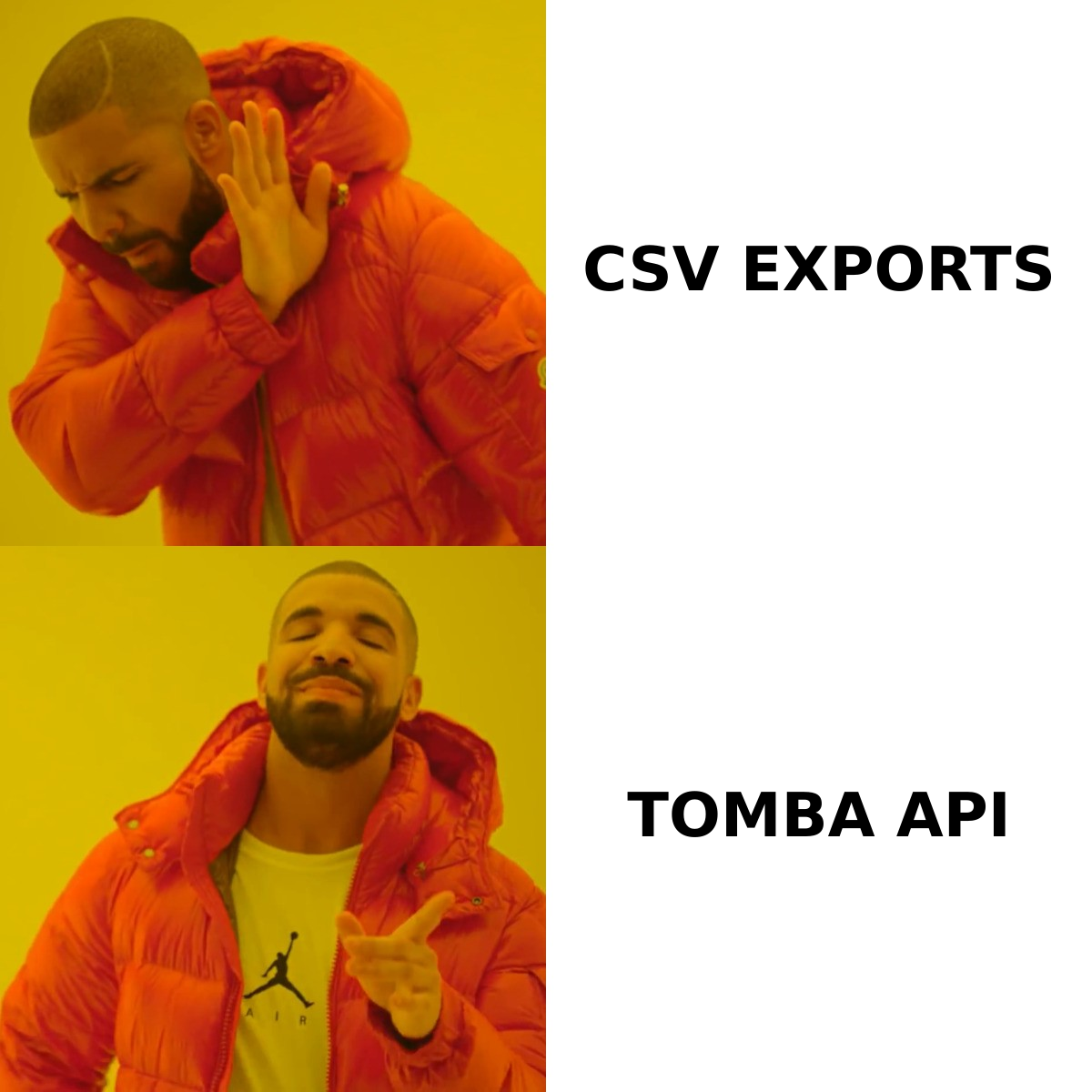
Five structural differences decide which one fits your motion:
- Data origin — Extruct researches live from public web sources at query time. LeadsForge queries a pre-built contact database. Live research is fresher and more flexible; a database is faster and more predictable.
- Unit of output — Extruct returns companies with custom research columns. LeadsForge returns people with contact details. That single difference determines where each sits in your pipeline.
- Query interface — Extruct is a spreadsheet-style workspace where you define columns as questions. LeadsForge is a chat prompt that resolves to filters. One rewards precision, the other rewards speed.
- Cost curve — Agentic research scales roughly linearly with rows times columns, because each cell is real work. Database lookups scale with credits consumed, which is cheaper per record but capped by what the database knows.
- Contact coverage — Extruct is not primarily a contact-data vendor; you typically enrich for emails downstream. LeadsForge bundles emails natively. If you use Extruct, budget for an email finder in the same workflow.
How do they compare feature by feature?#
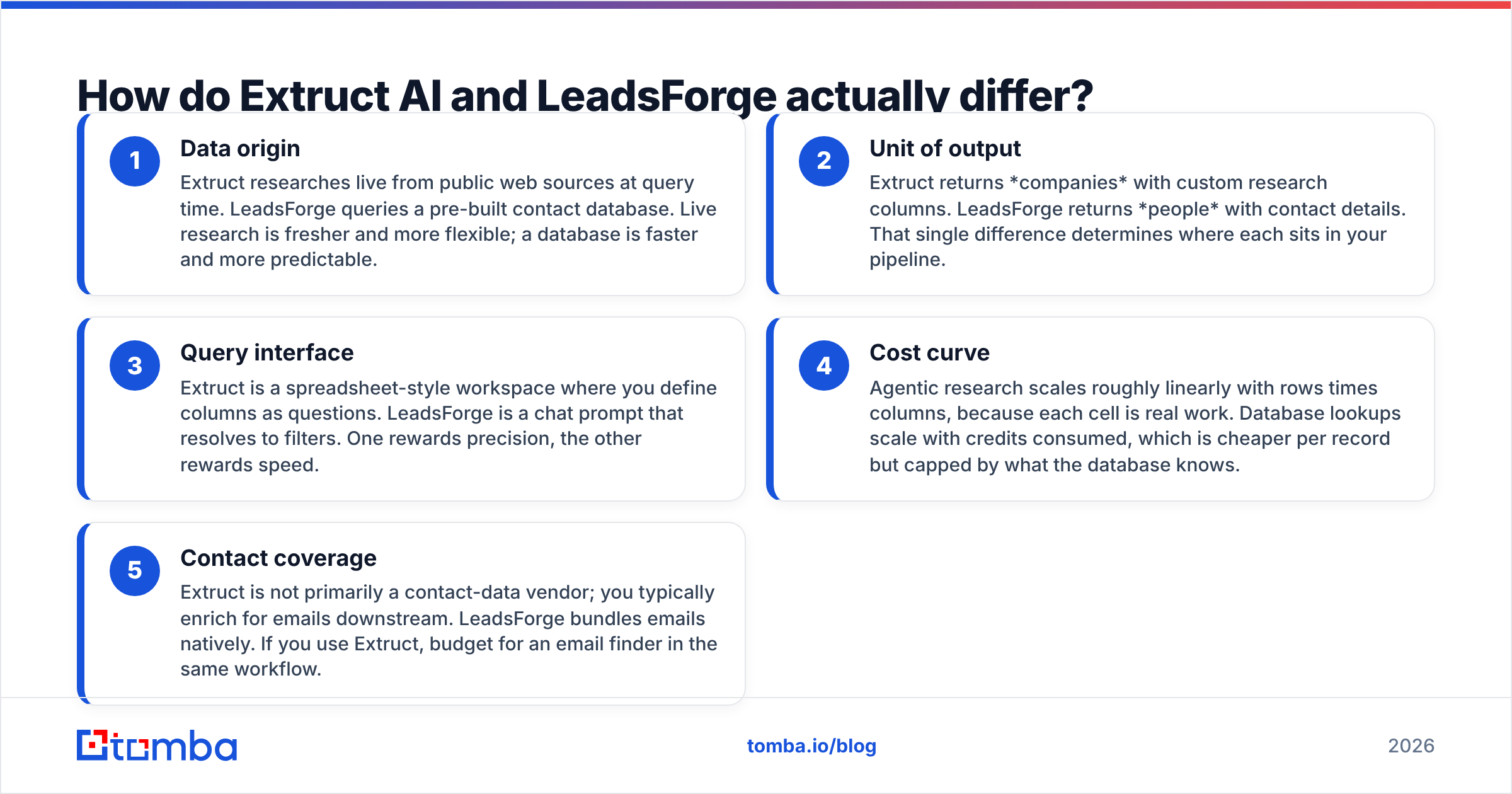
| Attribute | Extruct AI | LeadsForge | Where Tomba fits |
|---|---|---|---|
| Primary output | Researched company lists | Contact lists with emails | Verified emails per person or domain |
| Core method | AI agents crawling live web | Query against contact database | Pattern detection + SMTP verification |
| Custom criteria | Yes — user-defined research columns | Limited to database fields | N/A (contact layer only) |
| Best for | Hard-to-filter, niche ICPs | Standard ICPs at volume | Turning any company list into reachable contacts |
| Email addresses included | Not the core product | Yes, bundled | Yes — core product |
| Verification | Not the focus | Claimed on returned emails | Dedicated email verifier with catch-all handling |
| Speed to first list | Minutes to hours (research runs) | Minutes | Seconds per lookup; bulk for lists |
| API access | Available | Available | Full email finder API |
| Learning curve | Moderate — you design the schema | Low — type a sentence | Low |
The row that matters most is "custom criteria." If you can express your ICP with title, industry, headcount, and geography, you do not need agentic research and you should not pay for it. If you cannot, no amount of database filtering will get you there, and that is the entire case for Extruct.
What does each one cost?#
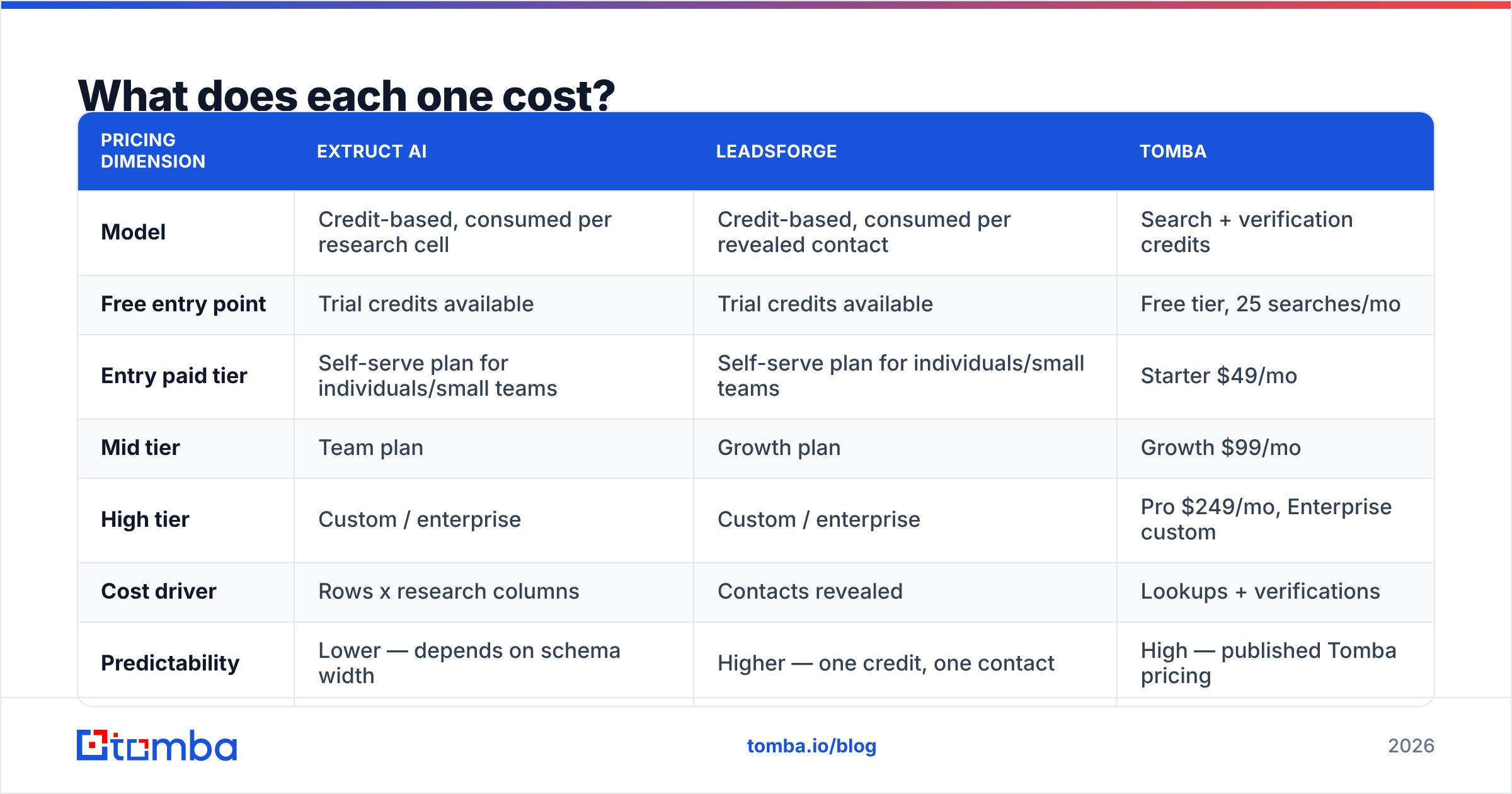
Both vendors iterate on packaging, so treat the shape below as directional and confirm on their own pages before committing budget. What does not change is the shape of each pricing model — and that shape tells you more than any specific number.
| Pricing dimension | Extruct AI | LeadsForge | Tomba |
|---|---|---|---|
| Model | Credit-based, consumed per research cell | Credit-based, consumed per revealed contact | Search + verification credits |
| Free entry point | Trial credits available | Trial credits available | Free tier, 25 searches/mo |
| Entry paid tier | Self-serve plan for individuals/small teams | Self-serve plan for individuals/small teams | Starter $49/mo |
| Mid tier | Team plan | Growth plan | Growth $99/mo |
| High tier | Custom / enterprise | Custom / enterprise | Pro $249/mo, Enterprise custom |
| Cost driver | Rows x research columns | Contacts revealed | Lookups + verifications |
| Predictability | Lower — depends on schema width | Higher — one credit, one contact | High — published Tomba pricing |
The practical warning: with agentic research, adding two more columns to a 5,000-row list does not cost a little more, it costs 10,000 more research operations. Teams underestimate this constantly. Design your schema before you scale your row count, not after.
Which one gives you better contact data?#
LeadsForge, on paper — because it actually ships contact data as the product, and Extruct largely does not. But "better" deserves a caveat that applies to every tool in this category.
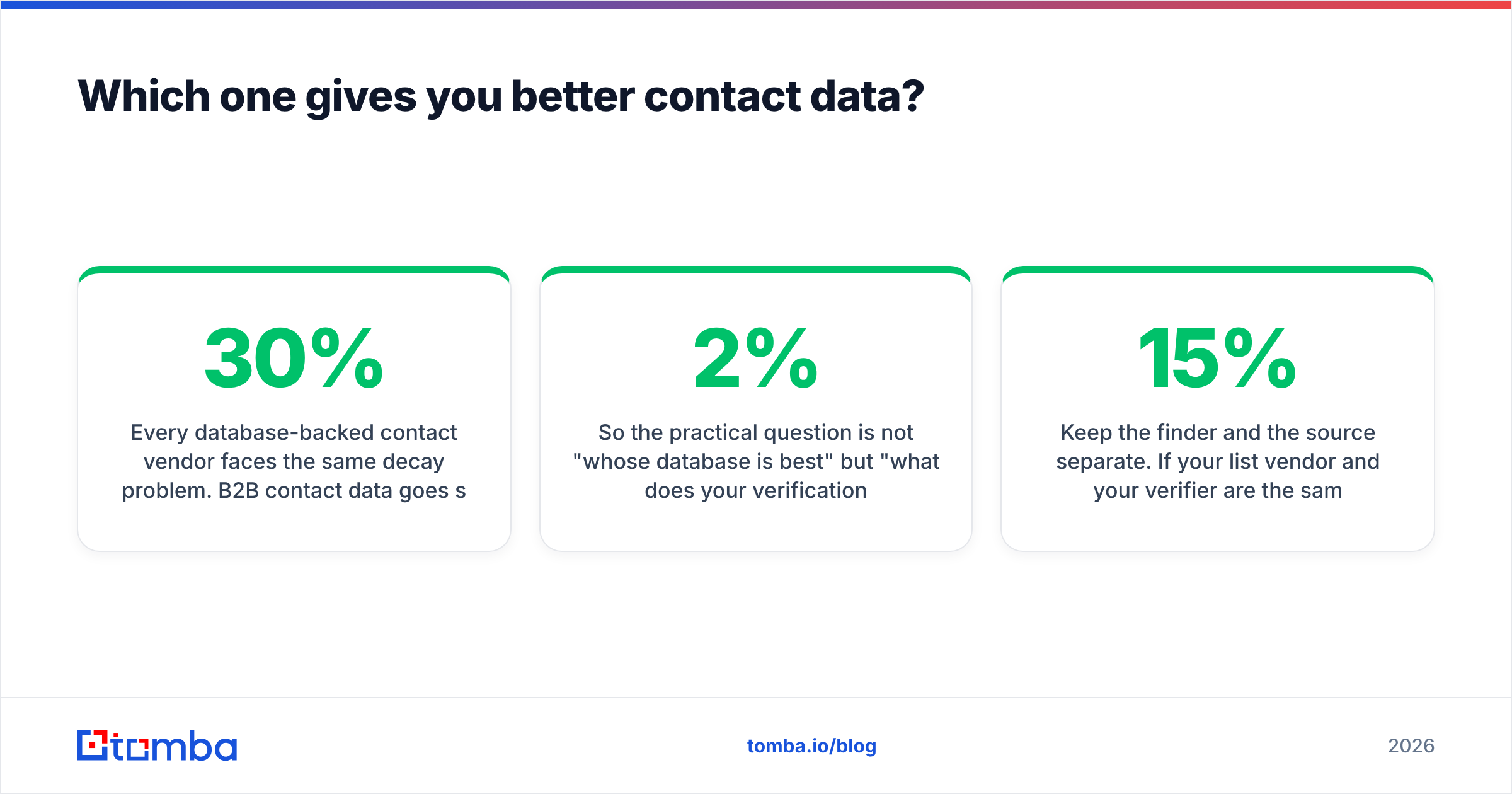
Every database-backed contact vendor faces the same decay problem. B2B contact data goes stale at roughly 25-30% per year through job changes alone, which is why analysts at Gartner and practitioners on G2 consistently rank data accuracy as the top complaint in this category regardless of vendor. A record that was verified in March may be a hard bounce in September, and no vendor's marketing page mentions this.
So the practical question is not "whose database is best" but "what does your verification layer look like." Three habits separate teams with sub-2% bounce rates from teams that get their domain throttled:
- Verify at send time, not at export time. The gap between when you pulled a list and when you emailed it is where bounces live. Re-verify anything older than 30 days.
- Handle catch-all domains explicitly. A catch-all server accepts everything, so standard SMTP checks return a useless "valid." You need a catch-all verifier that scores deliverability probability instead of pretending the answer is binary.
- Keep the finder and the source separate. If your list vendor and your verifier are the same system, you have no independent check on their claims. An independent finder-verifier pass on someone else's list routinely surfaces 5-15% of records that should not be sent to.
That last point is the honest reason a dedicated tool sits alongside either of these platforms rather than being displaced by them.
Who should choose Extruct AI?#
Choose Extruct if two or more of these describe you:
- Your ICP is a behavior, not a firmographic. "Companies hiring their first RevOps person," "brands that just switched ecommerce platforms," "firms mentioning SOC 2 in their careers page." Filter panels cannot express these; research agents can.
- Your deal size justifies research cost. At $50k ACV, spending real money to qualify 500 accounts is obviously correct. At $500 ACV, it is not.
- You are doing account-based outbound. ABM starts with account selection, and Extruct is fundamentally an account-selection tool.
- You want an audit trail. Cited sources per cell matter when a VP asks why a specific account is on the target list.
- You already have a contact-enrichment step. Extruct hands you companies. You still need domain search or a bulk finder to convert those domains into people you can email.
Who should choose LeadsForge?#
Choose LeadsForge if:
- Your ICP is standard. Title plus industry plus size plus geography covers it, and there is nothing exotic about the qualification.
- You need volume this week. A conversational query to a working list in under ten minutes is genuinely faster than any filter-based UI.
- You have no data ops resource. The chat interface is the whole point — nobody needs to learn a query builder.
- Your market is well covered. US and Western European tech and professional services are the sweet spot for essentially every contact database, including this one.
Where it gets uncomfortable is at the edges: very small companies, non-English markets, newly created roles, and industries that do not live on LinkedIn. That is not a knock on LeadsForge specifically — it is the shared ceiling of database-first tooling.
Can you use both — and where does Tomba fit?#
The strongest setup most teams land on is a three-layer stack, and it does not require picking a winner:
- Account selection — Extruct AI (or manual research) produces a company list matching a non-obvious ICP, with the qualifying evidence attached.
- Contact discovery — feed those domains into a finder to surface the right people. This is where bulk email finding does the heavy lifting: upload domains and roles, get contacts back, no per-company manual work.
- Verification before send — run everything through verification immediately before the sequence starts, with explicit catch-all handling.
LeadsForge compresses layers 1 and 2 into a single step, which is exactly why it is faster and exactly why it is less flexible. That is the whole trade in one sentence.
If you already own one of these platforms, the missing piece is almost always layer 3 — and layer 3 is the one that determines whether your domain reputation survives the quarter. A verification pass is the cheapest insurance in the entire outbound stack, typically a fraction of a cent per record against the cost of a burned sending domain.
What's the verdict on Extruct AI vs LeadsForge?#
There is no universal winner, and any article claiming one is optimizing for a clean ending rather than for your pipeline.
Extruct AI wins when your competitive advantage is targeting — when finding the right 300 accounts matters more than reaching 30,000 people. It is a research tool that happens to output lists.
LeadsForge wins when your competitive advantage is velocity — when your ICP is well understood and your bottleneck is simply getting enough qualified contacts into sequences. It is a list tool that happens to use AI as the interface.
Neither wins on contact accuracy alone, because neither is architected primarily as a verification system. That layer is deliberately someone else's job, and pretending otherwise is how teams end up with 12% bounce rates and a spam-foldered domain.
Start with the question you actually cannot answer today. If it is "who should I target," look at Extruct. If it is "how do I reach more of the people I already know I want," look at LeadsForge. Then, either way, put a real verification step between the export and the send button.
Ready to turn any company list into reachable contacts? The Tomba Email Finder plugs into whichever platform you pick — take the domains from an Extruct research run or the accounts from a LeadsForge query, and get verified, deliverable addresses back with confidence scores and catch-all detection. Start on the free tier with 25 searches a month, scale to Starter at $49/mo when it proves out, and stop paying for bounces you could have caught before sending.
Related guides#
Ready to find emails that actually work?
Join 150,000+ professionals who stopped guessing and started sending. Free credits on signup — no credit card required.
Get the Tomba newsletter
Practical outbound tactics and product updates — once every two weeks.
About the author