Extruct AI vs Ocean.io: Which B2B Company Data Tool Wins?
Extruct AI runs research agents over any company list. Ocean.io finds lookalike accounts from your best customers. Here's how the two differ on data model, pricing structure, and the contact gap both leave behind.
Extruct AI vs Ocean.io comes down to one question: do you need to find accounts, or judge them? Extruct AI researches companies you already have. Ocean.io finds new companies that resemble your best customers. This guide compares the two on data model, pricing shape, and the contact gap they both leave behind.
TL;DR
- Extruct AI is a research engine, not a database. You give it a company list and a set of questions. AI agents crawl the open web and return structured columns with source links.
- Ocean.io is a lookalike account-discovery database. You feed it your best customers. It returns companies that resemble them on website content, industry signals, and firmographics.
- They solve different halves of one problem. Ocean.io answers "who else looks like this?" Extruct answers "is this company a fit, and why?"
- Both are sales-led on pricing. Neither publishes a meaningful free tier. Expect a demo, an annual conversation, and seat or credit minimums.
- Neither is a contact-data tool. You end up with domains and no verified inbox to write to. That is where an email finder or a bulk enrichment API closes the loop.
What are Extruct AI and Ocean.io?#
The short version: Extruct AI enriches companies you already identified; Ocean.io identifies companies you didn't know existed. Most teams that evaluate both realise this halfway through the trial.
Extruct AI positions itself as an AI agent layer for company research. The mental model is a spreadsheet where every column is a question instead of a static field. You paste in domains — from a conference attendee list, a CRM export, a scraped directory — and define columns like "does this company run a partner program?", "what payment processor is on their checkout page?", or "have they hired a Head of RevOps in the last 12 months?". Agents read the web, then fill the grid with an answer plus a source link.
Ocean.io comes at it from the opposite direction. It maintains its own B2B company graph, built largely from website content and firmographic signals. Its headline feature is lookalike search. Upload 50 closed-won accounts, and it scores the rest of its universe by similarity. You then filter by size, geography, tech, and growth signals, and export the survivors.
Analogy: Ocean.io is a talent scout who watches every game in the league and hands you a shortlist. Extruct is the analyst who takes that shortlist and writes a scouting report on each name.
How does Extruct AI actually work?#
Extruct's workflow has four moving parts, and understanding them tells you fast whether it fits your motion:
- Input list — you supply the companies. Extruct is not primarily a discovery product, though it can expand a list from a seed description. Its accuracy story starts with domains you hand it.
- Agent columns — each column is a natural-language research task with a defined output type (boolean, number, category, free text). This is where the value sits. Anything a junior researcher could verify by reading a website, a press release, or a jobs page is fair game.
- Source citation — good agent tools show their work. Extruct returns the URL that justified each answer, which matters when a rep is about to open a cold email with the claim.
- Export or sync — CSV out, or push into the CRM. At this point the row is still a company, not a person.
The catch is the one every agentic research tool shares: cost and latency scale with the number of cells, not rows. Two hundred companies × eight research columns is 1,600 agent tasks. If your qualification logic is simple firmographics — headcount, country, industry — you are paying premium agent pricing for something a static database answers instantly.
How does Ocean.io actually work?#
Ocean.io's core is the similarity model. Rather than asking you to guess SIC codes, it reads company websites and clusters businesses by what they say they do. That matters because standard industry taxonomies are bad at modern categories — "vertical SaaS for dental clinics" does not exist as a NAICS code.
The typical workflow:
- Seed with real customers. Import closed-won accounts from your CRM, ideally segmented by tier so the model learns from your good customers, not all of them.
- Generate lookalikes. The platform returns ranked matches with a similarity score.
- Layer filters. Headcount, revenue band, region, growth indicators, technologies. This is where a broad lookalike set becomes a workable territory.
- Export or push to CRM. Same endpoint as Extruct: a list of companies.
Where Ocean.io gets criticised in public reviews on sites like G2 is coverage depth outside its strongest regions, plus the freshness of headcount and funding fields. That complaint applies to essentially every company database, not just this one. Treat any single vendor's firmographics as a strong prior, not gospel.
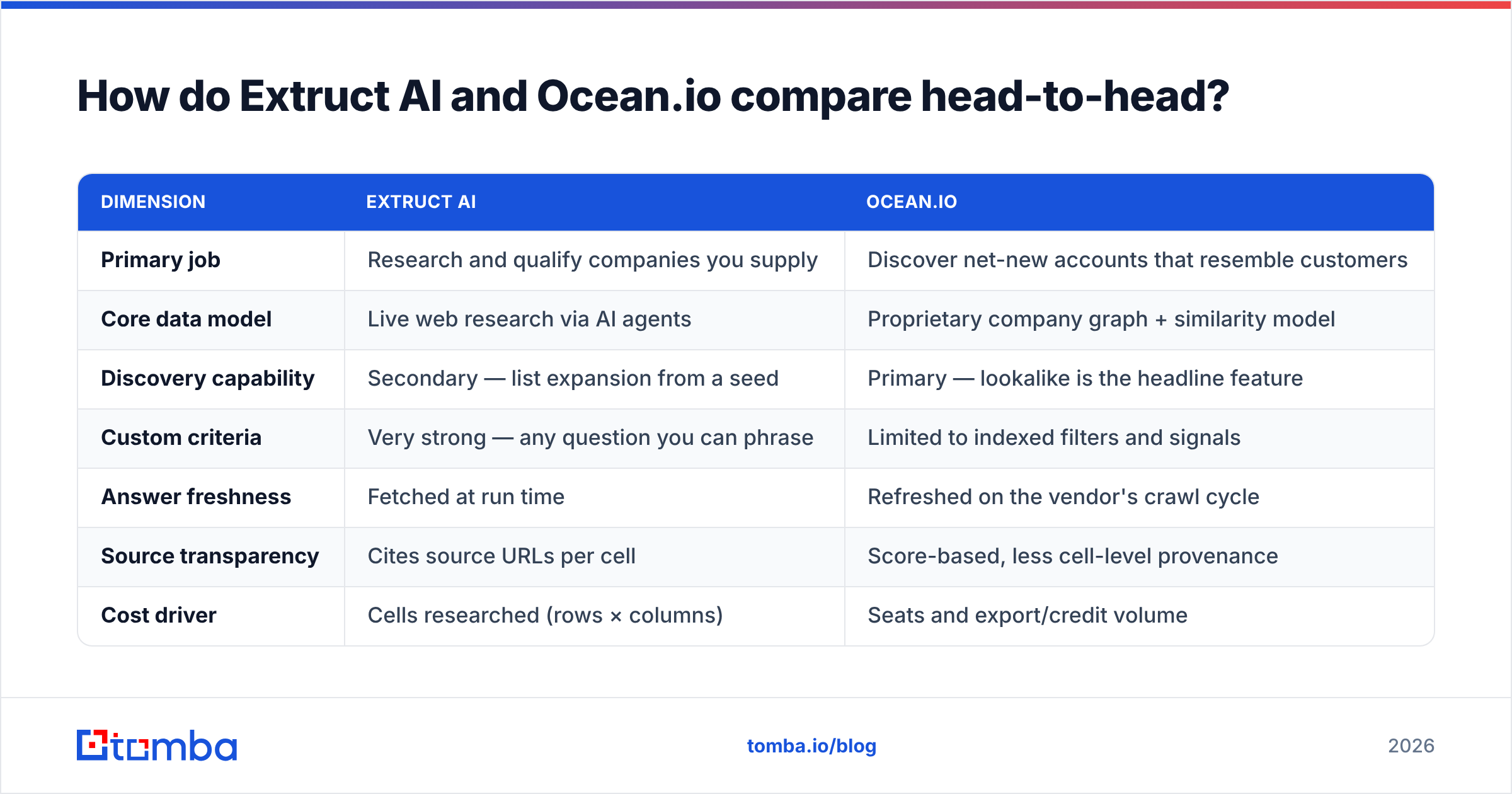
Extruct AI vs Ocean.io: how do they compare head-to-head?#
| Dimension | Extruct AI | Ocean.io |
|---|---|---|
| Primary job | Research and qualify companies you supply | Discover net-new accounts that resemble customers |
| Core data model | Live web research via AI agents | Proprietary company graph + similarity model |
| Discovery capability | Secondary — list expansion from a seed | Primary — lookalike is the headline feature |
| Custom criteria | Very strong — any question you can phrase | Limited to indexed filters and signals |
| Answer freshness | Fetched at run time | Refreshed on the vendor's crawl cycle |
| Source transparency | Cites source URLs per cell | Score-based, less cell-level provenance |
| Cost driver | Cells researched (rows × columns) | Seats and export/credit volume |
| Contact data (emails) | Not the product | Not the product |
| Best fit | Complex, non-firmographic qualification | High-volume ICP expansion |
| Weakest fit | Simple filters at large scale | Nuanced, narrative qualification |
The pattern in that table is worth stating plainly: these are complements more often than substitutes. A mature outbound team can justify running Ocean.io to build the account universe each quarter, then Extruct to score the top slice before reps touch it. A team of three SDRs almost certainly cannot justify both.
What do Extruct AI and Ocean.io cost?#
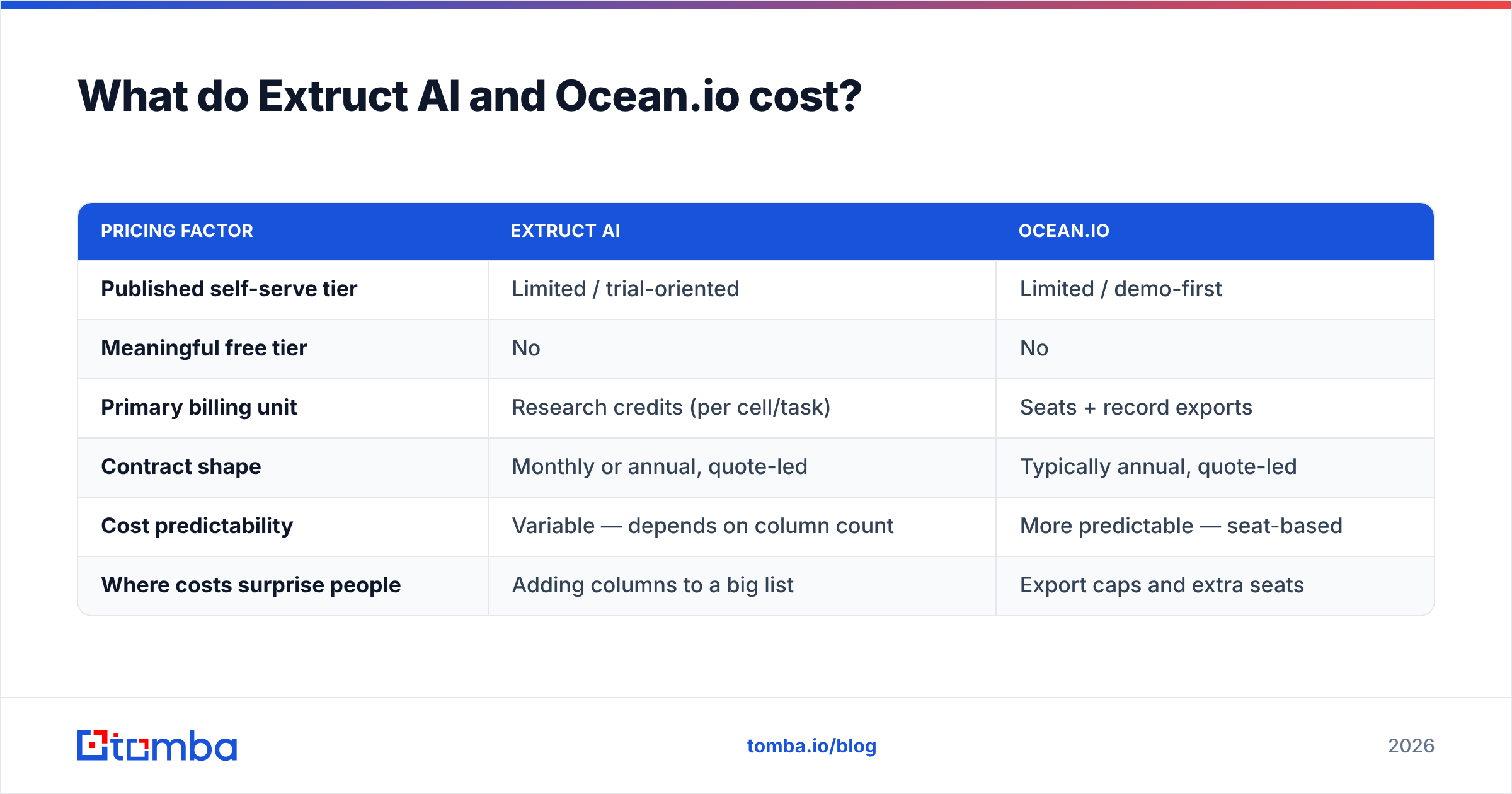
Both vendors are sales-led, and both change packaging often enough that any number printed in a blog post ages badly. So here is the honest version: check the vendor pages before you budget, and treat the shape of the pricing as more informative than the sticker.
| Pricing factor | Extruct AI | Ocean.io |
|---|---|---|
| Published self-serve tier | Limited / trial-oriented | Limited / demo-first |
| Meaningful free tier | No | No |
| Primary billing unit | Research credits (per cell/task) | Seats + record exports |
| Contract shape | Monthly or annual, quote-led | Typically annual, quote-led |
| Cost predictability | Variable — depends on column count | More predictable — seat-based |
| Where costs surprise people | Adding columns to a big list | Export caps and extra seats |
On budget, Extruct AI vs Ocean.io splits along one clean line: Extruct's bill scales with your curiosity, Ocean.io's scales with your headcount. Add three research columns across a 5,000-row list and you just ran 15,000 agent tasks. Add two SDRs to Ocean.io and you pay for two seats, however much they search.

That second table is also why so many evaluations stall. Neither vendor lets you self-serve your way to a verdict, so you are comparing two demos rather than two datasets. Force the issue: give both vendors the same 200 real target accounts, and compare the outputs cell by cell.
Which one finds better-fit accounts?#
It depends on whether your ICP is describable in fields or only in sentences.
Ocean.io wins when your ICP is pattern-shaped. "Mid-market logistics software companies in DACH, 50–500 employees, growing headcount" is a pattern. A similarity model trained on your closed-won accounts finds those faster and cheaper than an agent running one company at a time.
Extruct wins when your ICP is condition-shaped. "Companies whose careers page lists an open role mentioning HIPAA, and whose docs site references a public API" is not a filter that exists in any database. It is a research question. Agent columns answer it; firmographic filters cannot.
A useful test before you buy: write down the five criteria that actually predict a closed deal for you. Count how many are available as a dropdown in any B2B data platform. If it's four or five, buy the database. If it's one or two, buy the research agent.
Where do both tools leave you stranded?#
Both hand you an excellent list of companies. Neither hands you a person you can email.
This gap quietly kills a lot of "we bought a data platform" projects. The account list is good, the ICP work is sound, and then the SDR opens the export and finds a column of domains. What's missing:
- Named decision-makers at the right seniority for that account tier.
- Verified work email addresses that will not bounce and burn the sending domain.
- Catch-all handling, because a meaningful slice of B2B domains accept everything and verify as "unknown".
- Phone numbers for the accounts worth a call rather than a sequence.
- A repeatable pipeline, so next quarter's list doesn't need the same afternoon of copy-paste.
That's a different product category. A domain search turns a domain into the people who work there with their public email patterns. An email verifier filters the result down to addresses that will actually deliver. A bulk email finder or the Tomba API makes the step programmatic, so it runs on every new export rather than once.
Concretely: Ocean.io or Extruct produces 800 qualified domains → domain search returns named contacts and role titles → verification drops the risky addresses → the survivors go into the sequencer. Skip verification and you end up with a 12% bounce rate and a sender reputation problem that takes six weeks to unwind.
Which should you choose in 2026?#
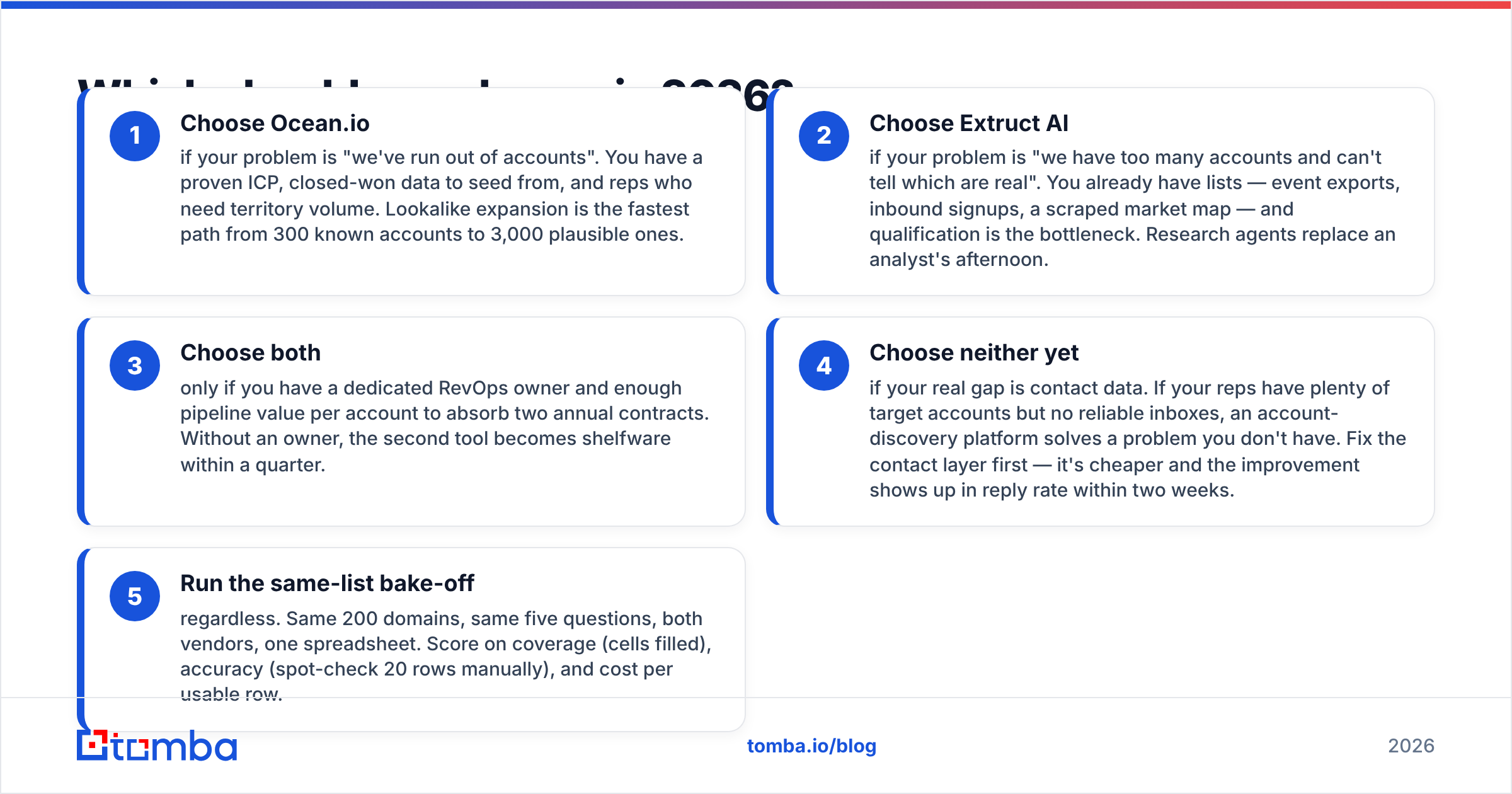
The Extruct AI vs Ocean.io decision is a question of motion, not feature count:
- Choose Ocean.io if your problem is "we've run out of accounts". You have a proven ICP, closed-won data to seed from, and reps who need territory volume. Lookalike expansion is the fastest path from 300 known accounts to 3,000 plausible ones.
- Choose Extruct AI if your problem is "we have too many accounts and can't tell which are real". You already have lists — event exports, inbound signups, a scraped market map — and qualification is the bottleneck.
- Choose both only if you have a dedicated RevOps owner and enough pipeline value per account to absorb two annual contracts. Without an owner, the second tool becomes shelfware within a quarter.
Two more calls are worth making before you sign anything:
- Choose neither yet if your real gap is contact data. If your reps have plenty of target accounts but no reliable inboxes, an account-discovery platform solves a problem you don't have. Fix the contact layer first. It's cheaper, and reply rate moves within two weeks.
- Run the same-list bake-off regardless. Same 200 domains, same five questions, both vendors, one spreadsheet. Score on coverage, accuracy (spot-check 20 rows by hand), and cost per usable row.
One caution for anyone comparing against generalist B2B databases: coverage claims in this category are never like-for-like. A vendor claiming "200M companies" and one claiming "20M companies" may return identical results for European mid-market SaaS, because the difference is dormant sole proprietorships. Judge on your territory, and use data-source transparency as the tiebreaker.
What's the fastest way to turn either export into replies?#
Take whichever platform's list you end up with and add the missing layer immediately, before it goes stale. Company data decays fast. People change jobs, teams restructure, and a domain you qualified in March may have a different buying committee by June.
Run the export through Tomba's Email Finder to attach named contacts and verified work emails to every account, then push the clean set into your sequencer. Tomba starts free with 25 searches a month, so you can test it on a slice of your Extruct or Ocean.io export before committing. Paid plans run from $49/mo (Starter) through $99/mo (Growth) and $249/mo (Pro) — see Tomba pricing for the full breakdown. The account-discovery layer and the contact layer are different jobs. Buy one of each, not two of the same.
Related guides#
Ready to find emails that actually work?
Join 150,000+ professionals who stopped guessing and started sending. Free credits on signup — no credit card required.
Get the Tomba newsletter
Practical outbound tactics and product updates — once every two weeks.
About the author