Extruct AI vs Salesbot: Which AI Sales Agent Wins in 2026?
Extruct AI researches companies at scale. Salesbot qualifies and replies inside your CRM. We break down pricing, data quality, and which one actually belongs in your stack.
TL;DR
- Extruct AI and Salesbot are not competitors. Extruct is an AI research agent that builds and enriches company lists; Salesbot is a CRM-native conversational agent (most commonly the one bundled with Kommo) that qualifies and replies to inbound leads.
- Pick Extruct if your bottleneck is finding and scoring accounts — custom research columns, deep-web signals, and CSV/API output.
- Pick Salesbot if your bottleneck is response time and lead triage — 24/7 replies across WhatsApp, Instagram, and web chat, tied to CRM pipeline stages.
- Neither one reliably gives you a verified contact email. Extruct returns company-level intelligence; Salesbot works with leads who already contacted you. That gap is where a dedicated email finder and email verifier belong.
- Budget reality: Extruct-style AI research tooling starts around $99–$200/mo for meaningful credit volume; Salesbot is effectively free inside a Kommo seat (~$15–$45/user/mo), which makes the "vs" framing misleading on cost alone.
Why are people comparing Extruct AI vs Salesbot at all?#
Because both get filed under "AI sales agent," and that label has stopped meaning anything.
Search "AI sales agent" and you get everything from research crawlers to chatbots to full SDR replacements. Extruct AI and Salesbot sit at opposite ends of that spectrum. Extruct works before a conversation exists — it goes and finds companies matching a description, then researches each one against columns you define. Salesbot works after a conversation starts — it answers the person who just messaged your Instagram at 11pm and routes them into a pipeline stage.
If you're evaluating them side by side, you're probably asking one of two real questions:
- "I need more qualified pipeline — which AI tool actually creates it?"
- "I have a budget for one AI tool this quarter — which gives me more leverage?"
The honest answer to (1) is that neither creates pipeline on its own. The honest answer to (2) depends entirely on whether you're inbound-heavy or outbound-heavy. Let's get concrete.
What is Extruct AI and what does it actually do?#
Extruct AI is an AI research agent for company data. You describe your ICP in natural language — "Series A-B fintech companies in the EU that recently launched a lending product" — and it returns a table of matching companies. Then you add custom columns, each one a research prompt: "Do they have an open engineering role?", "What's their pricing model?", "Which cloud provider do they use?"
The agent goes out, reads websites, job boards, filings, and news, and fills the cells. That's the core loop.
What it's genuinely good at:
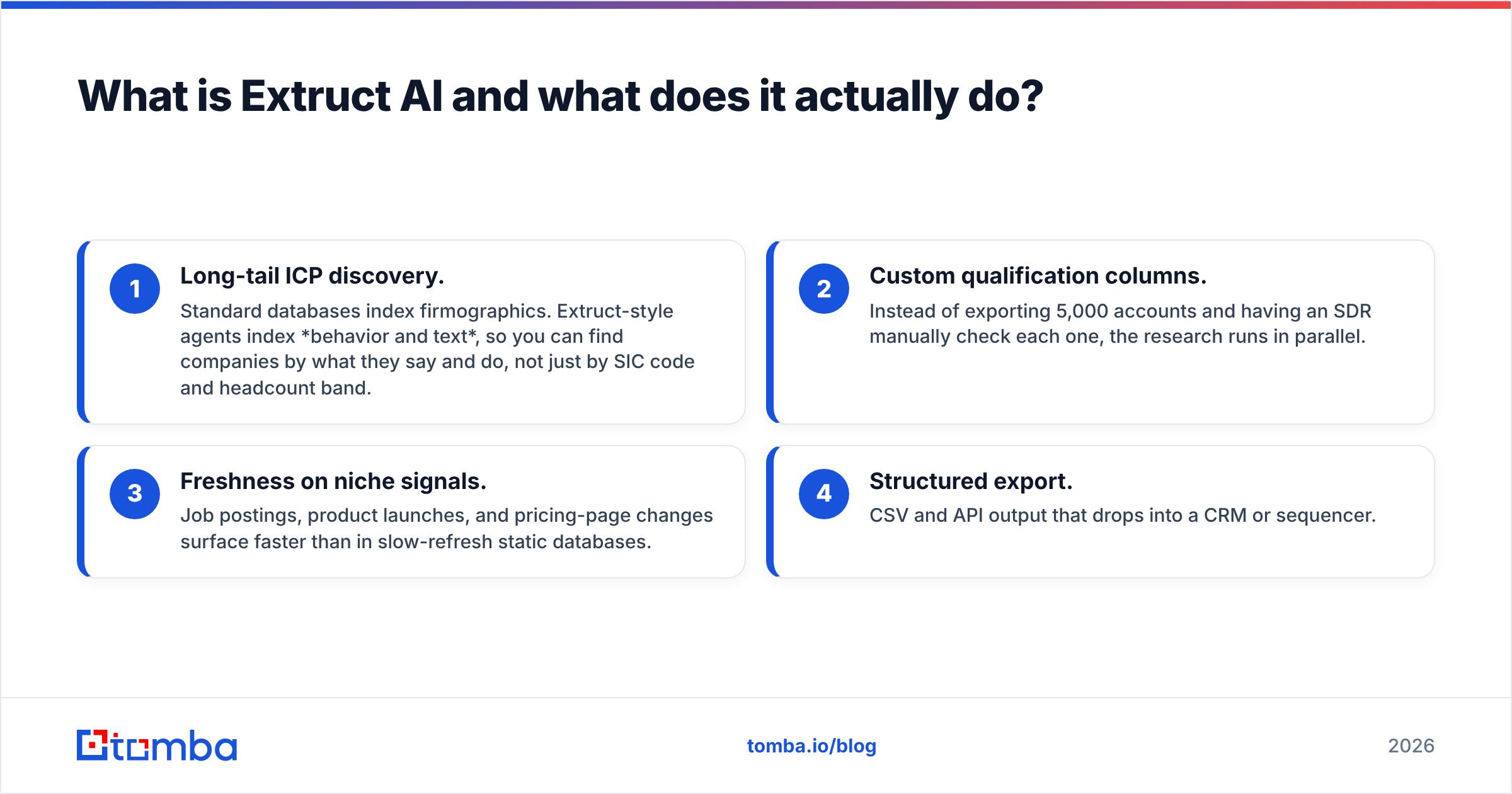
- Long-tail ICP discovery. Standard databases index firmographics. Extruct-style agents index behavior and text, so you can find companies by what they say and do, not just by SIC code and headcount band.
- Custom qualification columns. Instead of exporting 5,000 accounts and having an SDR manually check each one, the research runs in parallel.
- Freshness on niche signals. Job postings, product launches, and pricing-page changes surface faster than in slow-refresh static databases.
- Structured export. CSV and API output that drops into a CRM or sequencer.
Where it falls short:
- Company-level, not people-level. You get a great account list. You do not reliably get the VP of Engineering's verified work email.
- Credit burn is real. Every custom column on every row is a research call. A 2,000-row list with six columns is 12,000 research operations, and pricing scales accordingly.
- Verification is on you. LLM-derived research is probabilistic. A column that says "uses Snowflake" is a strong hint, not an audited fact.
Screenshot placeholder: Extruct AI research table with custom ICP columns filled by the agent.
What is Salesbot and who is it for?#
Salesbot is the automation and conversational-AI layer inside a CRM — most people searching this term mean Kommo's Salesbot, though the name is also used generically for CRM-native chat agents.
It handles the messages that arrive on their own: WhatsApp, Instagram DMs, Facebook Messenger, Telegram, live chat, and email. It asks qualifying questions, books meetings, updates fields, moves cards between pipeline stages, and pings a human when it hits something it can't handle.
What it's genuinely good at:
- Speed to lead. The single highest-leverage variable in inbound conversion. A bot replying in 30 seconds at 2am beats a rep replying in 6 hours, every time.
- Multi-channel unification. Messaging apps are where a lot of SMB and LATAM/EMEA B2B buying actually happens, and Salesbot lives natively in them.
- Zero-to-low marginal cost. It's bundled with the CRM seat rather than sold as a separate AI product.
- No-code builder. Sales ops can ship a qualification flow without engineering.
Where it falls short:
- It's reactive. No inbound traffic means no Salesbot value. It cannot go find you accounts.
- CRM lock-in. The value is tied to living inside that specific CRM. If you're on HubSpot or Salesforce, this isn't your tool.
- Scripted-feel ceiling. Flow-based bots handle the top 70% of questions well and get brittle on the rest.
Extruct AI vs Salesbot: how do they compare head-to-head?#
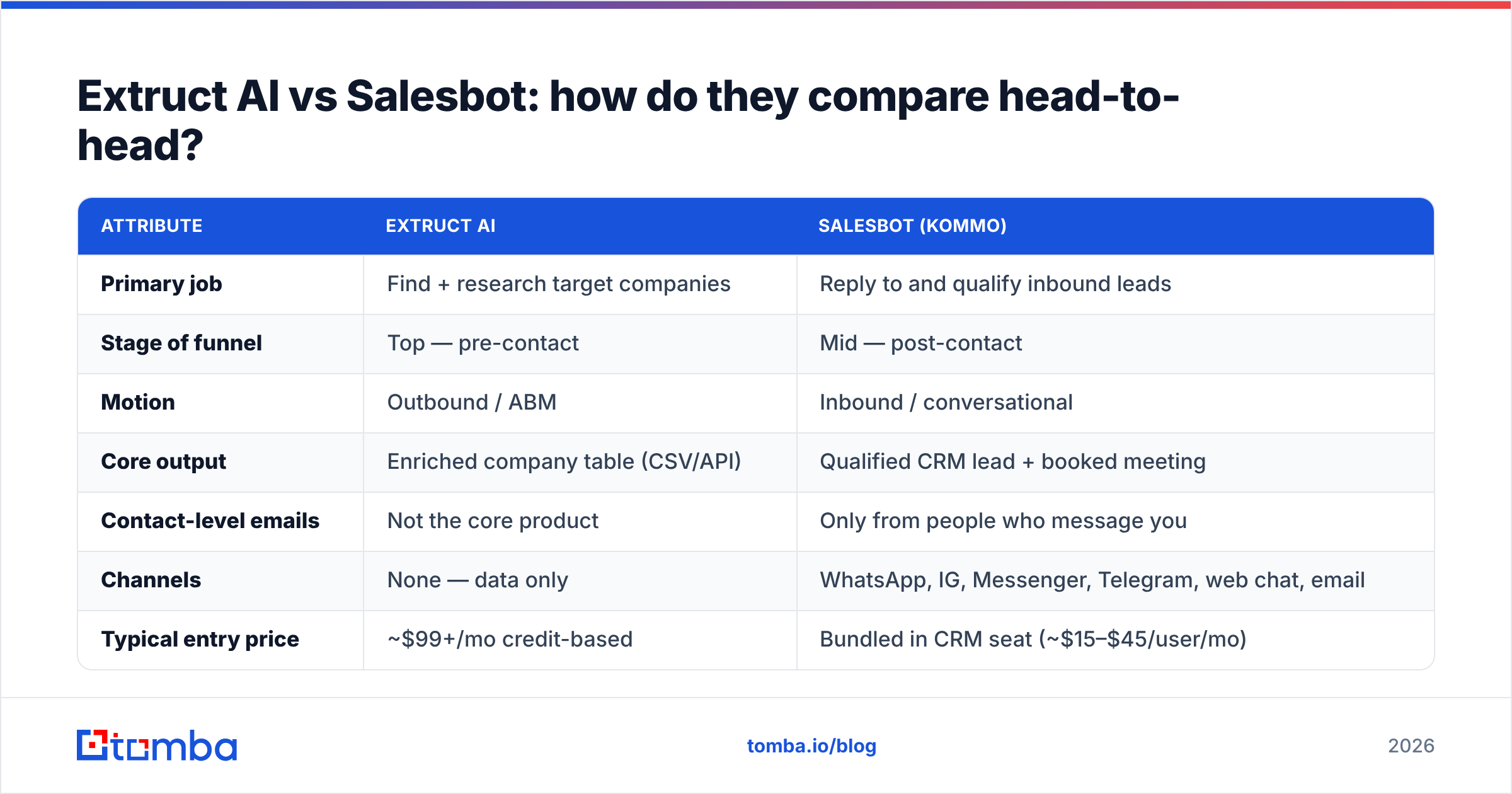
| Attribute | Extruct AI | Salesbot (Kommo) |
|---|---|---|
| Primary job | Find + research target companies | Reply to and qualify inbound leads |
| Stage of funnel | Top — pre-contact | Mid — post-contact |
| Motion | Outbound / ABM | Inbound / conversational |
| Core output | Enriched company table (CSV/API) | Qualified CRM lead + booked meeting |
| Contact-level emails | Not the core product | Only from people who message you |
| Channels | None — data only | WhatsApp, IG, Messenger, Telegram, web chat, email |
| Typical entry price | ~$99+/mo credit-based | Bundled in CRM seat (~$15–$45/user/mo) |
| Free tier | Limited trial credits | Included with CRM trial |
| Setup time | Hours (define ICP + columns) | Days (map flows to pipeline) |
| Best for | Founders, ABM teams, RevOps building lists | SMB inbound teams, agencies, e-commerce |
| Kills the need for | Manual account research | After-hours first response |
| Doesn't solve | Verified contact emails, sending | Cold prospecting, list building |
Read that table once and the "vs" collapses. These tools overlap on roughly nothing.
Which one should you buy if you can only buy one?#
Answer: whichever end of your funnel is currently starved.
Buy Extruct AI if:
- Your inbound volume is under ~50 leads/month and reps are idle.
- You sell into a niche where firmographic filters fail ("companies running headless commerce", "agencies that just won a Fortune 500 logo").
- You have an ABM motion and need account-level research at a depth a human can't sustain.
- You already have a sender infrastructure and a sequencer — you just need better accounts feeding it.
Buy Salesbot if:
- You get more than ~200 inbound conversations a month across messaging channels.
- Your median first-response time is measured in hours, not minutes.
- You're already on Kommo (or willing to move) and your buyers are on WhatsApp.
- Your reps spend more time triaging "is this a real lead?" than actually selling.
Buy neither, yet, if: you don't have a verified contact list. That's the more common situation than either vendor will tell you, and it's worth its own section.
What do both tools leave you missing?#
A deliverable email address attached to a named human.
This is the quiet gap. Extruct hands you a beautiful research table: 800 companies, scored, with six custom qualification columns. Now what? You still need the decision-maker at each of those 800 companies, their verified work email, and — increasingly — a mobile number. Salesbot, meanwhile, only ever sees people who already raised a hand.
Here's the sequence that actually works in 2026:
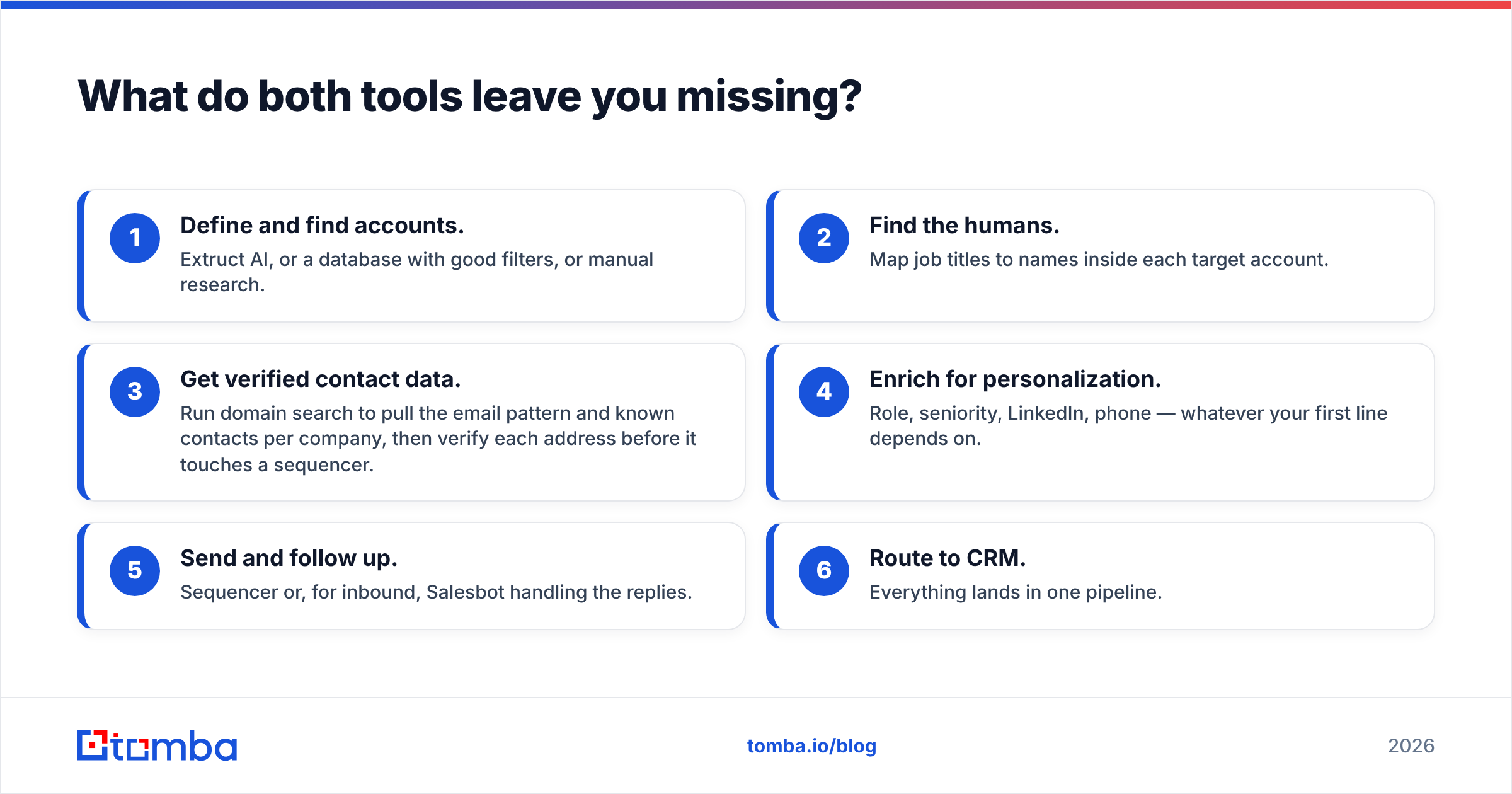
- Define and find accounts. Extruct AI, or a database with good filters, or manual research.
- Find the humans. Map job titles to names inside each target account.
- Get verified contact data. Run domain search to pull the email pattern and known contacts per company, then verify each address before it touches a sequencer.
- Enrich for personalization. Role, seniority, LinkedIn, phone — whatever your first line depends on.
- Send and follow up. Sequencer or, for inbound, Salesbot handling the replies.
- Route to CRM. Everything lands in one pipeline.
Steps 2–4 are where most stacks leak. You can have a perfect account list and a perfect reply bot and still bounce 22% of your sends because nobody verified the addresses. Google and Microsoft both treat bounce rate as a sender-reputation signal, and Google's own bulk sender guidelines put a hard spam-complaint ceiling on your domain — one bad list can throttle every campaign you run after it.
Screenshot placeholder: bounce-rate dashboard before and after list verification.
How does pricing really compare?#
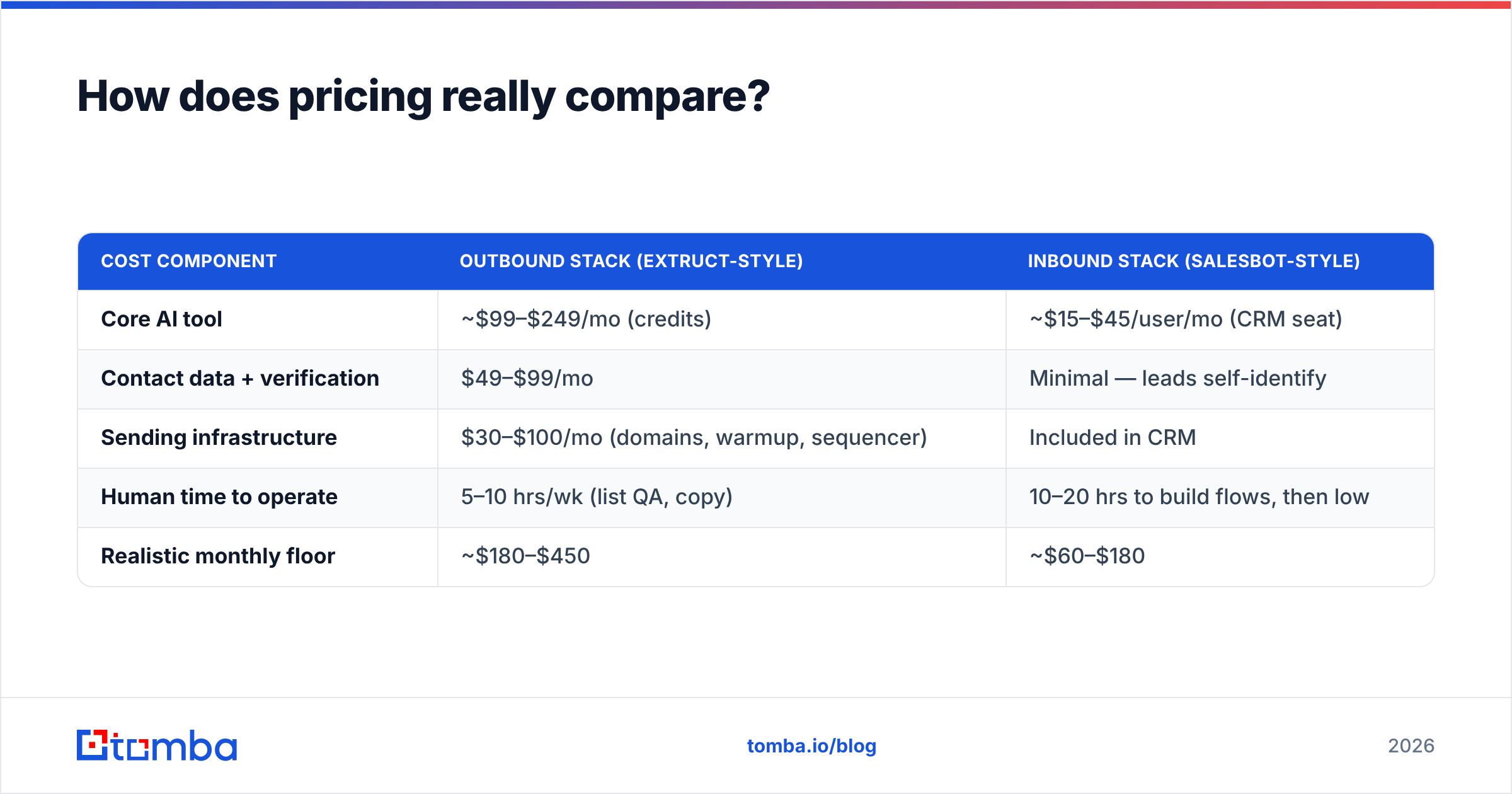
Comparing sticker prices here is apples-to-hangars, but the total cost of a working stack is comparable — and that's the number that matters.
| Cost component | Outbound stack (Extruct-style) | Inbound stack (Salesbot-style) |
|---|---|---|
| Core AI tool | ~$99–$249/mo (credits) | ~$15–$45/user/mo (CRM seat) |
| Contact data + verification | $49–$99/mo | Minimal — leads self-identify |
| Sending infrastructure | $30–$100/mo (domains, warmup, sequencer) | Included in CRM |
| Human time to operate | 5–10 hrs/wk (list QA, copy) | 10–20 hrs to build flows, then low |
| Realistic monthly floor | ~$180–$450 | ~$60–$180 |
Two things fall out of this. First, the inbound stack is cheaper — but only if you have inbound. Buying Salesbot with no traffic is buying a receptionist for an empty office. Second, in the outbound stack the AI research tool is rarely the largest line item once you count data and deliverability; teams that over-index on research credits and under-invest in verification end up with expensive lists that bounce.
For reference, Tomba pricing starts with a free tier at 25 searches/month, then Starter at $49/mo, Growth at $99/mo, and Pro at $249/mo — which slots into the "contact data + verification" row above without a separate verifier subscription.
If you want third-party sentiment before committing to either vendor, G2's sales-intelligence category and Capterra's CRM listings are the least-marketed sources of user reviews — filter by company size, because SMB and enterprise reviewers of these tools want completely different things.
Can you run both together?#
Yes, and for a hybrid GTM team it's the right answer.
The clean architecture looks like this:
- Extruct AI owns account discovery and research. Output: a scored account list with qualification columns.
- A contact-data layer turns accounts into verified people. Output: name, title, verified email, phone.
- A sequencer runs the outbound touches.
- Salesbot catches every reply and inbound message across channels, qualifies, and books.
- The CRM is the single source of truth; everything writes back to it.
The handoff that breaks most often is between research and contact data. An account list with a company domain is not a prospect list. You need the domain-to-person step to be automated, or an SDR spends Monday morning copy-pasting names off LinkedIn. That's what a bulk email finder run over your Extruct export is for — feed it 800 domains and target titles, get back deliverable addresses.
Also worth knowing: if a chunk of your target domains are catch-all (very common in mid-market European B2B), standard verification returns "unknown" and most teams just guess. A catch-all verifier resolves a meaningful share of those instead of leaving them in limbo or, worse, sending to them blind.
What about alternatives to each?#
If Extruct AI isn't the fit, the usual comparison set is Clay (more powerful, steeper learning curve, waterfall enrichment), Ocean.io (lookalike-based account discovery), and traditional databases like Apollo or ZoomInfo (broader contact coverage, weaker custom research). Teams that want a straightforward account list without the credit math often use BookYourData for pay-as-you-go B2B contacts with a guaranteed-accuracy model — a different philosophy from agentic research, and a good fit when you already know exactly who you're targeting. Also see our breakdown of Apollo alternatives if contact coverage is your priority over research depth.
If Salesbot isn't the fit, look at Intercom's Fin (best-in-class inbound AI, enterprise price), Drift, Tidio, or HubSpot's own chatbot builder if you're already in that ecosystem. The deciding factor is almost always which CRM you're committed to — conversational agents are only as good as their write-access to your pipeline.
Frequently asked questions#
Is Extruct AI a replacement for Apollo or ZoomInfo? No. It's a research layer, not a contact database. It answers questions those databases can't filter for, but it won't hand you 50 million verified contact records.
Does Salesbot do outbound? It can send templated follow-ups to existing contacts inside the CRM, but it isn't a cold-outbound engine and shouldn't be used as one — messaging channels like WhatsApp punish unsolicited outreach hard.
Which has better data accuracy? They measure different things. Extruct's accuracy question is "is this research claim true?" — treat outputs as high-quality hypotheses, spot-check a sample of 20 rows before trusting a column. Salesbot's accuracy question is "did it qualify correctly?" — audit its transcripts weekly for the first month.
Do I still need an email verifier if I use an AI research tool? Yes. Research agents infer; verifiers check. Any address that arrives via inference or pattern-matching should be verified before it hits your sending infrastructure.
The bottom line#
Stop treating Extruct AI vs Salesbot as a choice. Extruct fills the top of an outbound funnel with researched accounts. Salesbot keeps the bottom of an inbound funnel from leaking. Whichever you buy, the connective tissue between "I know which company to target" and "I sent an email that landed in a real inbox" is contact data — and that's the piece neither tool owns.
Start there. Run your target domains through the Tomba Email Finder to turn an account list into a verified contact list, with verification built into the same workflow instead of bolted on afterward. The free tier gives you 25 searches a month to test accuracy against domains you already know, and Starter is $49/mo when you're ready to run volume. Get the data layer right first — the AI agents on either side of it work far better when what's flowing between them is real.
Related guides#
Ready to find emails that actually work?
Join 150,000+ professionals who stopped guessing and started sending. Free credits on signup — no credit card required.
Get the Tomba newsletter
Practical outbound tactics and product updates — once every two weeks.
About the author