Extruct AI vs SMARTe: Which B2B Data Tool Wins in 2026?
Extruct AI researches companies with autonomous agents. SMARTe sells verified contact data at scale. They solve different halves of the same problem — here is which one your GTM stack actually needs, and where both fall short.
TL;DR
- Extruct AI is a research agent, not a database. You give it a company list and a set of custom questions; AI agents crawl the live web and fill in a spreadsheet. It excels at qualification criteria no static database stores.
- SMARTe is a contact database with intent and technographic layers. You search filters, get people with emails and phones, push them to your CRM. It excels at volume and compliance coverage.
- They are not really substitutes. Extruct answers which accounts deserve outreach. SMARTe answers who do I email at those accounts. Many teams end up running both.
- Neither publishes transparent self-serve pricing at the low end — both lean on demos and annual contracts, which matters if you are a 3-person team testing a channel.
- Contact-level verification is the shared weak spot. Whichever you pick, run the final email list through a dedicated email verifier before it touches your sending domain.
What are Extruct AI and SMARTe?#
Short version: Extruct AI is an AI agent that researches companies on demand. SMARTe is a B2B contact and account database you query with filters.
Think of it like hiring versus subscribing. Extruct is the intern you hand a list of 400 companies and a question — "does this company run a partner program, and who runs it?" — and it comes back with a filled column and source links. SMARTe is the phone book that already has 200M+ contact records indexed, waiting for you to filter by title, geography, and tech stack.
That distinction drives every other difference between them: pricing model, latency, accuracy failure modes, and who on your team actually logs in.
Extruct's pitch is custom research at scale. You define the columns — funding stage, whether they sell to enterprise, whether their careers page lists a RevOps role, whether they mention SOC 2 — and agents go find the answers from the live web. No pre-built schema constrains what you can ask.
SMARTe's pitch is coverage and compliance. It maintains a large curated database of business contacts with a strong emphasis on GDPR/CCPA-aligned sourcing and international coverage (notably APAC and EMEA, where many US-first vendors thin out). It ships a Chrome extension for LinkedIn prospecting and native CRM sync.
How does Extruct AI actually work?#
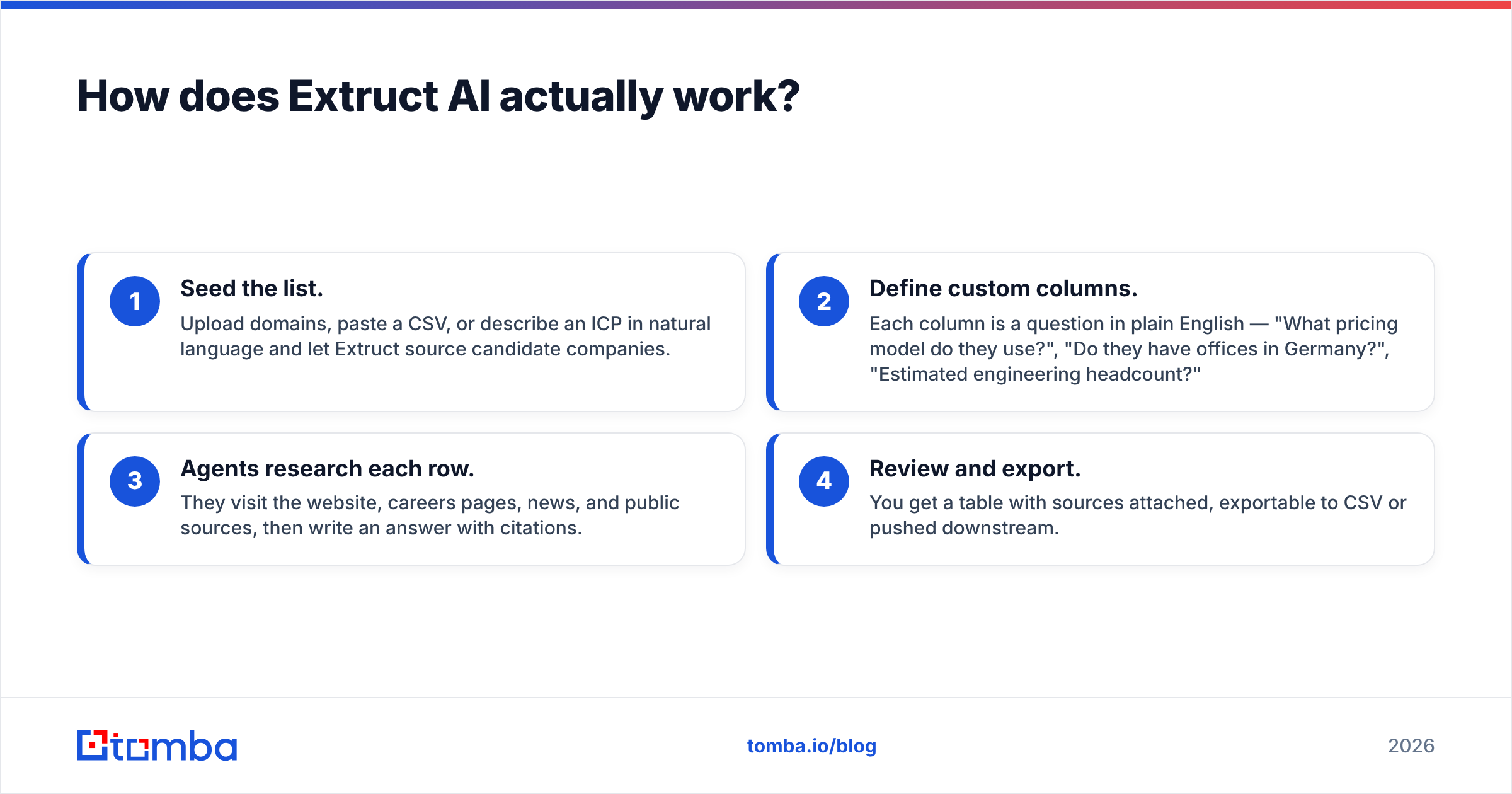
Extruct runs on an agentic loop rather than a lookup. The practical flow:
- Seed the list. Upload domains, paste a CSV, or describe an ICP in natural language and let Extruct source candidate companies.
- Define custom columns. Each column is a question in plain English — "What pricing model do they use?", "Do they have offices in Germany?", "Estimated engineering headcount?"
- Agents research each row. They visit the website, careers pages, news, and public sources, then write an answer with citations.
- Review and export. You get a table with sources attached, exportable to CSV or pushed downstream.
The upside is obvious: you can qualify on criteria that literally do not exist as a filter in any database. "Companies whose docs mention a public API but who don't list an integrations partner" is not a Clearbit field. It is a research question, and research agents handle it.
The downsides are equally real. Agentic research is slower than a database query — minutes per row, not milliseconds. Costs scale with how many questions you ask, not just how many companies. And answers inherit the quality of what is publicly crawlable; a stealthy company with a one-page site returns thin results no matter how good the agent is.

What does SMARTe do differently?#
SMARTe sits in the traditional B2B data intelligence category alongside ZoomInfo, Cognism, and Lusha, with a few positioning choices worth knowing:
- International depth. Its contact coverage outside North America is a stated strength, which matters if your ICP includes India, Singapore, Germany, or the UK. Many US-centric providers return sparse or stale records there.
- Compliance posture. SMARTe leans hard on GDPR-conscious sourcing and notice-based processing — a meaningful check for EU-targeting teams whose legal reviewers ask where records came from.
- Mobile numbers. Direct dials and mobiles are a headline feature, not an add-on afterthought, which puts it in play for teams that still run calls.
- Workflow surface. A browser extension for LinkedIn, CRM connectors for Salesforce and HubSpot, and list export cover the day-to-day SDR loop.
Where SMARTe cannot help you is the qualification question. If your ICP is "SaaS companies that just launched a marketplace," no filter combination gets you there. You would need to research it — which is exactly Extruct's job.
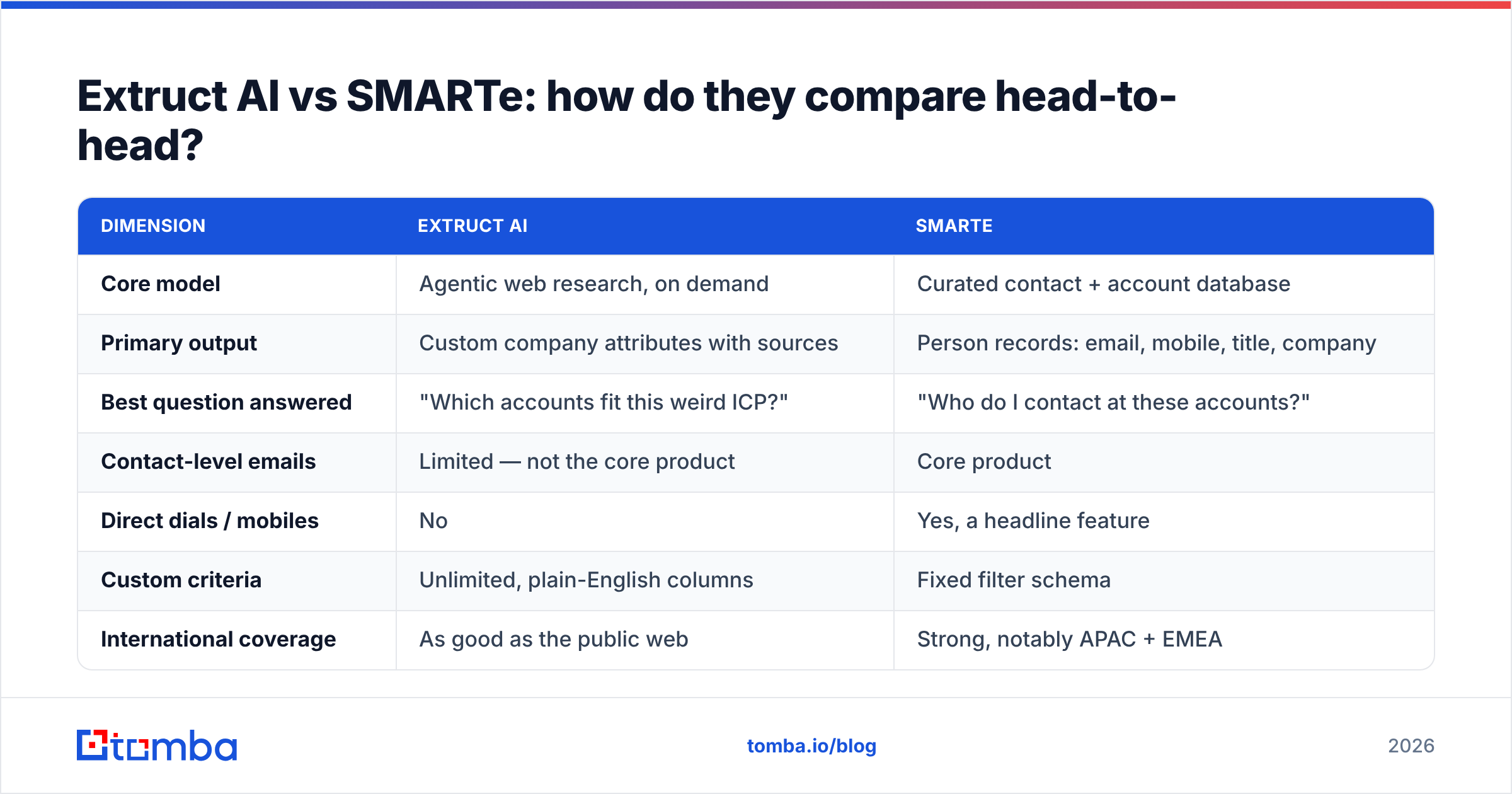
Extruct AI vs SMARTe: how do they compare head-to-head?#
| Dimension | Extruct AI | SMARTe |
|---|---|---|
| Core model | Agentic web research, on demand | Curated contact + account database |
| Primary output | Custom company attributes with sources | Person records: email, mobile, title, company |
| Best question answered | "Which accounts fit this weird ICP?" | "Who do I contact at these accounts?" |
| Contact-level emails | Limited — not the core product | Core product |
| Direct dials / mobiles | No | Yes, a headline feature |
| Custom criteria | Unlimited, plain-English columns | Fixed filter schema |
| International coverage | As good as the public web | Strong, notably APAC + EMEA |
| Speed per record | Minutes (agent runs) | Instant (indexed lookup) |
| Freshness | Live at query time | Refresh-cycle dependent |
| Pricing transparency | Limited public pricing; demo-led | Quote-based; demo-led |
| Typical buyer | Founder, GTM engineer, RevOps | SDR team, demand gen, sales ops |
| CRM sync | Export / API-oriented | Native Salesforce + HubSpot |
The table makes the real conclusion obvious: these tools overlap by maybe 20%. Comparing them is closer to comparing a research assistant to a phone directory than comparing two email finders.
Which one has better data accuracy?#
Wrong question — they fail differently, so measure them differently.
Extruct's failure mode is interpretation error. The agent finds a page, reads it, and infers an answer that is defensible but wrong — a careers page listing "Head of Growth" gets read as evidence of a formal RevOps function. Because every answer ships with source links, this is auditable. Spot-check 20 rows, count how many citations actually support the claim, and you have a real accuracy number in 15 minutes.
SMARTe's failure mode is staleness and pattern guessing. A contact record is correct on the day it was collected; people change jobs at roughly 20–25% per year in tech. The record does not know that. Some database providers also backfill emails using pattern inference (first.last@domain.com) without a live SMTP check, which is where bounce rates come from.
That second failure mode is why a verification step belongs in your pipeline regardless of vendor. A catch-all verifier plus standard SMTP validation will separate the records that will land from the ones that will burn your domain reputation. If you are pulling a few thousand rows at a time, a bulk email finder run is cheaper than a single deliverability recovery.
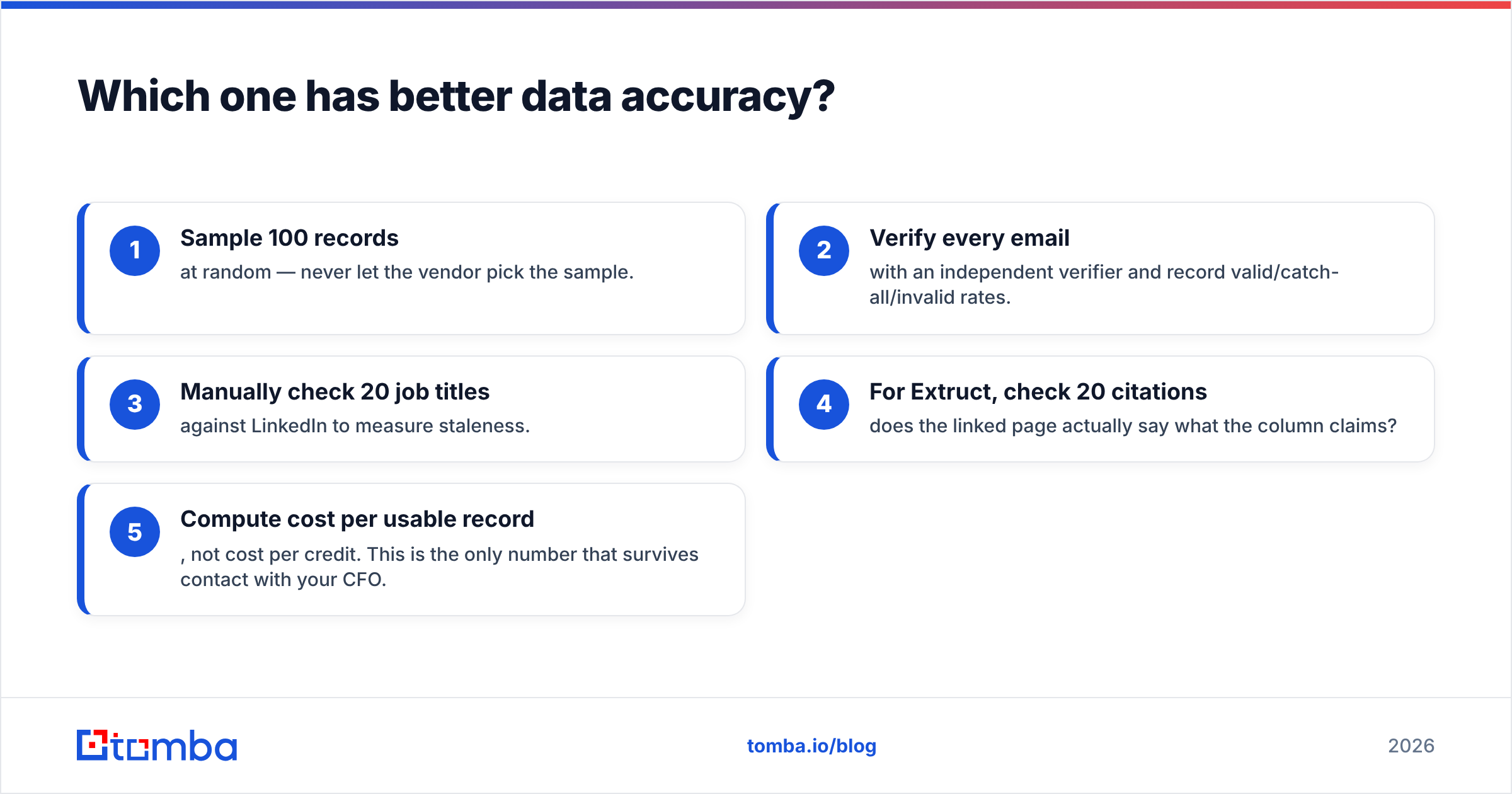
A practical accuracy audit you can run on either tool during a trial:
- Sample 100 records at random — never let the vendor pick the sample.
- Verify every email with an independent verifier and record valid/catch-all/invalid rates.
- Manually check 20 job titles against LinkedIn to measure staleness.
- For Extruct, check 20 citations — does the linked page actually say what the column claims?
- Compute cost per usable record, not cost per credit. This is the only number that survives contact with your CFO.
How do pricing and credits compare?#
Both vendors run demo-led motions, which is itself a data point: neither is optimized for a solo founder who wants to swipe a card at 11pm. Published details shift often, so treat any number you see in a blog post — including this one — as something to confirm on the vendor's own page before you sign.
The structural difference matters more than the headline number:
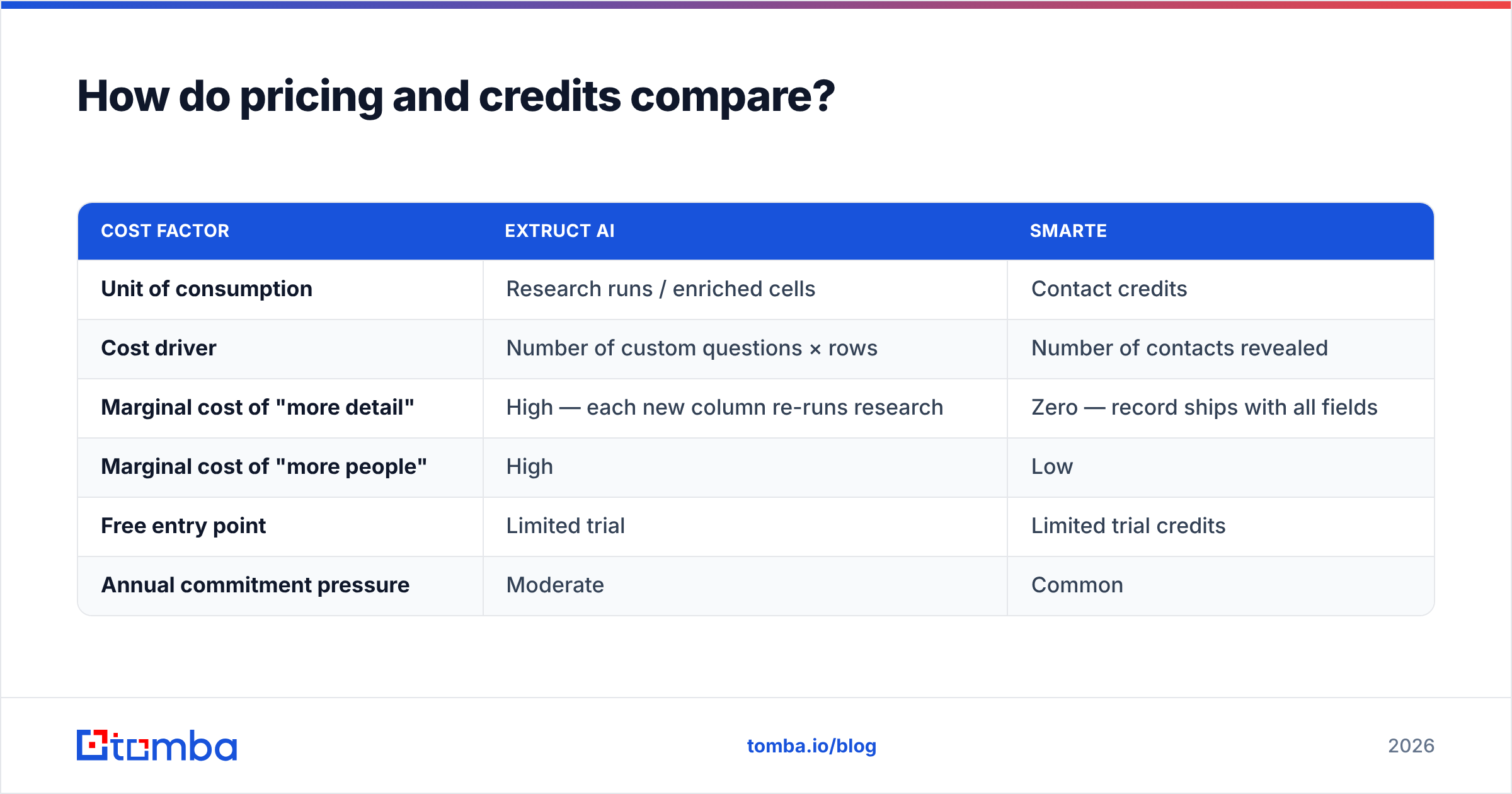
| Cost factor | Extruct AI | SMARTe |
|---|---|---|
| Unit of consumption | Research runs / enriched cells | Contact credits |
| Cost driver | Number of custom questions × rows | Number of contacts revealed |
| Marginal cost of "more detail" | High — each new column re-runs research | Zero — record ships with all fields |
| Marginal cost of "more people" | High | Low |
| Free entry point | Limited trial | Limited trial credits |
| Annual commitment pressure | Moderate | Common |
Translation: Extruct gets expensive when you ask a lot of questions. SMARTe gets expensive when you contact a lot of people. If your motion is 200 hyper-qualified accounts, Extruct's model is friendly. If it is 20,000 contacts across three regions, SMARTe's model is friendlier.
For comparison, transparent self-serve pricing exists elsewhere in this stack. Tomba pricing publishes a free tier at 25 searches/month, Starter at $49/mo, Growth at $99/mo, and Pro at $249/mo — no demo required to see the number. That is not a claim that Tomba does what either of these tools does; it is a note that pricing opacity is a choice, and it costs you evaluation time.
Which teams should pick Extruct AI?#
Pick Extruct if you recognize yourself here:
- Your ICP is defined by behavior, not firmographics. "Companies migrating off Zendesk" or "agencies that publish case studies for fintech clients" cannot be filtered — only researched.
- You are a GTM engineer or technical founder. Extruct rewards people who enjoy writing precise prompts and iterating on column definitions. It punishes people who want a "download list" button.
- Your deal sizes are large and your list is small. Spending real compute per account only pencils out when each account is worth thousands.
- You already have contact data. Extruct sharpens targeting; it does not replace your contact source.
Skip Extruct if you need 10,000 mobile numbers by Friday. That is not the tool.
Which teams should pick SMARTe?#
Pick SMARTe if:
- You run an outbound team with quota-carrying SDRs who need volume and CRM hygiene more than clever qualification.
- Your territory includes EMEA or APAC and your current provider returns embarrassing gaps there.
- Legal cares where data came from. SMARTe's compliance framing is easier to defend in a procurement review than a generic scraper.
- Phone matters. If half your pipeline comes from dials, a database that treats mobiles as a first-class field beats one that doesn't have them at all.
Skip SMARTe if your entire problem is "I don't know which 300 companies to target." More contacts at the wrong accounts is a faster way to burn a domain, not a fix.
What are the alternatives worth shortlisting?#
A two-vendor comparison is artificially narrow. Before you commit to either, put these on the same spreadsheet:
- Clay — the most direct Extruct competitor for agentic enrichment, with a bigger integration marketplace and a steeper learning curve.
- Cognism / ZoomInfo — the incumbent databases SMARTe is positioned against. Larger coverage, larger invoices, harder contracts to exit.
- BookYourData — a strong option if you want pay-as-you-go, prebuilt B2B lists with a stated accuracy guarantee and no annual commitment. For teams that just need a clean, targeted list without a platform subscription, it removes a lot of friction.
- Apollo — database plus sequencing in one seat; check the Apollo alternative breakdown if you are weighing all-in-one against best-of-breed.
- Tomba — the finder-and-verifier layer, with domain search, a documented email finder API, and data enrichment for filling gaps in records the big platforms return incomplete.
Read peer reviews on G2 with a filter for company size close to yours — a 2,000-seat enterprise's complaints about a tool are usually irrelevant to a 12-person team, and vice versa.
What's the actual verdict?#
If you must choose one: pick SMARTe if you have an outbound team to feed, and Extruct AI if you have an ICP problem to solve.
The honest answer is that the "vs" framing is a search-query artifact. A mature 2026 stack looks like three distinct layers, not one vendor:
- Account selection — Extruct AI, Clay, or a well-run analyst
- Contact discovery — SMARTe, BookYourData, or an equivalent database
- Verification and enrichment — a dedicated verifier before anything is sent
Skipping layer three is where most teams lose. You can buy pristine account research and premium contact records and still land in spam because 18% of the emails were pattern-guessed six months ago and nobody re-checked them.
Run a 100-record bake-off. Measure cost per usable record, not per credit. Then decide.
Ready to fix the layer both tools leave open?#
Whichever platform wins your evaluation, the emails still need to be real on the day you send. Tomba's Email Finder finds and confirms professional addresses by domain, name, or company — with a free tier at 25 searches/month so you can test it against your Extruct or SMARTe export before paying anyone anything. Export 200 records from your trial, run them through Tomba, and compare valid rates side by side. That single test will tell you more about your data quality than any vendor demo.
Related guides#
Ready to find emails that actually work?
Join 150,000+ professionals who stopped guessing and started sending. Free credits on signup — no credit card required.
Get the Tomba newsletter
Practical outbound tactics and product updates — once every two weeks.
About the author