Extruct AI vs Wiza (2026): Which B2B Data Tool Wins?
Extruct AI researches companies with AI agents. Wiza exports contacts from LinkedIn. They solve different halves of the same problem — here is which one belongs in your stack, and what both still miss.
TL;DR — Extruct AI vs Wiza, in one screen.
Here is the short version of Extruct AI vs Wiza. The two tools are not rivals. One picks the accounts. The other pulls the contacts.
- Extruct AI and Wiza are not really competitors. Extruct is an AI research agent. It builds and enriches company lists from the open web. Wiza is a LinkedIn-native exporter. It turns people — profiles, Sales Navigator searches, saved lists — into contact rows with emails and phones.
- Pick Extruct AI if your bottleneck is account selection: "find me every Series A fintech in the Nordics that just hired a Head of Compliance." No other kind of tool answers that in one pass.
- Pick Wiza if your bottleneck is contact extraction. You already know the accounts, you live inside Sales Navigator, and you need exportable emails and mobile numbers today.
The rest comes down to two things: what neither tool does, and what that gap costs you.
- Neither is a real verification layer. Both hand you addresses. Neither is built to prove an address will accept mail on a catch-all domain. That gap is where bounce rates come from.
- Cheapest honest stack for most teams: account research (Extruct or manual ICP work) → contact discovery via a dedicated email finder → verification before send. Tomba starts at $49/mo with a free tier of 25 searches.
What is Extruct AI?#
Extruct AI is an AI agent platform for company research. You describe the kind of company you want in plain language. It then reads the live web — sites, filings, job boards, news — and returns a structured table of accounts. Then you add columns. Each column is its own research question: "Do they run a partner program?", "What CRM is on their site?", "How many engineers do they list on their careers page?"
The mental model is a spreadsheet where every cell is a small researcher. You do not buy a static database snapshot and hope it is fresh. You run a query, and the agents fetch what is true this week. That is the pitch on extruct.ai. It works nothing like ZoomInfo or Apollo.
Here is why RevOps teams care: the same mechanism does qualification. You can score accounts against a custom rubric — "is this company likely to need SOC 2 tooling?" — in bulk. That used to be an SDR reading 200 websites.
And here is the limit. Extruct is company-first. It is excellent at telling you which 300 companies matter. It is weak at telling you who to email at each one, with a deliverable address attached. Person-level contact data is not its center of gravity.
What is Wiza?#
Wiza is the opposite shape. It plugs into LinkedIn and Sales Navigator, and it exports people. Run a Sales Navigator search, hit the extension, and Wiza turns 1,000 profiles into 1,000 CSV rows. Each row carries a job title, company name, work email, and — on the higher tier — a mobile number. Its own wiza.co positioning is basically "Sales Navigator, but exportable."
Two things Wiza does well are worth naming:
- Real-time lookup, not pure database recall. For many contacts it finds and checks the email at export time, instead of serving a cached row from 2023.
- It only charges for valid results. The credit model is tied to what it actually returns. That is a fairer deal than tools that burn a credit on every miss.
The limits mirror Extruct's. Wiza depends on LinkedIn as the source of truth. Some personas are thin on LinkedIn — plant managers, local trades, most of the industrial mid-market, a lot of non-US regions. For those, Wiza's coverage falls off a cliff, because the profiles are not there to export. Wiza also does not tell you which companies to target. It assumes you already built that list.

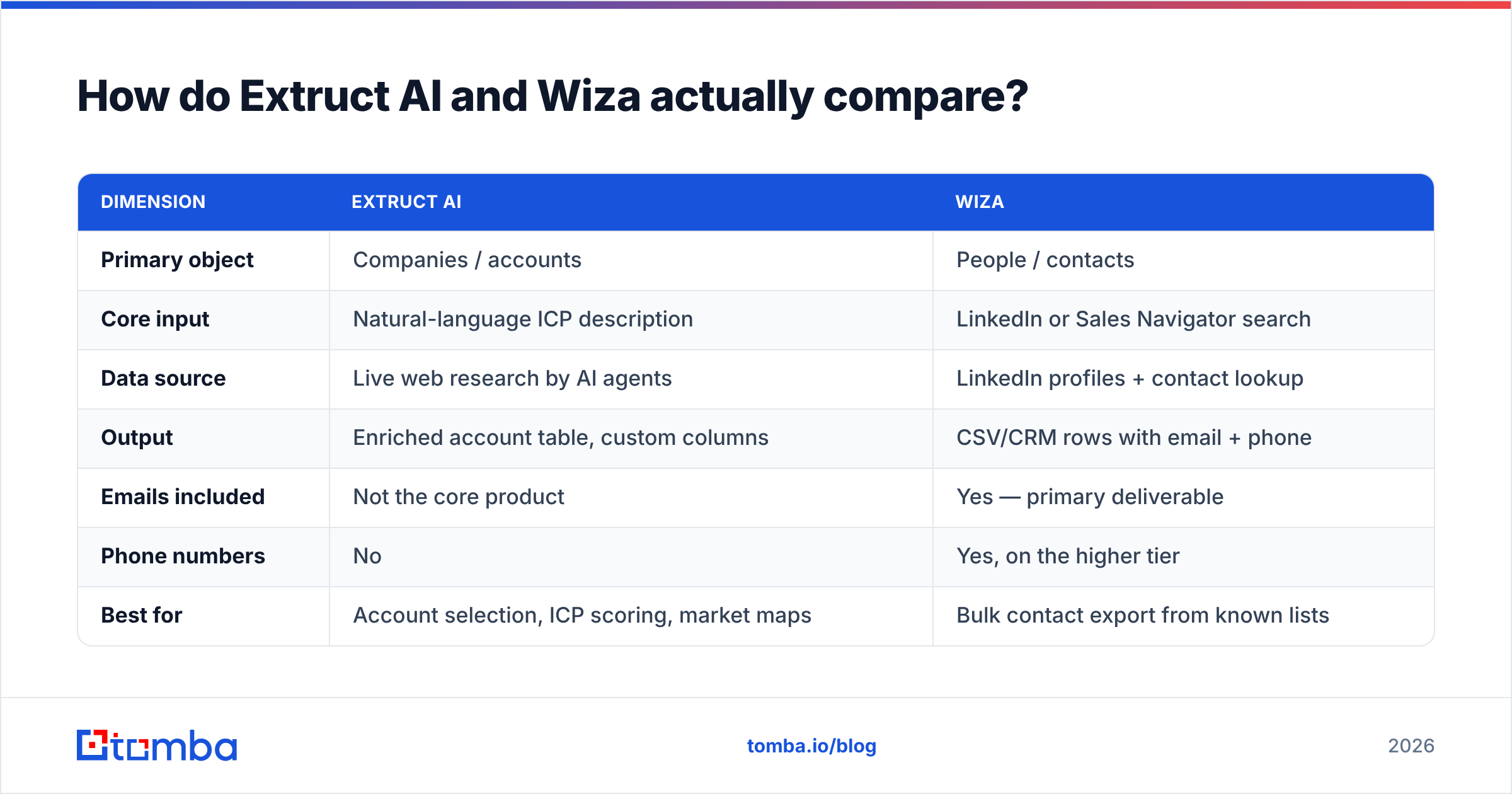
Extruct AI vs Wiza: how do they actually compare?#
| Dimension | Extruct AI | Wiza |
|---|---|---|
| Primary object | Companies / accounts | People / contacts |
| Core input | Natural-language ICP description | LinkedIn or Sales Navigator search |
| Data source | Live web research by AI agents | LinkedIn profiles + contact lookup |
| Output | Enriched account table, custom columns | CSV/CRM rows with email + phone |
| Emails included | Not the core product | Yes — primary deliverable |
| Phone numbers | No | Yes, on the higher tier |
| Best for | Account selection, ICP scoring, market maps | Bulk contact export from known lists |
| Weakest at | Person-level contact detail | Finding accounts you have not identified |
| Learning curve | Prompt-writing; you design the columns | Near zero if you know Sales Navigator |
| Fits which role | RevOps, founders, growth/market research | SDRs, recruiters, agency prospectors |
Read that table as a division of labor, not a scoreboard. Say you have both problems: you do not know your accounts and you do not have contacts. One tool will not fix that.
Which one has more accurate data?#
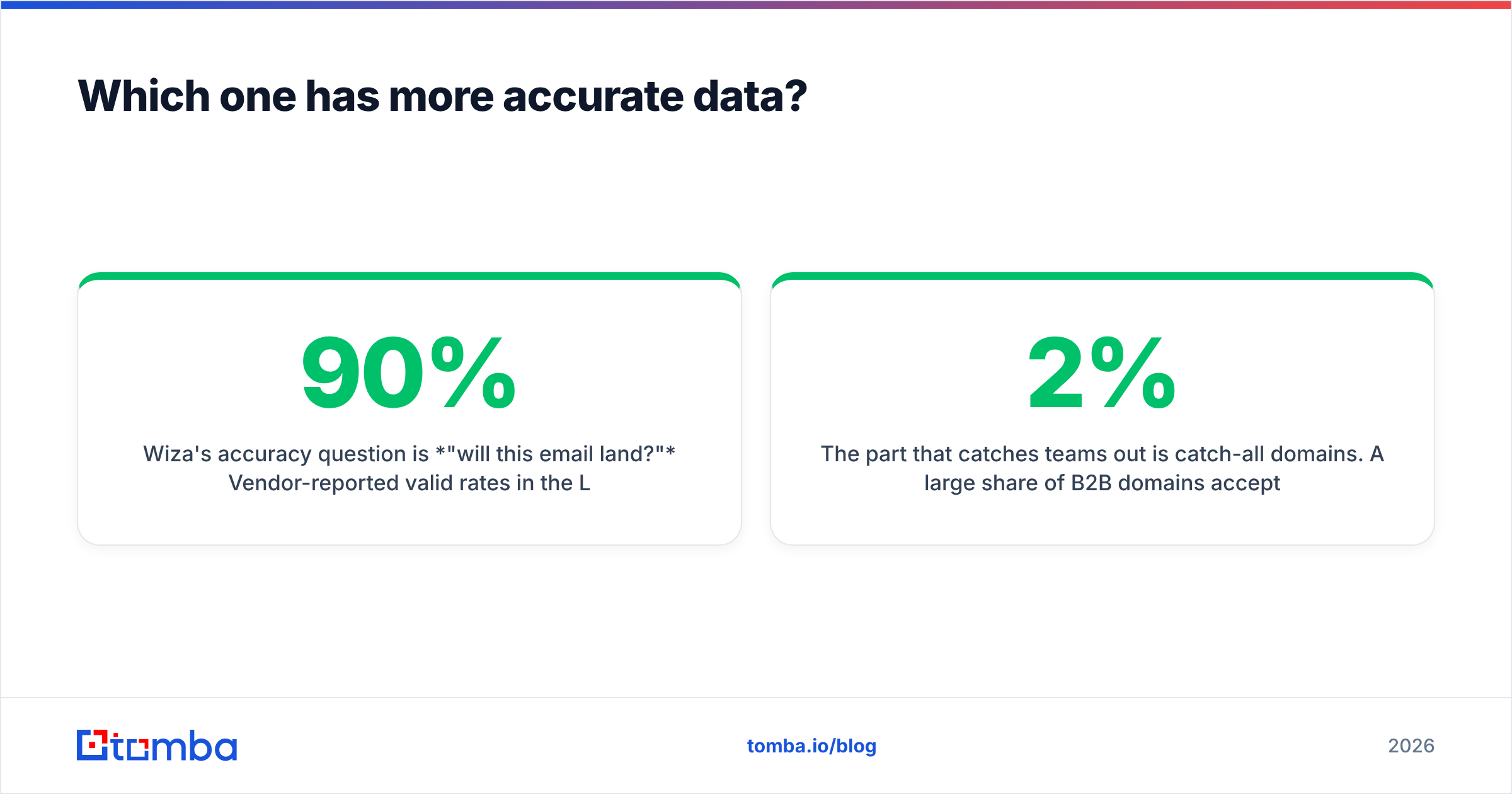
The honest answer: they are accurate about different things. Neither number is the one that decides your bounce rate.
Extruct's accuracy question is "is this claim about the company true?" Agents read live sources, so freshness is strong — headcount, funding, tech signals, hiring activity. But AI research has a failure mode databases do not: confident synthesis from a weak source. A column that asks "do they sell to enterprise?" will always return something. Spot-check 20 rows before you trust 2,000.
Wiza's accuracy question is "will this email land?" Vendor-reported valid rates in the LinkedIn-export category cluster in the 80–90% range. Wiza is competitive there for US-based, LinkedIn-active, mid-to-senior contacts. User reviews on G2 tell the more useful story. Coverage is uneven by geography and seniority, and phone match rates run well below email match rates across every vendor in this space.

The part that catches teams out is catch-all domains. A large share of B2B domains accept every address at the SMTP layer. So a naive check returns "valid" for an address that will hard-bounce or vanish into a black hole. Any tool that reports a simple valid/invalid flag without a catch-all strategy is overstating its accuracy. Run exports through a catch-all verifier before they hit a sequence. That is the difference between a 2% bounce rate and a 9% one — and at 9% you are gambling with the sending domain itself.
What does each one cost in 2026?#
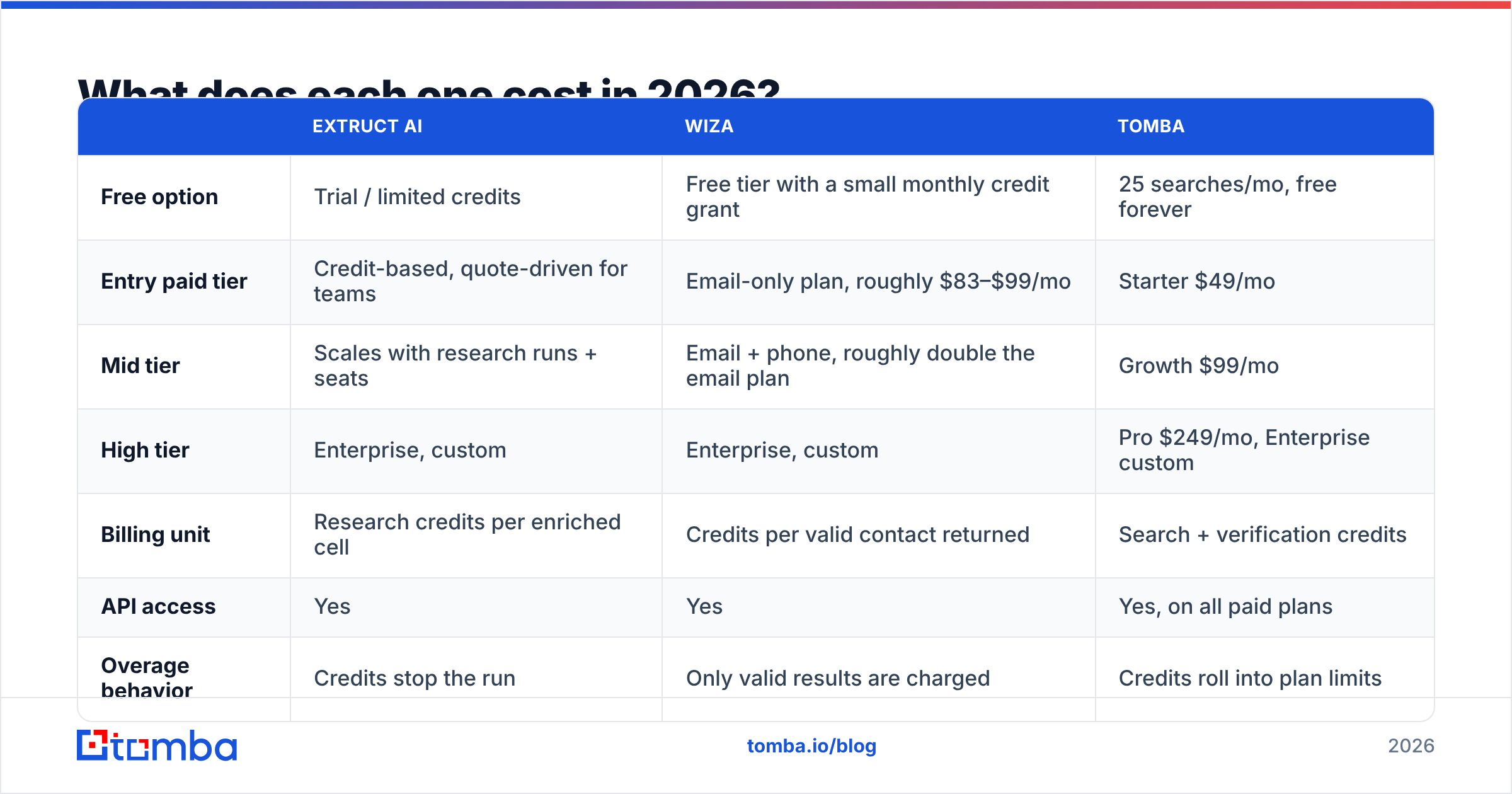
Pricing in this category moves quarterly. Treat these as shapes rather than quotes, and confirm on each vendor's page before you buy.
| Extruct AI | Wiza | Tomba | |
|---|---|---|---|
| Free option | Trial / limited credits | Free tier with a small monthly credit grant | 25 searches/mo, free forever |
| Entry paid tier | Credit-based, quote-driven for teams | Email-only plan, roughly $83–$99/mo | Starter $49/mo |
| Mid tier | Scales with research runs + seats | Email + phone, roughly double the email plan | Growth $99/mo |
| High tier | Enterprise, custom | Enterprise, custom | Pro $249/mo, Enterprise custom |
| Billing unit | Research credits per enriched cell | Credits per valid contact returned | Search + verification credits |
| API access | Yes | Yes | Yes, on all paid plans |
| Overage behavior | Credits stop the run | Only valid results are charged | Credits roll into plan limits |
Two cost traps are worth flagging.
Extruct's cost scales with columns, not rows. A 500-account list with 12 custom research columns is 6,000 agent tasks, not 500. Teams model the row count and get surprised by the multiplier.
Wiza's phone tier is the expensive one. Mobile numbers roughly double the price. Mobile match rates are also the least reliable field any vendor sells. If you are not running a calling motion this quarter, buy the email plan and add phone data later. Or source numbers separately through a phone finder, only for accounts that reach late stage.

Which workflows does each tool actually win?#
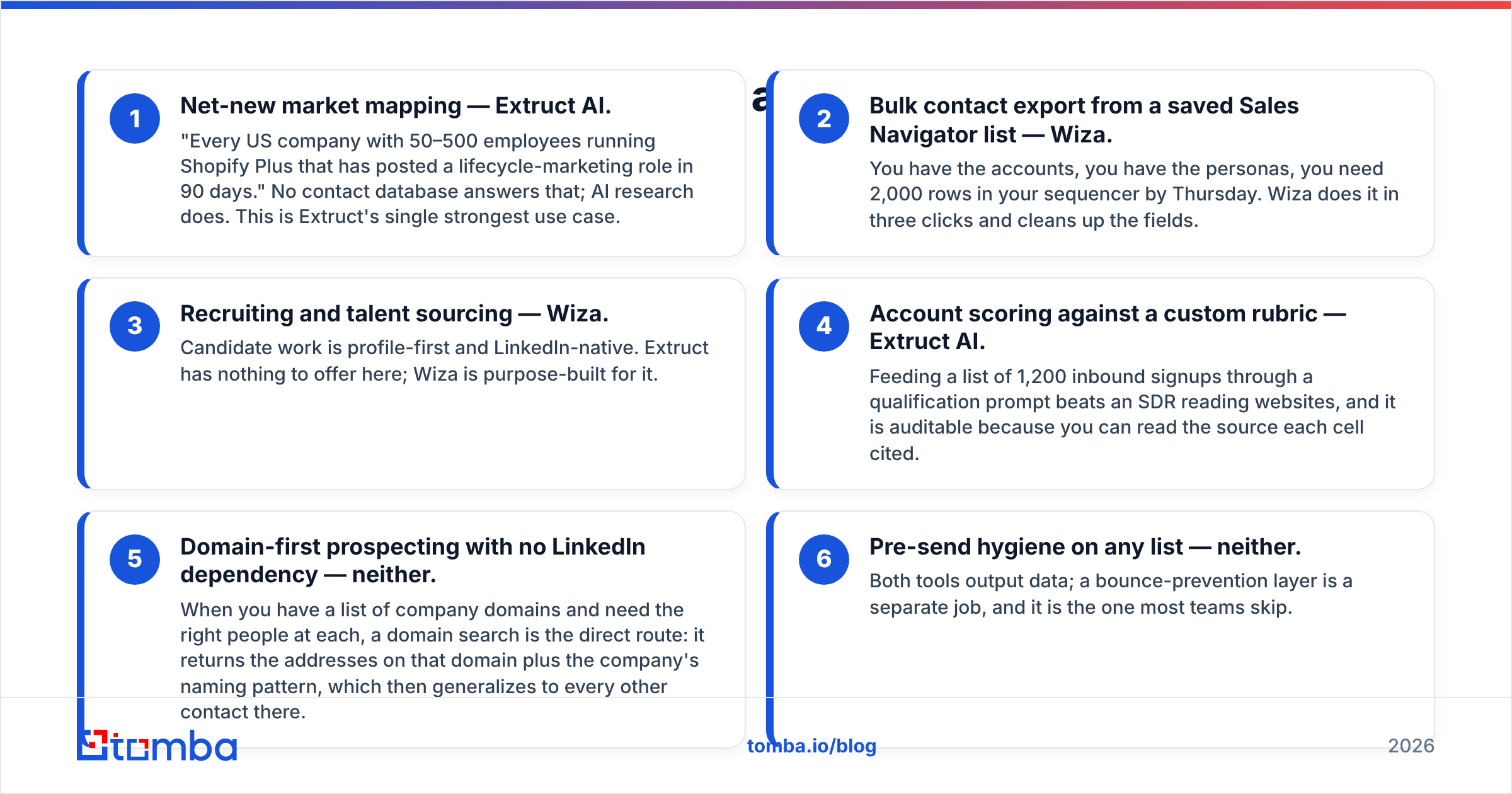
- Net-new market mapping — Extruct AI. "Every US company with 50–500 employees running Shopify Plus that has posted a lifecycle-marketing role in 90 days." No contact database answers that. AI research does. This is Extruct's single strongest use case.
- Bulk contact export from a saved Sales Navigator list — Wiza. You have the accounts and the personas. You need 2,000 rows in your sequencer by Thursday. Wiza does it in three clicks and cleans up the fields.
- Recruiting and talent sourcing — Wiza. Candidate work is profile-first and LinkedIn-native. Extruct has nothing to offer here. Wiza is built for it.
The last three are where the Extruct AI vs Wiza framing breaks down, because the winner is a third tool.
- Account scoring against a custom rubric — Extruct AI. Feed 1,200 inbound signups through a qualification prompt. It beats an SDR reading websites, and it is auditable, because you can read the source each cell cited.
- Domain-first prospecting with no LinkedIn dependency — neither. You have a list of company domains and need the right people at each. A domain search is the direct route. It returns the addresses on that domain plus the company's naming pattern, which then generalizes to every other contact there.
- Pre-send hygiene on any list — neither. Both tools output data. Bounce prevention is a separate job, and it is the one most teams skip.

Where do both tools leave a gap?#
Between "I know the account" and "I can safely email this person," there are three steps neither Extruct nor Wiza fully owns.
Coverage outside LinkedIn. Wiza's ceiling is LinkedIn's coverage. If you sell to manufacturing ops, healthcare administration, European SMBs, or public-sector buyers, a large share of your ICP has no maintained profile. A pattern-based finder works from company domain plus name. It does not care whether a profile exists, because it works from the mail infrastructure outward.
That is why teams pair a LinkedIn tool with a fallback finder, rather than replacing one with the other. If Wiza's coverage is the specific thing hurting you, a Wiza alternative comparison is a shorter path than a full re-platform.
Verification depth. Real verification is syntax, MX, SMTP, role-account detection, disposable-domain detection, and a defensible answer on catch-all domains. Export tools ship a light version of this, because verification is not their product. Run exports through a dedicated email verifier before they load into a sequencer. It is cheap insurance: verification credits cost a fraction of what a damaged sending domain costs to rebuild.
Enrichment after the export. A CSV with name, title, and email is only the start. Firmographics, tech stack, and social handles are what make personalization work at volume. Pushing rows through data enrichment fills those columns without a second seat license.
It is also worth saying plainly: not every team should be building lists at all. Say your ICP is stable and broad — all dental practices in three states. Buying a pre-built, verified list from a specialist like BookYourData is often faster and cheaper than paying per credit to rebuild it yourself. Research tooling earns its keep when the ICP is unusual or the signals are time-sensitive. When the universe is known and static, buying it is the rational move.
Should you use Extruct AI, Wiza, or both?#
Use Extruct AI alone if you are a founder or RevOps lead doing market research and ICP definition, and contacts are somebody else's step. You want the map, not the mailing list.
Use Wiza alone if you are an SDR or recruiter who lives in Sales Navigator. Your accounts are handed to you, and your only job is turning profiles into rows. Nothing about Extruct helps you here.
Use both if you run a full outbound motion and account selection is genuinely hard. Extruct builds the target list, and Wiza pulls contacts for the accounts that are on LinkedIn. Budget realistically: that is two subscriptions, and the combined monthly cost lands well north of $250 before you have verified a single address.
Use neither if your problem is simpler than both tools assume. Many teams already know their accounts, so agentic research is overkill. Their personas are also not reliably on LinkedIn, so exports underdeliver. That team needs one thing: a fast, accurate way to go from company domain to verified contact, at a price that does not scale with seats. Check the Tomba pricing tiers against your monthly contact volume. If you need 2,000 verified contacts a month, the math usually favors a finder-plus-verifier over a seat-based export tool.
One process note matters more than the tool choice: verify at the point of send, not at the point of purchase. B2B contact data decays at roughly 2–3% per month as people change roles. A list exported in January and mailed in April is much worse than the vendor's advertised accuracy. Re-verify anything older than 30 days. That one habit moves bounce rates more than swapping vendors ever will.
What should you do next?#
Run the cheap test before you sign an annual contract. Take 50 accounts you already know are good. Have each candidate tool produce contacts for them. Then send all three outputs through the same verifier and compare three numbers: match rate, verified-valid rate, and cost per verified contact. Vendor accuracy claims are marketing. Cost per usable row is the only figure that survives contact with a sequencer.
Say that test shows your real gap is contact discovery, not account research — which it is for most outbound teams. Start with the Tomba Email Finder. The free tier gives you 25 searches to run the comparison yourself, paid plans start at $49/mo, and finding, verifying, and catch-all checking happen in one place instead of three. Build the list once, verify it before every send, and let the Extruct AI vs Wiza argument settle itself on your own data.
Related guides#
Ready to find emails that actually work?
Join 150,000+ professionals who stopped guessing and started sending. Free credits on signup — no credit card required.
Get the Tomba newsletter
Practical outbound tactics and product updates — once every two weeks.
About the author