Extruct AI vs Zintlr: Which B2B Data Tool Wins in 2026?
Extruct AI researches companies with AI agents. Zintlr sells contact records with personality intel. They solve different halves of the same problem — here's which one your team actually needs, and what neither replaces.
Extruct AI vs Zintlr is a comparison people search for, but the two tools barely overlap. One builds company lists with AI agents. The other sells contact records. Here is what each does well, what it costs, and which one your team should buy.
TL;DR
- Extruct AI and Zintlr are not really competitors. Extruct is an AI research agent that builds and enriches company lists from the open web. Zintlr is a contact database that sells person-level records plus personality profiling.
- Pick Extruct AI if your bottleneck is account selection — finding the 400 companies that match a weird, non-firmographic criterion ("uses Snowflake and just opened a UK office").
- Pick Zintlr if your bottleneck is contact acquisition — you already know the accounts and need emails, direct dials, and a behavioural read on the buyer.
- Neither is a full stack. Both leave you verifying deliverability yourself, which is where a dedicated email verifier earns its keep.
- Budget reality: Extruct-style AI research is priced per enrichment run, and Zintlr-style databases per credit or per seat. Confirm current numbers on the vendor's own pricing page.
What are Extruct AI and Zintlr, actually?#
Short answer: they occupy opposite ends of the go-to-market data pipeline.
Extruct AI is an AI agent platform for company research. You describe the kind of company you want in plain language. Then you name the columns you want filled ("does this company have a self-serve trial?", "how many engineers on LinkedIn?", "which cloud do they run on?"). The agent reads the live web and fills the table. Think of it as a very fast intern who reads 10,000 company websites and never complains about the spreadsheet.
Zintlr is a B2B contact database. It ships a searchable index of companies and people, and it exposes emails and phone numbers. On top of that it layers personality intelligence — a behavioural read on a prospect, drawn from public signals, meant to shape how you write to them. Think of it as a rolodex that also tells you whether the person prefers bullet points or small talk.
The confusion is understandable. Both sell "B2B data." But one generates a list that didn't exist before, and the other retrieves records from a list that already exists. That distinction drives almost every decision below.
Extruct AI vs Zintlr: how do they compare head to head?#
Here is the practical comparison. Treat pricing rows as directional — both vendors iterate on packaging, so confirm on their sites.
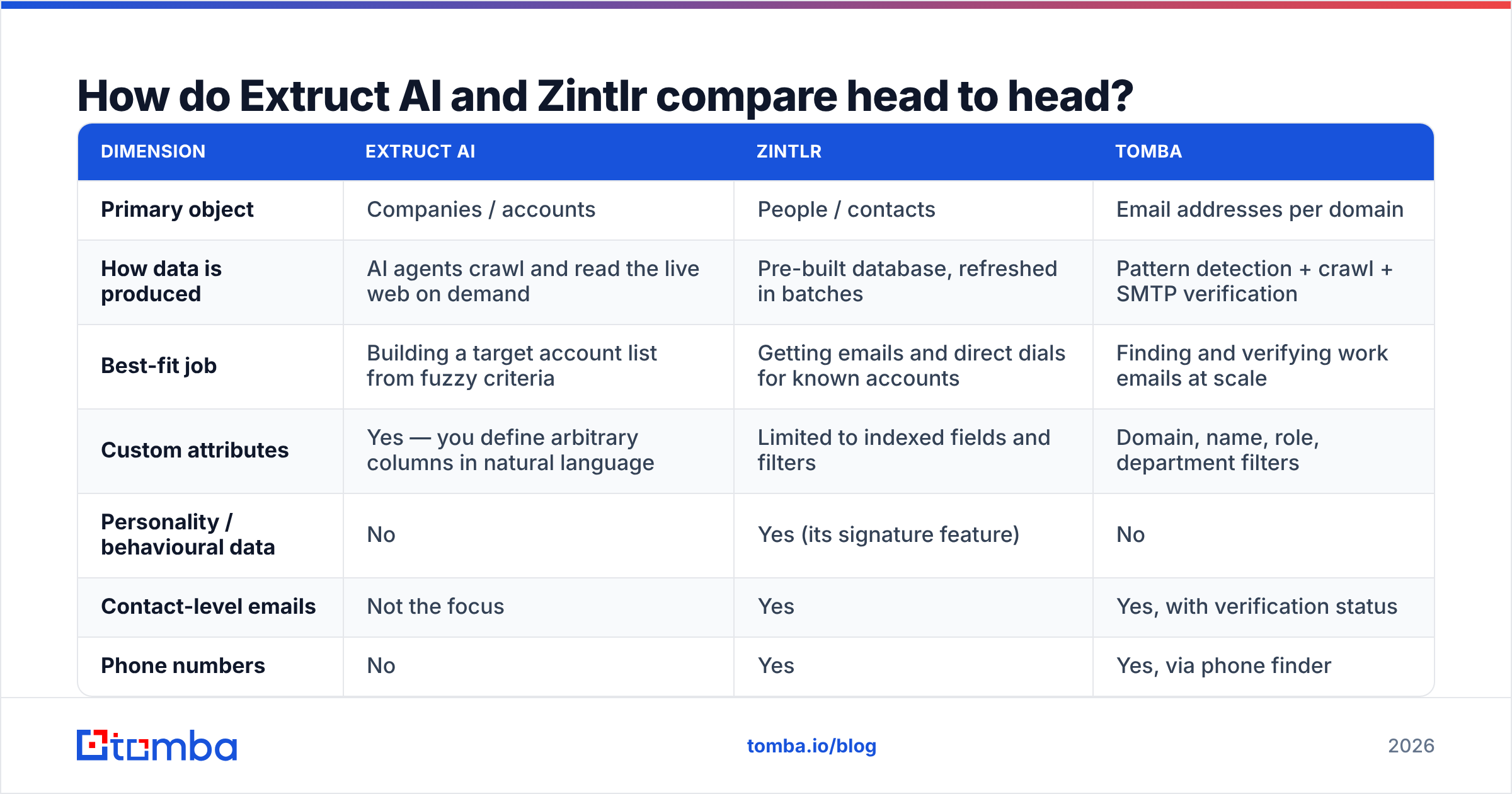
| Dimension | Extruct AI | Zintlr | Tomba |
|---|---|---|---|
| Primary object | Companies / accounts | People / contacts | Email addresses per domain |
| How data is produced | AI agents crawl and read the live web on demand | Pre-built database, refreshed in batches | Pattern detection + crawl + SMTP verification |
| Best-fit job | Building a target account list from fuzzy criteria | Getting emails and direct dials for known accounts | Finding and verifying work emails at scale |
| Custom attributes | Yes — you define arbitrary columns in natural language | Limited to indexed fields and filters | Domain, name, role, department filters |
| Personality / behavioural data | No | Yes (its signature feature) | No |
| Contact-level emails | Not the focus | Yes | Yes, with verification status |
| Phone numbers | No | Yes | Yes, via phone finder |
| Verification built in | No SMTP layer | Basic validity signals | Full SMTP + catch-all handling |
| API access | Yes | Yes | Yes — Tomba API, CLI, MCP |
| Free tier | Trial-based | Limited free plan | 25 searches/mo, free forever |
| Entry paid price | Custom / usage-based | Credit-based tiers | $49/mo Starter |
| Freshness model | Real-time at query time | Database recency varies by segment | Re-verified at request time |
Two things jump out of that table.
First, Extruct's freshness advantage is structural, not marketing. It reads the web when you ask, so it avoids the staleness problem every static database has. If a company shipped a pricing page yesterday, Extruct can see it. Zintlr, like every index-based provider, sees what was in the last refresh.
Second, Zintlr's contact depth is something Extruct doesn't attempt. Extruct will happily tell you a company hires SDRs in Berlin. It will not hand you the VP of Sales's mobile number. Different products.

What is Extruct AI good at, and where does it break?#
Where it wins:
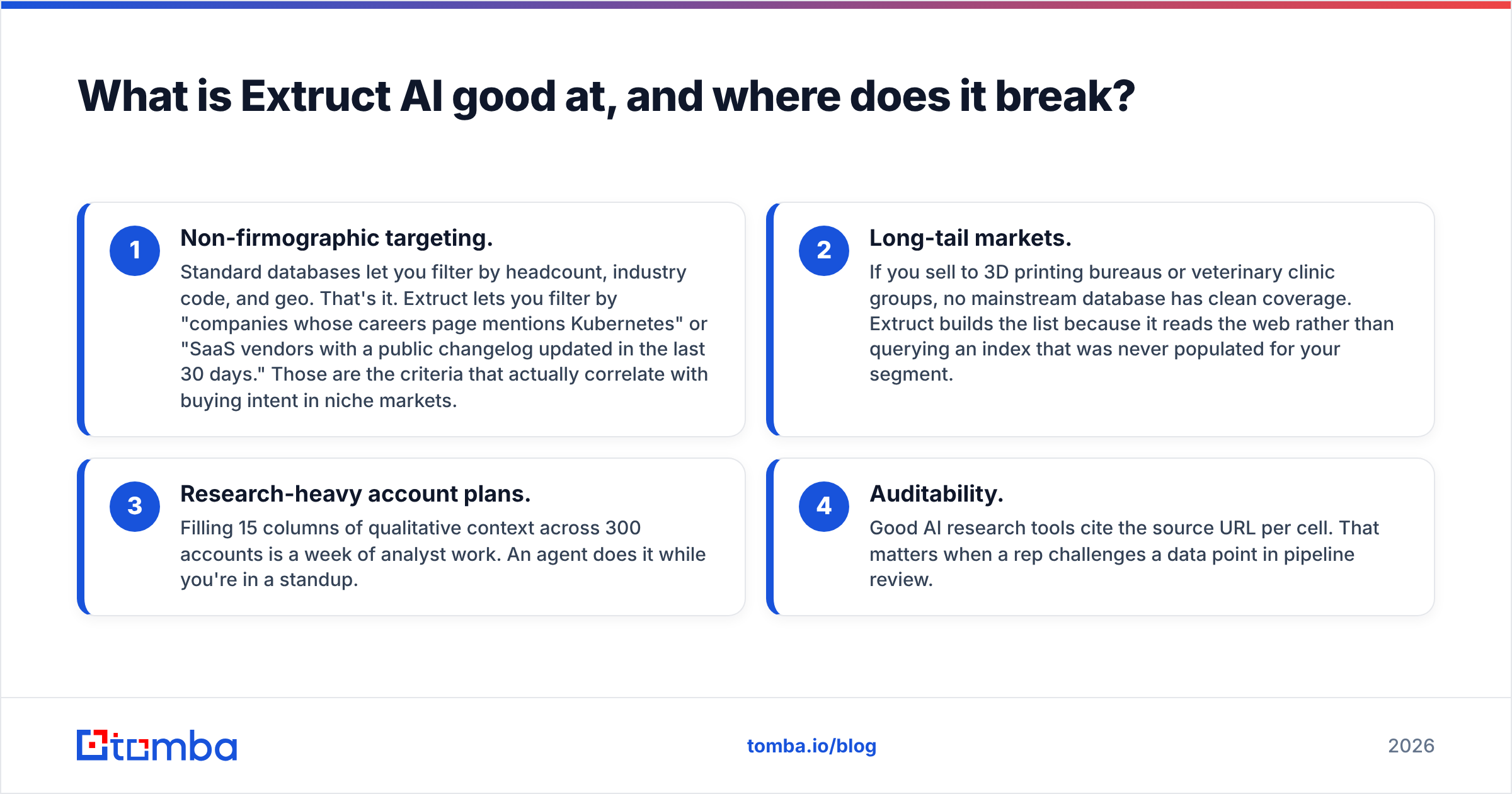
- Non-firmographic targeting. Standard databases filter by headcount, industry code, and geo. That's it. Extruct filters by "companies whose careers page mentions Kubernetes" or "SaaS vendors with a public changelog updated in the last 30 days." Those criteria track buying intent in niche markets.
- Long-tail markets. If you sell to 3D printing bureaus or veterinary clinic groups, no mainstream database has clean coverage. Extruct builds the list because it reads the web rather than querying an index that was never populated for your segment.
- Research-heavy account plans. Filling 15 columns of qualitative context across 300 accounts is a week of analyst work. An agent does it while you're in a standup.
- Auditability. Good AI research tools cite the source URL per cell. That matters when a rep challenges a data point in pipeline review.
Where it breaks:
- It hallucinates like any LLM system when the source is thin. If a company's site says nothing about its tech stack, an under-constrained agent will still produce an answer. Spot-check 20 rows before you trust 2,000.
- Cost scales with columns, not rows. Ten enrichment columns across 1,000 companies is 10,000 agent operations. Budget accordingly.
- No contacts. You finish with a beautiful account list and zero people to email. That gap is exactly why teams pair it with an email finder or a contact database.
- Latency. Live web research is slower than a database lookup. Fine for batch jobs, wrong for a real-time form-fill.
What is Zintlr good at, and where does it break?#
Where it wins:
- Speed to contact. You have a domain, you want the head of marketing's email. That's a sub-second lookup, not a research project.
- Phone coverage. Direct dials remain scarce and expensive across the market. Any provider with real mobile coverage in your geo is worth testing on that axis alone.
- Personality intelligence. This is the genuinely differentiated bit. Does a behavioural profile built from public signals lift reply rates? That is an empirical question for your market. Still, the framing is useful, and reps who struggle with tone find it a helpful crutch. Treat it as a hypothesis generator, not a fact.
- Predictable pricing. Credits per record is easy to model. Usage-based AI pricing is not.
Where it breaks:
- Coverage is uneven outside core geos. Like most contact databases, EU and APAC records thin out relative to the US. Run a sample test against 200 of your target accounts before signing anything.
- Staleness on job changes. B2B contact data decays roughly 25–30% a year as people change roles. Any static database inherits that decay curve. This is not a Zintlr-specific criticism; it's physics for the category.
- No SMTP verification layer you should rely on for sending. "In the database" is not the same as "will accept mail today."
- Fixed schema. You get the fields Zintlr indexes. You can't invent a column.
Which one is more accurate?#
The Extruct AI vs Zintlr accuracy debate is the wrong question. The two tools measure different things.
Extruct's accuracy is a research accuracy question: did the agent read the right page and draw the right conclusion? You measure it by sampling cells and checking cited sources. Expect high accuracy on facts stated plainly on a website — headcount, location, product names. Expect lower accuracy on inferences like revenue estimates, buying intent, or internal tooling.
Zintlr's accuracy is a record accuracy question: does this email belong to this person, and does it still work? You measure it by sending — or, better, by verifying before you send.
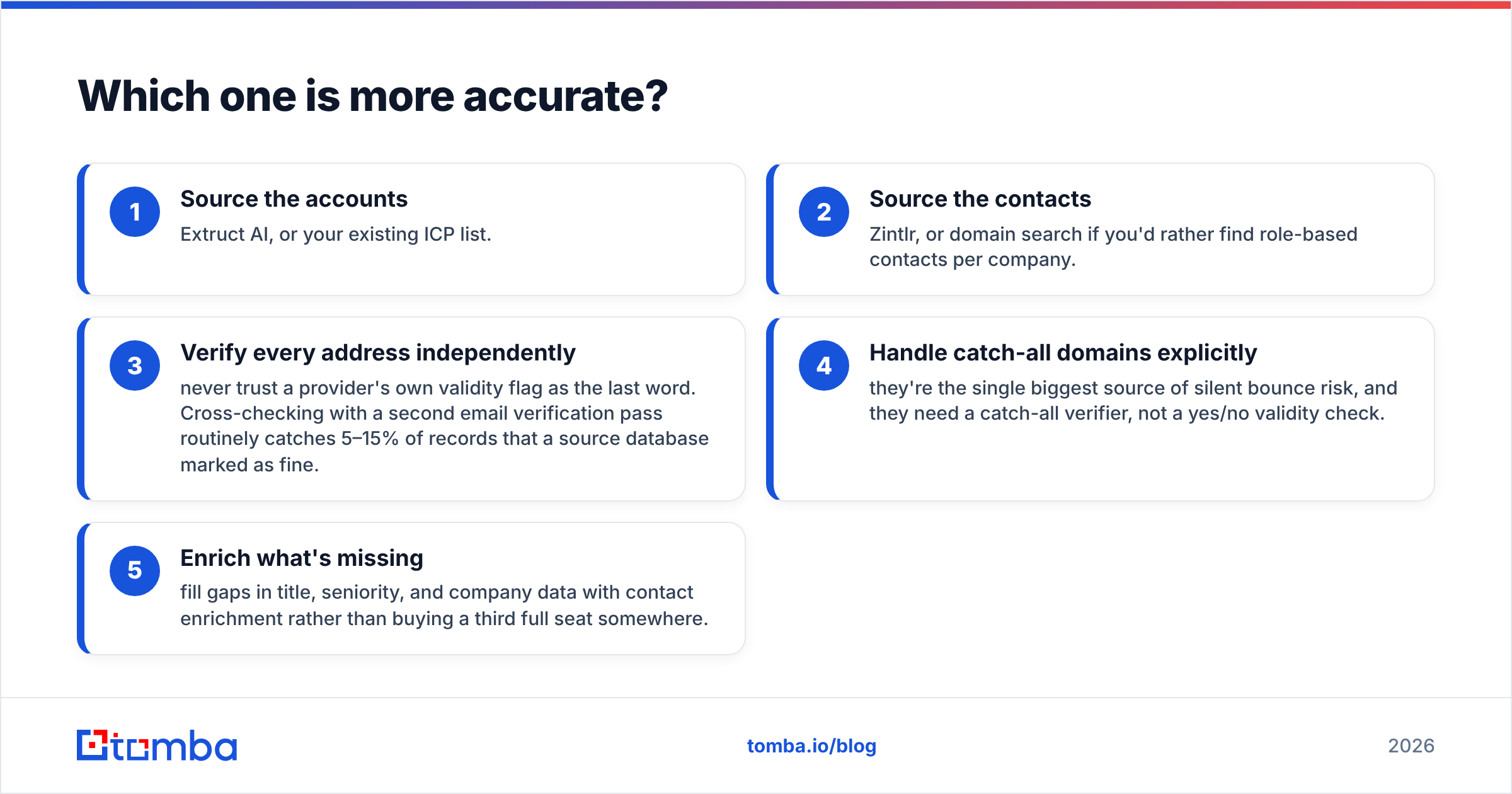
That second measurement is where most teams lose money. Here's the honest sequence that works regardless of which vendor you buy:
- Source the accounts — Extruct AI, or your existing ICP list.
- Source the contacts — Zintlr, or domain search if you'd rather find role-based contacts per company.
- Verify every address independently — never trust a provider's own validity flag as the last word. A second email verification pass routinely catches 5–15% of records that a source database marked as fine.
- Handle catch-all domains explicitly — they're the single biggest source of silent bounce risk, and they need a catch-all verifier, not a yes/no validity check.
- Enrich what's missing — fill gaps in title, seniority, and company data with contact enrichment rather than buying a third full seat somewhere.
Step 3 is non-negotiable. Your sender reputation decides whether any of this data turns into revenue. Bounce rates above roughly 3% destroy it. No data vendor takes responsibility for your domain reputation. You do.
What do they cost, and what's the real total?#
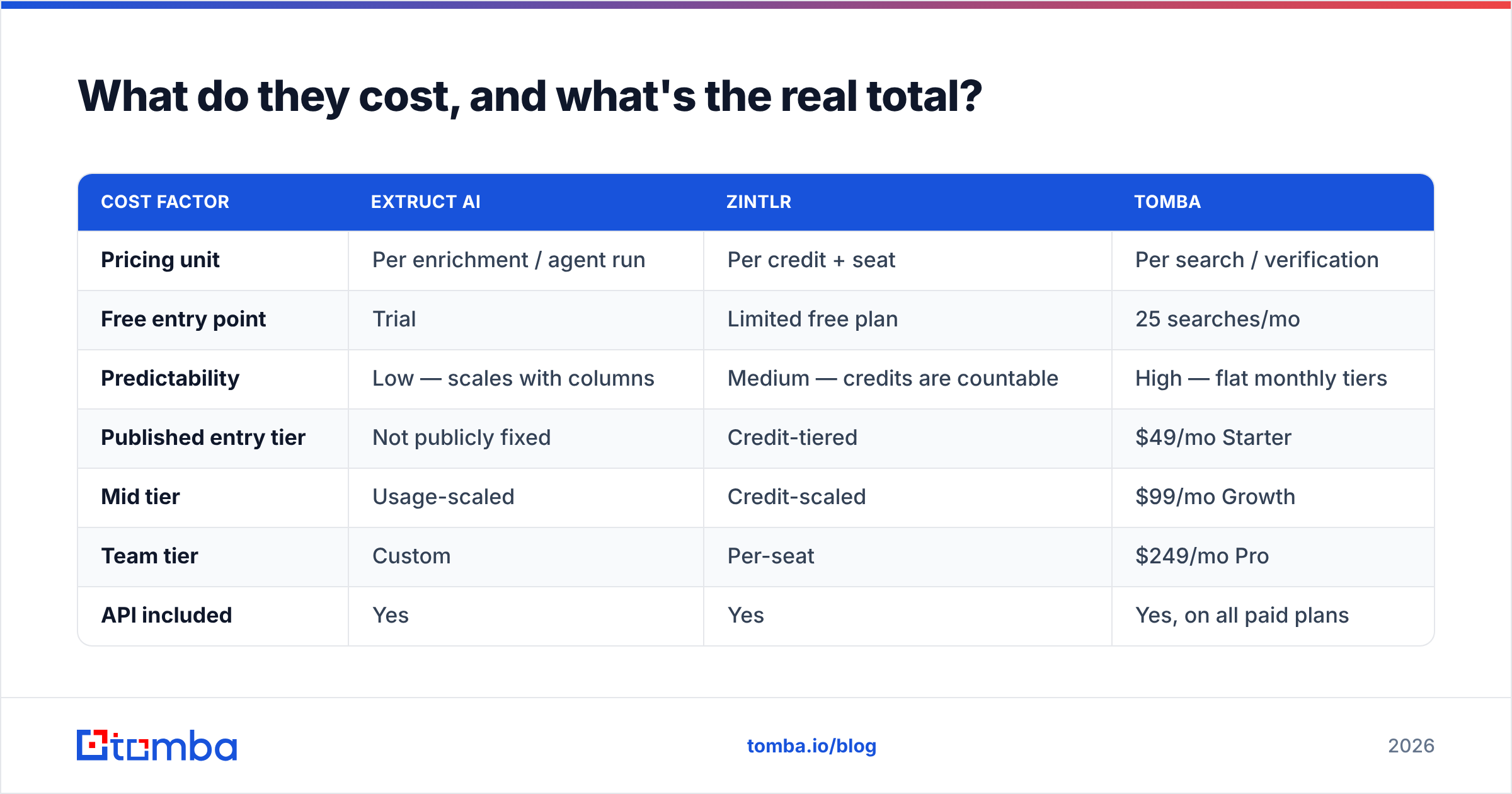
Both vendors price in ways that make direct comparison awkward. Extruct sells usage — agent runs and enrichments. Zintlr sells credits and seats. What follows compares pricing models, not current numbers. Check both vendor pages and cross-reference user reports on G2 before you buy.
| Cost factor | Extruct AI | Zintlr | Tomba |
|---|---|---|---|
| Pricing unit | Per enrichment / agent run | Per credit + seat | Per search / verification |
| Free entry point | Trial | Limited free plan | 25 searches/mo |
| Predictability | Low — scales with columns | Medium — credits are countable | High — flat monthly tiers |
| Published entry tier | Not publicly fixed | Credit-tiered | $49/mo Starter |
| Mid tier | Usage-scaled | Credit-scaled | $99/mo Growth |
| Team tier | Custom | Per-seat | $249/mo Pro |
| API included | Yes | Yes | Yes, on all paid plans |
| Hidden cost to plan for | Re-running enrichments as data ages | Wasted credits on stale records | Minimal — verification is priced in |
The hidden cost line matters more than the sticker price. With an AI research tool, you pay again every time you refresh a column. With a credit database, you pay for records that turn out to be stale — and you generally don't get the credit back. Model both at 12 months, not at month one. If you want a flat, countable baseline to compare against, Tomba pricing publishes every tier openly.
Which should you pick for your use case?#
- Founder-led sales in a niche market → Extruct AI. No database covers your segment. Generate the list, then find contacts separately.
- SDR team with a defined ICP → Zintlr. Your problem is contact throughput, not account discovery.
- RevOps building an enrichment pipeline → Neither alone. You want an API-first layer that fills CRM gaps deterministically, plus verification on write. That's a Tomba API job.
- Agencies running outbound for several clients → Extruct for the research deliverable, plus a per-domain finder for volume. Client lists change monthly. A static database subscription is the wrong shape.
- Anyone sending 500+ cold emails a month → add independent verification, whatever you buy. It is the highest-ROI $49 in the stack.
- Teams that need phone as well as email → Zintlr for dials, or a phone finder plus email workflow if you'd rather consolidate vendors.
Can you use both together?#
Yes, and for larger teams that's the correct answer. Running Extruct AI vs Zintlr as an either/or choice only makes sense on a small budget. The clean architecture looks like this:
Extruct AI defines the account universe with criteria a database can't express. Zintlr (or a domain-based finder) turns those accounts into named people. A verifier decides which of those people you're actually allowed to email. Your sequencer does the sending.
The failure mode is buying two tools that overlap on the same layer — two contact databases, or two research tools. You get 15% incremental coverage for 100% incremental cost. Map your stack to layers before you map it to logos. If you're already paying for a broad platform, our breakdown of Apollo alternatives walks through where the overlap usually hides.
One more practical note: standardise the join key. Domain is the only identifier that survives across all three tools. Company names don't match, LinkedIn URLs change, and person IDs are vendor-specific. Build on domain and your pipeline survives a vendor swap.
The verdict#
Extruct AI wins on account discovery. Zintlr wins on contact acquisition. Neither wins on deliverability, because neither is trying to.
If you can only buy one, ask which list you can't build today. If you can't name the companies, buy the research agent. If you can name them but can't reach anyone, buy the contact database. That's the whole decision.
And whichever you choose, close the loop on the last mile. Sourcing contacts you can't actually deliver to is the most expensive kind of busywork in outbound.
Start with the layer that pays for itself first. Tomba Email Finder finds work emails by domain, name, or company. Every result comes back with a verification status, so you know which addresses are safe to send to before you burn a single send. The free tier gives you 25 searches a month with no card. Starter is $49/mo when you're ready to run volume. Test it against 100 of your current accounts and compare the bounce rate to whatever you use now.
Related guides#
Ready to find emails that actually work?
Join 150,000+ professionals who stopped guessing and started sending. Free credits on signup — no credit card required.
Get the Tomba newsletter
Practical outbound tactics and product updates — once every two weeks.
About the author