Eye Catching Email Subject Lines: 60+ Examples for 2026
Most subject lines die before the preview text even loads. Here are the character limits, the seven formulas that still work, and 60+ eye catching email subject lines you can steal for cold outreach, newsletters, and win-backs in 2026.
TL;DR
- Mobile inboxes cut most subject lines at 30–40 characters. Write the payload first, the qualifier second, or nobody reads it.
- Curiosity beats cleverness. Specificity beats curiosity. "Q3 churn number" outperforms "You won't believe this."
- Personalization tokens only lift opens when the data behind them is right. A wrong first name costs more than no first name.
- Seven formulas cover roughly 90% of high-performing B2B subject lines: question, number, mutual reference, observation, one-word, deadline, and reply-thread.
- Subject lines cannot rescue a bad list. Verified deliverable addresses move open rates more than any word choice.
What makes an email subject line eye catching in 2026?#
An eye catching subject line does one job: it makes the recipient's next physical action "tap" instead of "swipe left." That's it. It doesn't need to be witty, and it definitely doesn't need to sell.
Three things determine whether that tap happens, and only one of them is the copy:
- Sender recognition. The from-name gets read before the subject line. An unknown sender at an unknown domain starts with a scoring penalty no amount of copywriting fixes.
- Placement. If your message lands in Promotions or Spam, the subject line is competing against 400 others in a folder nobody opens on Tuesday.
- The first 30–40 characters. This is the actual copy problem, and it's smaller than most people assume.
Marketers spend 80% of their effort on point three and 0% on points one and two. That ratio is backwards. If you're seeing single-digit open rates, the copy is rarely the bottleneck — the list is. Bounces, spam traps, and role accounts drag your sender reputation down until even a perfect subject line gets filtered.
Fix the list, then fix the words. The rest of this guide assumes your list is clean.
How long should an eye catching subject line be?#
Short. Shorter than the guidance you read in 2019, because inbox previews got narrower and mobile share kept climbing.
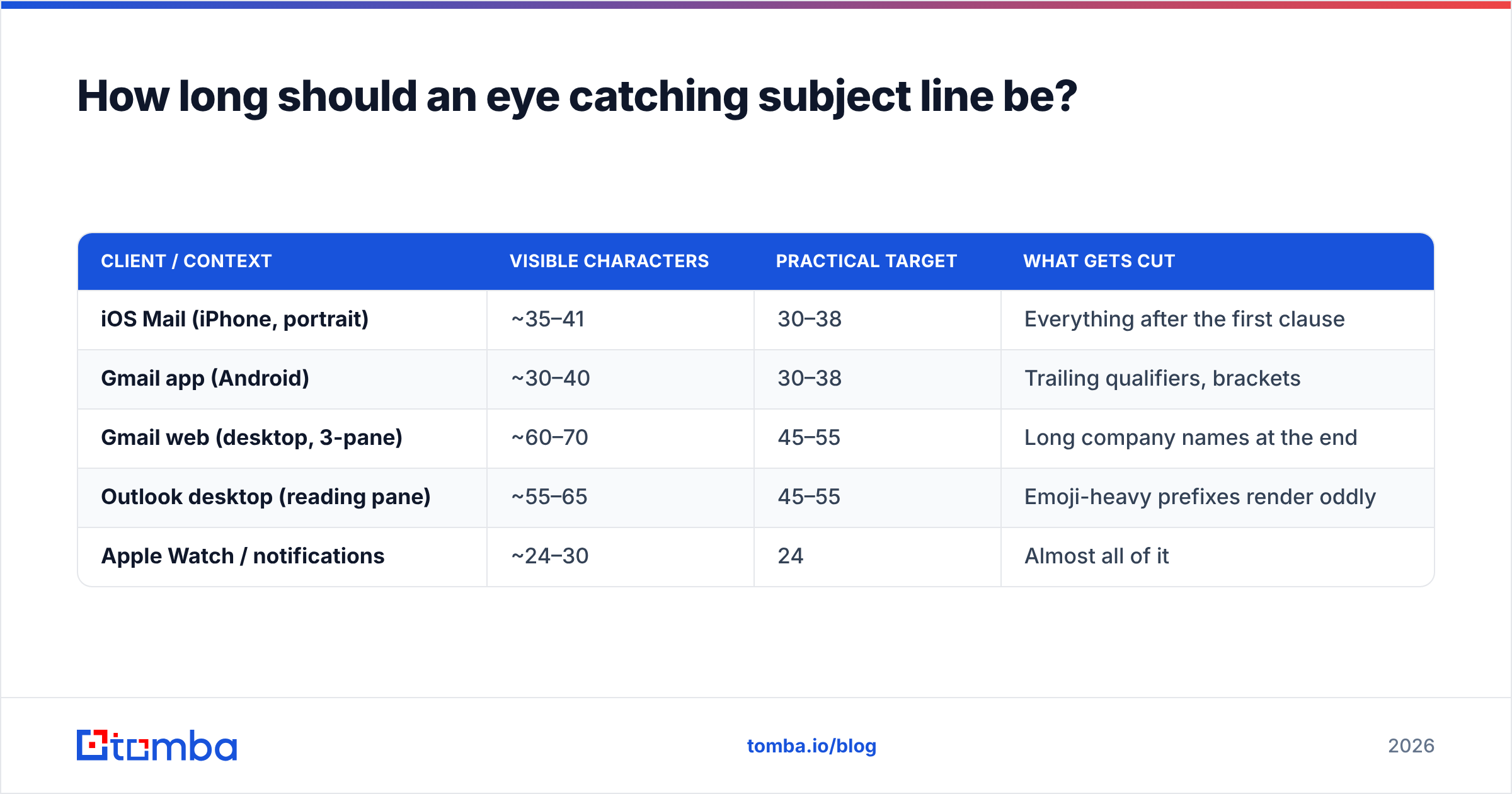
Here's what's actually visible before truncation across the clients that matter for B2B:
| Client / context | Visible characters | Practical target | What gets cut |
|---|---|---|---|
| iOS Mail (iPhone, portrait) | ~35–41 | 30–38 | Everything after the first clause |
| Gmail app (Android) | ~30–40 | 30–38 | Trailing qualifiers, brackets |
| Gmail web (desktop, 3-pane) | ~60–70 | 45–55 | Long company names at the end |
| Outlook desktop (reading pane) | ~55–65 | 45–55 | Emoji-heavy prefixes render oddly |
| Apple Watch / notifications | ~24–30 | 24 | Almost all of it |
The takeaway isn't "always write 30 characters." It's front-load the payload. Put the interesting noun in the first four words and let the tail truncate harmlessly.
Bad: Quick question about how your team at Acme handles onboarding
Good: Acme onboarding — quick question
Same information. The second one survives an iPhone.
What are the 7 subject line formulas that still work?#
Almost every high-performing B2B subject line is a variation of one of these. Use them as scaffolding, not scripts.
- The specific question. Names a real decision the recipient owns. "Who owns SDR tooling at Acme?" — works because it's answerable in one line and implies a short reply.
- The number. A metric, count, or dollar figure creates an information gap that vagueness can't. "3 duplicate records in your CRM" beats "CRM data issues."
- The mutual reference. A shared person, event, community, or investor. "Sarah said to reach out" — only if it's true. Fabricated references are the fastest way to burn a domain.
- The observation. Proof you looked at their business before writing. "Your careers page lists 6 open AE roles" signals research in five words.
- The one-word subject. "Pricing", "Timing", "Renewal" — reads like an internal thread. Highest risk, highest reward, and it fails badly if the body doesn't immediately justify it.
- The soft deadline. Real constraints only. "Closing the Q3 pilot list Friday" works; "LAST CHANCE!!!" gets filtered.
- The reply-thread. No subject line at all, or a bare
Re:on a genuine second touch. Never fake aRe:on a first send — recipients notice, and it converts curiosity into resentment.
Notice what's missing: puns, alliteration, and anything a copywriter would be proud of. Cleverness competes with clarity for the same 35 characters, and clarity wins in B2B.
Which subject line style fits which email type?#
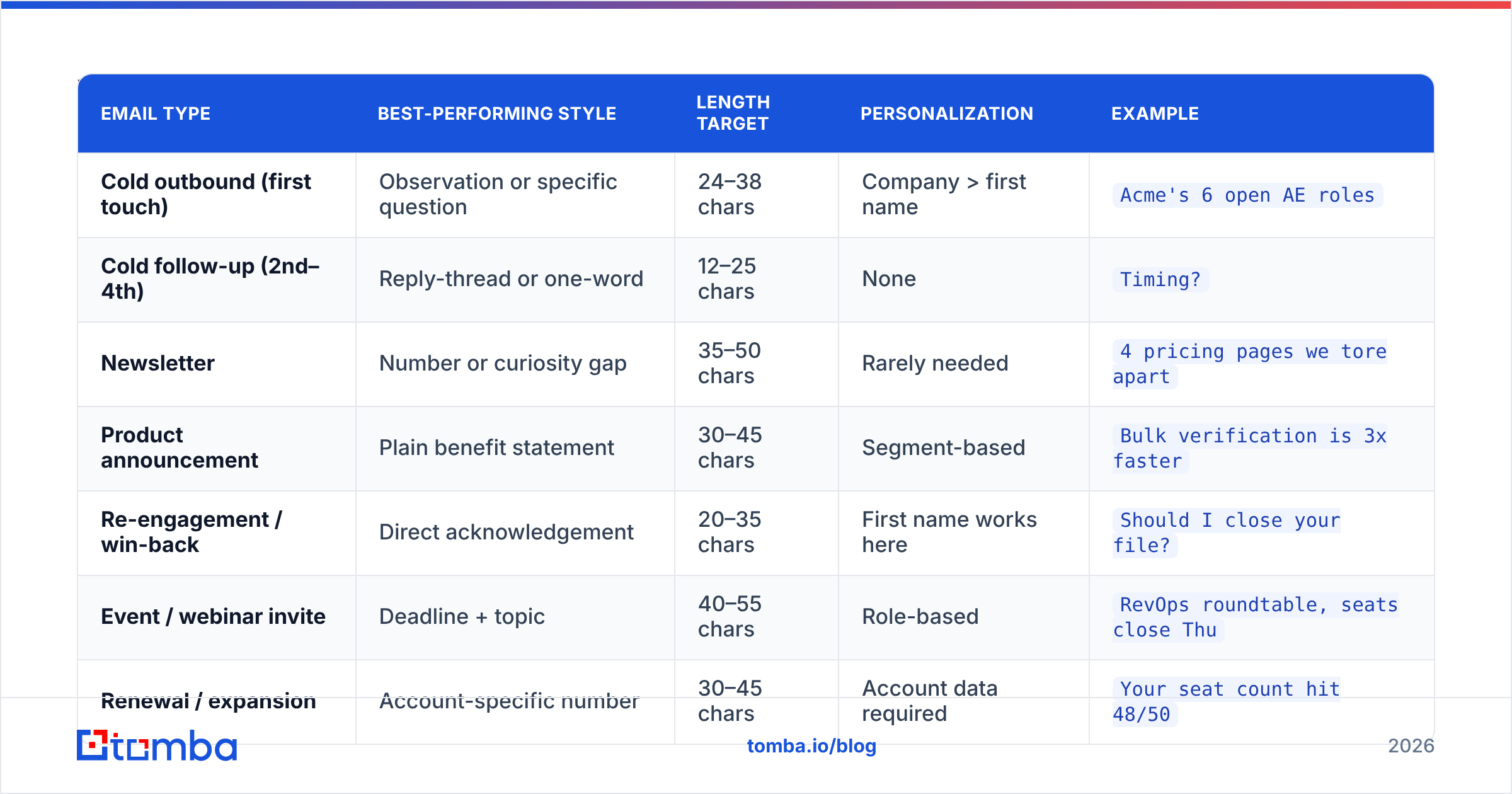
Different email types have different permission levels. A newsletter subscriber opted in; a cold prospect did not. Matching style to context matters more than the individual words.
| Email type | Best-performing style | Length target | Personalization | Example |
|---|---|---|---|---|
| Cold outbound (first touch) | Observation or specific question | 24–38 chars | Company > first name | Acme's 6 open AE roles |
| Cold follow-up (2nd–4th) | Reply-thread or one-word | 12–25 chars | None | Timing? |
| Newsletter | Number or curiosity gap | 35–50 chars | Rarely needed | 4 pricing pages we tore apart |
| Product announcement | Plain benefit statement | 30–45 chars | Segment-based | Bulk verification is 3x faster |
| Re-engagement / win-back | Direct acknowledgement | 20–35 chars | First name works here | Should I close your file? |
| Event / webinar invite | Deadline + topic | 40–55 chars | Role-based | RevOps roundtable, seats close Thu |
| Renewal / expansion | Account-specific number | 30–45 chars | Account data required | Your seat count hit 48/50 |
A pattern worth stealing from the table: personalization intensity should drop as the sequence progresses. Your first email earns attention with research. Your fourth earns it with brevity.
What are 60+ eye catching email subject lines you can steal?#
Swap the brackets for real data. Do not send any of these with the placeholders still in them — it happens more than you'd think.
Cold outbound, first touch
[Company] + [your category]?Who owns [function] at [Company]?Question about your [tool] setupSaw your post on [topic][Company]'s [N] open [role] rolesIdea for [Company]'s Q4 pipelineYour [page] loads in 4.2s[Competitor] switched last monthTwo minutes on [specific problem]?Re: [Company] hiring plan[First name] — quick one on [topic]Worth a look for [department]?
Follow-ups
Timing?Still relevant?Closing the loopBad time?One more ideaShould I stop?Bumping this upAny interest?Last note from meWrong person?
Newsletters
The [N]-step teardown nobody asked forWe tested [N] tools. Two survived.What [industry] gets wrong about [topic][Number]% of [audience] do this wrongA boring tactic that prints moneyInside [Company]'s [process]The [year] version of [old tactic]Unpopular opinion: [claim][N] charts, no commentaryRead this before you buy [category]
Re-engagement
Should I close your file?Is this still a priority?Breaking up with your inboxYou went quiet — my fault?Removing you from the listStill interested in [topic]?Left this on your deskCircling back one final time
Product and lifecycle
[Feature] is liveYour [metric] went up [N]%[N] credits left this monthWe fixed the thing you reportedNew: [feature] for [use case]Your trial ends ThursdayYour account hit [N] of [limit]Changelog: [month]
Event and webinar
[Topic] roundtable — [N] seats leftCoffee at [Conference]?You + [N] other [role]s, Thursday30 minutes, no slidesLive teardown: [Company]Are you going to [Event]?
Curiosity-led (use sparingly)
This one's a little weirdDon't open this after 5pmA dumb question about [topic]The email I almost didn't sendPermission to be direct?Not a sales emailYou'll probably say noI was wrong about [topic]
The curiosity-led group tests well and ages badly. Rotate them out every quarter, because once a formula spreads across sequencing tools, response rates collapse.

What kills open rates faster than a boring subject line?#
Five things, ranked by how much damage they do:
- Invalid addresses. Hard bounces above roughly 2% start suppressing your inbox placement across the whole domain. Run every import through an email verifier before the first send, not after the first bounce report.
- Catch-all guesswork. Catch-all domains accept everything, then silently discard. They inflate your "delivered" number while your reply rate stays flat. A catch-all verifier tells you which ones are safe to keep.
- Spam-trigger stacking. One exclamation mark is fine.
FREE!!! LIMITED TIMEin a subject with an image-heavy body and three tracking links is not. Run drafts through a spam checker before you queue 5,000 sends. - Authentication gaps. Missing or misaligned SPF, DKIM, and DMARC records send a large share of otherwise clean mail to spam. Google and Yahoo's bulk-sender requirements made this non-optional. Litmus and the major ESPs publish current checklists worth bookmarking.
- Sending volume spikes. Going from 20 emails a day to 800 on a fresh domain looks exactly like a compromised account. Ramp gradually.
None of these are copywriting problems. All of them will make good copy look bad in your reporting.
Does personalization in subject lines still work?#
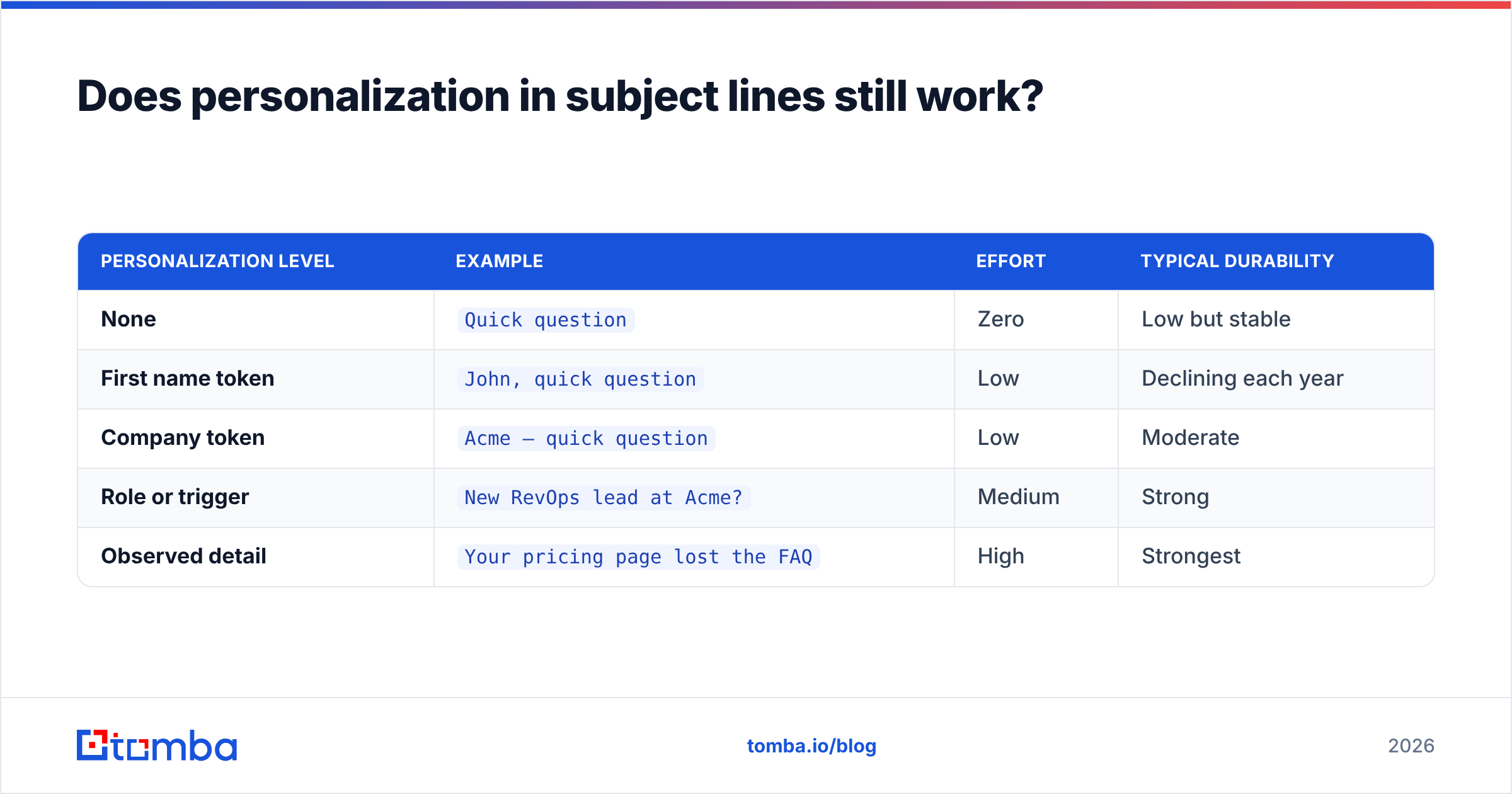
Yes, but the useful kind isn't Hi {{FirstName}}.
Token-level personalization has been commoditized. Everyone has it, recipients recognize the shape of it, and one mismatched merge field ("Hi There," "Hi ,") signals automation instantly. Research summarized by HubSpot has consistently shown personalized subject lines lifting open rates — but the effect shrinks every year as usage saturates.
What still works is context personalization: referencing something only someone who looked at the account would know.
| Personalization level | Example | Effort | Typical durability |
|---|---|---|---|
| None | Quick question |
Zero | Low but stable |
| First name token | John, quick question |
Low | Declining each year |
| Company token | Acme — quick question |
Low | Moderate |
| Role or trigger | New RevOps lead at Acme? |
Medium | Strong |
| Observed detail | Your pricing page lost the FAQ |
High | Strongest |
The bottom two rows require accurate firmographic data, which means your enrichment layer matters more than your copy layer. If your CRM says a prospect is a "Director of Marketing" and they were promoted eight months ago, the personalization actively hurts. Refreshing records through data enrichment keeps those references from backfiring.
How should you A/B test subject lines without fooling yourself?#
Most subject-line tests are statistically meaningless. Here's a workable discipline:
- Test one variable. Length or angle or personalization — never all three. If A is
Timing?and B isJohn, do you have 15 minutes on Thursday to discuss onboarding?, you learn nothing about which change mattered. - Set a minimum sample. Below roughly 1,000 recipients per variant, a 2-point difference in opens is noise. For small B2B lists, run the test across a full month of sends instead of a single blast.
- Measure replies, not opens. Apple Mail Privacy Protection pre-fetches images and inflates open rates. Opens are now a directional signal at best. Reply rate and meetings booked are the numbers that survive.
- Keep a losers file. Log the variants that failed and why. Teams re-test the same losing angle every two quarters because nobody wrote it down.
- Re-test winners quarterly. Formulas decay. A subject line that won in January is now in twelve competitors' sequences.
If you want a fast starting point, generate a batch with a subject line generator, then run the shortlist through a subject line tester to catch truncation and spam-word issues before they hit the queue.
Which subject line mistakes should you retire in 2026?#
- Emoji in B2B subject lines. They render inconsistently in Outlook, and they read as consumer marketing to a procurement lead.
RE:orFWD:on first contact. It's a lie the recipient can verify in one second.- All-caps urgency. Filters weight this heavily, and it caps your ceiling at the least discerning segment of your list.
- Company name as the entire subject.
Tombaalone tells the reader nothing and looks like a receipt. - Questions you don't answer in the body. The subject sets an expectation; violating it trains people to ignore your from-name permanently.
- Length over 60 characters with the point at the end. Nobody reads the end.
What's the fastest way to improve your next send?#
Start with the list, not the line. Pull a clean set of role-matched contacts, verify them, then apply the shortest formula that fits your email type. In that order, a mediocre subject line still lands. In reverse order, a brilliant one doesn't get seen.
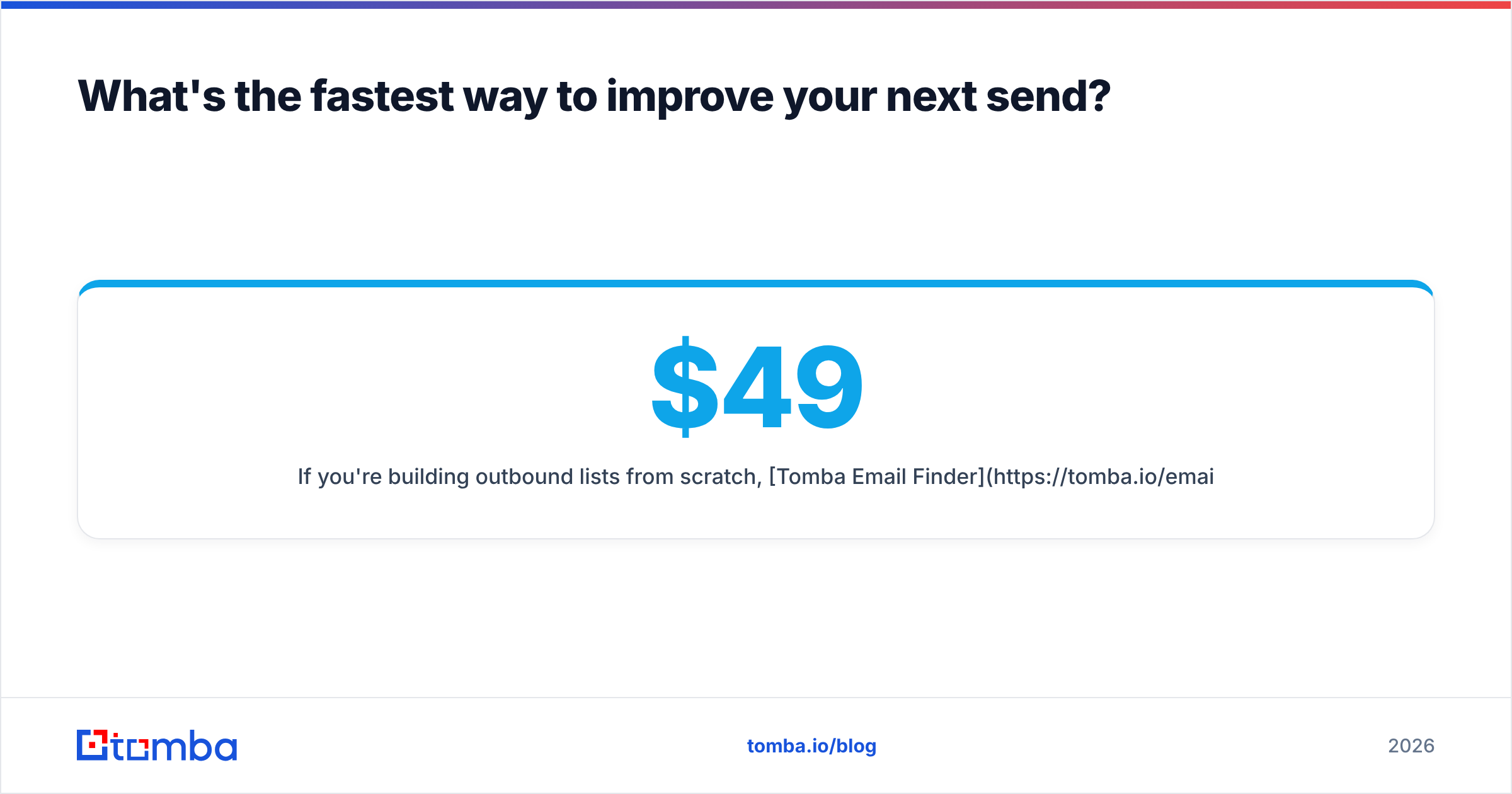
If you're building outbound lists from scratch, Tomba Email Finder finds verified professional addresses by name, domain, or company, with confidence scoring on every result so you're not guessing which addresses will bounce. The free tier includes 25 searches per month, and paid plans start at $49/mo on Starter, $99/mo on Growth, and $249/mo on Pro — full details on the Tomba pricing page. Clean the list first, and your subject lines finally get a fair test.
Related guides#
Ready to find emails that actually work?
Join 150,000+ professionals who stopped guessing and started sending. Free credits on signup — no credit card required.
Get the Tomba newsletter
Practical outbound tactics and product updates — once every two weeks.
About the author