EZ Texting Pricing, Reviews, Pros and Cons (2026 Guide)
A neutral breakdown of EZ Texting pricing tiers, real per-message costs, carrier fees, review themes, and where the platform quietly gets expensive — plus what to use instead.
Short answer: EZ Texting is easy to use, and the bill is easy to underestimate. This EZ Texting pricing, reviews, pros and cons guide covers the real 2026 costs, the themes in user reviews, and where the tool falls short.
TL;DR
- EZ Texting plans run about $25/mo (Launch) to $299/mo (top tiers). The sticker price is not the real cost. Carrier fees, credit overages, and per-number rentals stack on top.
- Reviews on G2 and Capterra cluster around the same two themes: the interface is genuinely easy, and the billing is genuinely confusing.
- The platform is strongest for local businesses with an existing opted-in list. It is weakest for B2B outbound teams who need to build a contact list first.
- 10DLC registration is mandatory in the US. It adds one-time and monthly fees, and it can delay your first send by days.
- If your problem is finding decision-makers, not texting people you already know, an SMS tool fixes the wrong half.
What is EZ Texting and who actually uses it?#
EZ Texting is a US-focused SMS and MMS marketing platform built for small and mid-sized businesses. You upload or collect a contact list, buy a dedicated number or share a shortcode, and send bulk texts — promotions, appointment reminders, event alerts, staffing notifications.
Think of it like a mailing-list tool that happens to use phone numbers instead of inboxes. The mechanics are familiar: contact groups, templates, scheduling, drip campaigns, and reporting on delivery and click rates. What changes is the delivery layer. Email deliverability comes down to reputation and authentication. SMS comes down to carriers, and carriers charge a toll at every gate.
The typical customer is a gym, dental practice, church, restaurant group, retail chain, or staffing agency. These are businesses with a physical customer base that already handed over a phone number. The tool was not built for cold B2B outbound. Use it that way and your number gets filtered fast.
EZ Texting pricing, reviews, pros and cons: what the plans cost in 2026#
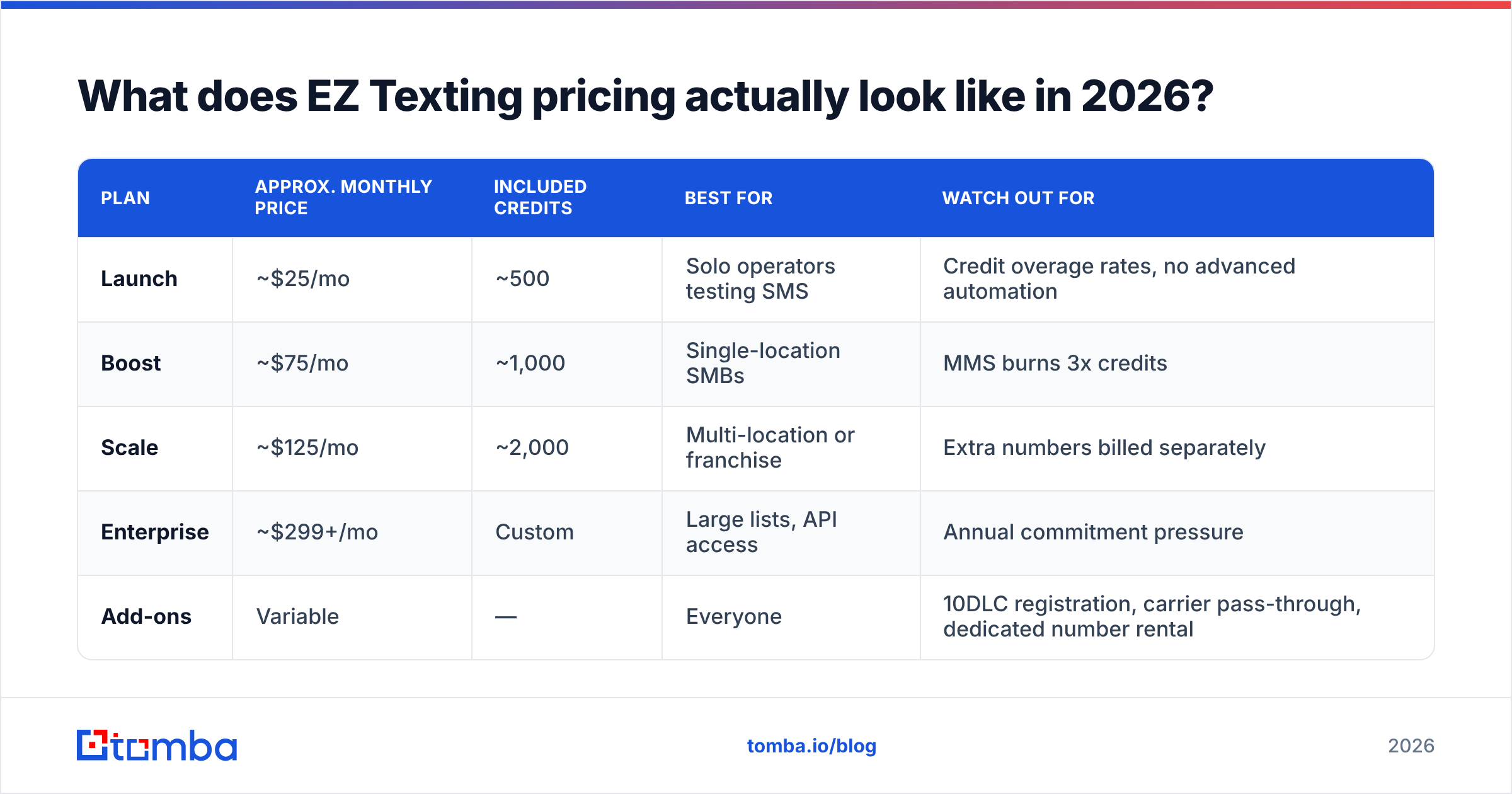
Here is the part most reviews skip. EZ Texting bills on a credit system layered over a monthly subscription. One SMS segment (160 characters) uses one credit. An MMS uses three. A 200-character message quietly becomes two segments, so your "1,000 messages" plan can run dry at 500 sends.
| Plan | Approx. monthly price | Included credits | Best for | Watch out for |
|---|---|---|---|---|
| Launch | ~$25/mo | ~500 | Solo operators testing SMS | Credit overage rates, no advanced automation |
| Boost | ~$75/mo | ~1,000 | Single-location SMBs | MMS burns 3x credits |
| Scale | ~$125/mo | ~2,000 | Multi-location or franchise | Extra numbers billed separately |
| Enterprise | ~$299+/mo | Custom | Large lists, API access | Annual commitment pressure |
| Add-ons | Variable | — | Everyone | 10DLC registration, carrier pass-through, dedicated number rental |
Treat those figures as directional. SMS vendors change packaging often, so check current numbers on the EZ Texting site before you budget. The structural point holds either way: the subscription is the floor, not the ceiling.
Three cost lines catch people out:
- Carrier pass-through fees. US carriers add per-message surcharges on top of your credits. That money is not EZ Texting's margin, but it still lands on your invoice.
- 10DLC registration. Every US business sending application-to-person SMS must register a brand and a campaign. Expect a one-time brand fee plus a monthly campaign fee. Also expect a few days of review before your first send clears.
- Segment math. Emojis push a message into UCS-2 encoding, which cuts the segment limit from 160 to 70 characters. One emoji can triple your cost per send.
Is EZ Texting worth it compared to alternatives?#
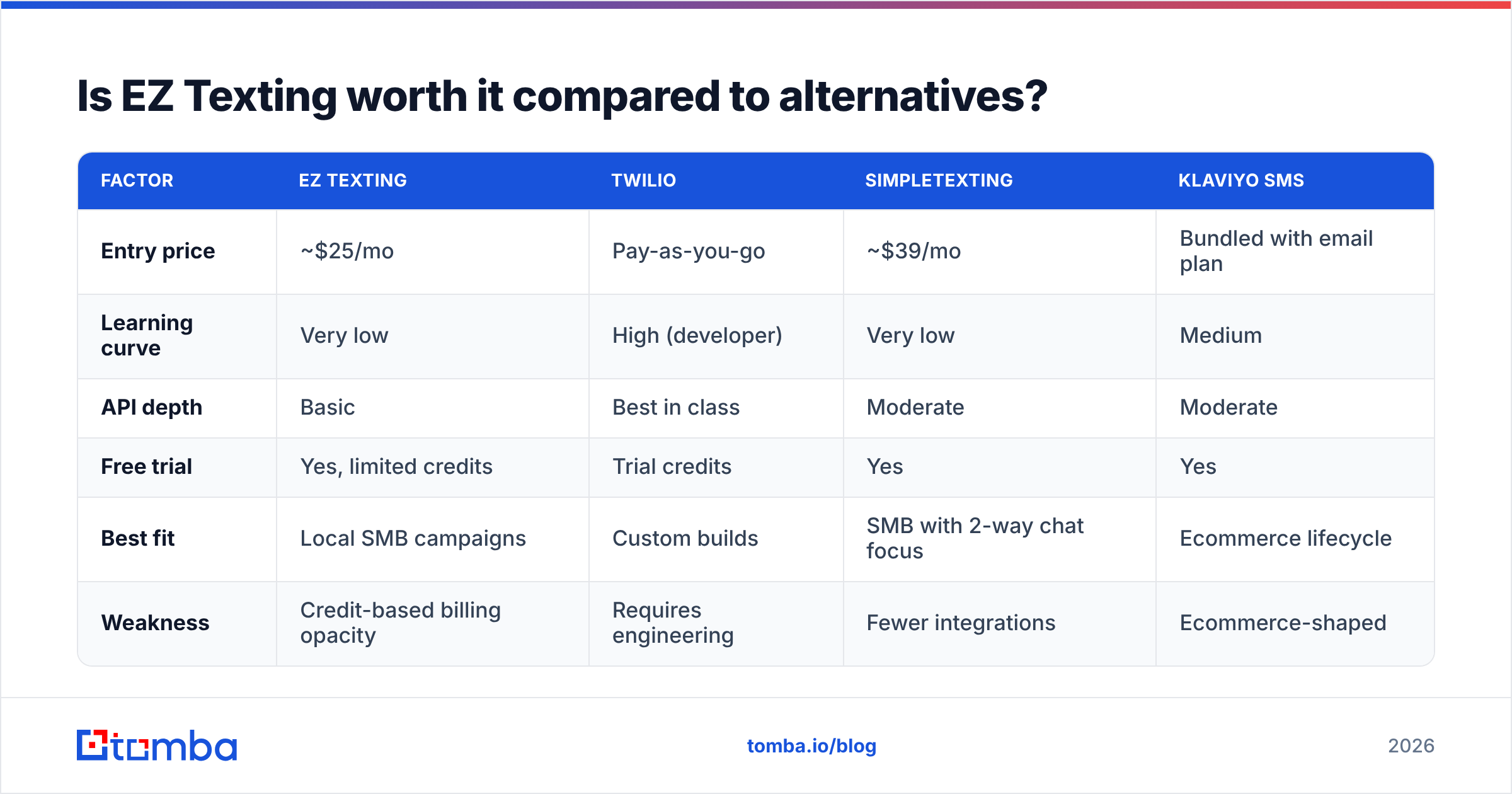
It depends on what you want. If you want the shortest path from "I have a list of customers" to "I sent them a text," EZ Texting is one of the easiest tools on the market. If you want granular automation, developer control, or per-message pricing without a subscription floor, you will find it restrictive.
| Factor | EZ Texting | Twilio | SimpleTexting | Klaviyo SMS |
|---|---|---|---|---|
| Entry price | ~$25/mo | Pay-as-you-go | ~$39/mo | Bundled with email plan |
| Learning curve | Very low | High (developer) | Very low | Medium |
| API depth | Basic | Best in class | Moderate | Moderate |
| Free trial | Yes, limited credits | Trial credits | Yes | Yes |
| Best fit | Local SMB campaigns | Custom builds | SMB with 2-way chat focus | Ecommerce lifecycle |
| Weakness | Credit-based billing opacity | Requires engineering | Fewer integrations | Ecommerce-shaped |
Here is the honest read from user reviews on G2 and Capterra. Scores are high on ease of use and support response. Scores are low on billing clarity and contract flexibility. The common complaint: unused credits expire at month end, and mid-cycle downgrades are hard. The common compliment: non-technical staff can run a campaign on day one, with no training.
What are the real pros and cons of EZ Texting?#
Pros
- Genuinely fast onboarding. Most teams send their first campaign within an hour. No developer required.
- Solid compliance scaffolding. Built-in opt-out handling, consent capture, and 10DLC guidance cut your TCPA risk. That is a real liability shield.
- Shortcode access without enterprise pricing. Shared shortcodes let small businesses run keyword campaigns that would otherwise cost thousands.
- Human support. Reviewers rate support above the category average. That matters when a campaign gets carrier-blocked at 9am on a Saturday.
- Native MMS and link shortening. Trackable short links and image sends work out of the box.
Cons
- Credit-based billing is opaque. Segment math, MMS multipliers, and expiring credits make forecasting harder than a flat per-message rate.
- Carrier fees sit outside the plan price. Your real cost per message is well above the advertised rate.
- Weak for B2B. There is no contact discovery layer. You must already own the phone numbers, and cold B2B SMS is hostile ground, both legally and practically.
- Limited automation depth. Next to a full marketing automation suite, branching logic and conditional flows are thin.
- Downgrade friction. Several reviewers report that scaling a plan down is harder than scaling it up.
Does EZ Texting solve a B2B prospecting problem?#
No — and this is the most important distinction for anyone reading this from a sales seat.
SMS platforms are distribution tools. They assume the hard part is done: you already have the contact, the consent, and the relationship. In B2B outbound, none of that is true at the start. The hard part is finding who to contact at a target account, getting a reachable address, and checking that it will not bounce.
Think of it like owning a delivery truck with no warehouse. The truck is excellent. It moves nothing until you fill it.
That gap is where a contact-discovery layer belongs. Before any channel — email, phone, or SMS — you need verified contact data:
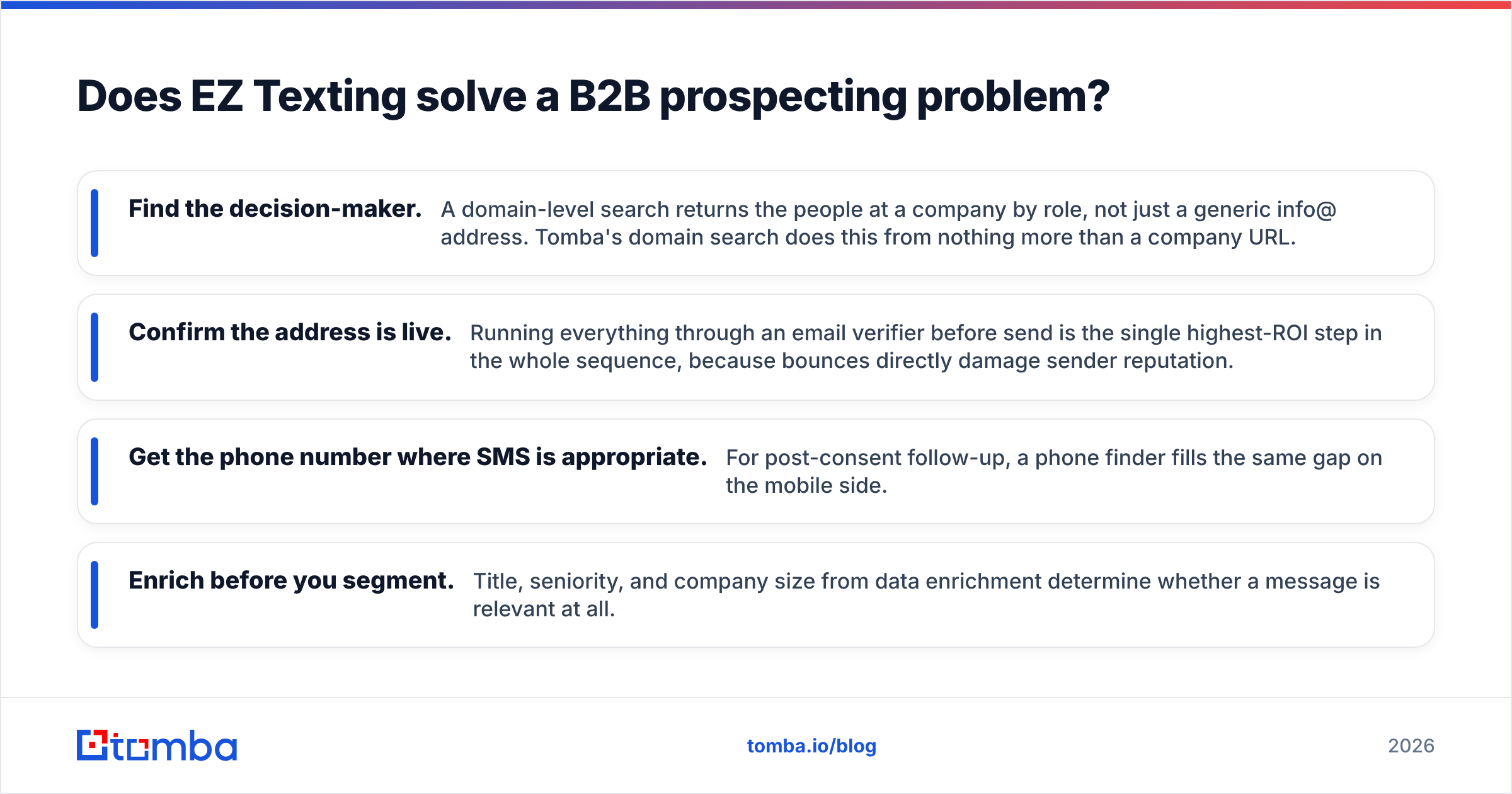
- Find the decision-maker. A domain-level search returns the people at a company by role, not just a generic info@ address. Tomba's domain search does this from nothing more than a company URL.
- Confirm the address is live. Running everything through an email verifier before send is the single highest-ROI step in the whole sequence, because bounces directly damage sender reputation.
- Get the phone number where SMS is appropriate. For post-consent follow-up, a phone finder fills the same gap on the mobile side.
- Enrich before you segment. Title, seniority, and company size from data enrichment determine whether a message is relevant at all.
If you skip that layer, you are paying an SMS platform to deliver messages to a list you cannot trust.
How should you budget for SMS in 2026?#
Build the model from the bottom up, not from the plan tier. Start with your monthly send volume. Multiply by average segments per message — assume 1.6 unless your copy is tight. Add MMS at 3x. Then add carrier surcharges and the monthly 10DLC fees. Compare that total to the plan's included credits and overage rate.
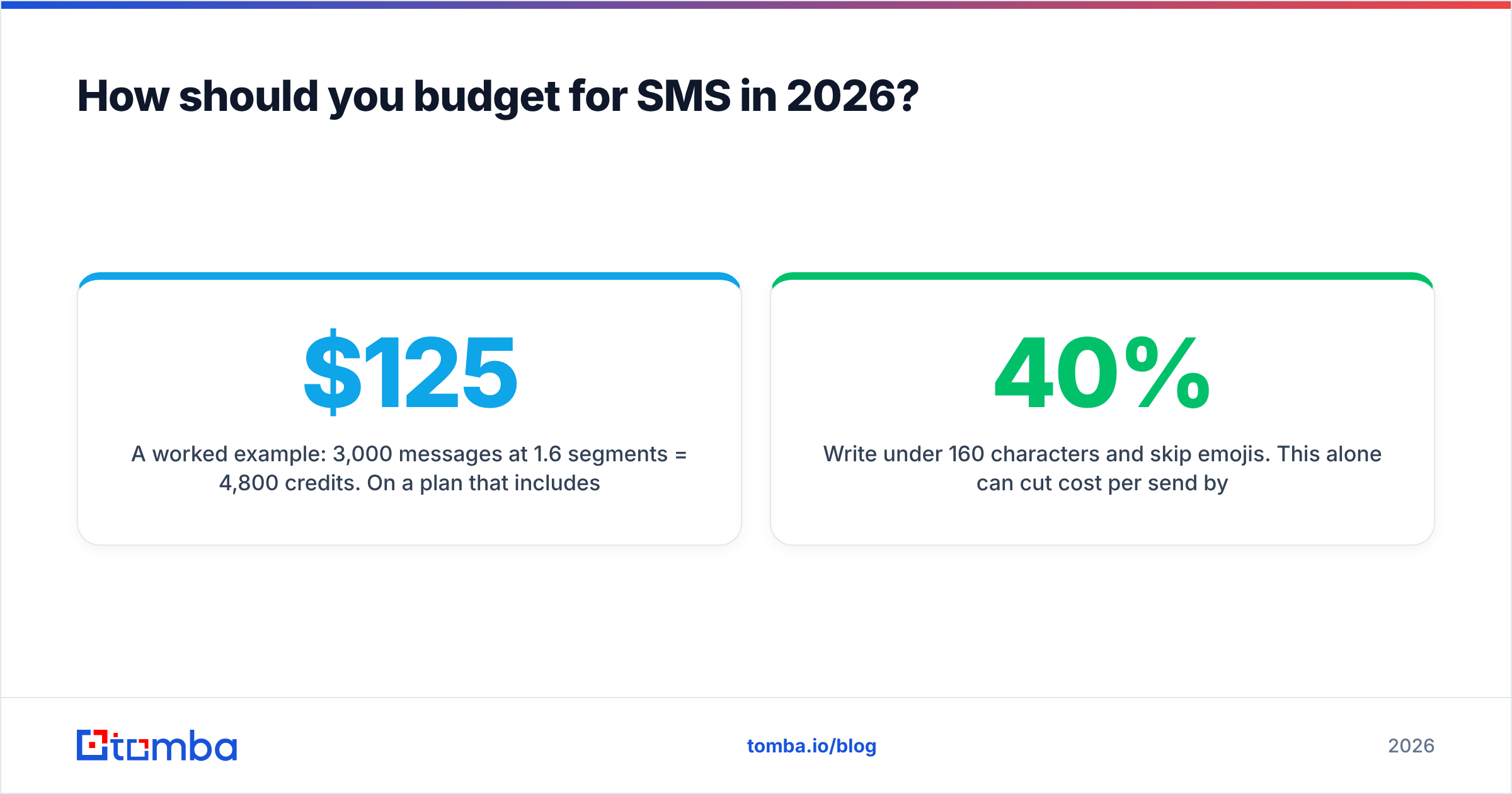
An example: 3,000 messages a month at 1.6 segments = 4,800 credits. On a plan that includes 2,000, you buy 2,800 in overage. Overage often costs more per unit than the base plan implies. That is how a $125/mo tool turns into a $300/mo line item.
Two guardrails cut real money:
- Write under 160 characters and skip emojis. This alone can cut cost per send by 40%.
- Clean your list quarterly. Dead numbers still consume credits on send attempt. The same discipline applies on the email side — teams that run regular bulk verify passes see the difference in both cost and email deliverability.
Who should buy EZ Texting — and who should not?#
Here is the EZ Texting pricing, reviews, pros and cons verdict in plain terms.
Buy it if: you run a local or multi-location business, you have an opted-in customer list, you need appointment reminders or promo blasts, and you want a non-technical team to own the channel. The usability is real and the compliance tooling has genuine value.
Skip it if: you are a B2B sales team doing outbound, you need deep API control (go Twilio), you send high volume with tight unit economics (negotiate direct carrier rates), or your primary channel is email and SMS is a nice-to-have. In that last case the money is better spent on data quality than on a second channel.
Test before committing: use the free trial credits on a real campaign segment, not a test list. Watch the invoice for one full cycle before signing anything annual. Check what your real cost per delivered message was, then decide.
Where does contact data fit into all of this?#
Every channel choice after "who do I contact" matters less than the quality of that list. An SMS platform with a bad list loses to a spreadsheet with a good one.
If your team is spending on outreach tooling before the contact data is solid, reverse the order. Start with Tomba's Email Finder — find verified professional email addresses by name, domain, or company, with a free tier of 25 searches per month and paid plans from $49/mo. Verify before you send, enrich before you segment, and only then argue about which channel to spend the budget on. See full Tomba pricing to size it against your volume.
Related guides#
Ready to find emails that actually work?
Join 150,000+ professionals who stopped guessing and started sending. Free credits on signup — no credit card required.
Get the Tomba newsletter
Practical outbound tactics and product updates — once every two weeks.
About the author