Fac Intelligence Alternatives: 7 Tools Compared (2026)
Fac Intelligence keeps pricing behind a quote and publishes little about coverage. Here are seven alternatives, from $49/mo email finders to pay-as-you-go databases, ranked on match rate, verification and real cost.
TL;DR
- Fac Intelligence sits in the "contact data + company intelligence" bucket, but it publishes almost no public pricing or match-rate data, which is the single most common reason teams start shopping for alternatives.
- If your real job-to-be-done is find and verify work emails at scale, a dedicated email finder like Tomba (free tier, then $49/mo) will usually beat a general intelligence platform on cost per verified contact.
- If you need sequencing, dialing and a CRM-adjacent workflow in one seat, Apollo is the obvious swap — but you pay for seats, not just data.
- If you want to buy a list once and own it forever, a pay-as-you-go database like BookYourData avoids subscription lock-in entirely.
- Test any alternative on your ICP with a 200-row sample before you sign. Vendor-published match rates almost never survive contact with a niche vertical.
What is Fac Intelligence, and why are people looking for alternatives?#
Fac Intelligence is positioned as a B2B data and company-intelligence provider: firmographic records, contact details, and enrichment for sales and marketing teams. That category is crowded, and the specifics matter more than the category label.
Here is the honest part. Compared with the incumbents in this space, Fac Intelligence publishes very little verifiable detail about database size, refresh cadence, GDPR handling, or list pricing. Most of what a buyer can find is quote-gated. That is not automatically a red flag — plenty of good vendors sell that way — but it does create three practical problems:
- You cannot benchmark cost per verified contact before a sales call.
- You cannot compare match rate against a public baseline.
- You cannot self-serve a pilot, so evaluation takes weeks instead of an afternoon.
So when people search for Fac Intelligence alternatives, they are usually not looking for "a different intelligence platform." They are looking for one of three things: transparent pricing, a higher verified-email match rate on their specific ICP, or an API they can wire into an existing stack without a procurement cycle.
Before you shortlist anything, verify current pricing and terms directly on each vendor's site. Data pricing in this category changes every few quarters.

What should you actually compare in a B2B data tool?#
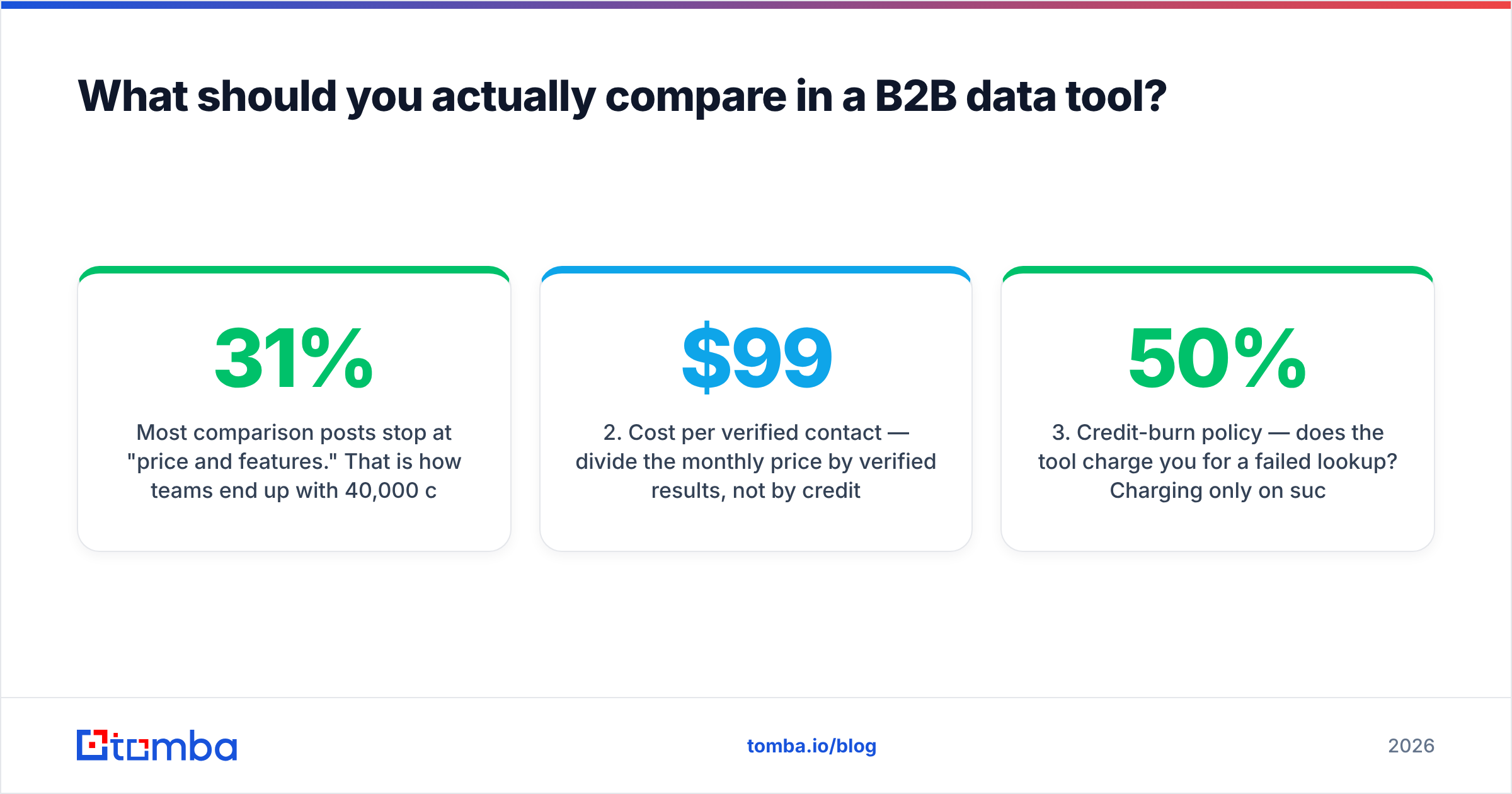
Most comparison posts stop at "price and features." That is how teams end up with 40,000 credits and a 31% bounce rate. Score every alternative on these six dimensions instead:
- Verified match rate on your ICP — not the vendor's global number. Run the same 200 target contacts through every trial and count how many come back with a verified (not "guessed" or "accept-all") email. This is the only metric that maps directly to pipeline.
- Cost per verified contact — divide the monthly price by verified results, not by credits issued. A $99 plan returning 700 verified emails beats a $49 plan returning 200.
- Credit-burn policy — does the tool charge you for a failed lookup? Charging only on successful finds can change effective cost by 30–50%.
- Verification depth — SMTP-level checks, catch-all handling, role-address flagging, and disposable detection. A finder without a real email verifier behind it is just a guesser with a UI.
- Delivery surface — web app, bulk CSV, Chrome extension, Sheets/Excel add-in, and a documented REST API. If your RevOps team lives in the CRM, an API-first tool wins; if your SDRs live in LinkedIn, an extension wins.
- Data provenance and compliance — where the records come from, how often they refresh, and whether the vendor honours GDPR/CCPA deletion requests. Ask for this in writing.
Run that scorecard and the shortlist below sorts itself fast.
Which Fac Intelligence alternatives are worth testing in 2026?#
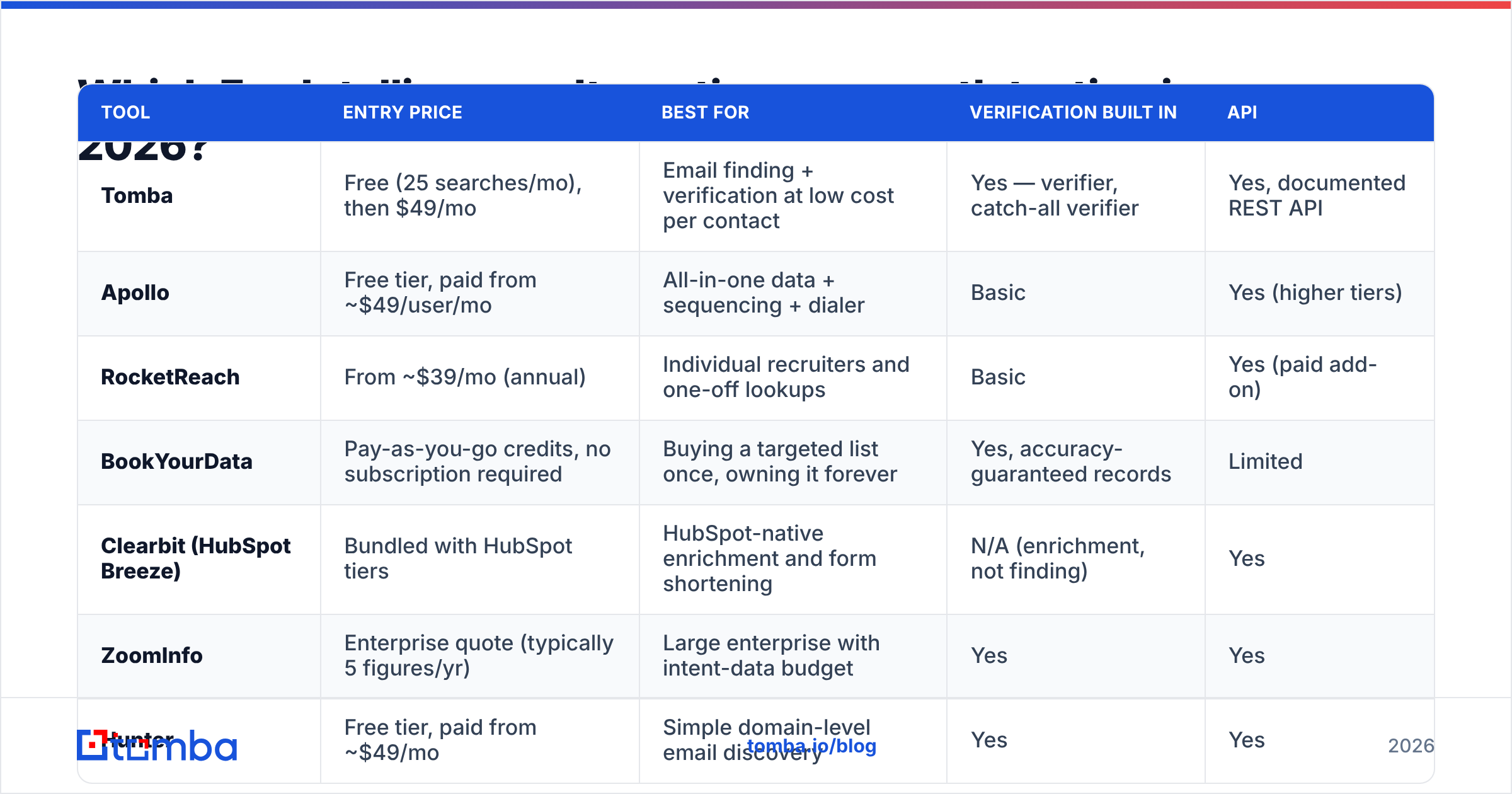
| Tool | Entry price | Best for | Verification built in | API |
|---|---|---|---|---|
| Tomba | Free (25 searches/mo), then $49/mo | Email finding + verification at low cost per contact | Yes — verifier, catch-all verifier | Yes, documented REST API |
| Apollo | Free tier, paid from ~$49/user/mo | All-in-one data + sequencing + dialer | Basic | Yes (higher tiers) |
| RocketReach | From ~$39/mo (annual) | Individual recruiters and one-off lookups | Basic | Yes (paid add-on) |
| BookYourData | Pay-as-you-go credits, no subscription required | Buying a targeted list once, owning it forever | Yes, accuracy-guaranteed records | Limited |
| Clearbit (HubSpot Breeze) | Bundled with HubSpot tiers | HubSpot-native enrichment and form shortening | N/A (enrichment, not finding) | Yes |
| ZoomInfo | Enterprise quote (typically 5 figures/yr) | Large enterprise with intent-data budget | Yes | Yes |
| Hunter | Free tier, paid from ~$49/mo | Simple domain-level email discovery | Yes | Yes |
Prices are list prices at time of writing and change often — check each vendor's pricing page before budgeting.

1. Tomba — best for cost per verified email#
Tomba is a focused email-finding and verification platform rather than a broad intelligence suite. That narrowness is the point: you are paying for match rate and verification, not for a dashboard you will never open.
The email finder resolves addresses from a name plus domain, and domain search returns every known address on a company domain with a confidence score and the source it was seen on. Around it sit a verifier, a catch-all verifier, a phone finder, and enrichment.
- Pricing: Free tier with 25 searches/mo, Starter $49/mo, Growth $99/mo, Pro $249/mo, Enterprise custom. Full Tomba pricing is public — no quote call required.
- Delivery surfaces: web app, Chrome extension, Google Sheets and Excel add-ins, bulk email finder for CSV uploads, plus a REST API and MCP server for agent-driven workflows.
- Where it wins over Fac Intelligence: transparent pricing, a free tier you can evaluate in ten minutes, and verification bundled rather than sold separately.
- Where it does not: Tomba does not sequence email or dial phones. Pair it with your existing sending tool.
2. Apollo — best if you want data and outreach in one seat#
Apollo bundles a large contact database with sequencing, a dialer, and light CRM functionality. For a small team that wants one login instead of four, it is the pragmatic default.
The trade-off is the pricing model. You buy seats, and credit limits are tied to those seats, so cost scales with headcount rather than with data consumption. Teams with two SDRs and 50,000 records to enrich often find that math unfavourable. Data quality is decent on US tech mid-market and noticeably thinner on EMEA SMB and non-tech verticals. If you like Apollo's workflow but not its bill, an Apollo alternative that charges per lookup is usually cheaper.
3. RocketReach — best for low-volume, high-variety lookups#
RocketReach is built around individual profile lookups: paste a LinkedIn URL or a name, get emails and phone numbers back. Recruiters and founders doing 50 targeted lookups a month get real value here.
At scale the economics flip. Per-lookup credit costs stay flat while dedicated finders offer volume tiers, and RocketReach's verification is lighter than a purpose-built verifier. Treat it as a precision tool, not a pipeline engine.
4. BookYourData — best for one-time list purchases#
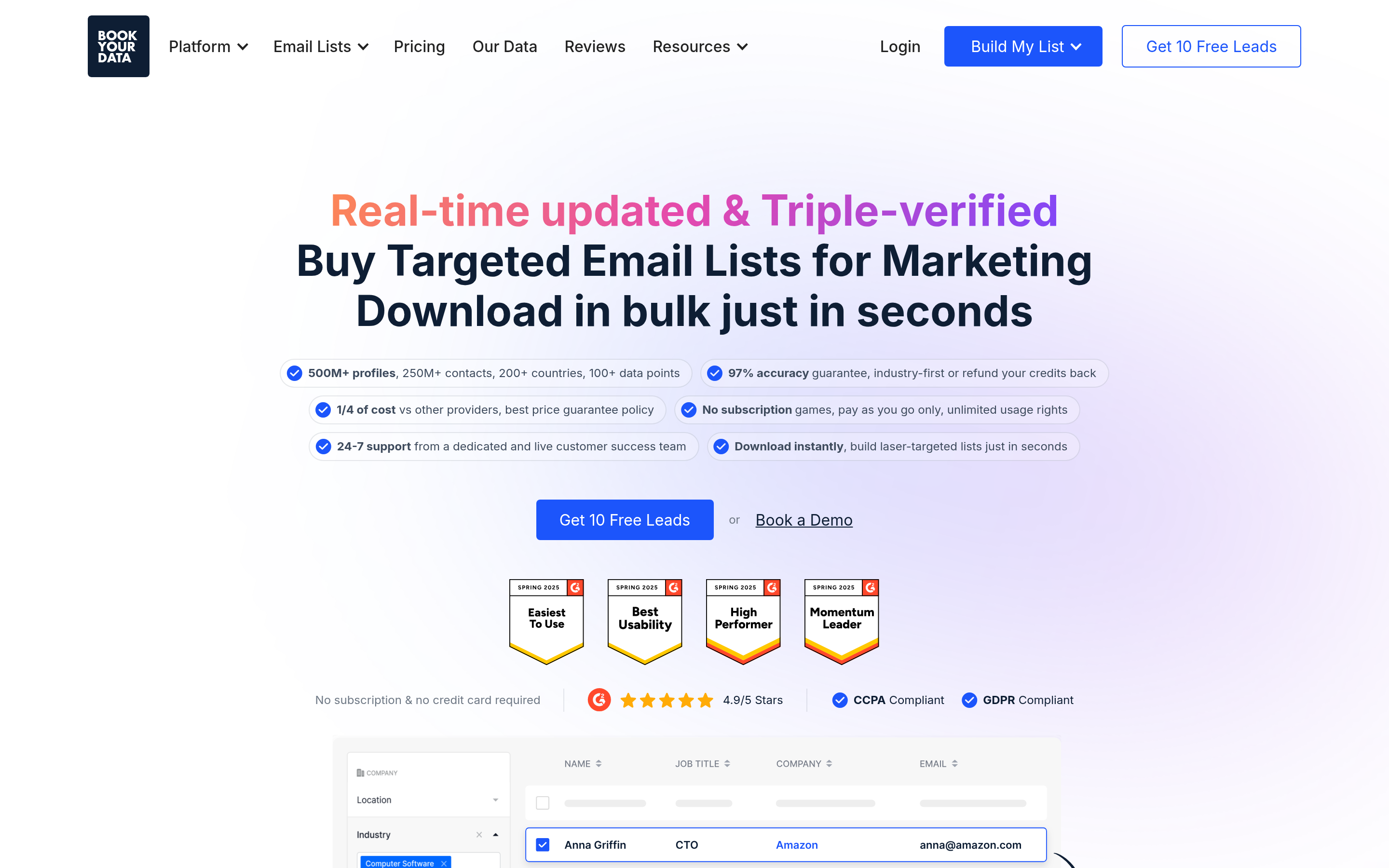
BookYourData takes a different approach: pay-as-you-go credits, no mandatory subscription, and records backed by an accuracy guarantee. You filter by industry, title, geography and tech stack, preview counts, then buy exactly the segment you need.
That model suits two situations well. First, one-off campaigns where a monthly subscription would sit idle for ten months of the year. Second, teams that want to own the data outright rather than rent access to a platform. If your outbound is campaign-shaped rather than continuous, it is a genuinely strong fit and often the cleanest escape from quote-gated enterprise contracts.
5. Clearbit / HubSpot Breeze Intelligence — best for HubSpot-native enrichment#
Clearbit is now part of HubSpot's Breeze Intelligence layer. If your CRM is HubSpot, enrichment happens inside the record with no integration work, and form shortening genuinely lifts conversion.
But Clearbit was always an enrichment product, not a finder. Give it a domain and it returns firmographics; it will not reliably hand you a named prospect's verified work email. If that is your core need, a Clearbit alternative built for contact discovery fills the gap better.
6. ZoomInfo — best if you have enterprise budget and need intent#

ZoomInfo remains the deepest dataset in the category, with intent signals, org charts and conversation intelligence layered on top. It is also the most expensive, typically a five-figure annual commitment with a multi-year term and seat minimums.
For a 5-person sales team, ZoomInfo is almost never the right answer to "we need better emails." For a 100-person org running account-based programmes, it often is. Check recent G2 reviews for current sentiment on contract flexibility before you engage.
7. Hunter — best for quick domain-level discovery#
Hunter does one thing cleanly: give it a domain, get back the email pattern and known addresses. The free tier is generous enough for early validation, and the API is simple.
Coverage outside of well-indexed web domains is thinner than the dedicated database players, and enrichment is minimal. It is a good starting point and a common tool for teams to outgrow.
How accurate are these tools, really?#
Accuracy is where marketing copy and reality diverge hardest. Every vendor in this category quotes a headline number in the 95–99% range, and every one of those numbers is measured on a sample that flatters the vendor.

Three things move accuracy more than brand choice:
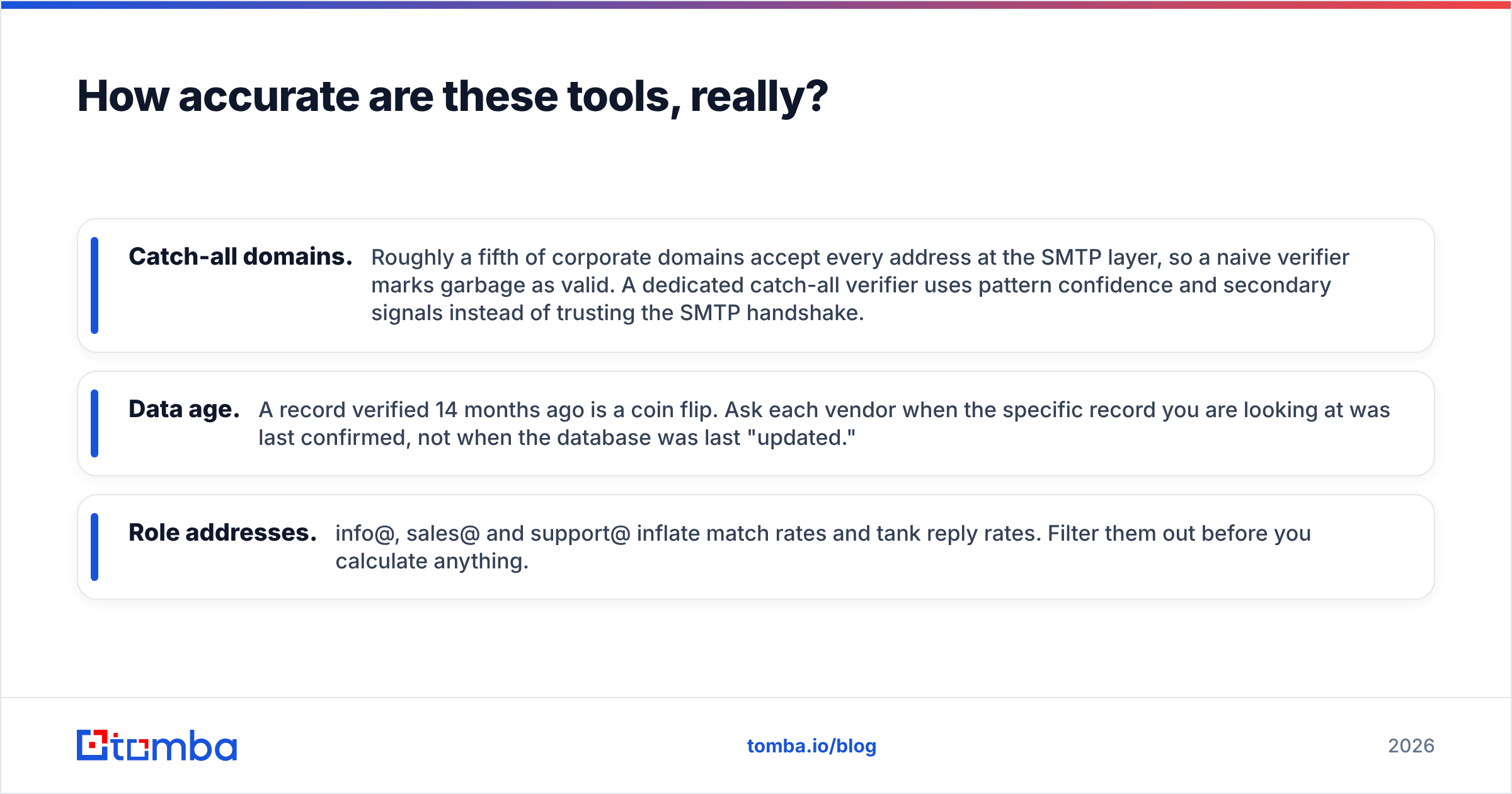
- Catch-all domains. Roughly a fifth of corporate domains accept every address at the SMTP layer, so a naive verifier marks garbage as valid. A dedicated catch-all verifier uses pattern confidence and secondary signals instead of trusting the SMTP handshake.
- Data age. A record verified 14 months ago is a coin flip. Ask each vendor when the specific record you are looking at was last confirmed, not when the database was last "updated."
- Role addresses. info@, sales@ and support@ inflate match rates and tank reply rates. Filter them out before you calculate anything.
Run your own test: take 200 contacts you already have confirmed emails for, strip the emails, and feed the names and domains through each trial. Count exact matches. That number, not the vendor's, is your real match rate.

Which alternative should you pick?#
Match the tool to the shape of your problem rather than to the longest feature list.
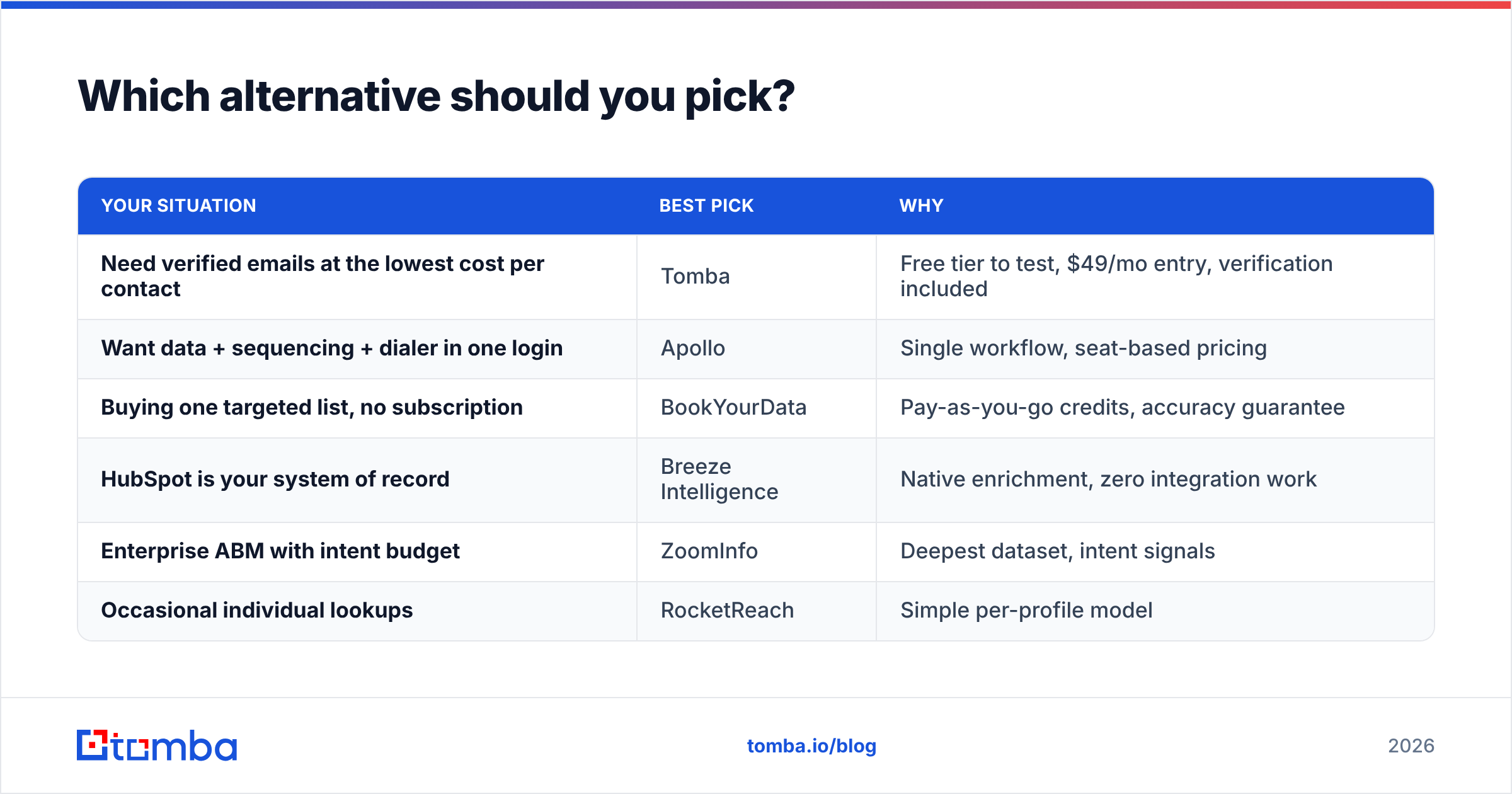
| Your situation | Best pick | Why |
|---|---|---|
| Need verified emails at the lowest cost per contact | Tomba | Free tier to test, $49/mo entry, verification included |
| Want data + sequencing + dialer in one login | Apollo | Single workflow, seat-based pricing |
| Buying one targeted list, no subscription | BookYourData | Pay-as-you-go credits, accuracy guarantee |
| HubSpot is your system of record | Breeze Intelligence | Native enrichment, zero integration work |
| Enterprise ABM with intent budget | ZoomInfo | Deepest dataset, intent signals |
| Occasional individual lookups | RocketReach | Simple per-profile model |
Two practical rules to close on. First, never migrate on a demo — migrate on a sample test with your own ICP. Second, separate finding from sending. Teams that bundle both into one vendor lose leverage on renewal and inherit that vendor's weakest half.
Ready to test a cheaper, more transparent option?#
If your main reason for leaving Fac Intelligence is opaque pricing and unverifiable match rates, start with the tool that publishes both. Tomba Email Finder gives you 25 free searches per month with no card, verification built in rather than sold as an add-on, and a documented API when you are ready to automate. Run your 200-contact benchmark, compare the verified match rate against your current bill, and let the numbers make the decision.
Related guides#
Ready to find emails that actually work?
Join 150,000+ professionals who stopped guessing and started sending. Free credits on signup — no credit card required.
Get the Tomba newsletter
Practical outbound tactics and product updates — once every two weeks.
About the author