Fac Intelligence vs Generect: B2B Data Compared for 2026
Both promise fresh B2B contact data, but they solve different problems. Here is an honest breakdown of coverage, accuracy, API access, pricing models and compliance — plus when a cheaper email-finder beats either one.
TL;DR
- Generect is an API-first B2B lead database built around real-time LinkedIn-sourced company and people data. Its strength is programmatic pulls and list-building at scale; its weakness is that pricing is quote-driven and self-serve onboarding is limited.
- Fac Intelligence positions itself as a B2B data and market-intelligence layer — firmographics, contacts and signals aimed at sales and research teams rather than pure list export. Expect a sales-led buying process.
- Neither publishes a fully transparent, credit-by-credit price list. If you want to compare cost per verified contact, you will have to run a trial with your own ICP and measure it yourself.
- For most small and mid-size outbound teams, the real question is not "which database" but "how many verified emails do I actually need per month". A focused email finder at $49/mo often beats a $10k+ annual data contract you use at 15% capacity.
- Run the same 200-contact test list through every tool you shortlist, then verify the output independently. Vendor-claimed accuracy is a marketing number; your bounce rate is the real one.
What are Fac Intelligence and Generect?#
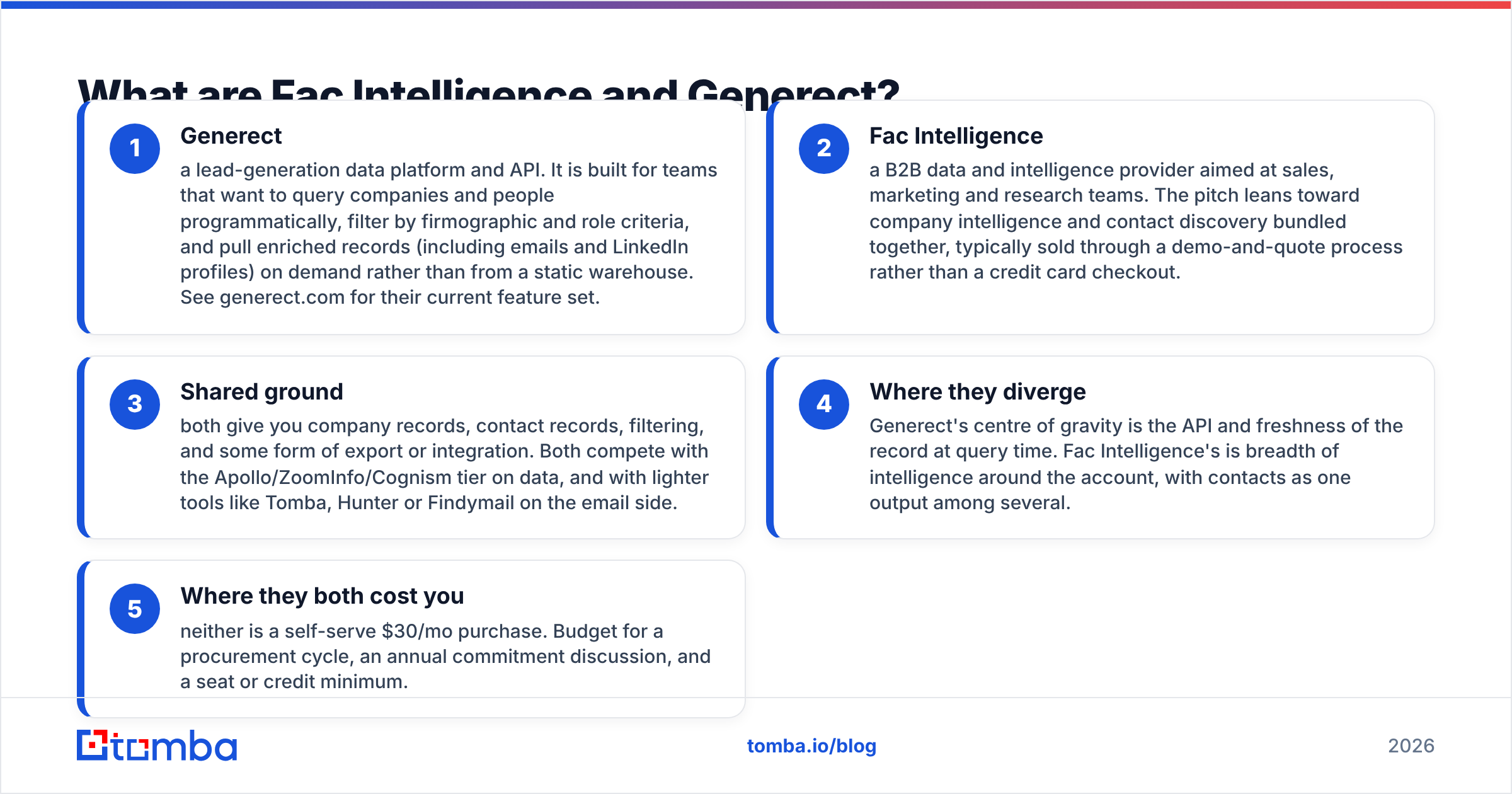
Two tools get compared because they overlap in one job — putting B2B contact and company records into your outbound motion — but they come at it from different directions.
- Generect — a lead-generation data platform and API. It is built for teams that want to query companies and people programmatically, filter by firmographic and role criteria, and pull enriched records (including emails and LinkedIn profiles) on demand rather than from a static warehouse. See generect.com for their current feature set.
- Fac Intelligence — a B2B data and intelligence provider aimed at sales, marketing and research teams. The pitch leans toward company intelligence and contact discovery bundled together, typically sold through a demo-and-quote process rather than a credit card checkout.
- Shared ground — both give you company records, contact records, filtering, and some form of export or integration. Both compete with the Apollo/ZoomInfo/Cognism tier on data, and with lighter tools like Tomba, Hunter or Findymail on the email side.
- Where they diverge — Generect's centre of gravity is the API and freshness of the record at query time. Fac Intelligence's is breadth of intelligence around the account, with contacts as one output among several.
- Where they both cost you — neither is a self-serve $30/mo purchase. Budget for a procurement cycle, an annual commitment discussion, and a seat or credit minimum.
If you are evaluating a broader shortlist, the same criteria in this post apply to any Apollo alternative or Clearbit alternative you add to it.
How do Fac Intelligence and Generect compare head-to-head?#
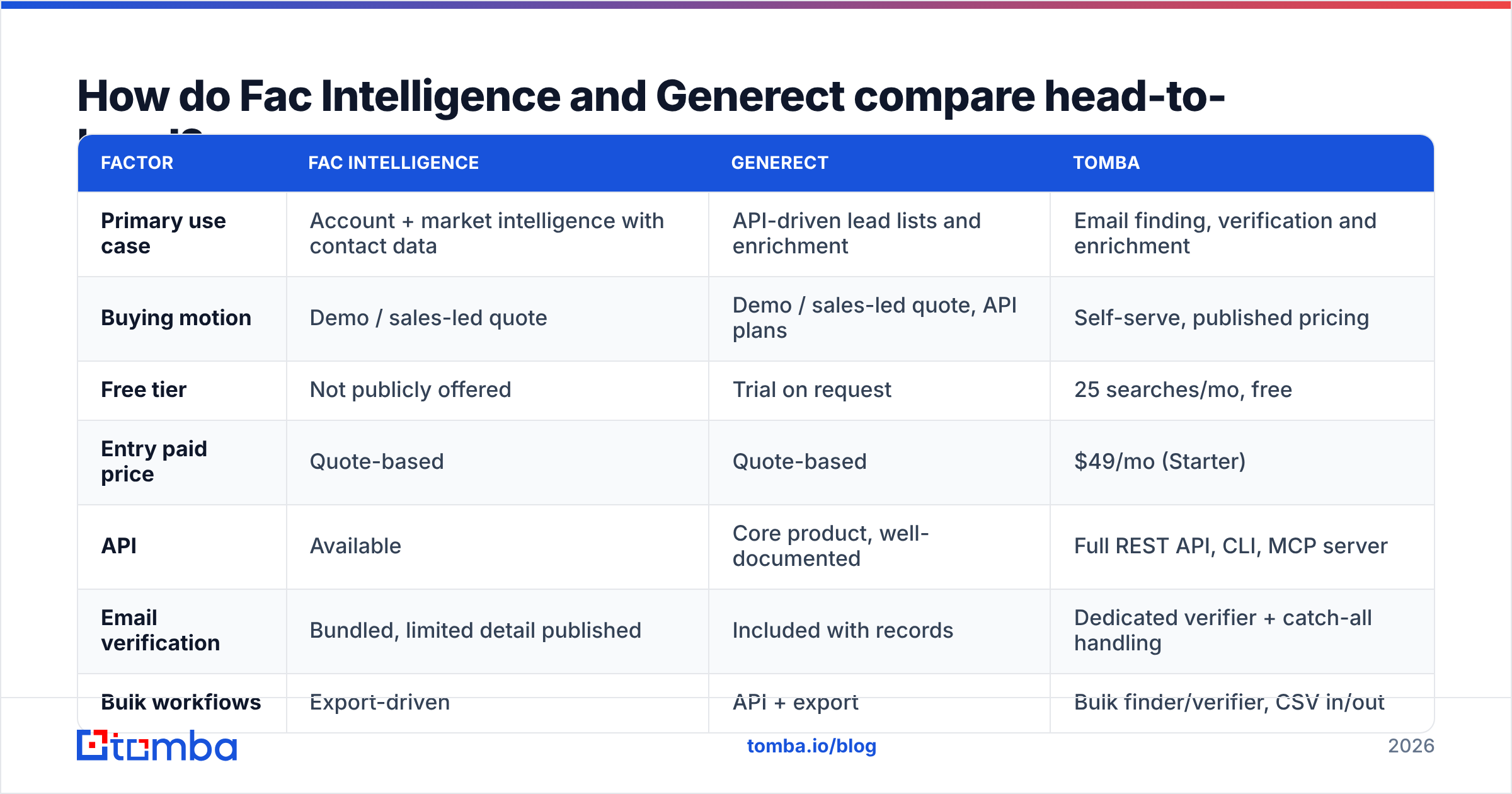
Here is the practical comparison. Where a vendor does not publish a figure, this table says so rather than inventing one — confirm current numbers on the vendor's own pricing page or in your quote before you sign.
| Factor | Fac Intelligence | Generect | Tomba |
|---|---|---|---|
| Primary use case | Account + market intelligence with contact data | API-driven lead lists and enrichment | Email finding, verification and enrichment |
| Buying motion | Demo / sales-led quote | Demo / sales-led quote, API plans | Self-serve, published pricing |
| Free tier | Not publicly offered | Trial on request | 25 searches/mo, free |
| Entry paid price | Quote-based | Quote-based | $49/mo (Starter) |
| API | Available | Core product, well-documented | Full REST API, CLI, MCP server |
| Email verification | Bundled, limited detail published | Included with records | Dedicated verifier + catch-all handling |
| Bulk workflows | Export-driven | API + export | Bulk finder/verifier, CSV in/out |
| Best for | Enterprise research + ABM teams | Dev-led growth teams automating lists | SDRs, agencies, founders needing verified emails fast |
| Worst for | Solo founders on a budget | Non-technical users who want a UI-first tool | Teams needing intent data or org charts |
The row that decides most evaluations is "buying motion". If you need contacts this week, a quote-based vendor with a two-week procurement loop is not a live option regardless of how good the data is.

Which one has better data accuracy?#
Neither vendor's published accuracy claim should decide this for you, and here is why: accuracy is measured differently by every provider. Some report "deliverable at time of delivery". Some exclude catch-all domains from the denominator. Some count a record as accurate if any field matches, not the email specifically.

What actually correlates with low bounce rates:
- Recency of the source event. A record derived from a profile updated last month beats one from a database snapshot taken 18 months ago. Generect's real-time query model is designed around this; static-warehouse vendors are not.
- Pattern confidence vs. observed address. An email guessed from
first.last@domain.comis a hypothesis. An address observed in a public source and then SMTP-checked is evidence. Ask each vendor which one you are buying. - Catch-all handling. Roughly one in five B2B domains accepts all mail, so SMTP checks return "valid" for addresses that do not exist. Tools that flag these honestly look less accurate on paper and perform better in your inbox. Tomba's catch-all verifier exists specifically for this gap.
- Role-account contamination.
info@,sales@andsupport@inflate coverage stats and destroy reply rates. Check whether they are counted as "contacts found".
How to run a fair accuracy test#
Pick 200 target companies that match your real ICP — not the vendor's demo list. Ask each tool for the same named contacts. Then:
- Record match rate: how many of the 200 returned any email at all.
- Record verified rate: how many came back as confidently valid (not "accept-all", not "unknown").
- Push all outputs through a single neutral email verifier so every tool is scored by the same referee.
- Send a real 100-contact campaign and record the hard-bounce percentage after 72 hours.
- Divide the invoice by the number of contacts that actually landed. That is your true cost per usable contact — usually 2–4x the advertised cost per credit.
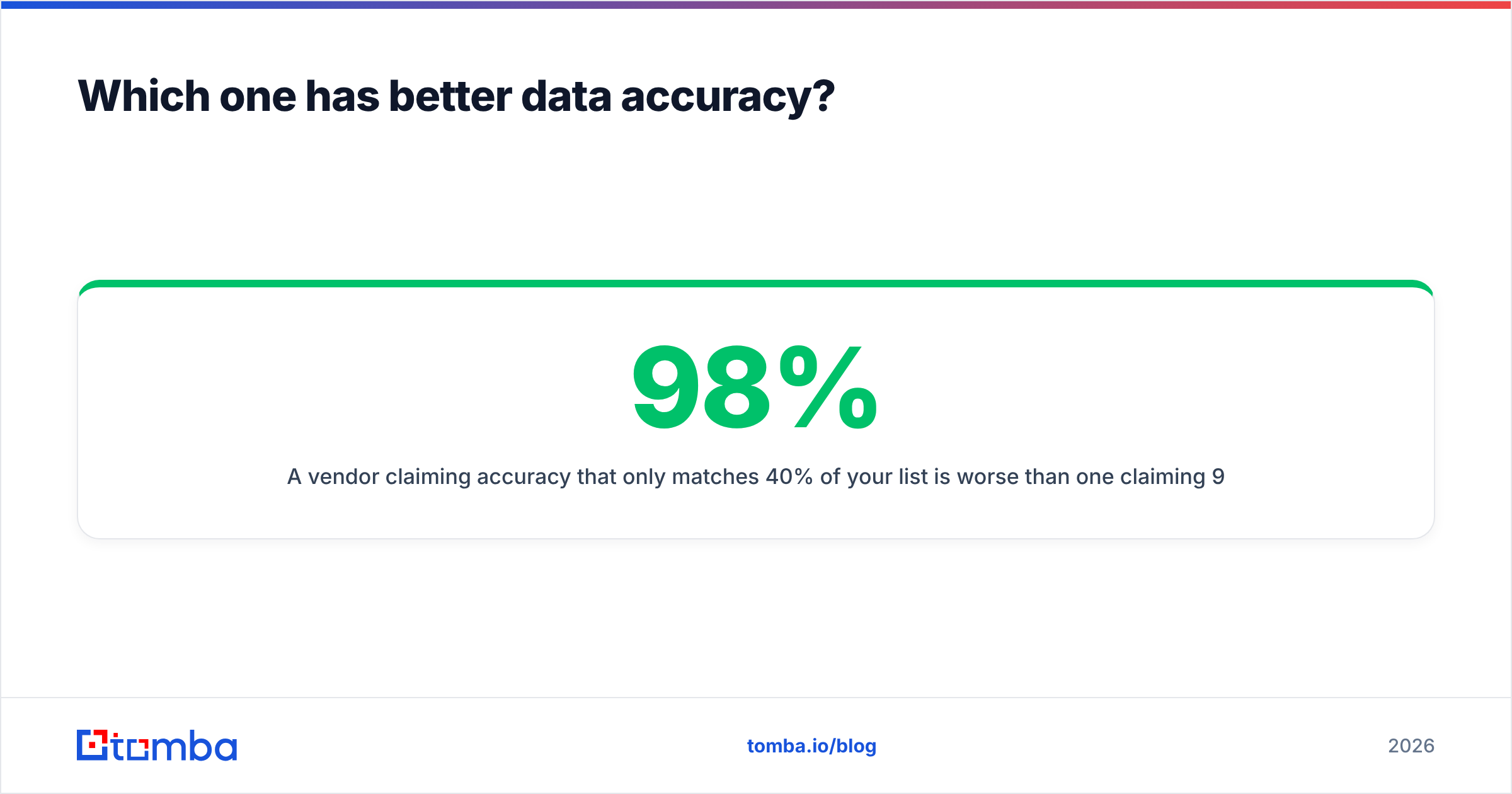
A vendor claiming 98% accuracy that only matches 40% of your list is worse than one claiming 92% at 75% match. Coverage and accuracy trade against each other, and only your list can tell you where the trade lands.
How does pricing work for each?#
Both Fac Intelligence and Generect run sales-led pricing, which means the number you pay depends on volume, contract length and how well you negotiate. That is normal at the enterprise data tier, but it makes side-by-side comparison hard and it hides three costs buyers routinely miss.
| Cost element | What to ask before signing |
|---|---|
| Annual minimum | Is there a floor commitment regardless of usage? Most enterprise data contracts have one. |
| Credit rollover | Do unused credits expire monthly, quarterly, or not at all? |
| Seat vs. credit pricing | Are you paying per user, per record, or both? Two-axis pricing scales badly. |
| Export rights | Can you keep exported records after churning, or is the data licensed only for the contract term? |
| Enrichment re-pulls | Does re-enriching an existing record cost a new credit? |
| API overage | What is the per-call rate above plan, and is it capped? |
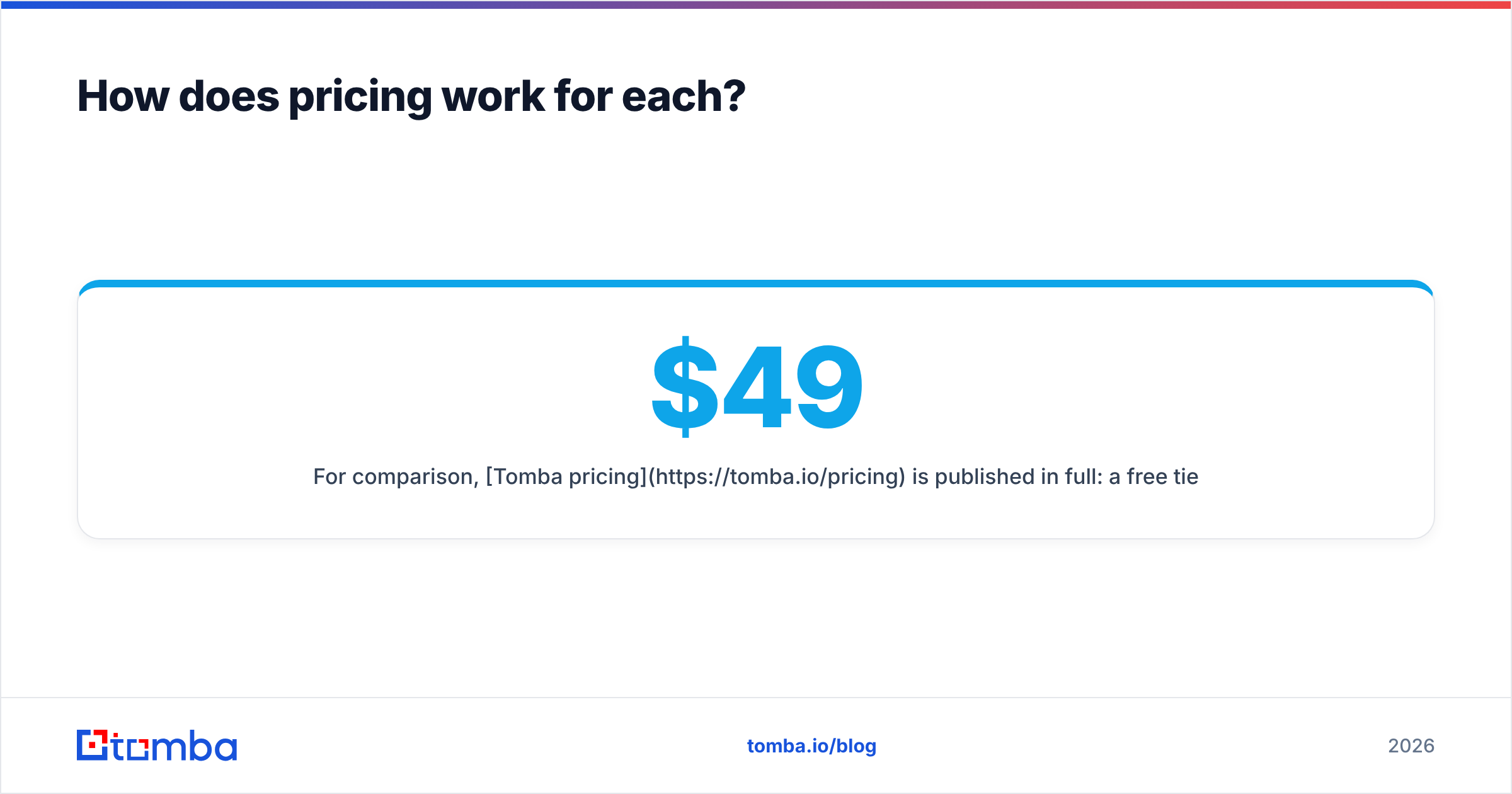
For comparison, Tomba pricing is published in full: a free tier with 25 searches/mo, Starter at $49/mo, Growth at $99/mo, Pro at $249/mo, and custom Enterprise. No demo required, no annual floor, no data-licensing clause on exported contacts. That is not automatically "better" — it is a different product class — but it removes an entire evaluation phase.
The honest framing: if your team burns 20,000+ verified contacts a month across multiple regions and needs firmographic depth for account scoring, a quote-based platform earns its price. If you burn 2,000 and mostly need the email to be right, you are subsidising features you never open.
Which is better for API-first teams?#
Generect has the clearer advantage here. Its product is designed to be consumed by code — you query, you get structured records back, you write them into your CRM or sequencer. If your growth team ships its own tooling, that model fits.
Fac Intelligence supports integration too, but the buying and onboarding experience leans toward the analyst and researcher persona: dashboards, saved searches, exports into the CRM. Both approaches work; they suit different orgs.
Questions that separate a good data API from a bad one:
- Rate limits. What is the sustained requests-per-second, and does it throttle silently or return a proper 429?
- Latency. A real-time lookup that takes 8 seconds cannot sit inside a form-fill enrichment flow.
- Idempotency. If a call times out and you retry, do you get charged twice?
- Webhooks vs polling. Bulk jobs should notify you, not force a polling loop.
- SDK coverage. Official libraries in your stack's language save a week of integration.
- Sandbox. Can you test against non-billable data before you commit credits?
If you want to benchmark response shape and latency against a documented reference, the Tomba API is free to test on the 25-search tier, and there is a Tomba MCP server if you are wiring lookups into an AI agent workflow rather than a classic backend.
What about compliance and data sourcing?#
This is where the two vendors matter most to legal, and where buyers ask the fewest questions.
Any B2B data provider selling into or about the EU and UK must have a lawful basis for processing personal data and must be able to honour deletion and objection requests. Under the GDPR, legitimate interest is the usual basis for B2B prospecting, but it comes with obligations — notification, opt-out handling, and documented data provenance.
Ask both vendors, in writing:
- Where does each record come from? Public web crawl, partner contribution, user-contributed contact books, or purchased lists? Contributed-contact-book models carry more risk than public-source models.
- Do you suppress DNC and opt-out lists? And how quickly does a deletion request propagate to already-exported records?
- Is there a DPA available? A vendor that cannot produce a data processing agreement is not enterprise-ready.
- Do you cover CCPA notice requirements for California residents in your database?
- What happens to my exported data after churn? Some contracts require deletion.
Tomba publishes its data sources publicly, which is the minimum bar you should hold every vendor to. If a provider treats sourcing as a trade secret, your compliance team inherits that opacity.
Where does Tomba fit as an alternative?#
Straight answer: Tomba is not trying to be a full market-intelligence platform. It is a focused contact-data tool, and for a large share of teams evaluating Fac Intelligence vs Generect, focused is what they actually needed.
| Scenario | Best fit |
|---|---|
| Enterprise ABM with account scoring and intent | Fac Intelligence tier (or ZoomInfo/Cognism class) |
| Dev team automating list building at high volume | Generect |
| SDR team that needs 2,000 verified emails a month | Tomba Starter/Growth |
| Agency running outbound for 10 clients | Tomba Growth/Pro + bulk email finder |
| Enriching inbound signups in real time | Tomba data enrichment or Generect API |
| Finding contacts from a LinkedIn list you already built | Tomba LinkedIn finder |
The pattern we see repeatedly: teams sign a five-figure data contract to solve a problem that was really "our emails bounce". Verification and a decent finder fix bounce rates. Firmographic depth fixes targeting. Those are separate purchases, and buying the expensive one does not automatically fix the cheap one.

Which should you choose?#
Decide with these four questions, in order:
- Do you need intelligence, or contacts? If your team builds account plans, scores territories, and researches markets, you need an intelligence platform — Fac Intelligence's category. If you need someone's email so a sequence can start, you do not.
- Is your workflow UI-driven or code-driven? Code-driven pushes you to Generect. UI-driven with export-to-CRM pushes you the other way.
- What is your monthly contact volume? Under ~5,000 records/mo, a self-serve tool at $49–$249/mo will almost always win on cost per usable contact. Above ~20,000 with multi-region coverage needs, the enterprise tier earns it.
- How fast do you need to be live? Quote-based vendors add 2–6 weeks. If that kills a quarter, start self-serve now and run the enterprise evaluation in parallel.
And regardless of which you pick: independently verify before you send. Third-party reviews on G2 are useful for support quality and onboarding friction, but nobody's review tells you whether a vendor covers your niche in your geography. Only your test list does that.
Start with the cheap experiment first#
Before you book a demo with either vendor, spend an hour proving what you actually need. Pull 100 target companies, run them through the Tomba Email Finder on the free tier, verify the results, and send a small campaign. If your match rate and bounce rate come back healthy, you have your answer — and you saved a procurement cycle. If coverage is thin for your specific segment, you now have a concrete gap to take into the Fac Intelligence and Generect demos, and a benchmark to hold them to.
Twenty-five free searches, no card, no call. That is a cheaper first step than any quote you are about to request.
Related guides#
Ready to find emails that actually work?
Join 150,000+ professionals who stopped guessing and started sending. Free credits on signup — no credit card required.
Get the Tomba newsletter
Practical outbound tactics and product updates — once every two weeks.
About the author