Fac Intelligence vs Jet Leads Pro: Which Wins in 2026?
Fac Intelligence and Jet Leads Pro both promise clean B2B contact data. We break down accuracy, coverage, pricing models and the test you should run before you sign anything.
Fac Intelligence vs Jet Leads Pro comes down to one question: do you need account depth or list volume? Here is the short answer, then the test that proves it.
TL;DR
- Fac Intelligence vs Jet Leads Pro is a choice between two halves of one job. One tool leans to account intelligence. The other leans to volume list building.
- Neither vendor publishes the number that matters: verified deliverable rate on your ICP. Treat any claim above 95% accuracy as marketing until you test it.
- Pricing models differ more than prices do. Credit rollover, catch-all handling and export limits set your real cost per usable contact.
- If you mainly need email discovery and verification with a clean API, a focused tool like Tomba (free tier, then $49/mo) often costs less.
- Run the 200-contact test in the last section before you sign anything. It takes an afternoon and settles the debate with data.
What are Fac Intelligence and Jet Leads Pro?#
Both are B2B lead data platforms. You give them a company, a domain or a set of filters. They give you back contacts — names, titles, work emails, sometimes direct dials — plus context about the account.
Fac Intelligence sits on the intelligence side. The pitch is signal-rich account data. Who the company is, what they run, what changed lately, and which people match your buyer persona. Contact data is the output, but research comes first.
Jet Leads Pro sits on the speed side. The pitch is throughput. Filter, build a list, export, load it into your sequencer, go. Fewer research screens, more focus on getting a usable CSV out the door.
That split matters more than any feature list. It predicts where each product spends its money. Research-first tools tend to have rich company records and thin long-tail contact coverage. Volume-first tools have the opposite problem: plenty of rows, more decay per row.
Neither tool is a category leader. Neither gets the independent coverage that ZoomInfo or Apollo attract. So you are judging them with less public evidence than usual.
Check current G2 category listings and Capterra before you trust a vendor page. Be wary of review counts under 25. Small samples in this category are often seeded.

Fac Intelligence vs Jet Leads Pro: how do they compare head-to-head?#
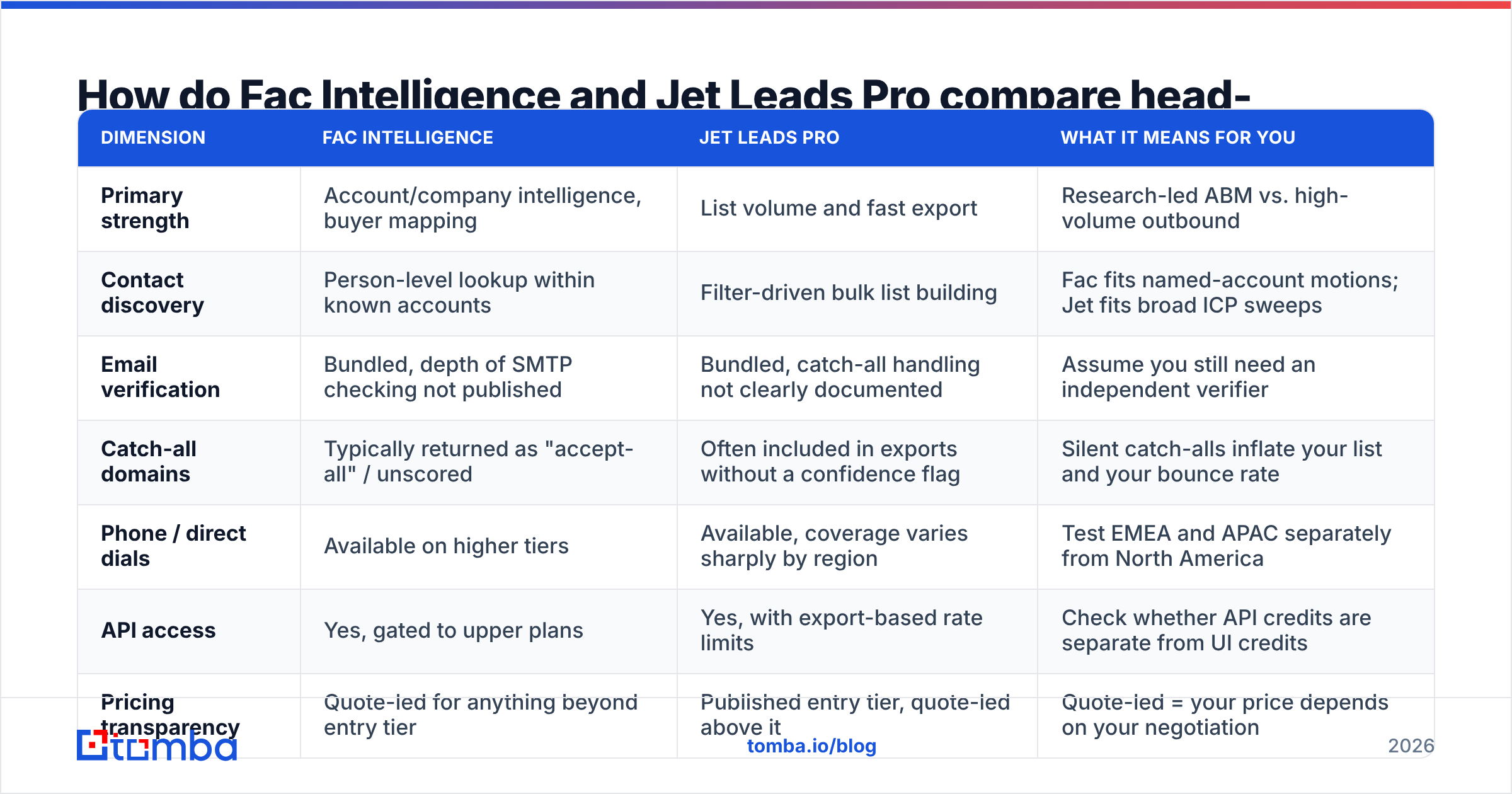
Here is the honest comparison. Where a vendor does not publish a figure, the table says so. An unpublished number tells you something too.
| Dimension | Fac Intelligence | Jet Leads Pro | What it means for you |
|---|---|---|---|
| Primary strength | Account/company intelligence, buyer mapping | List volume and fast export | Research-led ABM vs. high-volume outbound |
| Contact discovery | Person-level lookup within known accounts | Filter-driven bulk list building | Fac fits named-account motions; Jet fits broad ICP sweeps |
| Email verification | Bundled, depth of SMTP checking not published | Bundled, catch-all handling not clearly documented | Assume you still need an independent verifier |
| Catch-all domains | Typically returned as "accept-all" / unscored | Often included in exports without a confidence flag | Silent catch-alls inflate your list and your bounce rate |
| Phone / direct dials | Available on higher tiers | Available, coverage varies sharply by region | Test EMEA and APAC separately from North America |
| API access | Yes, gated to upper plans | Yes, with export-based rate limits | Check whether API credits are separate from UI credits |
| Pricing transparency | Quote-led for anything beyond entry tier | Published entry tier, quote-led above it | Quote-led = your price depends on your negotiation |
| Credit rollover | Not guaranteed; confirm in writing | Not guaranteed; confirm in writing | Unused credits expiring monthly is a hidden 20-40% cost |
| Best-fit team size | Mid-market to enterprise ABM teams | SMB and agency list builders | Wrong fit here wastes more money than a bad price |
Two things stand out. First, both platforms bundle verification. That sounds handy, and usually is not. A vendor grading its own homework has no reason to mark a contact undeliverable.
Second, both go quote-led fast. That is normal in this segment. But it means "which is cheaper" has no public answer. It has your answer, after a sales call.
Which platform has better data accuracy?#
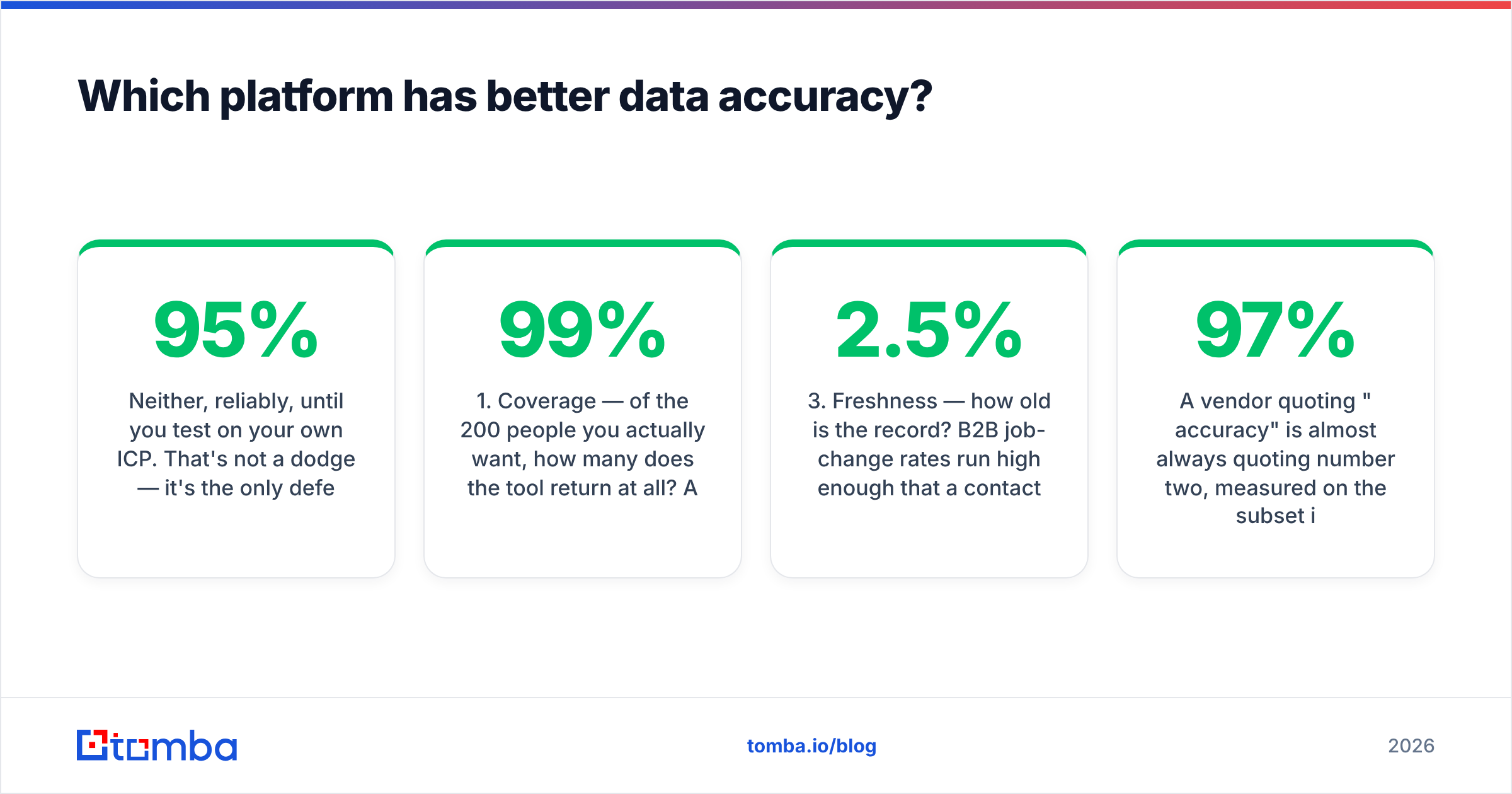
Neither, until you test on your own ICP. That is not a dodge. Both claim 95% or more, and neither publishes a method.
Accuracy here is three separate numbers that marketing folds into one:
- Coverage — of the 200 people you want, how many does the tool return at all? A tool can be 99% right on the 40 it finds and still miss 160.
- Deliverability — how many returned emails pass an outside verifier without a hard bounce? This number protects your domain.
- Freshness — how old is the record? Untended B2B data decays about 2-2.5% per month. That is a third of your list in a year.
A vendor quoting "97% accuracy" almost always means number two. It is measured on the subset the tool chose to return. That says nothing about coverage, and coverage is where these platforms differ most.

The practical move is simple. Pull the same 200-row sample from both tools. Run every address through a neutral email verifier with no stake in the result. Score coverage and deliverability apart.
You will usually find a small gap on deliverability and a big gap on coverage. Coverage is what you are really buying.
Watch catch-all domains closely. Many mid-market and enterprise domains accept all mail at the SMTP layer. A naive verifier calls them "valid". A lazy one calls them "unknown". Both answers are wrong for your purpose.
A dedicated catch-all verifier uses pattern confidence and secondary signals to give you a usable score. If neither tool flags catch-alls in exports, budget for that gap.
What do they actually cost?#
Ask three questions on the sales call, in this order. Write the answers down.
- What is the cost per found and verified contact, not per credit? Credits burn on failed lookups. A $0.10 credit with a 55% hit rate really costs $0.18 per usable contact.
- Do unused credits roll over, and for how long? Monthly expiry on an annual deal is the most common way teams overpay.
- Are API, UI and bulk-export credits the same pool? Split pools cost you more if you build automation.
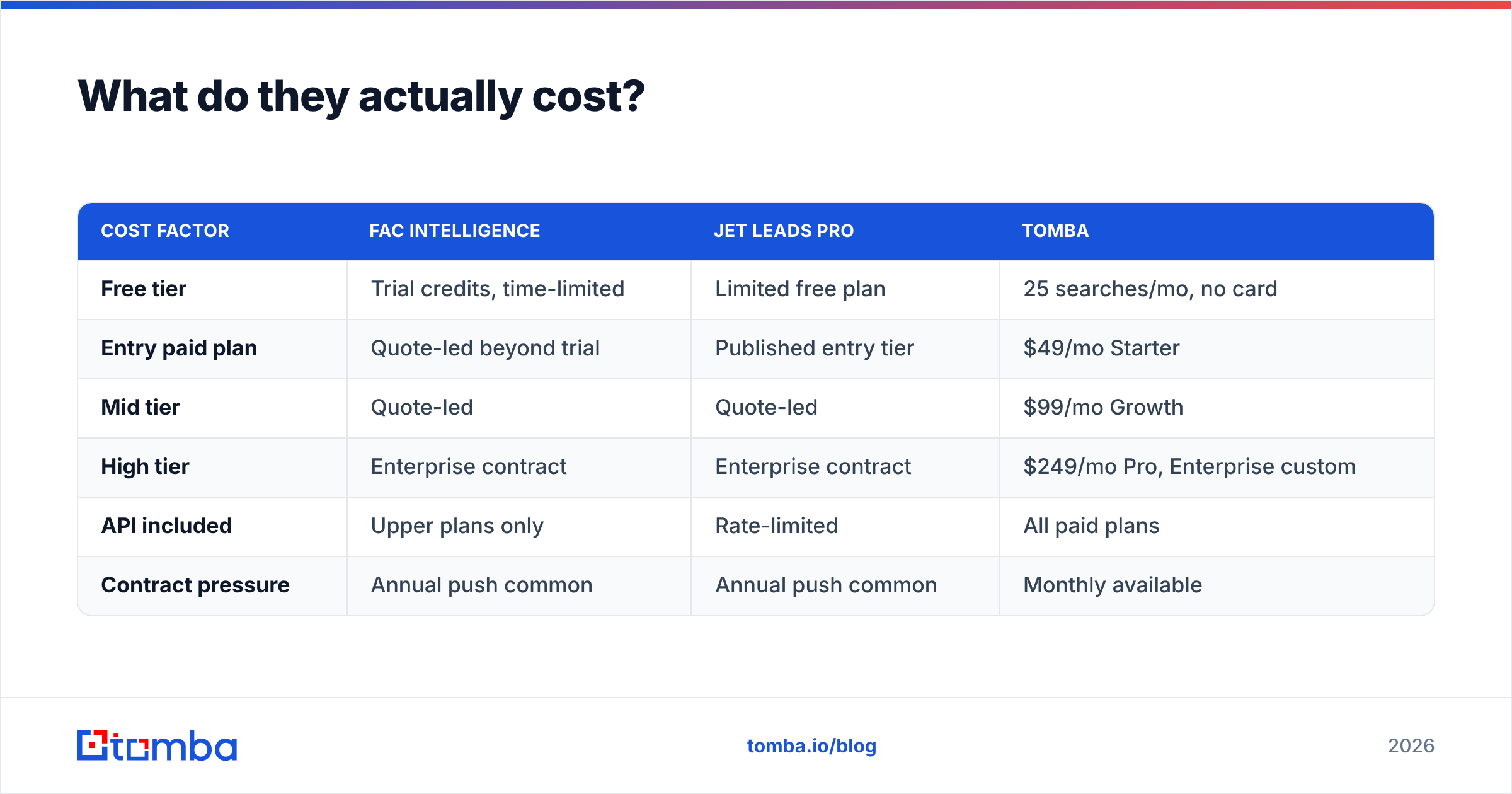
Here is how the pricing models compare with a focused, published-price option:
| Cost factor | Fac Intelligence | Jet Leads Pro | Tomba |
|---|---|---|---|
| Free tier | Trial credits, time-limited | Limited free plan | 25 searches/mo, no card |
| Entry paid plan | Quote-led beyond trial | Published entry tier | $49/mo Starter |
| Mid tier | Quote-led | Quote-led | $99/mo Growth |
| High tier | Enterprise contract | Enterprise contract | $249/mo Pro, Enterprise custom |
| API included | Upper plans only | Rate-limited | All paid plans |
| Contract pressure | Annual push common | Annual push common | Monthly available |
Full Tomba pricing is public. That is why it sits in the table. You can work out cost per contact before you talk to anyone. With quote-led vendors you cannot, and that gap is on purpose.
One line item gets forgotten: the cost of a bad send. A 6% bounce rate does more than waste credits. It hurts your sender reputation and drags down every campaign that follows. Cheap data that bounces is the most expensive data you can buy.
Who should choose Fac Intelligence?#
Pick Fac Intelligence if most of these are true:
- You run named-account ABM. You know the 300 companies that matter. You need depth in each one, not breadth across 30,000.
- Your buying committee is large. Mapping a six-person committee rewards org context, not a title-filtered list.
- Research time costs you real money. If AEs spend hours per account on manual context, an intelligence layer pays back fast.
- You have budget for a quote-led deal. Research-first tools rarely compete on price.
Skip it if you run high-volume outbound to a long tail of SMBs. You will pay for depth you never open.
Who should choose Jet Leads Pro?#
Pick Jet Leads Pro if most of these are true:
- You build lists in bulk every week. Agencies and SDR teams get more value per dollar from throughput than from context.
- Filters can describe your ICP. "SaaS, 50-200 headcount, US, VP Marketing" works. An ICP that needs human judgment does not.
- You already own a verification layer. Volume tools ship more marginal records, so you need a downstream check.
- You want to start without procurement. A published entry tier lets you test with a card.
Skip it if your deal size justifies real research. Skip it too if you sell into regions where its coverage thins out.

How do they compare to focused tools and databases?#
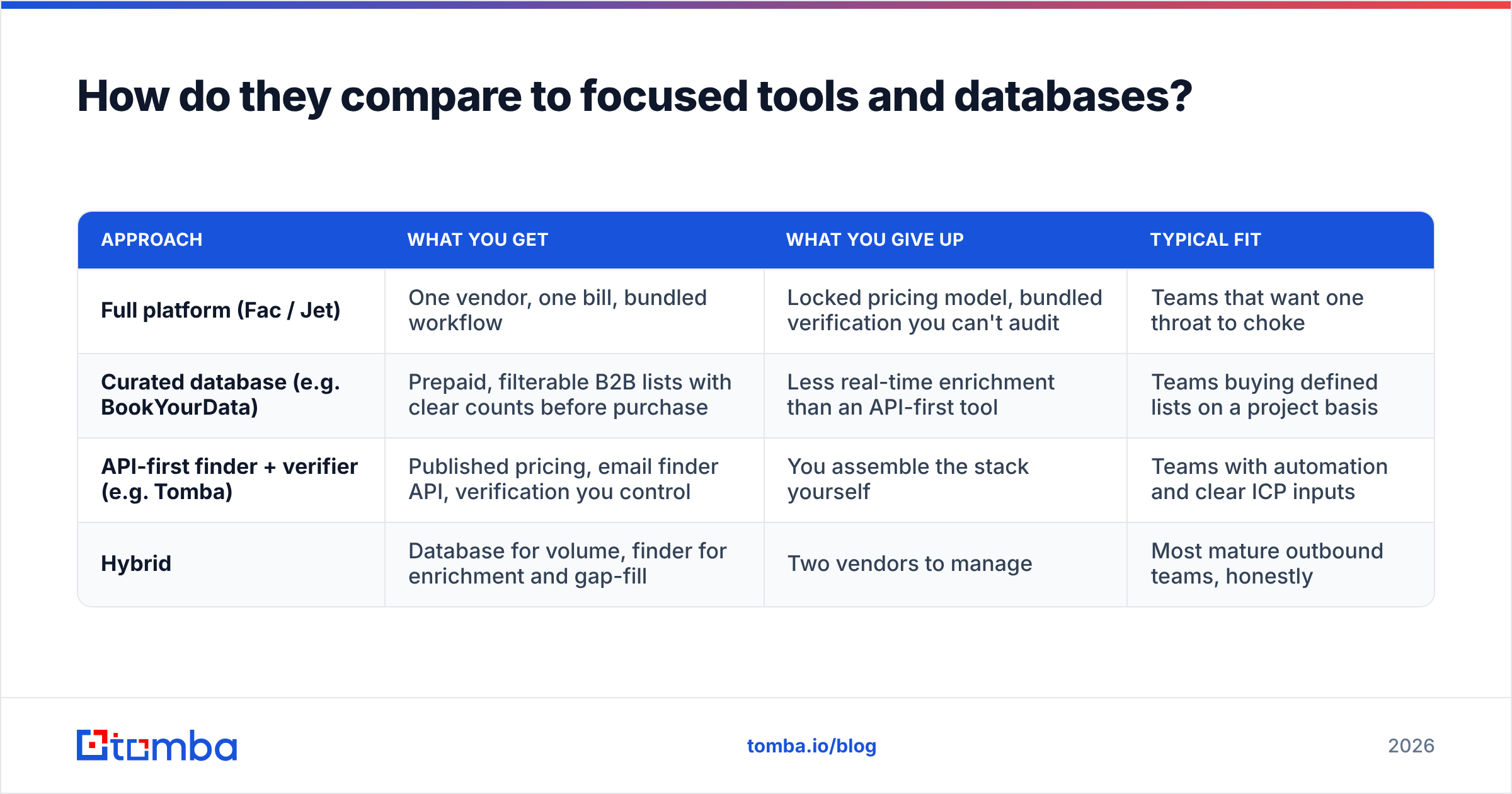
The versus framing hides a third option. Do not buy a platform at all. Split the job instead.
Most teams weighing these two tools need two things. A source of accounts and contacts. And a reliable way to turn a name plus a domain into a deliverable email. Those are separate buys, and splitting them is often cheaper.
| Approach | What you get | What you give up | Typical fit |
|---|---|---|---|
| Full platform (Fac / Jet) | One vendor, one bill, bundled workflow | Locked pricing model, bundled verification you can't audit | Teams that want one throat to choke |
| Curated database (e.g. BookYourData) | Prepaid, filterable B2B lists with clear counts before purchase | Less real-time enrichment than an API-first tool | Teams buying defined lists on a project basis |
| API-first finder + verifier (e.g. Tomba) | Published pricing, email finder API, verification you control | You assemble the stack yourself | Teams with automation and clear ICP inputs |
| Hybrid | Database for volume, finder for enrichment and gap-fill | Two vendors to manage | Most mature outbound teams, honestly |
BookYourData is worth a look if your problem is "I need 5,000 clean contacts in this segment this quarter". Prepaid lists with visible counts beat credit-metered platforms for that job. It solves a narrow problem well.
Tomba fits the other side. You have the accounts and need the emails. The email finder resolves name-plus-domain queries. Domain search pulls the contacts at a company. Verification runs apart from whoever sourced the record. That neutrality is what you want when you audit an accuracy claim.

What should you test before you buy either one?#
Run this before any contract. It takes an afternoon. It has settled more vendor arguments than any demo.
- Build a 200-row golden list. Real accounts, real named people, from your CRM or LinkedIn. Include your awkward segments.
- Run the same list through both trials. Same inputs, same day. Note whether each tool returned anything at all. That is your coverage number.
- Verify every address with a neutral third party. Never use the vendor's own check here. Score valid, invalid and catch-all apart.
- Work out cost per verified contact. Credits used divided by verified results. It is often 2-3x the headline price.
- Send a 50-address test from a warmed backup domain. Compare real bounces with the prediction. Above 3% means the verification is decorative.
- Re-verify a 90-day-old sample. The drop tells you how fast that vendor's data rots. No sales deck ever will.
Want a broader primer? The Wikipedia overview of lead generation is a fair neutral start. HubSpot's sales research publishes benchmarks you can check your own results against.
Fac Intelligence vs Jet Leads Pro: which one wins?#
Fac Intelligence wins for named-account ABM teams. Jet Leads Pro wins for high-volume list building. Neither wins on price transparency, and neither should be your only verification layer.
That is the honest verdict. Both are credible tools built for different motions. Picking on a feature matrix instead of your go-to-market is how teams pay enterprise prices for a CSV exporter.
The bigger point is the frame. Contact data has two jobs: sourcing and validating. Bundle them with one vendor and you can never audit either. Teams that split the stack spend less and bounce less, because the tool grading the data did not sell it to you.
Is your real bottleneck turning known companies into deliverable emails? Start with the Tomba Email Finder. The free tier gives you 25 searches a month with no card. That is enough to run the 200-row test above as a control. Paid plans start at $49/mo with the API on every tier, so you can wire it into your flow without a procurement cycle.
Related guides#
Ready to find emails that actually work?
Join 150,000+ professionals who stopped guessing and started sending. Free credits on signup — no credit card required.
Get the Tomba newsletter
Practical outbound tactics and product updates — once every two weeks.
About the author