Fac Intelligence vs RocketReach: Which B2B Data Tool Wins in 2026?
Fac Intelligence and RocketReach both promise verified B2B contacts, but they solve different problems. Here is an honest breakdown of coverage, accuracy, pricing traps, and which one your outbound team should actually pay for in 2026.
TL;DR
- RocketReach is the safer default if you want a large people-search index, a Chrome extension, and phone numbers bundled with emails — but per-seat pricing and lookup caps get expensive fast once more than two reps need access.
- Fac Intelligence positions itself as a firmographic + contact intelligence layer rather than a pure lookup box. It suits account research and enrichment workflows more than high-volume, name-by-name prospecting.
- Neither tool publishes an independently audited accuracy figure. Treat every vendor "98% accurate" claim as marketing until you run your own 200-contact bounce test.
- If your bottleneck is finding and verifying work emails at scale via API, a dedicated email finder like Tomba is usually cheaper per valid contact than either platform.
- The real cost driver is not the sticker price — it is wasted credits on catch-all domains, seat minimums, and annual-only discounts.
What are Fac Intelligence and RocketReach?#
Short version: RocketReach is a contact search engine; Fac Intelligence is a company-intelligence layer that also returns contacts.
RocketReach has been around since 2015 and built its reputation on breadth. You type a person's name and company, or filter by title and industry, and it returns work emails, personal emails, and phone numbers. It ships a browser extension, bulk lookups, a CRM push, and an API. Its index is aggregated from public web sources, partner data, and user contributions.
Fac Intelligence sits in a newer category. Instead of leading with "look up this person," it leads with "understand this account" — firmographics, technographics, signals, and then the humans attached to those accounts. That framing matters more than it sounds, because it changes what you are actually buying: RocketReach sells you lookups, Fac Intelligence sells you context.
Both get lumped into the same G2 grid, which is why buyers end up comparing them on price alone and regretting it a quarter later.

How do their data models actually differ?#
Here is the core distinction, broken down the way a RevOps lead would evaluate it:
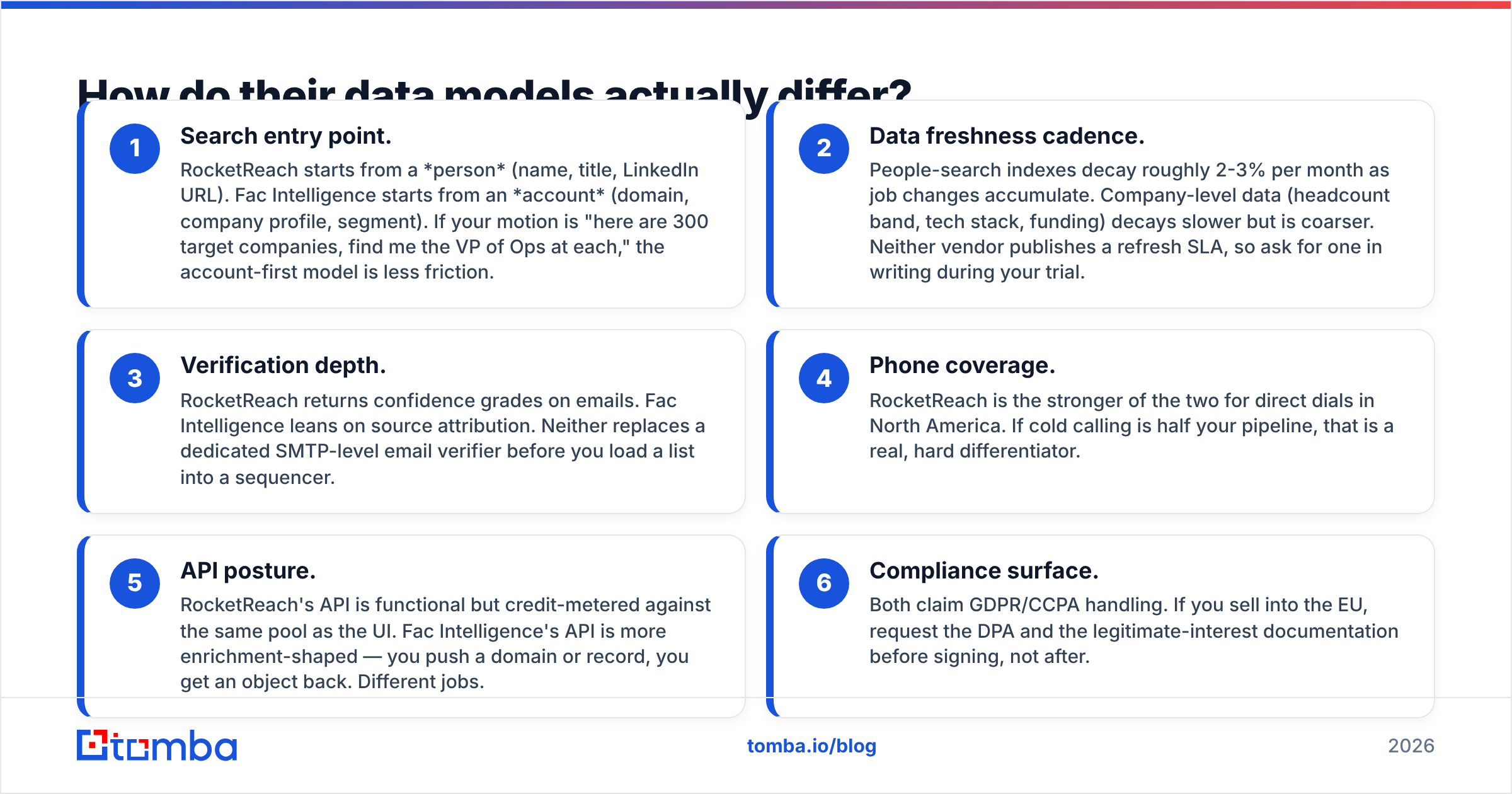
- Search entry point. RocketReach starts from a person (name, title, LinkedIn URL). Fac Intelligence starts from an account (domain, company profile, segment). If your motion is "here are 300 target companies, find me the VP of Ops at each," the account-first model is less friction.
- Data freshness cadence. People-search indexes decay roughly 2-3% per month as job changes accumulate. Company-level data (headcount band, tech stack, funding) decays slower but is coarser. Neither vendor publishes a refresh SLA, so ask for one in writing during your trial.
- Verification depth. RocketReach returns confidence grades on emails. Fac Intelligence leans on source attribution. Neither replaces a dedicated SMTP-level email verifier before you load a list into a sequencer.
- Phone coverage. RocketReach is the stronger of the two for direct dials in North America. If cold calling is half your pipeline, that is a real, hard differentiator.
- API posture. RocketReach's API is functional but credit-metered against the same pool as the UI. Fac Intelligence's API is more enrichment-shaped — you push a domain or record, you get an object back. Different jobs.
- Compliance surface. Both claim GDPR/CCPA handling. If you sell into the EU, request the DPA and the legitimate-interest documentation before signing, not after.
The takeaway: these are not substitutes. Buying Fac Intelligence to replace RocketReach (or the reverse) usually leaves a gap somewhere in your workflow that you patch with a third tool anyway.
How accurate is the data from each platform?#
This is where most comparison posts hand-wave, so let's be precise about what "accuracy" means.
There are three separate numbers vendors blur together:
- Coverage / hit rate — of 100 requested contacts, how many returned any email?
- Deliverability — of the emails returned, how many did not bounce?
- Correctness — of the delivered emails, how many actually belonged to the right person?
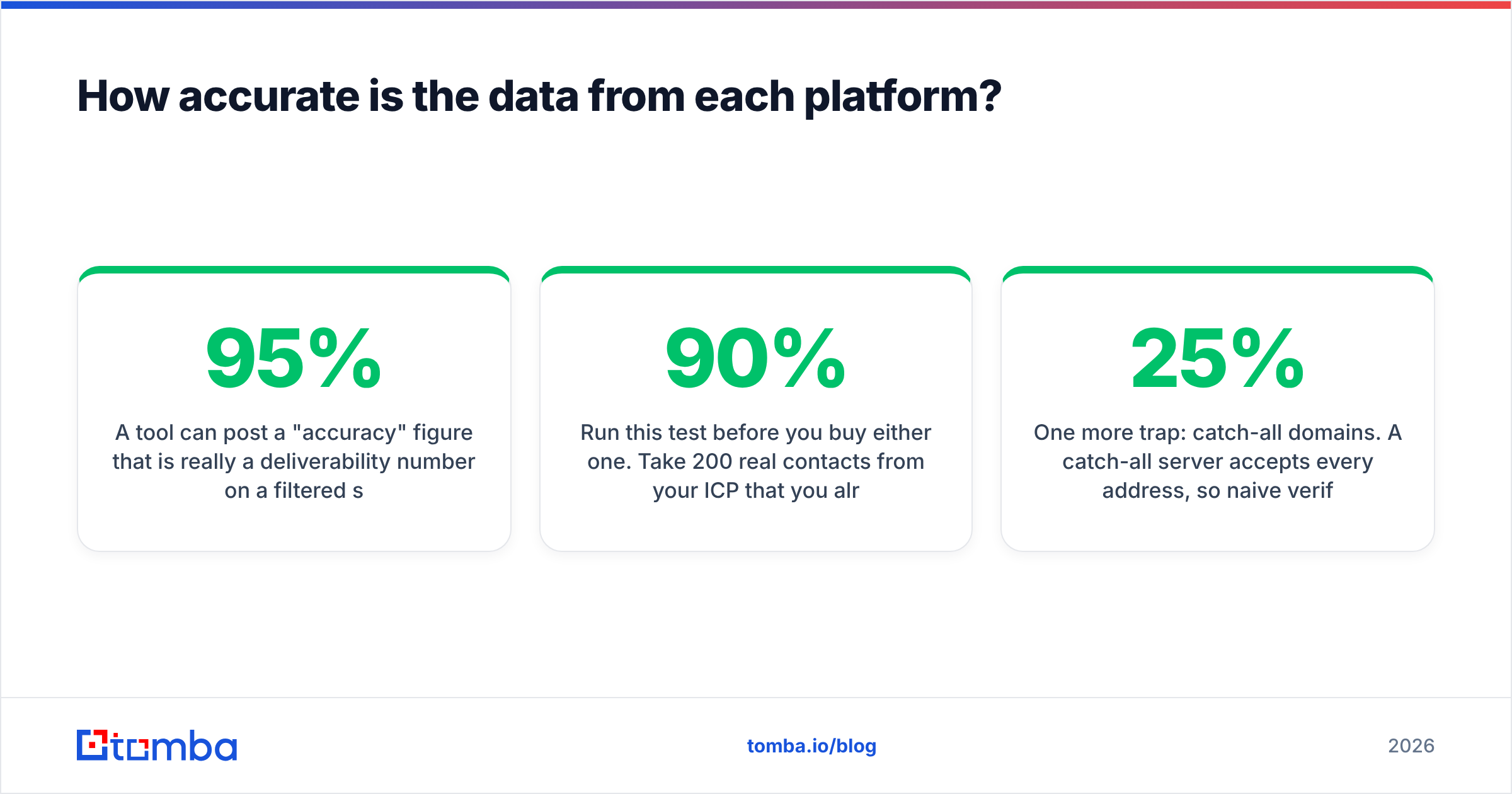
A tool can post a 95% "accuracy" figure that is really a deliverability number on a filtered subset, while its hit rate on your ICP is 45%. That gap is where your budget disappears.

RocketReach generally lands in the mid-to-high range on coverage for US-based tech, finance, and SaaS titles, and noticeably weaker for SMB, non-English-speaking markets, and non-desk roles. Fac Intelligence's contact layer is thinner in raw volume but tends to be tied to a verifiable company record, which reduces the "wrong Jane Smith" failure mode.
Run this test before you buy either one. Take 200 real contacts from your ICP that you already have verified emails for. Run them blind through each trial. Measure hit rate, then bounce-test the returned addresses with an independent email verification pass. Anything above 90% deliverability on your segment is genuinely good. Anything below 70% means you are paying to generate spam complaints.
One more trap: catch-all domains. A catch-all server accepts every address, so naive verifiers mark them "valid" and the vendor counts the credit as a win. Roughly 15-25% of B2B domains are catch-all depending on your market. Use a dedicated catch-all verifier so those records get flagged rather than silently inflating your list quality.
Fac Intelligence vs RocketReach: the feature and pricing comparison#
Pricing on both platforms changes and both run annual-only discounts, so verify current numbers on the vendor sites. The structural differences below are stable.
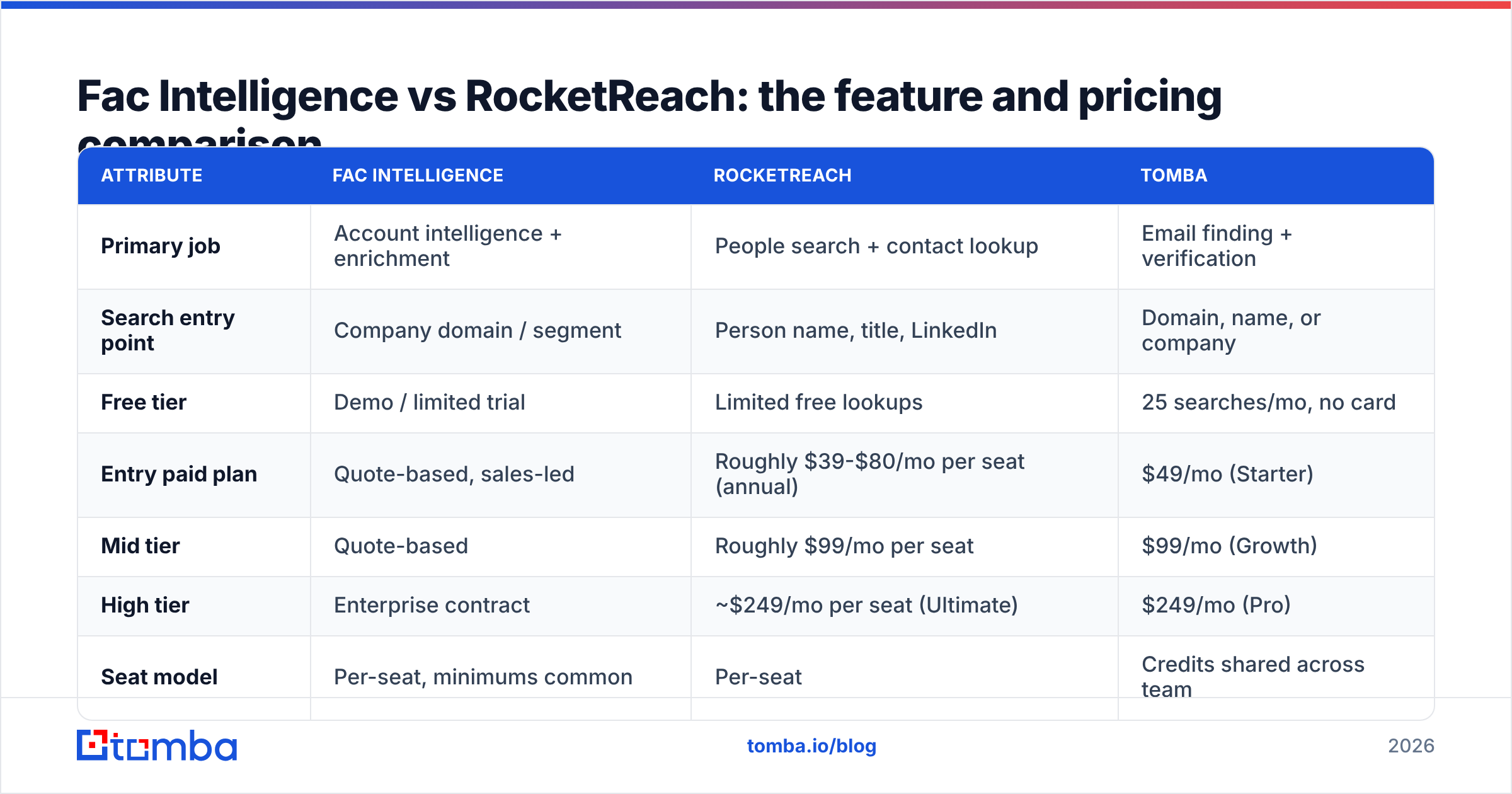
| Attribute | Fac Intelligence | RocketReach | Tomba |
|---|---|---|---|
| Primary job | Account intelligence + enrichment | People search + contact lookup | Email finding + verification |
| Search entry point | Company domain / segment | Person name, title, LinkedIn | Domain, name, or company |
| Free tier | Demo / limited trial | Limited free lookups | 25 searches/mo, no card |
| Entry paid plan | Quote-based, sales-led | Roughly $39-$80/mo per seat (annual) | $49/mo (Starter) |
| Mid tier | Quote-based | Roughly $99/mo per seat | $99/mo (Growth) |
| High tier | Enterprise contract | ~$249/mo per seat (Ultimate) | $249/mo (Pro) |
| Seat model | Per-seat, minimums common | Per-seat | Credits shared across team |
| Phone numbers | Limited | Strong in North America | Available via phone finder |
| Bulk CSV processing | Yes, enterprise tiers | Yes, credit-metered | Yes, all paid plans |
| Public API | Enrichment-oriented | Yes, shares credit pool | Yes, full REST + CLI + MCP |
| Catch-all handling | Not surfaced | Flagged inconsistently | Dedicated catch-all verifier |
| Contract friction | Sales call required | Self-serve | Self-serve |

The line that matters most in that table is seat model. RocketReach charges per user. A five-person SDR team on the $99 tier is $495/month before anyone has sent an email. Fac Intelligence's enterprise contracts typically carry seat minimums too. Credit-pooled tools decouple headcount from spend — you pay for data volume, not for how many people are logged in.
Which one is better for cold outbound?#
For pure volume outbound, RocketReach wins between these two — and a dedicated email finder beats both on cost per valid contact.
Cold outbound has a specific shape: you need thousands of accurate work emails per month, verified, deduplicated, and pushed into a sequencer without a human touching each row. Judge tools on cost per deliverable contact, not per credit.
Run the math honestly:
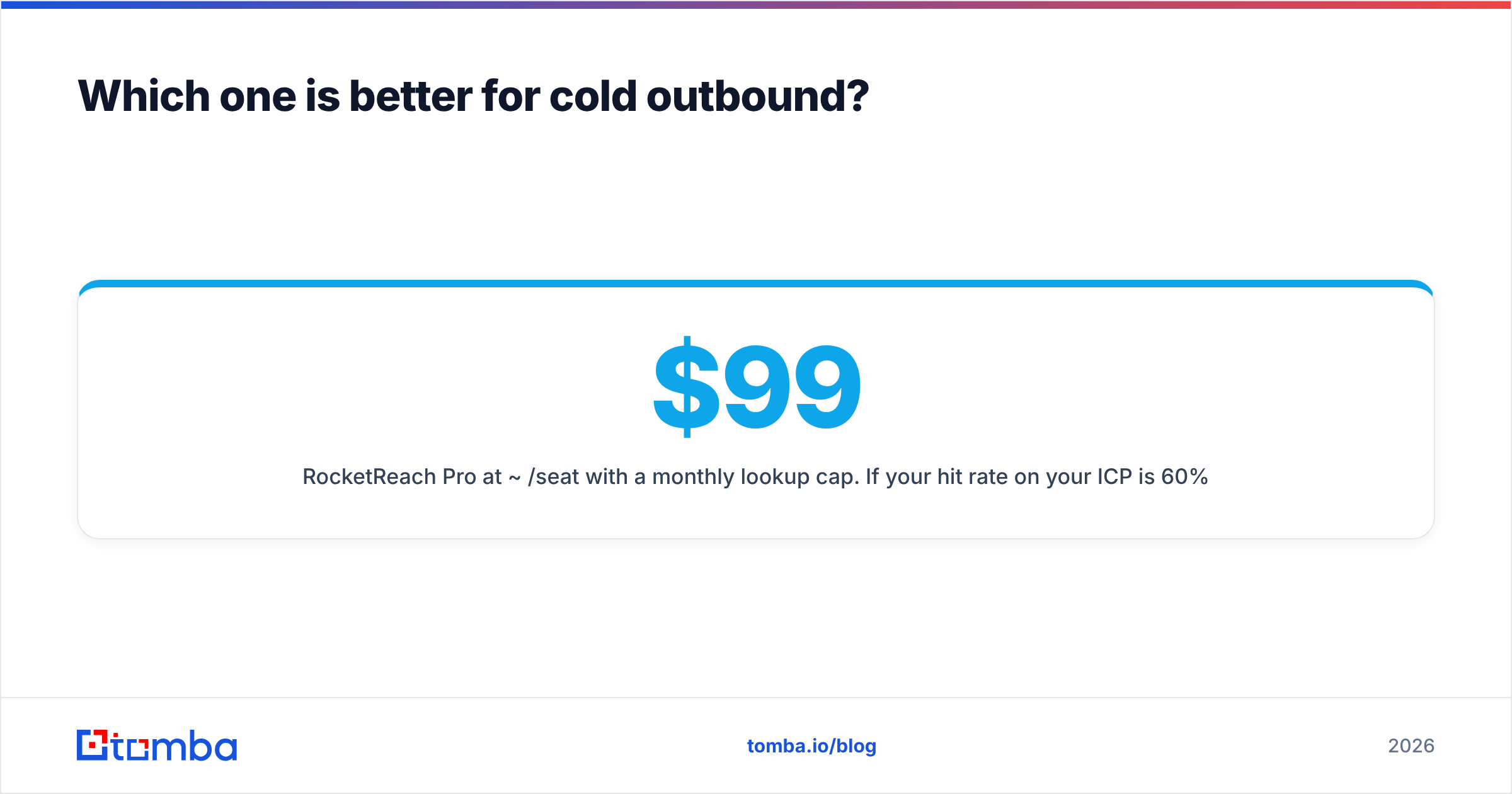
- RocketReach Pro at ~$99/seat with a monthly lookup cap. If your hit rate on your ICP is 60% and your post-verification deliverability is 85%, your effective yield is about 51 usable contacts per 100 credits. Your real cost per usable contact is roughly double the sticker rate.
- Fac Intelligence at an enterprise contract is hard to model per-contact because the value is in the account layer, not the lookup volume. If you evaluate it as a cold-email data source, you will likely find the cost per contact unattractive — that is not the job it was built for.
Where a specialist tool pulls ahead: a bulk email finder run lets you upload a domain list, return the pattern-matched contacts, and verify in the same pass. No per-seat tax, no separate verification vendor, and you can automate the whole loop through the Tomba API so your enrichment runs on a cron instead of on an SDR's afternoon.
If your motion is LinkedIn-first, a LinkedIn finder that resolves profile URLs to verified work emails removes the step where reps copy names into a search box one at a time.

Which one is better for account-based marketing?#
Fac Intelligence, clearly — assuming you have the budget and the ABM motion to justify it.
ABM lives and dies on account selection. You need to know which 300 companies to chase before you care about which humans work there. Firmographic filters, technographic signals, and hiring or funding triggers are what tell you an account is in-market. A people-search index cannot do that. RocketReach will happily give you 40 contacts at a company that has zero intent to buy.
The pattern that works in practice for most mid-market teams:
- Use an account-intelligence layer (Fac Intelligence, or a comparable platform) to build and score the target list.
- Use a high-yield email finder to resolve the contacts at those accounts.
- Use a verifier as the last gate before anything reaches your sending domain.
That's three jobs, and buying one tool that does all three mediocre-ly is how teams end up with a 4% reply rate and a burned domain. If you want the vocabulary straight, the B2B glossary covers the difference between an MQL, an ICP account, and an intent signal.
What are the hidden costs buyers miss?#
Five things reliably blow up the budget after month one:
- Rollover rules. Unused credits usually expire monthly. If you buy for peak volume, you overpay in every slow month.
- Annual-only discounts. The advertised price is often the annual-prepay rate. Monthly billing can be 25-40% higher on both platforms.
- Seat minimums. Enterprise contracts frequently require 3-5 seats. That doubles the floor price for a small team.
- Credit burn on failures. Some vendors charge a credit for a "no result." Ask explicitly. Over a 10,000-row list with a 55% hit rate, that is 4,500 wasted credits.
- The second vendor. Neither platform fully replaces a standalone verifier, so most teams end up paying a bounce-checking tool on top. Bundling finding and verification in one plan removes that line item.
On the vendor side, both RocketReach and Fac Intelligence maintain listings on G2 where the review volume and recency give you a rough sanity check on support quality — read the 3-star reviews, not the 5-star ones. For a broader framing of how contact data fits into a modern GTM stack, HubSpot's research library is a reasonable neutral baseline.
How should you choose between them?#
Match the tool to your bottleneck, not to the feature list.
- You cold call as much as you email, North America focused. RocketReach. The direct-dial coverage is the differentiator and nothing else in this comparison matches it.
- You run true ABM with a small target list and a long cycle. Fac Intelligence. You are buying account context, and per-contact cost stops being the metric that matters.
- You need 5,000+ verified work emails a month, programmatically. Neither. Use a dedicated email finder with a real API, credit pooling, and built-in verification. That is where cost per usable contact drops by half.
- You are a two-person team testing a market. Start free. Twenty-five searches a month is enough to validate a segment before you commit to any annual contract.
- You are consolidating vendors. Map the three jobs — account selection, contact resolution, verification — and check which of your current tools actually own each one. Most stacks have redundancy in one job and a gap in another.
Also worth a look if you want a straightforward, list-purchase model rather than a search subscription: BookYourData sells pre-verified B2B lists with a pay-as-you-go structure, which fits teams that need a one-time list rather than a recurring lookup tool.
The bottom line#
Fac Intelligence and RocketReach are both defensible purchases — for different teams. RocketReach is the broader people-search index with the better phone coverage and a self-serve path. Fac Intelligence is the account-intelligence layer for teams whose problem is which companies to target, not who works there. Neither is the cheapest way to produce large volumes of verified work emails, and both charge per seat, which punishes growing teams.
If your actual bottleneck is contact resolution at scale, start with the specialist. The Tomba Email Finder resolves emails by domain, name, or company, verifies them in the same pass, pools credits across your whole team instead of charging per seat, and exposes everything through a REST API, CLI, and MCP server so your enrichment runs without a human in the loop. The free tier gives you 25 searches a month with no card — run your own 200-contact accuracy test against whatever you are paying for today, and let the bounce rate decide. Full Tomba pricing starts at $49/month.
Related guides#
Ready to find emails that actually work?
Join 150,000+ professionals who stopped guessing and started sending. Free credits on signup — no credit card required.
Get the Tomba newsletter
Practical outbound tactics and product updates — once every two weeks.
About the author