FAC Intelligence vs SignalHire: B2B Contact Data Compared
SignalHire is a public, self-serve contact finder with phone data. FAC Intelligence is the quieter, quote-based option. Here's how they compare on coverage, verification, pricing, and workflow fit — plus when a dedicated email finder beats both.
FAC Intelligence vs SignalHire is really a question about proof. One tool lets you test it in ten minutes. The other starts with a sales call.
TL;DR
- SignalHire is the open option: public pricing, self-serve signup, a Chrome extension, and both email and mobile lookups in one credit system.
- FAC Intelligence sits in the quote-based corner of the market. Expect a demo call before you see a number. Expect to ask hard questions about where the data comes from.
- Neither tool removes the step that protects your domain: verification before send. Both hand you addresses. Only a verifier tells you which ones will bounce.
- If your real job is finding work emails at scale — by domain, by name, or by API — a dedicated email finder usually wins on cost per valid contact.
- Quick split for FAC Intelligence vs SignalHire: SignalHire for recruiter-style sourcing with phone numbers, FAC Intelligence if a rep can prove regional coverage you can't get elsewhere, Tomba for high-volume verified email wired into your stack.
FAC Intelligence vs SignalHire: what are these two tools?#
Both solve the same surface problem. You have a name and a company. You need a way to reach that person. But they come at it from opposite ends.
SignalHire is a contact-finding platform built around a browser extension. You open LinkedIn, a company site, or a candidate profile and click the extension. It returns work emails, personal emails, and mobile numbers where it has them. It also adds an ATS-style layer: lists, pipeline stages, team seats. A big slice of its users are recruiters, not SDRs.
Pricing and plan tiers are published on signalhire.com. That matters more than it sounds. You can budget without booking a call.
FAC Intelligence is harder to pin down, and you should treat that as data in itself. It sells as a B2B intelligence and lead-data provider, not a self-serve browser tool. Public documentation is thin. Pricing is not listed at the time of writing. Most reviews start with a sales conversation.
That is not automatically a red flag. Plenty of good regional data vendors sell this way. But it does move the burden of proof onto you.
The difference in one line: with SignalHire you test the product; with FAC Intelligence you review a proposal.

FAC Intelligence vs SignalHire: the head-to-head table#
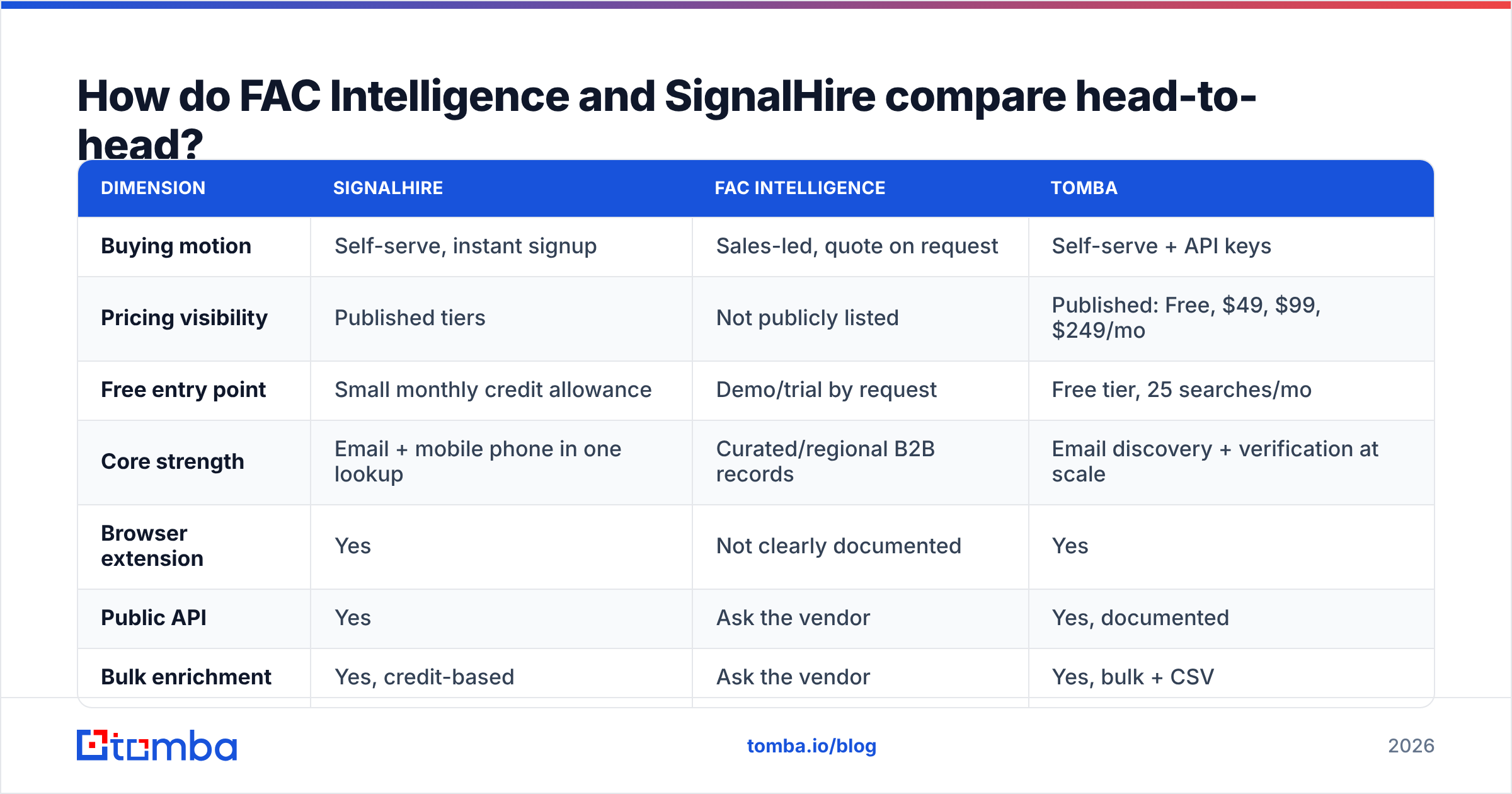
Here is the honest side-by-side. Where a vendor does not publish something, the table says so instead of inventing a number. "Not publicly listed" is a fair scoring factor when you are the one signing the contract.
| Dimension | SignalHire | FAC Intelligence | Tomba |
|---|---|---|---|
| Buying motion | Self-serve, instant signup | Sales-led, quote on request | Self-serve + API keys |
| Pricing visibility | Published tiers | Not publicly listed | Published: Free, $49, $99, $249/mo |
| Free entry point | Small monthly credit allowance | Demo/trial by request | Free tier, 25 searches/mo |
| Core strength | Email + mobile phone in one lookup | Curated/regional B2B records | Email discovery + verification at scale |
| Browser extension | Yes | Not clearly documented | Yes |
| Public API | Yes | Ask the vendor | Yes, documented |
| Bulk enrichment | Yes, credit-based | Ask the vendor | Yes, bulk + CSV |
| Best-fit user | Recruiters, founder-led sales | Teams needing niche regional data | Outbound and RevOps teams at volume |

Two things stand out. First, SignalHire wins on how fast you can test it. You can prove or disprove its value against your own list this afternoon.
Second, both tools bundle discovery and delivery-readiness together. That is where most teams quietly lose money. A credit spent on a contact that bounces costs you twice: once at the vendor, once at your sender reputation.
How accurate is the data, really?#
Accuracy claims here mean little without a definition, and almost every vendor uses a different one. Three questions cut through the noise.
- What counts as a "found" contact? Some tools count a guessed pattern (
first.last@domain.com) as found. That is a hypothesis, not a contact. - When was the address checked — at send time, or back in 2023? B2B contact data goes stale fast as people change jobs. The general data-degradation problem hits every static database.
- How are catch-all domains handled? A catch-all server accepts everything. So a naive verifier marks every address as valid. This is the single biggest source of inflated accuracy numbers in the industry.

Run the same test on both vendors before you commit. Take 100 contacts whose addresses you already know. Hold them out. Then see what each tool returns.
Measure three things. Coverage: how many it found. Precision: how many matched your known-good address. Bounce rate: run the results through an independent email verifier and count the hard bounces.
A tool that finds 80% at 92% precision beats one that finds 95% at 70% precision. Every time. The second one is quietly burning your domain.
For catch-all domains, do not accept a plain valid/invalid answer. A catch-all verifier that returns a confidence score is far more useful than a tool that shrugs and says "accept_all". You can still mail high-confidence catch-alls from a separate, warmed domain.
Which one gives you better phone coverage?#
On phones, FAC Intelligence vs SignalHire is not a close call — at least not on what you can verify today. SignalHire returns mobile numbers next to emails in the same credit action. That is why recruiters like it. A candidate who ignores email will often answer a text.
FAC Intelligence's phone coverage is a question for the sales call. Do not assume it. Ask for it in writing, by region, with a sample file.
Whatever you choose, treat phone data like email data.
- Split direct dials from switchboards. A main company line is not a lead. It is a receptionist.
- Check the local rules before you dial. Consent and do-not-call laws differ across the US, EU, and UK. "The vendor gave it to me" is not a defence.
- Validate the line type. Landline, mobile, or VoIP changes both your connect rate and your legal risk. A phone validator sorts this out before your dialler wastes a slot.
- Measure connect rate, not coverage. 60% coverage with a 15% connect rate beats 90% coverage with 4%.
- Add phone, don't swap. Phone is a second channel on top of email, not a substitute. Teams that drop email for calls usually book fewer meetings.
Happy with your current data provider and only short on numbers? A standalone phone finder costs less than moving your whole contact stack for one field.
How does pricing actually work for each?#
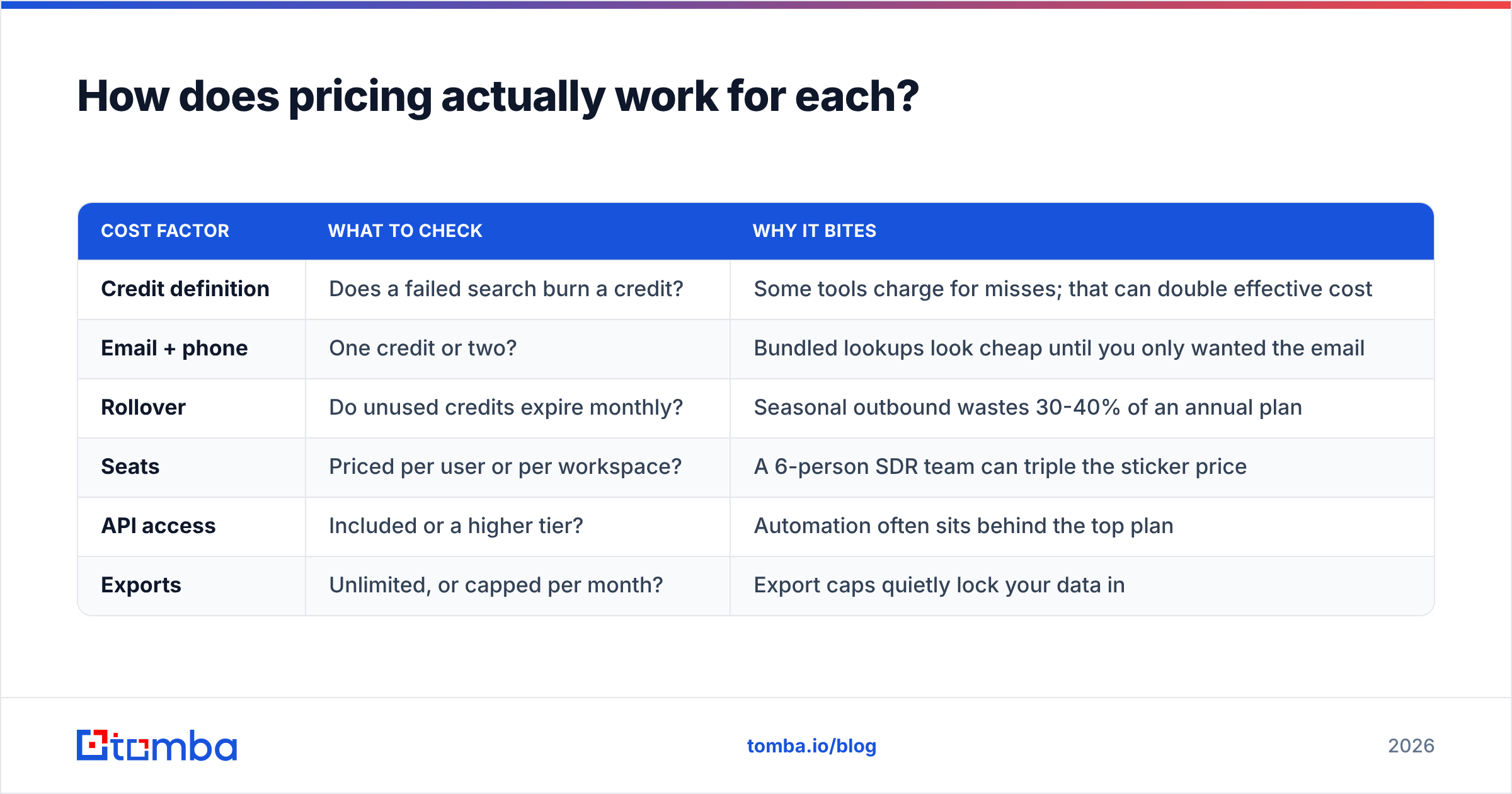
Pricing is where FAC Intelligence vs SignalHire splits hardest. One publishes, one quotes. Credit models make it worse, because a "credit" means something different in every product. Before you compare dollars, work out the cost per usable contact — the cost per contact that exists and survives verification.
| Cost factor | What to check | Why it bites |
|---|---|---|
| Credit definition | Does a failed search burn a credit? | Some tools charge for misses; that can double your real cost |
| Email + phone | One credit or two? | Bundled lookups look cheap until you only wanted the email |
| Rollover | Do unused credits expire monthly? | Seasonal outbound wastes 30-40% of an annual plan |
| Seats | Priced per user or per workspace? | A 6-person SDR team can triple the sticker price |
| API access | Included or a higher tier? | Automation often sits behind the top plan |
| Exports | Unlimited, or capped per month? | Export caps quietly lock your data in |
For reference, published Tomba pricing runs a free tier at 25 searches a month, Starter at $49, Growth at $99, and Pro at $249, plus custom Enterprise. API access is included, not an upcharge.
SignalHire publishes tiers in a broadly similar band. Check the current numbers on their site before you budget, since credit limits change. FAC Intelligence needs a quote, so build your comparison on their proposal rather than a homepage.
One note for any quote-based vendor. Ask for the pilot terms in the contract, not in the email thread. A 30-day exit tied to a measured bounce rate is a fair ask. Vendors confident in their data say yes.

Who should choose FAC Intelligence, and who should choose SignalHire?#
- Choose SignalHire if you are a recruiter, a founder sourcing your own leads, or a small sales team. You get email and mobile in one click from LinkedIn. Self-serve means you can prove ROI without a procurement cycle.
- Choose FAC Intelligence if their rep can show coverage the open players cannot match — on your ICP, in your region, with a sample file you supply. Niche regions and verticals are where sales-led vendors earn their premium.
- Choose a dedicated email finder if your work is domain-first, not profile-first. You have 4,000 target companies and need decision-maker addresses at volume, in a pipeline. That is a domain search and bulk-enrichment job, not a browser-extension job.
- Choose more than one if your volume justifies it. Waterfall enrichment — hit provider A, send the misses to provider B — often lifts coverage by 15 to 25 points. It only works when your tools have real APIs.
One honest ceiling on the FAC Intelligence vs SignalHire debate: no single provider covers the whole B2B universe. Peer reviews in G2's lead-intelligence category show the same pattern for every vendor. Strong in some regions and seniority bands. Thin in others. Anyone who claims otherwise is selling.
Where does Tomba fit between these two?#
Tomba is not an ATS or a full GTM suite, and that is the point of the comparison. It focuses on the step where mistakes cost the most: turning a company or a name into a verified, deliverable work email, then keeping that data fresh.
Four things matter in a bake-off:
- Find and verify in one place. Spot catch-alls without exporting to a second vendor and importing again.
- Built for volume. Bulk lead generation for lists, plus a documented email finder API when the list lives in your own product or warehouse.
- Open pricing. Free, $49, $99, $249. No demo gate to learn whether it fits your budget.
- Where reps already work. Chrome extension, Google Sheets, Excel, and CRM integrations, so contacts land in the tools your team already uses.
Where SignalHire wins: phone plus email in one lookup for candidate sourcing. Where a quote-based vendor like FAC Intelligence may win: a regional dataset you have tested yourself. Be honest about which one you need. Most outbound teams find the real constraint is verified email volume, not exotic coverage.
What's the verdict on FAC Intelligence vs SignalHire?#
Default to SignalHire unless FAC Intelligence clears a bar you set in advance. Openness is a feature. Published pricing, instant signup, and a testable extension let you measure the tool instead of trusting a deck.
FAC Intelligence earns a serious look when you hit a coverage wall in one market and a rep will back the claim with a sample file. Make them prove it on your own held-out list, not on their case study.
Whichever you pick, keep discovery and deliverability as two separate, measured steps. The number that predicts your reply rate is not how many contacts a tool found. It is how many were real when you pressed send.
Want to settle FAC Intelligence vs SignalHire with your own data? Start with the Tomba Email Finder. The free tier gives you 25 searches a month. That is enough to benchmark it against whatever the other two return on the same 25 targets. Compare coverage, compare precision, then compare the bill.
Related guides#
Ready to find emails that actually work?
Join 150,000+ professionals who stopped guessing and started sending. Free credits on signup — no credit card required.
Get the Tomba newsletter
Practical outbound tactics and product updates — once every two weeks.
About the author