9 Best Fastbase Alternatives in 2026 (Tested & Compared)
Fastbase turns Google Analytics traffic into company names — but company names don't reply to email. Here are nine alternatives compared on match rate, contact data, pricing, and what they actually deliver to your SDRs.
TL;DR
- Fastbase (WebLeads) reads your Google Analytics data and tells you which companies visited your site. It's cheap, fast to install, and stops exactly there — you get a firmographic record, not a person to email.
- The main reasons teams shop for Fastbase alternatives: low match rates outside the US/EU enterprise segment, no contact-level data, thin CRM integrations, and reporting that feels like 2015 Analytics.
- Your real choice is between three categories: company-level visitor ID (Leadfeeder/Dealfront, Albacross, Lead Forensics), person-level identity resolution (RB2B, Vector, Warmly), and contact data platforms you pair with any of them.
- Company-level tools cost $99–$1,000+/mo. Person-level tools cost more per identified visitor but shorten the path to a send.
- Whatever you pick, budget for the last mile: turning a company or a name into a verified, deliverable email. That's where a tool like Tomba's email finder does the work visitor-ID vendors hand off to you.
What is Fastbase and what does it actually do?#
Fastbase is a website visitor intelligence product built on top of Google Analytics. You connect your GA property, it de-anonymises a slice of your traffic by matching IP addresses and network data to company records, and it surfaces a feed: which companies visited, which pages they hit, how long they stayed, how often they came back.
It also sells adjacent products — a B2B contact database, an ads-audience export, and a lead scoring layer — but WebLeads is the flagship and the reason most people find it.
The pitch is honest and narrow: 97% of your B2B traffic never fills in a form, and Fastbase recovers a fraction of that as company names. It's genuinely useful signal. A visit from a target account that read your pricing page three times last week is a better outbound trigger than almost anything you'll buy from a static list.
The problem is what happens next. Fastbase hands you "Acme Corp visited /pricing." Your SDR still has to figure out who at Acme, find their email, verify it, and write something relevant — before the intent signal goes cold. That handoff gap is the single biggest driver of Fastbase alternative searches.
Correction — that image belongs inline:

Why do teams look for Fastbase alternatives?#
From reviews on G2 and conversations with teams who've churned, five complaints repeat:
- Match rate falls off outside big enterprises. IP-to-company matching works well for companies with owned network ranges. It works poorly for remote-first teams, small businesses, and anyone on consumer broadband or a VPN. Depending on your ICP, you may resolve 8% of sessions or 35%.
- No contact-level output. You get firmographics and page paths. You don't get a person, a role, an email, or a phone. Every identified account needs a second tool before it's actionable.
- Integration depth. Slack and email alerts exist, but bi-directional CRM sync, enrichment-on-write, and workflow triggers are thinner than what Dealfront or HubSpot-native tools ship.
- Data hygiene. ISP records, hosting providers, and stale company mappings leak into the feed. Teams end up building manual exclusion lists.
- Reliance on Google Analytics. Tying identification to a GA property means GA4 changes, consent-mode restrictions, and ad-blockers all cut into your coverage directly.
None of these make Fastbase a bad product at its price point. They make it an incomplete one for teams that expect a visitor feed to produce sends.
How should you compare Fastbase alternatives?#
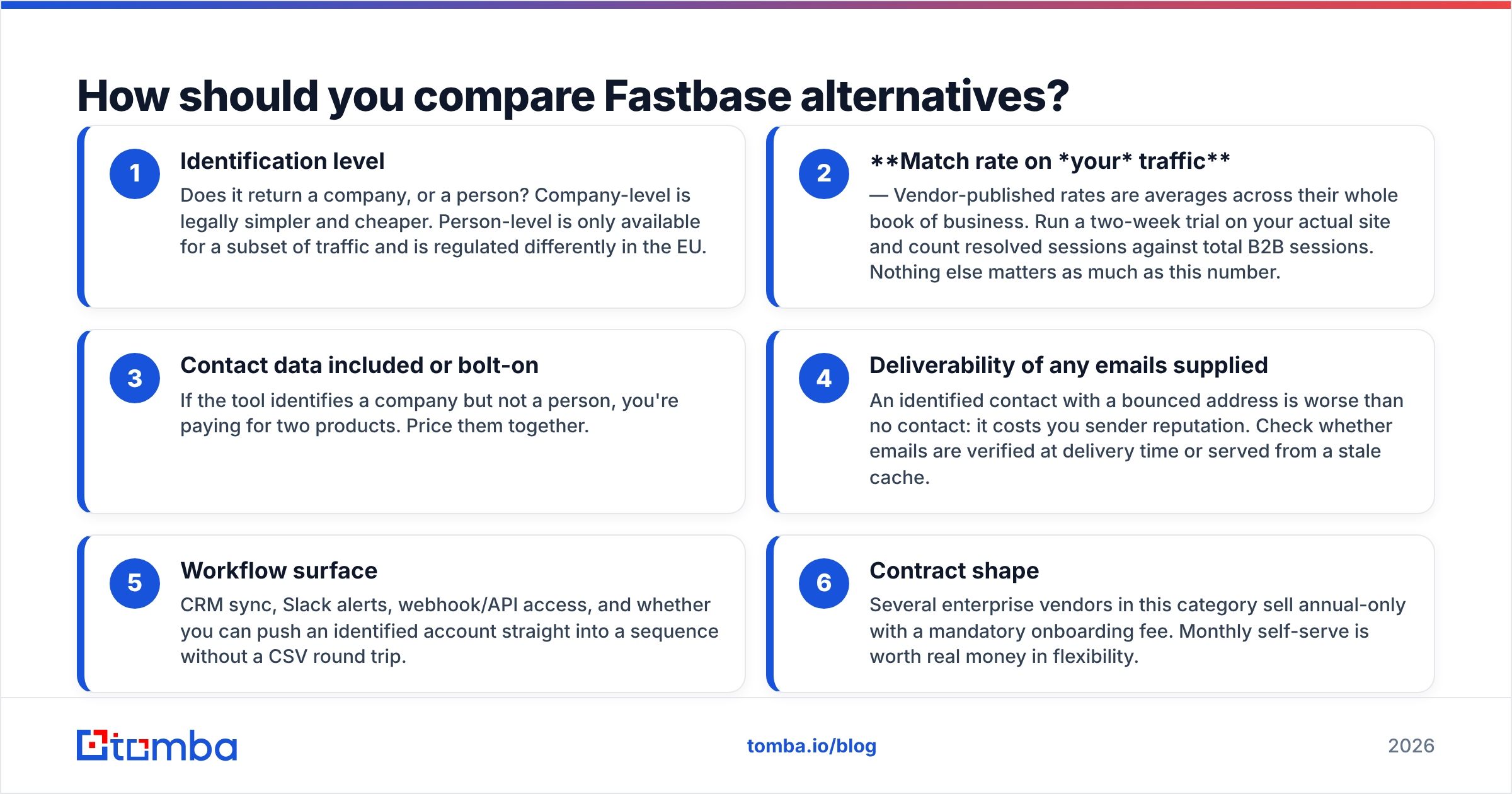
Score every candidate on these six axes before you look at price:
- Identification level — Does it return a company, or a person? Company-level is legally simpler and cheaper. Person-level is only available for a subset of traffic and is regulated differently in the EU.
- Match rate on your traffic — Vendor-published rates are averages across their whole book of business. Run a two-week trial on your actual site and count resolved sessions against total B2B sessions. Nothing else matters as much as this number.
- Contact data included or bolt-on — If the tool identifies a company but not a person, you're paying for two products. Price them together.
- Deliverability of any emails supplied — An identified contact with a bounced address is worse than no contact: it costs you sender reputation. Check whether emails are verified at delivery time or served from a stale cache.
- Workflow surface — CRM sync, Slack alerts, webhook/API access, and whether you can push an identified account straight into a sequence without a CSV round trip.
- Contract shape — Several enterprise vendors in this category sell annual-only with a mandatory onboarding fee. Monthly self-serve is worth real money in flexibility.
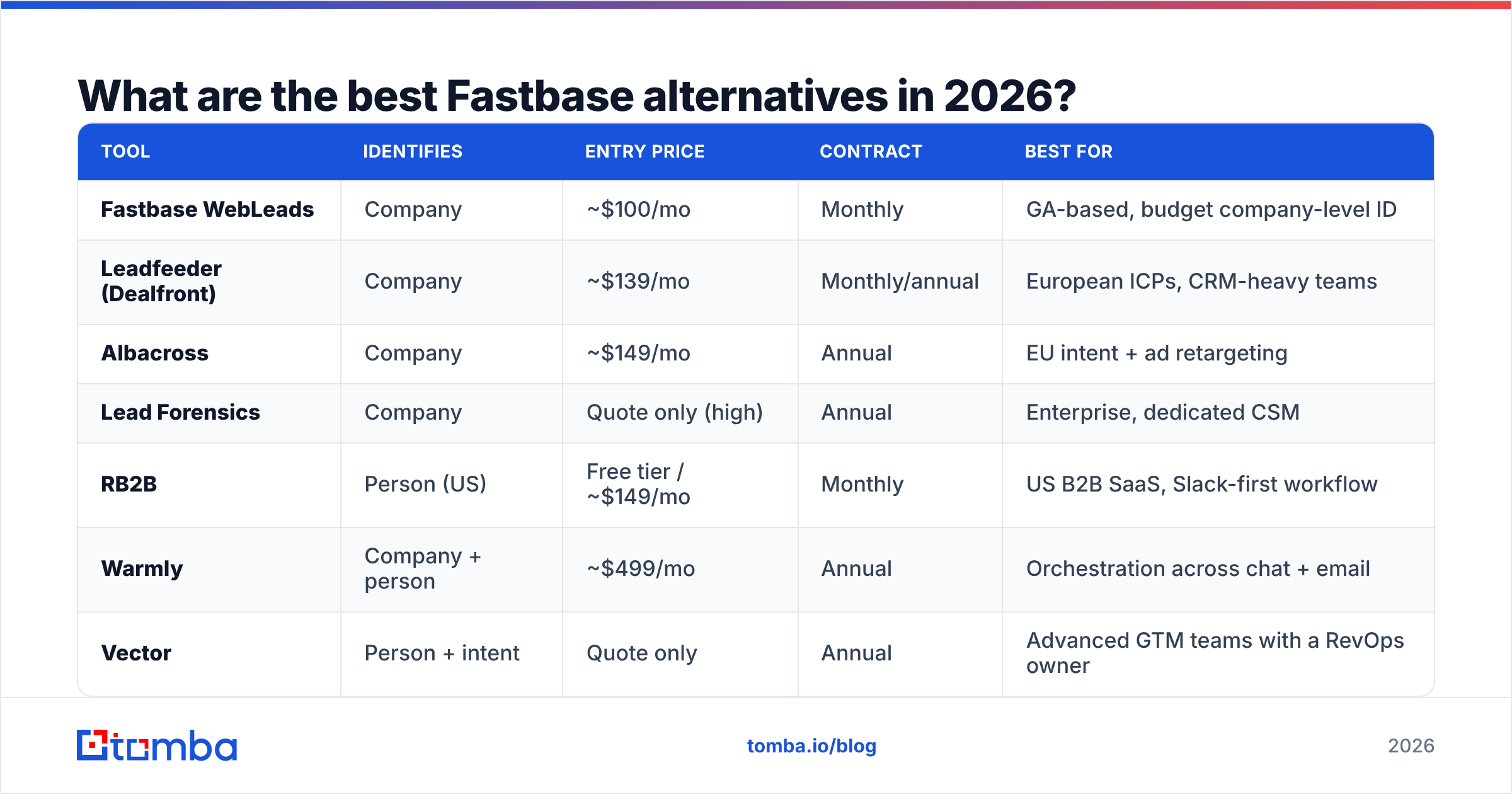
What are the best Fastbase alternatives in 2026?#
| Tool | Identifies | Entry price | Contract | Best for |
|---|---|---|---|---|
| Fastbase WebLeads | Company | ~$100/mo | Monthly | GA-based, budget company-level ID |
| Leadfeeder (Dealfront) | Company | ~$139/mo | Monthly/annual | European ICPs, CRM-heavy teams |
| Albacross | Company | ~$149/mo | Annual | EU intent + ad retargeting |
| Lead Forensics | Company | Quote only (high) | Annual | Enterprise, dedicated CSM |
| RB2B | Person (US) | Free tier / ~$149/mo | Monthly | US B2B SaaS, Slack-first workflow |
| Warmly | Company + person | ~$499/mo | Annual | Orchestration across chat + email |
| Vector | Person + intent | Quote only | Annual | Advanced GTM teams with a RevOps owner |
| HubSpot Breeze Intelligence | Company | Credit add-on | Annual | Existing HubSpot shops |
| Tomba Reveal + Email Finder | Company → contacts | Free tier, $49/mo Starter | Monthly | Turning visits into verified sends |
| BookYourData | Contact list (not visitor ID) | Pay-as-you-go | No contract | Building target lists to pair with visitor signal |
Leadfeeder / Dealfront#
The default Fastbase alternative. Dealfront merged Leadfeeder with Echobot, so you get visitor identification plus a European company database, trigger events, and contact records in one place. Match quality on EU traffic is the strongest in the category, GDPR posture is well documented, and the CRM integrations (HubSpot, Pipedrive, Salesforce) are genuinely two-way.
Downsides: pricing scales with identified companies per month, so a traffic spike is a bill spike, and the contact data quality varies sharply by region.
Albacross#
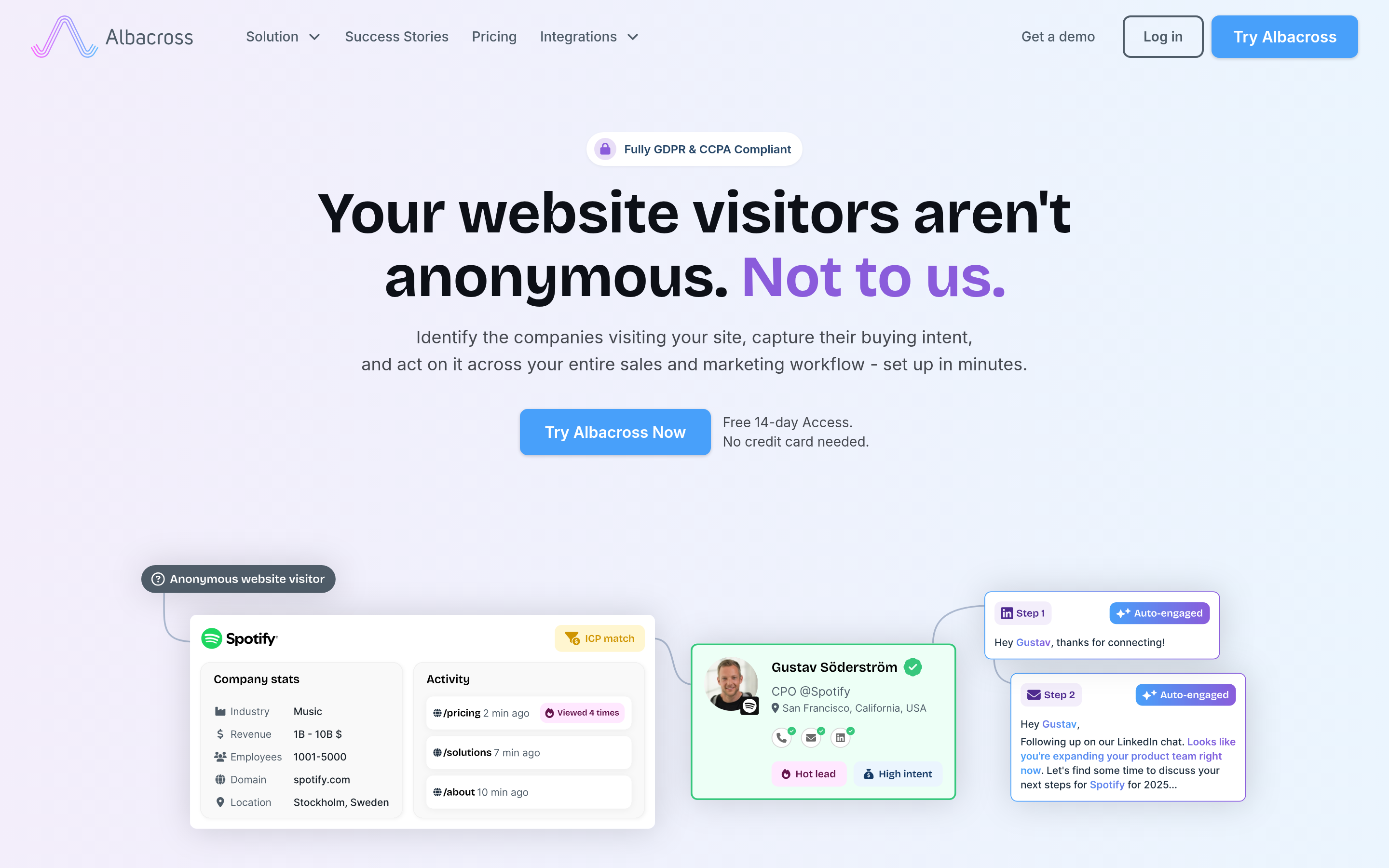
Strong on the marketing side rather than the SDR side. Albacross identifies companies and then lets you build ad audiences from them, which makes it a good fit if your motion is account-based advertising more than cold outbound. Annual contracts are standard.
Lead Forensics#
The enterprise incumbent. Big match database, dedicated account management, and pricing that reflects both — expect a quote in the four figures per month, annual, with an onboarding component. If you have a large field sales team and a defined territory model, the hand-holding can be worth it. If you're a five-person startup, it isn't.
RB2B and person-level tools#
RB2B changed the conversation by resolving individual US visitors to a LinkedIn profile and pushing them into Slack in near real time. When it hits, it's the shortest path from anonymous session to named human that exists. Caveats are real: US-only identification, coverage limited to a slice of traffic, and a privacy profile that some legal teams will not sign off on. Warmly and Vector sit in the same family with more orchestration and higher price floors.
HubSpot Breeze Intelligence#
If you already run HubSpot, the native option removes an integration. Company-level identification and enrichment credits fold into your existing portal, which is administratively simpler than another vendor. It is not the deepest matcher on the market, but "already in the CRM" beats "better data in a second tab" more often than vendors admit. Details live on hubspot.com.
BookYourData#
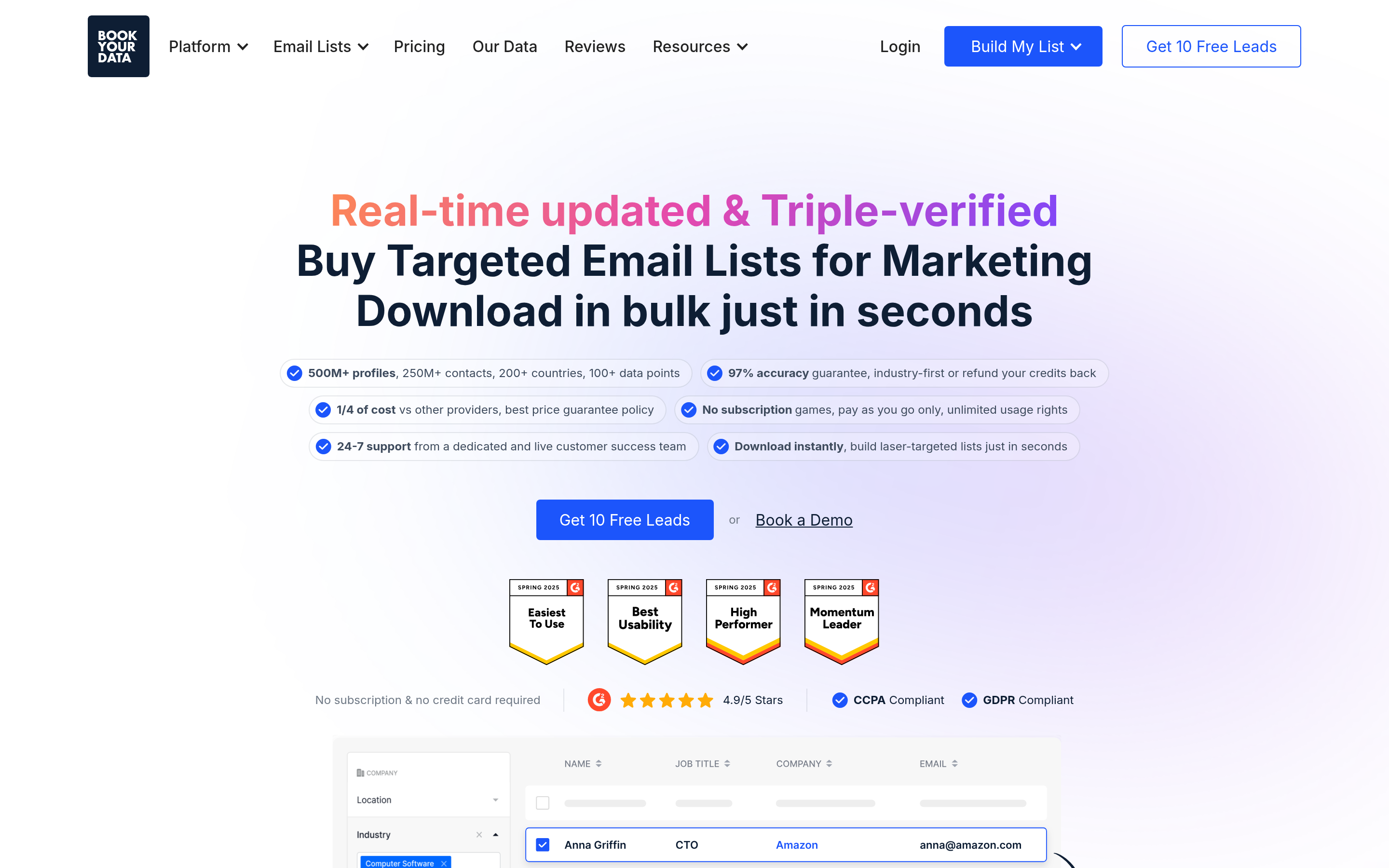
Different category, frequently the right complement. BookYourData sells verified B2B contact lists on a pay-as-you-go basis with no contract, which pairs well with visitor identification: use the visitor feed to learn which accounts are in-market, then pull the right personas at those accounts. Teams that dislike annual commitments often run this alongside a cheap company-level tool rather than buying one expensive all-in-one.
Tomba (Reveal + Email Finder)#
Tomba approaches the problem from the contact side. Website visitor reveal identifies the companies hitting your site; the email finder and domain search then take that company and return the actual people — role-filtered, pattern-verified, with SMTP-level checks before the address reaches your sequence. Data enrichment fills in the rest of the record.
The practical difference: most tools on this list stop at "Acme visited." Tomba's stack continues to "here are the three RevOps leads at Acme, verified, in your CRM." Pricing is transparent and monthly — free tier at 25 searches, Starter $49/mo, Growth $99/mo, Pro $249/mo, Enterprise custom. Full breakdown on the Tomba pricing page.
Is a person-level tool better than a company-level one?#
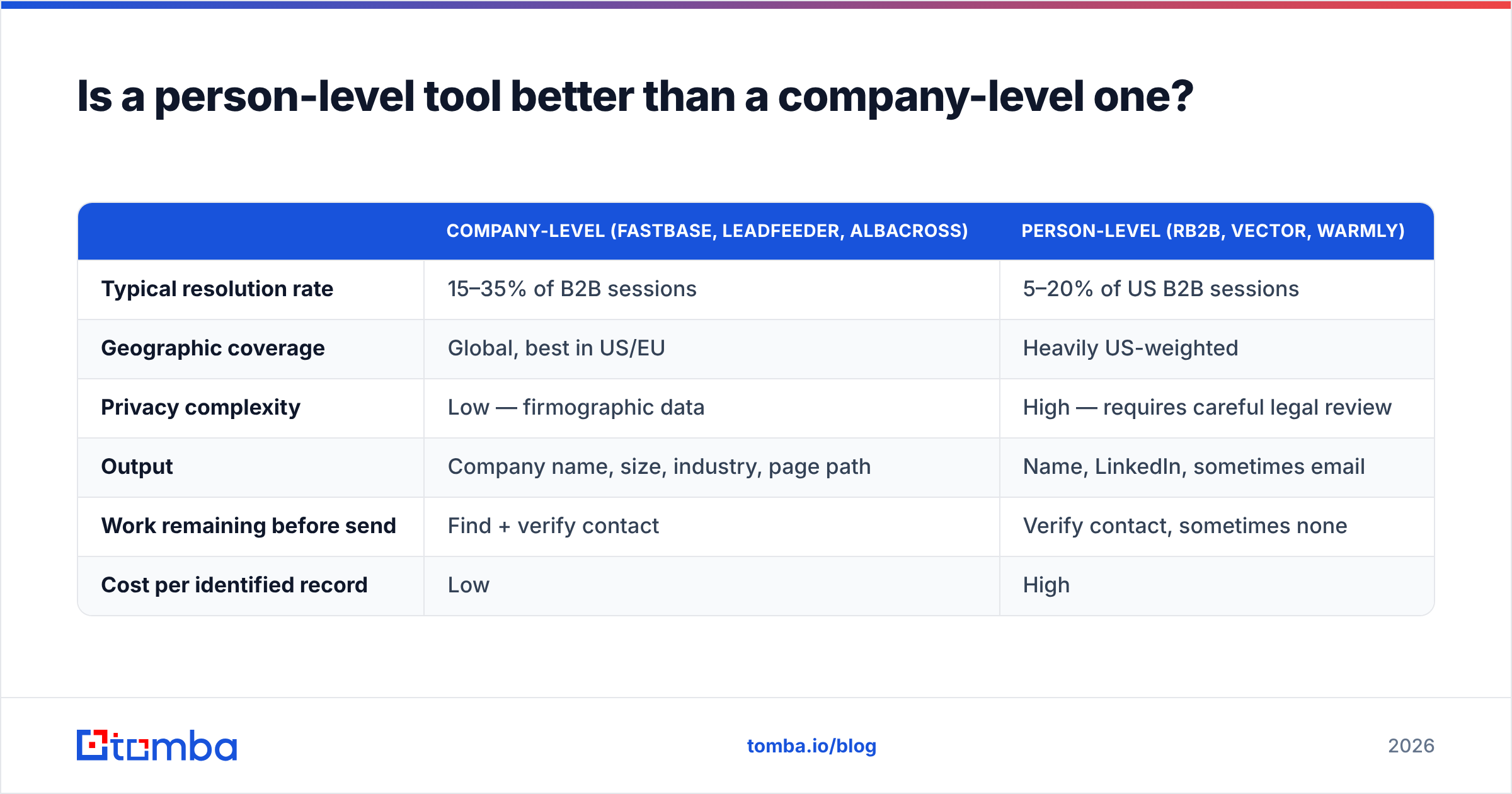
Not automatically — they fail in different directions.
| Company-level (Fastbase, Leadfeeder, Albacross) | Person-level (RB2B, Vector, Warmly) | |
|---|---|---|
| Typical resolution rate | 15–35% of B2B sessions | 5–20% of US B2B sessions |
| Geographic coverage | Global, best in US/EU | Heavily US-weighted |
| Privacy complexity | Low — firmographic data | High — requires careful legal review |
| Output | Company name, size, industry, page path | Name, LinkedIn, sometimes email |
| Work remaining before send | Find + verify contact | Verify contact, sometimes none |
| Cost per identified record | Low | High |
The honest recommendation: if your ICP is EU-heavy or your legal team is conservative, buy company-level and solve the contact problem with a dedicated finder. If you sell to US SaaS and your legal posture allows it, person-level tools compress your workflow meaningfully — but budget for the coverage gap, because they will not identify most of your traffic either.

How do you turn visitor data into actual outreach?#
Here's the workflow that works regardless of which vendor you pick:
- Filter ruthlessly. Most identified companies are not prospects. Set rules — employee count, industry, page depth, repeat visits within 14 days — and only promote accounts that clear all four. A feed you don't trust is a feed nobody opens.
- Pick the persona, not the person. Decide in advance which two or three job titles you'd contact at any account. This makes the next step scriptable.
- Resolve contacts in bulk. Push the filtered account list through a bulk email finder with your title filters. You get named contacts back without manual LinkedIn spelunking.
- Verify before you send. Run every address through an email verifier and route catch-all domains to a separate, lower-volume sequence. Visitor-ID vendors rarely verify at send time; assume you have to.
- Reference the behaviour, carefully. "Saw you were looking at integrations" is creepy. "Most teams evaluating us at this stage ask about the Salesforce sync — here's the short version" is useful. Same signal, different framing.
- Measure account-level, not lead-level. The KPI is meetings booked from identified accounts within 30 days of the visit, not raw identified-company count. Vendors will always show you the second number.
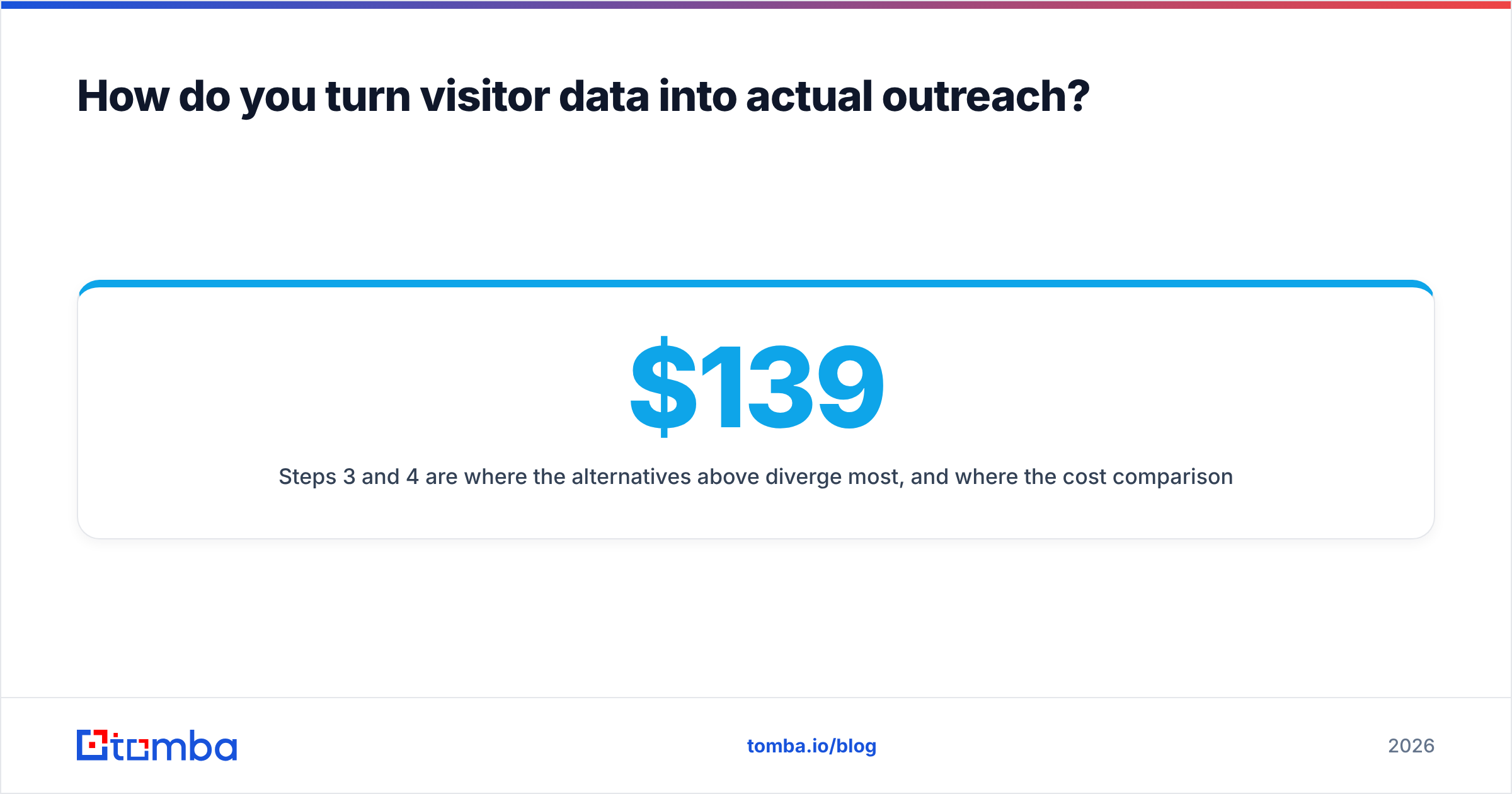
Steps 3 and 4 are where the alternatives above diverge most, and where the cost comparison gets real. A $139/mo visitor tool that requires a $500/mo data platform to be usable is a $639/mo tool.
Which Fastbase alternative should you choose?#
- You want the cheapest company-level feed and already live in GA: stay on Fastbase, and add a contact finder. It does what it says at a price nobody else matches.
- Your ICP is European and you run outbound from a CRM: Dealfront/Leadfeeder.
- You sell to US SaaS and your legal team is comfortable: RB2B, with a verification step bolted on.
- You're already deep in HubSpot: Breeze Intelligence, unless match rate testing says otherwise.
- You have an enterprise field team and a real budget: Lead Forensics.
- Your actual bottleneck is contacts, not signal: the visitor tool matters less than the finder. Fix the last mile first.
Run a two-week parallel trial before committing to anything annual. Point two tools at the same traffic, export both lists, and count how many identified accounts you'd actually contact. The winner is usually obvious and rarely the one with the best demo.
Ready to turn identified accounts into replies?#
Every tool on this list gives you a company name. The work that produces revenue starts after that. Tomba Email Finder takes a domain and a role and returns verified, deliverable addresses for the people who matter — with a free tier of 25 searches to test it against your own visitor feed before you spend anything. Pair it with whichever identification tool wins your trial, and your SDRs stop researching and start sending.
Related guides#
Ready to find emails that actually work?
Join 150,000+ professionals who stopped guessing and started sending. Free credits on signup — no credit card required.
Get the Tomba newsletter
Practical outbound tactics and product updates — once every two weeks.
About the author