Fathom vs Grain (2026): Which AI Notetaker Wins for Sales?
Fathom and Grain both record, transcribe, and summarize sales calls — but they price, sync, and coach very differently. Here's the honest breakdown and which one fits your team.
TL;DR
- Fathom wins on free. Its free plan gives unlimited recording and transcription for a single user, which no other serious AI notetaker matches. Grain's free plan caps you at roughly 20-25 recordings.
- Grain wins on revenue workflows. Deal boards, coaching scorecards, and richer CRM field-mapping make Grain the better fit once you have a sales manager who actually reviews calls.
- Pricing crossover happens around 5 seats. Fathom is cheaper per seat at the entry tier; Grain's Business tier bundles conversation intelligence that Fathom charges more for.
- Neither tool fills your pipeline. Both summarize conversations you already booked. If the calendar is empty, the notetaker is irrelevant — that's a prospecting data problem, not a recording problem.
- Our pick: solo founders and small teams → Fathom. Managed SDR/AE teams with coaching processes → Grain.
What are Fathom and Grain, and why do people compare them?#
Both are AI meeting assistants that join your Zoom, Google Meet, or Microsoft Teams calls, record them, transcribe them, and hand you a structured summary plus action items when the call ends. Think of them as a diligent junior rep who sits silently in every meeting, types everything, and emails you a one-page recap before you've closed the tab.
The comparison keeps coming up because they occupy nearly identical surface area. Both plug into the same three video platforms. Both push notes to HubSpot and Salesforce. Both clip highlight reels. Both promise "never take notes again."
The divergence is underneath. Fathom built its distribution on an aggressive free tier and consumer-grade speed — summaries land in under a minute, and the individual user is the buyer. Grain built for the revenue team as the buyer: deal-level rollups, coaching scorecards, and analytics a VP of Sales actually opens on a Monday.
That difference in who they were designed for explains almost every pricing, feature, and limitation gap below.
How do Fathom and Grain compare on pricing and plans?#
Pricing is where most teams make the decision, and where the marketing pages are least helpful. Here's the practical shape as of early 2026 — always confirm current numbers on each vendor's page before you buy, since both have repriced in the last 18 months.
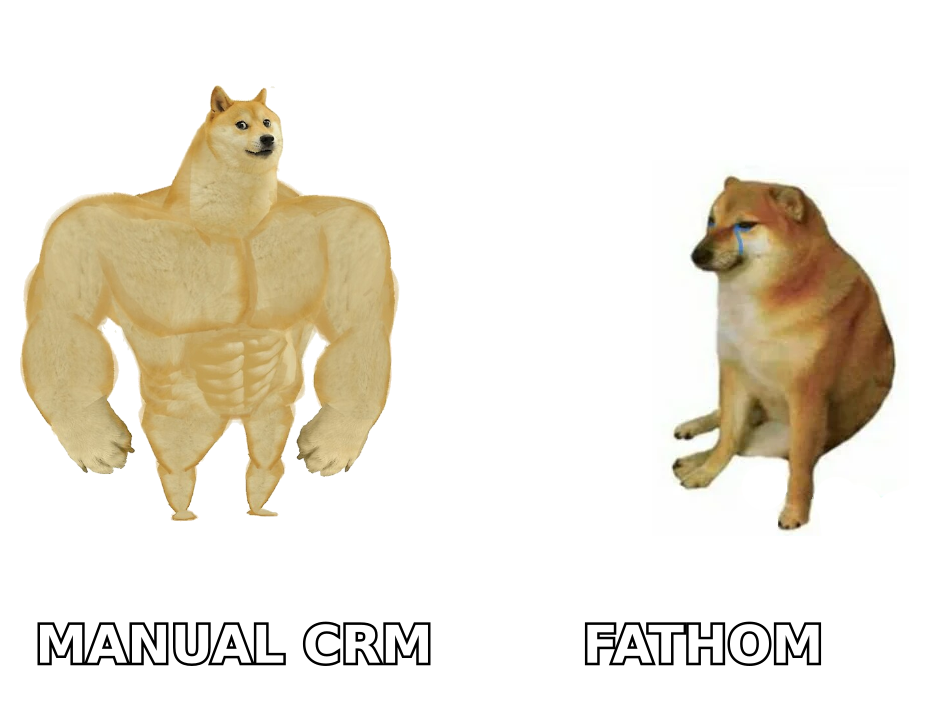
| Attribute | Fathom | Grain |
|---|---|---|
| Free plan | Unlimited recording + transcription, 1 user, limited AI summaries | ~20-25 recordings, 1 user, basic summaries |
| Entry paid tier | ~$19/user/mo (Premium) | ~$19/user/mo (Starter) |
| Mid tier | ~$29/user/mo (Team Edition) | ~$29/user/mo (Business) |
| Top tier | ~$39/user/mo (Team Edition Pro) | Enterprise, custom pricing |
| CRM auto-sync | Team Edition and above | Business and above |
| Coaching scorecards | Limited | Native, template-driven |
| Deal/pipeline view | No | Yes (Business+) |
| Languages supported | 28+ | 30+ |
| Minimum seats | 1 | 1 (3+ practical for team features) |
The headline: at one seat, Fathom is effectively free forever and Grain is not. At ten seats with CRM sync and coaching turned on, the annual difference between them narrows to a rounding error — and at that point you're buying capability, not price.
One caveat that trips up buyers: Fathom's "unlimited" free tier is unlimited on recording and transcription, not on AI-generated summary types. You get a limited number of advanced summaries per month before you're nudged upward. That's a fair trade for free, but it isn't the same thing as a free paid plan.
Which one has better AI summaries and transcription accuracy?#
Both sit in the same accuracy band — mid-to-high 90s word accuracy on clean audio in English, degrading similarly with heavy accents, crosstalk, and bad microphones. Neither has a defensible transcription moat; they both lean on the same class of speech models.
The real difference is summary shape.
Fathom produces fast, tight recaps built around action items and a chronological rundown. It's excellent when you want to reread a call in 40 seconds and forward the recap to a prospect. Fathom's follow-up-email generation is genuinely good — it drafts something you can send with two edits rather than a rewrite.
Grain produces structured, template-driven notes. You define the template (MEDDIC, BANT, discovery-call framework, whatever your team runs), and Grain fills the fields from the conversation. If your team runs a qualification methodology, this is the more useful output because it slots straight into a scorecard and a CRM field.
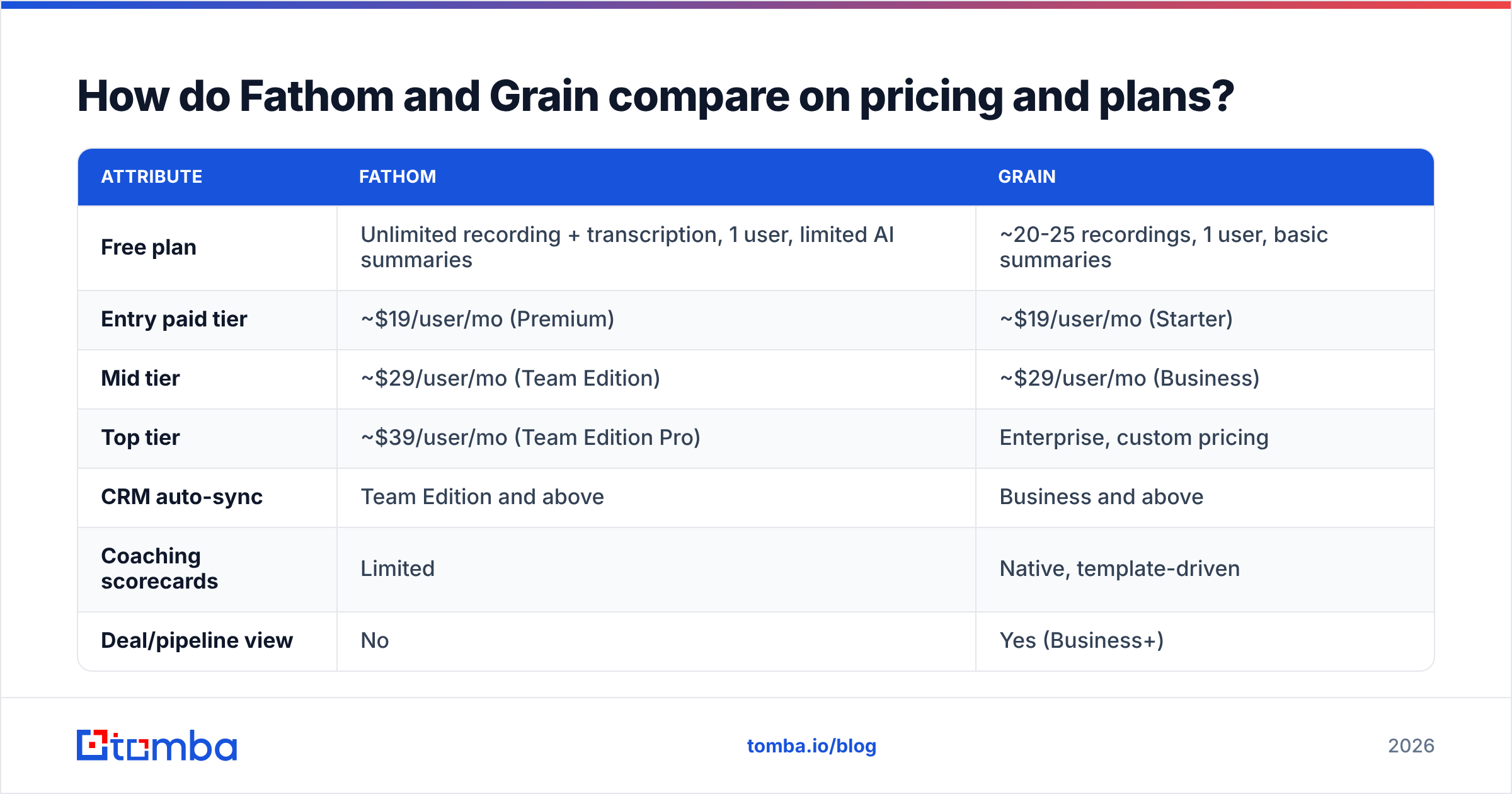
How to judge them yourself in a week:
- Run both on the same five calls. Overlapping bots are allowed on every major platform — record twice and compare outputs side by side.
- Score the action items, not the transcript. Transcript accuracy is table stakes. Count how many action items each tool caught, invented, or missed.
- Check the speaker labeling on a four-person call. This is where notetakers quietly fall apart, and where it matters most for attribution.
- Test one bad-audio call on purpose. A rep on a phone in a car is your real worst case, not a studio-quality webinar.
- Time the delivery. Fathom typically posts summaries within a minute of hangup; Grain can take a few minutes. On back-to-back call days that gap is felt.
- Send the follow-up email each tool drafts. Whichever needs fewer edits is the one your reps will actually use.
Is Grain better than Fathom for sales teams?#
For teams with a manager who reviews calls, yes — Grain is built for that job and Fathom is not.
Grain's coaching layer lets you define scorecards, tag moments against them, and roll results up by rep. You can answer "did our reps ask about budget on discovery calls last month, and who didn't?" without watching a single recording. Grain also builds a deal view that stitches every conversation with an account into one timeline, which matters on six-month enterprise cycles.
Fathom's team features exist but are lighter: shared team libraries, keyword alerts, and highlight playlists. It's collaboration, not conversation intelligence. If you want a Gong-style analytics layer without Gong-style pricing, Grain is closer.
Where Fathom wins for sales: rep adoption. Reps don't resist Fathom because it's free, instant, and doesn't feel like surveillance. Adoption is the single biggest failure mode for any call-recording rollout — a coaching platform nobody turns on scores zero. If you have no coaching process today, buying Grain's scorecards is buying a gym membership before you've decided to exercise.
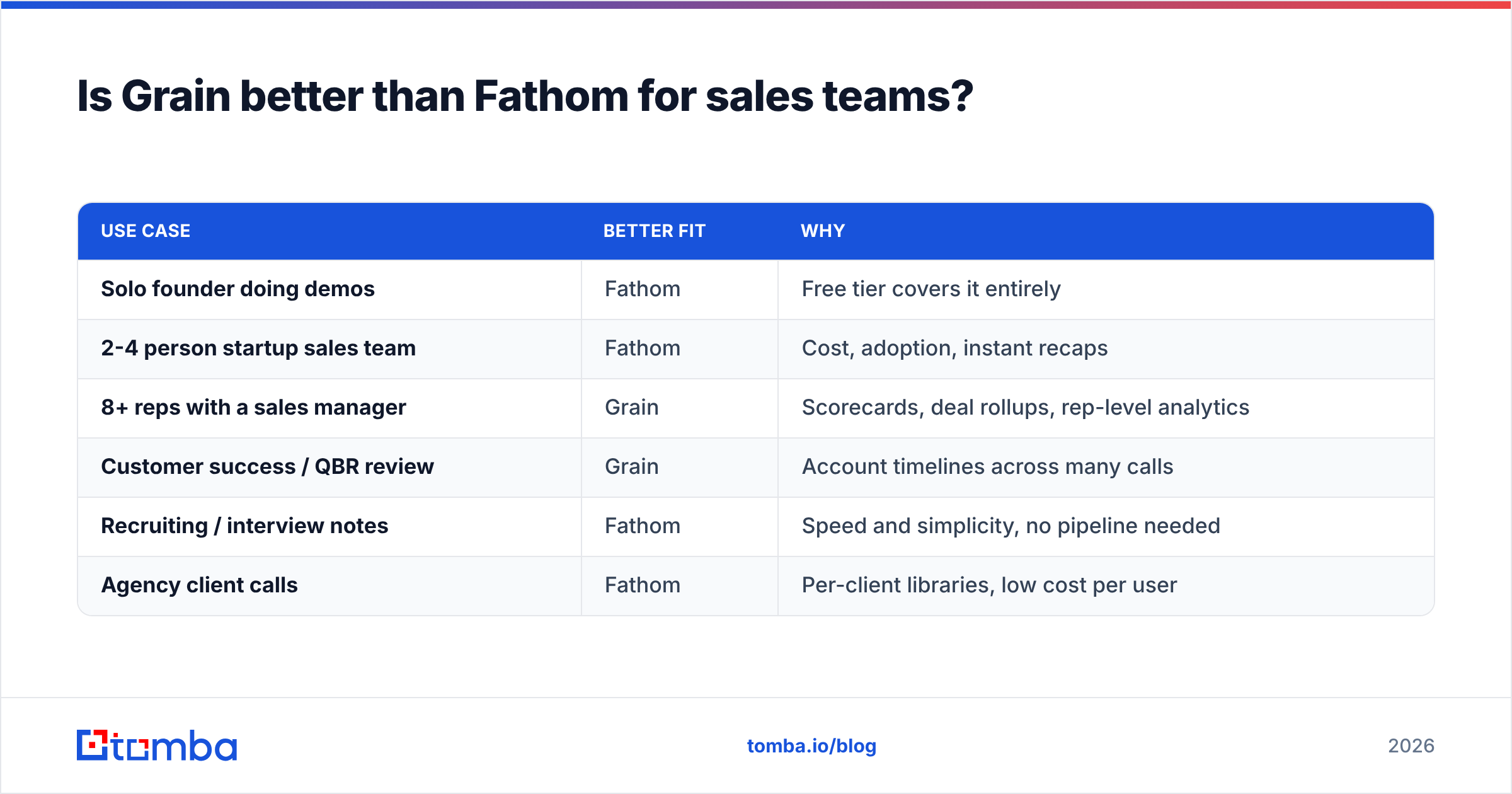
| Use case | Better fit | Why |
|---|---|---|
| Solo founder doing demos | Fathom | Free tier covers it entirely |
| 2-4 person startup sales team | Fathom | Cost, adoption, instant recaps |
| 8+ reps with a sales manager | Grain | Scorecards, deal rollups, rep-level analytics |
| Customer success / QBR review | Grain | Account timelines across many calls |
| Recruiting / interview notes | Fathom | Speed and simplicity, no pipeline needed |
| Agency client calls | Fathom | Per-client libraries, low cost per user |
How well do they integrate with your CRM and stack?#
Both push to HubSpot and Salesforce. The details matter more than the logo wall.
Fathom's sync logs the call, attaches the transcript and summary to the contact or deal record, and can push action items as tasks. It's clean, and it works. What it doesn't do well is map AI-extracted values into custom CRM fields at scale.
Grain does that mapping. You can tell it to extract "budget," "decision timeline," and "competitor mentioned" from the conversation and write each into a named Salesforce or HubSpot field. For a RevOps team trying to keep pipeline data honest without nagging reps, that's the whole ballgame. See HubSpot's own CRM data quality guidance for why field hygiene beats note volume.
Both connect to Slack, Zapier, and Notion. Both have APIs, though Grain's is more developer-oriented for pulling structured call data downstream.
One honest limitation for both: they enrich records for meetings that already happened. Neither tool creates contact records for people you haven't met. That's a separate layer — you still need a data enrichment source to fill in the firmographics and verified contact details behind each account before the call gets booked. Pairing a notetaker with an enrichment pipeline is how the CRM stays complete rather than half-populated.
What are the real limitations of each tool?#
Buy on the constraints, not the feature list.
Fathom's constraints:
- No deal or pipeline view. Calls live as individual artifacts. Reconstructing an account's history means opening five recordings.
- Coaching is manual. No scorecards, no rep-level rollup. You watch calls the old way.
- Free tier limits on advanced summaries. Unlimited recording, metered intelligence.
- Less flexible CRM field mapping. Great at logging, weaker at structured extraction.
Grain's constraints:
- Weaker free plan. The recording cap means you'll hit a paywall inside a month of real usage.
- Slower summary delivery. Minutes, not seconds. Noticeable on a heavy call day.
- Team features need a team. Below roughly five reps, most of what you're paying for goes unused.
- Setup effort is real. Scorecards and field mapping need someone to configure and maintain them.
Shared constraints worth naming:
- Consent and compliance. Two-party consent states and the EU require disclosure. Both tools announce the bot, but your process still needs a policy. G2's conversation intelligence category reviews are full of teams that skipped this step.
- Bot fatigue. Prospects notice a recording bot. On cold first calls it can add friction.
- Neither generates pipeline. This is the big one.
Does an AI notetaker actually improve pipeline?#
Only downstream of the meeting. That distinction saves teams a lot of wasted budget.
An AI notetaker improves conversion on calls you already have — better follow-ups, cleaner handoffs, faster ramp for new reps, less admin drag. Those are real gains. Realistic ranges: a few hours per rep per week recovered from manual notes, and meaningfully faster onboarding when a new hire can listen to twenty won deals in their first week.
What it does not do is put meetings on the calendar. If your reps have eight conversations a month, a $29/seat notetaker makes those eight slightly better. It doesn't make them eighteen.
The sequence that works:
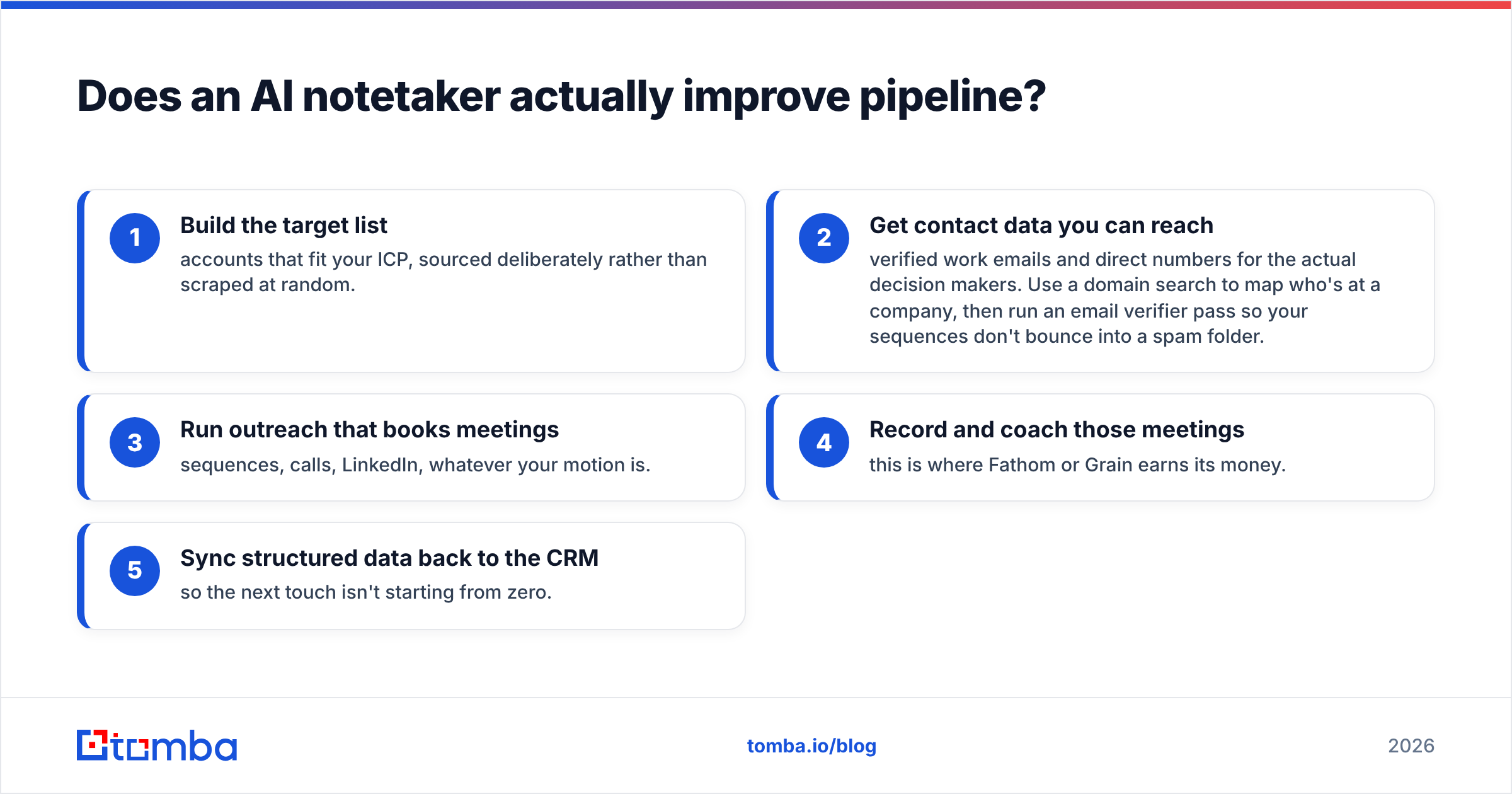
- Build the target list — accounts that fit your ICP, sourced deliberately rather than scraped at random.
- Get contact data you can reach — verified work emails and direct numbers for the actual decision makers. Use a domain search to map who's at a company, then run an email verifier pass so your sequences don't bounce into a spam folder.
- Run outreach that books meetings — sequences, calls, LinkedIn, whatever your motion is.
- Record and coach those meetings — this is where Fathom or Grain earns its money.
- Sync structured data back to the CRM — so the next touch isn't starting from zero.
Skipping straight to step four is the most common mistake. Teams buy conversation intelligence to fix a pipeline problem, then discover six months later that the calls were never the bottleneck. Check your own numbers first: if your reply rate on outbound is under 3%, your problem is upstream of the call.
Which should you choose in 2026?#
Choose Fathom if: you're a solo founder, a small team, or an agency; you want zero-friction adoption; your budget is tight; you value instant summaries and strong follow-up email drafts; you don't yet have a formal coaching process.
Choose Grain if: you have five or more reps and a manager who reviews calls; you run a qualification framework you want auto-filled; you need custom CRM field extraction; you want deal-level analytics without enterprise pricing.
Choose neither yet if: your reps aren't having enough conversations to justify recording them. Fix the top of the funnel first.
A pragmatic hybrid many teams land on: Fathom on the free tier for everyone as a safety net, Grain on paid seats for the reps whose calls actually get coached. Nothing stops you from running both during a quarter to see which one your team opens without being asked. That behavioral signal beats any comparison table — including this one.
Where should your budget go first?#
Before you spend on a notetaker, make sure the meetings exist. The cheapest lever in most B2B motions isn't better call summaries — it's reaching more of the right people with contact data that's actually deliverable.
Tomba's email finder gives you verified professional email addresses by name, domain, or company, with a free tier of 25 searches a month and paid plans starting at $49/mo. Feed it your target account list, verify what comes back, and hand your reps a calendar worth recording. Then let Fathom or Grain do what they're genuinely good at: making those conversations count. See full Tomba pricing or start free and test it against your current list this week.
Related guides#
Ready to find emails that actually work?
Join 150,000+ professionals who stopped guessing and started sending. Free credits on signup — no credit card required.
Get the Tomba newsletter
Practical outbound tactics and product updates — once every two weeks.
About the author