Feature Benefit Selling: How to Sell Outcomes, Not Specs
Most reps list features and hope buyers connect the dots. They don't. Here's the exact framework for turning specs into outcomes buyers pay for — with scripts, tables, and a translation test.
TL;DR
- Feature benefit selling means translating what your product is into what the buyer gets — and most reps stop halfway, at the feature.
- A benefit is only a benefit if the buyer would put it in their own performance review. "Real-time sync" is a feature. "You stop reconciling two systems every Friday" is a benefit.
- The strongest structure is four parts: Feature → Function → Benefit → Proof. Skipping proof turns benefits into marketing noise.
- Benefits must be segmented by role. The same feature sells differently to an SDR manager, a RevOps lead, and a CFO.
- Feature-dumping correlates with longer cycles and more no-decision losses. The fix is a translation habit you can drill in 20 minutes a week.
What is feature benefit selling?#
Feature benefit selling is the practice of pairing every product capability you mention with the specific business outcome it produces for the person you're talking to. It's not a script. It's a discipline — the discipline of never letting a spec leave your mouth without an "…which means you…" attached to it.
The failure mode is easy to spot. A rep says: "Our platform has real-time API access, 99.9% uptime, SOC 2 Type II compliance, and native Salesforce sync." Four facts. Zero reasons to buy. The buyer is now doing the translation work themselves, and they'll do it badly or not at all.
Here's the everyday version: a car salesperson who tells you the engine is a 2.0L turbocharged inline-four has told you nothing. A salesperson who says "it merges onto the highway without you flooring it, which matters on your commute" has told you something you can feel. Same engine. Different sale.
The distinction goes back to the classic FAB model — Features, Advantages, Benefits — which has been taught in sales training since the 1970s and still shows up in most enterprise onboarding decks. The reason it persists is that it works. The reason it fails in practice is that reps memorize the acronym and skip the hard part: knowing what the buyer actually cares about.
What's the actual difference between a feature, an advantage, and a benefit?#
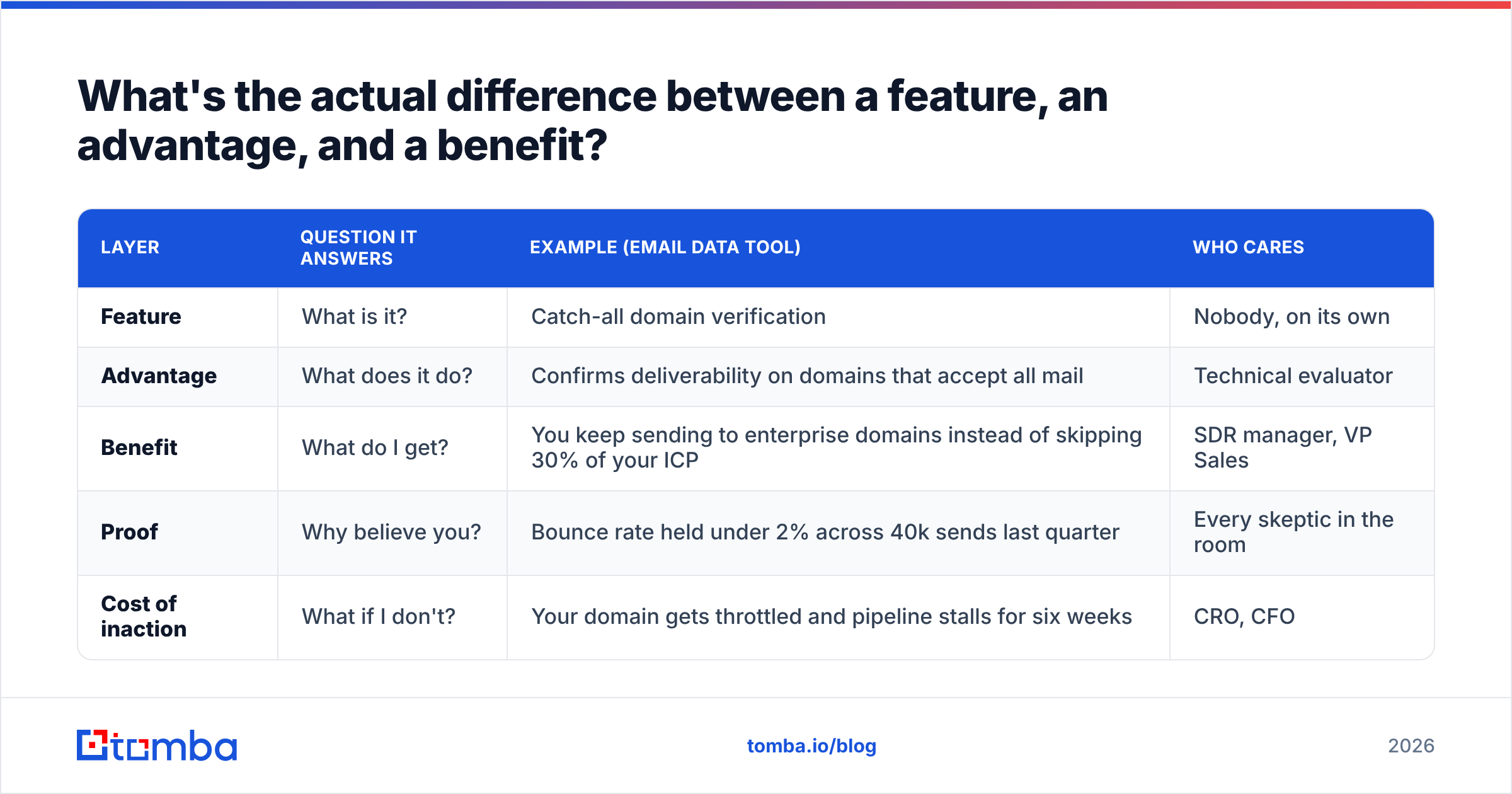
Most reps can define these three words and still can't use them. The test is whether you can move a single capability across all three columns without cheating.
| Layer | Question it answers | Example (email data tool) | Who cares |
|---|---|---|---|
| Feature | What is it? | Catch-all domain verification | Nobody, on its own |
| Advantage | What does it do? | Confirms deliverability on domains that accept all mail | Technical evaluator |
| Benefit | What do I get? | You keep sending to enterprise domains instead of skipping 30% of your ICP | SDR manager, VP Sales |
| Proof | Why believe you? | Bounce rate held under 2% across 40k sends last quarter | Every skeptic in the room |
| Cost of inaction | What if I don't? | Your domain gets throttled and pipeline stalls for six weeks | CRO, CFO |
Notice the fourth and fifth rows. Traditional FAB stops at benefit, and that's why FAB-trained reps sound like brochures. A benefit without proof is a claim. A benefit without a cost-of-inaction frame gives the buyer no reason to act this quarter rather than next year.
The advantage layer is the one people skip. It's the mechanical bridge — how the feature produces the outcome. Buyers who are technical will not accept a benefit claim unless they can see the mechanism. Buyers who are not technical will glaze over if you spend too long there. Read the room.
How do you translate any feature into a benefit?#
Use the four-step translation. It takes about 90 seconds per feature and you only have to do it once per product capability.
- Write the feature in plain, boring language. No adjectives. "Bulk email verification, 50,000 rows per upload." If you can't write it without marketing words, you don't understand it yet.
- Ask "so what?" until you hit money, time, or risk. Bulk verification → fewer bounces → protected sender reputation → emails land in inbox → more replies → more pipeline. Stop when you hit a metric a manager reports on. Anything above that is corporate poetry.
- Attach a number you can defend. "Cuts list-cleaning from four hours to eleven minutes." Vague benefits ("saves time," "improves efficiency") are worse than no benefit, because they signal you've never watched a customer do the work.
- Name the role who owns that number. A benefit with no owner has no budget behind it. If nobody in the room is measured on the thing you improved, you're pitching to the wrong room.
Run this on ten features and you'll find two or three that don't survive step two. That's useful information. Those are the features to stop leading with.
Why does feature dumping still happen?#
Because it's comfortable, and because the incentives quietly reward it.
Reps default to features under pressure. When a call goes quiet or a buyer pushes back, listing capabilities feels like progress — you're saying true things, and true things feel safe. Benefits require a point of view about the buyer's business, and a point of view can be wrong.
Product marketing makes it worse. Most enablement decks are organized by feature because that's how engineering ships. A rep who follows the deck's structure will feature-dump by default. Sales leaders then coach "talk about value!" without rewriting the deck, and nothing changes.
There's also a knowledge gap. You cannot articulate a benefit for a buyer whose day you've never seen. Reps who have done ride-alongs, watched screen recordings, or read support tickets translate features naturally. Reps who have only read the website recite the website.
The third cause is discovery failure. If you didn't learn what the buyer is measured on, you have no choice but to feature-dump — you're spraying capabilities and hoping one sticks. Research from HubSpot's sales statistics consistently shows discovery quality as one of the strongest predictors of close rate; benefit articulation is downstream of discovery, not a substitute for it.
Which benefits matter to which buyer?#
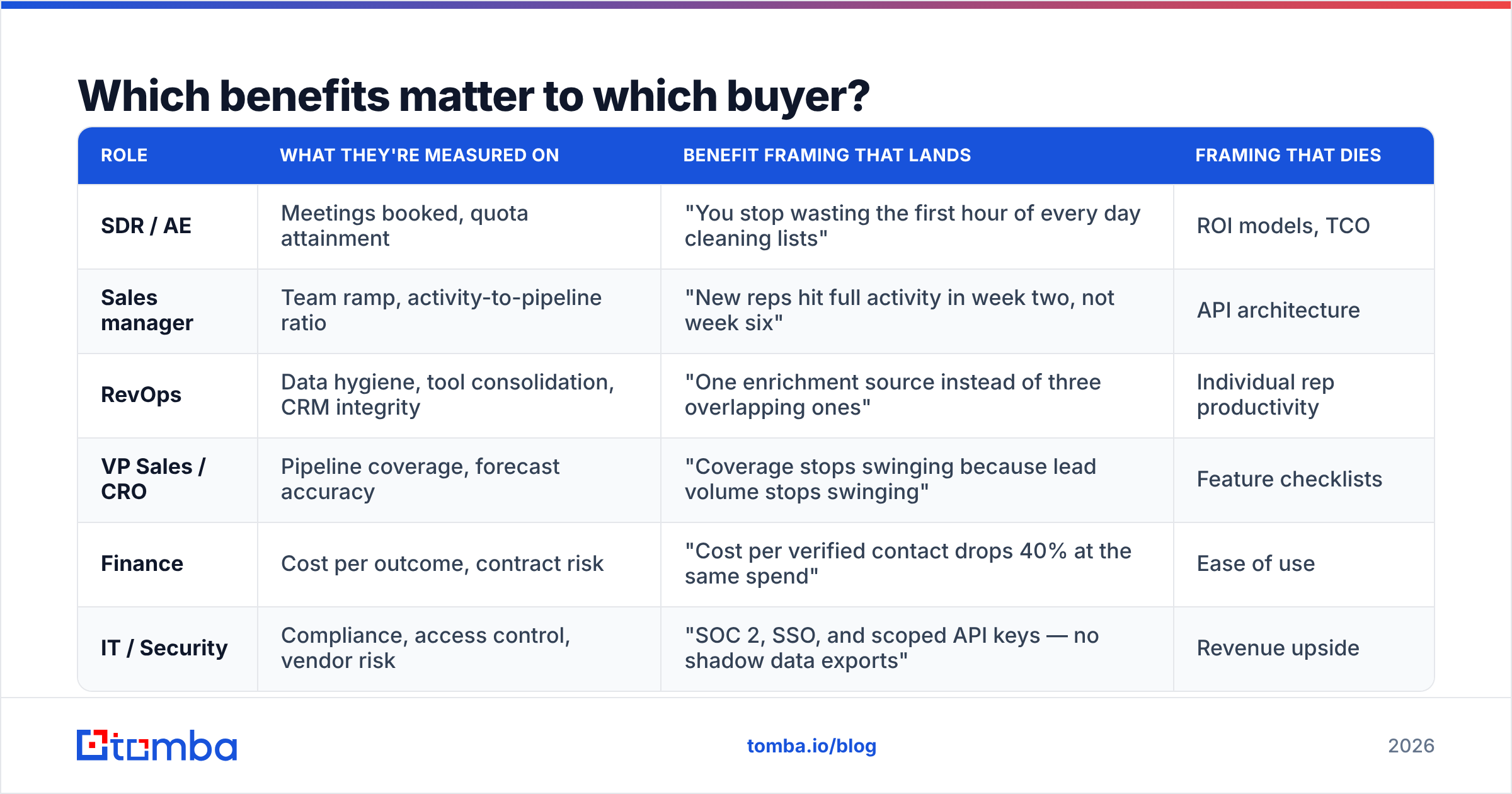
The same feature has three or four different benefits depending on who's listening. Get this wrong and your best material lands on the wrong ears.
| Role | What they're measured on | Benefit framing that lands | Framing that dies |
|---|---|---|---|
| SDR / AE | Meetings booked, quota attainment | "You stop wasting the first hour of every day cleaning lists" | ROI models, TCO |
| Sales manager | Team ramp, activity-to-pipeline ratio | "New reps hit full activity in week two, not week six" | API architecture |
| RevOps | Data hygiene, tool consolidation, CRM integrity | "One enrichment source instead of three overlapping ones" | Individual rep productivity |
| VP Sales / CRO | Pipeline coverage, forecast accuracy | "Coverage stops swinging because lead volume stops swinging" | Feature checklists |
| Finance | Cost per outcome, contract risk | "Cost per verified contact drops 40% at the same spend" | Ease of use |
| IT / Security | Compliance, access control, vendor risk | "SOC 2, SSO, and scoped API keys — no shadow data exports" | Revenue upside |
The practical move: build a one-page benefit matrix per product line, with roles down the left and your top six features across the top. Fill in the cells. Most teams discover that 40% of their cells are empty — meaning they've never articulated why a given persona should care about a given feature. Those empty cells are where deals stall.
For a concrete example, take a domain search capability. To an SDR, the benefit is "you build a 200-contact list for a target account in four minutes." To RevOps, it's "account coverage becomes measurable instead of anecdotal." To the CFO, it's "you stop paying per-contact rates for data you could pull by domain." One feature, three sales.
What does feature benefit selling look like in a real call?#
Bad version:
"So we've got an email finder, a verifier, catch-all handling, a Chrome extension, bulk uploads, an API, and integrations with HubSpot and Salesforce."
Seven features in one breath. The buyer nods and forgets all of it.
Better version, using the four-layer structure:
"You mentioned your team spends Monday mornings rebuilding lists. Here's the part that matters for that: bulk upload takes a CSV of 5,000 rows and returns verified addresses with a confidence score on each one. [feature + function] Which means Monday morning becomes a ten-minute job instead of a half-day, and your reps start dialing before lunch. [benefit] One team we work with cut their list-prep time from six hours a week to under one, and their connect rate went up because the bad numbers were gone before anyone dialed. [proof] If you don't fix it, you're paying four SDR salaries for about three SDRs' worth of selling time. [cost of inaction]"
Same product. The second version does three things the first doesn't: it anchors to something the buyer said, it converts the feature into a Monday-morning change, and it quantifies the cost of the status quo.

Notice also that the second version mentions one feature. Restraint is part of the technique. Every additional feature you mention dilutes the one that actually maps to the problem the buyer described. If you've done real discovery, you should be able to run a full demo on three capabilities.
How do you build a benefit library your team will actually use?#
A benefit library is a shared doc mapping every feature to its function, benefit, proof point, and owning persona. Teams that maintain one ramp reps faster and produce more consistent messaging across the funnel. Teams that don't end up with every rep inventing their own story, which is why your win/loss data looks like noise.
Build it in this order:
- Inventory the features. Pull from the product docs and changelog, not the marketing site. Aim for 20–40 line items, grouped by workflow rather than by engineering team.
- Interview five customers, not five product managers. Ask what changed in their week after adoption. Their words become your benefit copy. This is the step everyone skips and it's the step that makes the library credible.
- Attach one proof point per benefit. A number, a named customer, a before/after, or a screenshot. No proof means the row stays greyed out until someone finds one.
- Assign a persona owner per row. If two personas claim the same benefit, split the row — the phrasing will differ.
- Review quarterly against closed-lost reasons. If "didn't see the value" appears in your loss reasons, that's a specific benefit failing, not a general skill gap. Trace it back to a row.
- Drill it in 20-minute blocks. Pick three rows a week. Reps deliver the translation out loud. It sounds remedial. It works, because the bottleneck is retrieval speed under pressure, not knowledge.
Third-party review sites are an underrated input here. Buyers on G2 and Capterra describe benefits in their own language, unfiltered by your positioning. Mine your own category's reviews and you'll find phrasings that convert better than anything your product marketing team wrote.
Where does data quality fit into all this?#
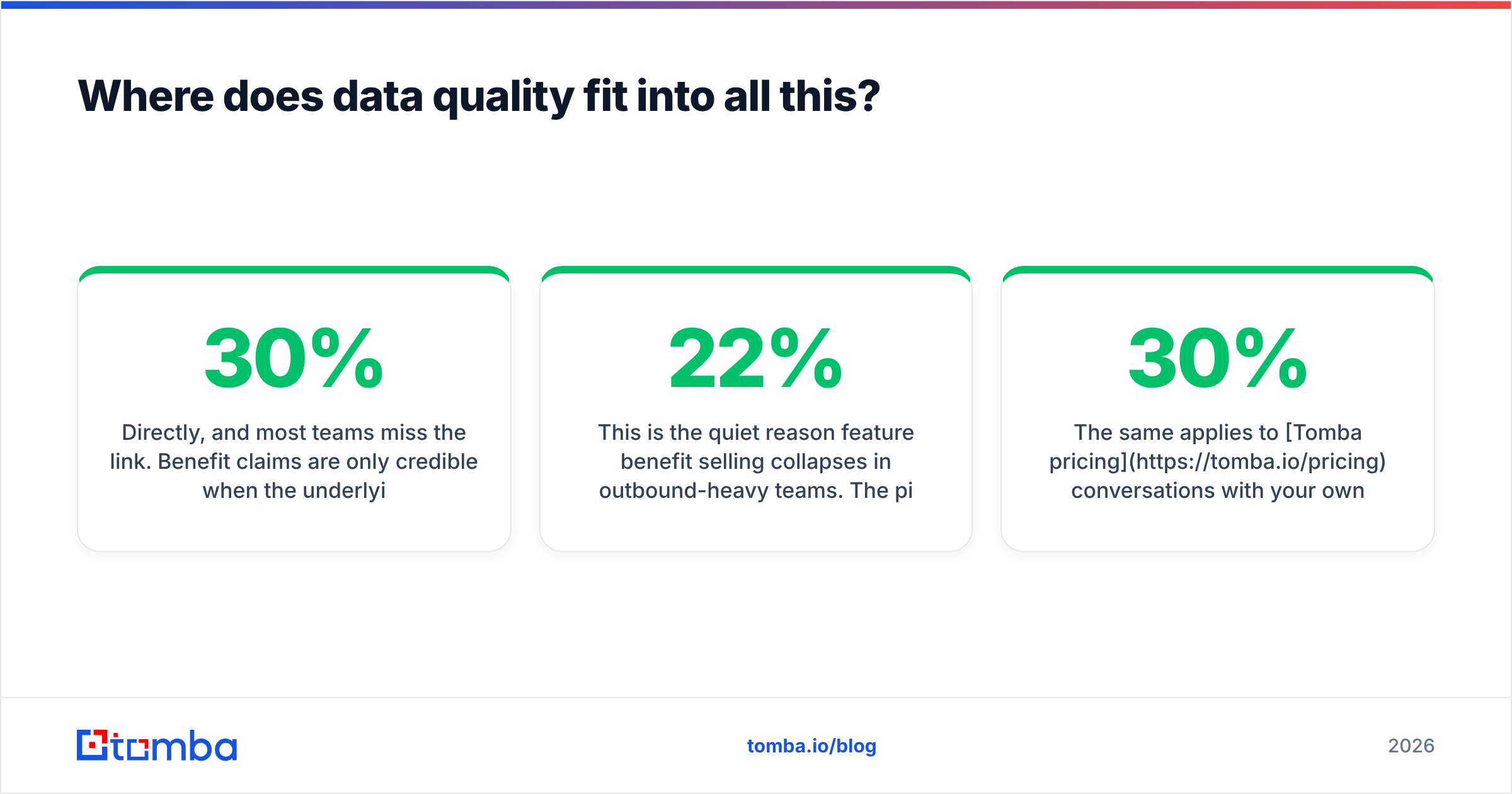
Directly, and most teams miss the link. Benefit claims are only credible when the underlying data is. If your rep promises "you'll reach 30% more of your ICP" but a third of the contacts bounce, the benefit inverts into a liability — and you've now taught the buyer that your claims don't hold.
This is the quiet reason feature benefit selling collapses in outbound-heavy teams. The pitch is fine; the list is bad. A rep promising better connect rates on a list with 22% invalid addresses is making a benefit claim they cannot deliver on. Fix the input before you sharpen the pitch.
Practically, that means running your prospect lists through an email verifier before outreach, not after bounces show up, and enriching records so your personalization is based on current facts rather than a two-year-old job title. Data enrichment isn't a benefit you sell — it's the substrate that makes your benefits true.
The same applies to Tomba pricing conversations with your own buyers: if your cost-per-outcome claim rests on data that decays 25–30% a year, the model breaks by month four. Peers in the space — including database-first vendors like BookYourData, which sells pre-verified contact lists rather than a search-and-verify workflow — solve the same problem from a different angle. Both approaches are legitimate; the deciding factor is whether your team wants to build lists dynamically or buy them in bulk.
What are the most common mistakes?#
Benefit inflation. "Transform your entire go-to-market" is not a benefit, it's a hallucination. Buyers discount inflated claims and then discount your credible ones by the same margin.
Benefits without discovery. Leading with benefits before you know the buyer's situation is just feature-dumping with better adjectives. The benefit has to attach to something they told you.
One benefit for all personas. Covered above, but worth repeating because it's the most expensive error. The CFO does not care about ease of use.
Confusing your differentiator with their priority. Your most unique feature may solve a problem this buyer doesn't have. Uniqueness is not relevance.
Skipping the mechanism. Technical buyers need the "how." If you can't explain how the feature produces the outcome, they'll assume you're bluffing — and they'll usually be right.
No cost of inaction. Buyers don't move because your product is good. They move because staying put is expensive. If your pitch has no downside frame, expect a long, polite no-decision.
Frequently asked questions#
Is feature benefit selling the same as value selling? They overlap but aren't identical. Feature benefit selling is tactical — it operates at the sentence level, translating capability into outcome. Value selling is strategic, quantifying total business impact across the deal and often involving a formal business case. Feature benefit selling is the building block; value selling is the structure you build with it.
Should you ever lead with features? Yes, in two cases: when a technical evaluator explicitly asks for specs, and when you're competing on a documented requirements list. Even then, attach the benefit after — "yes, we support scoped API keys, which means your security review doesn't become the blocker."
How many benefits should one pitch contain? Three, at most, tied to what surfaced in discovery. More than that and retention collapses. Buyers remember the story, not the list.
Does this apply to product-led and self-serve motions? More than ever. Your pricing page, onboarding emails, and in-app tooltips are all doing benefit translation without a human present. The same test applies: would the user put this outcome in their own performance review?
Put better data behind your benefit claims#
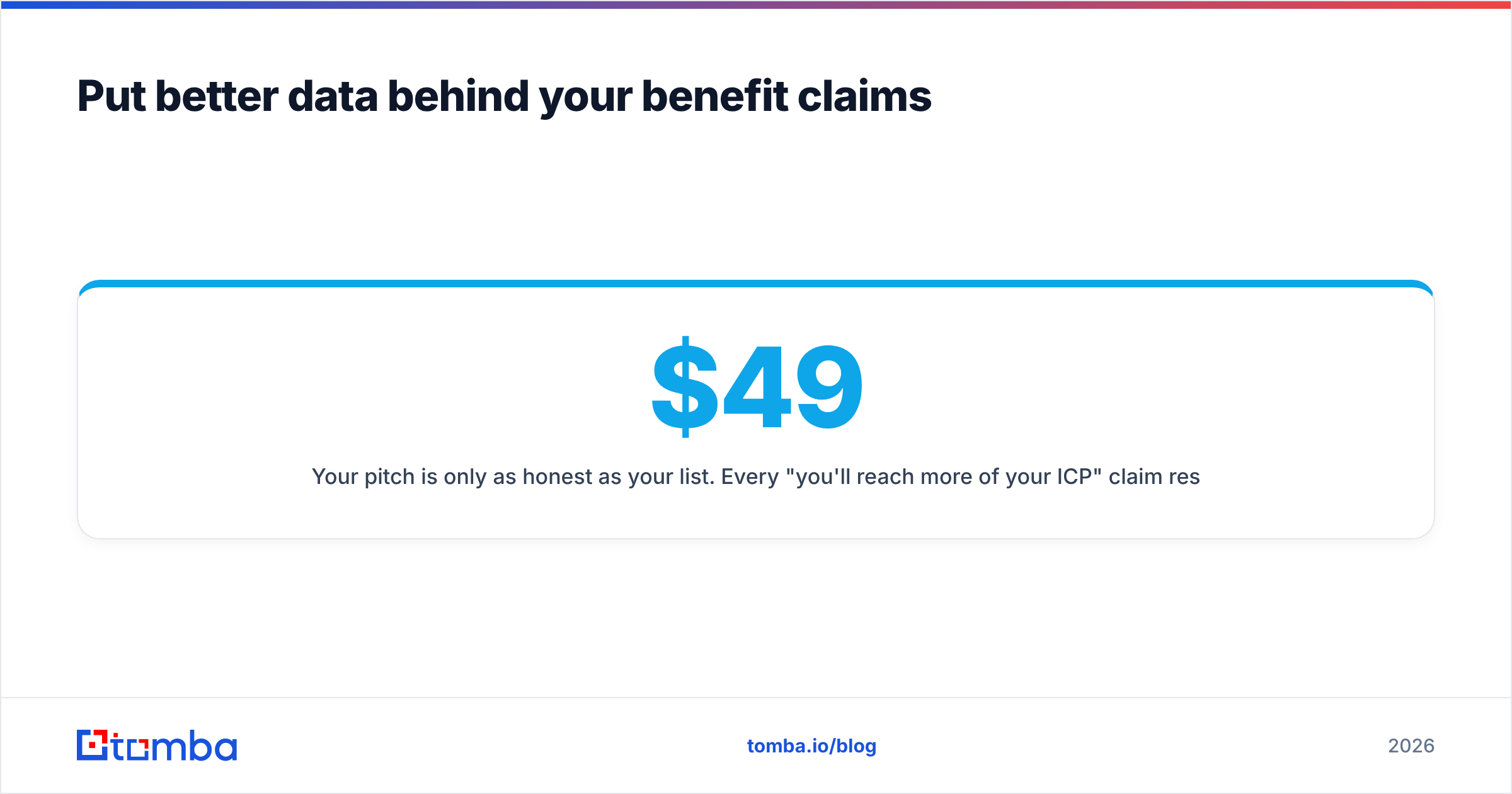
Your pitch is only as honest as your list. Every "you'll reach more of your ICP" claim rests on contacts that actually exist, actually work, and actually belong to the person you think they do. Tomba Email Finder gives you verified professional email addresses by domain, name, or company — with a free tier of 25 searches a month to test against your own target accounts before you commit. Paid plans start at $49/mo (Starter), $99/mo (Growth), and $249/mo (Pro), with volume and API access scaling from there.
Fix the data first, then sharpen the translation. In that order, feature benefit selling stops being a training exercise and starts showing up in your close rate.
Related guides#
Ready to find emails that actually work?
Join 150,000+ professionals who stopped guessing and started sending. Free credits on signup — no credit card required.
Get the Tomba newsletter
Practical outbound tactics and product updates — once every two weeks.
About the author