Feel Felt Found: The Objection-Handling Script That Still Works
The feel felt found method is decades old and still shows up in every objection-handling deck. Here's when it works, when it sounds like a canned script, and what to say instead.
TL;DR
- Feel felt found is a three-step objection-handling pattern: acknowledge the emotion ("I understand how you feel"), normalize it ("others felt the same"), then resolve it with evidence ("what they found was...").
- It works because it buys agreement before it asks for it. It fails when buyers hear the literal words, which have been in sales training decks since the 1960s.
- The step that carries all the weight is found. Without a specific, named, checkable outcome, the first two steps are just flattery.
- Modern rewrites drop the exact phrasing and keep the structure: acknowledge → normalize → evidence → check-in question.
- Feel felt found beats improvised rebuttals but loses to discovery when the objection is actually a symptom of bad qualification.
What is the feel felt found method?#
Feel felt found is a three-beat script for responding to a sales objection without arguing. You mirror the prospect's emotion, tell them other buyers had the same reaction, and then close with what those buyers discovered after they moved forward.
The canonical wording:
"I understand how you feel. Other operations directors felt the same way about the migration risk. What they found was that the switch took nine days, not the quarter they'd budgeted for."
Think of it like a doctor who says "yes, that hurts, and it hurts for most people with this injury — here's what happened to the last forty patients who did the rehab." The pain isn't denied. It's placed inside a pattern with a known ending. That's the whole mechanism.
Structurally, each beat does a different job:
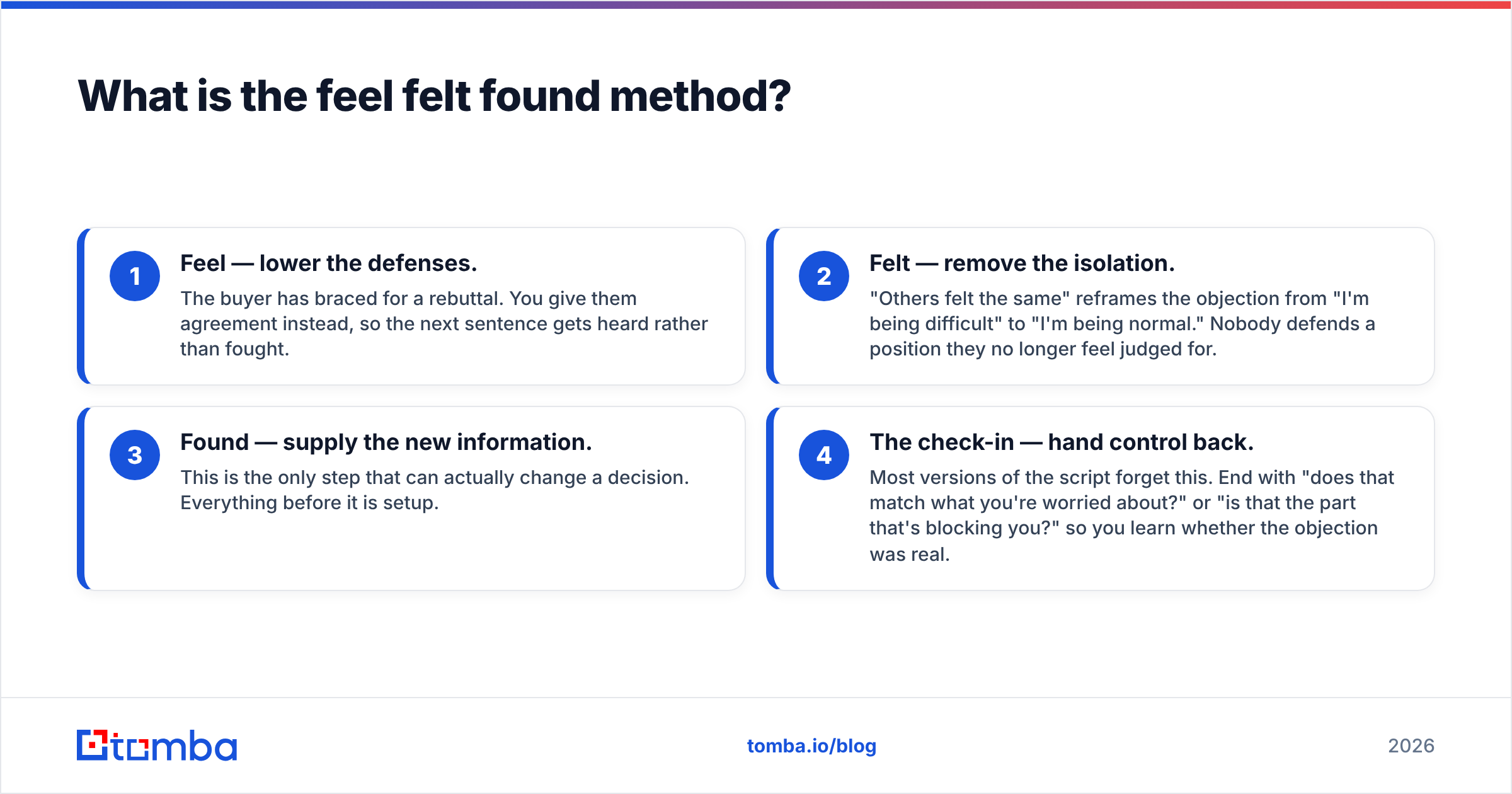
- Feel — lower the defenses. The buyer has braced for a rebuttal. You give them agreement instead, so the next sentence gets heard rather than fought.
- Felt — remove the isolation. "Others felt the same" reframes the objection from "I'm being difficult" to "I'm being normal." Nobody defends a position they no longer feel judged for.
- Found — supply the new information. This is the only step that can actually change a decision. Everything before it is setup.
- The check-in — hand control back. Most versions of the script forget this. End with "does that match what you're worried about?" or "is that the part that's blocking you?" so you learn whether the objection was real.
Miss step 4 and you've delivered a monologue. Miss step 3 and you've delivered sympathy.
Where did feel felt found come from?#
The pattern is usually traced to mid-century insurance and door-to-door sales training, and it survives because it's easy to teach. A rep can learn it in ten minutes, and it generalizes across price, timing, authority, and competitor objections without rewriting.
That ubiquity is now its biggest liability. Every major sales blog documents it — HubSpot's objection-handling guide lists it among the standard plays — which means your buyer has likely read it, been trained on it, or heard it three times this quarter from vendors in your category. Saying the literal words "I understand how you feel" in 2026 is a tell.
The structure is fine. The phrasing is burned.
How do you say feel felt found without sounding scripted?#
Keep the sequence, change every word, and shorten it. A scripted version runs 40 seconds. A good version runs 12.
Scripted (avoid):
"I completely understand how you feel, Sarah. Many of our clients felt exactly the same way when they first heard the price. But what they found was that the ROI more than justified the investment."
Rewritten (use):
"Yeah, $99 a month per seat is real money when you've got fourteen seats. The last two teams your size pushed back on the same number. Both cut their list-building hours by about six per rep per week, which is where the math flipped for them. Is it the total, or is it that you can't prove the return yet?"
Four changes did the work:
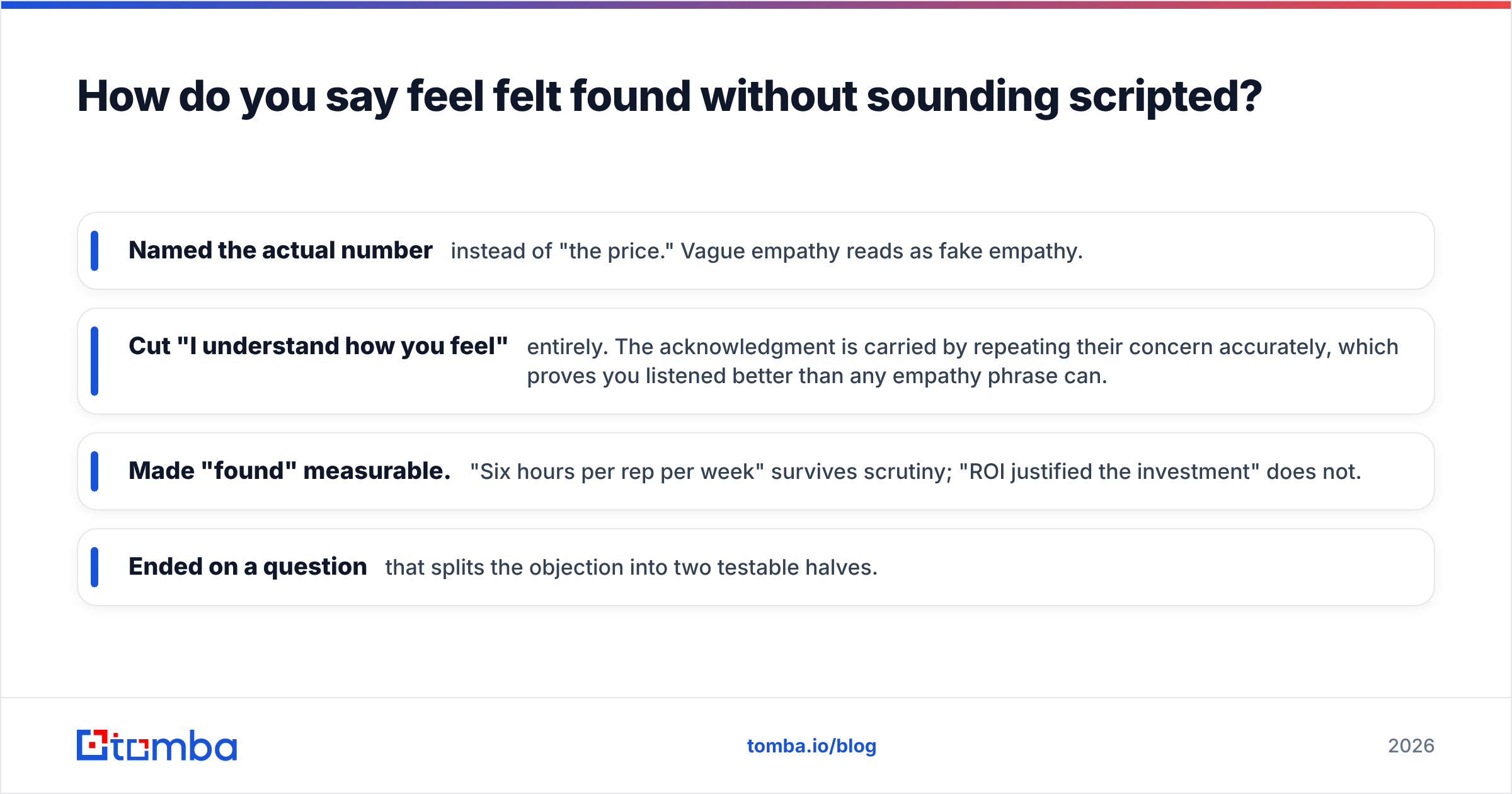
- Named the actual number instead of "the price." Vague empathy reads as fake empathy.
- Cut "I understand how you feel" entirely. The acknowledgment is carried by repeating their concern accurately, which proves you listened better than any empathy phrase can.
- Made "found" measurable. "Six hours per rep per week" survives scrutiny; "ROI justified the investment" does not.
- Ended on a question that splits the objection into two testable halves.
One more rule: never say "but." "I understand, but" deletes everything before it. Use "and" or just start a new sentence.
When does feel felt found backfire?#
Three situations, and they account for most of the damage.
1. The objection is a brush-off, not a concern. "We're all set" and "send me some info" aren't objections — they're exits. Applying a three-step empathy script to a brush-off makes you sound like you didn't notice you were being dismissed. Ask a question instead: "Fair enough — are you all set because you've got a tool for this, or because it's not a priority this quarter?"
2. You have no "found." If you can't name a comparable customer, a metric, or a specific outcome, the script collapses into "I hear you, other people also hear you, trust me." That's worse than saying nothing. When you're short on proof, switch to discovery and earn the right to make a claim later.
3. The buyer is technical or senior. Engineering leads, CFOs, and heads of RevOps have the strongest allergic reaction to recognizable sales patterns. With them, skip the emotional beats and lead with the evidence: "Two teams migrating off the same stack finished in nine days. Want the config diff?"
There's also a quieter failure mode: using feel felt found to paper over bad targeting. If four out of five prospects raise the same objection, the objection isn't a conversation problem — it's a segmentation problem. Gartner's research on B2B buying behavior has been consistent for years that buyers spend the majority of their cycle away from vendors, so recurring objections usually mean your list, not your rebuttal, needs fixing.
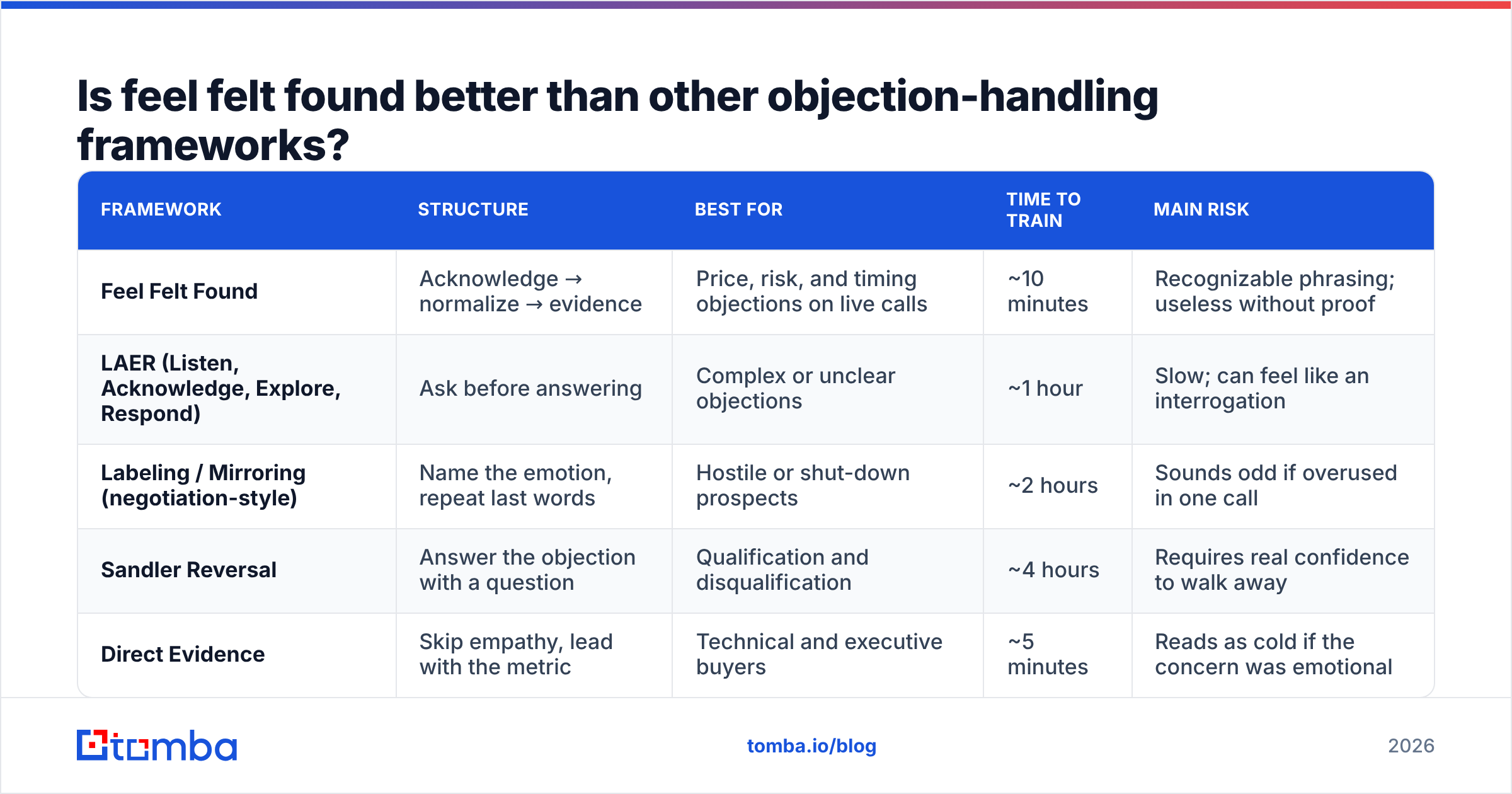
Is feel felt found better than other objection-handling frameworks?#
It's the fastest to teach and the weakest under scrutiny. Here's how it stacks up against the frameworks reps actually compete with:
| Framework | Structure | Best for | Time to train | Main risk |
|---|---|---|---|---|
| Feel Felt Found | Acknowledge → normalize → evidence | Price, risk, and timing objections on live calls | ~10 minutes | Recognizable phrasing; useless without proof |
| LAER (Listen, Acknowledge, Explore, Respond) | Ask before answering | Complex or unclear objections | ~1 hour | Slow; can feel like an interrogation |
| Labeling / Mirroring (negotiation-style) | Name the emotion, repeat last words | Hostile or shut-down prospects | ~2 hours | Sounds odd if overused in one call |
| Sandler Reversal | Answer the objection with a question | Qualification and disqualification | ~4 hours | Requires real confidence to walk away |
| Direct Evidence | Skip empathy, lead with the metric | Technical and executive buyers | ~5 minutes | Reads as cold if the concern was emotional |
The honest verdict: feel felt found is a floor, not a ceiling. It stops a rep from arguing with a buyer, which is the single most expensive mistake in objection handling. It won't out-perform a rep who genuinely explores the objection first. Most teams should use LAER's "explore" step before the found step and treat feel felt found as the delivery mechanism for the answer.
What does feel felt found look like for the five most common objections?#
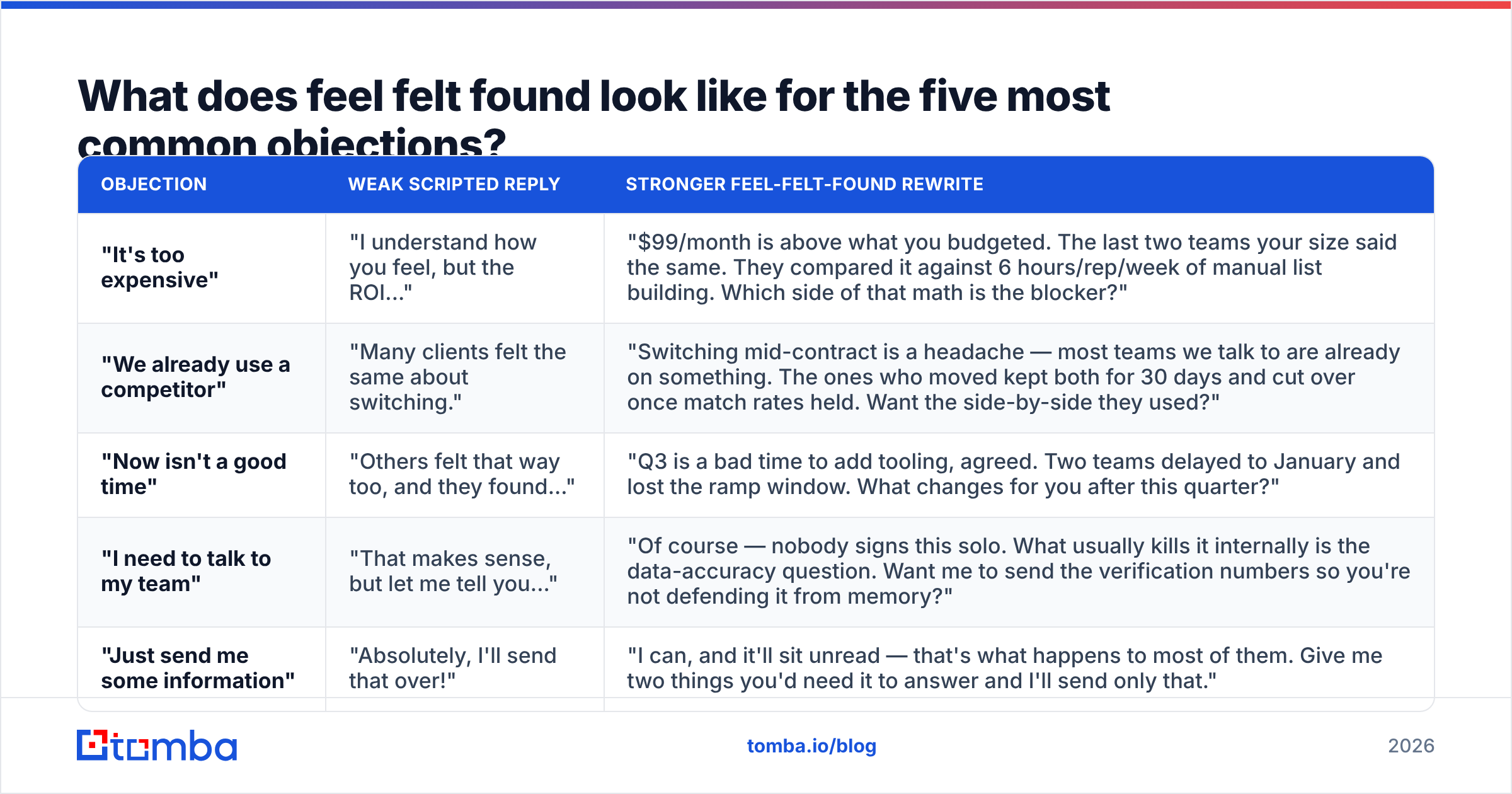
Use the structure, change the content. Here are field-ready versions:
| Objection | Weak scripted reply | Stronger feel-felt-found rewrite |
|---|---|---|
| "It's too expensive" | "I understand how you feel, but the ROI..." | "$99/month is above what you budgeted. The last two teams your size said the same. They compared it against 6 hours/rep/week of manual list building. Which side of that math is the blocker?" |
| "We already use a competitor" | "Many clients felt the same about switching." | "Switching mid-contract is a headache — most teams we talk to are already on something. The ones who moved kept both for 30 days and cut over once match rates held. Want the side-by-side they used?" |
| "Now isn't a good time" | "Others felt that way too, and they found..." | "Q3 is a bad time to add tooling, agreed. Two teams delayed to January and lost the ramp window. What changes for you after this quarter?" |
| "I need to talk to my team" | "That makes sense, but let me tell you..." | "Of course — nobody signs this solo. What usually kills it internally is the data-accuracy question. Want me to send the verification numbers so you're not defending it from memory?" |
| "Just send me some information" | "Absolutely, I'll send that over!" | "I can, and it'll sit unread — that's what happens to most of them. Give me two things you'd need it to answer and I'll send only that." |
Notice that the empathy beat never uses the word "feel." It uses accuracy. Restating the objection in the buyer's own terms is the acknowledgment.

How do you build the "found" half so it holds up?#
The found step needs three ingredients, and most reps have none of them on hand mid-call.
- A named comparable. Not "our clients" — a company type, size, and stack the buyer recognizes. "A 12-person SDR team running HubSpot and Instantly" beats "many organizations."
- A number with a unit and a timeframe. "Reply rate went from 4% to 9% over six weeks" is checkable. "Significantly better results" is noise. If you don't track this, start; response rate is the metric buyers challenge most often.
- An artifact you can send within the hour. A one-page case note, a screenshot, a shared benchmark. The offer to send proof is often more persuasive than the proof itself, because it signals the claim survives inspection.
Build these once as a team, not per rep. A shared objection library — five objections, three found-statements each, with links to the artifact — takes an afternoon and outperforms any amount of individual improvisation. If you're assembling written versions for follow-up, a bank of cold email templates keeps the phrasing consistent between the call and the recap email.
And the uncomfortable prerequisite: your found statements are only as good as the data underneath them. If your outreach list is stale, you'll spend every call handling "we don't do that anymore" and "she left the company in March" — objections no framework can fix. Clean contact data removes an entire class of objection before the call starts. Running your list through an email verifier is a less glamorous investment than objection training and usually returns more.
Does feel felt found work in cold email?#
Partially. The structure compresses badly into text because email has no room for a three-beat setup, and the empathy beat reads as filler on a screen.
What survives is felt + found without the feel:
"Most heads of sales I write to already have a data vendor and aren't looking to add another. The two who did switch this quarter did it for one reason: match rate on EU domains. Yours is the same profile. Worth a number?"
That's 47 words, carries the normalize-then-evidence pattern, and skips the empathy line that makes the written version sound like a form letter. Reserve the full three-beat delivery for live calls and voice notes, where tone does half the work.
How should a sales manager coach this?#
Coach the found step and ignore the rest. Reps pick up the acknowledge-and-normalize habit in a week; they never independently build a library of specific, checkable outcomes.
A practical drill: pull the five most common objections from call recordings, assign each rep two, and require a written found-statement with a named comparable, a number, and a linked artifact. Reject anything containing "ROI," "significantly," "many of our clients," or "industry-leading." Run it in a 45-minute session and you'll have a usable objection library by the end of the day. Most modern sales engagement platforms let you attach these snippets directly to call scripts so they're available in the moment rather than in a doc nobody opens.
The measure of success isn't fewer objections. It's shorter ones — the gap between the objection and the next real question should shrink.
The short version#
Feel felt found earns its place because it stops reps from arguing. That alone is worth teaching. But treat the literal phrasing as radioactive, put your energy into the evidence half, and remember that a framework applied to a badly qualified prospect just makes a "no" take longer to arrive.
If the objections you keep hearing are "wrong person," "she doesn't work here," or "how did you get this address," the fix isn't a better script. Start with a list you can defend: use the Tomba Email Finder to reach verified decision-makers by name and domain, with a free tier of 25 searches a month and paid plans starting at $49/mo. Handle fewer objections by earning fewer of them.
Related guides#
Ready to find emails that actually work?
Join 150,000+ professionals who stopped guessing and started sending. Free credits on signup — no credit card required.
Get the Tomba newsletter
Practical outbound tactics and product updates — once every two weeks.
About the author