FidForward Pricing Review 2026: Pros, Cons and Real Costs
FidForward promises AI-collected feedback without the survey fatigue. Here is what the pricing model actually looks like, what reviewers praise and complain about, and when a cheaper stack does the same job.
This FidForward pricing review covers what the tool actually costs, what buyers praise, and where it falls short.
TL;DR
- FidForward is an AI feedback assistant. It nudges employees for feedback inside the tools they already use, then turns those comments into review-ready summaries. It sits in the performance-management category, not the survey-tool category.
- Pricing is per seat and quote-led. There is no public price card yet, so treat any number you see — including the ranges below — as a starting point, not a quote.
- The best reviews come from HR and people-ops leads at 50–500 employee companies. The worst come from teams under 25, where the cost per outcome is hard to defend.
- Three costs buyers underestimate: annual-only terms, seat creep as headcount grows, and implementation time.
- If your real problem is pipeline data, not people data, spend the budget elsewhere. A credit-based email finder costs a fraction of a per-seat HR platform.
What is FidForward, and who is it actually for?#
FidForward is an AI agent that collects continuous feedback from your team and structures it for performance reviews. Instead of a quarterly survey blast, it prompts people in context — after a meeting, a project milestone, or a shipped deliverable. Scattered comments become a usable record for managers.
The analogy: most feedback tools are like a once-a-year tax filing. You scramble to remember twelve months of receipts. FidForward tries to be the receipt scanner that catches each expense as it happens, so review season is assembly rather than archaeology. You can see the current positioning on the official FidForward site.
Who it fits:
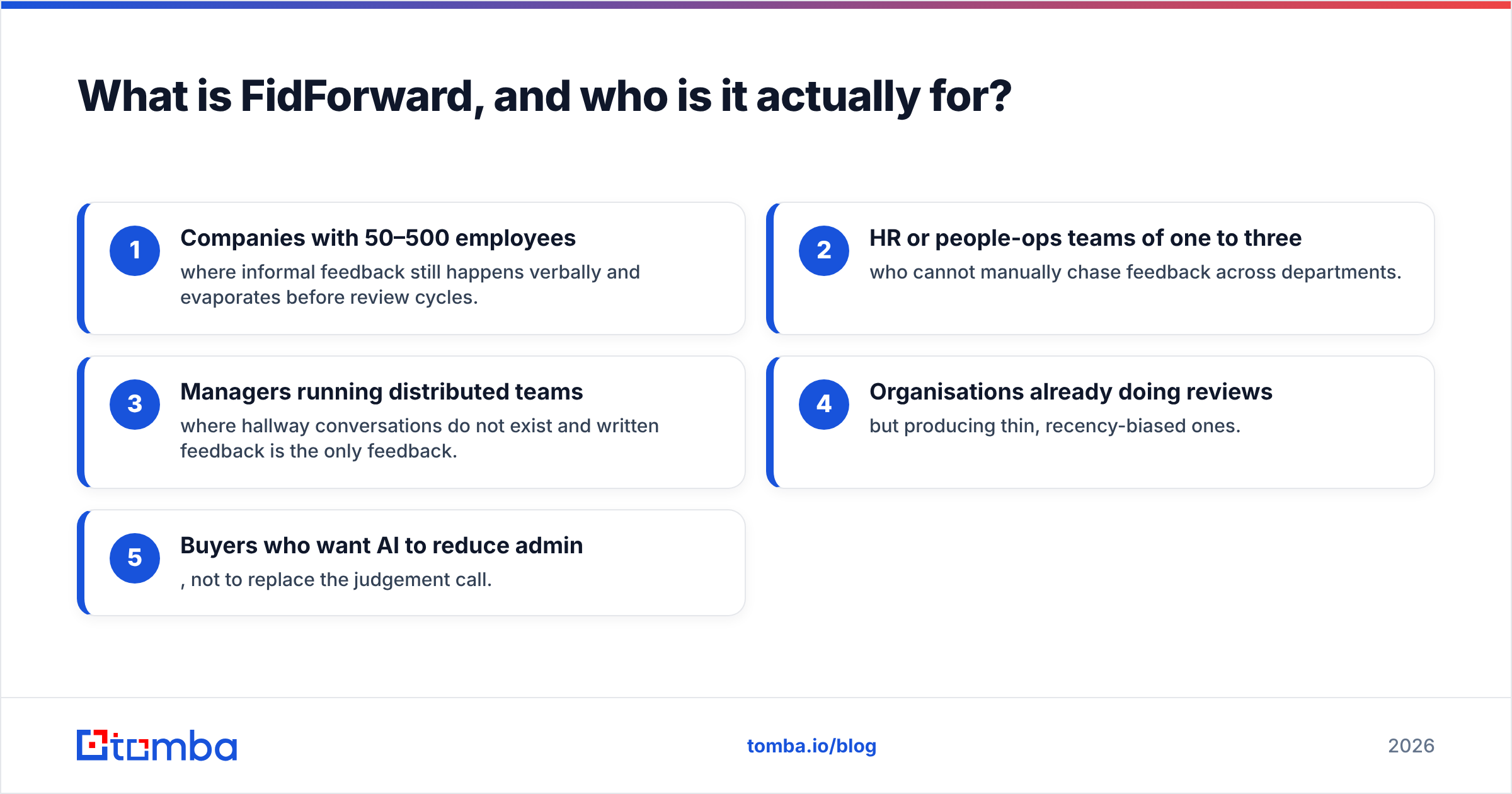
- Companies with 50–500 employees where informal feedback still happens verbally and evaporates before review cycles.
- HR or people-ops teams of one to three who cannot manually chase feedback across departments.
- Managers running distributed teams where hallway conversations do not exist and written feedback is the only feedback.
- Organisations already doing reviews but producing thin, recency-biased ones.
- Buyers who want AI to reduce admin, not to replace the judgement call.
Who it does not fit: teams under 20 people who talk daily. Companies with no review process at all, because a tool will not create a culture. And organisations with strict data-residency rules that have not cleared an AI vendor through procurement.

FidForward pricing review: how the pricing actually works#
Conclusion first: FidForward prices per seat, sells annually, and quotes on a call. That is standard for the performance-management category. It has three practical consequences.
The pricing mechanics you should expect:
- Per-employee, per-month billing. Your cost scales with headcount, not usage. Hiring 40 people mid-contract usually means a mid-term true-up, not a free ride until renewal.
- Annual commitment as the default. Monthly options, where they exist, carry a premium of roughly 15–25%. Ask for one anyway if you want a real pilot.
- Tiering by module, not by volume. Feedback collection, review cycles, goal tracking, and analytics are usually split across tiers. The feature you demoed may sit one tier above your quote.
Two more line items to check:
- Implementation and onboarding. Some vendors bundle it, some charge a one-time fee. Get this in writing before signing. It is the most common surprise line item.
- Minimum seat counts. Small teams often hit a floor of 25–50 seats. That floor is what makes the effective per-user price so high below that threshold.
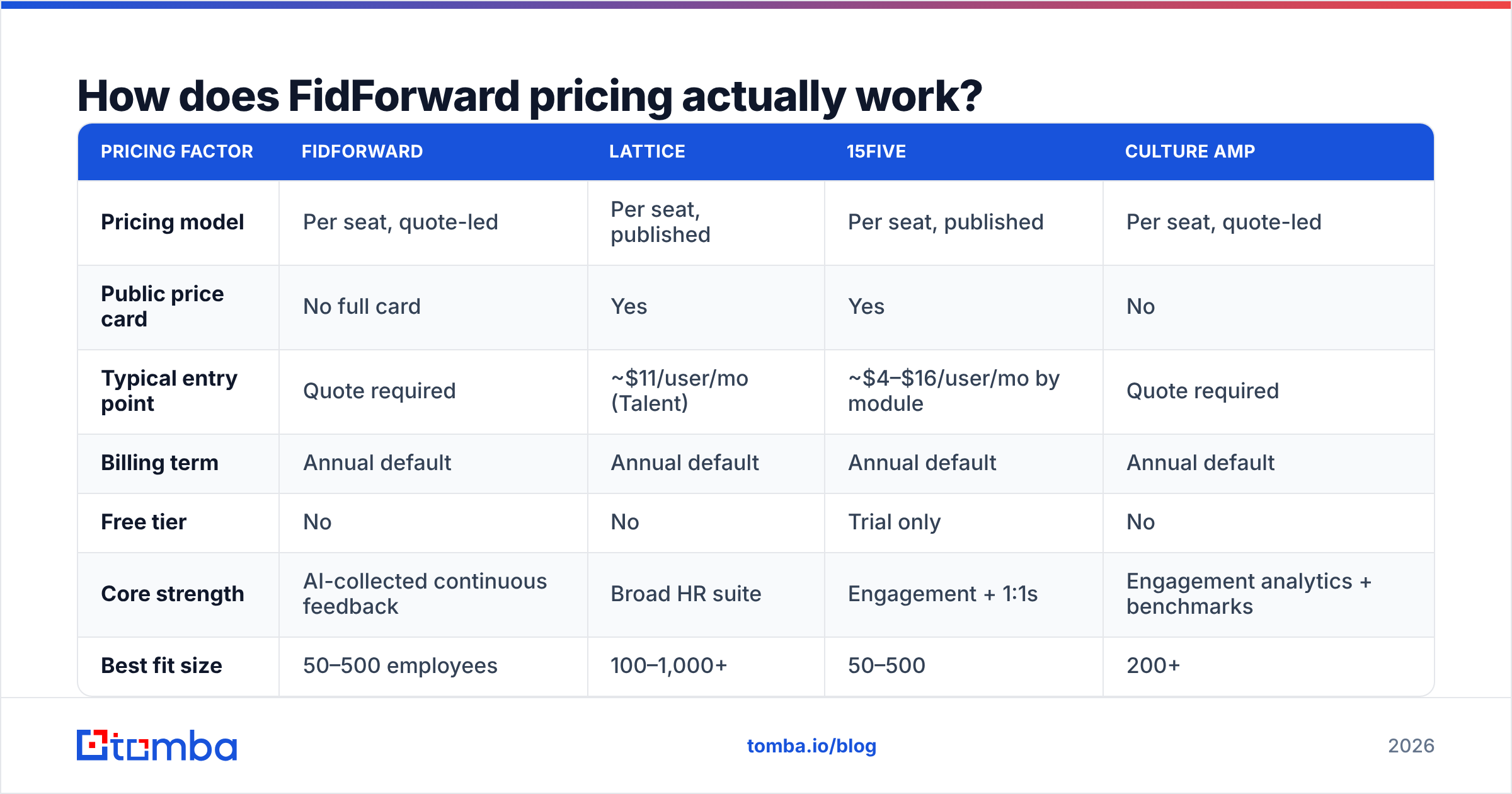
Here is how the economics compare across the category. Published list prices move often, so verify each on the vendor's own page before you build a business case.
| Pricing factor | FidForward | Lattice | 15Five | Culture Amp |
|---|---|---|---|---|
| Pricing model | Per seat, quote-led | Per seat, published | Per seat, published | Per seat, quote-led |
| Public price card | No full card | Yes | Yes | No |
| Typical entry point | Quote required | ~$11/user/mo (Talent) | ~$4–$16/user/mo by module | Quote required |
| Billing term | Annual default | Annual default | Annual default | Annual default |
| Free tier | No | No | Trial only | No |
| Core strength | AI-collected continuous feedback | Broad HR suite | Engagement + 1:1s | Engagement analytics + benchmarks |
| Best fit size | 50–500 employees | 100–1,000+ | 50–500 | 200+ |
The pattern is clear: nobody in this category sells cheaply to small teams. The vendors that hide pricing tend to price on your headcount and your urgency. That is not a knock on FidForward. It is how enterprise HR software has worked for a decade, as any scan of G2's performance management category will confirm.
What do FidForward reviews say?#
Any honest FidForward pricing review has to start with volume. Review counts are still thin compared with incumbents, and that is itself a data point. When a vendor has dozens rather than thousands of reviews on G2 or Capterra, you are buying a younger product. Expect a faster roadmap, more responsive founders, and less battle-tested edge-case handling.
The recurring themes in buyer feedback across the AI-feedback niche:
What reviewers consistently praise
- Reduced admin load. The most common quantified claim is hours saved per review cycle for HR leads — the tool does the chasing.
- Better-quality inputs. Feedback captured close to the event is more specific than feedback recalled six months later. Reviewers notice the difference in review documents.
- Low friction for employees. Prompts arriving in existing tools beat a separate portal nobody logs into.
- Responsive support. Typical of a smaller vendor — you often get a real human quickly.
What reviewers consistently criticise
- Opaque pricing. Buyers dislike having to book a call to learn whether the product is even in budget.
- AI summaries need editing. Nobody should send an AI-drafted review verbatim, and reviewers who tried it say so.
- Integration gaps. Younger platforms cover the big HRIS and chat tools first; niche stacks wait.
- Adoption depends on management. If managers ignore the nudges, you have bought a very expensive reminder system.
That last point is the honest one. Every performance tool review reduces to the same finding, echoed in Gartner's HR technology research: the software is rarely the bottleneck. Manager behaviour is.
What are the real pros of FidForward?#
1. It attacks the right problem. Most feedback tools optimise the review form. FidForward optimises the input — getting feedback written down at all. That is the actual failure point in most companies.
2. Continuous beats episodic. Recency bias is the dominant flaw in annual reviews. A system that captures evidence across the year structurally reduces it.
3. Setup effort is modest. Compared with a full HR suite migration, an AI feedback layer is a light lift. You are not re-platforming payroll.
4. It scales with headcount without scaling HR headcount. For a two-person people team supporting 300 employees, that leverage is the whole business case.
5. It produces a searchable record. Documented feedback protects you in promotion disputes and performance-management cases. Ask any employment lawyer what undocumented performance issues cost.
What are the cons you should price in?#
1. Quote-led pricing costs you time. Two discovery calls before a number is real friction, and it makes side-by-side budgeting harder.
2. Per-seat billing punishes growth. If you plan to double headcount, model the year-two cost, not the year-one quote. A $9/seat deal at 80 people is a very different line item at 200.
3. Annual lock-in on a young product. Roadmap risk is real. Negotiate a shorter first term or an out-clause tied to adoption thresholds.
4. AI output still needs a human. Budget manager time for editing. The tool reduces work; it does not eliminate it.
5. It solves an internal problem, not a revenue problem. This matters for prioritisation. If you have $12k of discretionary spend and a pipeline gap, feedback tooling is not the highest-return purchase this quarter.
Is FidForward worth it in 2026?#
Yes — if three conditions hold.
Condition one: you already run reviews. The tool improves an existing process. It does not create one.
Condition two: you are between 50 and 500 people. Below that, the per-seat minimums make the cost per outcome hard to justify. Above that, you will likely need a broader suite with compensation and succession modules.
Condition three: your managers will use it. Run a 60-day pilot with two departments and measure prompt-response rate. If it is under 50%, the problem is not the vendor.
If any of those conditions fail, the honest answer is simpler. A shared document template, a calendar reminder, and a manager who cares will get you 70% of the value for zero dollars. That is not a fashionable thing to write in a software review, but it is true.
How should you negotiate a FidForward quote?#
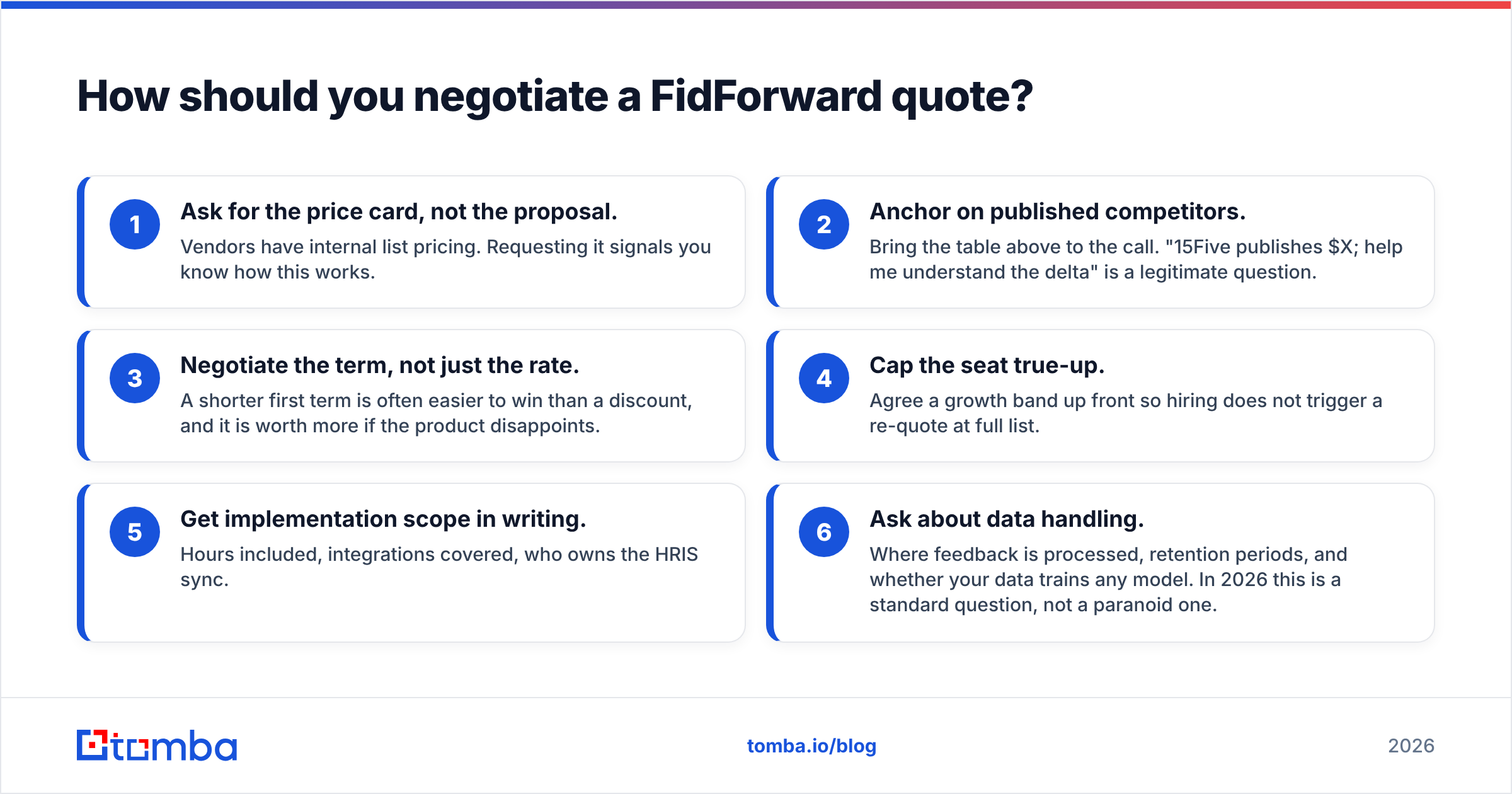
Treat it like any quote-led SaaS purchase.
- Ask for the price card, not the proposal. Vendors have internal list pricing. Requesting it signals you know how this works.
- Anchor on published competitors. Bring the table above to the call. "15Five publishes $X; help me understand the delta" is a legitimate question.
- Negotiate the term, not just the rate. A shorter first term is often easier to win than a discount, and it is worth more if the product disappoints.
- Cap the seat true-up. Agree a growth band up front so hiring does not trigger a re-quote at full list.
- Get implementation scope in writing. Hours included, integrations covered, who owns the HRIS sync.
- Ask about data handling. Where feedback is processed, retention periods, and whether your data trains any model. In 2026 this is a standard question, not a paranoid one.
Where does FidForward sit in your wider go-to-market budget?#
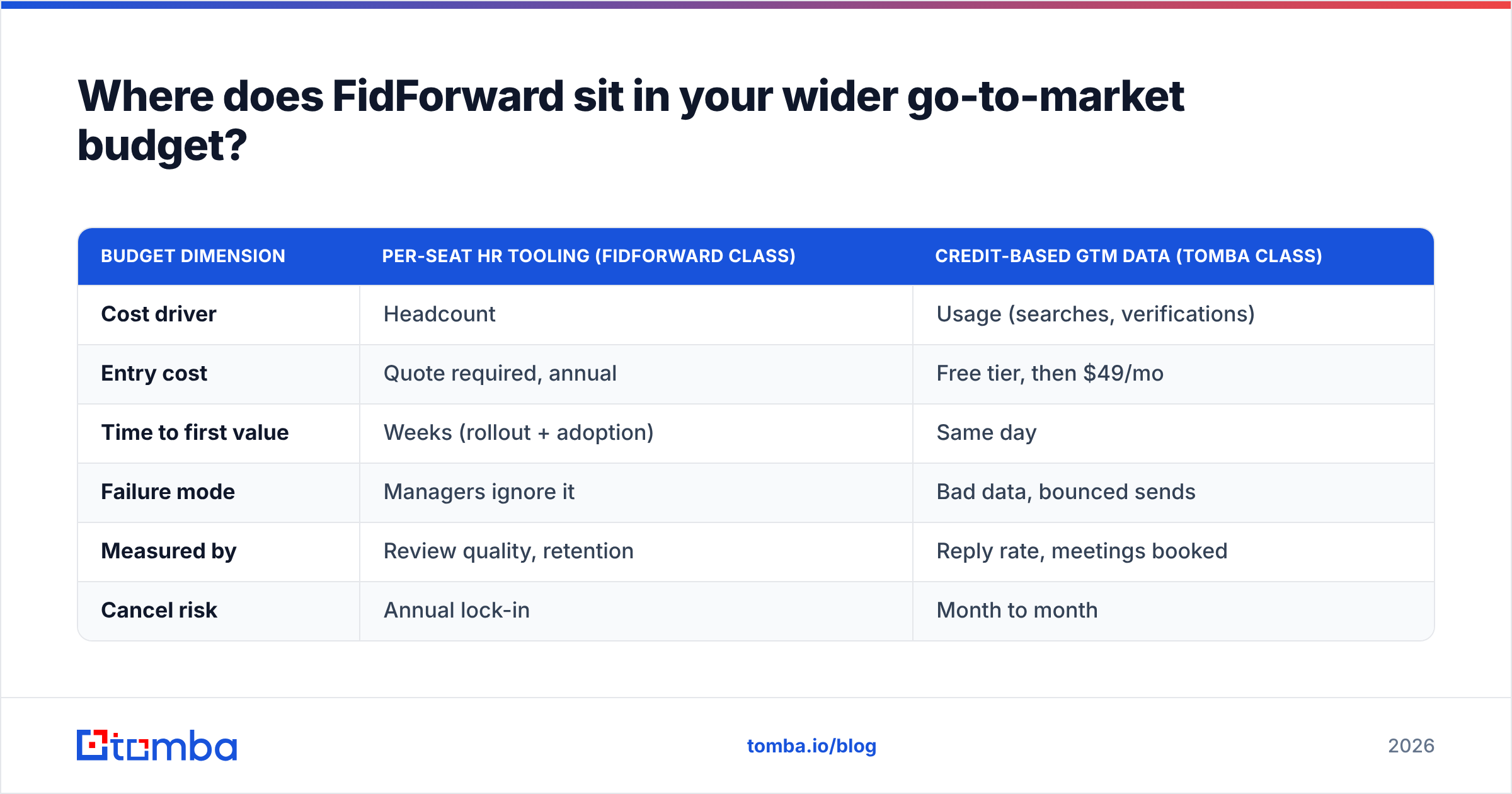
This is where the comparison gets useful for revenue teams. Performance-feedback software is a per-seat cost that improves internal quality. Prospecting data is a credit-based cost that improves external output. They compete for the same budget line in most small companies, and both deserve the same discipline.
| Budget dimension | Per-seat HR tooling (FidForward class) | Credit-based GTM data (Tomba class) |
|---|---|---|
| Cost driver | Headcount | Usage (searches, verifications) |
| Entry cost | Quote required, annual | Free tier, then $49/mo |
| Time to first value | Weeks (rollout + adoption) | Same day |
| Failure mode | Managers ignore it | Bad data, bounced sends |
| Measured by | Review quality, retention | Reply rate, meetings booked |
| Cancel risk | Annual lock-in | Month to month |
For reference, Tomba pricing runs a free tier at 25 searches per month, Starter at $49/mo, Growth at $99/mo, and Pro at $249/mo. It is usage-based, so a hiring spurt does not change your bill. The comparison is not "which tool is better"; they do different jobs. The point is simpler. Credit-based tooling lets you test a hypothesis for the price of a lunch, while per-seat annual tooling asks for a year of conviction before you learn anything.
If your bottleneck is that your reps do not have enough qualified conversations, fix that first. Clean contact data, verified before send, protects your email deliverability and your response rate. Both are measurable inside a month. Feedback tooling pays off over quarters. Sequence accordingly.
What are the best FidForward alternatives?#
- 15Five — the closest published-pricing comparison. Modular, transparent, strong on 1:1s and check-ins. Choose it if budget certainty matters more than AI-first capture.
- Lattice — broader suite covering goals, reviews, and engagement. Choose it if you want one vendor for the whole talent stack and can absorb the higher per-seat cost.
- Culture Amp — engagement analytics with heavy benchmarking. Choose it at 200+ employees where comparative data is the point.
- Small Improvements / Leapsome — mid-market alternatives worth a quote if you want a shortlist of three rather than two.
- A well-run template plus a calendar — genuinely the right answer under 25 people. Revisit software at 50.
Run the shortlist to three, demo all three in the same week, and give every vendor the same five scenarios from your actual org. Demos tuned to the vendor's happy path tell you nothing.
The bottom line#
The short version of this FidForward pricing review: it is a credible, focused product attacking the real weak point in performance reviews — feedback that never gets written down. The pros are genuine. Less admin, better inputs, a searchable record. The cons are structural to the category: quote-led pricing, per-seat scaling, annual commitment, and a young review base. Price it against 15Five and Lattice, negotiate the term hard, and pilot before you commit a year.
And be honest about which problem is actually costing you money this quarter. If your reviews are thin, buy feedback software. If your pipeline is thin, buy better contact data. No amount of internal feedback fixes an empty calendar.
Start with the cheaper experiment. Run Tomba Email Finder on your next 25 target accounts for free, verify the results with the email verifier before you send, and measure reply rate against your current list. If it moves, you have found a revenue lever for $49/mo with no annual commitment — and a much easier conversation with finance when the HR software quote lands.
Related guides#
Ready to find emails that actually work?
Join 150,000+ professionals who stopped guessing and started sending. Free credits on signup — no credit card required.
Get the Tomba newsletter
Practical outbound tactics and product updates — once every two weeks.
About the author