Field Sales in 2026: The Complete Playbook for Outside Reps
Field sales is not dead — but the economics changed. Here's what an outside rep actually costs in 2026, when territory coverage beats a Zoom link, and the stack that keeps windshield time from eating your quota.

TL;DR
- Field sales is not dead — it consolidated. It survives where deal size, regulation, or physical product inspection makes a video call insufficient.
- A fully loaded field rep costs roughly $180k–$260k/year in 2026 once you add car allowance, travel, and territory overhead. Inside sales runs about a third of that.
- The break-even rule of thumb: if your average contract value is under ~$25k and your close rate lift from being on-site is under 8 points, field coverage loses to a hybrid model.
- Windshield time is the real killer. Top field teams now spend 60%+ of their planning effort on route density and pre-visit research, not on the pitch itself.
- The modern field stack is small: a CRM, a mobile route planner, verified contact data, and a signal source. Everything else is noise.
What is field sales in 2026?#
Field sales — also called outside sales — is any selling motion where the rep physically travels to the prospect. Territory reps calling on hospital systems, manufacturer reps walking distributor floors, medical device specialists sitting in on procedures, ag-tech reps standing in a field with a farmer. The definition hasn't moved. The economics have.
Between 2020 and 2023, most B2B organizations discovered they could close mid-market deals over video and cut travel budgets to near zero. Then win rates in complex, high-consideration categories started sagging, and a chunk of that travel budget came back — but selectively. What exists in 2026 is not the pre-2020 field org. It's a smaller, more expensive, more instrumented team that gets deployed only where physical presence measurably moves the number.
Think of it like a specialist surgeon versus a GP. You don't send the surgeon to look at a rash. You send them where the intervention is worth the cost of their time. Most companies that still run field teams got burned by treating every account as surgery.
The practical shift: field reps no longer own prospecting. In the majority of hybrid orgs, an SDR or a RevOps-built list hands the field rep a qualified, routed, pre-researched set of accounts, and the rep's job starts at the door. That division of labor is what makes the cost structure survivable.
Is field sales better than inside sales?#
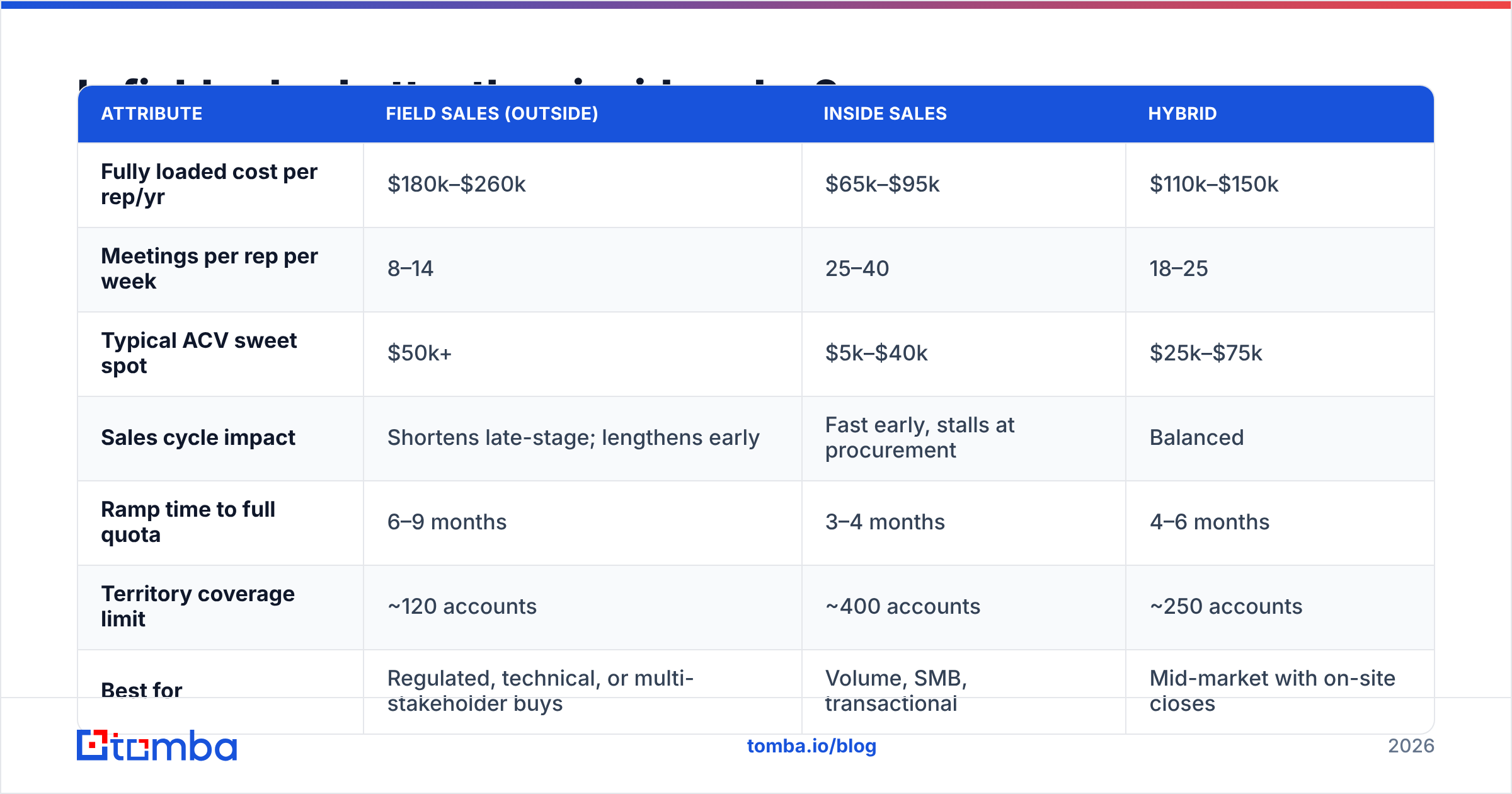
Neither is better. They're priced differently and they buy you different things. Here's the honest comparison across the attributes that actually determine which one you should fund.
| Attribute | Field sales (outside) | Inside sales | Hybrid |
|---|---|---|---|
| Fully loaded cost per rep/yr | $180k–$260k | $65k–$95k | $110k–$150k |
| Meetings per rep per week | 8–14 | 25–40 | 18–25 |
| Typical ACV sweet spot | $50k+ | $5k–$40k | $25k–$75k |
| Sales cycle impact | Shortens late-stage; lengthens early | Fast early, stalls at procurement | Balanced |
| Ramp time to full quota | 6–9 months | 3–4 months | 4–6 months |
| Territory coverage limit | ~120 accounts | ~400 accounts | ~250 accounts |
| Best for | Regulated, technical, or multi-stakeholder buys | Volume, SMB, transactional | Mid-market with on-site closes |
| Weakest at | Pipeline generation at scale | Winning against incumbent relationships | Clear rep ownership |
Two numbers in that table drive most decisions. The cost ratio (roughly 3:1) and the meeting ratio (roughly 1:3). A field rep costs three times as much and holds a third as many conversations — which means each field conversation has to be worth about nine times an inside conversation to break even. That's a brutal hurdle, and it's exactly why field sales survived only in categories where it clears easily.
Where it clears easily: medical devices, industrial equipment, building products, agricultural inputs, enterprise infrastructure, and any category where the buyer needs to touch the thing or where a compliance officer sits in the room.
Where it doesn't: SaaS under $40k ACV, professional services with remote delivery, and anything a buyer will happily evaluate from a G2 profile. G2's category data makes that self-service evaluation path obvious — if your buyers are researching you there before they talk to anyone, a field rep is arriving too late to change the shortlist.

What does a modern field sales process look like?#
The old field process was: territory list, drive, knock, follow up. The 2026 version front-loads almost everything and treats the visit as the expensive final step rather than the discovery step.
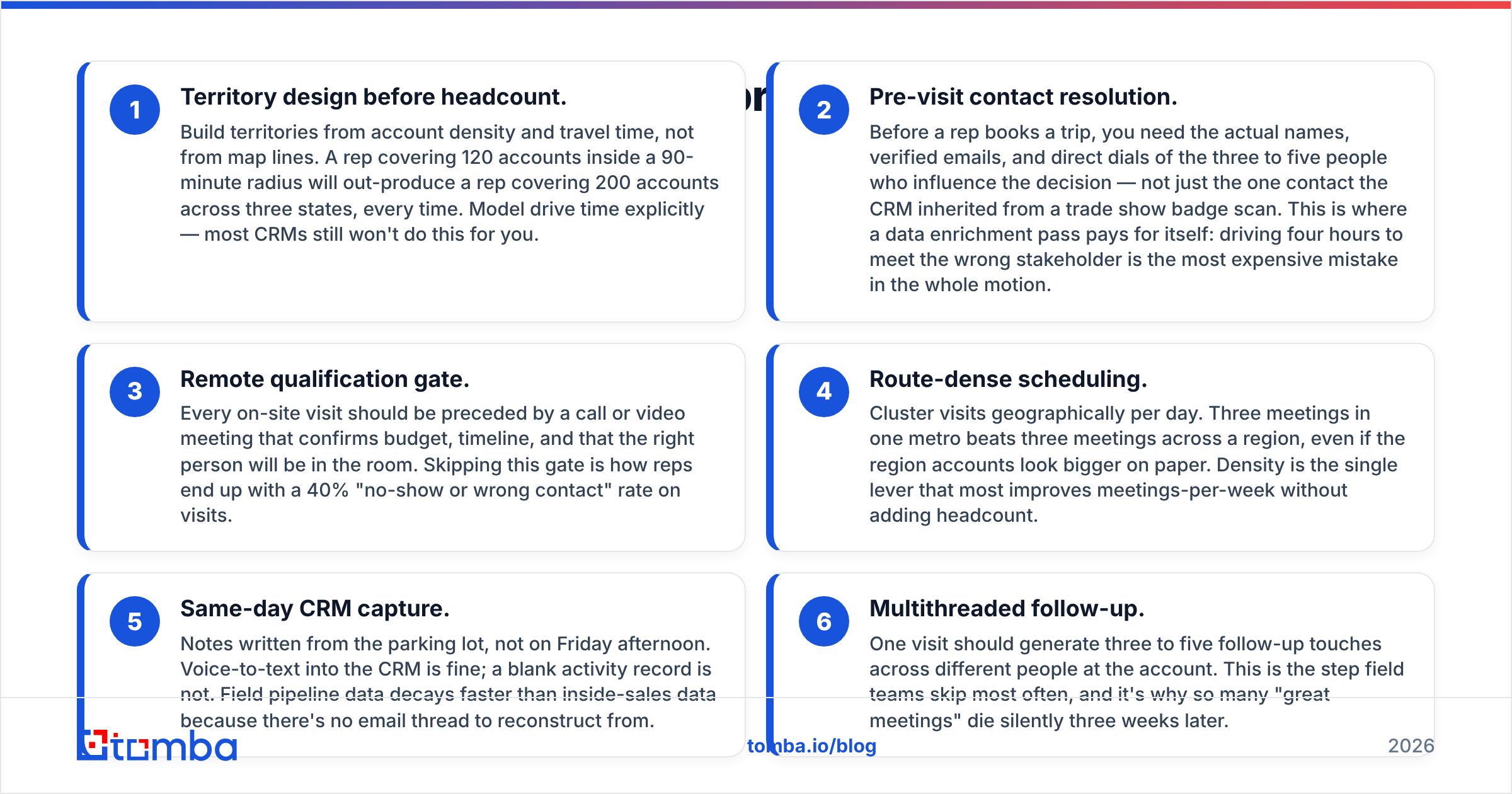
Territory design before headcount. Build territories from account density and travel time, not from map lines. A rep covering 120 accounts inside a 90-minute radius will out-produce a rep covering 200 accounts across three states, every time. Model drive time explicitly — most CRMs still won't do this for you.
Pre-visit contact resolution. Before a rep books a trip, you need the actual names, verified emails, and direct dials of the three to five people who influence the decision — not just the one contact the CRM inherited from a trade show badge scan. This is where a data enrichment pass pays for itself: driving four hours to meet the wrong stakeholder is the most expensive mistake in the whole motion.
Remote qualification gate. Every on-site visit should be preceded by a call or video meeting that confirms budget, timeline, and that the right person will be in the room. Skipping this gate is how reps end up with a 40% "no-show or wrong contact" rate on visits.
Route-dense scheduling. Cluster visits geographically per day. Three meetings in one metro beats three meetings across a region, even if the region accounts look bigger on paper. Density is the single lever that most improves meetings-per-week without adding headcount.
Same-day CRM capture. Notes written from the parking lot, not on Friday afternoon. Voice-to-text into the CRM is fine; a blank activity record is not. Field pipeline data decays faster than inside-sales data because there's no email thread to reconstruct from.
Multithreaded follow-up. One visit should generate three to five follow-up touches across different people at the account. This is the step field teams skip most often, and it's why so many "great meetings" die silently three weeks later.
When does a field sales team actually pay for itself?#
Run this math before you hire. It takes ten minutes and it's more reliable than any vendor's ROI calculator.
Take your current inside-sales close rate on the target segment. Estimate — honestly, from historical data if you have it — how many points on-site presence would add. Then multiply the incremental close rate by your average contract value and by the number of deals a field rep can realistically touch in a year (usually 60–90 opportunities, not 200).
If the incremental revenue doesn't clear $400k per rep, don't hire. You need roughly 2x the fully loaded cost to cover management overhead, territory support, and the reality that at least one rep in three won't ramp.
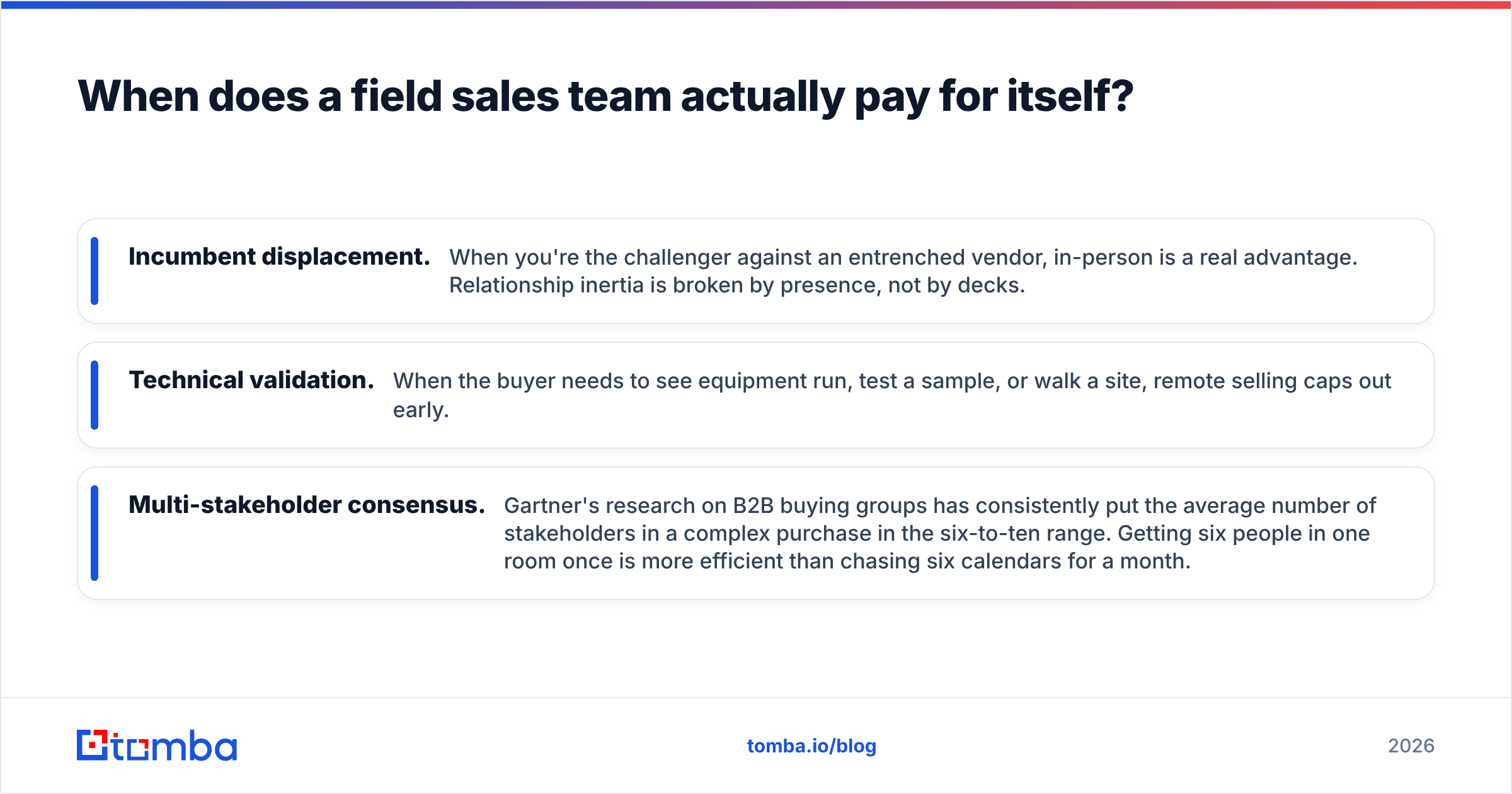
The lift is usually largest in three situations:
- Incumbent displacement. When you're the challenger against an entrenched vendor, in-person is a real advantage. Relationship inertia is broken by presence, not by decks.
- Technical validation. When the buyer needs to see equipment run, test a sample, or walk a site, remote selling caps out early.
- Multi-stakeholder consensus. Gartner's research on B2B buying groups has consistently put the average number of stakeholders in a complex purchase in the six-to-ten range. Getting six people in one room once is more efficient than chasing six calendars for a month.
Outside those three, the honest answer is usually hybrid: inside reps run the cycle, a small field team parachutes in for the close, and travel is booked against a specific deal stage rather than a territory calendar.
What tech stack does a field sales team need?#
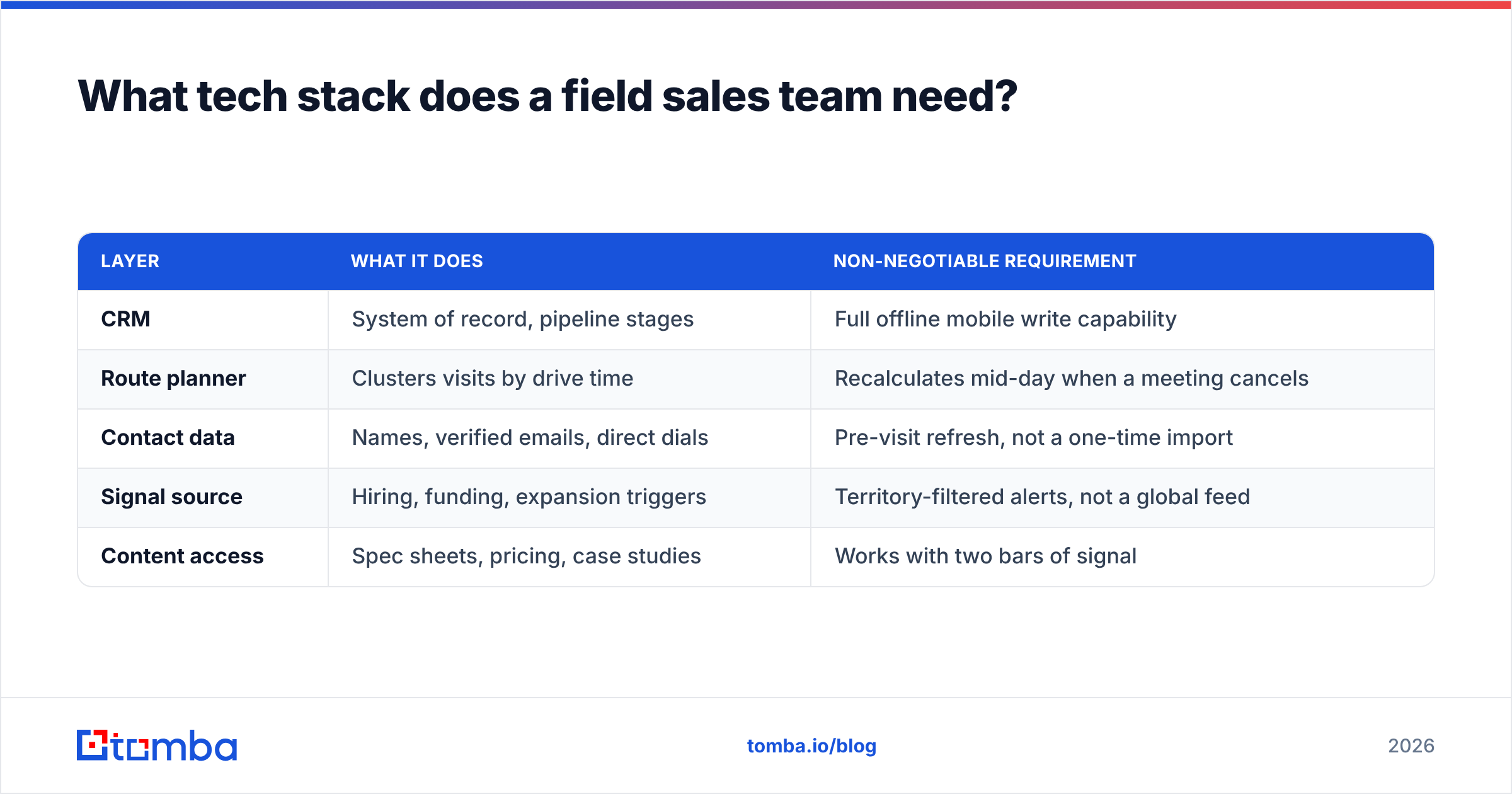
Keep it small. Field reps abandon tools that take more than 30 seconds to use from a phone in a parking lot. The stack that survives contact with reality looks like this.
| Layer | What it does | Non-negotiable requirement |
|---|---|---|
| CRM | System of record, pipeline stages | Full offline mobile write capability |
| Route planner | Clusters visits by drive time | Recalculates mid-day when a meeting cancels |
| Contact data | Names, verified emails, direct dials | Pre-visit refresh, not a one-time import |
| Signal source | Hiring, funding, expansion triggers | Territory-filtered alerts, not a global feed |
| Content access | Spec sheets, pricing, case studies | Works with two bars of signal |
The layer teams underinvest in is contact data. A field territory decays at roughly 25–30% per year through job changes alone, which means a list built in January is meaningfully wrong by October. Refreshing contacts before a trip — using a phone finder for direct dials and verifying emails so your follow-up doesn't bounce — costs a few dollars per account and protects a several-hundred-dollar trip.
Note what's not on the list: sequencing platforms, conversation intelligence, and most sales engagement suites. They're excellent for inside teams and largely ignored by field reps who don't send 60 emails a day. Buy them for the desk-based half of your org and stop paying for seats your outside reps never open. If you're comparing what to keep, HubSpot's sales tooling breakdown and Salesforce's own field service and sales cloud docs are reasonable neutral starting points for understanding what each layer is actually meant to do.

How do you measure field sales performance?#
Activity metrics that work for inside sales fall apart in the field. Dials and emails sent tell you nothing about a rep who spends three hours a day driving. Measure these instead.
Meetings per week, by quality tier. Split into discovery, working, and decision-stage meetings. A rep with 12 meetings that are all "checking in" is worse than a rep with six decision-stage meetings. Raw meeting count is a vanity metric in the field.
Windshield-to-face ratio. Hours driving divided by hours in front of buyers. Anything above 2:1 signals a territory design problem, not a rep problem. Fix the map before you coach the person.
Account penetration. Number of distinct contacts engaged per open opportunity. Under three is a single-threaded deal, which in field sales — where cycles run long and champions leave — is where forecasts go to die.
Visit-to-next-step conversion. What percentage of on-site visits produce a scheduled, calendared next action? Below 60% means your qualification gate isn't working and reps are driving to unqualified meetings.
Cost per closed-won. Include travel. Most field orgs never compute this and are shocked when they finally do. It's the only number that lets you compare field to inside honestly.
Two of these — windshield ratio and cost per closed-won — should be reviewed by the sales manager monthly, not quarterly. Field problems compound; a badly designed territory quietly wastes 200 rep-hours before anyone notices in a QBR.
What are the most common field sales mistakes?#
Treating the territory as a static list. Accounts move, merge, close, and change buyers. A territory that hasn't been re-scored in 12 months is mostly fiction. Rebuild the account list against a current B2B database at least twice a year and re-rank by fit, not by last year's revenue.
Sending the field rep to prospect. Cold territory canvassing has a terrible hourly return for someone earning $200k+ fully loaded. Prospecting is desk work. Let inside resources or automation surface the qualified accounts and let the field rep close them.
Optimizing for miles instead of density. Reps naturally chase the biggest logo on the map. Managers should push back: three medium accounts in one metro produce more pipeline than one whale four hours away, at least until the whale is qualified.
Letting follow-up decay. The visit generates the goodwill; the follow-up converts it. Bounced emails after a good meeting are an unforced error — verify addresses before the trip so the thank-you note actually lands.
Running field and inside as rivals. When comp plans put them in conflict over the same accounts, both underperform. Define the handoff stage explicitly and pay both sides on the closed deal.
Should you hire field reps or convert to hybrid?#
Default to hybrid unless your ACV and category clearly justify pure field. Hybrid gives you most of the on-site lift at roughly 60% of the cost, and it's far easier to unwind if the segment turns out not to need presence.
The staged approach that works: start every new segment inside-only, instrument the loss reasons for six months, and only add field coverage where "we went with the incumbent" or "we needed to see it work" show up repeatedly in closed-lost notes. That's evidence. Hiring field reps because a competitor has them is not.
If you do hire, hire in pairs within a single metro before expanding. One isolated rep in a distant territory has no coaching, no peer benchmark, and no way to distinguish a bad territory from a bad hire.
Get your field territory data right before the first trip#
Everything above depends on one unglamorous input: knowing exactly who to see, that they still work there, and how to reach them afterward. A field visit built on stale contact data is a $600 mistake with a full tank of gas attached.
Tomba's email finder resolves verified work addresses by name and company domain so your pre-visit research and post-visit follow-up both land — with a free tier at 25 searches per month to test a territory, and paid plans from $49/month when you're ready to refresh a whole account list. Build the territory on real contacts, then go drive.
Related guides#
Ready to find emails that actually work?
Join 150,000+ professionals who stopped guessing and started sending. Free credits on signup — no credit card required.
Get the Tomba newsletter
Practical outbound tactics and product updates — once every two weeks.
About the author