Field Sales Rep in 2026: Role, Pay, and Daily Playbook
What a field sales rep actually does in 2026, what the job pays, how it compares to inside sales, and the territory system that keeps windshield time from eating your quota.

TL;DR
- A field sales rep sells face-to-face inside a defined geographic or account territory — site visits, trade shows, lunch meetings, and on-site demos, not a headset and a dialer queue.
- The role did not die with remote work. It consolidated: fewer field reps, bigger deal sizes, and a much higher bar for pre-visit research.
- Median on-target earnings in 2026 sit roughly between $95K and $180K depending on segment, with a 50/50 or 60/40 base-to-variable split.
- The biggest killer of field quota is windshield time. Reps who plan territory in clusters and pre-qualify contacts before driving out-earn reps who "just show up."
- The modern field stack is small: a CRM, a route planner, a mobile enablement app, and a contact-data source that gives you the right person's email and direct line before you walk in.
What is a field sales rep?#
A field sales rep is a salesperson whose primary selling motion happens in person, inside an assigned territory. Think of it like a doctor who makes house calls instead of running a clinic — same expertise, but the value comes from being physically present where the problem lives.
That physical presence buys three things a video call cannot: you see the customer's actual operation, you meet people who were never on the invite list, and you get the kind of trust that only shows up when someone gives you an hour of their day in their building.
Field reps are also called outside sales reps, territory managers, or account executives (field). Titles vary; the job does not. You own a geography or a named-account book, you generate a large share of your own pipeline, and you are measured on closed revenue rather than activity volume.
The role is common in medical devices, industrial equipment, building products, food and beverage distribution, agriculture, enterprise software with heavy on-prem components, and any category where the buyer wants to see the thing before signing for it.
How is a field sales rep different from an inside sales rep?#
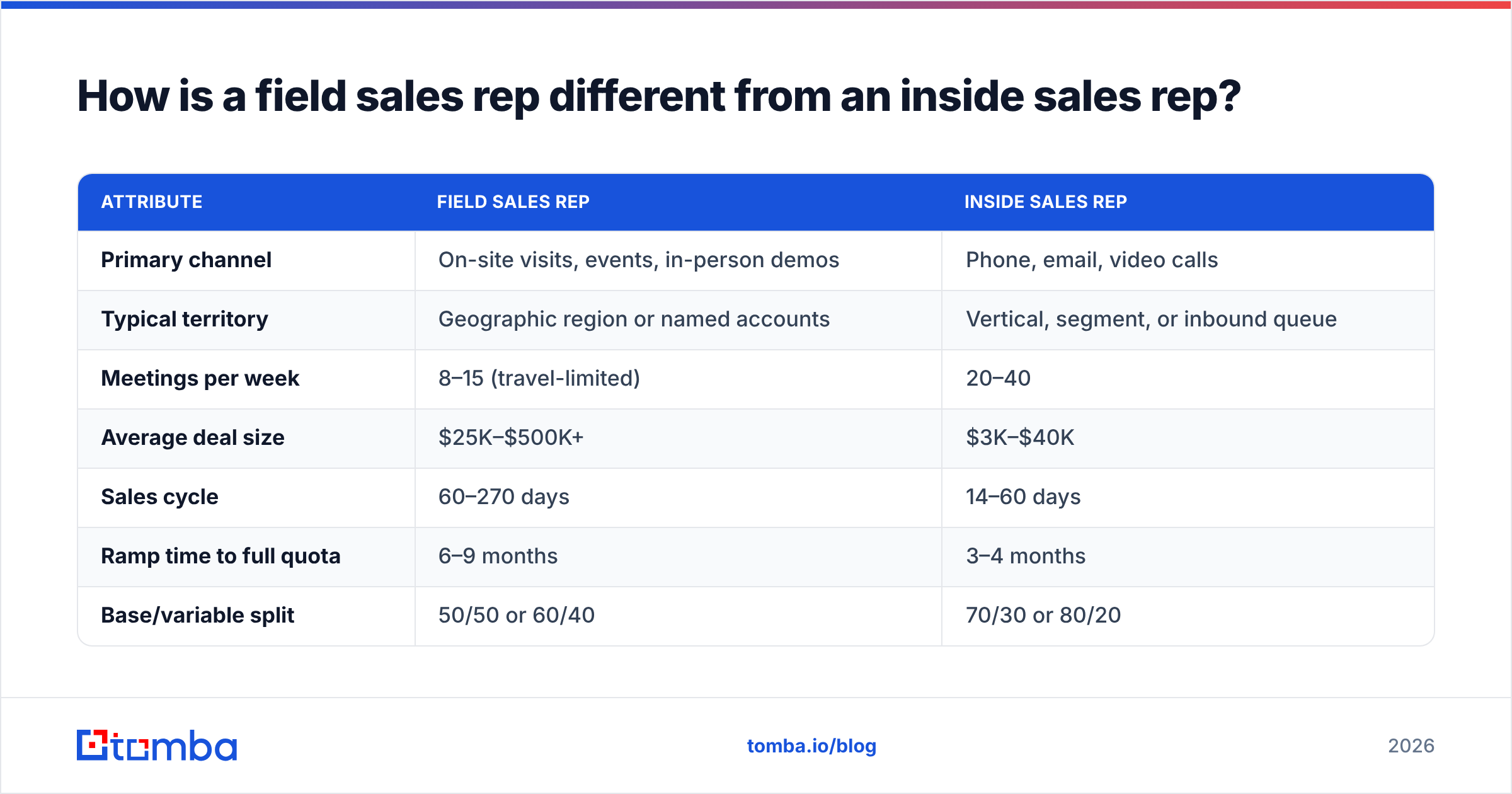
The short answer: inside sales optimizes for volume, field sales optimizes for depth. Here is the practical breakdown.
| Attribute | Field sales rep | Inside sales rep |
|---|---|---|
| Primary channel | On-site visits, events, in-person demos | Phone, email, video calls |
| Typical territory | Geographic region or named accounts | Vertical, segment, or inbound queue |
| Meetings per week | 8–15 (travel-limited) | 20–40 |
| Average deal size | $25K–$500K+ | $3K–$40K |
| Sales cycle | 60–270 days | 14–60 days |
| Ramp time to full quota | 6–9 months | 3–4 months |
| Base/variable split | 50/50 or 60/40 | 70/30 or 80/20 |
| Travel expectation | 40–70% | Under 10% |
| Cost per meeting | High (travel, expenses, time) | Low |
| Best fit when | Buyer needs to see, touch, or trust it | Product is self-evident and fast to evaluate |
The row that matters most is cost per meeting. An inside rep who wastes a meeting loses 30 minutes. A field rep who wastes a meeting loses half a day plus mileage. That single asymmetry drives every good habit in this job — and every bad quarter that comes from skipping the research step.
What does a field sales rep actually do all day?#
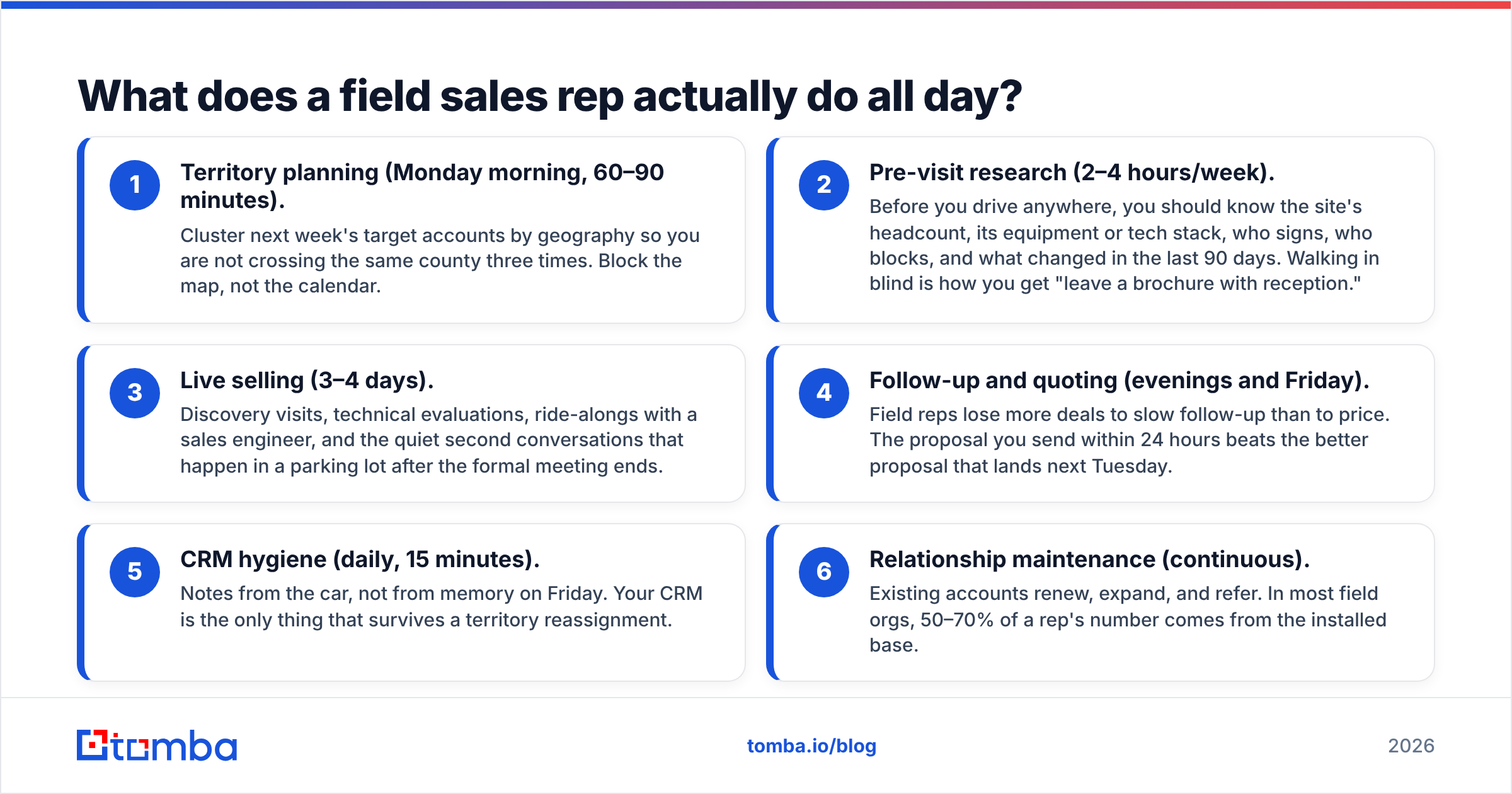
Forget the montage of handshakes. A well-run field week looks like this:
- Territory planning (Monday morning, 60–90 minutes). Cluster next week's target accounts by geography so you are not crossing the same county three times. Block the map, not the calendar.
- Pre-visit research (2–4 hours/week). Before you drive anywhere, you should know the site's headcount, its equipment or tech stack, who signs, who blocks, and what changed in the last 90 days. Walking in blind is how you get "leave a brochure with reception."
- Live selling (3–4 days). Discovery visits, technical evaluations, ride-alongs with a sales engineer, and the quiet second conversations that happen in a parking lot after the formal meeting ends.
- Follow-up and quoting (evenings and Friday). Field reps lose more deals to slow follow-up than to price. The proposal you send within 24 hours beats the better proposal that lands next Tuesday.
- CRM hygiene (daily, 15 minutes). Notes from the car, not from memory on Friday. Your CRM is the only thing that survives a territory reassignment.
- Relationship maintenance (continuous). Existing accounts renew, expand, and refer. In most field orgs, 50–70% of a rep's number comes from the installed base.
The reps who consistently hit quota are not the most charismatic. They are the ones who treat steps 1 and 2 as non-negotiable and refuse to burn a drive on an unqualified stop.
How much does a field sales rep make in 2026?#
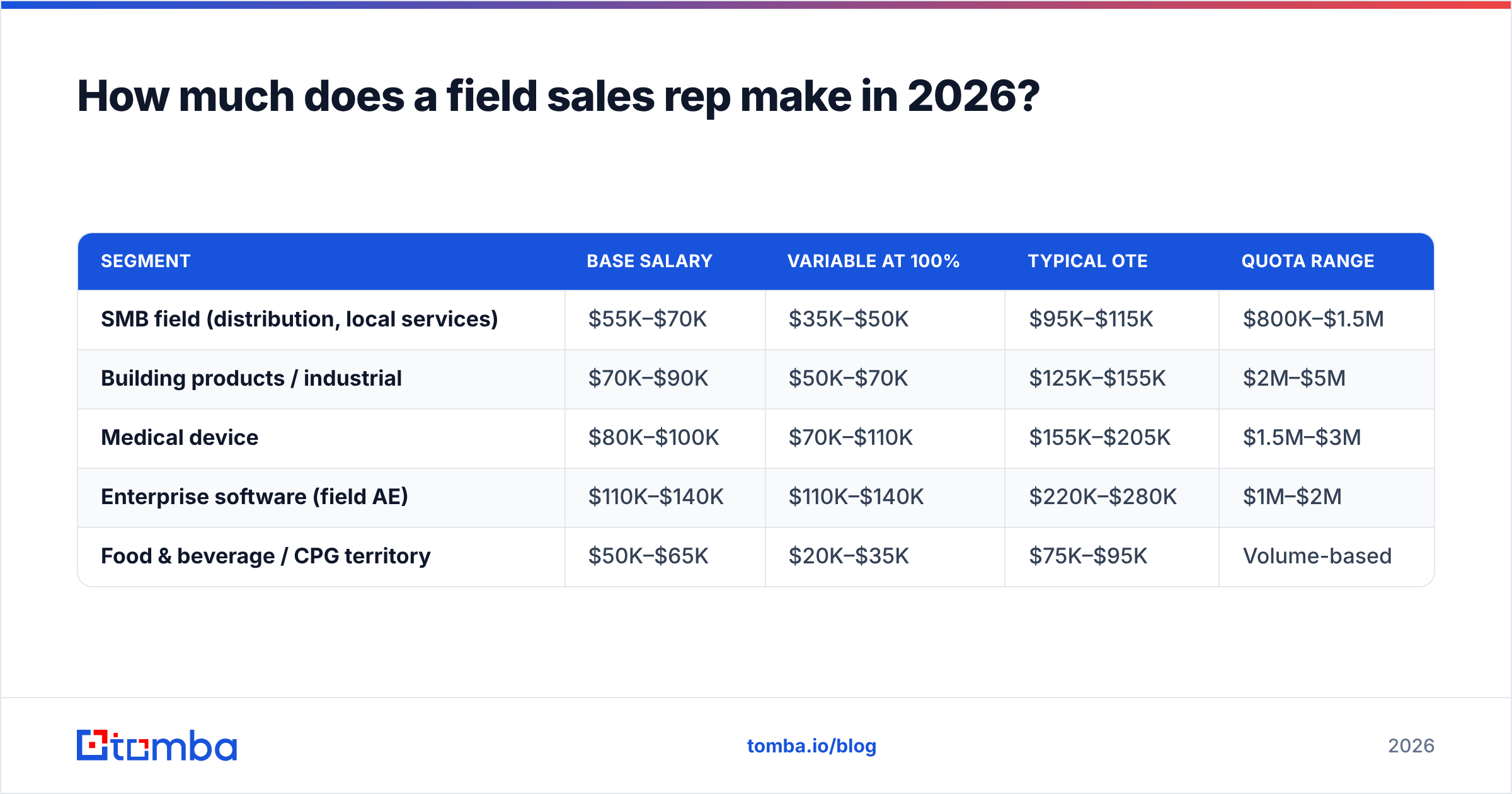
Compensation varies more by industry than by geography. These are realistic 2026 on-target earnings (OTE) bands for a rep with 2–5 years of experience in the US market:
| Segment | Base salary | Variable at 100% | Typical OTE | Quota range |
|---|---|---|---|---|
| SMB field (distribution, local services) | $55K–$70K | $35K–$50K | $95K–$115K | $800K–$1.5M |
| Building products / industrial | $70K–$90K | $50K–$70K | $125K–$155K | $2M–$5M |
| Medical device | $80K–$100K | $70K–$110K | $155K–$205K | $1.5M–$3M |
| Enterprise software (field AE) | $110K–$140K | $110K–$140K | $220K–$280K | $1M–$2M |
| Food & beverage / CPG territory | $50K–$65K | $20K–$35K | $75K–$95K | Volume-based |
Two caveats before you use these numbers in a negotiation. First, published OTE assumes 100% attainment, and typical field attainment sits closer to 60–75% across most orgs — ask a hiring manager what percentage of the team hit plan last year, and treat a dodge as an answer. Second, accelerators matter more than base. A plan that pays 1.5x–3x above quota is worth more than a $10K bump in base if the territory is real.
Also check the expense structure. Car allowance vs. mileage reimbursement vs. company vehicle is a $6K–$12K annual swing that never shows up on the offer letter's headline number.
What tools does a field sales rep need in 2026?#
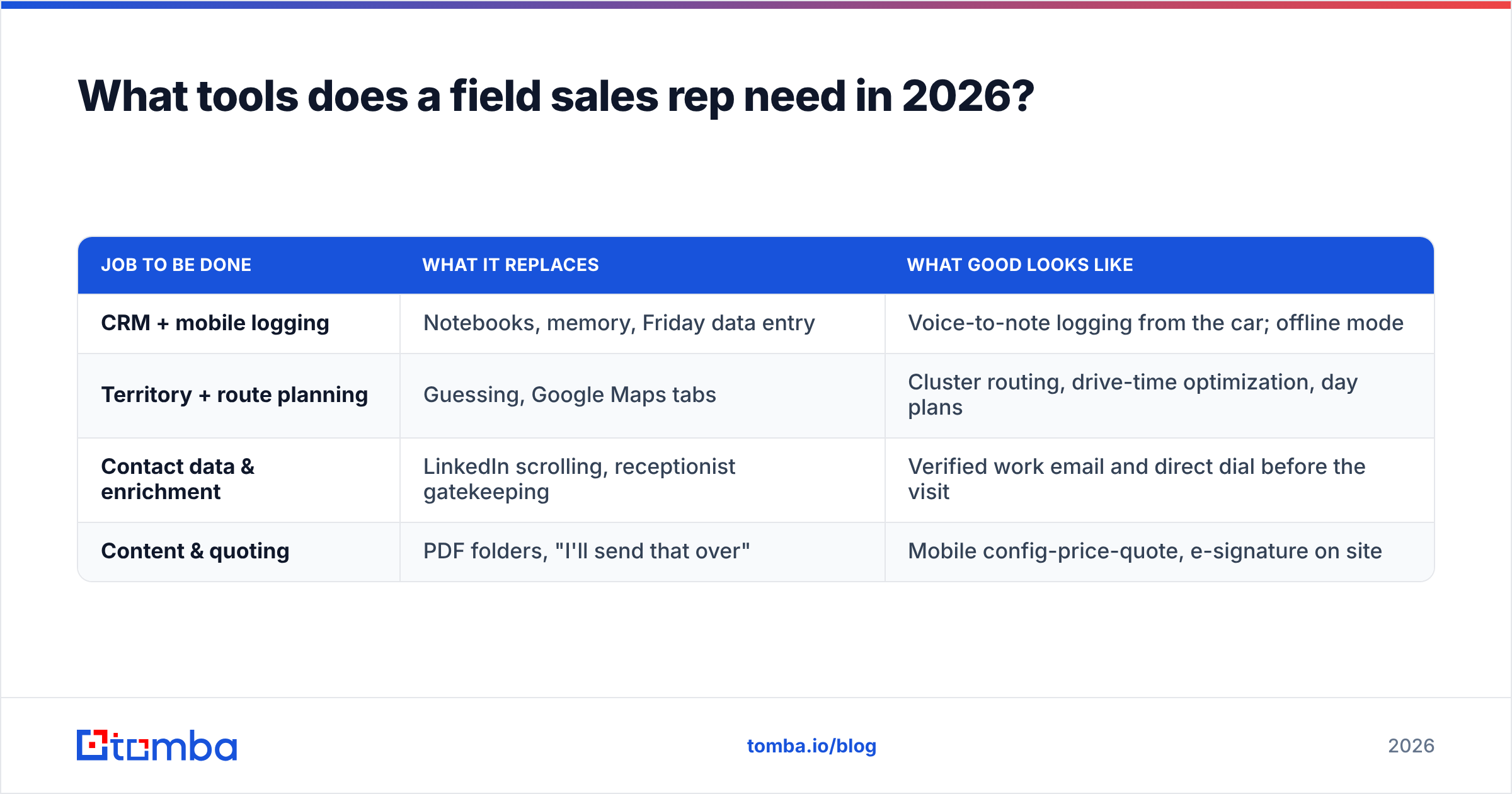
The field stack got smaller and sharper. You do not need fourteen tools. You need four jobs done well.
| Job to be done | What it replaces | What good looks like |
|---|---|---|
| CRM + mobile logging | Notebooks, memory, Friday data entry | Voice-to-note logging from the car; offline mode |
| Territory + route planning | Guessing, Google Maps tabs | Cluster routing, drive-time optimization, day plans |
| Contact data & enrichment | LinkedIn scrolling, receptionist gatekeeping | Verified work email and direct dial before the visit |
| Content & quoting | PDF folders, "I'll send that over" | Mobile config-price-quote, e-signature on site |
The contact-data row is the one field reps under-invest in, and it is the one with the clearest ROI. If you are driving 90 minutes to a plant, knowing the operations director's name, verified email, and direct line before you arrive is the difference between a meeting and a business card left at a front desk. Tools like an email finder and a phone finder turn a company name on your route list into an actual human you can pre-contact.
For account-based territories, running data enrichment across your whole book once a quarter is worth a full day of your time. Job changes are the highest-signal event in field sales — your champion moving to a new plant is a warm door at a brand-new account, and stale CRM records hide that completely.
Is field sales still worth it in 2026?#
Yes, in the segments where it was always worth it — and no, everywhere else.
The honest picture: remote and hybrid buying cut the number of field roles in categories where the product could be evaluated on a screen. Research from Gartner's sales practice and Salesforce's State of Sales has tracked B2B buyers spending the majority of their evaluation time in self-service channels for several years running. Anyone who tells you the field is untouched is selling something.
But the flip side is a structural advantage. When most vendors show up as a Zoom rectangle, the rep who shows up in person is competing in a much emptier room. In deals above roughly $75K, with multiple stakeholders and a physical operation, in-person coverage still correlates with higher win rate and faster consensus — because you get access to the people who never join the call.
The test for whether field sales makes sense for your product is simple:
- Does the buyer need to see it work in their environment? If yes, field wins.
- Is the decision committee larger than four people? If yes, field wins — you cannot build coalitions on a shared screen.
- Is the average contract value under $20K? If yes, field loses on unit economics no matter how good the rep is.
- Is there an existing installed base to expand? If yes, field pays for itself on renewals alone.

How do you build a territory plan that doesn't waste windshield time?#
Windshield time is the field rep's version of technical debt: invisible on a Monday, fatal by the end of the quarter. Here is a plan that survives contact with reality.
Step 1 — Rank the territory, don't cover it. Score every account on revenue potential, fit, and accessibility. Take the top 20% and call it your A-list. Coverage is a vanity metric; concentration is a compensation strategy.
Step 2 — Cluster geographically, then sequence. Group A-list accounts into drive-day clusters of four to six. One cluster per field day. If a single account sits an hour from every other stop, it needs to be a top-decile opportunity or it becomes a video call.
Step 3 — Enrich before you drive. For every account in next week's clusters, get the two or three named contacts who matter, verified. A bulk email finder run against your route list takes minutes and means every stop has a human attached to it, not a building.
Step 4 — Warm the door 48 hours out. A short email and a voicemail before the visit converts a drop-in into an appointment. Reps who skip this step report roughly half the meeting rate on the same drive. Keep the message to three sentences and one specific reason you are in the area.
Step 5 — Book the next step in the room. Never leave without a calendared follow-up. "I'll reach out next week" is how a $200K opportunity becomes a ghost.
Step 6 — Review weekly, replan monthly. Territories rot. Accounts get acquired, plants close, champions leave. A monthly re-rank keeps your A-list honest.
One more thing worth stealing from inside sales: pattern-based prospecting. Most companies use a predictable email format, and a company email pattern check plus verification gets you a reachable contact at accounts that never answer the switchboard. Field reps who borrow inside-sales prospecting discipline consistently beat field reps who rely on relationships alone.
How do you break into field sales?#
The common path is inside sales first, then field promotion after 18–24 months — that is still the highest-probability route, and it teaches pipeline math before you are handed a territory. Industry experience is the second path: technicians, clinical specialists, and operations people move into field roles regularly because they already speak the customer's language.
If you are interviewing, ask these four questions and weigh the answers heavily:
- What was team attainment last year? Below 50% means the quota, not the reps, is the problem.
- Is the territory new or inherited? An inherited book with active accounts is worth $30K in year-one earnings versus a greenfield map.
- What's the split between new logos and installed base? Pure hunting territories carry more variance.
- Who generates the pipeline — me or marketing? In most field orgs the honest answer is "you, mostly." Budget your week accordingly.
For a broader view of how compensation and quota design interact, HubSpot's sales research library is a reasonable free benchmark, and the concept of a sales territory itself has a longer history than most modern playbooks acknowledge.
The bottom line#
Field sales in 2026 rewards preparation far more than presence. The rep who drives out with three verified contacts, a known trigger event, and a booked appointment closes at multiples of the rep who drives out with a company list and optimism. The territory did not get harder; the tolerance for wasted trips got much lower.
If your field motion is losing days to unqualified stops and wrong contacts, fix the input side first. Start with the Tomba Email Finder — drop in a company domain, get verified work emails for the decision-makers on your route, and warm every door before you turn the key. The free tier covers 25 searches a month so you can test it against next week's cluster, and paid plans start at $49/month if the territory earns it. Full Tomba pricing is public, and the API and Sheets add-on plug straight into whatever route-planning spreadsheet you already trust.
Related guides#
Ready to find emails that actually work?
Join 150,000+ professionals who stopped guessing and started sending. Free credits on signup — no credit card required.
Get the Tomba newsletter
Practical outbound tactics and product updates — once every two weeks.
About the author