Field Sales vs Inside Sales: Which Model Wins in 2026?
Field sales costs 4-6x more per meeting than inside sales — but still closes bigger deals. Here's the honest cost, quota, and cycle-time breakdown, plus how to decide which model your deal size actually justifies.
TL;DR
- Field sales costs roughly $400–$1,200 per qualified meeting once you count travel, lodging, and windshield time. Inside sales lands closer to $75–$250.
- The deciding variable is not company size or industry — it's annual contract value. Below roughly $25K ACV, field sales rarely pays for itself. Above $150K ACV, pure inside sales usually leaves money on the table.
- Inside sales reps run 3–5x the activity volume, but field reps historically carry 2–3x the quota. Neither number means anything without a cost-per-dollar-of-revenue calculation.
- The 2026 reality is that almost nobody runs a pure model anymore. The winning structure is hybrid: inside sales sources and qualifies, field closes the top decile of pipeline.
- Both models die the same way — bad contact data. A field rep who drives four hours to a wrong address and an SDR who emails a bounced address are burning the same budget, just at different speeds.
What is field sales, and what is inside sales?#
Field sales means a rep who travels to the buyer. Site visits, on-site demos, trade-show booths, steak dinners, territory maps. The rep owns a geography and a short list of large accounts, and the primary sales motion is face-to-face.
Inside sales means a rep who sells remotely — phone, email, video call, LinkedIn, chat. The rep owns a segment or a vertical rather than a zip code, and the primary motion is high-frequency touch across a wider account list.
Think of it like the difference between a general contractor and a call-center dispatcher. The contractor shows up, walks the site, and can spot the load-bearing wall nobody mentioned on the phone. The dispatcher handles twenty jobs in the time the contractor handles one, but can only work from what people tell them. Both are legitimate. They just cost wildly different amounts and produce different information.
The distinction blurred badly after 2020. Plenty of "field" reps now run 80% of their cycle over Zoom and fly out once to sign. Plenty of "inside" reps take three flights a year for renewals. So when you compare field sales vs inside sales in 2026, you're really comparing cost structures and coverage models, not job titles.
How do field sales and inside sales actually compare?#
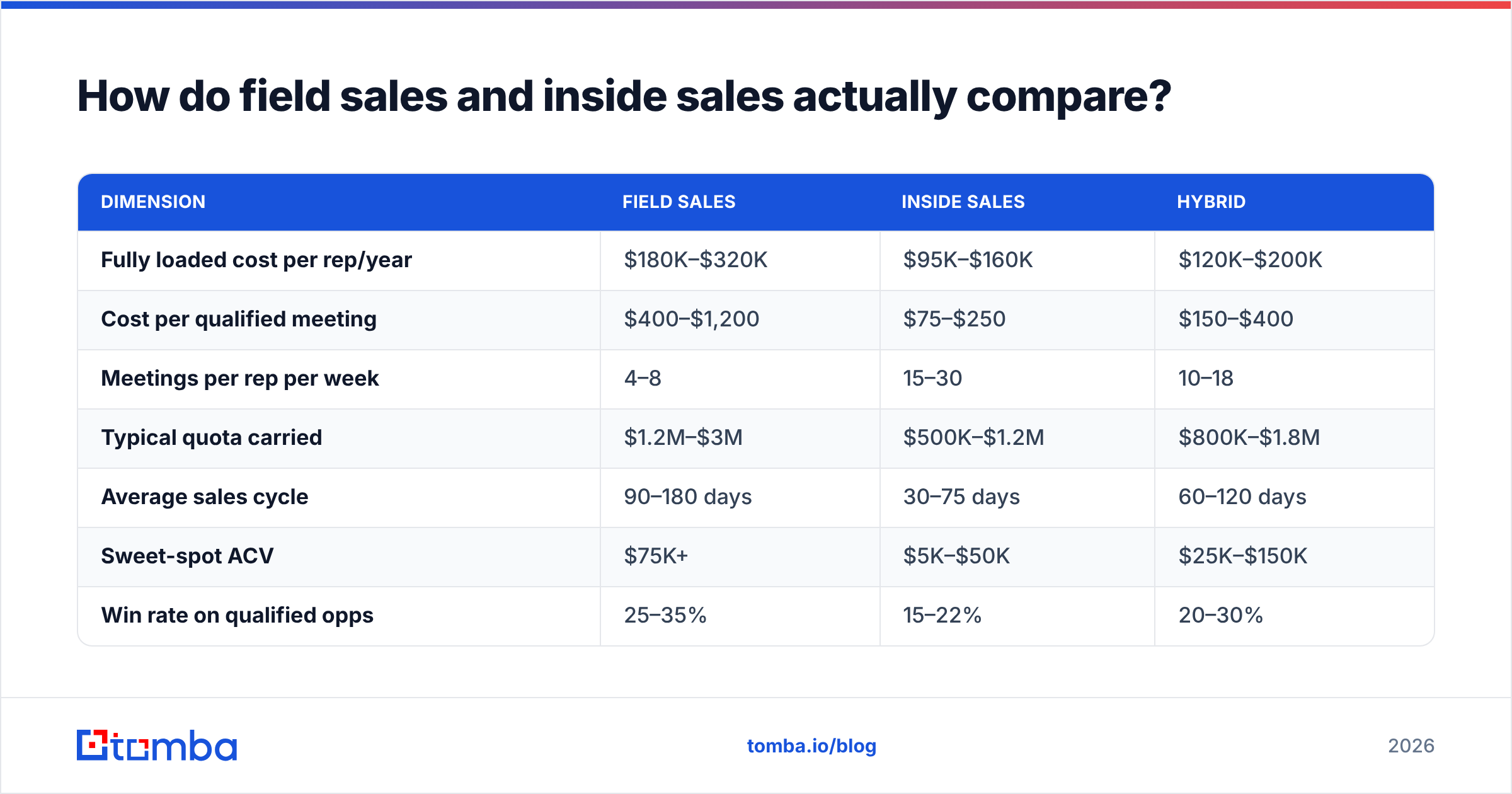
Here is the concrete side-by-side. Figures reflect typical mid-market B2B SaaS and industrial-adjacent orgs in North America; your numbers will shift with vertical and geography, but the ratios hold up remarkably well.
| Dimension | Field Sales | Inside Sales | Hybrid |
|---|---|---|---|
| Fully loaded cost per rep/year | $180K–$320K | $95K–$160K | $120K–$200K |
| Cost per qualified meeting | $400–$1,200 | $75–$250 | $150–$400 |
| Meetings per rep per week | 4–8 | 15–30 | 10–18 |
| Typical quota carried | $1.2M–$3M | $500K–$1.2M | $800K–$1.8M |
| Average sales cycle | 90–180 days | 30–75 days | 60–120 days |
| Sweet-spot ACV | $75K+ | $5K–$50K | $25K–$150K |
| Win rate on qualified opps | 25–35% | 15–22% | 20–30% |
| Ramp time to full productivity | 6–9 months | 3–5 months | 4–6 months |
| Territory coverage per rep | 1 metro / region | National or global | Region + remote overflow |
Two things jump out.
First, field reps win more of what they touch. That 25–35% win rate is not a fluke — physical presence creates commitment, surfaces objections earlier, and gets you in front of the people who don't answer cold calls. Gartner's B2B buying research has consistently found that complex purchases involve 6–10 stakeholders, and getting all of them in a room is still easier in a room.
Second, field reps are wildly more expensive per unit of activity. A field rep costs about 2x an inside rep but produces about a quarter of the meetings. That's an 8x difference in cost per meeting, offset by roughly a 1.6x better win rate and a 2.5x bigger deal. Do that arithmetic and you get the threshold everyone keeps rediscovering.
What's the break-even ACV between the two models?#
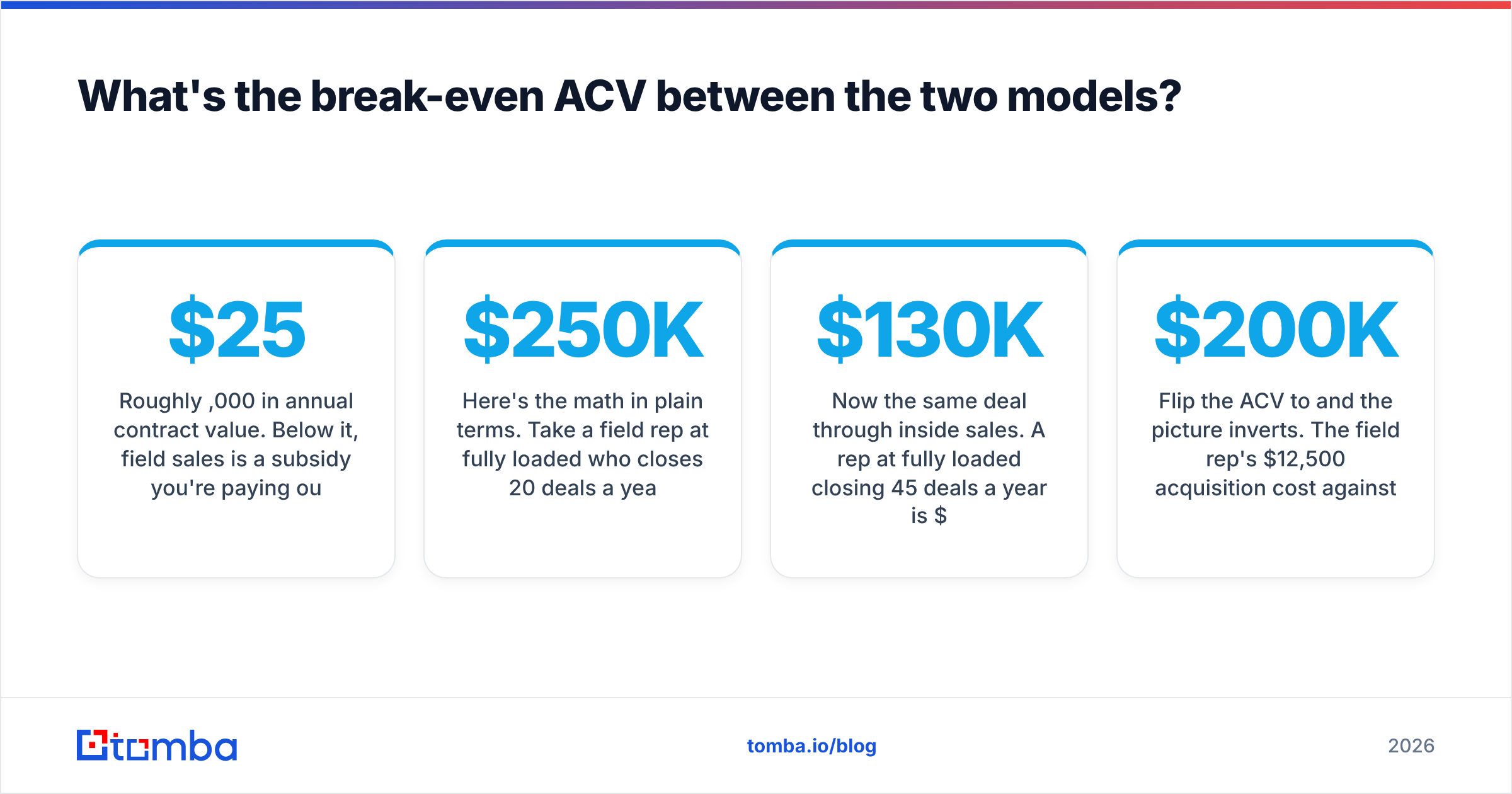
Roughly $25,000 in annual contract value. Below it, field sales is a subsidy you're paying out of gross margin.
Here's the math in plain terms. Take a field rep at $250K fully loaded who closes 20 deals a year. That's $12,500 of sales cost per closed deal before commission accelerators. If your ACV is $20K with a 70% gross margin, you're netting $14K per deal and spending $12,500 to get it. You are running a very sophisticated break-even charity.
Now the same deal through inside sales. A rep at $130K fully loaded closing 45 deals a year is $2,900 per deal. Same $14K of gross profit. That model funds itself with room to reinvest.
Flip the ACV to $200K and the picture inverts. The field rep's $12,500 acquisition cost against $140K of gross profit is trivial, and the 10-point win-rate advantage is worth far more than the travel budget. Sending an inside rep against a $200K committee purchase and hoping video calls carry it is how you lose to the competitor who showed up.
The four questions that actually decide your model:
- What is your median ACV, not your average? Averages get distorted by one whale. If your median deal is $18K and your average is $60K, you have an inside-sales business with a small field overlay — not a field-sales business.
- How many stakeholders sign off? One or two decision-makers is remote-closeable. Six-plus with procurement and security review usually needs someone physically credible.
- Is the product demonstrable remotely? Software: yes. Anything involving a factory floor, a physical install, or a regulated site audit: no.
- How concentrated is your TAM geographically? If 60% of your buyers sit in three metros, field economics improve dramatically because windshield time collapses. If they're spread across 40 states, inside sales wins on coverage alone.
- What is your competitor doing? If every competitor sends a VP on-site for deals your size, remote-only is a structural disadvantage regardless of your spreadsheet.
- Can you fund the ramp? Field reps take 6–9 months to produce. If your runway can't absorb three quarters of near-zero output, the model choice is made for you.
Is inside sales just cheaper field sales?#
No — and treating it that way is the most common structural mistake in B2B sales orgs.
Inside sales is a different information-gathering strategy, not a discount version of the same one. A field rep learns things nobody would type into a CRM: which VP actually controls the budget, whether the "current solution" is a spreadsheet held together by one analyst, whether the champion is job-hunting. That intelligence is why win rates are higher.
Inside sales substitutes breadth for depth. Instead of one rep learning everything about ten accounts, you have one rep learning enough about two hundred. That works when your product is standardized, your buyer persona is consistent, and your qualification criteria can be reduced to firmographic and behavioral signals.
The failure mode is running inside sales with field-sales expectations — asking a remote rep to navigate a nine-person buying committee on a 120-day cycle while also making 60 dials a day. You get neither depth nor volume. Pick a lane per segment, and staff it honestly.
The second failure mode is the reverse: field reps doing their own prospecting. A $250K/year rep spending 11 hours a week researching contacts is $30K of annual payroll spent on work an SDR plus a decent email finder does better and faster. HubSpot's sales research has repeatedly shown reps spend roughly a third of their week on non-selling activity. For field reps, that third is the most expensive third in the company.
What does the hybrid model look like in practice?#
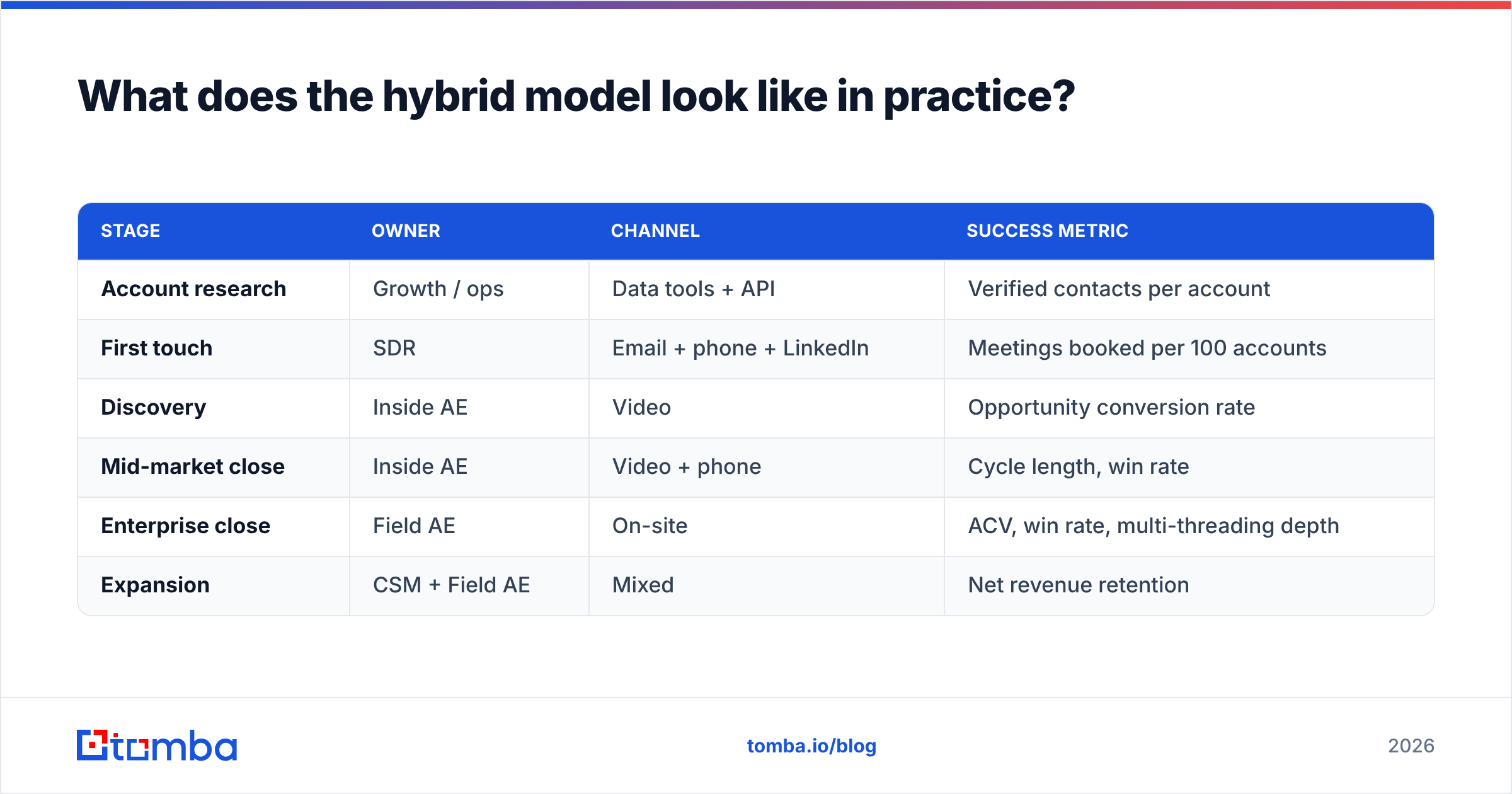
The structure that keeps winning in 2026 is a three-layer split, not a binary choice.
Layer 1 — Remote sourcing. SDRs or a growth team build and qualify the list. Nobody flies anywhere. This is where data enrichment and verification do the heavy lifting: firmographics, tech stack, hiring signals, verified contact details. Cost per qualified account here should be under $50.
Layer 2 — Remote qualification and mid-market close. Inside AEs run discovery and close everything below your field threshold. Roughly 70–80% of your logo count closes here, representing maybe 35–45% of revenue.
Layer 3 — Field close on the top decile. Named accounts, strategic deals, competitive displacements, and renewals above a revenue floor get an on-site motion. Small headcount, large quota, high win rate.
| Stage | Owner | Channel | Success metric |
|---|---|---|---|
| Account research | Growth / ops | Data tools + API | Verified contacts per account |
| First touch | SDR | Email + phone + LinkedIn | Meetings booked per 100 accounts |
| Discovery | Inside AE | Video | Opportunity conversion rate |
| Mid-market close | Inside AE | Video + phone | Cycle length, win rate |
| Enterprise close | Field AE | On-site | ACV, win rate, multi-threading depth |
| Expansion | CSM + Field AE | Mixed | Net revenue retention |
The clean part of this structure is that the expensive resource only touches deals whose size justifies it. The messy part is the handoff — a field rep who inherits a poorly qualified opportunity and flies out for it will (correctly) stop trusting the pipeline within two quarters.
Where do both models break down?#
Contact data. Every time.
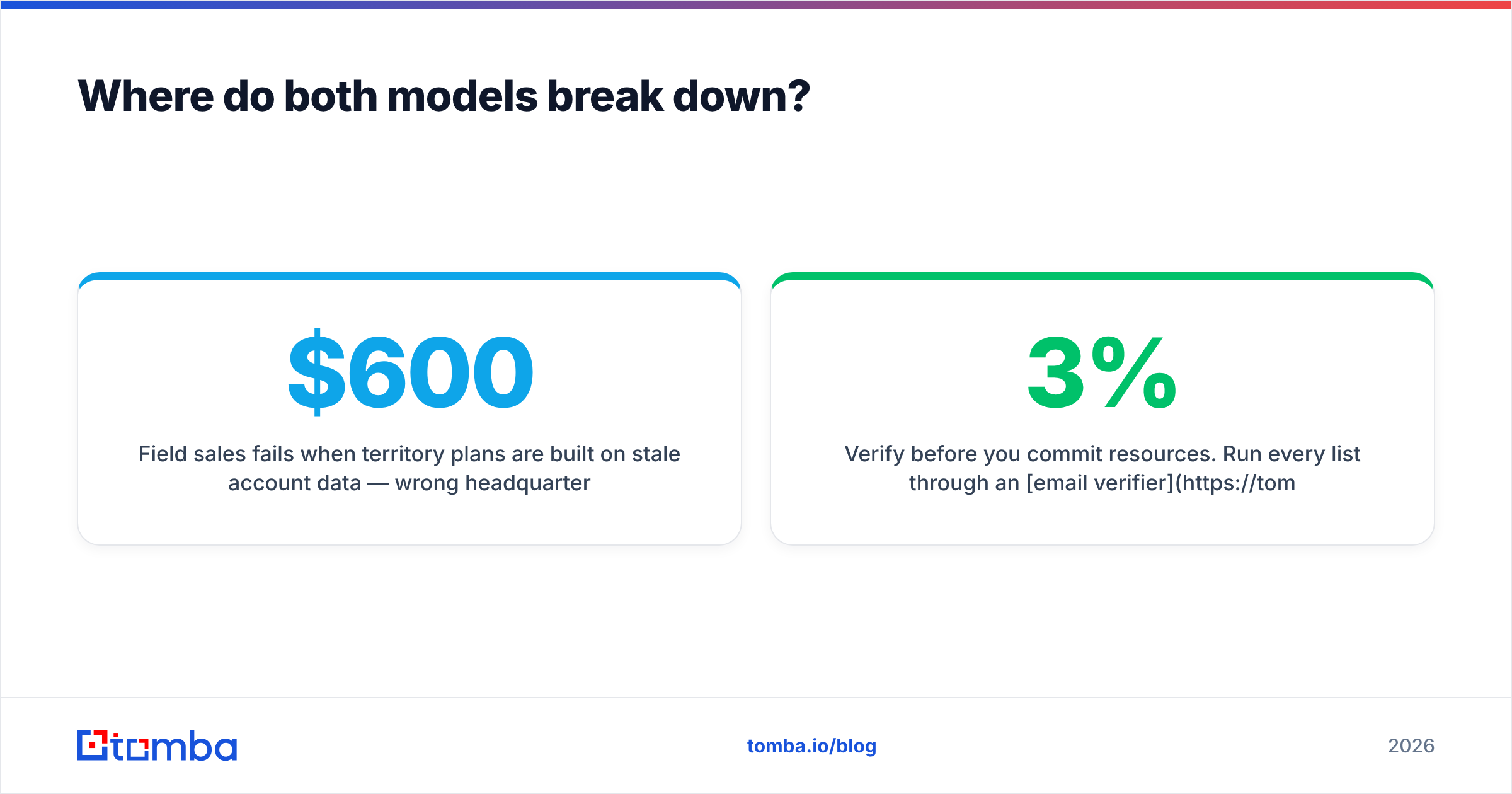
Field sales fails when territory plans are built on stale account data — wrong headquarters, an acquired company, a decision-maker who left 14 months ago. The rep discovers this after burning a day and $600. Inside sales fails the same way but silently: bounced emails quietly wreck sender reputation, and by the time you notice, your whole domain is landing in spam.
The tell is identical in both models — pipeline that looks healthy in the CRM and converts terribly in reality.
Concrete fixes that apply to both:
- Verify before you commit resources. Run every list through an email verifier before an SDR touches it, and confirm the account's current entity status before a field rep books travel. Bounce rates above 3% are a five-alarm signal, not a rounding error.
- Multi-thread from day one. Use domain search to map an account's full contact surface rather than betting the deal on one champion. Single-threaded enterprise deals lose at roughly double the rate of multi-threaded ones.
- Route by data quality, not just by size. If you have four verified contacts and a confirmed tech-stack signal, that account is field-ready. One unverified generic inbox is not a reason to book a flight.
- Instrument cost per meeting per model. Most orgs track cost per lead and cost per acquisition but skip the middle. Cost per qualified meeting, split by model, is the number that tells you whether your field team is a profit center or a legacy habit.
- Kill the vanity territory. If a field territory has produced under 1.2x its fully loaded cost for three consecutive quarters, it's an inside-sales territory with a company car attached.
For teams evaluating vendors on the data layer, it's worth comparing coverage models honestly — providers like BookYourData offer strong pre-built contact lists for teams that want volume upfront, while API-first tools suit orgs that enrich continuously inside a CRM workflow. Check current Tomba pricing and per-credit economics against your monthly contact volume before you commit; the right answer depends on whether your list needs are bursty or continuous. Independent review data on G2 is a reasonable sanity check on accuracy claims from any vendor, including this one.
Which model should you pick for 2026?#
Start with your median ACV, then adjust for buying-committee size and geographic concentration. That's the whole decision framework.
- Median ACV under $25K: Inside sales, full stop. Add field only for a named-accounts list you can count on one hand.
- $25K–$75K: Inside-led hybrid. Inside AEs close the bulk; field flies out for competitive deals and multi-year commitments only.
- $75K–$150K: Balanced hybrid. Roughly one field AE per two to three inside AEs, with a hard revenue floor for field involvement.
- $150K+ with 5+ stakeholders: Field-led, but keep a remote SDR layer. Never let a $300K-quota rep build their own lists.
- Physical product, install, or regulated site: Field regardless of ACV — but push everything pre-site-visit onto remote channels to protect field capacity.
One more thing that gets missed: these thresholds move with your gross margin. A 90%-margin software business can afford field sales at lower ACVs than a 40%-margin hardware business. Run the break-even with your own margin, not the industry's.
The models are converging anyway. The field rep of 2026 does discovery over video and travels for the close. The inside rep of 2026 handles deals that would have required a flight in 2015. What hasn't converged is the cost structure — and that's the only part of this decision that's actually quantitative.
Get the contact layer right before you pick a model#
Whichever way you go, both models run on the same fuel: accurate, current, verified contact data for the right people at the right accounts. A field territory plan built on bad data wastes thousands per week in travel. An inside-sales sequence built on bad data wastes your domain reputation, which is harder to buy back.
Tomba's Email Finder gives your team verified professional emails by domain, name, or company — so SDRs stop guessing patterns and field reps stop driving to dead accounts. Start free with 25 searches a month, or move to Starter at $49/mo when you're ready to build territory lists at volume. Growth ($99/mo) and Pro ($249/mo) plans add the bulk and API throughput that hybrid teams need to keep both layers fed.
Pick your sales model on economics. Build it on data you've actually verified.
Related guides#
Ready to find emails that actually work?
Join 150,000+ professionals who stopped guessing and started sending. Free credits on signup — no credit card required.
Get the Tomba newsletter
Practical outbound tactics and product updates — once every two weeks.
About the author