Final Follow Up Email Template: 9 Proven Examples for 2026
The last email in your sequence often outperforms every message before it. Here are nine final follow up email templates, when to send each, and the mistakes that quietly kill your reply rate.
TL;DR
- A final follow-up email is a closing message that gives the prospect a clean exit — and that exit is exactly why it converts. Reps routinely see the last email in a sequence pull 2-3x the reply rate of message three or four.
- The best final follow up email template does three things: names the silence without guilt-tripping, restates one specific value point, and offers a one-word reply option ("no" is a valid answer).
- Nine templates below cover cold outbound, warm inbound, post-demo ghosting, renewal risk, recruiting, and partnership outreach — copy them directly.
- Timing matters more than wording: send the closer 5-9 days after your previous touch, in the morning of the recipient's timezone, from the same thread.
- None of it works if the address is wrong. Verify before you send — a 20%+ bounce rate on a "final" send burns the domain you'll need next quarter.
What is a final follow up email?#
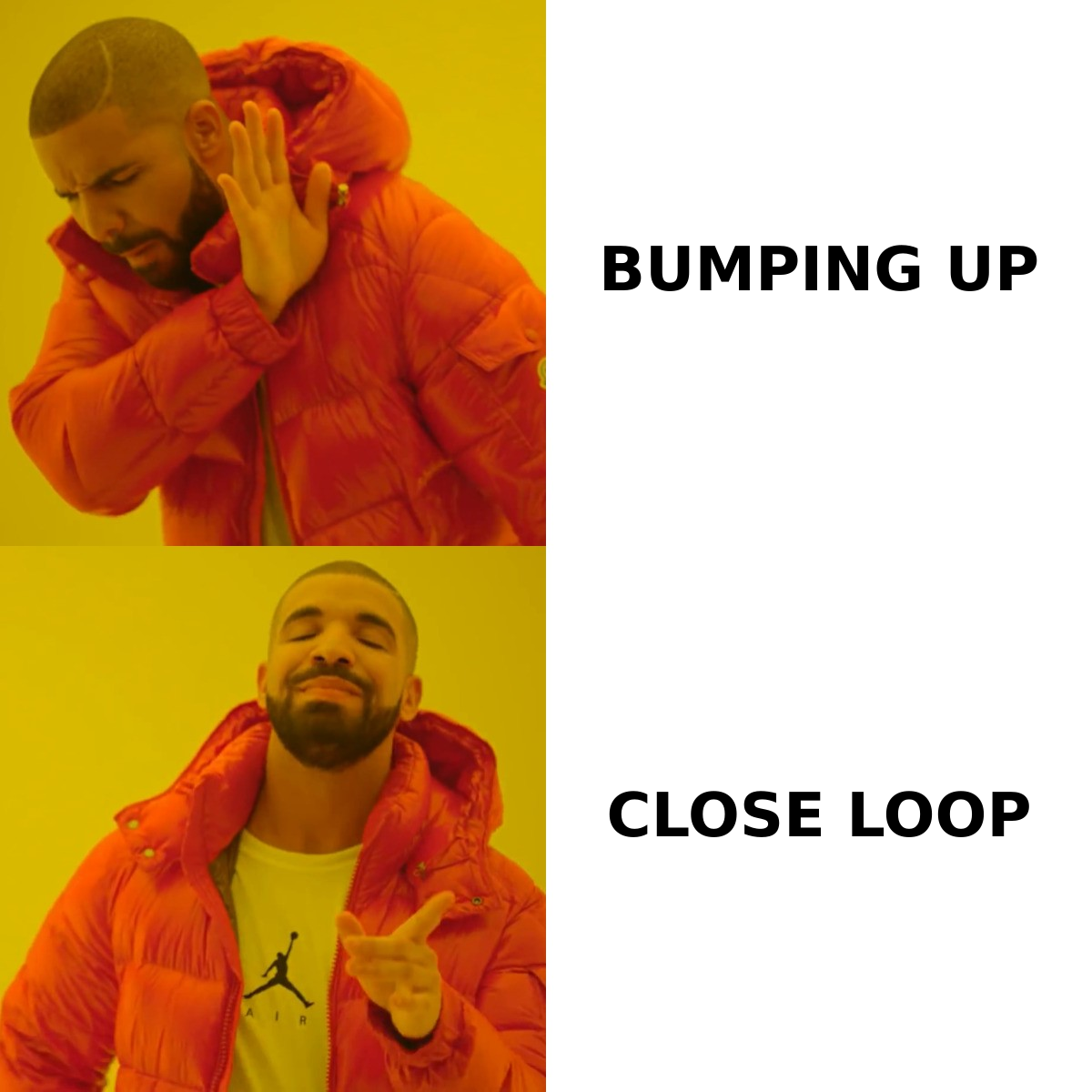
A final follow-up email is the last message in an outreach sequence, sent specifically to close the loop rather than to push for a meeting. Think of it like a restaurant closing the tab at the end of the night: you're not refusing to serve the customer again, you're just clearing the table so both sides know where things stand.
That framing is the whole trick. Every message before the last one asks the prospect to do something. The final one asks them to decide something, and deciding is cheaper than doing. That's why the closer so often outperforms the middle of the sequence.
It also goes by other names — breakup email, closing loop email, permission-to-close. The mechanics are identical.
Why does the last email get the highest reply rate?#
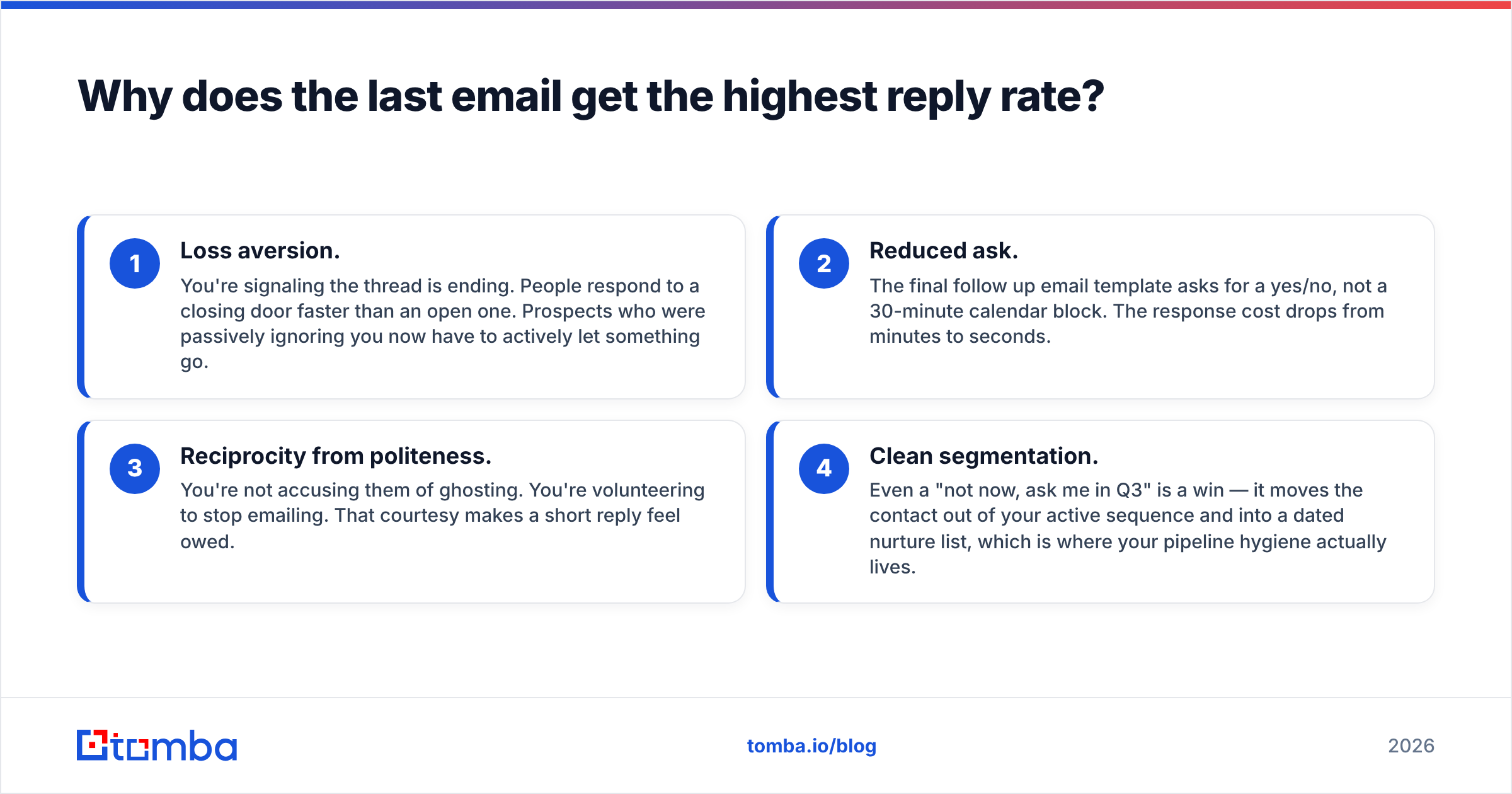
Four psychological levers stack in the final message, and none of them exist in a standard "just checking in" bump:
- Loss aversion. You're signaling the thread is ending. People respond to a closing door faster than an open one. Prospects who were passively ignoring you now have to actively let something go.
- Reduced ask. The final follow up email template asks for a yes/no, not a 30-minute calendar block. The response cost drops from minutes to seconds.
- Reciprocity from politeness. You're not accusing them of ghosting. You're volunteering to stop emailing. That courtesy makes a short reply feel owed.
- Clean segmentation. Even a "not now, ask me in Q3" is a win — it moves the contact out of your active sequence and into a dated nurture list, which is where your pipeline hygiene actually lives.
The failure mode is treating the closer as another guilt trip. "I've reached out three times and haven't heard back" makes the reader the villain. Nobody replies to feel bad.

What should a final follow up email template include?#
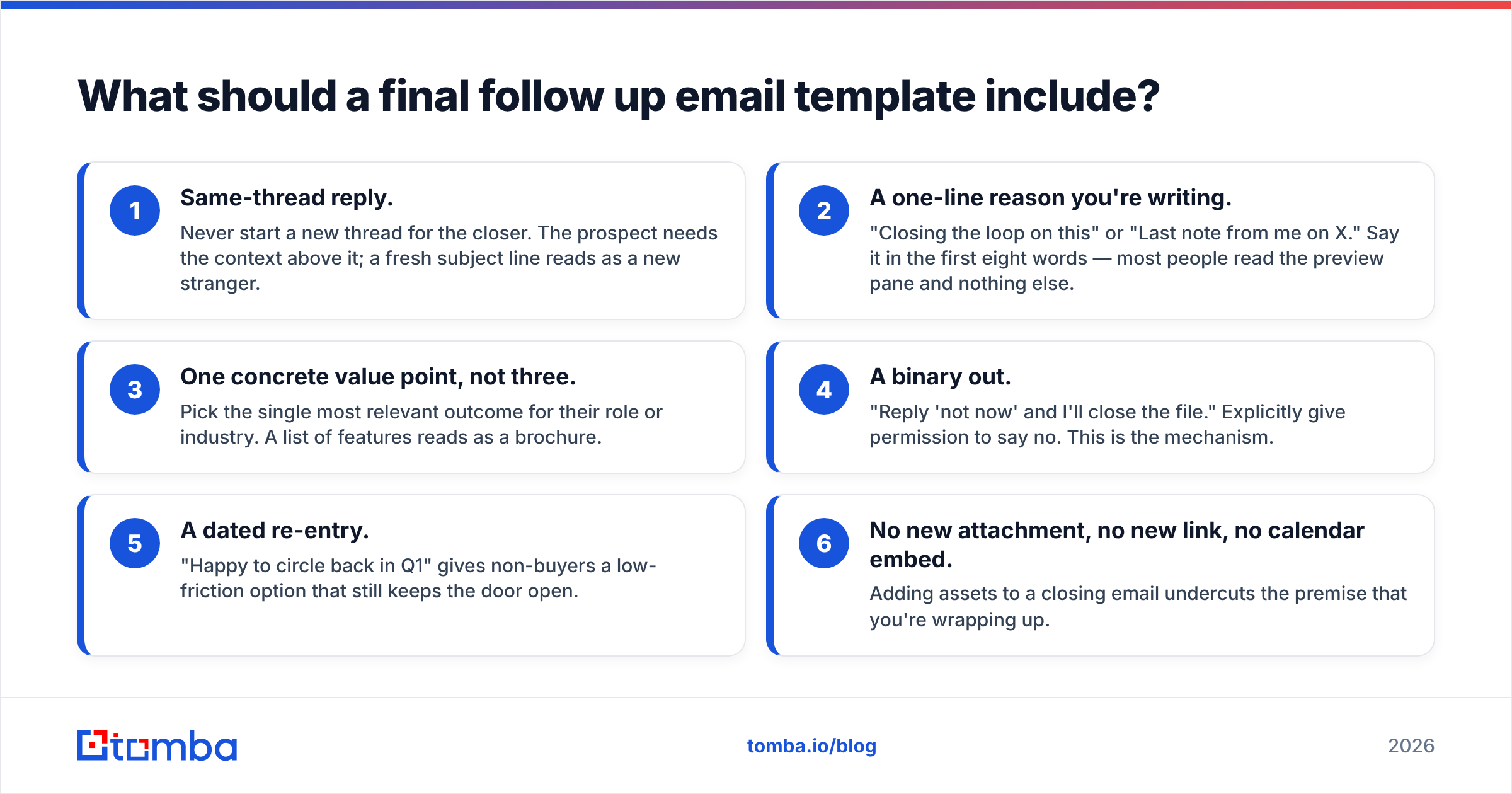
Six components, in this order. Drop any one of them and the reply rate slides.
- Same-thread reply. Never start a new thread for the closer. The prospect needs the context above it; a fresh subject line reads as a new stranger.
- A one-line reason you're writing. "Closing the loop on this" or "Last note from me on X." Say it in the first eight words — most people read the preview pane and nothing else.
- One concrete value point, not three. Pick the single most relevant outcome for their role or industry. A list of features reads as a brochure.
- A binary out. "Reply 'not now' and I'll close the file." Explicitly give permission to say no. This is the mechanism.
- A dated re-entry. "Happy to circle back in Q1" gives non-buyers a low-friction option that still keeps the door open.
- No new attachment, no new link, no calendar embed. Adding assets to a closing email undercuts the premise that you're wrapping up.
Keep the whole thing under 90 words. If your closer needs a scroll, it isn't a closer.
Which final follow up email template fits your situation?#
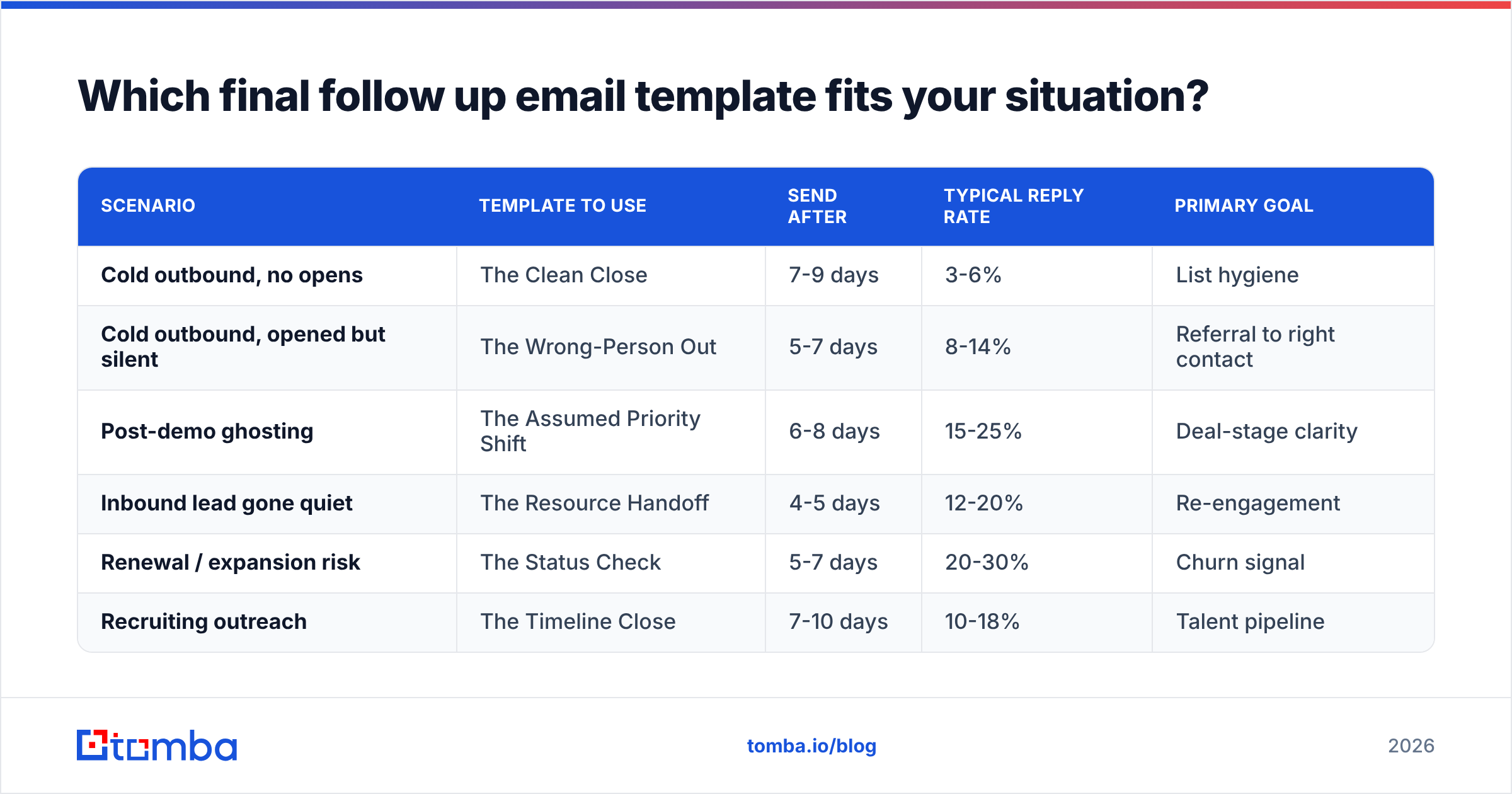
Different silences mean different things. A prospect who never opened anything is not the same as one who sat through a 45-minute demo and vanished. Match the template to the scenario:
| Scenario | Template to use | Send after | Typical reply rate | Primary goal |
|---|---|---|---|---|
| Cold outbound, no opens | The Clean Close | 7-9 days | 3-6% | List hygiene |
| Cold outbound, opened but silent | The Wrong-Person Out | 5-7 days | 8-14% | Referral to right contact |
| Post-demo ghosting | The Assumed Priority Shift | 6-8 days | 15-25% | Deal-stage clarity |
| Inbound lead gone quiet | The Resource Handoff | 4-5 days | 12-20% | Re-engagement |
| Renewal / expansion risk | The Status Check | 5-7 days | 20-30% | Churn signal |
| Recruiting outreach | The Timeline Close | 7-10 days | 10-18% | Talent pipeline |
Reply rates above are directional ranges from typical mid-market B2B sequences, not guarantees. Your own numbers depend on list quality, ICP fit, and how many touches came before. Track your baseline before you judge any template.
What are the nine final follow up email templates?#
Copy these, swap the brackets, and cut anything that sounds like you.
1. The Clean Close (cold outbound)#
Subject: (keep the existing thread subject)
Hi [First name] — closing the loop on this one.
I reached out because [company] is [specific trigger: hiring 12 SDRs / expanding into DACH / switched to HubSpot], and that usually means [specific problem].
If that's not a priority this quarter, just reply "not now" and I'll stop here — no hard feelings.
[Your name]
2. The Wrong-Person Out#
Hi [First name], last note from me.
I may have picked the wrong person — if [problem area] sits with someone else on your team, who should I be talking to?
If it's nobody right now, "nobody" is a perfectly good answer and I'll close the file.
This one has the best hidden ROI: even a one-word referral hands you a warm intro path.
3. The Assumed Priority Shift (post-demo)#
Hi [First name] — I'm assuming [project] slipped down the list, which happens.
Two options: I can put this on ice and check back in [month], or if it's dead, tell me and I'll stop the emails.
Either answer is genuinely useful on my end.
4. The Resource Handoff (inbound gone quiet)#
Hi [First name], you downloaded [asset] a couple of weeks back and I've been noisy since. Wrapping up.
The one thing most people in your seat actually use from it is [specific tactic]. If you try it and hit a wall, reply here anytime — thread stays open on my side.
5. The Status Check (renewal risk)#
Hi [First name] — before I update our notes, is [account] planning to continue with [product] past [renewal date]?
A yes/no is all I need. If there's something we broke, I'd rather hear it now than in the churn report.
6. The Timeline Close (recruiting)#
Hi [First name], I'll stop here on the [role] conversation.
If the timing is wrong but the role is interesting, say "later" and I'll ping you in six months rather than next week.
7. The One-Metric Close#
Hi [First name] — one number then I'll go: teams like [comparable company] cut [metric] by [X%] in [timeframe] after [change].
If that number isn't interesting, this isn't a fit and I'll close it out.
Use this when your product has a defensible, specific proof point. Never invent the number.
8. The Honest Admin Close#
Hi [First name], my CRM is telling me to close this out. Before I do — is this a "no," or a "not yet"?
Reply with either word and I'll do the right thing.
Blunt, faintly funny, and works well with technical buyers who dislike sales theater.
9. The Partnership Close#
Hi [First name] — wrapping up on the [partnership idea].
If co-marketing isn't on your roadmap this half, no problem. If it is but the timing's off, tell me the quarter and I'll come back then with something specific.
When should you send the final follow-up?#
Gap timing beats clever copy. Three rules:
- 5-9 days after the previous touch. Shorter than five days reads as pestering; longer than nine and the thread has gone cold enough that they've forgotten the context.
- Tuesday through Thursday, 7-9am local to the recipient. Not your timezone. If you're prospecting across regions, your sequencing tool should be handling this — if it isn't, that's a bigger problem than your template.
- Never on the same day as a marketing send to the same contact. Two emails from one company on one morning is how you get filtered, not how you get a reply.
On sequence length: four to six touches before the closer is the sane range for cold outbound in 2026. Past that you're not persistent, you're just training people to archive on sight. HubSpot's sales research library and vendor category data on G2's sales engagement listings both point at the same directional finding — reply rates flatten hard after touch six.
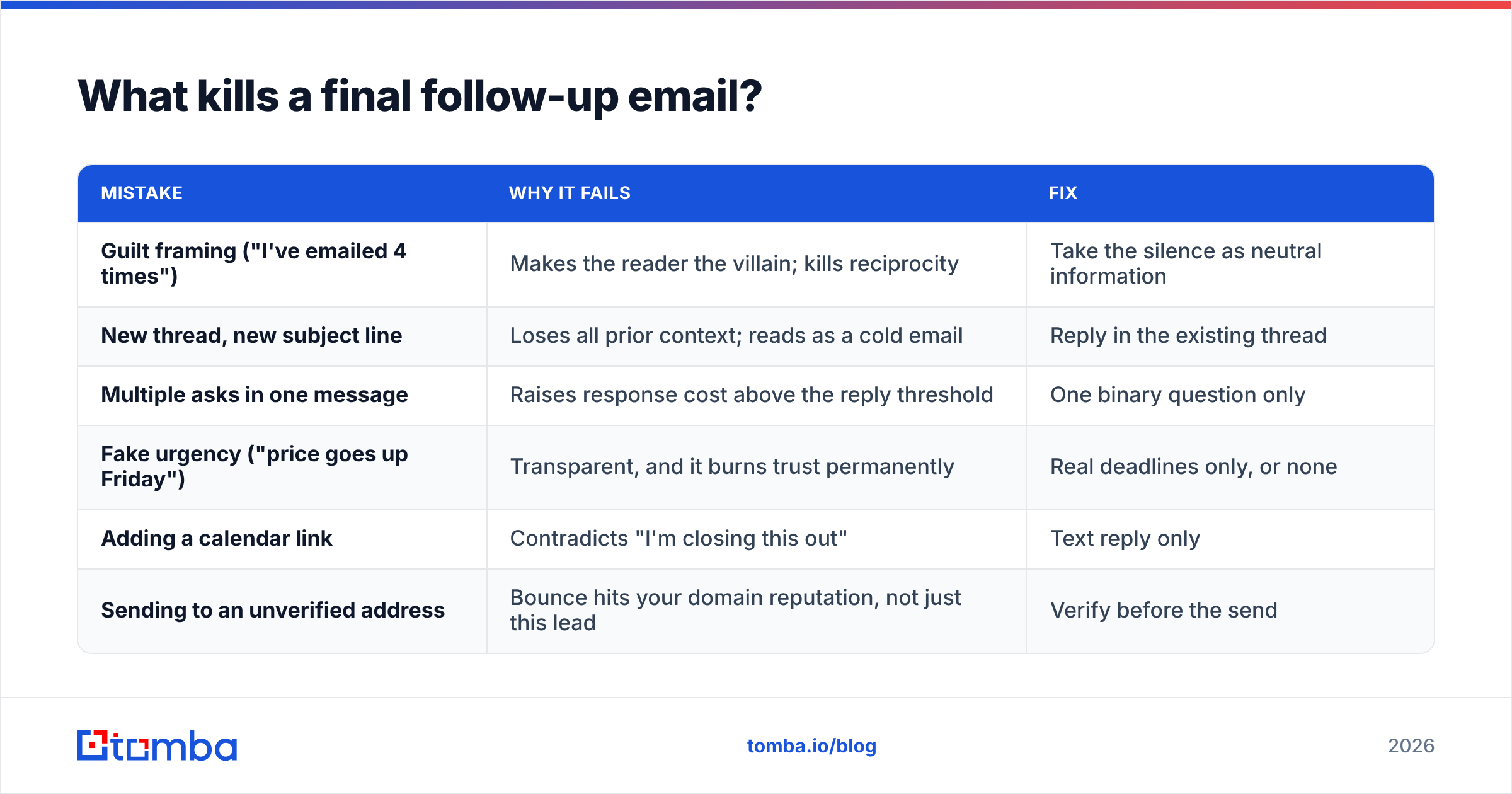
What kills a final follow-up email?#
Ranked by how much damage each does:
| Mistake | Why it fails | Fix |
|---|---|---|
| Guilt framing ("I've emailed 4 times") | Makes the reader the villain; kills reciprocity | Take the silence as neutral information |
| New thread, new subject line | Loses all prior context; reads as a cold email | Reply in the existing thread |
| Multiple asks in one message | Raises response cost above the reply threshold | One binary question only |
| Fake urgency ("price goes up Friday") | Transparent, and it burns trust permanently | Real deadlines only, or none |
| Adding a calendar link | Contradicts "I'm closing this out" | Text reply only |
| Sending to an unverified address | Bounce hits your domain reputation, not just this lead | Verify before the send |
That last one is the sleeper. Reps obsess over subject lines while sending closers to addresses that stopped existing six months ago. A sender reputation hit from a high-bounce send degrades every campaign that follows it, including the ones with perfect copy.
How do you make sure the final email actually arrives?#
Three checks, in order, and none of them are optional if you're sending at volume:
- Validate the address before the closer goes out. Contacts change jobs constantly; an address that verified in January may be dead by August. Run the list through an email verifier before the last send in any sequence — it's the send most likely to hit a stale record, because it's furthest from the day you built the list.
- Test the copy for spam triggers. "Last chance," "act now," and heavy link density in a short email are a bad combination. A quick pass through a spam checker catches most of it.
- Check the subject line if you're forced to start a new thread. You shouldn't be, but if the original thread is genuinely unrecoverable, run the replacement through a subject line tester rather than guessing.
If you'd rather start from a library than a blank page, the cold email templates collection covers the earlier messages in the sequence — the ones that determine whether your closer has anything to close.
For teams evaluating where their contact data comes from in the first place, it's worth reading vendor documentation directly and comparing methodology; Gartner's sales research is a reasonable neutral starting point for the buying-committee context that shapes how many touches you actually need.
Frequently asked questions#
Should the final follow-up email have a subject line change? No. Reply in-thread and keep the original subject. Changing it strips the context that makes the closer work and resets the conversation to zero.
Is "breakup email" the same as a final follow-up? Effectively yes, though the tone differs. "Breakup" framing tends to be more dramatic ("I guess this isn't meant to be"), which reads as performative to senior buyers. The neutral close outperforms it in most B2B contexts.
How many times can I send a final follow-up? Once. If you send a "last email" and then keep emailing, every future closer you write is worthless — you've taught the contact that your closing signal is fake.
What if they reply "not now"? That's a win. Tag it, set a dated re-entry, and stop. Re-engaging a "not now" at the date they specified converts far better than a fresh cold sequence to the same person.
Ready to send closers that actually land?#
Great copy sent to a dead inbox is worth exactly zero. Before you queue your next sequence — and especially before the final message in it — build the list from verified, current data instead of a spreadsheet someone exported last year.
Tomba's Email Finder finds professional email addresses by domain, name, or company, and pairs with real-time verification so your closer reaches a human. Start on the free tier (25 searches/month) to test your list quality, then scale on the Starter plan at $49/month when the numbers hold up. Full Tomba pricing is public — no sales call required to see it.
Related guides#
Ready to find emails that actually work?
Join 150,000+ professionals who stopped guessing and started sending. Free credits on signup — no credit card required.
Get the Tomba newsletter
Practical outbound tactics and product updates — once every two weeks.
About the author