11 Best FinalScout Alternatives in 2026 (Free & Paid)
FinalScout's ChatGPT-powered LinkedIn email extraction is convenient, but credits burn fast and coverage varies by region. Here are 11 alternatives tested on cost, accuracy, and API depth.
TL;DR
- FinalScout is a LinkedIn-first email finder with an AI writing layer. It works, but you pay per verified email and the free tier (usually a handful of credits) runs out in one prospecting session.
- If your workflow is domain-first rather than profile-first, a general email finder with an API — like Tomba, Hunter, or Findymail — is cheaper per usable contact.
- If you need LinkedIn Sales Navigator list exports at volume, Wiza and Evaboot are the closer replacements.
- The single biggest cost lever is not price per credit. It's how many credits get spent on emails that bounce.
- Best all-round swap for most teams in 2026: a verified email finder with a real API and a free tier you can actually test on.
What is FinalScout and why do people look for alternatives?#
FinalScout is a Chrome extension and web app that pulls email addresses from LinkedIn profiles, search results, groups, and event attendee lists, then layers on ChatGPT-generated outreach copy. Its pitch is "find the email and write the email in one place." For a solo founder doing 50 profiles a week, that's genuinely convenient.
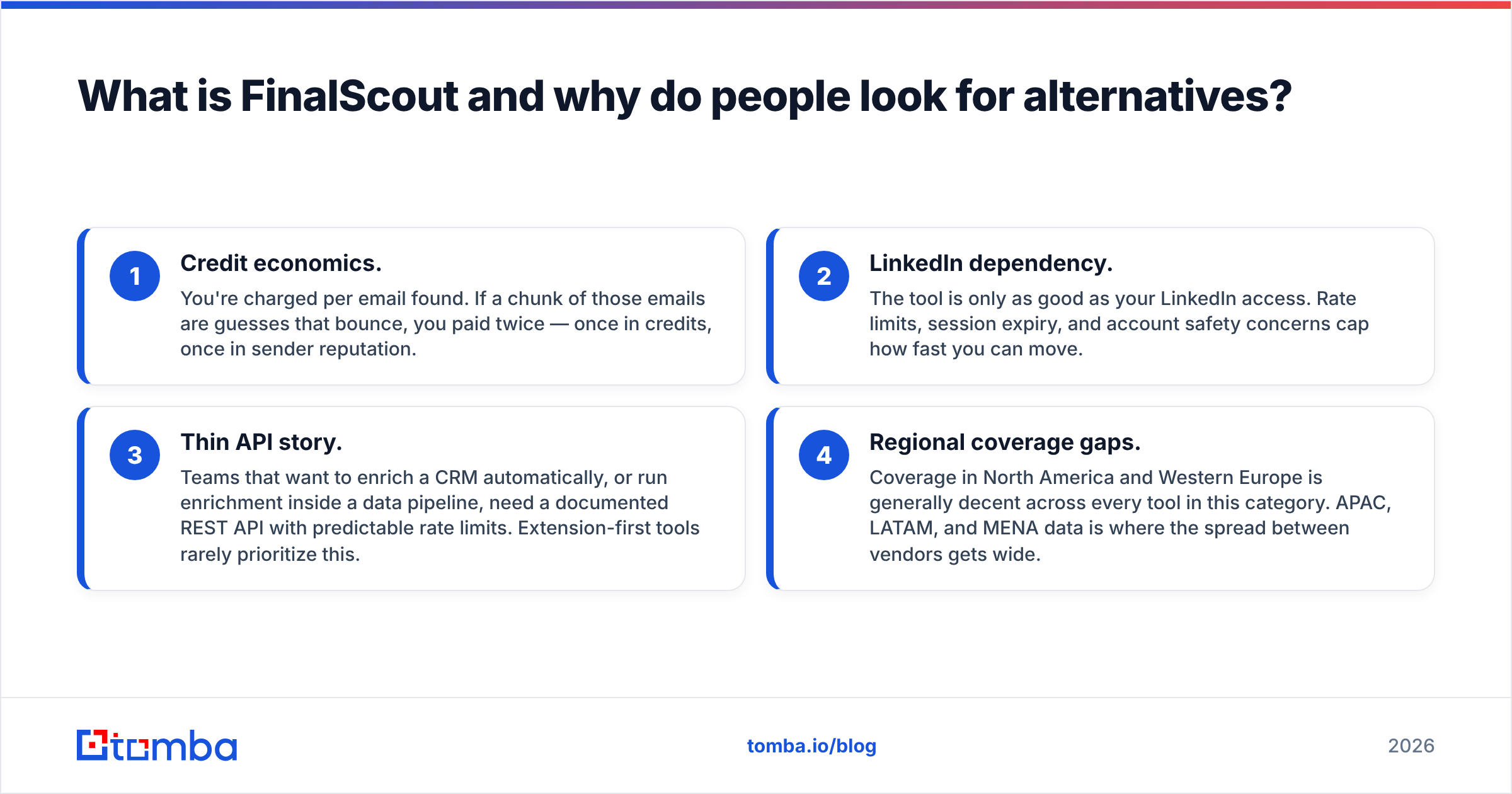
The friction shows up at scale, and it's almost always one of these four things:
- Credit economics. You're charged per email found. If a chunk of those emails are guesses that bounce, you paid twice — once in credits, once in sender reputation.
- LinkedIn dependency. The tool is only as good as your LinkedIn access. Rate limits, session expiry, and account safety concerns cap how fast you can move.
- Thin API story. Teams that want to enrich a CRM automatically, or run enrichment inside a data pipeline, need a documented REST API with predictable rate limits. Extension-first tools rarely prioritize this.
- Regional coverage gaps. Coverage in North America and Western Europe is generally decent across every tool in this category. APAC, LATAM, and MENA data is where the spread between vendors gets wide.
If any of those four apply to you, the alternatives below are worth a real trial — not a demo, a trial with your own list.
How should you evaluate a FinalScout alternative?#
Do not start from the pricing page. Start from your workflow. Four questions, in order:
- Where does your list come from? If it's a LinkedIn Sales Navigator search, you want a Sales Nav exporter. If it's a list of company domains from a funding database or a conference sponsor page, you want a domain search tool. These are different products, and buying the wrong one is the most common mistake.
- Do you need verification bundled or separate? Some tools return "found" emails without SMTP-level validation. You then pay a second vendor to verify. Bundled verification is usually cheaper end to end.
- Do you need an API? If enrichment needs to happen without a human clicking a button — on form submit, on CRM record creation, on a nightly job — the API is not optional. Check for documented rate limits and an official SDK, not just a webhook.
- What's the real cost per usable contact? Take the plan price, divide by credits, then divide by your observed valid rate. A $49 plan at 85% validity beats a $29 plan at 55% validity every single time.
Run that math before you look at a single feature grid.
Which FinalScout alternatives are worth testing in 2026?#
Here's the shortlist, grouped by what they're actually good at.
Domain-first email finders (best for account-based prospecting)
- Tomba — Domain search, single email finder, bundled verification, and a documented REST API. Free tier is 25 searches/month; paid starts at $49/mo. Strong fit when you already have a target account list.
- Hunter — The category veteran. Clean UI, solid domain search, good Google Sheets add-on. Pricier at volume than newer entrants.
- Findymail — Built for cold email operators, with a strong "no bounce" positioning and native Lemlist/Instantly integrations.
LinkedIn / Sales Navigator exporters (closest to FinalScout's core job)
- Wiza — The most direct functional replacement. Exports Sales Navigator lists with verified emails and phones.
- Evaboot — Cleans and exports Sales Nav searches, filters out false-positive matches from LinkedIn's own filters.
- ContactOut — Extension-heavy, strong personal-email coverage, popular with recruiters.
All-in-one sales platforms (data + sequencing in one bill)
- Apollo.io — Huge contact database plus sequencing and dialer. Great value if you'll actually use the sequencer; overkill if you just need emails.
- Lusha — Clean data, strong on direct dials, EU-friendly compliance posture.
Verification-first tools (pair with any finder)
- ZeroBounce, Bouncer, NeverBounce — These don't find emails, they validate lists. Worth pairing if your finder doesn't bundle verification.
B2B database purchase (buy the list outright)
- BookYourData — A pay-as-you-go B2B contact database with an accuracy guarantee. Different model entirely: you filter and buy contacts rather than look them up one at a time. Genuinely useful when you need 5,000 contacts in a defined ICP today and don't want to run a lookup loop.
How do the top FinalScout alternatives compare on price and features?#
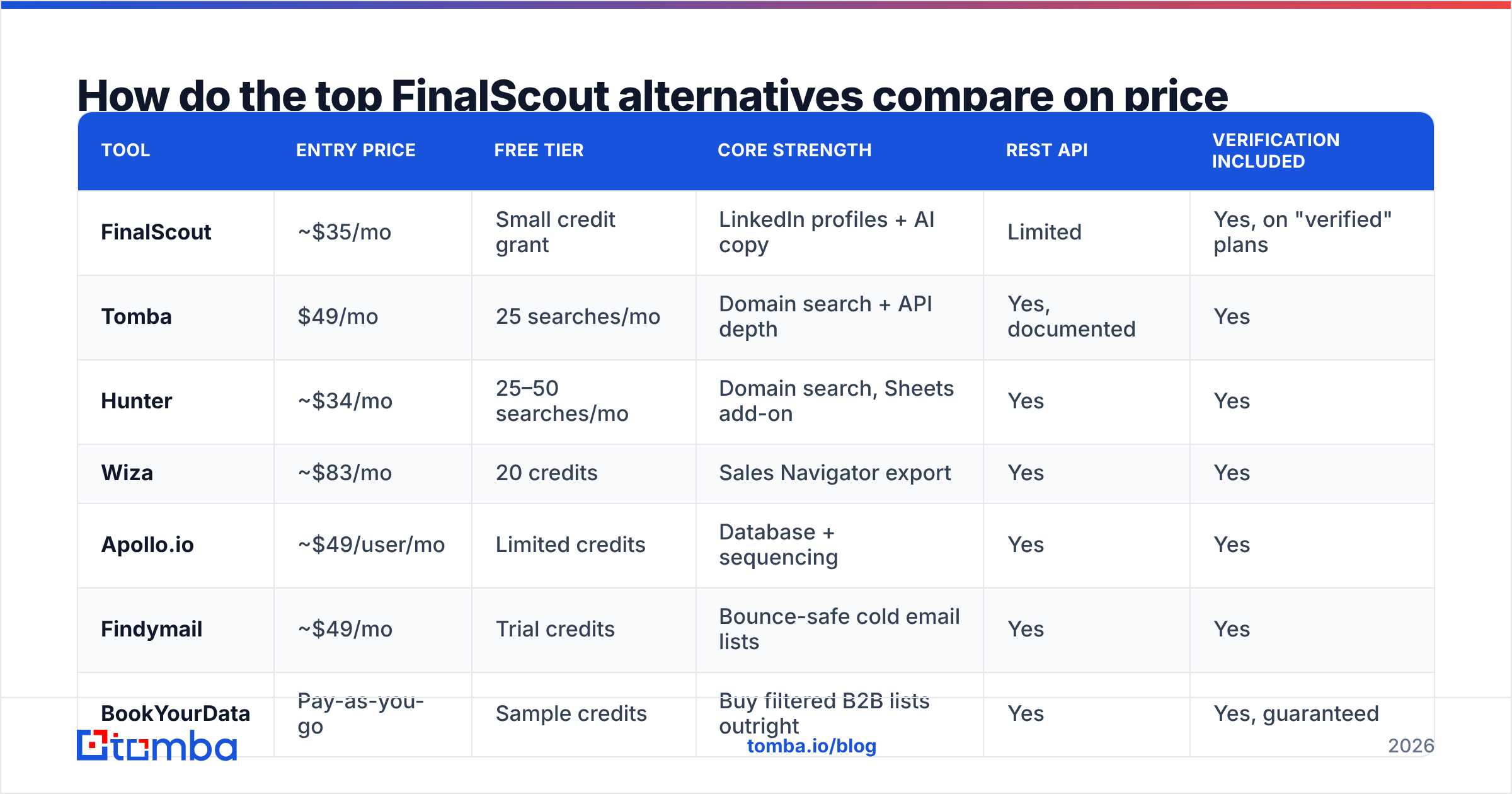
| Tool | Entry price | Free tier | Core strength | REST API | Verification included |
|---|---|---|---|---|---|
| FinalScout | ~$35/mo | Small credit grant | LinkedIn profiles + AI copy | Limited | Yes, on "verified" plans |
| Tomba | $49/mo | 25 searches/mo | Domain search + API depth | Yes, documented | Yes |
| Hunter | ~$34/mo | 25–50 searches/mo | Domain search, Sheets add-on | Yes | Yes |
| Wiza | ~$83/mo | 20 credits | Sales Navigator export | Yes | Yes |
| Apollo.io | ~$49/user/mo | Limited credits | Database + sequencing | Yes | Yes |
| Findymail | ~$49/mo | Trial credits | Bounce-safe cold email lists | Yes | Yes |
| BookYourData | Pay-as-you-go | Sample credits | Buy filtered B2B lists outright | Yes | Yes, guaranteed |
| ContactOut | ~$49/mo | 20/mo | Personal emails, recruiting | Yes (higher tiers) | Partial |
Prices move. Always confirm against the vendor's own page before you commit — Hunter, Apollo, and Wiza all list current tiers publicly, and Tomba pricing runs Free (25 searches), Starter $49/mo, Growth $99/mo, Pro $249/mo, and custom Enterprise.
Why does accuracy matter more than price per credit?#
Because a wrong email costs you three times.
First, the credit itself. Second, the bounce, which drags your domain's sender reputation down and pushes future sends toward spam. Third, the opportunity cost — that prospect is now unreachable from that domain for the rest of the quarter.
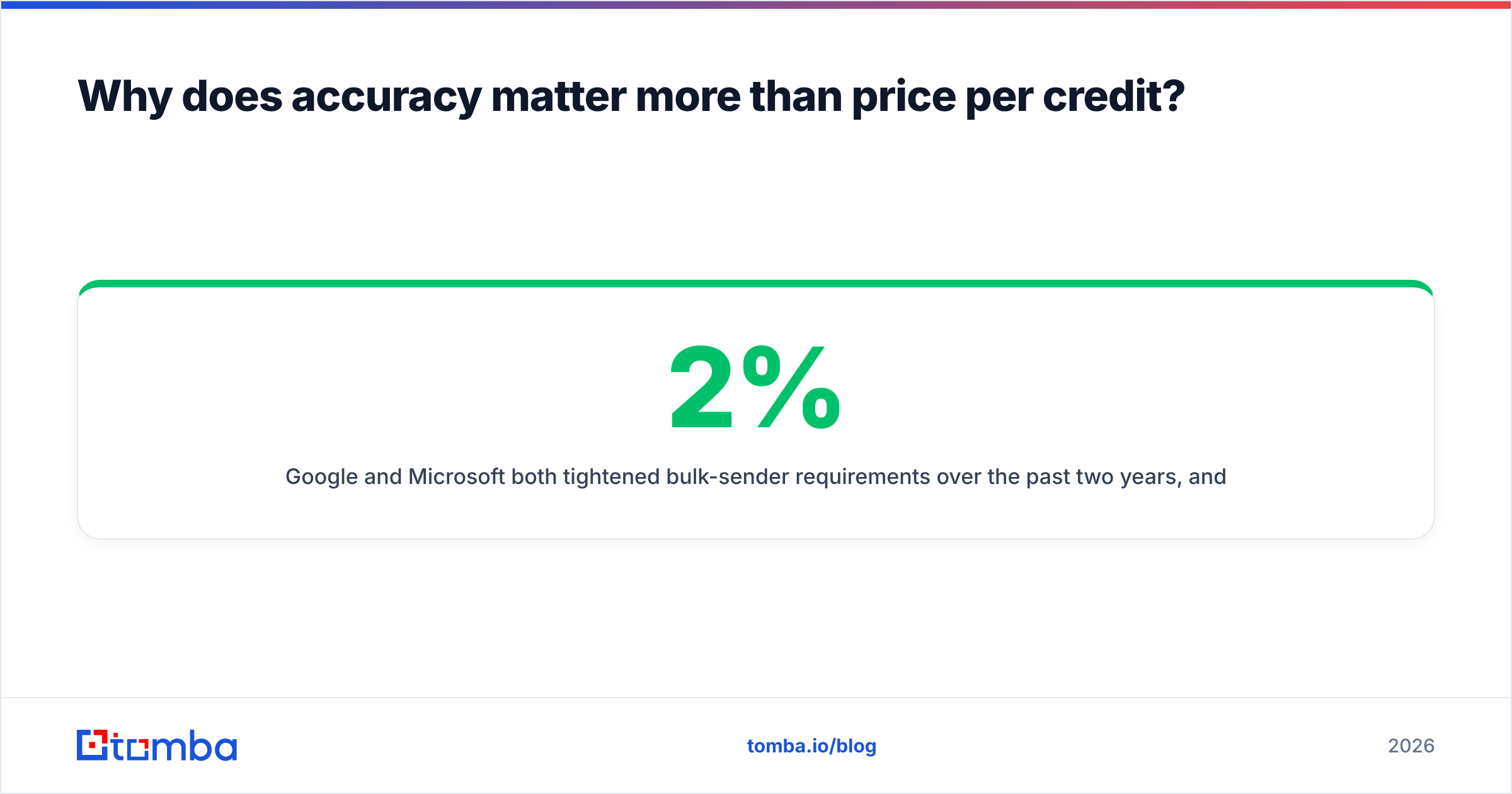
Google and Microsoft both tightened bulk-sender requirements over the past two years, and the practical threshold most operators now target is a bounce rate under 2%. Google's own sender guidelines spell out the spam-rate thresholds that trigger throttling. A finder that returns 1,000 "emails" with a 70% validity rate hands you a 30% bounce rate if you send blind — roughly fifteen times over the line.

The defensive move is simple and it applies no matter which tool you pick: run every list through an email verifier before it touches your sequencer. If your finder bundles verification, confirm it's doing real SMTP checks and not just syntax and MX-record validation. Those are not the same thing, and vendors are frequently vague about which one they run.
Catch-all domains are the other trap. A catch-all server accepts mail for every address, so standard verification returns "valid" for addresses that don't exist. If a meaningful slice of your ICP sits on catch-all domains — common in enterprise and in EU mid-market — you need a dedicated catch-all verifier rather than a generic pass/fail check.

Which alternative fits your specific use case?#
You're a solo founder doing manual, high-intent outreach. Stay close to FinalScout's model but check the free tiers first. Tomba's 25 free searches/month and Hunter's free tier both let you validate coverage on your actual ICP before paying anything. Test the same 20 target companies in each and count usable results.
You run outbound for a team of 3–15 reps. You need seats, an API, and predictable per-contact economics. Domain-first finders win here because your list-building is account-based, not profile-based. Pull the full contact map for each target domain in one call rather than clicking through profiles. A bulk email finder turns a 500-domain list into a contact table in one job.
You live inside Sales Navigator. Wiza or Evaboot. Nothing else replicates the export-a-saved-search workflow as cleanly. Budget for a separate verifier if their bundled validation doesn't hit your bounce threshold.
You're a recruiter. ContactOut and Lusha skew toward personal emails and mobile numbers, which matters more in recruiting than in B2B sales. Pair with a phone finder if direct dials are the bottleneck.
You're building a product or internal tool. API quality is the entire decision. Look for documented rate limits, official SDKs, sane error codes, and a sandbox. The Tomba API covers finder, verifier, domain search, and enrichment through one key, which keeps your integration surface small.
You need volume now, not a lookup loop. BookYourData's pay-as-you-go database model is the right shape when you need thousands of filtered contacts immediately and the per-lookup approach would take days.
What do you lose when you leave FinalScout?#
Be honest about the trade-offs. Two things you'll likely give up:
- The bundled AI copywriter. FinalScout writes the outreach for you. Most pure finders don't. That said, this is easy to replace — a cold email AI writer or your sequencer's built-in generator covers it, and decoupling copy from data usually produces better copy anyway because you're not constrained by one vendor's prompt.
- Profile-level context. Extension-based tools show you the profile and the email side by side. Domain-first tools give you a contact table with less individual context. If your personalization depends on reading each profile, factor that back in — or use a LinkedIn finder to bridge profile URLs to verified emails while keeping your main workflow domain-based.
What you gain is usually worth it: lower cost per usable contact, an API you can automate against, and independence from LinkedIn's rate limits.
How do you migrate without breaking your pipeline?#
Run both tools in parallel for two weeks. Don't cut over cold.
- Build a benchmark list. 100 contacts from your real ICP, ideally ones you already know the correct email for — past customers, current pipeline, people who've replied to you. This is your ground truth.
- Run it through both tools. Record found rate, valid rate after independent verification, and cost per verified contact.
- Check regional splits. Break results down by country. Aggregate numbers hide the exact gap that will hurt you if half your ICP is outside the US.
- Test the API before you buy. If automation is part of the plan, hit the endpoint with real payloads on the free tier. Read the rate limits. Trigger an error deliberately and see what comes back.
- Confirm bounce rate on a small send. 50 contacts, real sequence, measure the bounce. This is the only number that actually matters, and it's the only one no vendor page will tell you.
Most teams find the winner is obvious by day four. If it isn't, the two tools are close enough that price and API quality should decide it.
What's the verdict on FinalScout alternatives?#
FinalScout is a fine tool for LinkedIn-native, manual prospecting at low volume. It stops being the right tool the moment your workflow becomes account-based, automated, or high-volume — which is exactly when most teams start searching for alternatives.
For LinkedIn Sales Navigator exports at scale, Wiza is the closest functional swap. For buying filtered lists in bulk, BookYourData's pay-as-you-go model is a clean fit. For everything else — account-based prospecting, CRM enrichment, API-driven workflows — a domain-first finder with bundled verification will cost less per usable contact and break less often.
Whichever you pick, verify before you send. Every recommendation above assumes it.
Try it on your own list. Start with the Tomba Email Finder free tier — 25 searches a month, no card — and run your benchmark list through it. Domain search, verification, and the API all come through one key, so if it works you can scale from a Chrome extension to a nightly enrichment job without changing vendors. Compare the valid rate against what FinalScout returns on the same 100 contacts, and let the numbers decide.
Related guides#
Ready to find emails that actually work?
Join 150,000+ professionals who stopped guessing and started sending. Free credits on signup — no credit card required.
Get the Tomba newsletter
Practical outbound tactics and product updates — once every two weeks.
About the author