FinalScout vs Forager: Which Email Finder Wins in 2026?
FinalScout sells LinkedIn-native email finding with AI writing built in. Forager sells fresh, API-first contact data. They solve different problems — here's which one fits your motion, and where a third option beats both on cost.
TL;DR
- FinalScout is a LinkedIn-first email finder with an AI writing layer bolted on. It shines when your prospecting starts inside a LinkedIn tab and ends with a one-off message.
- Forager is an API-first B2B data provider. It shines when you need fresh contact records flowing into a warehouse, CRM, or enrichment pipeline without a human clicking anything.
- They are not really competitors. Choosing between them is mostly a question of where your workflow lives — a browser extension or a data pipeline.
- Both charge in a way that punishes volume: FinalScout via credit packs and seats, Forager via enterprise contracts with minimum commitments.
- If you want domain search, verification, enrichment, and an API on one flat plan, Tomba starts at $49/mo and covers most of what each tool does separately.
Most "X vs Y" posts pretend the two products are interchangeable. This one isn't going to. FinalScout and Forager land in the same search results because both promise you a verified work email, but they were built for different buyers and it shows in every design decision — pricing model, output format, even where you're expected to click.
Let's break down what each actually does, then figure out which one belongs in your stack.
What is FinalScout?#
FinalScout is a Chrome extension and web app that finds email addresses from LinkedIn profiles, LinkedIn Sales Navigator searches, and company domains. Its differentiator has always been the pairing of contact discovery with AI-generated outreach: you scrape a profile, the tool guesses the email, and a GPT-powered writer drafts a personalized message using the profile data it just pulled.
The pitch on finalscout.com leans hard on a deliverability guarantee — the marketing claims up to 98% valid emails. In practice, that number describes emails FinalScout returns as valid, not the percentage of profiles it can find an email for. Those are two very different metrics, and the gap between them is where most people's expectations break.
Where FinalScout fits:
- Solo founders and small sales teams doing 50–300 touches a month, mostly sourced by hand from LinkedIn.
- Recruiters working candidate lists, where LinkedIn is the system of record anyway.
- Agency SDRs who need to go from "found the person" to "sent the message" without switching tools.
- One-off research — a conference attendee list, a podcast guest list, a partner shortlist.
Where it struggles: bulk work. Once you need 10,000 contacts enriched from a CSV of company domains, a LinkedIn-tethered extension becomes the bottleneck, and LinkedIn's rate limiting becomes your rate limiting.

What is Forager?#
Forager (forager.ai) sits at the opposite end. It's a B2B contact and company data provider built around freshness — the core claim is that records are refreshed on a rolling basis rather than sold from a static dump that was scraped 18 months ago. Delivery is API-first, with bulk enrichment and data-feed options for teams that want records landing in Snowflake or their CRM automatically.
You don't really "use" Forager the way you use a Chrome extension. You integrate it. That means the buyer is usually a RevOps lead, a data engineer, or a growth team with an existing pipeline, not an SDR looking for one email before lunch.
The freshness angle matters more than vendors usually admit. B2B contact data decays at roughly 22–30% per year — people change jobs, companies rebrand, mailboxes get deactivated. A provider that re-verifies continuously will always beat a bigger-but-staler database on bounce rate, even if its raw record count looks smaller on the sales deck. You can see the same dynamic reflected in independent user reviews on G2, where match rate complaints cluster around vendors selling volume rather than recency.
Where Forager fits:
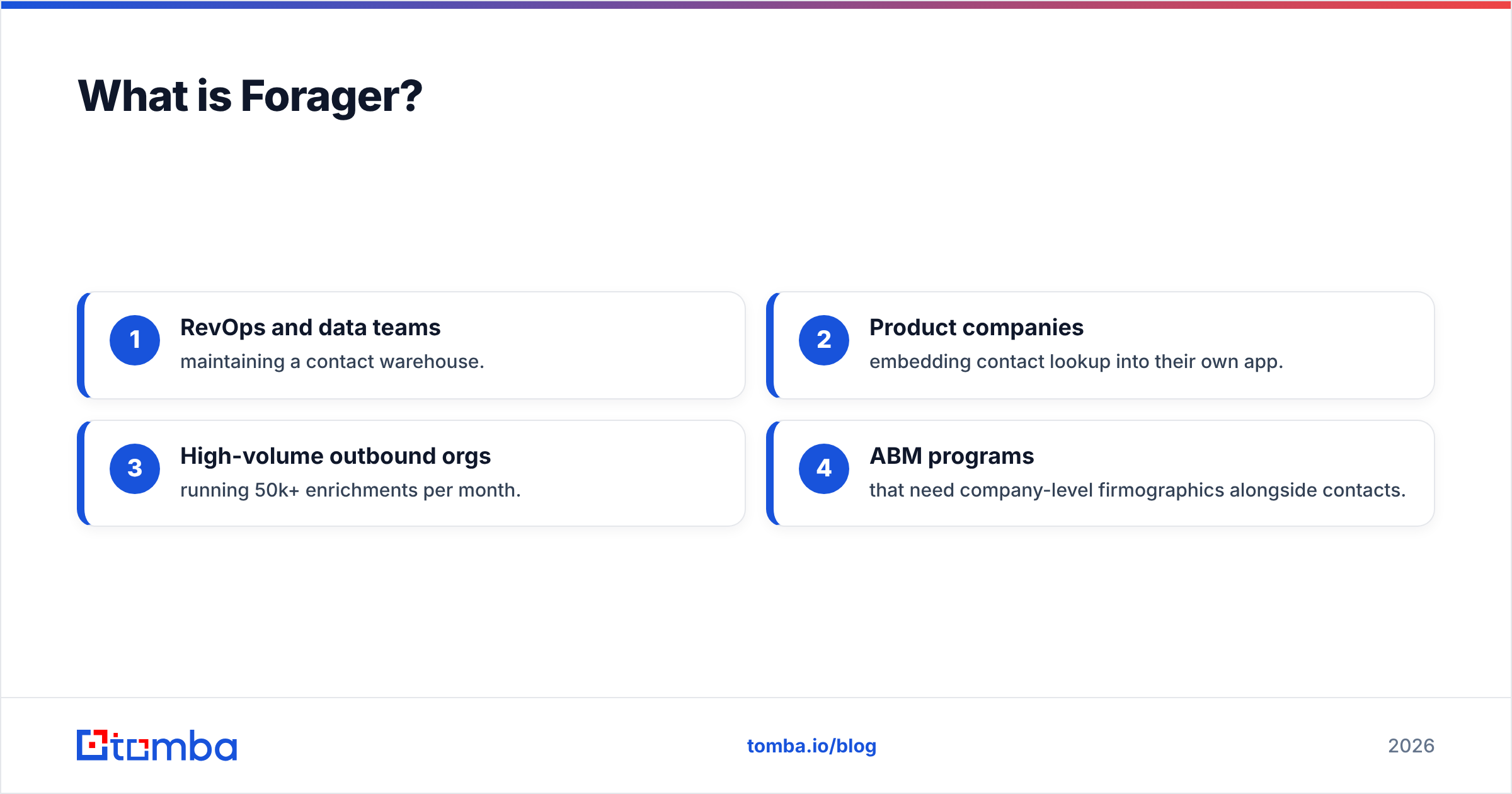
- RevOps and data teams maintaining a contact warehouse.
- Product companies embedding contact lookup into their own app.
- High-volume outbound orgs running 50k+ enrichments per month.
- ABM programs that need company-level firmographics alongside contacts.
Where it struggles: the individual rep. There's no satisfying answer to "I just need this one person's email right now" when the entry point is an API key and a contract.
FinalScout vs Forager: how do they actually compare?#
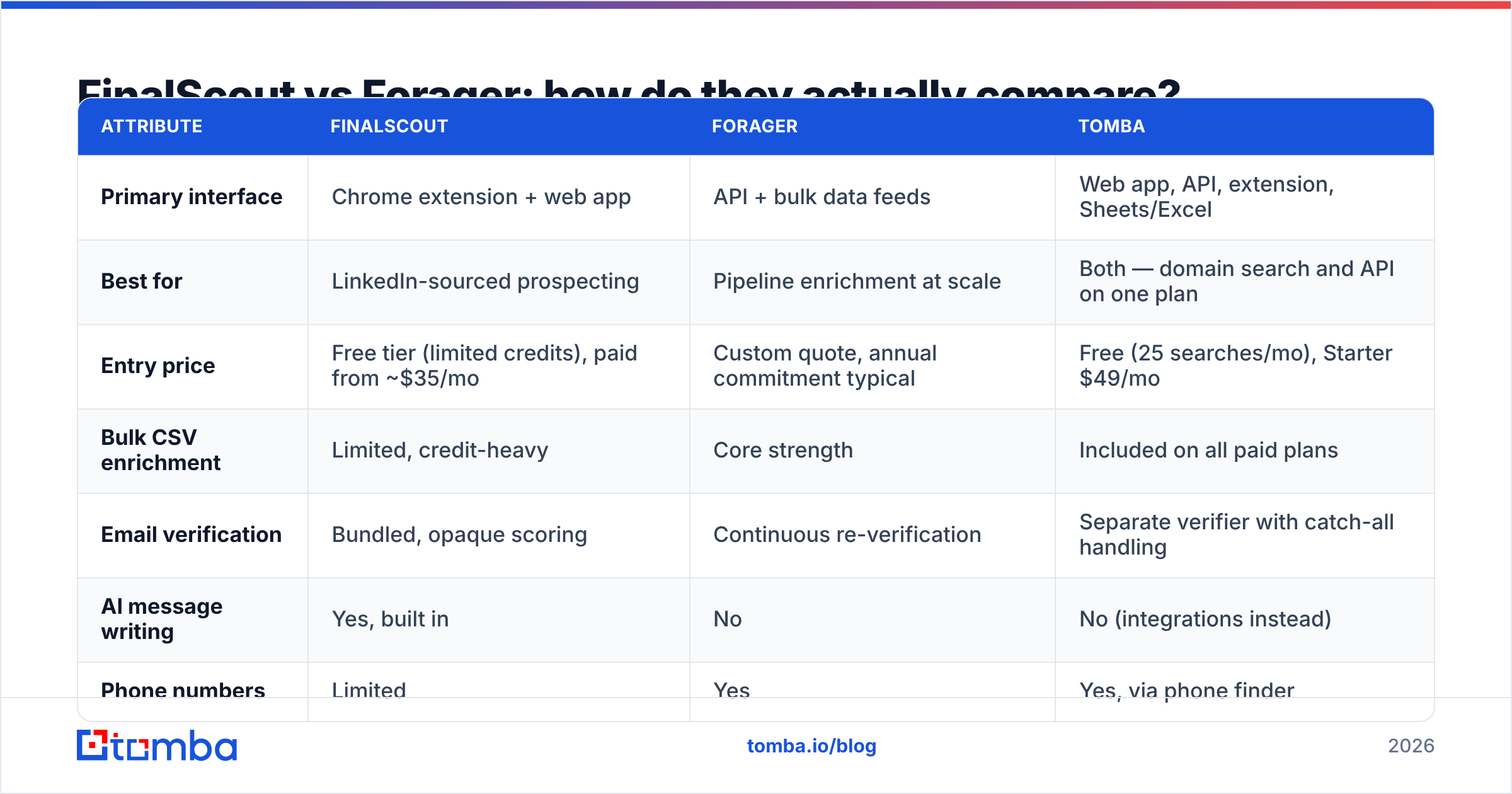
Here's the head-to-head. Pricing moves, so treat these as directional and confirm on each vendor's own page before you buy.
| Attribute | FinalScout | Forager | Tomba |
|---|---|---|---|
| Primary interface | Chrome extension + web app | API + bulk data feeds | Web app, API, extension, Sheets/Excel |
| Best for | LinkedIn-sourced prospecting | Pipeline enrichment at scale | Both — domain search and API on one plan |
| Entry price | Free tier (limited credits), paid from ~$35/mo | Custom quote, annual commitment typical | Free (25 searches/mo), Starter $49/mo |
| Bulk CSV enrichment | Limited, credit-heavy | Core strength | Included on all paid plans |
| Email verification | Bundled, opaque scoring | Continuous re-verification | Separate verifier with catch-all handling |
| AI message writing | Yes, built in | No | No (integrations instead) |
| Phone numbers | Limited | Yes | Yes, via phone finder |
| Works without LinkedIn | Partially | Yes | Yes |
| Self-serve signup | Yes | Sales-led | Yes |

The row that decides most evaluations is "self-serve signup." If you can't get a card-swipe answer this week, FinalScout wins by default for small teams. If you need 100,000 records with a data processing agreement, Forager wins by default because FinalScout was never built for that.
Which one has better data accuracy?#
Accuracy is where marketing claims and reality diverge hardest, so define your terms before you test anything.
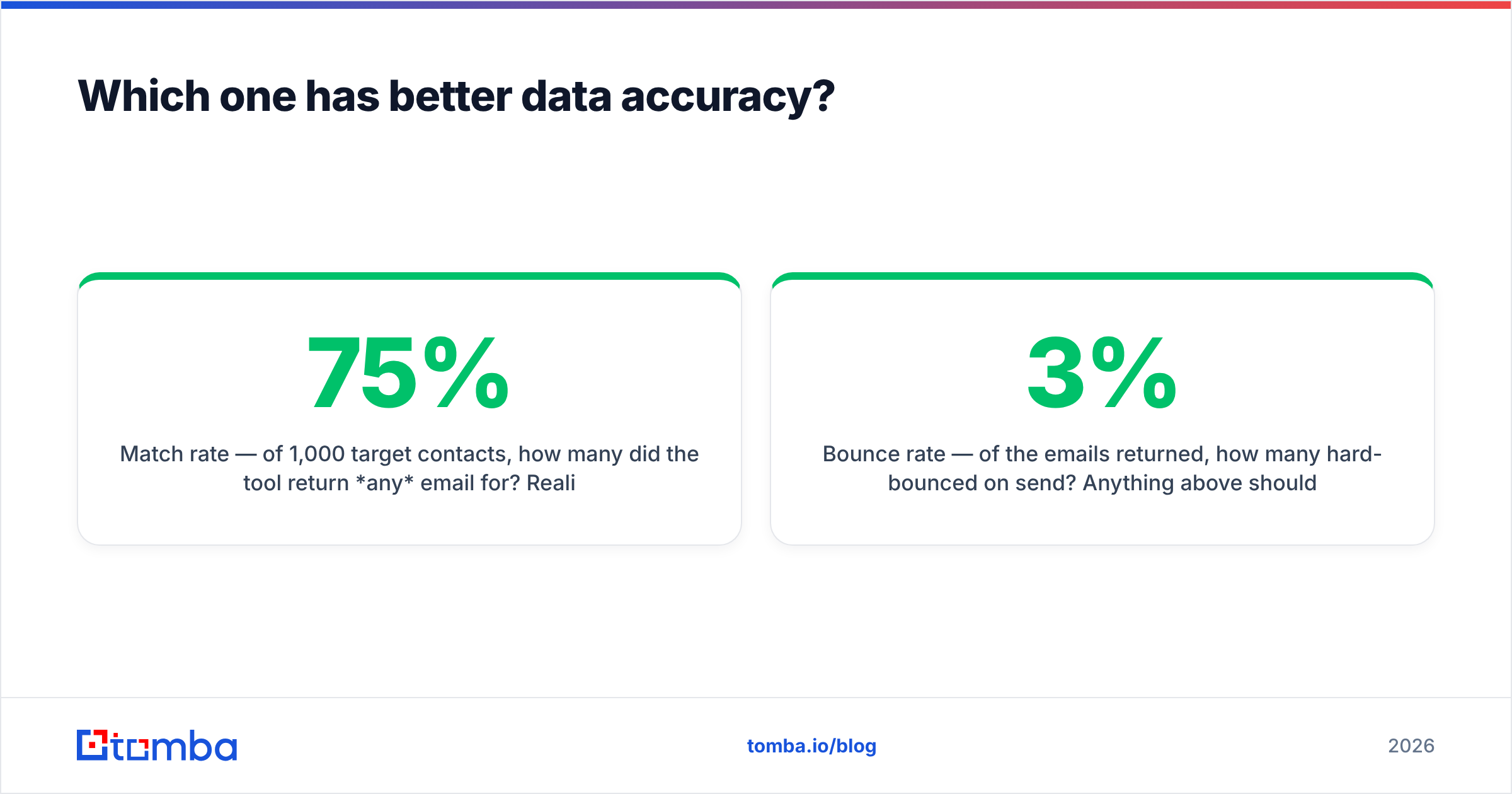
- Match rate — of 1,000 target contacts, how many did the tool return any email for? Realistic range for good providers: 55–75% on standard B2B targets, lower for SMB, non-English, and non-tech verticals.
- Bounce rate — of the emails returned, how many hard-bounced on send? Anything above 3% should worry you; above 5% and your sender reputation starts absorbing damage.
- Catch-all share — how many results sit on domains that accept everything and verify nothing? These inflate match rate while telling you nothing.
- Freshness — when was the record last confirmed? A 2023 verification on a 2026 send is a coin flip.

FinalScout's advantage is context: it's reading a live LinkedIn profile, so it knows the person's current employer at the moment of lookup. That kills a whole class of "left the company in 2024" errors. Its weakness is that pattern-guessed emails on catch-all domains often get returned as "valid" because the SMTP check can't disprove them.
Forager's advantage is the refresh cadence and the fact that verification runs as a continuous process rather than a one-time check at export. Its weakness is coverage variance — API-sourced data is only as good as the segment you're querying, and long-tail SMB coverage is thinner than the enterprise-heavy examples in any vendor demo.
The honest verdict: neither tool is reliably more accurate across the board. Accuracy is segment-specific. Run 200 contacts from your actual ICP through both, send to them, and count bounces. Any conclusion drawn without a send test is a guess.
If you want to sanity-check a list before committing budget, run it through a dedicated email verifier first — the delta between "provider says valid" and "independent verifier says valid" tells you more about a vendor than their homepage does.
Is FinalScout's AI writing feature worth paying for?#
Short answer: it's a nice-to-have that shouldn't drive the purchase.
The AI writing layer takes LinkedIn profile fields — headline, recent posts, company description — and generates an opener. It works. It produces grammatically correct, mildly personalized copy faster than you'd write it yourself.
The problem is that everyone else's AI is reading the same three fields. When four vendors all reference the same "congrats on the Series B" signal from the same public profile, personalization stops being personalization. Prospects pattern-match it in about two seconds.
Where the feature does earn its keep:
- Volume floor — if the alternative is sending nothing because writing is the bottleneck, generated copy beats silence.
- First-draft speed — treat output as a skeleton you edit, not a message you send.
- Non-native writers — teams selling into English-speaking markets from elsewhere get real value here.
- Recruiting outreach — candidate messaging tolerates templated warmth better than enterprise sales does.
If you're buying FinalScout primarily for the AI, you're overpaying for something a general-purpose LLM does for a fraction of the cost. Buy it for the LinkedIn extraction; treat the writer as a bonus.
What does each one really cost per usable contact?#
This is the calculation almost nobody runs, and it's the only one that matters.
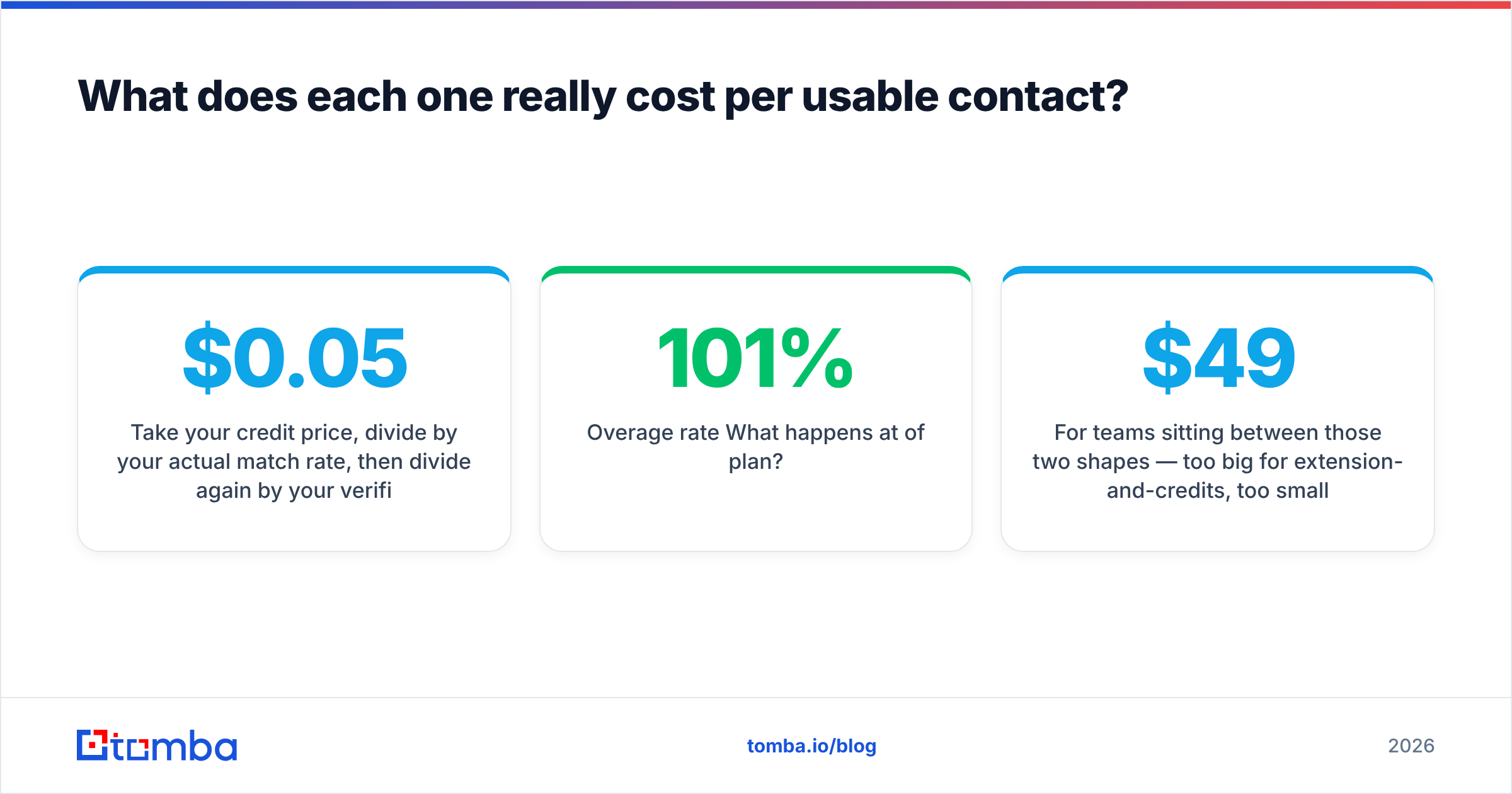
Take your credit price, divide by your actual match rate, then divide again by your verified-deliverable rate. A $0.05 credit at a 60% match rate and a 90% deliverable rate is really $0.09 per usable contact — and that's before you account for credits burned on failed lookups, which many tools still charge for.
| Cost factor | What to ask the vendor |
|---|---|
| Credit consumption on misses | Do I pay for a lookup that returns nothing? |
| Catch-all results | Are those counted as successful matches? |
| Seat pricing | Does adding an SDR add a full license fee? |
| Credit rollover | Do unused credits expire monthly? |
| Overage rate | What happens at 101% of plan? |
| Annual lock-in | Is the headline price monthly or annual-only? |
FinalScout's credit packs look cheap at the entry tier and get expensive fast at volume, especially with per-seat multiplication. Forager's contracts price well at scale but carry a floor that makes them irrational below a certain volume — you'll pay for capacity you don't touch.
For teams sitting between those two shapes — too big for extension-and-credits, too small for a data contract — flat-rate pricing usually wins. Tomba pricing runs Free (25 searches/mo), Starter $49/mo, Growth $99/mo, Pro $249/mo, with Enterprise on quote. The same plan covers domain search, verification, and the Tomba API, so you're not stitching together a finder, a verifier, and a data feed from three vendors.
Which should you choose for your team?#
Run through this in order and stop at your first yes:
- Does your prospecting begin and end inside LinkedIn, at under ~500 contacts a month? → FinalScout. The workflow fit is genuinely good and the free tier lets you test it in an afternoon.
- Do you need contact records flowing into a warehouse or product automatically, at 50k+/month, with procurement already involved? → Forager. This is the shape it was designed for.
- Do you need both — some manual LinkedIn sourcing, some bulk domain enrichment, an API for the CRM sync — without paying two vendors? → A general-purpose platform. Tomba's email finder plus its LinkedIn finder and bulk tools cover both motions on one plan.
- Are you mostly worried about bounce rate on a list you already own? → Neither. Buy verification, not discovery.
One caveat on all three: no tool fixes a bad target list. A 95%-accurate email sent to the wrong persona is a 95%-accurate waste. Spend the hour on ICP definition before you spend the money on credits.
What about the middle path?#
Most teams that evaluate FinalScout and Forager end up with a hybrid: an extension for opportunistic, high-intent finds, and an API for the systematic enrichment that runs overnight. That's a reasonable architecture — it's just expensive when the two halves come from different vendors with different credit systems and different verification standards.
The alternative is picking one platform that does adequate work on both sides. You give up FinalScout's AI writer and Forager's warehouse-native feeds. You get consistent verification logic, one credit pool, one bill, and — critically — one accuracy baseline to measure against instead of two vendors each blaming the other for your bounce rate.
That tradeoff is worth it for the large middle of the market: teams doing 1,000–50,000 lookups a month who need reliability more than they need any single specialized feature.
Ready to test a third option?#
Before you commit to a credit pack or a data contract, benchmark both against a neutral baseline. Pull 100 contacts from your real ICP, run them through the Tomba Email Finder on the free tier (25 searches/mo, no card), and compare match rate and bounce rate against whatever FinalScout or Forager returns for the same list. If a flat $49/mo plan with domain search, verification, and full API access covers your volume, that's the cheapest correct answer — and if it doesn't, you'll at least have real numbers to negotiate with.
Related guides#
Ready to find emails that actually work?
Join 150,000+ professionals who stopped guessing and started sending. Free credits on signup — no credit card required.
Get the Tomba newsletter
Practical outbound tactics and product updates — once every two weeks.
About the author