FinalScout vs Goava: Which B2B Data Tool Wins in 2026?
FinalScout scrapes LinkedIn for emails. Goava maps Nordic accounts and tells you who to call. They solve different halves of the same problem — here's which one earns the budget, and when neither is the right answer.
TL;DR
- FinalScout is a LinkedIn-first contact extractor. You open a profile or run a Sales Navigator search, and it pulls out emails plus an AI-drafted message. It works best when your prospect list already lives inside LinkedIn.
- Goava is a Nordic sales intelligence platform. It scores and recommends which companies to target, using Swedish and Nordic company data. It works best when your buyers are Nordic firms and you don't yet know who to call.
- FinalScout vs Goava is not a like-for-like fight. Goava tells you which account deserves attention. FinalScout tells you the person's inbox. Buying one and expecting the other's job is the most common mistake here.
On price and gaps:
- Pricing is open on one side only. FinalScout publishes self-serve tiers. Goava is quote-based with annual deals, which prices out solo sellers and small teams.
- Neither is a full email data layer. If you need every contact at a domain, an API, and verification in one place, a dedicated email finder fills the gap both leave open.
What is FinalScout?#
FinalScout is a Chrome extension and web app with one job. It turns a LinkedIn profile into a usable email address, then drafts the first message with AI.
You install the extension and open a profile. It also reads a LinkedIn or Sales Navigator search page, or a group member list. FinalScout then tries to find a work email for each person, marks it valid or risky, and offers ChatGPT-backed templates. You go from "found them" to "emailed them" without switching tabs.
The company promises high deliverability on the emails it returns. It also leans hard on GDPR-friendly positioning. That makes sense: LinkedIn scraping is the most closely watched corner of the B2B data market.
What FinalScout is not: a company database you can query without LinkedIn. It is not a filter for building a territory list. It is not an API you can wire into a CRM sync job. Its unit of work is the profile you are already looking at.
What is Goava?#
Goava is a Swedish sales intelligence platform for teams selling into the Nordics. Its core promise is priority order. Instead of a raw list, it reads your CRM, learns which accounts look like your best customers, and ranks companies to approach. Each pick comes with a reason.
The data underneath is registry-grade Nordic material. Think company financials, headcount, industry codes, owners, tech signals, and news triggers. For a rep selling in Stockholm, Oslo, or Copenhagen, that depth is hard to match. Global vendors treat the Nordics as a thin slice of a much larger index.
Goava's weakness mirrors its strength. Outside the Nordics, coverage thins out fast. It is also an account-level tool by design. Finding one person's inbox is not its job, so you will still need a second tool for that.
FinalScout vs Goava: how do they actually compare?#
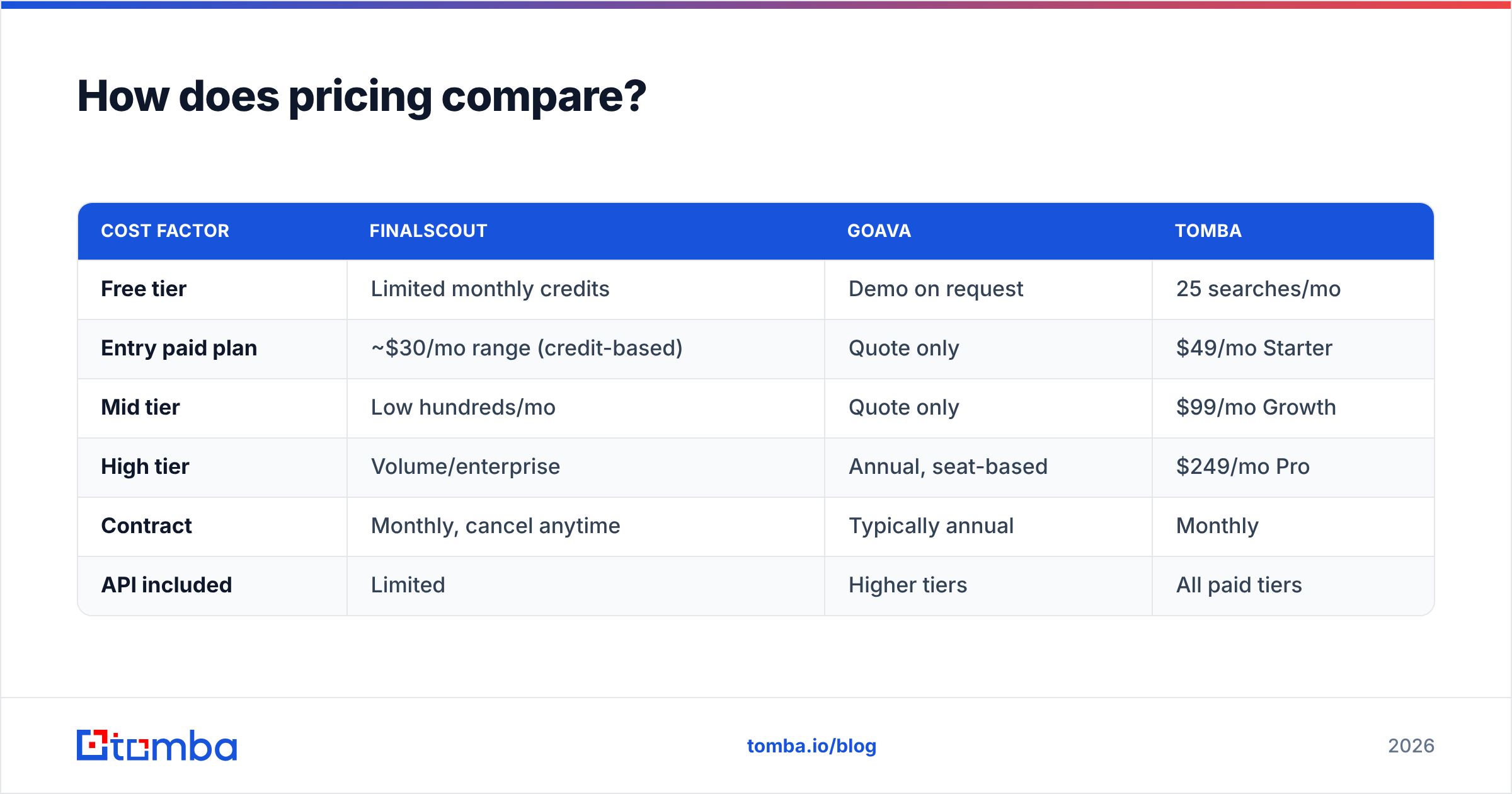
| Dimension | FinalScout | Goava |
|---|---|---|
| Primary job | Extract emails from LinkedIn profiles | Recommend which accounts to target |
| Data unit | Person (contact-level) | Company (account-level) |
| Geographic strength | Global, follows LinkedIn's footprint | Nordics (Sweden, Norway, Denmark, Finland) |
| Entry point | Chrome extension over LinkedIn | Web app + CRM integration |
| Pricing model | Self-serve monthly tiers, published | Quote-based, typically annual |
| Free option | Limited free credits | Demo / trial by request |
| Email verification | Built-in validity signal | Not a core feature |
| AI features | Message drafting (ChatGPT-based) | Account scoring and recommendations |
| API access | Limited | Available on higher-tier commercial plans |
| Best for | SDRs living inside LinkedIn | Nordic AEs building a territory plan |
Read that table twice before you compare price tags. Two tools can land on the same shortlist and still answer different questions. FinalScout vs Goava is the textbook case.

Which one finds more usable email addresses?#
FinalScout wins this one, and it is not close. Goava is not really competing for the job.
But "finds more emails" hides four questions that matter more than the headline number.
- Match rate — of the profiles you feed in, how many return an address at all? LinkedIn-based tools do well on tech, SaaS, and marketing roles at firms with public email patterns. They do worse on manufacturing, healthcare, government, and any firm with an odd email format.
- Verification depth — a returned address is not a valid one. Ask what the tool actually did. An SMTP check? A pattern guess? A copy of a known company format? This is where a standalone email verifier earns its keep, whatever produced the address.
Two more checks decide your bounce rate:
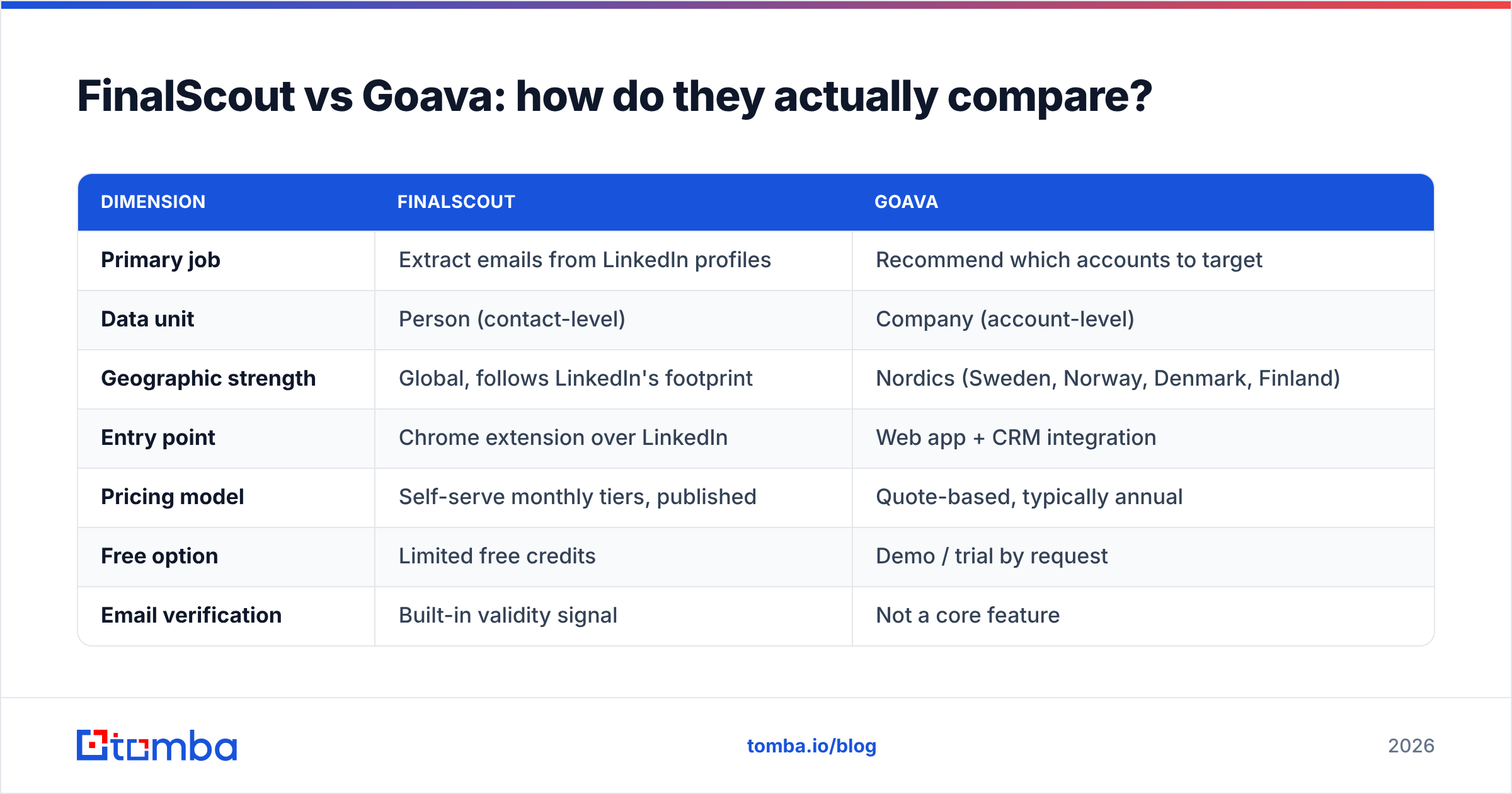
- Catch-all handling — many B2B domains accept every address at the gateway. Naive checks then mark junk as "valid." Tools that flag catch-all domains honestly beat tools that wave them through. A dedicated catch-all verifier is the gap between a 2% bounce rate and a 12% one.
- Personal vs work addresses — some LinkedIn tools return personal Gmail addresses. Those pad match-rate claims. They also hurt your reply rate and your compliance record.
Test all four on your own buyer list before you commit. A 60% match rate on your real target beats a claimed 95% on someone else's.
How does pricing compare?#
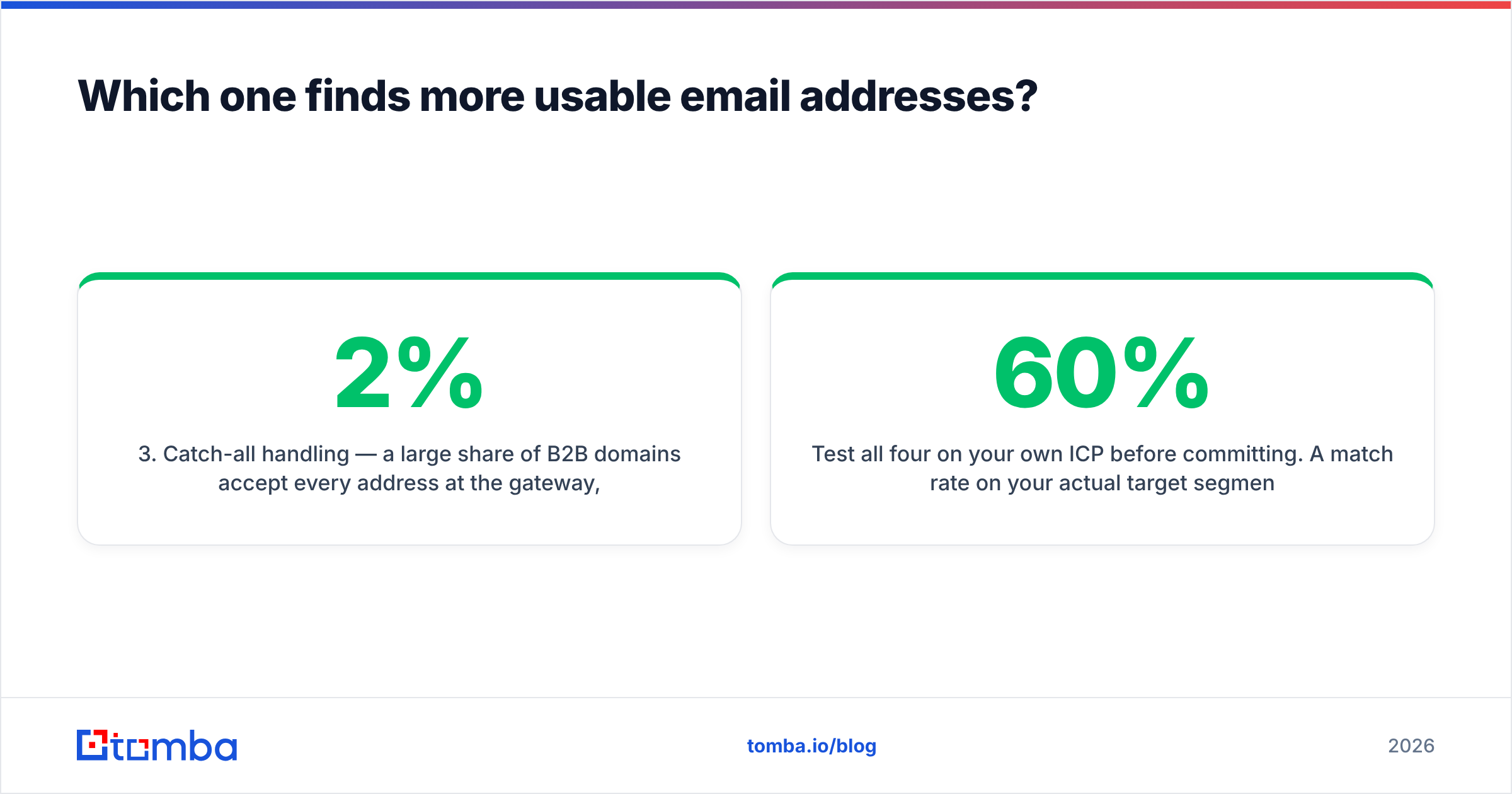
FinalScout publishes self-serve tiers. There is a small free allowance, then monthly plans priced by credit volume. Entry paid plans sit in the low tens of dollars. Higher tiers run into the low hundreds. Check the vendor page before you budget. Credit pricing changes often, and some plans burn a credit even on a failed lookup.
Goava does not publish list prices. Expect a discovery call, a seat-based annual contract, and a floor built for teams rather than one rep. That is normal for sales intelligence platforms, and it is a fair model. The product is meant to serve a whole territory, not one seller on a trial.
Here is how the three cost structures sit next to each other:
| Cost factor | FinalScout | Goava | Tomba |
|---|---|---|---|
| Free tier | Limited monthly credits | Demo on request | 25 searches/mo |
| Entry paid plan | ~$30/mo range (credit-based) | Quote only | $49/mo Starter |
| Mid tier | Low hundreds/mo | Quote only | $99/mo Growth |
| High tier | Volume/enterprise | Annual, seat-based | $249/mo Pro |
| Contract | Monthly, cancel anytime | Typically annual | Monthly |
| API included | Limited | Higher tiers | All paid tiers |
Full Tomba pricing is public for the same reason FinalScout's is. A team running a lean outbound test should not need a sales call to learn if a tool is affordable.
Is FinalScout better for LinkedIn outbound?#
For outbound sourced on LinkedIn, yes. The workflow never leaves the tab you already prospect in. If your process is "search Sales Navigator, skim profiles, export the good ones," that loop is fast.
Three caveats before you standardize on it:
- LinkedIn dependency is a platform risk. Extraction extensions sit at odds with LinkedIn's terms, and enforcement shifts. Any tool that pulls data through a browser session on someone else's site carries that risk. Heavy scraping can also get the account banned — usually a rep's personal one.
- The AI drafting is a convenience, not an edge. Templated ChatGPT openers are now the most obvious pattern in the inbox. Use it for a first draft you rewrite, never for send-as-is copy.
- Volume ceilings are real. Profile-by-profile work does not scale to tens of thousands of contacts. A domain-level or API approach does.
If LinkedIn is your main source but you want a backup, use a LinkedIn finder with an API. Same input, plus an escape hatch when you need bulk.
Is Goava worth it outside the Nordics?#
Mostly no. That is not a knock — it is the product's stated scope.
Goava's edge is deep Nordic registry and financial data, plus scoring trained on it. Take that away and you pay platform prices for coverage others do better. If you sell to SaaS firms in North America, Goava is the wrong shortlist entry.
Where it earns the spend:
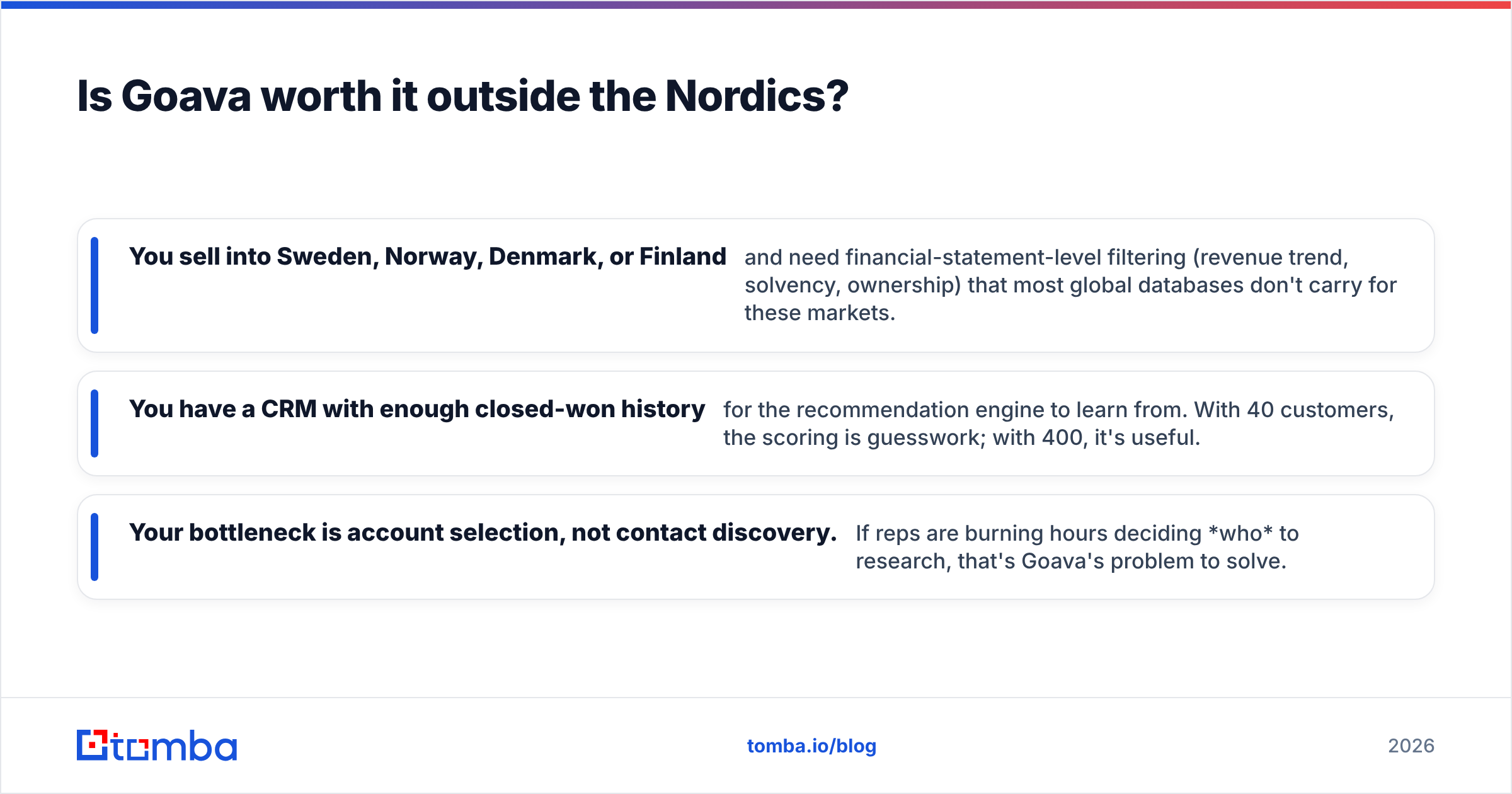
- You sell into Sweden, Norway, Denmark, or Finland and need filters on revenue trend, solvency, and ownership. Most global databases do not carry that for these markets.
- You have a CRM with enough closed-won history for the scoring to learn from. With 40 customers, it guesses. With 400, it helps.
- Your bottleneck is picking accounts, not finding contacts. If reps burn hours deciding who to research, that is Goava's problem to solve.
If your bottleneck is "we know the accounts, we can't reach anyone," a platform subscription is an expensive fix for a cheap problem. A domain search across your target list solves it directly.

What are the compliance and data-quality tradeoffs?#
The FinalScout vs Goava comparison raises two different flags. Neither is a deal-breaker if you handle it well.
FinalScout / LinkedIn extraction. Under GDPR, scraping a public profile is still processing personal data. You need a lawful basis, and for B2B outreach that is usually legitimate interest. You also need a written balancing test, a clear opt-out, and honored deletion requests. The vendor's compliance claims cover their processing, not yours. Buyer reviews on G2 read truer on data quality than any vendor page.
Goava / registry data. Company-level registry data is lower risk. Much of it is public corporate filings, not personal data. Contact records attached to those companies still fall under GDPR. Nordic buyers also tend to know their privacy rights, so sloppy sourcing shows up as complaints fast.
Either way, verification is your deliverability insurance. Bounces are the fastest way to wreck sender reputation. No amount of clever copy saves a list that is 15% dead.
Where do both tools leave a gap?#
Run either one for a quarter and the same three gaps show up.
- No domain-wide sweep. Neither gives you a clean "show me every reachable contact at these 300 domains" motion. FinalScout works profile by profile. Goava works account by account, with no contact depth.
- Thin automation surface. Outbound teams need lookups inside a workflow: a CRM trigger, a form-fill enrichment, a nightly sync. That needs an email finder API, not a browser extension.
- Verification treated as a bolt-on. Both hand you addresses. Neither is built as a verification system. Catch-all domains, role accounts, and stale records need their own layer.
That is why many teams run a targeting tool and a contact-discovery layer instead of betting on one subscription.
Which should you choose?#
- Choose FinalScout if LinkedIn is where your prospecting starts and ends, your volumes are modest, and you want the fastest path from profile to inbox.
- Choose Goava if you sell into the Nordics, you have a team and a budget, and your real problem is which of 40,000 companies to work this quarter.
- Choose both if you are a Nordic sales team. Goava picks the accounts, a contact layer gets the emails. They fit together well.
- Choose neither if you need broad, verified, API-ready contact data that is not tied to one social network or one region.
That last case is more common than the shortlist suggests. Most teams weighing FinalScout vs Goava are really asking one question: which of these fixes my pipeline? The answer often sits one layer below both. You need contact data you can pull for any domain, verify before sending, and automate into your stack.
That is the layer Tomba Email Finder is built for. Start free with 25 searches a month. Test it on your own list, not a vendor demo. Move to Starter at $49/mo when the match rate holds up. No annual contract, no discovery call, and the same API on every paid plan.
Related guides#
Ready to find emails that actually work?
Join 150,000+ professionals who stopped guessing and started sending. Free credits on signup — no credit card required.
Get the Tomba newsletter
Practical outbound tactics and product updates — once every two weeks.
About the author