FinalScout vs Harmonic (2026): Which Tool Wins for B2B Prospecting?
FinalScout scrapes LinkedIn profiles into verified emails. Harmonic tracks startup growth signals for investors. Here's which one actually fits your pipeline — and where both fall short.
TL;DR
- FinalScout and Harmonic are not really competitors. FinalScout is a LinkedIn-first email extractor with AI email writing. Harmonic is a private-company intelligence platform built for VCs, corp dev, and startup-hunting GTM teams.
- Pick FinalScout if your motion is "I have a LinkedIn search URL and I need emails out of it today," and you're comfortable with browser-extension workflows and LinkedIn's rate limits.
- Pick Harmonic if you sell to early-stage startups and need to know which company just raised, doubled headcount, or launched — before it hits Crunchbase.
- Harmonic costs multiples of FinalScout. FinalScout starts free with a paid tier in the ~$40–$50/mo range; Harmonic is a quote-based platform typically landing in the four-to-five-figure annual bracket.
- Neither one is a great pure email-finding engine. If contact accuracy and API-level throughput are what you actually need, a dedicated email finder at $49/mo will out-perform both on cost per verified contact.
What is FinalScout, and who is it for?#
FinalScout is a LinkedIn-centric prospecting tool. You install a Chrome extension, run a search on LinkedIn or Sales Navigator, and FinalScout scrapes the visible profiles and attempts to resolve a valid business email for each one. It layers an AI email writer on top, so you can push from "here's a list of 500 profiles" to "here are 500 first-touch drafts" in one workflow.
Its main claims are around email deliverability — the product markets a high validity rate on the emails it returns, and it does run its own verification step before handing you a CSV. In practice, the useful part is the tight loop: find profile → resolve email → draft message, without leaving the browser.
What it is not: a database. FinalScout has no meaningful firmographic layer, no funding data, no technographics, no intent signals. Its entire universe is whatever LinkedIn shows you. If your ICP is discoverable through a Sales Navigator filter set, that's fine. If it isn't, FinalScout has nothing to give you.
The constraints are the usual LinkedIn-extension constraints. You're bound by LinkedIn's page limits (roughly 1,000 results per search, 100 pages), by connection-level visibility, and by whatever throttling LinkedIn decides to apply to accounts that scrape aggressively. Anyone who has burned a LinkedIn account to a extraction tool knows this risk is real, not theoretical. Check the FinalScout site for their current stance on usage limits.

What is Harmonic, and who is it for?#
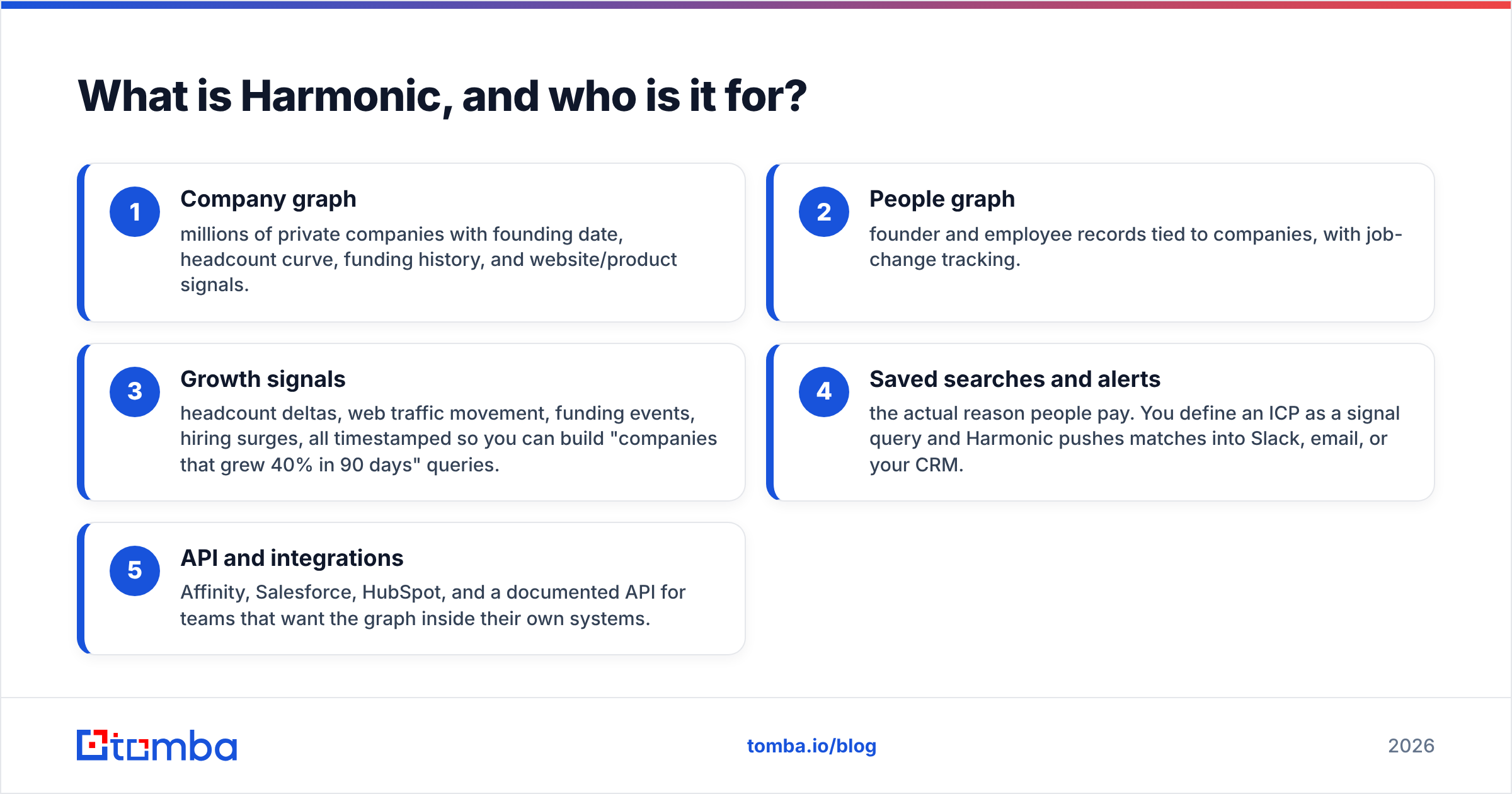
Harmonic sits in a different category entirely. It's a private-market intelligence platform — a live graph of startups, founders, and employees, refreshed continuously from web, social, hiring, and funding sources. The pitch is "know about the company before anyone else does."
The core primitives are different from a prospecting tool:
- Company graph — millions of private companies with founding date, headcount curve, funding history, and website/product signals.
- People graph — founder and employee records tied to companies, with job-change tracking.
- Growth signals — headcount deltas, web traffic movement, funding events, hiring surges, all timestamped so you can build "companies that grew 40% in 90 days" queries.
- Saved searches and alerts — the actual reason people pay. You define an ICP as a signal query and Harmonic pushes matches into Slack, email, or your CRM.
- API and integrations — Affinity, Salesforce, HubSpot, and a documented API for teams that want the graph inside their own systems.
The buyer is a venture fund sourcing deals, a corp dev team scanning acquisition targets, or a GTM team at a company that sells to startups (dev tools, fintech infra, HR platforms). If your ICP is "Series A companies that just hired their first RevOps person," Harmonic is genuinely good at that. If your ICP is "VP Marketing at any 200-person manufacturer," Harmonic is expensive overkill.
Harmonic does surface contact information, but it is not the product's center of gravity. Email coverage is thinner than a dedicated finder, and you will want a verification layer before anything goes into a sequence.
FinalScout vs Harmonic: how do they actually compare?#
Here's the head-to-head on the dimensions that decide the purchase.
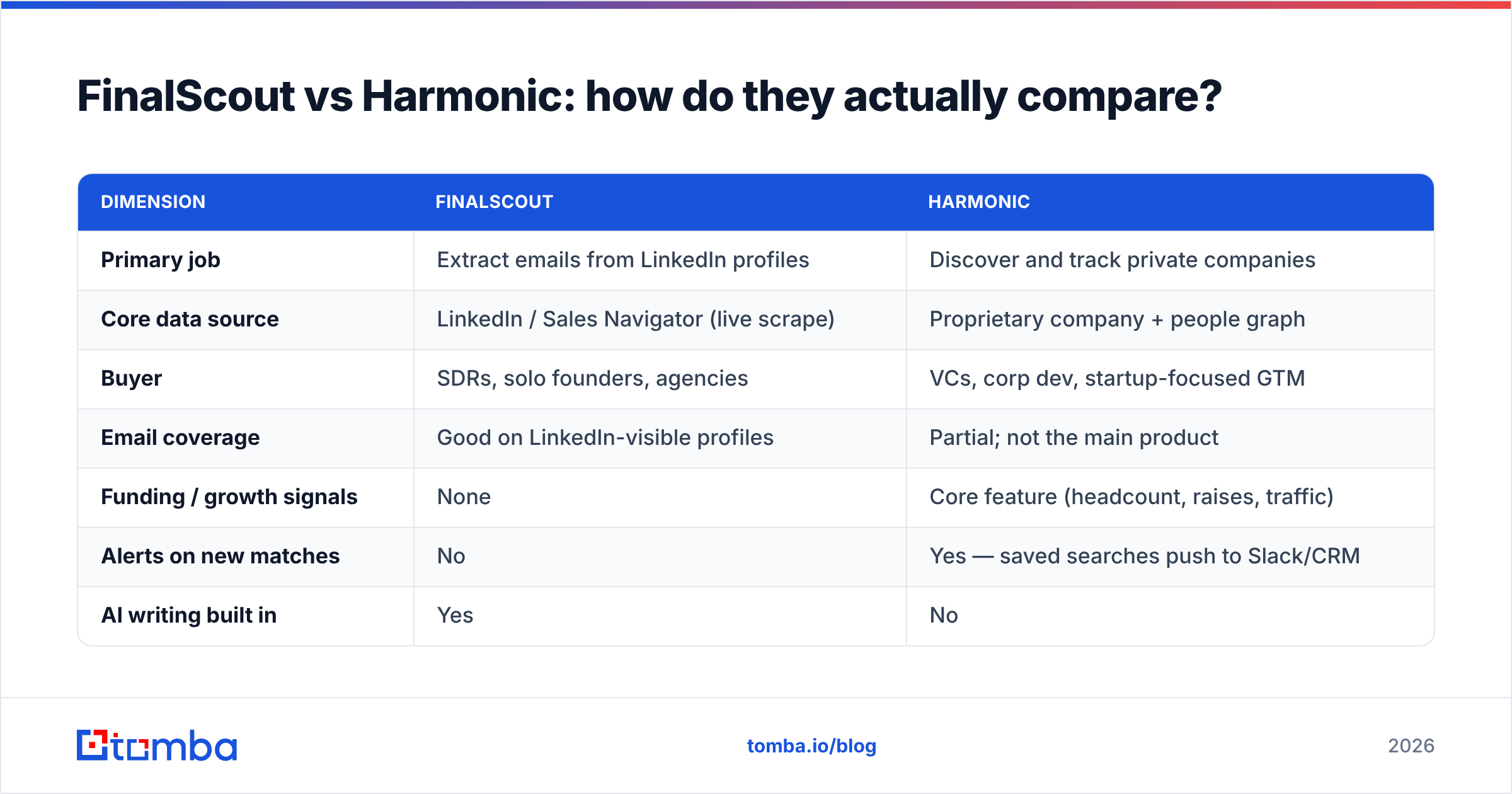
| Dimension | FinalScout | Harmonic |
|---|---|---|
| Primary job | Extract emails from LinkedIn profiles | Discover and track private companies |
| Core data source | LinkedIn / Sales Navigator (live scrape) | Proprietary company + people graph |
| Buyer | SDRs, solo founders, agencies | VCs, corp dev, startup-focused GTM |
| Email coverage | Good on LinkedIn-visible profiles | Partial; not the main product |
| Funding / growth signals | None | Core feature (headcount, raises, traffic) |
| Alerts on new matches | No | Yes — saved searches push to Slack/CRM |
| AI writing built in | Yes | No |
| Entry price | Free tier; paid from ~$40–$50/mo | Quote only; enterprise annual contracts |
| API access | Limited | Full documented API |
| Best for list building | Small, LinkedIn-sourced lists | Signal-based target account lists |
| Weakness | Depends on LinkedIn; no firmographics | Cost; weak on contact-level depth |
The short read: FinalScout is a tactical extraction tool, Harmonic is a strategic sourcing platform. Comparing them on price alone is misleading because they're solving different halves of the funnel. Harmonic tells you who to go after. FinalScout tells you how to reach the people you already identified.
Which one is better for cold outbound?#
FinalScout, if you're picking only one — but with caveats.
Cold outbound needs three things: a list, contact data, and deliverable sends. FinalScout gives you two of three, and does the list part only if LinkedIn's filters happen to match your ICP. That's a real limitation. Sales Navigator filters are firmographically shallow — you get headcount bands, industry tags, and geography, and that's roughly it. You cannot filter on "uses Stripe," "raised in the last 90 days," or "posted a job for a security engineer."
Harmonic can do all three of those queries. But then you still need contact data, and you'll likely end up bolting a finder on top anyway. That's the honest structural problem: Harmonic replaces your targeting layer, not your contact layer.
For a team running high-volume outbound, the cost math matters. Harmonic's annual commitment is usually justified by a small number of very high-value outcomes — a deal sourced, an acquisition found. It is almost never justified by "we sent 5,000 cold emails this quarter." If your unit economics run on volume, you want cheap, accurate, API-driven contact resolution, not a private-market graph.
One more thing outbound teams underrate: catch-all domains. A large share of B2B domains accept all mail, which means a "valid" result from any scraping tool may still bounce. Running results through a catch-all verifier before your first send is the difference between a 2% bounce rate and a 12% one, and 12% will hurt your sender reputation inside a week.
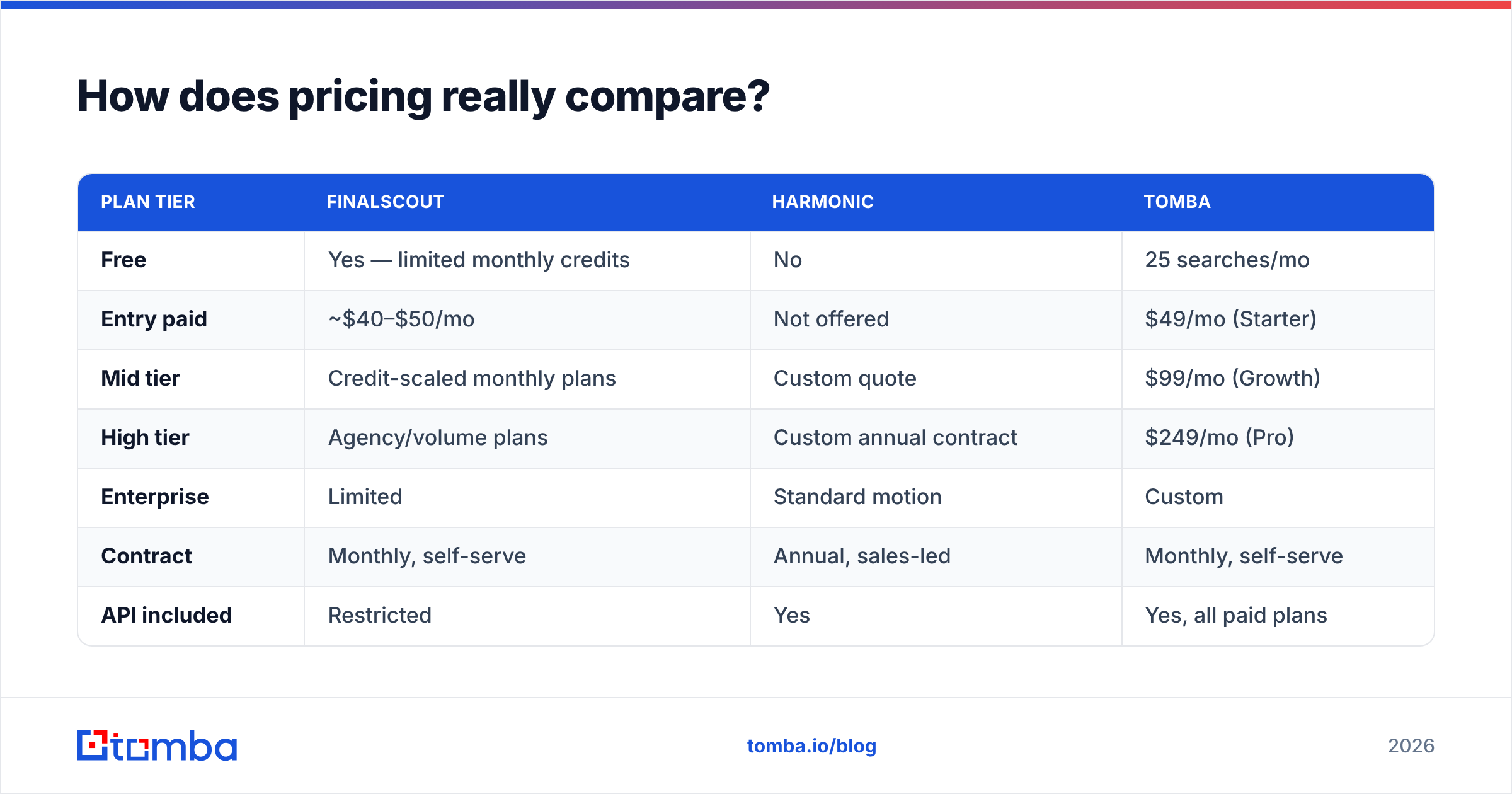
How does pricing really compare?#
| Plan tier | FinalScout | Harmonic | Tomba |
|---|---|---|---|
| Free | Yes — limited monthly credits | No | 25 searches/mo |
| Entry paid | ~$40–$50/mo | Not offered | $49/mo (Starter) |
| Mid tier | Credit-scaled monthly plans | Custom quote | $99/mo (Growth) |
| High tier | Agency/volume plans | Custom annual contract | $249/mo (Pro) |
| Enterprise | Limited | Standard motion | Custom |
| Contract | Monthly, self-serve | Annual, sales-led | Monthly, self-serve |
| API included | Restricted | Yes | Yes, all paid plans |
Two things stand out. First, Harmonic has no self-serve on-ramp — you talk to sales, you get a quote, you sign an annual. That's fine for a fund with a sourcing budget; it's a hard stop for a five-person sales team testing a channel. Second, FinalScout's credit model means your real cost scales with volume in a way the sticker price hides. Two thousand extractions a month is a very different bill from two hundred.
For reference, Tomba pricing is flat and self-serve across the board: free at 25 searches, Starter at $49/mo, Growth at $99/mo, Pro at $249/mo, and custom enterprise. Every paid tier includes API access, which matters if you're automating rather than clicking.

What about data accuracy and compliance?#
Accuracy claims in this category are mostly unfalsifiable marketing. Every vendor quotes a validity percentage measured on a sample they chose. Treat all of them as directional.
What you can actually evaluate:
- Where does the data come from? FinalScout's is live-scraped from LinkedIn plus pattern inference. Harmonic's is aggregated from public web, hiring boards, and funding sources. Neither publishes a full sourcing map. If provenance matters to your legal team, ask both vendors for it in writing.
- Is there a verification step? FinalScout verifies before delivery. Harmonic largely does not — contact fields come as-is from the graph.
- How stale is it? Harmonic's signal freshness is genuinely strong; that's the product. FinalScout is as fresh as the LinkedIn profile, which is as fresh as the person's last update — often 6–18 months old for email-relevant job data.
- GDPR posture. Both operate in the grey zone that all B2B contact data occupies. Scraping LinkedIn specifically carries additional terms-of-service exposure that a database vendor does not. G2 reviews for both categories are worth reading for real-world compliance complaints, not just feature praise.
The practical mitigation is boring and effective: never trust a single source. Pull contacts from your finder, run them through verification, and drop anything that doesn't come back deliverable. A domain search against the target company is a cheap cross-check — if the pattern the scraper guessed doesn't match the company's actual pattern, you've caught a bad record before it costs you a bounce.
Are there better alternatives to both?#
Yes, depending on which job you're hiring for.
If you need targeting signals but Harmonic's price is prohibitive: look at Crunchbase Pro or PitchBook for funding-first coverage, or a job-posting-signal tool if hiring is your main trigger. None of them match Harmonic's freshness on headcount deltas, but they cost a fraction.
If you need contact resolution at scale: the dedicated finder market is where the real competition is. BookYourData is a solid option if you prefer buying pre-built, pay-as-you-go lists with a bounce guarantee rather than resolving contacts one by one — different model, genuinely good at what it does. Tools like Apollo bundle contacts with sequencing. Tomba focuses narrowly on finding and verifying, with API-first delivery and no seat-based pricing games.
If you're doing LinkedIn-specific work: a LinkedIn finder that resolves emails from profile URLs gives you FinalScout's core value without a scraper sitting in your browser session — which also removes the account-risk problem.
If you're enriching an existing list: neither FinalScout nor Harmonic is built for this. You want bulk enrichment — upload a CSV of companies and names, get back verified emails and phones. Data enrichment and bulk processing are separate disciplines from discovery, and tools built for discovery handle them badly.
What's the verdict?#
Buy Harmonic if you sell to or invest in early-stage startups and the timing of an outreach determines whether you win. Its signal engine is the best-in-class reason to pay enterprise money, and there's no cheap substitute for knowing about a company two weeks before your competitors do.
Buy FinalScout if you're a small team, LinkedIn is your discovery layer, and you want one tool that goes from profile to draft email. It's affordable, it works, and the AI writing is a real time-saver on volume.
Buy neither if what you actually need is accurate contact data at a predictable cost. That's the most common case, and it's the one both of these tools handle as a side feature rather than a core competency. A team sending 3,000 emails a month spends more energy cleaning bad records than sourcing new ones — and no amount of clever targeting fixes a list that bounces.
Run the honest test before committing to either: take 100 known-good contacts from your CRM, feed them through each tool, and measure match rate and accuracy against ground truth you already have. Vendors hate this test because it's the only one that isn't gameable.
Start with the contact layer. Targeting platforms and scrapers only pay off if the emails they hand you actually land. Tomba Email Finder resolves professional emails by name, domain, or company, verifies them before delivery, and exposes everything through an API on every paid plan — starting free at 25 searches/month and $49/mo on Starter. Test it against whatever you're using now on the same 100 contacts and let the match rate decide.
Related guides#
Ready to find emails that actually work?
Join 150,000+ professionals who stopped guessing and started sending. Free credits on signup — no credit card required.
Get the Tomba newsletter
Practical outbound tactics and product updates — once every two weeks.
About the author