FinalScout vs NeverBounce (2026): Finder vs Verifier
FinalScout finds emails on LinkedIn. NeverBounce verifies lists you already have. They solve different halves of the same problem — here's how the pricing, accuracy and workflows actually compare in 2026.
TL;DR — FinalScout vs NeverBounce in 30 seconds
- FinalScout vs NeverBounce is not a head-to-head fight. The two tools do different jobs. FinalScout finds email addresses, mostly on LinkedIn. NeverBounce verifies addresses you already have.
- If your list is empty, NeverBounce cannot help you. If your list is old, FinalScout will not clean it.
- FinalScout sells credits and lives inside LinkedIn. NeverBounce charges per check, roughly $0.003 to $0.008 each. It is API-first and now sits under ZoomInfo.
- Buy both and you get two bills, two credit pools, and a CSV handoff. One tool that finds and checks in the same call is usually cheaper below ~50k contacts a month.
- Verdict: pick FinalScout for LinkedIn prospecting. Pick NeverBounce to clean big inherited lists. Pick a combined tool like Tomba when you want one workflow and one bill.
What are you really comparing in FinalScout vs NeverBounce?#
You are comparing two stages of the same pipeline.
Think of a restaurant kitchen. FinalScout is the buyer at the market who picks the tomatoes. NeverBounce is the cook who checks each tomato for bruises. Both matter. Neither replaces the other. Hire only the buyer and you serve bad food. Hire only the cook and you have nothing to inspect.
In email terms:
- Discovery — you know a person and a company. You need their work email. That is FinalScout's job, and the job of any email finder.
- Validation — you have 40,000 addresses of unknown age. You need to know which ones will bounce. That is NeverBounce's job.
- Enrichment — you want job title, phone, and company size. Neither tool is built for that.
- Sending — neither tool sends your campaign.
Most people who search “finalscout vs neverbounce” are really asking a budget question. Do I need both? Or can one of them carry my outbound? The honest answer depends on where your contacts come from. Let's get concrete.

What is FinalScout and who is it for?#
FinalScout is a LinkedIn-first email finder with an AI writing layer on top. You install the Chrome extension. Then you open a LinkedIn profile, a Sales Navigator search, a group, or a post's engagement list. The tool pulls those contacts into a list. It claims a 98% delivery rate, so it expects the emails it hands you to land.
Where it fits well:
- You live in Sales Navigator. FinalScout assumes your target list is built from LinkedIn filters, not from domain lists.
- You want volume from social sources. Pulling post engagers or group members is a real edge over plain domain-based finders.
- You want AI-drafted first-touch copy without leaving the tool.
Where it gets uncomfortable:
- Credits burn on the search, not on the keeper. Read the current credit policy before you commit. Vendors change usage rules more often than they change prices.
- LinkedIn is a single point of failure. Extension-based extraction depends on LinkedIn's tolerance for it. Every tool in this category carries that risk. It is not unique to FinalScout, but it is real.
- There is no standalone bulk checker. The delivery promise covers emails FinalScout finds. You cannot point it at a 200k-row CSV you bought two years ago.
Does your prospecting start and end on LinkedIn? Then FinalScout is a fair choice. Do you also work from domain lists, event sheets, or CRM exports? Then you will hit its limits fast. That is when a LinkedIn finder inside a broader data platform starts to make more sense.
What is NeverBounce and who is it for?#
NeverBounce is one of the older, better-known email checkers. ZoomInfo owns it now. It does one thing. You give it a list, and it tells you which addresses are valid, invalid, disposable, catch-all, or unknown. You can upload a CSV, call the live API from a signup form, or plug it into most CRMs and ESPs.
Its reputation rests on three things:
- Accuracy near 99.9% on the valid/invalid call. The process is documented: syntax, DNS and MX, disposable checks, SMTP probes, and role-account flags.
- A fast live API. It is quick enough to sit on a signup form and block junk at the door.
- Credit refunds. You are not billed for addresses that come back “unknown.” That matters more than people expect on catch-all-heavy B2B lists.
Where it falls short for a prospecting team:
- It creates zero new contacts. Ever.
- Catch-all domains stay fuzzy. No SMTP checker can settle a domain that accepts all mail. Many large B2B domains do exactly that. NeverBounce is honest here and returns “catch-all” instead of guessing. Still, a slice of your list stays in limbo. A dedicated catch-all verifier adds pattern and history signals on top of SMTP to close that gap.
- Per-check pricing scales in a straight line. That is fine at 5k. It stings at 500k when you re-check every quarter.
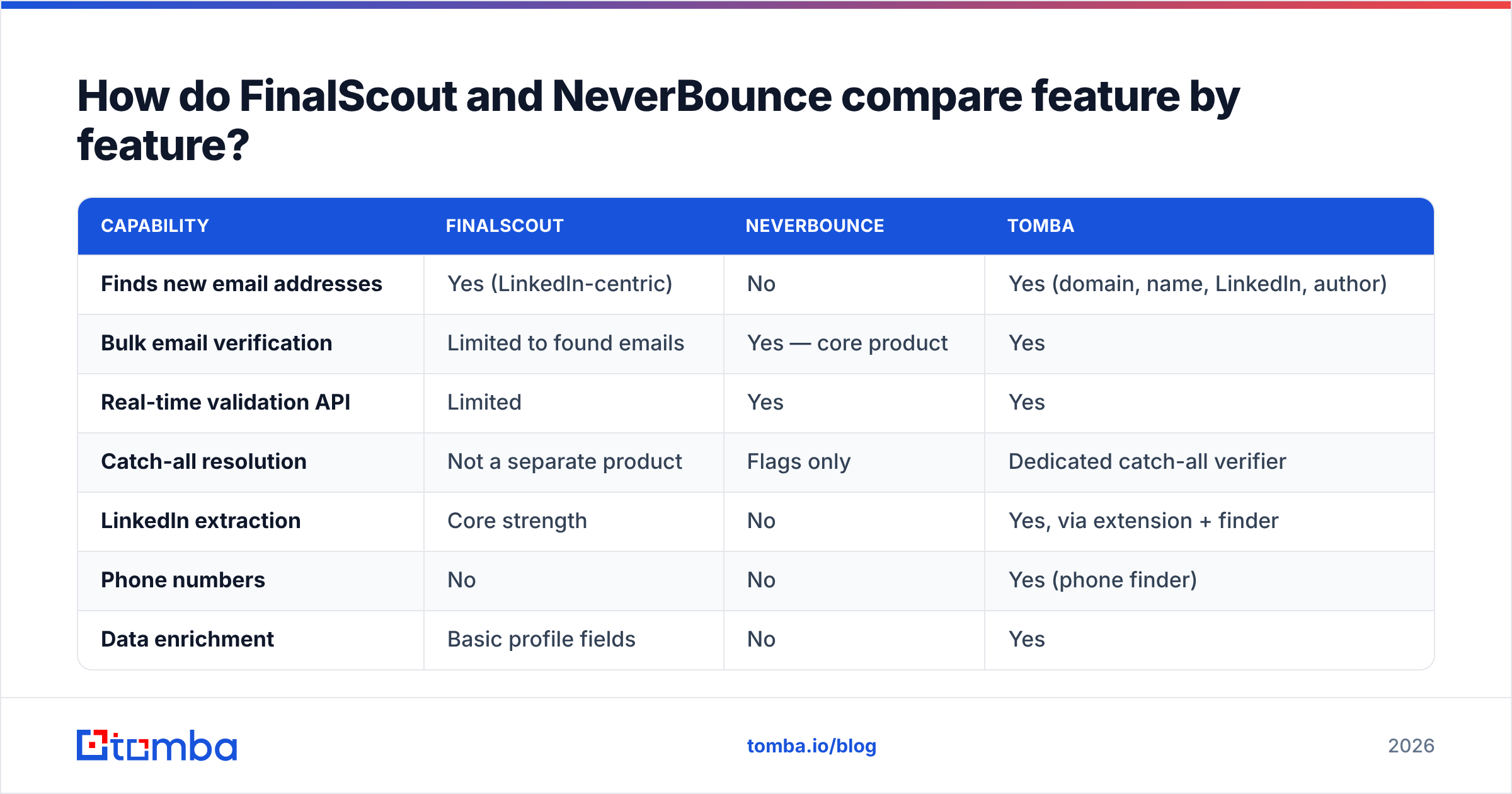
FinalScout vs NeverBounce: feature by feature#
| Capability | FinalScout | NeverBounce | Tomba |
|---|---|---|---|
| Finds new email addresses | Yes (LinkedIn-centric) | No | Yes (domain, name, LinkedIn, author) |
| Bulk email verification | Limited to found emails | Yes — core product | Yes |
| Real-time validation API | Limited | Yes | Yes |
| Catch-all resolution | Not a separate product | Flags only | Dedicated catch-all verifier |
| LinkedIn extraction | Core strength | No | Yes, via extension + finder |
| Phone numbers | No | No | Yes (phone finder) |
| Data enrichment | Basic profile fields | No | Yes |
| Bulk CSV workflow | Export-oriented | Upload-oriented | Both directions |
| Pricing model | Credit tiers | Per-verification volume | Flat monthly plans |
| Free tier | Limited monthly credits | Trial credits | 25 searches/mo |
The grid makes the pattern obvious. FinalScout owns the left side of the pipeline. NeverBounce owns the right side. Neither owns the middle. The middle is where you find an address and confirm it is live before it enters a sequence. That gap is where most teams lose money or inbox placement.
Which one is more accurate?#
That is the wrong question. The two numbers measure different things.
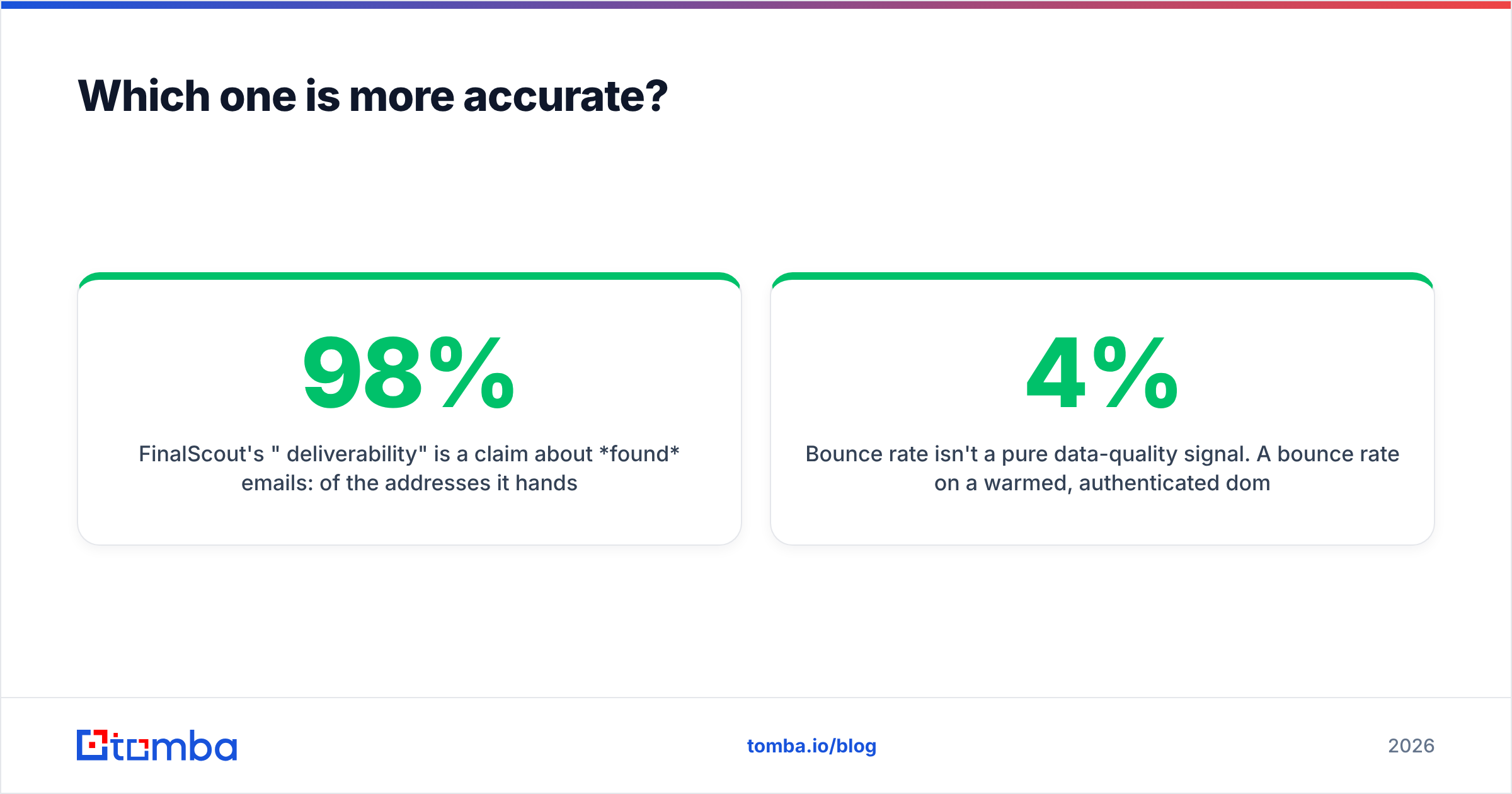
FinalScout's “98% delivery” is a claim about the emails it finds. Of the addresses it hands you, it expects 98% to accept mail. NeverBounce's “99.9% accuracy” is a claim about its verdicts. When it calls an address valid or invalid, it expects to be right 99.9% of the time.
You cannot average those numbers. You should not compare them side by side either. Measure what matters to you instead: hit rate and bounce rate. Hit rate is the share of your target list that produced a usable address. Bounce rate is the share of sends that hard-bounced.

Two notes on reading any accuracy claim in this category:
- Vendor tests run on vendor-friendly lists. A finder tested on Fortune 500 marketing directors always looks better than the same tool tested on 12-person agencies. Run your own 200-contact sample before you sign a yearly deal.
- Bounce rate is not a pure data signal. A 4% bounce on a warm, signed domain is not the same as 4% on a cold one. The two hit your sender reputation very differently. Keep the variables apart.
Want an outside read? G2's email verification category beats any vendor case study page. Filter the reviews by company size close to yours.
How much does FinalScout vs NeverBounce cost in 2026?#
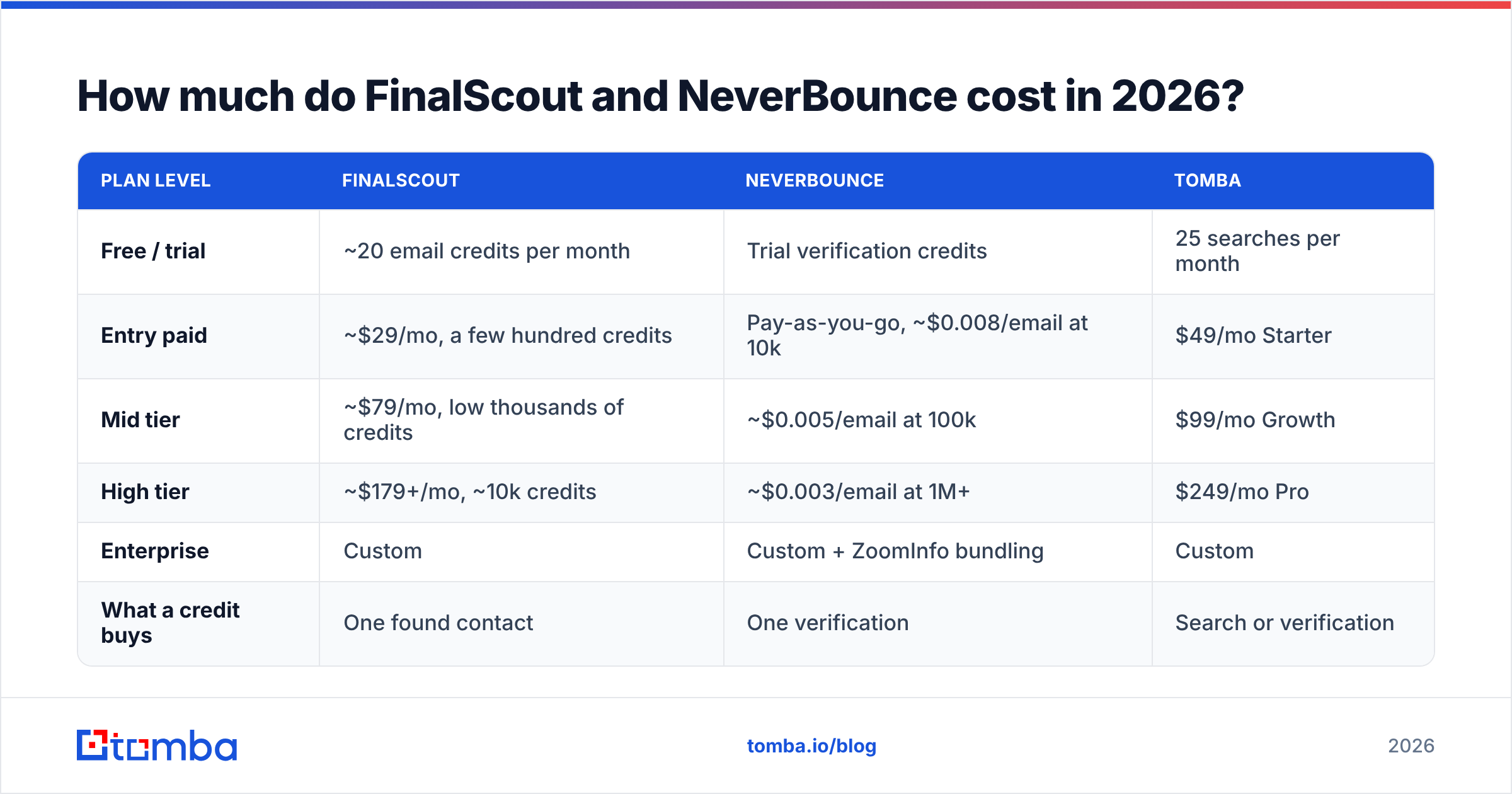
Both vendors change prices often. Treat these numbers as a guide and check the pricing pages before you buy.
| Plan level | FinalScout | NeverBounce | Tomba |
|---|---|---|---|
| Free / trial | ~20 email credits per month | Trial verification credits | 25 searches per month |
| Entry paid | ~$29/mo, a few hundred credits | Pay-as-you-go, ~$0.008/email at 10k | $49/mo Starter |
| Mid tier | ~$79/mo, low thousands of credits | ~$0.005/email at 100k | $99/mo Growth |
| High tier | ~$179+/mo, ~10k credits | ~$0.003/email at 1M+ | $249/mo Pro |
| Enterprise | Custom | Custom + ZoomInfo bundling | Custom |
| What a credit buys | One found contact | One verification | Search or verification |
Read that last row again. It is where budgets go sideways. A NeverBounce credit is cheap because a check is cheap. A FinalScout credit costs more because a search is harder work. In every FinalScout vs NeverBounce cost debate, someone compares “$0.008 per email” with “$29 for 500 credits.” One is a lookup. The other is a check. That mix-up is the most common mistake here.
Model the stacked cost instead. Say you need 5,000 new contacts a month and want them verified. That means a FinalScout mid-tier plan plus a NeverBounce top-up. Then add the time spent exporting, re-importing, matching, and deduping between the two. Now compare that with a single plan at Tomba pricing, where find and verify pull from one pool. Below roughly 50,000 contacts a month, the math usually favors one tool.
Do you actually need both tools?#
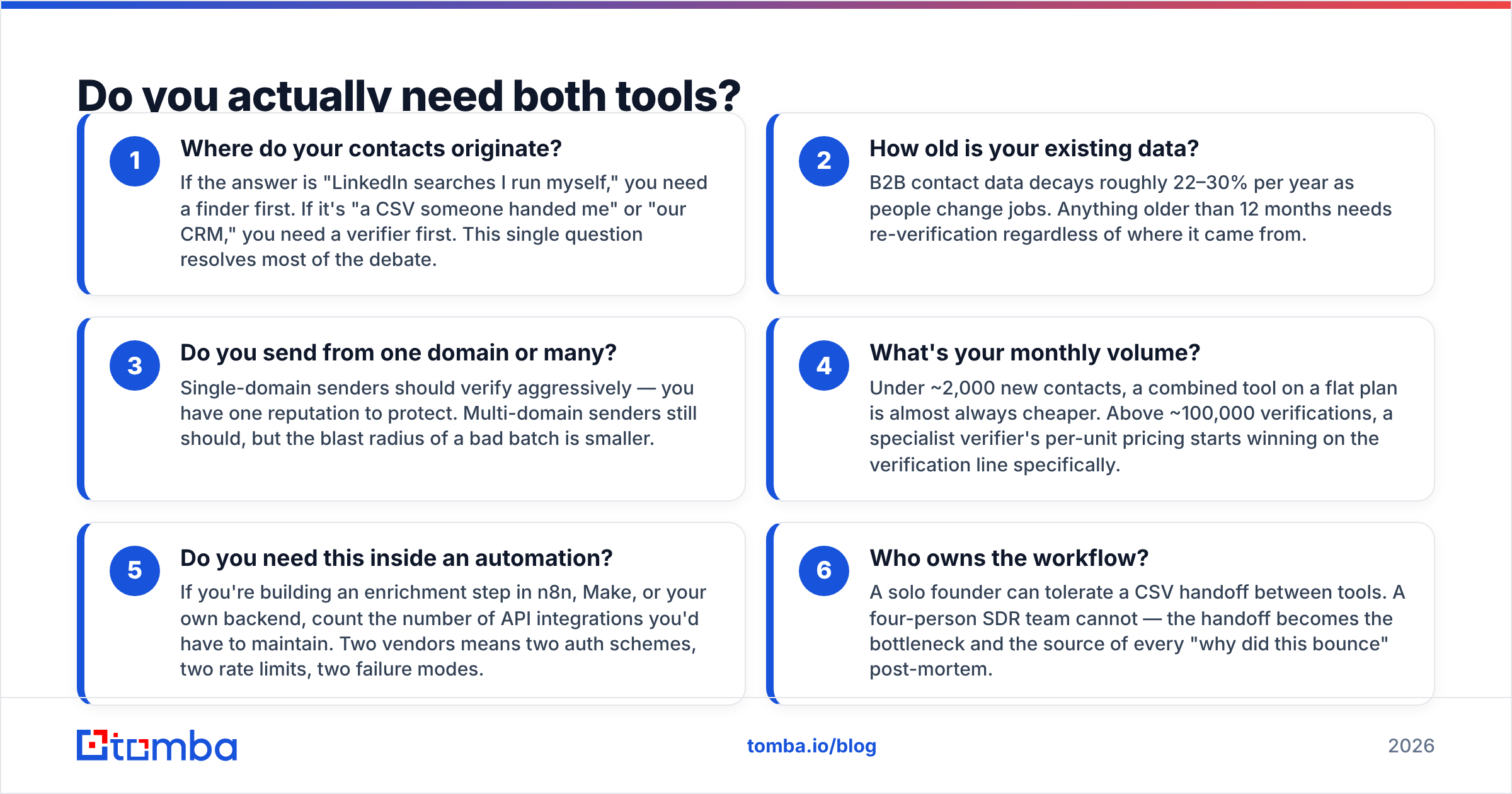
Here is the decision framework. Apply it in order. The first three questions are about your data.
- Where do your contacts come from? “LinkedIn searches I run myself” means you need a finder first. “A CSV someone handed me” or “our CRM” means you need a checker first. This one question settles most of the debate.
- How old is your data? B2B contact data decays about 22–30% a year as people change jobs. Anything older than 12 months needs a fresh check.
- Do you send from one domain or many? Single-domain senders should verify hard. You only have one reputation to protect. Multi-domain senders should verify too, but a bad batch does less damage.
The last three questions are about volume and workflow.
- What is your monthly volume? Under ~2,000 new contacts, one combined tool on a flat plan almost always wins. Above ~100,000 checks, a specialist's per-unit price wins on the verification line.
- Do you need this inside an automation? Building an enrichment step in n8n, Make, or your own backend? Count the integrations you must maintain. Two vendors mean two auth schemes, two rate limits, and two failure modes.
- Who owns the workflow? A solo founder can live with a CSV handoff. A four-person SDR team cannot. The handoff becomes the bottleneck and the cause of every “why did this bounce” post-mortem.
Answered “LinkedIn” to #1 and “under 2,000” to #4? You are paying two vendors to do one job. Answered “an inherited 500k-row database” instead? Then a dedicated checker earns its keep, and a finder is optional.
Where does Tomba fit between these two?#
Tomba sits in the middle of the pipeline that FinalScout vs NeverBounce splits in half.
The core product is the email finder. Give it a domain, a name, a company, or a LinkedIn profile. It returns the work address with a confidence score and the public sources behind it. The email verifier runs the same SMTP, MX, disposable, and role-account checks a specialist would. The catch-all verifier then tries to settle the accept-all domains that plain SMTP probing has to give up on.
In practice, one API call can find and check an address at once. One credit pool covers both. One invoice arrives. For bulk work, the bulk email finder handles CSVs in both directions. Turn a list of names into verified addresses, or clean a list you already have.

Two honest caveats, because this is a comparison and not a brochure:
- If your volume is huge — millions of checks a quarter, no discovery needed — a pure verifier's unit price will beat a bundled plan. Buy the specialist.
- If your whole motion is LinkedIn post scraping, FinalScout's social sourcing is more specialized than a general finder. Match the tool to the source.
For everyone in between, and that is most B2B teams under 50 people, the one-platform case holds.
FinalScout vs NeverBounce: which should you choose in 2026?#
| If you… | Choose |
|---|---|
| Prospect exclusively inside Sales Navigator | FinalScout |
| Need to clean a large inherited database | NeverBounce |
| Validate emails on signup forms in real time | NeverBounce |
| Find and verify contacts in one workflow | Tomba |
| Build enrichment into an automated pipeline | Tomba or NeverBounce API |
| Need phone numbers alongside emails | Tomba |
| Verify 500k+ addresses per quarter | NeverBounce |
| Run outbound solo on a tight budget | Tomba (one plan, both jobs) |
Here is the takeaway that matters. Do not buy a checker to solve a discovery problem. Do not trust a finder's delivery promise to clean a list it never produced. Work out which half you are missing. Then decide whether you want two specialists or one platform that covers both.
Would you rather skip two vendor relationships, two credit ledgers, and a CSV bridge? Start with the Tomba Email Finder. The free tier gives you 25 searches a month. That is enough to test accuracy on a real slice of your list before you spend a thing. Find the address, verify it in the same call, and push it straight into your sequence.
Related guides#
Ready to find emails that actually work?
Join 150,000+ professionals who stopped guessing and started sending. Free credits on signup — no credit card required.
Get the Tomba newsletter
Practical outbound tactics and product updates — once every two weeks.
About the author