FinalScout vs Prosperfleet Valgen: 2026 Honest Comparison
One tool is a LinkedIn-native email finder with a huge user base. The other barely has a public footprint. Here is the honest, evidence-first breakdown of FinalScout vs Prosperfleet Valgen — plus what to do when a vendor won't publish its numbers.
TL;DR
- FinalScout is a real, widely reviewed LinkedIn-native email finder with a public pricing page, a Chrome extension, and thousands of third-party reviews. It is the safer of the two by a wide margin.
- Prosperfleet Valgen has almost no verifiable public footprint — no indexed pricing page, no meaningful review volume, no published accuracy methodology. That is not proof it is bad, but it is a procurement risk you have to price in.
- If your entire motion runs through LinkedIn Sales Navigator, FinalScout is a legitimate pick. If you need domain-level coverage, API access, and bulk verification, neither tool is the natural fit.
- The metric that actually matters is cost per verified, deliverable contact — not credits, not headline accuracy claims. Most teams miscount this by 2-3x.
- Before you sign with any unfamiliar vendor, run the 6-point due-diligence checklist near the bottom of this post. It takes 30 minutes and has saved teams five figures.
What are FinalScout and Prosperfleet Valgen?#
FinalScout is a LinkedIn-first prospecting tool. You browse a profile, a Sales Navigator list, or a group, and its Chrome extension pulls out professional email addresses and pushes them into a list. It also bolts on AI email drafting, which is the feature most of its marketing leans on. The company advertises high deliverability on found addresses and publishes plans openly on finalscout.com. It has a substantial review trail on public marketplaces like G2, which is the single most useful signal you get for free when evaluating a vendor.
Prosperfleet Valgen is the harder half of this comparison to write honestly. As of early 2026, there is no widely indexed product site, no published pricing tier, no documented data-sourcing policy, and no review volume that would let anyone — us included — make a defensible accuracy claim about it. We are not going to invent numbers to fill a table. If you landed here because a rep pitched you Prosperfleet Valgen, the correct read is: treat it as an unverified vendor and demand a paid pilot on your own list before committing budget.
That asymmetry is the real story of this comparison, and it is worth more to you than a fabricated feature grid.

How do FinalScout and Prosperfleet Valgen compare head-to-head?#
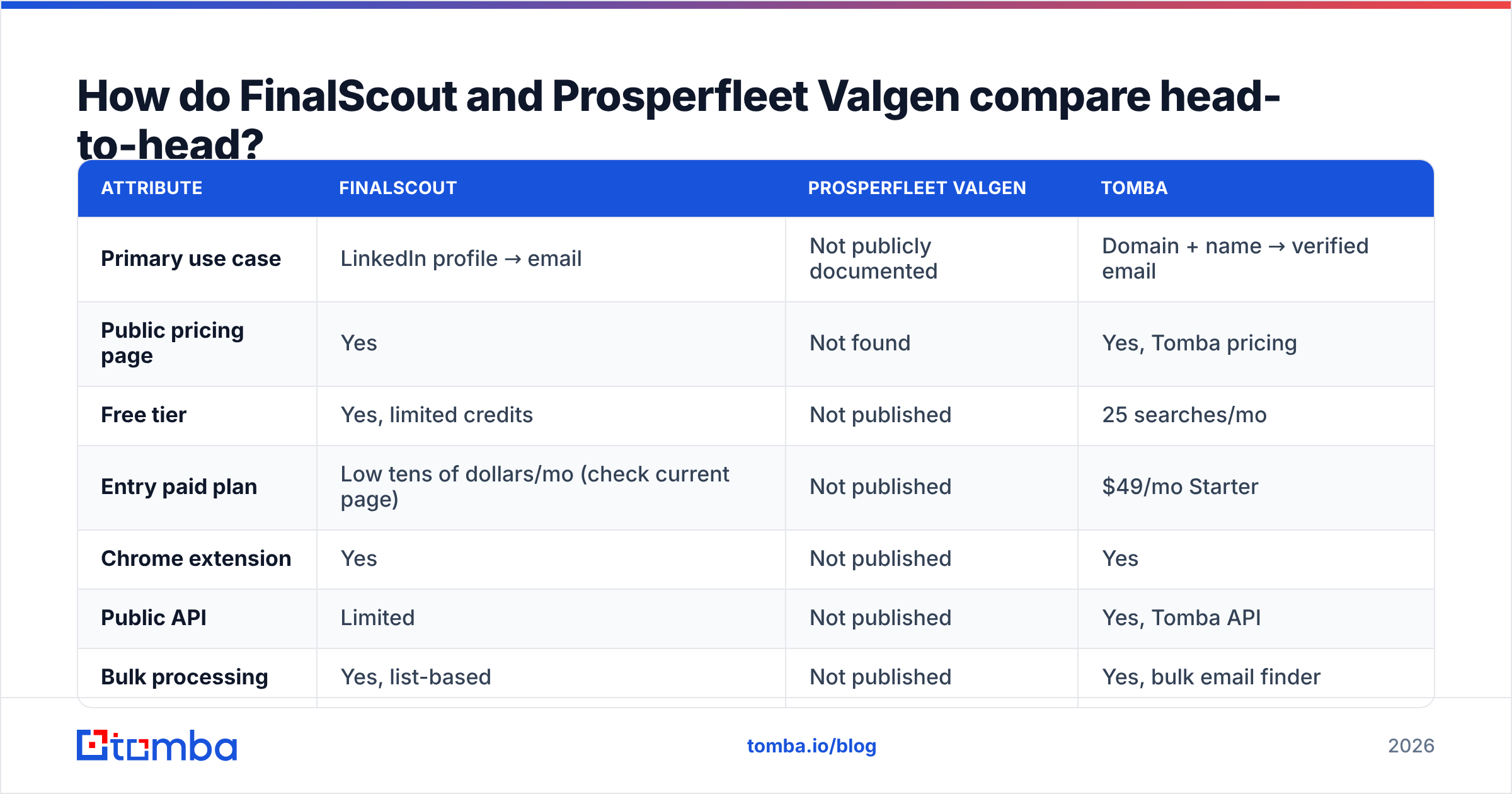
Here is what can be stated with confidence, and where the gaps sit. "Not published" means exactly that — we could not verify it, so we are not filling it in.
| Attribute | FinalScout | Prosperfleet Valgen | Tomba |
|---|---|---|---|
| Primary use case | LinkedIn profile → email | Not publicly documented | Domain + name → verified email |
| Public pricing page | Yes | Not found | Yes, Tomba pricing |
| Free tier | Yes, limited credits | Not published | 25 searches/mo |
| Entry paid plan | Low tens of dollars/mo (check current page) | Not published | $49/mo Starter |
| Chrome extension | Yes | Not published | Yes |
| Public API | Limited | Not published | Yes, Tomba API |
| Bulk processing | Yes, list-based | Not published | Yes, bulk email finder |
| Catch-all handling | Not documented in detail | Not published | Dedicated catch-all verifier |
| Third-party review volume | High | Negligible | Moderate and growing |
| Data-source transparency | Partial | None found | Published data sources |
Two things jump out. First, FinalScout is genuinely good at the one job it was built for and does not pretend to be a full data platform. Second, the Prosperfleet Valgen column is mostly empty — and an empty column in a buying decision is a cost, not a neutral.

Which one actually finds more valid emails?#
Nobody can answer this for Prosperfleet Valgen without a benchmark, so let's talk about how to run one yourself — because vendor-published accuracy figures are close to useless.
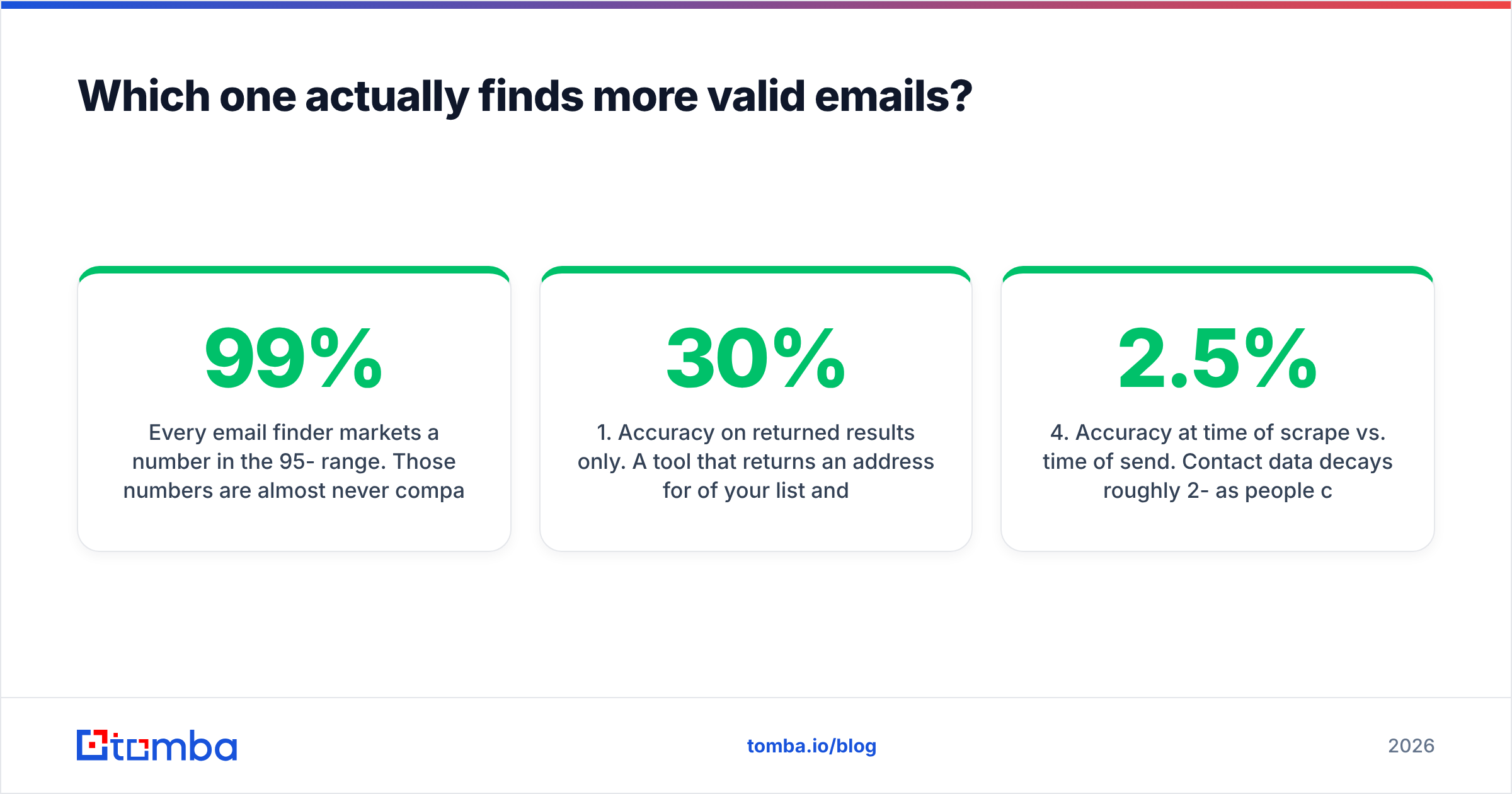
Every email finder markets a number in the 95-99% range. Those numbers are almost never comparable, because vendors define the denominator differently:
- Accuracy on returned results only. A tool that returns an address for 30% of your list and gets 97% of those right will advertise "97% accurate." Its actual coverage is terrible.
- Accuracy including catch-all domains. Some vendors count a catch-all "accept-all" response as a valid hit. It is not. It is an unknown, and on a real send it bounces often enough to hurt you.
- Accuracy on a curated test set. Benchmarks built from large, well-indexed tech companies inflate everyone's score. Your ICP is probably 40-person manufacturers in the Midwest, not Stripe.
- Accuracy at time of scrape vs. time of send. Contact data decays roughly 2-2.5% per month as people change jobs. A file that was 96% accurate in January is meaningfully worse by June.

The fix is boring and effective: build a 200-row golden set from accounts you already have relationships with, where you know the real addresses. Run each candidate tool against it blind. Score three columns — found, correct, and confidently wrong. That last column is the one that kills campaigns, because a confidently wrong address bounces and drags your domain reputation with it.
Then run every result through an independent email verifier before it touches your sequencer. Never let the tool that found the address be the only tool that validates it. That is grading your own homework.
What do they actually cost per usable contact?#
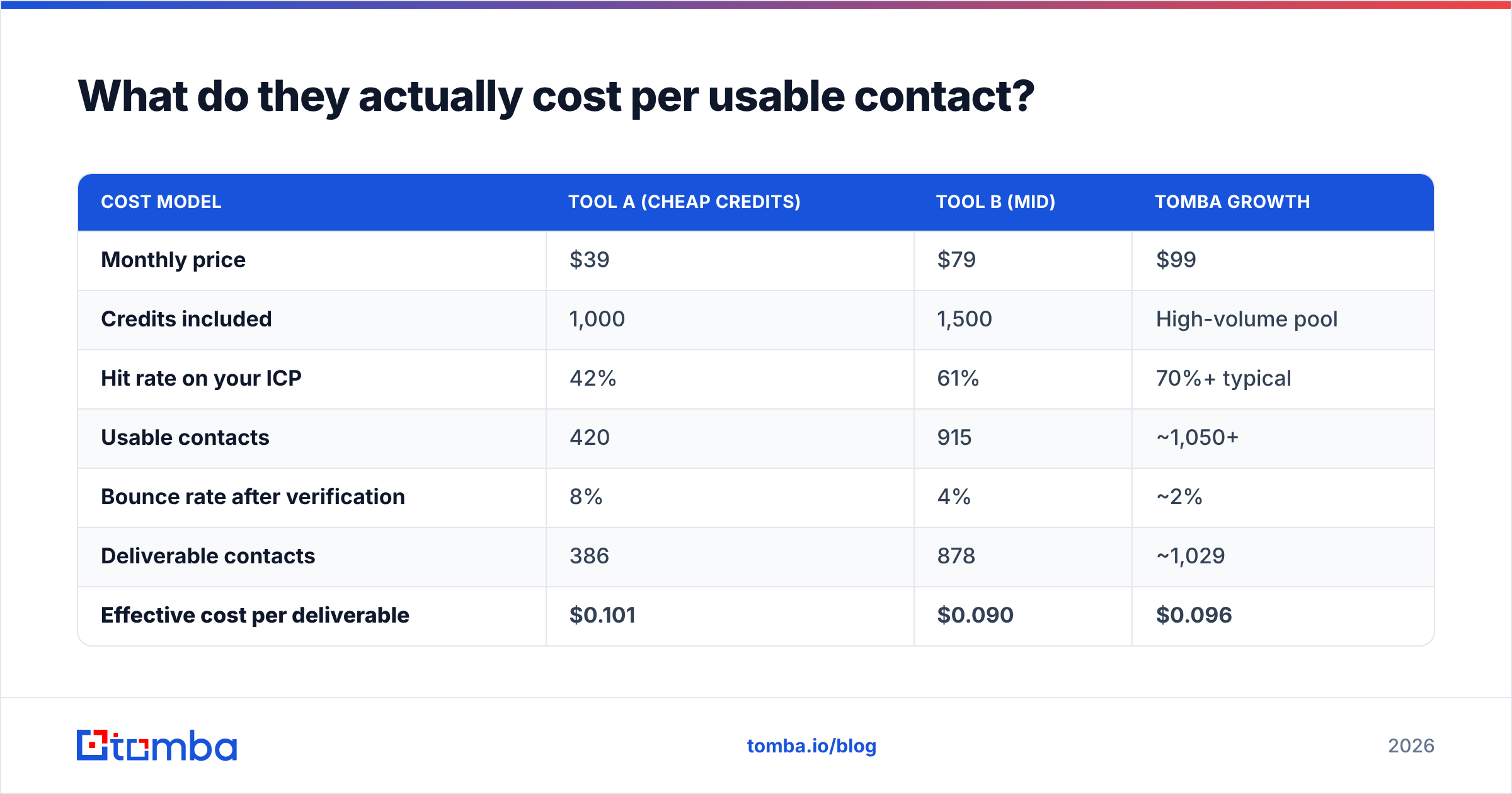
Credit pricing hides the real number. Here is the arithmetic that matters, using representative figures — plug in your own quotes:
| Cost model | Tool A (cheap credits) | Tool B (mid) | Tomba Growth |
|---|---|---|---|
| Monthly price | $39 | $79 | $99 |
| Credits included | 1,000 | 1,500 | High-volume pool |
| Hit rate on your ICP | 42% | 61% | 70%+ typical |
| Usable contacts | 420 | 915 | ~1,050+ |
| Bounce rate after verification | 8% | 4% | ~2% |
| Deliverable contacts | 386 | 878 | ~1,029 |
| Effective cost per deliverable | $0.101 | $0.090 | $0.096 |
The cheapest sticker price produced the worst cost per deliverable contact in this model, and that is the normal outcome. A low hit rate on your specific ICP silently doubles your real price, and every bounce carries a second, uncosted penalty against your sender reputation.
Ask any vendor — FinalScout, Prosperfleet Valgen, anyone — two questions before you buy:
- Do failed lookups consume credits? Some tools charge you for the miss. Over a 10,000-row list with a 50% hit rate, that doubles your bill.
- Are catch-all results billed as hits? If yes, you are paying full price for a maybe.

Where does each tool fit in a real workflow?#
FinalScout fits the seller who lives inside LinkedIn. You are building lists from Sales Navigator searches, you work profile by profile, your volume is in the hundreds per month, and you want the email and a first-draft message in the same motion. For that shape of work it is coherent and reasonably priced. Pair it with disciplined LinkedIn outreach sequencing and it holds up.
Where FinalScout struggles is anything that starts from a company rather than a person. If your account list is 800 domains from a CRM export and you need the VP of Ops at each one, a LinkedIn-scraping extension is the wrong shape of tool. You want domain search that takes a domain and returns the people plus their pattern, and you want it available over an API so it runs on a schedule instead of in a browser tab.
Prosperfleet Valgen fits — genuinely unknown. If a rep is telling you it fits your workflow, make them prove it on your golden set, not theirs.
For teams doing account-based work at scale, the practical architecture looks like this:
- Source the account list from your ICP definition, not from whatever the tool's database happens to hold.
- Resolve people to domains using a domain-level finder rather than a profile-level scraper.
- Enrich with title, seniority, and firmographics so your segmentation is real — see data enrichment for what this layer should return.
- Verify independently, including a specific pass for catch-all domains, which behave differently from standard mailboxes.
- Suppress and dedupe against your CRM before anything enters a sequence.
- Re-verify anything older than 90 days, because decay is relentless and re-verification is far cheaper than a bounce.
What should you check before buying an unproven vendor?#
This is the section to actually use. When a vendor has no public track record — Prosperfleet Valgen today, some other name next quarter — run this before you sign anything:
- Demand a written data-sourcing statement. Where does the data come from? Scraping, opt-in partners, public records, user contribution? A vendor that will not answer this in writing is a compliance liability, not a bargain.
- Check GDPR and CCPA posture explicitly. Ask for the DPA, the lawful basis for processing EU contact data, and the data-subject deletion process. If they improvise the answer on a call, walk.
- Run a blind pilot on your golden set. 200 known-correct rows, scored by you. Do not accept a vendor-run demo on a vendor-chosen list.
- Test the failure modes, not the happy path. Feed it obscure domains, non-English names, recently acquired companies, and freemail-heavy SMBs. Every tool looks great on Fortune 500 tech.
- Confirm the exit path. Can you export everything in CSV without a support ticket? Is there an API you can pull from? Data you cannot get out is data you do not own.
- Look for corroboration outside the vendor's own site. Review platforms, a real changelog, named customers you can actually reach. A vendor with a real product ships visibly — Tomba publishes a changelog for exactly this reason.
If a vendor clears all six, the lack of brand recognition might genuinely be an opportunity — early-stage tools often price aggressively. If it clears two, you are not buying software, you are buying risk.
Is there a better third option?#
Depends on the shape of your problem, and it is worth naming the honest trade-offs.
If your motion is LinkedIn-native and low-volume, FinalScout is fine and you can stop reading. If you need prebuilt, filterable lists rather than a lookup engine, a database-first provider like BookYourData is a reasonable direction — it solves a different problem (buy a segment) than a finder does (resolve a known person), and for some teams that is the faster path to first meetings.
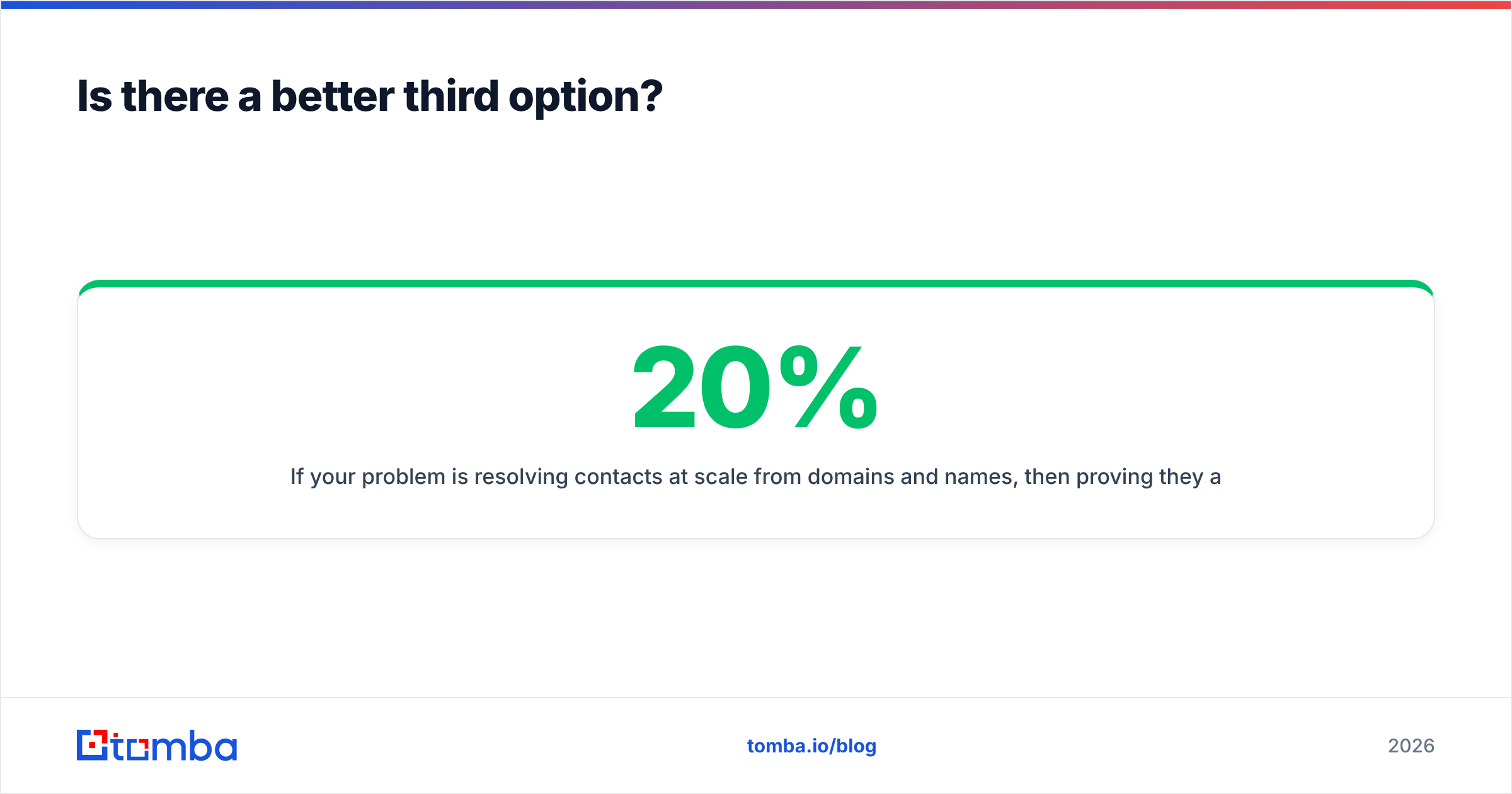
If your problem is resolving contacts at scale from domains and names, then proving they are deliverable, that is where an infrastructure-style finder earns its keep. Tomba sits here: Tomba Email Finder for lookups, domain search for company-wide sweeps, a dedicated catch-all verifier for the awkward 20% of domains that break naive validation, and an API plus Google Sheets and CRM integrations so the workflow runs without a human in a browser tab. Pricing is public and unglamorous: free tier at 25 searches/month, Starter $49/month, Growth $99/month, Pro $249/month.
The honest caveat: Tomba is not a LinkedIn scraper with an AI writer attached. If that specific combination is what you want in one window, FinalScout does it more directly.
So which one should you pick in 2026?#
Pick FinalScout if LinkedIn is your primary sourcing surface, your volume is modest, and you value speed over pipeline architecture. It is a known quantity with a public price and a public review trail — and in vendor selection, "known quantity" is worth real money.
Do not pick Prosperfleet Valgen on faith. Not because it is bad — we have no evidence either way — but because you cannot make a defensible spend decision on a vendor with no verifiable accuracy data, no published pricing, and no independent reviews. Put it through the six-point checklist. If it clears, pilot it against your golden set alongside two known tools. If it will not submit to that, the decision has been made for you.
Pick a domain-first platform if your outbound runs on account lists, needs API automation, and lives or dies on deliverability. That is a different tool category than either name in this title.
Whatever you choose, hold the line on two rules: verify independently of whoever found the address, and measure cost per deliverable contact rather than cost per credit. Those two habits will outperform any tool switch you make this year.
Ready to test that against your own list? Start with Tomba Email Finder — the free tier gives you 25 searches a month, enough to run a real golden-set benchmark before you spend a dollar. Run it head-to-head with whatever you are considering, score the results yourself, and let the numbers pick the winner.
Related guides#
Ready to find emails that actually work?
Join 150,000+ professionals who stopped guessing and started sending. Free credits on signup — no credit card required.
Get the Tomba newsletter
Practical outbound tactics and product updates — once every two weeks.
About the author