FinalScout vs Pubrio: Which B2B Email Finder Wins in 2026?
One is a LinkedIn-first email extractor, the other is a GTM database with intent signals. Here is how FinalScout and Pubrio actually differ on coverage, verification, credits and price — and when neither is the right pick.
FinalScout vs Pubrio is a common shortlist, but it is not a fair fight. The two tools do different jobs. FinalScout pulls emails out of LinkedIn profiles. Pubrio builds target lists from a large B2B database. Below, FinalScout vs Pubrio is compared on coverage, credits, pricing and bounce rates — plus when neither one is the right buy.
TL;DR
- FinalScout is a LinkedIn-first extractor. It assumes you are already browsing profiles or Sales Navigator lists. It pulls the emails out, then drafts outreach with AI.
- Pubrio is a database-first GTM platform. You start from filters: industry, headcount, tech stack, buying intent. Then you export contacts you never sourced by hand.
- FinalScout vs Pubrio is rarely a head-to-head fight. If your buyers live on LinkedIn, FinalScout wins on workflow. If you need net-new accounts at volume, Pubrio's search wins.
- Both charge in credits, and both have limits worth reading twice. Export caps and LinkedIn account risk sit on one side. Coverage gaps outside North America and tech sit on the other.
- Neither is a verification engine. If bounce rate is your bottleneck, a dedicated finder plus verifier stack (Tomba, free at 25 searches a month) is the cheaper fix.
What are FinalScout and Pubrio?#
FinalScout is a Chrome extension built around LinkedIn. You open a profile, a Sales Navigator search, or a group member list. The tool reads the contact and tries to resolve a valid work email.
The AI layer is its selling point. The same tool that finds the address will also draft a cold email from the profile. The vendor markets a high deliverability guarantee on what it returns.
Pubrio sits in a different category. It is a B2B contact and company database with a search screen. You filter by company size, tech stack, hiring signals and intent topics, then export the matches.
Pubrio also ships LinkedIn tools and AI content features. But the core of the product is the database and its signals, not a browser extension.
That split drives almost every difference below. One tool answers "what is this person's email?" The other answers "who should I email at all?"

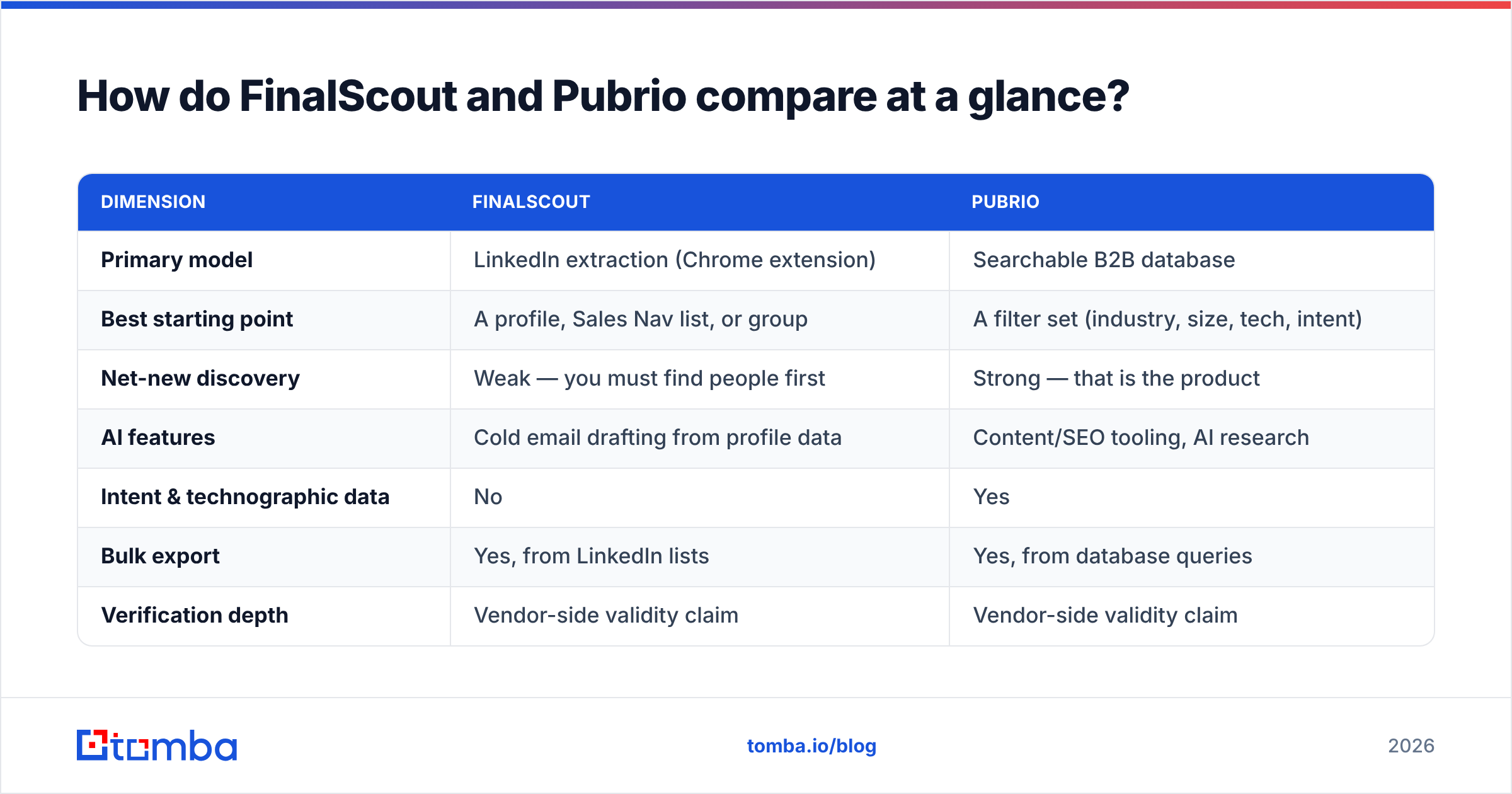
FinalScout vs Pubrio: how do they compare at a glance?#
| Dimension | FinalScout | Pubrio |
|---|---|---|
| Primary model | LinkedIn extraction (Chrome extension) | Searchable B2B database |
| Best starting point | A profile, Sales Nav list, or group | A filter set (industry, size, tech, intent) |
| Net-new discovery | Weak — you must find people first | Strong — that is the product |
| AI features | Cold email drafting from profile data | Content/SEO tooling, AI research |
| Intent & technographic data | No | Yes |
| Bulk export | Yes, from LinkedIn lists | Yes, from database queries |
| Verification depth | Vendor-side validity claim | Vendor-side validity claim |
| API access | Limited | Available on higher tiers |
| Typical buyer | SDR, recruiter, solo founder | RevOps, demand gen, outbound team |
| Free entry | Small monthly credit allowance | Limited free credits |
Treat plan details as directional. Both vendors have repackaged their tiers more than once. Check the live pricing page before you commit budget.
Also confirm what counts as a credit: a search, a returned email, or a verified one? That single definition moves your real cost more than the headline price does.
What is FinalScout genuinely good at?#
Speed on a known list. Say a recruiter already has a Sales Navigator search dialed in. FinalScout turns two steps into one: no separate export, then enrich. You run the search, click extract, and the addresses land with the profile context attached.
Profile-to-email context. The extension reads the profile while it resolves the address. So the AI draft has real material: current title, tenure, recent role change, company blurb. That beats a mail-merge token, even if you still rewrite most of it.
Recruiting use cases. Recruiters live inside LinkedIn. A tool that never asks them to leave it wins on workflow, whatever the record counts say.
Where it gets thin: FinalScout inherits LinkedIn's limits. Your volume is capped by what your account can safely view. Heavy scraping of any kind carries account risk. That is true of every extension-based tool, not just this one. And if a person has no LinkedIn profile, FinalScout has nothing to work from.
What is Pubrio genuinely good at?#
Building a target list from zero. This is the gap FinalScout leaves. Say your ICP is "Series A–B SaaS firms in DACH running HubSpot with an open RevOps role." You cannot browse your way there. You need a query.
Signals, not just records. Intent topics, tech stack and hiring data change your priorities, not just your targeting. A list of 4,000 matching companies is noise. The 60 researching your category this month are a week of work.
Team-scale workflows. Database platforms are built for shared lists, CRM dedupe and repeat exports. Extensions usually are not.
Where it gets thin: coverage is never even. Every B2B provider, Pubrio included, is denser in North American tech. It thins out in mid-market European manufacturing, LATAM services or APAC SMBs.
So run your own sample of 100 known-good companies first. Do that before you believe any published coverage claim. Freshness is the second issue: a contact captured 18 months ago, at a company with 30% annual churn, is a coin flip.
Which one actually returns more valid emails?#
You cannot settle FinalScout vs Pubrio from marketing pages. Each vendor defines "accuracy" its own way. Three numbers matter:
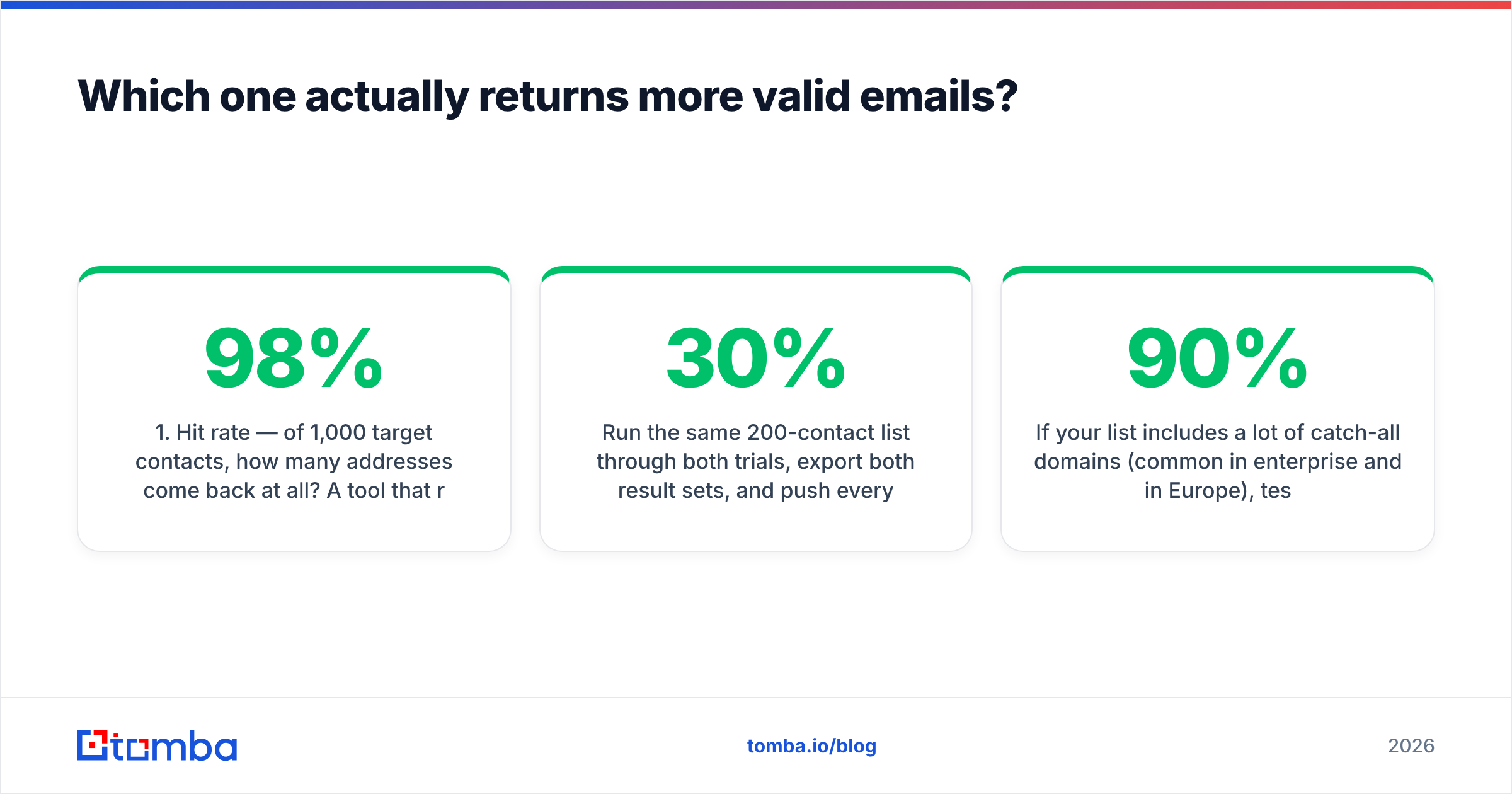
- Hit rate — of 1,000 target contacts, how many addresses come back at all? A tool that returns 400 at 98% validity is worse for pipeline than one returning 800 at 92%.
- Validity rate — of the addresses returned, how many survive SMTP checks by a neutral third party, not the vendor's own checker?
- Catch-all handling — how many results are marked "valid" when the domain simply accepts everything? Most inflated accuracy claims live here.

Run the same 200-contact list through both trials. Export both result sets. Then push everything through an independent email verifier before you score anything. The two tools usually disagree on 15–30% of records. The overlap set is where both are confident and correct.
Does your list hold a lot of catch-all domains? That is common in enterprise and in Europe. Test it with a catch-all verifier. A tool that returns 90% "valid" on a catch-all-heavy list is not accurate. It is optimistic.

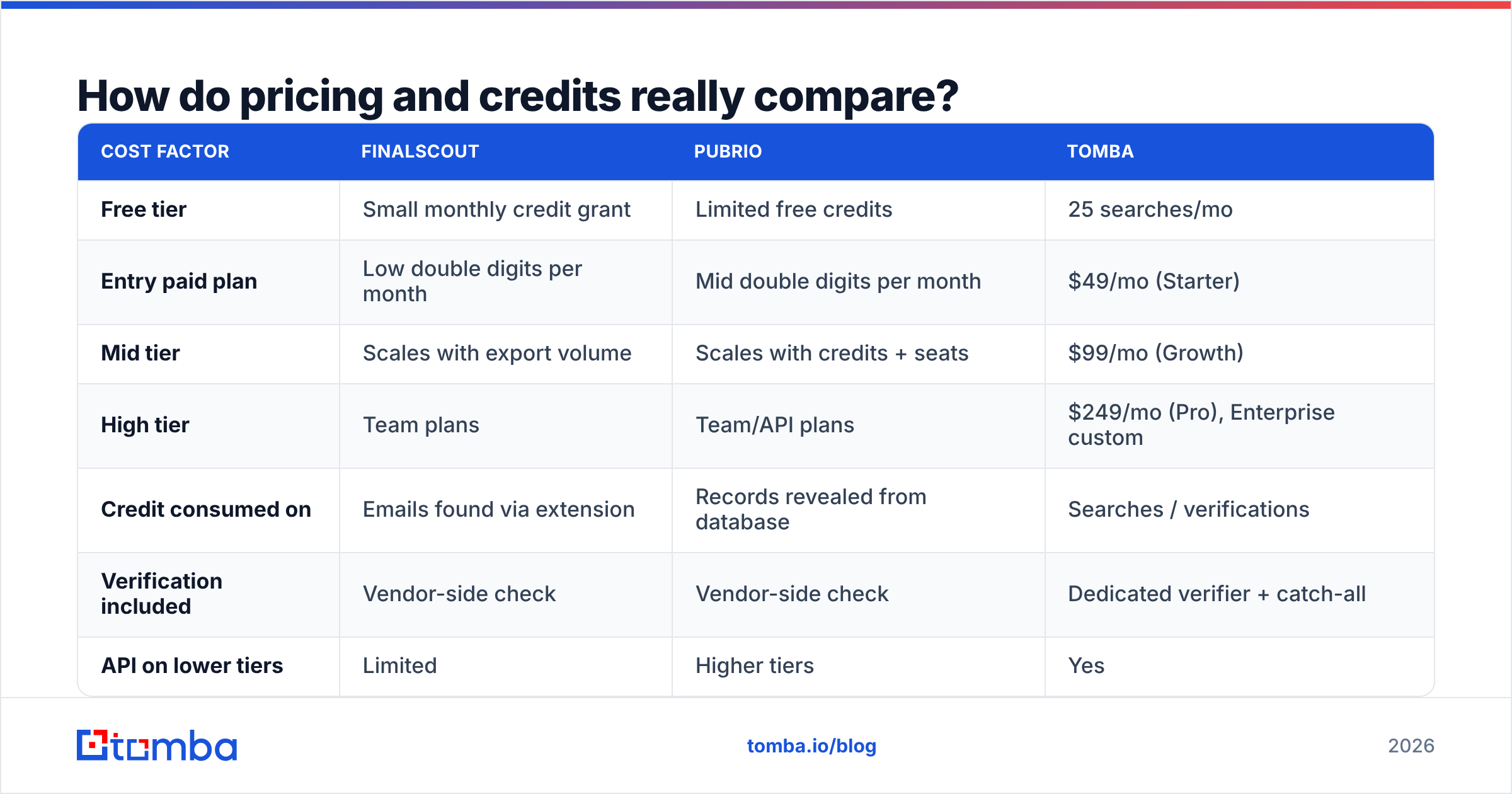
How do FinalScout vs Pubrio pricing and credits compare?#
| Cost factor | FinalScout | Pubrio | Tomba |
|---|---|---|---|
| Free tier | Small monthly credit grant | Limited free credits | 25 searches/mo |
| Entry paid plan | Low double digits per month | Mid double digits per month | $49/mo (Starter) |
| Mid tier | Scales with export volume | Scales with credits + seats | $99/mo (Growth) |
| High tier | Team plans | Team/API plans | $249/mo (Pro), Enterprise custom |
| Credit consumed on | Emails found via extension | Records revealed from database | Searches / verifications |
| Verification included | Vendor-side check | Vendor-side check | Dedicated verifier + catch-all |
| API on lower tiers | Limited | Higher tiers | Yes |
Exact FinalScout and Pubrio figures move, so confirm both on the vendors' own pages. The structural question does not move: are you paying for discovery, for resolution, or for verification?
FinalScout charges mostly for resolution. Pubrio charges mostly for discovery. If you already pay a sequencer, a data provider and a verifier, you may be buying the same credit three times. Tomba pricing is worth a benchmark, because it prices finding and verifying in one place.
One underrated cost is wasted sends. A 12% bounce rate on 5,000 emails is not just 600 lost sends. It also damages domain reputation, which taxes every campaign after it. Cheap data that bounces is the most expensive data you can buy.
Which should you choose for your workflow?#
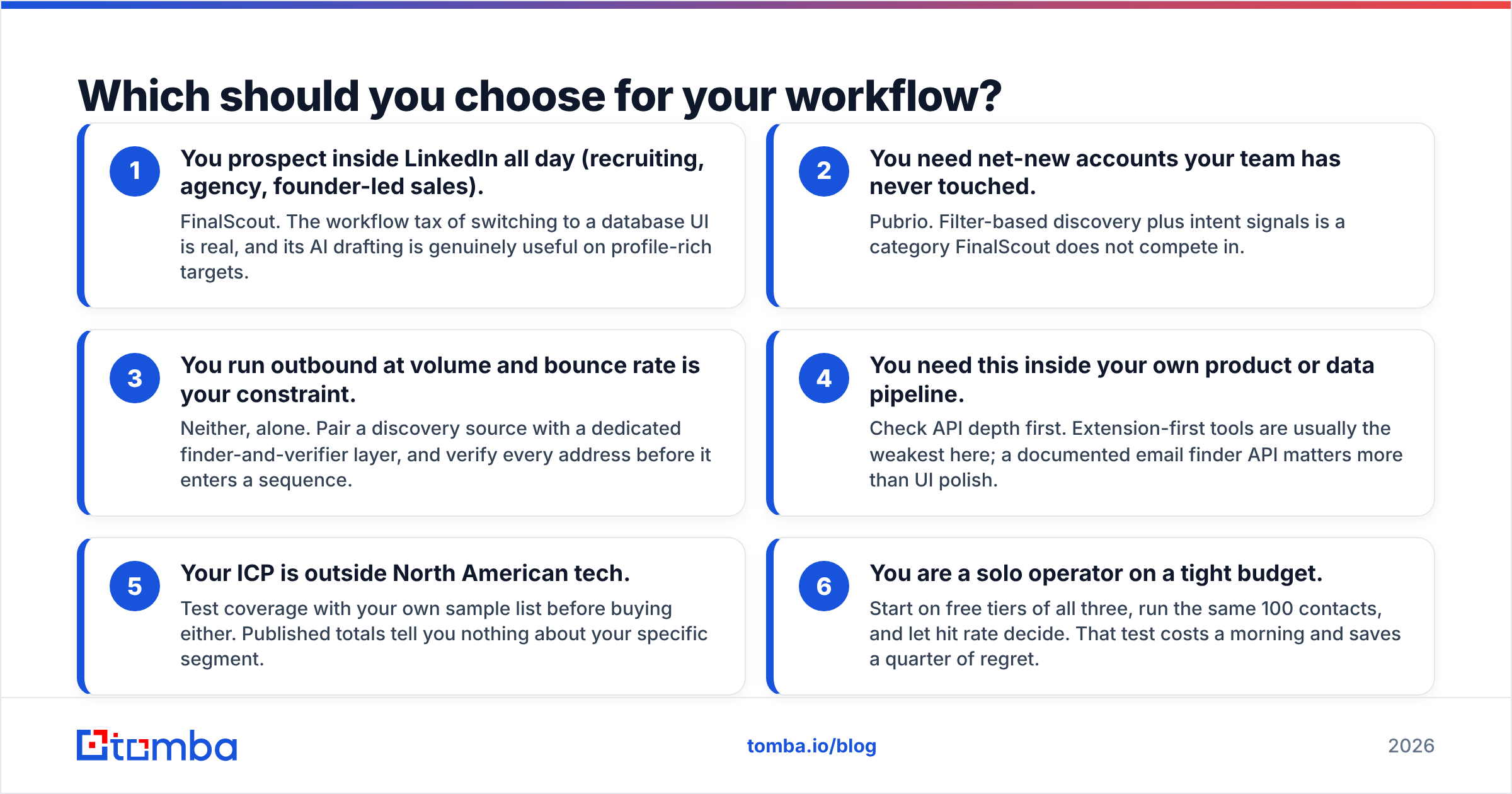
FinalScout vs Pubrio comes down to your workflow, not the feature list. Six common cases:
- You prospect inside LinkedIn all day (recruiting, agency, founder-led sales). Pick FinalScout. Switching to a database UI carries a real workflow tax, and the AI drafting helps on profile-rich targets.
- You need net-new accounts your team has never touched. Pick Pubrio. Filter-based discovery plus intent signals is a game FinalScout does not play.
- You run outbound at volume and bounce rate is your constraint. Pick neither on its own. Pair a discovery source with a dedicated finder and verifier, then check every address before it enters a sequence.
- You need this inside your own product or data pipeline. Check API depth first. Extension-first tools are usually weakest here. A documented email finder API matters more than UI polish.
- Your buyers sit outside North American tech. Test coverage with your own sample list before you buy either one. Published totals tell you nothing about your segment.
- You are a solo operator on a tight budget. Start on the free tiers of all three. Run the same 100 contacts and let hit rate decide. That test costs a morning and saves a quarter of regret.
Where does a dedicated email finder beat both?#
FinalScout vs Pubrio is a choice between two bundles: data plus AI plus workflow. Bundles are handy until the weakest part sets your ceiling. In cold outreach, that part is almost always verification.
A focused stack looks different. Use domain search to map every reachable contact at a target company. Use a LinkedIn finder when you do have profile URLs. Then use a verifier that runs SMTP checks and flags catch-alls honestly, instead of rounding them up to "valid."
Keep discovery wherever it is strongest — Pubrio, a niche database, or your own scraping. Just stop paying a premium for a weak verifier bolted onto it.

That split also protects you commercially. Data vendors reprice and repackage all the time. You can see it in the churn of reviews on G2 for every tool in this category. If your finding layer is decoupled from your sequencer and your CRM, swapping a vendor is a config change, not a migration project.
What is the verdict on FinalScout vs Pubrio?#
Pick FinalScout if LinkedIn is your prospecting surface. It is better at turning profiles you have already qualified into contactable people. The AI drafting is a real time saver for one-to-one outreach.
Pick Pubrio if you need lists you could not build by browsing. Its search, tech filters and intent layer solve the discovery problem FinalScout does not touch.
Pick neither as your only layer if deliverability is your scorecard. Both return addresses. Neither is built as a verification platform, and vendor-reported validity is not verified validity. Teams with the lowest bounce rates run discovery and verification as separate, swappable parts.
The honest FinalScout vs Pubrio test takes one afternoon: 200 contacts, three free tiers, one neutral verifier, one spreadsheet. Score hit rate, validity and cost per verified email. Whatever wins on your list is the right answer — whatever any comparison post says, including this one.
Ready to benchmark? Run your list through the Tomba Email Finder next to your FinalScout or Pubrio trial. The free tier gives you 25 searches a month with no card. Starter is $49/mo when you scale. Every result ships with verification and catch-all detection, so the number you see is the number that lands.
Related guides#
Ready to find emails that actually work?
Join 150,000+ professionals who stopped guessing and started sending. Free credits on signup — no credit card required.
Get the Tomba newsletter
Practical outbound tactics and product updates — once every two weeks.
About the author