FinalScout vs SignalHire (2026): Which Email Finder Wins?
FinalScout sells AI-written LinkedIn outreach. SignalHire sells emails plus mobile numbers. We compare accuracy, credit models, real pricing and export limits to show which one actually fits your outbound motion in 2026.
FinalScout vs SignalHire comes down to one question: do you need phone numbers? FinalScout finds emails inside LinkedIn and drafts the message for you. SignalHire finds emails and mobile numbers across the wider web. Here is how the two compare on accuracy, credits and real 2026 pricing.
TL;DR
- FinalScout is a LinkedIn-first email finder with an AI writing layer. It shines when your prospecting starts inside LinkedIn or Sales Navigator.
- SignalHire is a contact-data tool. You get emails and mobile numbers, plus an extension that works on LinkedIn, GitHub and company sites. Recruiters lean on it hard.
- Neither tool suits high-volume, programmatic enrichment. Both charge per revealed contact, and neither has a clean developer story.
- Credits are the real price difference. SignalHire charges more for a phone than an email. FinalScout bills per email found, and unverified results still burn budget.
- Still stuck on FinalScout vs SignalHire? Need phones → SignalHire. Live in LinkedIn → FinalScout. Need volume plus an API → a dedicated finder like Tomba.
FinalScout vs SignalHire: what are they, actually?#
Short answer: they solve overlapping problems from opposite directions.
FinalScout started as a Chrome extension. It scrapes LinkedIn profiles and search results, then resolves each profile to a business email. The AI layer is the differentiator. It writes a personalized cold email from the headline, experience and posts. You then export to CSV or push the result into a sequencer. The pitch is "from LinkedIn profile to sent email without leaving the tab."
SignalHire is closer to a contact database with a scraper on the front. It reveals emails and direct dials. It works on LinkedIn, but also on GitHub, Facebook and plain company websites. On top sit recruiting features: candidate pipelines, team seats, an ATS-lite tracker. A large share of users are technical recruiters, not SDRs. That shapes the product more than the marketing admits.
The practical result: FinalScout optimizes for message throughput. SignalHire optimizes for contact coverage. You feel that gap on day three, not day one.
FinalScout vs SignalHire: how do they compare head to head?#
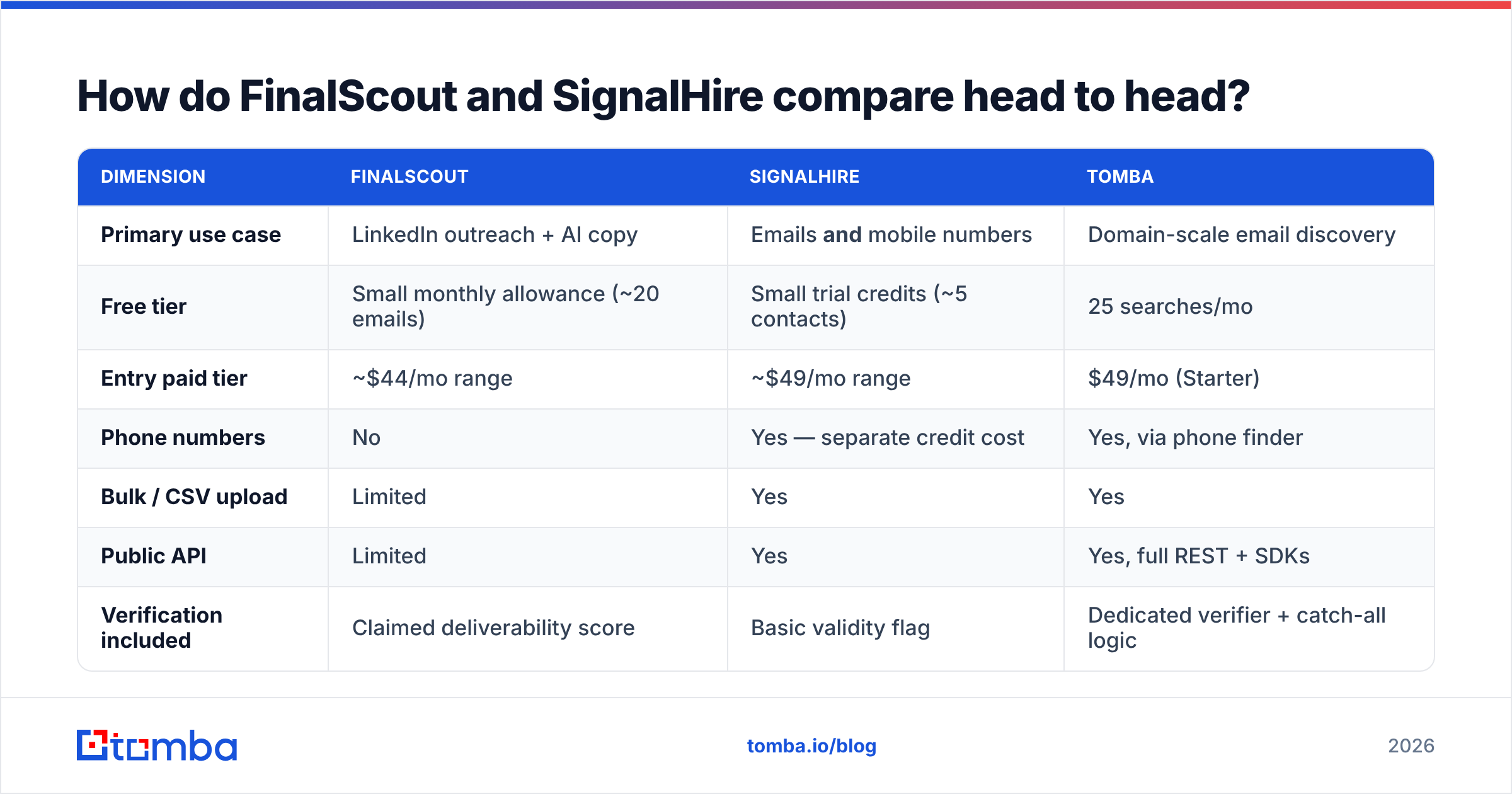
Here is the side-by-side. Pricing moves, so treat these as directional. Confirm on each vendor's page before you buy.
| Dimension | FinalScout | SignalHire | Tomba |
|---|---|---|---|
| Primary use case | LinkedIn outreach + AI copy | Emails and mobile numbers | Domain-scale email discovery |
| Free tier | Small monthly allowance (~20 emails) | Small trial credits (~5 contacts) | 25 searches/mo |
| Entry paid tier | ~$44/mo range | ~$49/mo range | $49/mo (Starter) |
| Phone numbers | No | Yes — separate credit cost | Yes, via phone finder |
| Bulk / CSV upload | Limited | Yes | Yes |
| Public API | Limited | Yes | Yes, full REST + SDKs |
| Verification included | Claimed deliverability score | Basic validity flag | Dedicated verifier + catch-all logic |
| Chrome extension | Yes (LinkedIn-focused) | Yes (multi-site) | Yes |
| Team seats | Paid plans | Paid plans, recruiter-oriented | All paid plans |
| Best for | Solo founders, LinkedIn-native SDRs | Recruiters, multichannel outbound | RevOps, agencies, developers |

Three things jump out of that table.
One: the phone gap decides it. FinalScout gives you no mobile numbers. If your sequence is email → LinkedIn → call, SignalHire covers two legs and FinalScout covers one. That single fact settles most FinalScout vs SignalHire debates in under a minute.
Two: the AI copy layer is a nice-to-have, not a moat. FinalScout's drafts are competent. They are polite, structured, and they name a job title and a company. They also read as templated at scale. Every sequencer on the market now ships the same feature. Do not pay a premium for it.
Three: neither is priced for volume. Both sell per-contact credits with hard monthly caps. Reveal four figures of contacts a month and the credit math turns ugly. That is when you start shopping for a bulk provider or an API.
FinalScout vs SignalHire: which one finds more valid emails?#
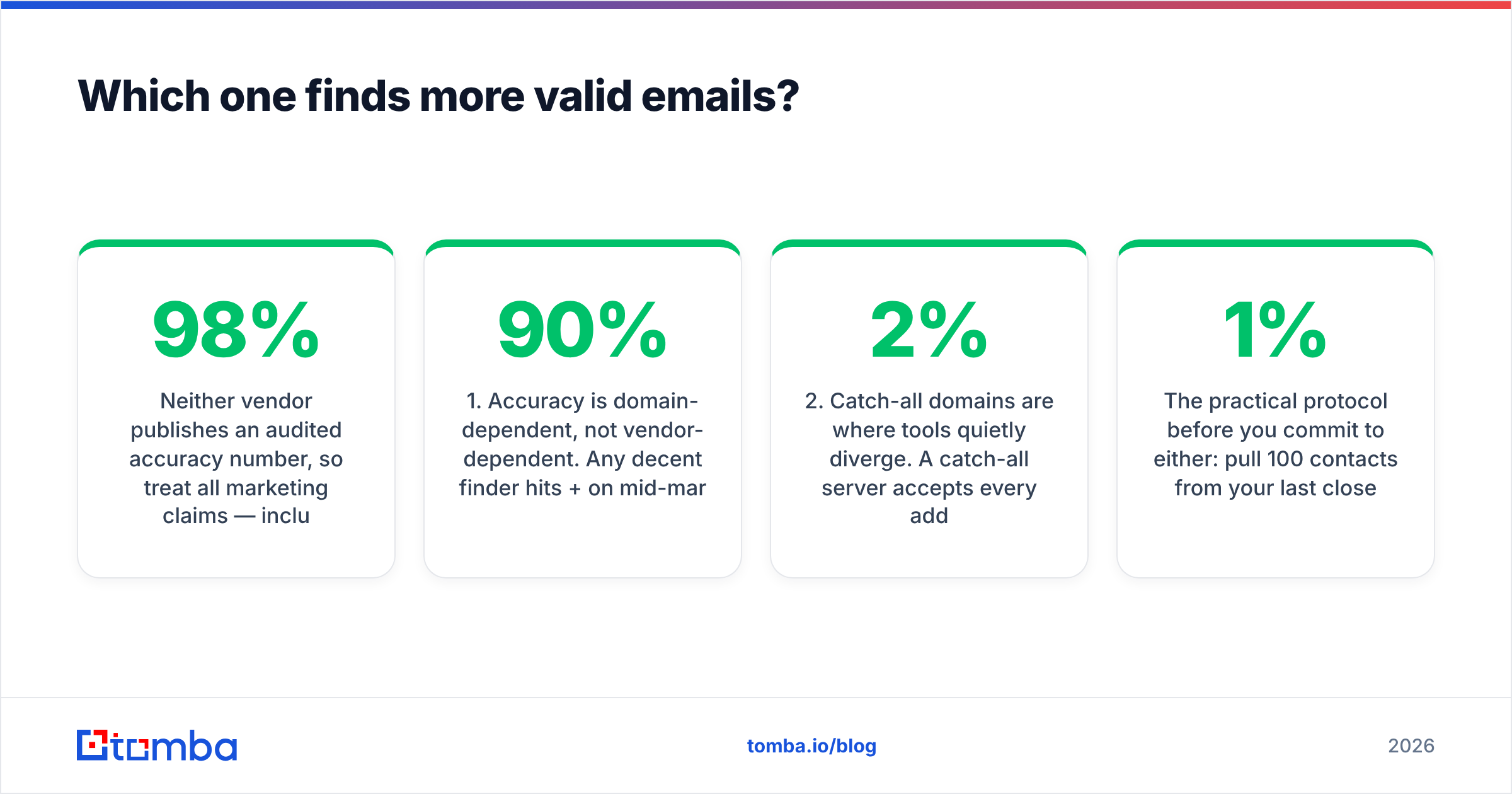
Neither vendor publishes an audited accuracy number. Treat every marketing claim as unverified until you test it on your ICP. That includes any "98% deliverability" badge.
From repeated sampling of finder tools, four patterns hold:
- Accuracy is domain-dependent, not vendor-dependent. Any decent finder hits 90%+ on mid-market SaaS with predictable
first.last@patterns. The same tool drops to 50-60% on agencies, professional services firms and catch-all domains. - Catch-all domains are where tools quietly diverge. A catch-all server accepts every address, so naive SMTP checks return "valid" for garbage. Tools that flag these honestly look worse on paper and better in your inbox. A proper catch-all verifier is the gap between a 2% bounce rate and a 12% one.
- "Found" is not "verified." FinalScout returns a confidence score. SignalHire returns a validity flag. Neither replaces a dedicated verification pass before you load a list into a sender.
- Coverage varies by geography. SignalHire is stronger in Europe and APAC than in US mid-market phone data. That surprises US-based buyers who assume the reverse.

Run this test before you commit to either. Pull 100 contacts from your last closed-won cohort. Push them through both free tiers. Then measure two numbers: found rate and bounce rate after verification.
A tool that finds 80 of 100 with a 1% bounce beats one that finds 95 with an 8% bounce. The second one damages your sender reputation. The first one does not.
Run every result through an independent email verifier as well. Do not trust a vendor to grade its own homework.
How does FinalScout vs SignalHire pricing really work?#
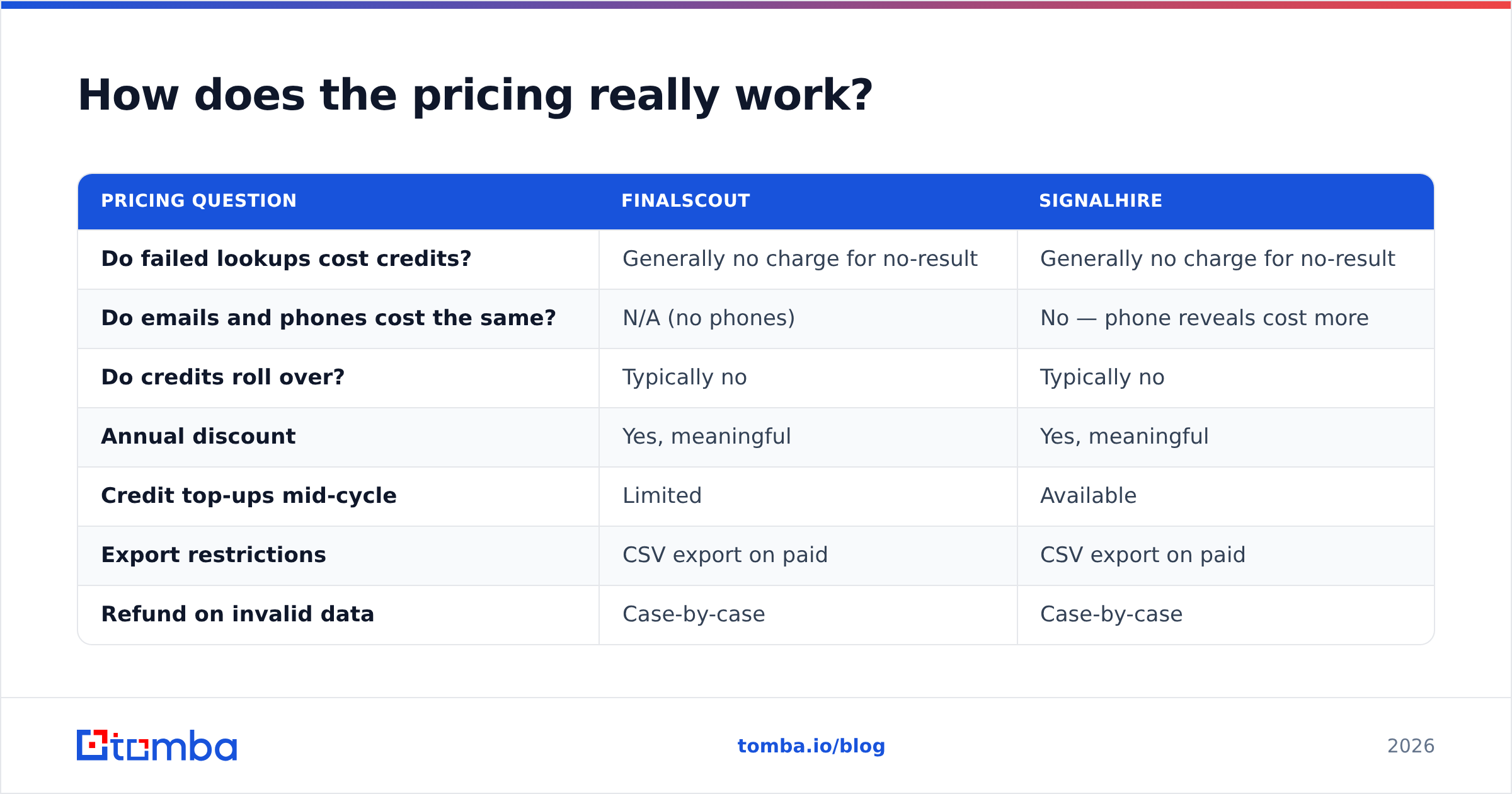
Both tools sell credits, and credits are where marketing pages get slippery. Ask these questions before you enter a card.
| Pricing question | FinalScout | SignalHire |
|---|---|---|
| Do failed lookups cost credits? | Generally no charge for no-result | Generally no charge for no-result |
| Do emails and phones cost the same? | N/A (no phones) | No — phone reveals cost more |
| Do credits roll over? | Typically no | Typically no |
| Annual discount | Yes, meaningful | Yes, meaningful |
| Credit top-ups mid-cycle | Limited | Available |
| Export restrictions | CSV export on paid | CSV export on paid |
| Refund on invalid data | Case-by-case | Case-by-case |
Two traps to watch:
The rollover trap. Non-rolling credits mean a slow month is wasted money. A heavy month is worse. You either buy an overage pack at a bad per-credit rate or stop prospecting. Teams with lumpy campaigns feel this more than they expect.
The dual-credit trap. On SignalHire, one "contact" can include both an email and a phone. That costs more than an email-only model predicts. Model your monthly spend on your real email-to-phone ratio, not on the headline credit count.
For reference, Tomba pricing runs Free (25 searches/mo), Starter at $49/mo, Growth at $99/mo, and Pro at $249/mo, with Enterprise custom. The entry point matches both tools. The API is included rather than gated behind a higher tier.

Is FinalScout better than SignalHire for cold email?#
For pure cold email, FinalScout is the tighter workflow and SignalHire is the deeper dataset.
FinalScout wins on time-to-first-email. Open a Sales Navigator search, run the extension, get emails plus drafted messages, export, send. For a founder sending 50 targeted emails a week, that loop is genuinely fast. The drafts also beat staring at a blank page.
Where it frustrates people:
- LinkedIn is your only source of truth. No LinkedIn presence, no contact. That kills coverage in trades, manufacturing and local services.
- Scraping lives at the mercy of LinkedIn's rate limits. Every extension in this category carries account-safety risk. Treat it as a real hazard, not a theory.
- The AI copy needs editing. It leans on "I noticed you're the VP of Engineering at Acme" openers. Prospects pattern-match those as automation instantly.
SignalHire's edge for cold email is that it is not LinkedIn-only. Reveal from a company website, a GitHub profile or a bulk domain list. You can then build campaigns around firmographics instead of profile polish. The trade-off: you write your own copy and run your own sequencing. SignalHire is data, not a sender.
Already running multichannel? SignalHire's phone data plus a phone finder fallback is the fuller stack. Still testing whether cold email works at all? FinalScout gets you to a sent message faster.
What about recruiters and non-sales users?#
Here SignalHire pulls decisively ahead. Most FinalScout vs SignalHire posts skip this, so it is worth saying plainly.
SignalHire ships candidate pipelines, stage tracking and team collaboration. Those map straight onto a recruiting workflow. You can reveal a candidate's personal email and mobile from a GitHub profile, tag them into a role, and share the pipeline with a hiring manager. That is an ATS-lite product living inside a contact finder. For agency recruiters, it removes a tool from the stack.
FinalScout has no equivalent. It is a sales-outreach product with an AI writer. Recruiters can use it, since LinkedIn is where candidates are. But they will export to a spreadsheet and manage the pipeline elsewhere.
Check current user sentiment on G2 before you commit either way. The split between "SDR who loves it" and "recruiter who churned" usually shows up on the first page of reviews.
When should you skip both and use something else?#
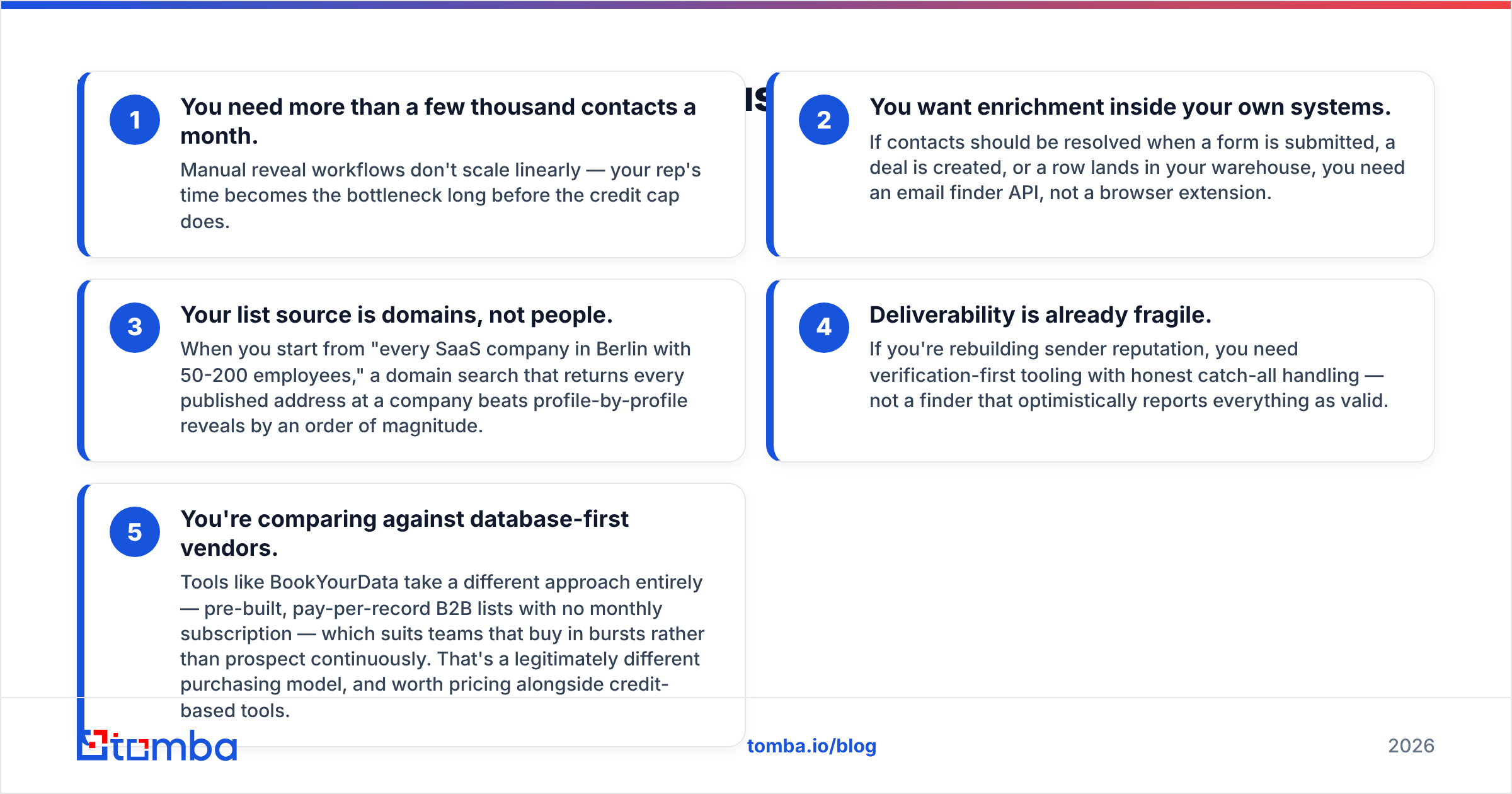
Both tools assume a human clicking an extension. That model has a ceiling. You have hit it when any of these is true:
- You need more than a few thousand contacts a month. Manual reveal workflows do not scale linearly. Your rep's time caps out long before the credits do.
- You want enrichment inside your own systems. Resolving contacts on form submit, deal creation or warehouse load needs an email finder API, not a browser extension.
- Your list starts from domains, not people. For "every SaaS company in Berlin with 50-200 employees," a domain search beats profile-by-profile reveals by an order of magnitude.
- Deliverability is already fragile. Rebuilding sender reputation calls for verification-first tooling with honest catch-all handling.
- You are weighing database-first vendors. Tools like BookYourData sell pre-built, pay-per-record B2B lists with no subscription. That suits teams who buy in bursts rather than prospect continuously. Price it alongside credit-based tools.
What's the verdict on FinalScout vs SignalHire?#
Pick SignalHire if you need phone numbers, work outside LinkedIn, recruit as well as sell, or want bulk uploads and an API without an enterprise tier. It is the broader tool.
Pick FinalScout if LinkedIn is your whole prospecting universe, you run solo or in a small team, and the AI drafting saves you real time. It is the faster tool for a narrower job.
Pick neither if you run volume, need programmatic enrichment, or care more about bounce rate than workflow polish. At scale, per-seat and per-click pricing works against you.
One last note. Never let the vendor be the only judge of its own data quality. Run every export through independent verification. Watch your bounce rate weekly. Re-test coverage each quarter on a fresh sample of your ICP. Contact data decays at roughly 2-3% per month, so last year's winner may lose today.
Ready to test the alternative? Your real bottleneck may be finding valid work emails at scale — by domain, by name, or by company. Start with the Tomba Email Finder. The free tier gives you 25 searches a month with no card. Verification is built in rather than bolted on. Every plan from $49/mo includes full API access. Run your 100-contact test against it alongside FinalScout and SignalHire, and let the found rate and the bounce rate decide.
Related guides#
Ready to find emails that actually work?
Join 150,000+ professionals who stopped guessing and started sending. Free credits on signup — no credit card required.
Get the Tomba newsletter
Practical outbound tactics and product updates — once every two weeks.
About the author