FinalScout vs The Org (2026): Which Email Tool Wins?
FinalScout scrapes LinkedIn profiles into verified emails. The Org maps org charts and reporting lines. They solve different halves of the same problem — here's which one you actually need, and what it costs.
FinalScout vs The Org is a matchup that looks even and isn't. One tool finds email addresses. The other maps who reports to whom. Here's what each one does, what it costs, and when you need a third tool instead.
TL;DR
- FinalScout is a LinkedIn-first email finder. A Chrome extension turns profiles, search results, and Sales Navigator lists into exported contacts, with AI-written outreach attached.
- The Org is not an email tool at all. It's a public organizational-chart database: reporting lines, team structures, executive moves. It's built for research, not for export-and-send.
- They only look like competitors because both start from "who works at this company." FinalScout answers how do I email them. The Org answers who reports to whom.
- Pricing splits the same way. FinalScout charges per credit on a monthly plan. The Org is mostly free to browse, with paid tiers aimed at company profile management and recruiting-style research.
- Need verified emails at volume with an API behind them? Neither is the endgame. A dedicated email finder with domain-level coverage will out-scale both.
What is FinalScout, exactly?#
FinalScout is a browser-extension prospecting tool built around LinkedIn. You install the extension, open a profile or a search result page, and it pulls contact data for the people on screen. Its selling point has always been the pairing of extraction with AI-written email copy. Find the address, draft the first message, same motion.
The mechanics matter more than the marketing:
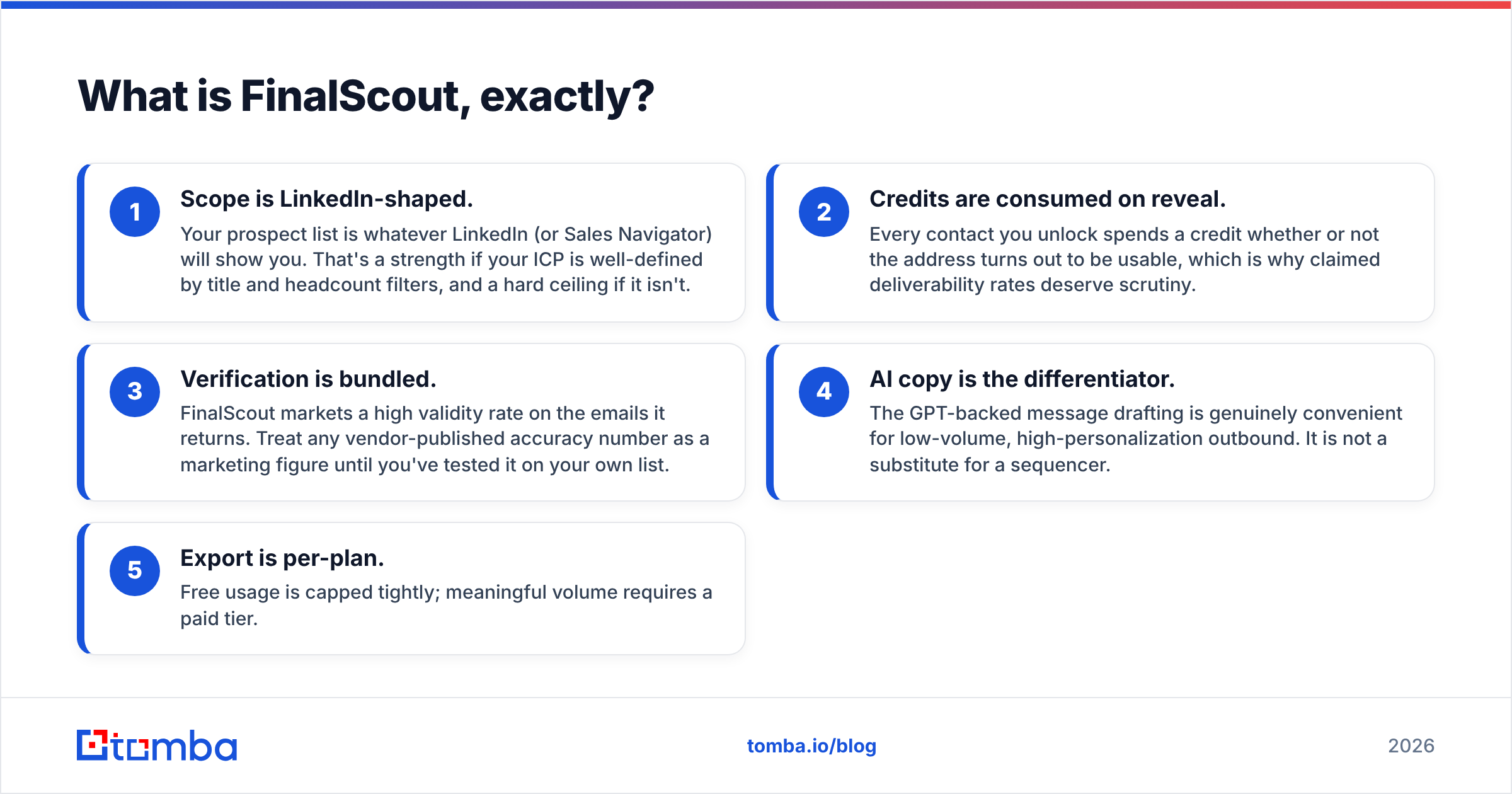
- Scope is LinkedIn-shaped. Your prospect list is whatever LinkedIn (or Sales Navigator) will show you. That's a strength if your ICP is defined by title and headcount filters. It's a hard ceiling if it isn't.
- Credits are spent on reveal. Every contact you unlock costs a credit, even when the address turns out to be dead. That's why claimed deliverability rates deserve scrutiny.
- Verification is bundled. FinalScout markets a high validity rate on the emails it returns. Treat any vendor's accuracy number as a marketing figure until you test it on your own list.
- AI copy is the differentiator. The GPT-backed drafting is handy for low-volume, high-personalization outbound. It is not a sequencer.
- Export is per-plan. Free usage is capped tightly. Real volume needs a paid tier.
The honest framing: FinalScout is a solid one-person prospecting tool for reps who live inside LinkedIn. It was never built to be the data layer under a RevOps stack.

What is The Org, and why do people compare it to a data vendor?#
The Org (theorg.com) is a public directory of organizational charts. Companies claim their profile and publish their leadership structure. The platform renders it as a browsable tree: CEO at the top, functional leads beneath, direct reports under those. It also tracks executive movement and publishes editorial content on leadership changes.
The FinalScout vs The Org question comes up for one reason: hierarchy is the piece most contact databases get wrong. You can buy a list of 400 "Directors of Marketing" and still not know which one owns budget. Or which one reports into RevOps. Or which one was hired three weeks ago. The Org gives you that shape, free and public, with no credit balance.
What it does not give you is a working email address. There's no bulk export of verified contacts, no API to build an enrichment pipeline on, and no verification layer. It's a research surface, and an unusually good one for account planning.
So the comparison is fair. But "which one should I buy" is usually the wrong question. Ask which layer of the problem you're stuck on.
FinalScout vs The Org: how do they actually compare?#
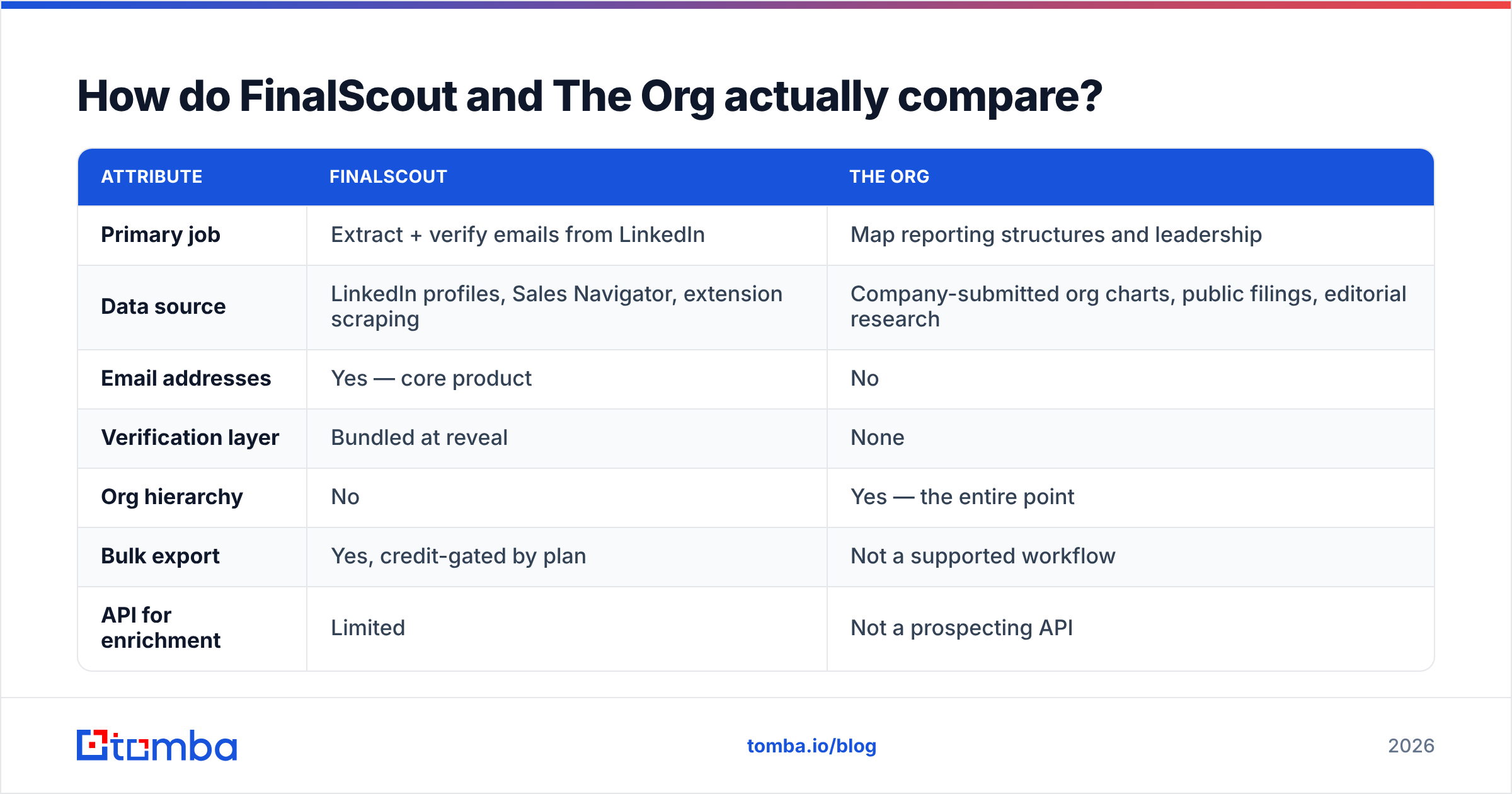
| Attribute | FinalScout | The Org |
|---|---|---|
| Primary job | Extract + verify emails from LinkedIn | Map reporting structures and leadership |
| Data source | LinkedIn profiles, Sales Navigator, extension scraping | Company-submitted org charts, public filings, editorial research |
| Email addresses | Yes — core product | No |
| Verification layer | Bundled at reveal | None |
| Org hierarchy | No | Yes — the entire point |
| Bulk export | Yes, credit-gated by plan | Not a supported workflow |
| API for enrichment | Limited | Not a prospecting API |
| Free tier | Small monthly credit allowance | Broad free browsing |
| Typical paid entry | Roughly $40–$50/mo range, credit-tiered | Free core; paid tiers for company/recruiting features |
| Best for | Individual reps working LinkedIn lists | Account research, org mapping, exec-move tracking |
| Weakest at | Non-LinkedIn coverage, API-scale workflows | Anything requiring an actual email |
Read that table as a division of labor, not a scoreboard. A rep who uses The Org to find the right five people at an account, then uses an email finder to get their addresses, runs a better process than a rep who uses either one alone.
Is FinalScout accurate enough for cold outbound?#
Accuracy claims in this category are inflated across every vendor, FinalScout included. The number that matters isn't the published validity rate. It's your bounce rate, on your list, in your ICP, this month.
Three things degrade real-world accuracy no matter which tool you use:
- Catch-all domains. Many B2B domains accept all mail at the SMTP layer. Verification then returns "unknown" instead of valid or invalid. Tools that quietly count those as valid inflate their numbers. Run suspect domains through a dedicated catch-all verifier before you commit them to a sequence.
- Role changes. LinkedIn profiles lag reality by weeks. A pattern-derived address at a company someone left in March is well-formed and useless.
- Pattern guessing without confirmation. Deriving
first.last@domain.comis trivial. Confirming the address exists is the hard part. That's where cheap tools cut corners.
Before you scale a list from any vendor, push it through an independent email verifier. Measure your own bounce rate against a 2% ceiling. Google Postmaster Tools and Microsoft SNDS will tell you the truth about your sender reputation, far more honestly than any vendor dashboard. For the deliverability rules both providers now enforce, read Google's bulk sender guidelines directly, not a blog summary of them.
When should you use The Org instead of a contact database?#
Use The Org when the bottleneck is targeting, not reachability. Concrete cases:
- Multi-threading an enterprise deal. You have one champion and need three more names in adjacent functions. The org chart shows you the buying committee before you guess at it.
- Post-reorg account research. A company restructures. Your old contact's title vanishes. You need to know where the function moved.
- Executive-move triggers. A new VP of Sales starts at a target account. That opens a 90-day window where budget gets re-examined. The Org surfaces these.
- Territory planning. A centralized decision structure and a distributed one call for different sequencing.
- Competitive intelligence. Which competitor a company just hired from is a real signal.
None of those workflows produce an email address. That's the handoff point. It's also why a domain search that returns every discoverable address at a company, with role and confidence attached, pairs well with hierarchy research instead of competing with it.
What are the real alternatives to both?#
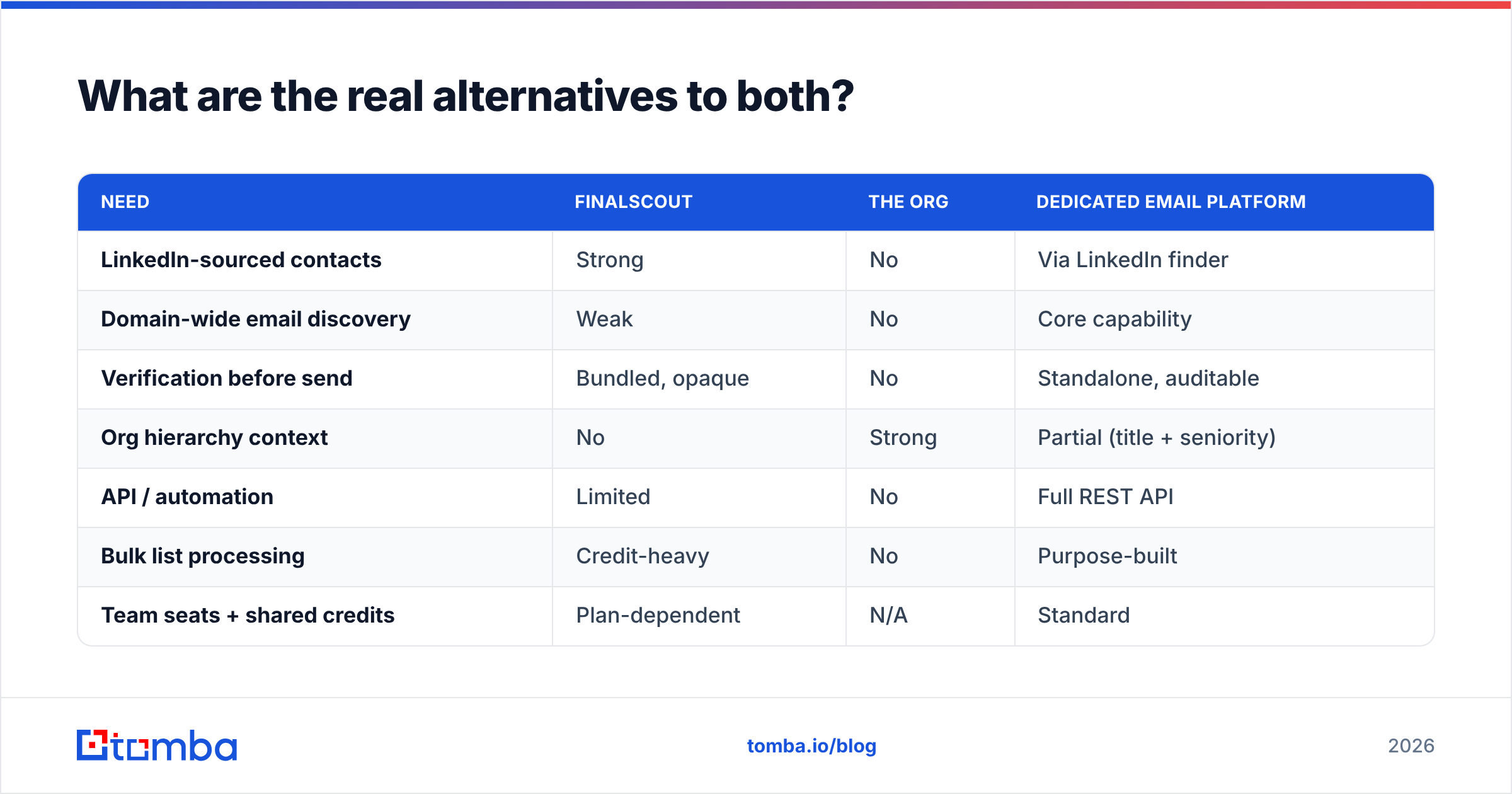
Most teams weighing FinalScout vs The Org are really shopping for a third thing: a reliable contact data layer that works outside one browser tab.
| Need | FinalScout | The Org | Dedicated email platform |
|---|---|---|---|
| LinkedIn-sourced contacts | Strong | No | Via LinkedIn finder |
| Domain-wide email discovery | Weak | No | Core capability |
| Verification before send | Bundled, opaque | No | Standalone, auditable |
| Org hierarchy context | No | Strong | Partial (title + seniority) |
| API / automation | Limited | No | Full REST API |
| Bulk list processing | Credit-heavy | No | Purpose-built |
| Team seats + shared credits | Plan-dependent | N/A | Standard |
Worth naming the other options honestly. BookYourData suits teams that want a pre-built, pay-as-you-go B2B list with a bounce guarantee rather than a per-lookup tool. It's a different buying model, and a genuinely useful one when you want volume without a subscription. Apollo bundles data with a sequencer if you want one vendor for both. Clearbit (now inside HubSpot) leans firmographic enrichment rather than contact discovery. Each solves a distinct problem. None is a drop-in replacement for the others.
How does Tomba fit between these two tools?#
Tomba sits in the layer FinalScout approximates and The Org ignores on purpose: finding and verifying professional email addresses at company scale, with an API behind it.
The practical differences:
- Domain-first, not profile-first. Instead of clicking through LinkedIn profiles one at a time, you query a domain. You get back the addresses discoverable at that company, with confidence scores and sources attached. When you do want LinkedIn as the entry point, the extension handles it.
- Verification is a separate, auditable step. Catch-all detection, SMTP checks, and syntax validation run as their own operations. You can inspect each one. It isn't a black box that hands you a percentage.
- Real automation surface. The Tomba API plugs into the enrichment jobs your ops team already runs. There's also a CLI, an MCP server, and Sheets/Excel add-ins for people who'd rather not write code.
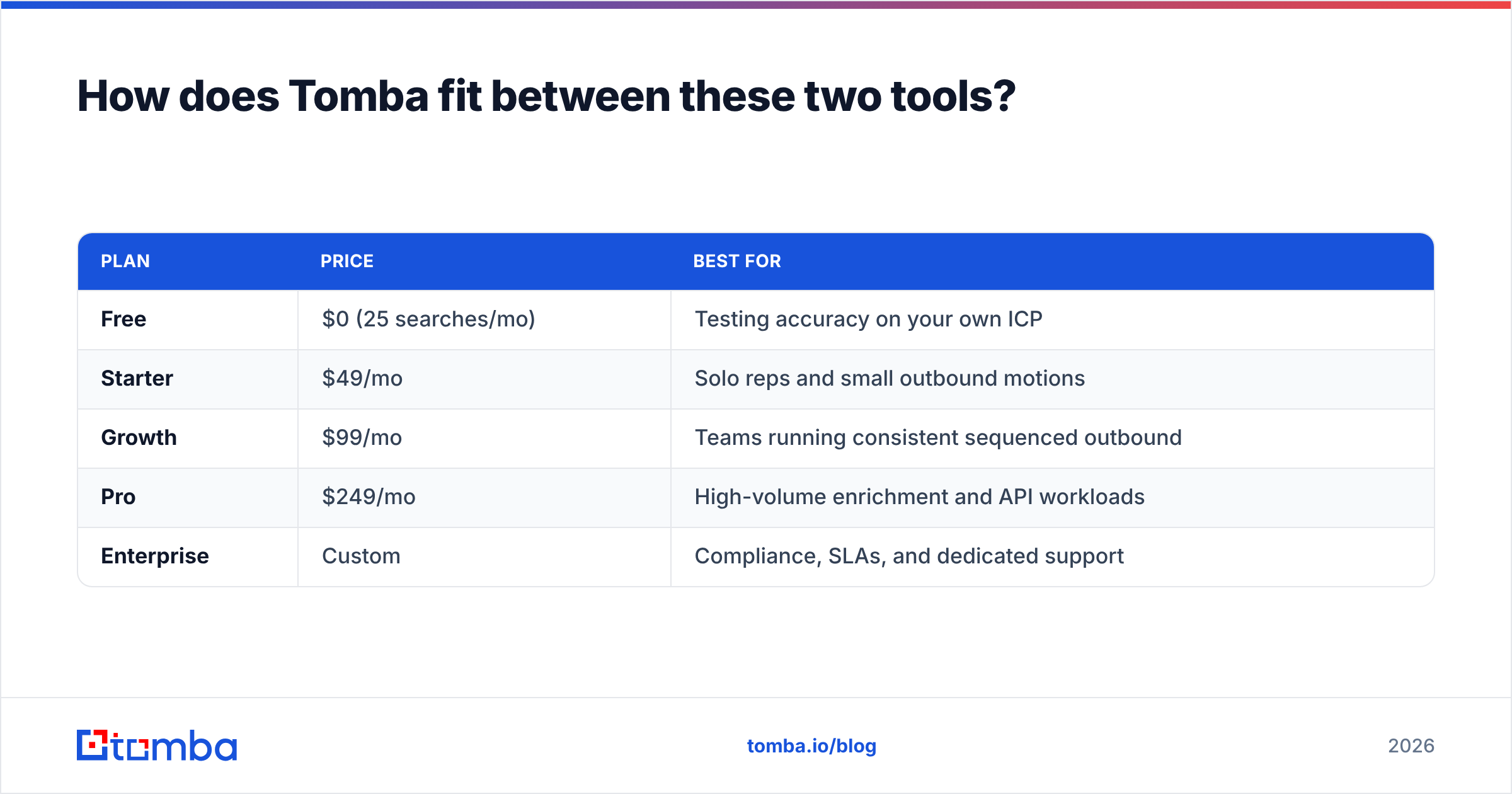
- Transparent pricing. Free tier at 25 searches/mo, Starter at $49/mo, Growth at $99/mo, Pro at $249/mo, Enterprise custom. Full Tomba pricing is public.
| Plan | Price | Best for |
|---|---|---|
| Free | $0 (25 searches/mo) | Testing accuracy on your own ICP |
| Starter | $49/mo | Solo reps and small outbound motions |
| Growth | $99/mo | Teams running consistent sequenced outbound |
| Pro | $249/mo | High-volume enrichment and API workloads |
| Enterprise | Custom | Compliance, SLAs, and dedicated support |
Where Tomba is not the answer: if you want AI-drafted first-touch copy generated inside the LinkedIn tab, FinalScout does that natively. And if you want a visual org chart, use The Org. Tomba doesn't render reporting trees, and pretending otherwise would be dishonest.
FinalScout vs The Org: which one should you pick?#
Pick by bottleneck, not by feature count.
- Solo rep, under 500 LinkedIn contacts a month, wants copy drafted for you. FinalScout is a reasonable fit. Test the bounce rate on your first 200 sends before you scale.
- Stuck on who to contact inside big accounts. The Org, free, today. It costs nothing, and it will change how you multi-thread.
- Need verified addresses at volume, feeding a CRM or sequencer automatically. Neither. You want a data platform with an API and a real verification stack. That's where Tomba, Apollo, or a list vendor like BookYourData belong, depending on whether you want per-lookup, bundled, or pre-built data.
- Doing all three. Use The Org for structure, a finder for addresses, and a verifier as the gate before anything enters a sequence. That stack costs less than most people assume. It also bounces less than any single-tool approach.
One process note outranks tool choice. Your response rate depends far more on list quality than on copy quality. A perfect email to a stale address is still a bounce. G2's software category data shows data accuracy as the top-weighted criterion in this category for exactly that reason.
Ready to fix the data layer?#
Settle the FinalScout vs The Org debate with a test instead of a table. If your real problem is getting verified addresses for people you've already identified, start there. The Tomba Email Finder gives you 25 free searches a month. That's enough to run an honest accuracy check against your own ICP before you pay anyone, including us. Run the same 50 target contacts through FinalScout and Tomba, send to both lists, and compare bounce rates. That takes an afternoon, and it settles the argument better than any comparison table, including this one.
Related guides#
Ready to find emails that actually work?
Join 150,000+ professionals who stopped guessing and started sending. Free credits on signup — no credit card required.
Get the Tomba newsletter
Practical outbound tactics and product updates — once every two weeks.
About the author