FinalScout vs VC-Backed Email Tools: Honest 2026 Comparison
FinalScout sells LinkedIn-native email finding with AI copy bolted on. VC-backed platforms sell everything at once. Here's which one actually gets verified addresses into your sequence — and what each really costs per usable contact.
TL;DR
- FinalScout is a LinkedIn-first email finder: you work inside LinkedIn or Sales Navigator, it resolves profiles to work emails, and it bundles AI email drafting. It is narrow by design.
- "VC-backed tools" here means the funded, multi-product platforms — Apollo, ZoomInfo, Lusha, Seamless.AI, Clay — that sell a database, a sequencer, intent data, and dialers on one seat-priced contract.
- Neither category wins on raw email coverage. What actually differs is where the data comes from, how credits are burned, and whether unverifiable addresses cost you anything.
- Seat pricing is the hidden cost. A three-rep team on a $99/user platform pays roughly $3,500/year before a single email is sent; a credit-priced API tool at $49–$99/month covers the same volume with no per-seat tax.
- If you only need verified emails and phone numbers piped into a CRM or script, a focused finder with an API — Tomba, FinalScout, or a database vendor like BookYourData — beats paying for platform features you never open.
What is FinalScout, and what does "VC-backed" mean here?#
FinalScout is a browser-extension-driven email finder built around LinkedIn. You browse a profile, a Sales Navigator list, or a group, and it extracts contacts and attempts to resolve a deliverable business email for each one. Its differentiator is the AI layer: it drafts a personalized cold email from the scraped profile so you go from "found the person" to "wrote the email" without leaving the tab. You can see the current feature set on FinalScout's own site.
"VC-backed tools" is not one product — it's a business model. Apollo, ZoomInfo, Lusha, Seamless.AI and Clay all raised institutional money, and that money shapes the product in predictable ways:
- Breadth over depth. Funded platforms expand sideways — database, sequencer, dialer, intent signals, meeting scheduler, AI SDR — because expansion sells the next round.
- Seat-based pricing. Growth targets favor per-user revenue, so pricing is usually per seat per month with credits attached to the seat, not to the account.
- Annual contracts. The bigger the raise, the harder the push toward 12-month commitments and mid-contract upsells.
- Aggressive free tiers. Funded runway pays for generous free plans that convert later, which is genuinely good for you in month one and expensive in month twelve.
- Data assembled at scale. Large crawlers, contributory networks, and acquired datasets — deep coverage in the US mid-market, thinner in EMEA and APAC.
None of that is a criticism. It's simply a different shape from a bootstrapped, single-purpose tool. Knowing the shape tells you where each one breaks.
Which one actually finds more valid emails?#
Coverage and accuracy are two different questions, and vendors deliberately blur them.
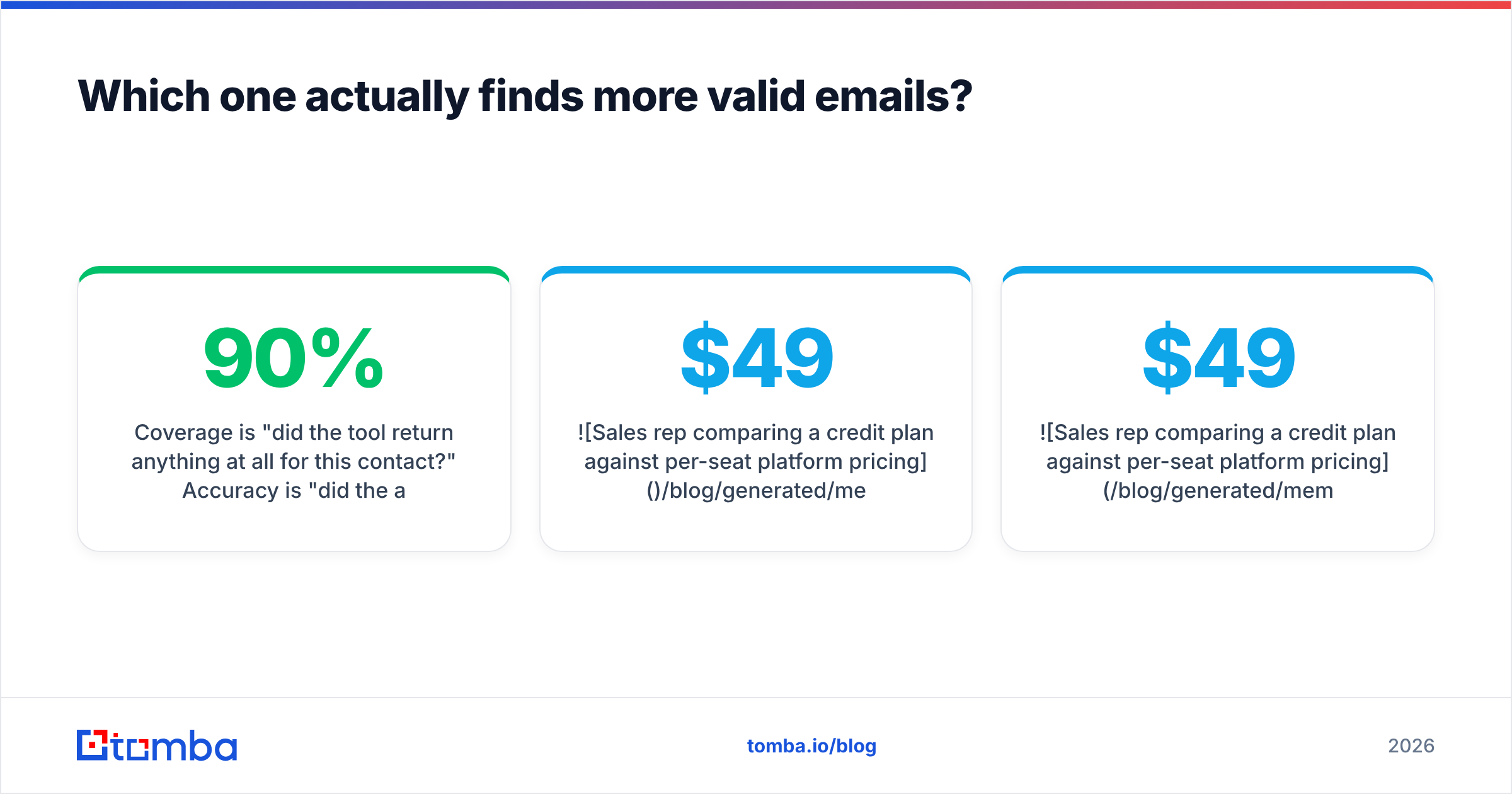
Coverage is "did the tool return anything at all for this contact?" Accuracy is "did the address it returned actually accept mail?" A tool can hit 90% coverage and 60% accuracy by guessing patterns and shipping them as results. That combination will wreck your email deliverability inside two weeks.

Three practical patterns hold across independent tests and user reviews on G2:
- LinkedIn-native tools win on identity, not on email. FinalScout is excellent at knowing who the person is because it reads the profile directly. Resolving that identity to a working mailbox is a separate problem, and it uses the same pattern-plus-verification techniques everyone else does.
- Big databases win on volume, lose on freshness. A funded platform with hundreds of millions of records will return something for almost any US-based contact. A meaningful slice of those records were last confirmed 12–24 months ago, which is several job changes ago in current B2B churn.
- Nobody is honest about catch-all domains. Roughly a fifth of business domains accept every address at the SMTP layer, so no verifier can prove a specific mailbox exists. Tools that silently mark these "valid" inflate their own accuracy numbers. Tools that flag them separately — see how a catch-all verifier handles it — look worse on paper and perform better in your inbox.
The practical test: pull 100 contacts you can independently confirm, run them through both tools, and count only addresses that survive verification and a real send with no bounce. Vendor-published accuracy claims are marketing until you reproduce them on your own ICP.

How do FinalScout and VC-backed platforms compare feature by feature?#
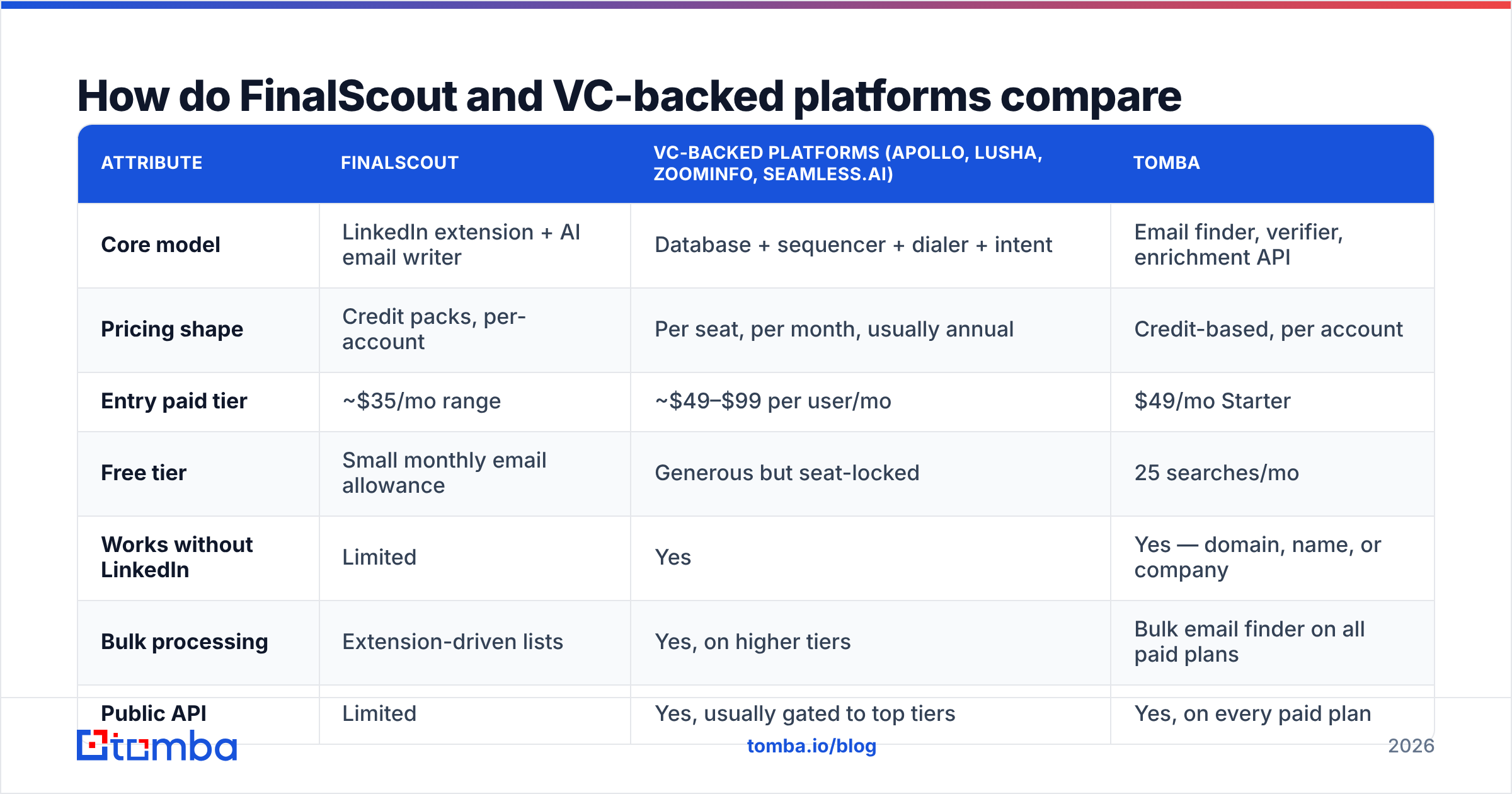
Here is the head-to-head on the attributes that change your monthly bill and your bounce rate. Pricing reflects publicly listed rates at the time of writing; funded platforms revise theirs often, so confirm before you sign.
| Attribute | FinalScout | VC-backed platforms (Apollo, Lusha, ZoomInfo, Seamless.AI) | Tomba |
|---|---|---|---|
| Core model | LinkedIn extension + AI email writer | Database + sequencer + dialer + intent | Email finder, verifier, enrichment API |
| Pricing shape | Credit packs, per-account | Per seat, per month, usually annual | Credit-based, per account |
| Entry paid tier | ~$35/mo range | ~$49–$99 per user/mo | $49/mo Starter |
| Free tier | Small monthly email allowance | Generous but seat-locked | 25 searches/mo |
| Works without LinkedIn | Limited | Yes | Yes — domain, name, or company |
| Bulk processing | Extension-driven lists | Yes, on higher tiers | Bulk email finder on all paid plans |
| Public API | Limited | Yes, usually gated to top tiers | Yes, on every paid plan |
| Catch-all handling | Marked as risky | Often reported as valid | Separate catch-all verification |
| Charges for unverified hits | Typically yes | Usually yes | Only for results returned |
| Team of 3 annual cost | ~$400–$900 | ~$1,800–$3,600+ | ~$588–$1,188 |
| Best for | Solo LinkedIn prospecting | Full outbound stack in one contract | Data layer feeding your own stack |

Two rows deserve emphasis.
"Works without LinkedIn." FinalScout's strength is also its ceiling. If your list starts as a spreadsheet of 800 domains from a trade-show directory, a LinkedIn-native workflow means manually finding each company's people first. A domain search inverts that: you feed the domain and get the roles back.
"Charges for unverified hits." This is where credit math quietly doubles your real cost. If a tool debits a credit for a guess it can't confirm, your effective price per usable email is far higher than the sticker price suggests.
What does each option really cost per verified email?#
Run the arithmetic on a realistic month: three reps, 2,000 contacts sourced, targeting 1,200 send-ready verified addresses.
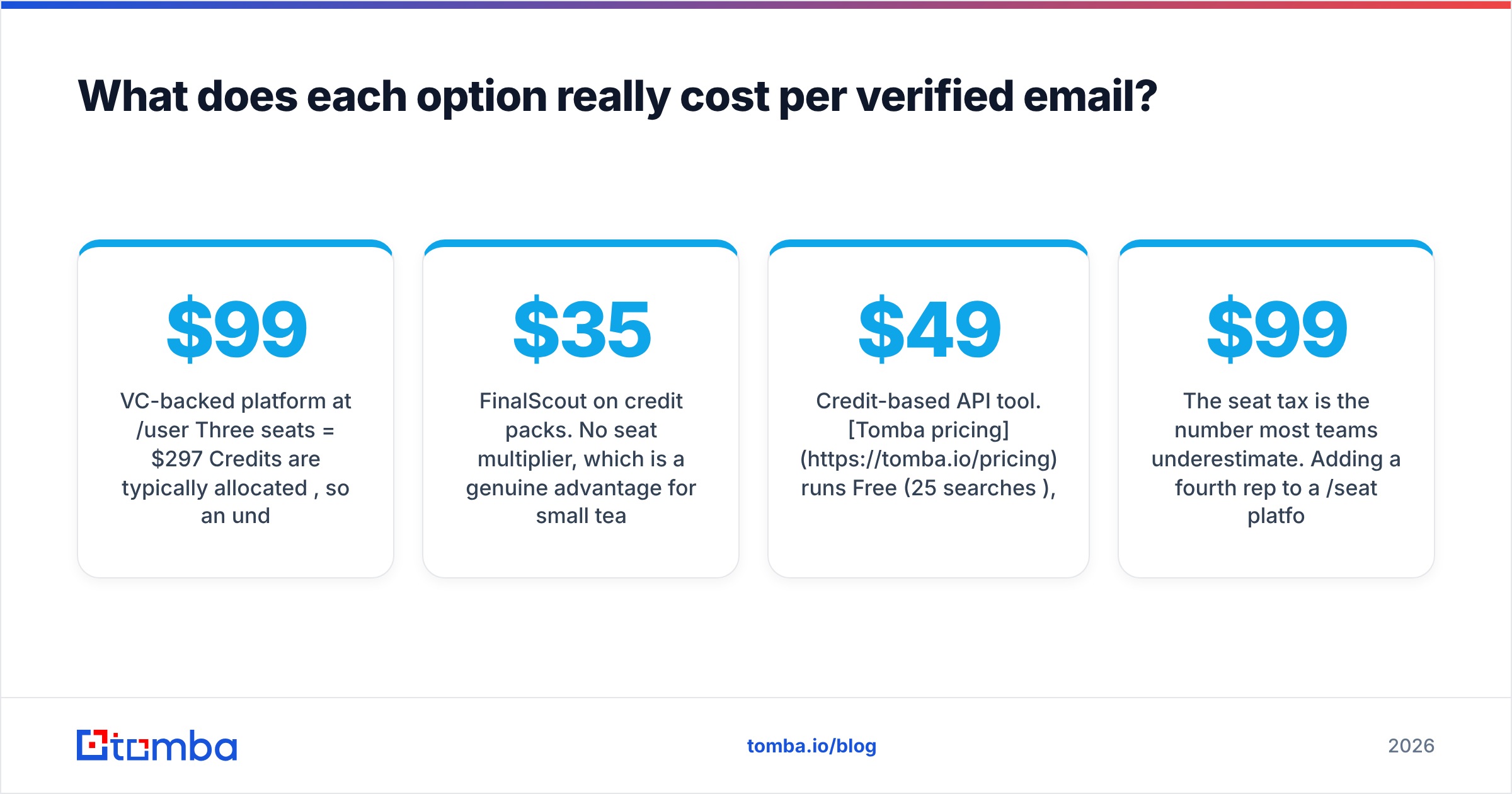
- VC-backed platform at $99/user/mo. Three seats = $297/month. Credits are typically allocated per seat, so an under-using rep's allowance can't always be pooled with a heavy user's. Add an export cap on the mid tier and you're either upgrading or buying a credit top-up. Realistic landed cost: $297–$450/month, or roughly $0.25–$0.38 per verified email — plus an annual commitment.
- FinalScout on credit packs. No seat multiplier, which is a genuine advantage for small teams. But throughput is bounded by extension-driven workflows and LinkedIn's own rate limits, so hitting 2,000 contacts in a month is manual labor. Landed cost: $35–$120/month plus meaningful rep hours.
- Credit-based API tool. Tomba pricing runs Free (25 searches/mo), Starter $49/mo, Growth $99/mo, Pro $249/mo. No per-seat fee — your whole team draws from one pool, and the same credits work through the UI, the Tomba API, Google Sheets, or the Chrome extension. Landed cost for this scenario: $99/month, about $0.08 per verified email.
- Database vendors like BookYourData. Pay-per-record with no subscription at all. If you need one clean list of 5,000 contacts in a defined vertical and nothing else, this is often the cheapest path per record — worth pricing alongside subscription tools rather than assuming a subscription is required.
The seat tax is the number most teams underestimate. Adding a fourth rep to a $99/seat platform costs $1,188/year for the privilege of the same data you already licensed. On credit pricing, a fourth rep costs zero until they actually consume credits.

Which should you pick for your team?#
Match the tool to the shape of your motion, not to the feature list.
- Solo founder or one-rep team living inside LinkedIn — FinalScout is a reasonable fit. Low commitment, no seat multiplier, and the AI drafting genuinely saves time when every prospect gets a bespoke opener. Pair it with an independent email verifier before you send; never trust a finder to grade its own output.
- Team of 5+ that needs sequencing, dialing, and reporting in one place — a VC-backed platform earns its price here. Consolidating four tools into one contract has real operational value, and one admin panel beats four. Negotiate hard on seats and confirm export limits in writing.
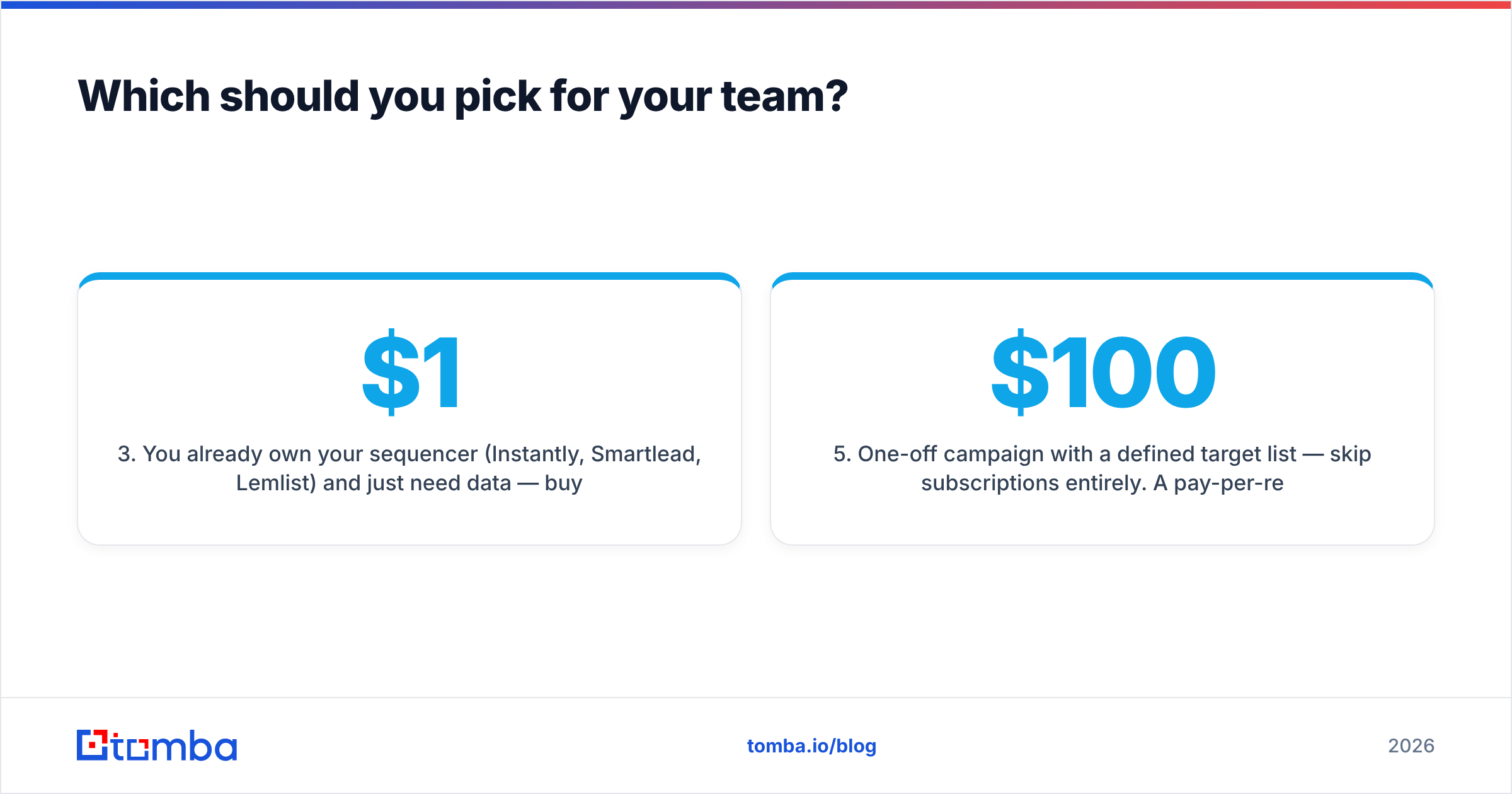
- You already own your sequencer (Instantly, Smartlead, Lemlist) and just need data — buy the data layer alone. This is the most common and most overpaid-for scenario: teams buy a $1,200/seat/year platform to use 10% of it. A credit-priced finder with a LinkedIn finder and bulk endpoints covers it for a fraction.
- Engineering-led growth or an internal enrichment pipeline — API access on the entry tier is the deciding factor. Most funded platforms gate their API behind the top plan; that single line item can be a 5x price difference for identical data.
- One-off campaign with a defined target list — skip subscriptions entirely. A pay-per-record vendor or a free tier plus a small credit pack finishes the job for under $100.
- Multi-region targeting outside North America — test coverage before committing. US-centric databases thin out fast in DACH, Nordics, LATAM, and APAC. Run the same 50 EMEA contacts through every candidate during trials; the gaps will be obvious.
Is a bootstrapped tool a real risk versus a funded one?#
The usual argument for funded vendors is stability — they'll still exist in three years. It cuts both ways.
Funded companies face pressure to grow revenue per account, which shows up as price increases at renewal, features moving up a tier, and acquisitions that change the roadmap. Bootstrapped tools face the opposite pressure: stay profitable, keep churn low, don't overspend. Both models fail sometimes. Neither is inherently safer.
What actually protects you is portability. Ask three questions before you commit:
- Can I export my data? Full CSV export of everything you found, not just the current view.
- Is there an API I can rebuild against? If your enrichment runs through a documented API, swapping vendors is a config change. If it runs through a proprietary UI, it's a migration project.
- Am I locked into an annual term? Monthly billing costs a bit more and buys you the option to leave. On a first contract, that option is usually worth the premium.
A tool that answers yes to all three is low-risk regardless of who funded it. A tool that answers no to all three is high-risk regardless of its Series C.
What's the verdict on FinalScout vs VC-backed tools?#
FinalScout wins if your prospecting genuinely lives inside LinkedIn, you're one or two people, and AI-drafted first touches save you real hours. It's focused, affordable, and doesn't charge per seat.
VC-backed platforms win if you need the whole outbound stack under one contract, have five or more reps, and the consolidation is worth the seat premium. Just go in knowing you're buying a bundle and will use part of it.
Neither wins for the largest group of buyers: teams that already have a sequencer and a CRM and only need accurate contact data flowing into them. That's a data-layer purchase, and it should be priced like one — by credit, not by seat, with an API on the entry plan and honest catch-all reporting.
Before you sign anything, run the same 100-contact test list through every finalist, count only the addresses that verify and deliver, and divide your monthly cost by that number. That one figure settles the argument faster than any feature matrix — including this one.
Ready to test the data layer on your own list? Start with the Tomba Email Finder — the free tier gives you 25 searches a month with no card, and paid plans start at $49/mo with the full API, bulk processing, and separate catch-all reporting included on every tier. Run your 100-contact benchmark, check the bounce rate yourself, and decide from the results instead of the pitch deck.
Related guides#
Ready to find emails that actually work?
Join 150,000+ professionals who stopped guessing and started sending. Free credits on signup — no credit card required.
Get the Tomba newsletter
Practical outbound tactics and product updates — once every two weeks.
About the author