Financial Advisor Call Script: 2026 Playbook That Books Meetings
Most advisor cold calls die in the first 9 seconds. Here are the exact scripts, objection responses, and compliance guardrails that actually book discovery meetings in 2026.
TL;DR
- A financial advisor call script is not a monologue — it is a decision tree with three exits: book, disqualify, or permission to follow up. Write all three before you dial.
- The first 9 seconds decide the call. Name, firm, reason for calling, and an upfront "did I catch you at a bad time?" beat any clever hook.
- Compliance is part of the script, not a disclaimer bolted on. FINRA and SEC rules govern what you can claim on a cold call — build the guardrails into the language.
- Bad phone data destroys more advisor pipeline than bad wording. If 30% of your numbers are wrong, no script saves you.
- Scripts for referrals, seminar follow-ups, orphan accounts, and true cold prospects are structurally different. Using one script for all four is why connect rates look flat.
What is a financial advisor call script, and why do most of them fail?#
A financial advisor call script is a structured conversation plan for a prospecting or follow-up call — an opener, a permission ask, a qualifying question set, an objection map, and a defined close. It is not a word-for-word recital. The advisors who convert treat the script as a route map: they know the destination and the three legal detours, but they still talk like a human.
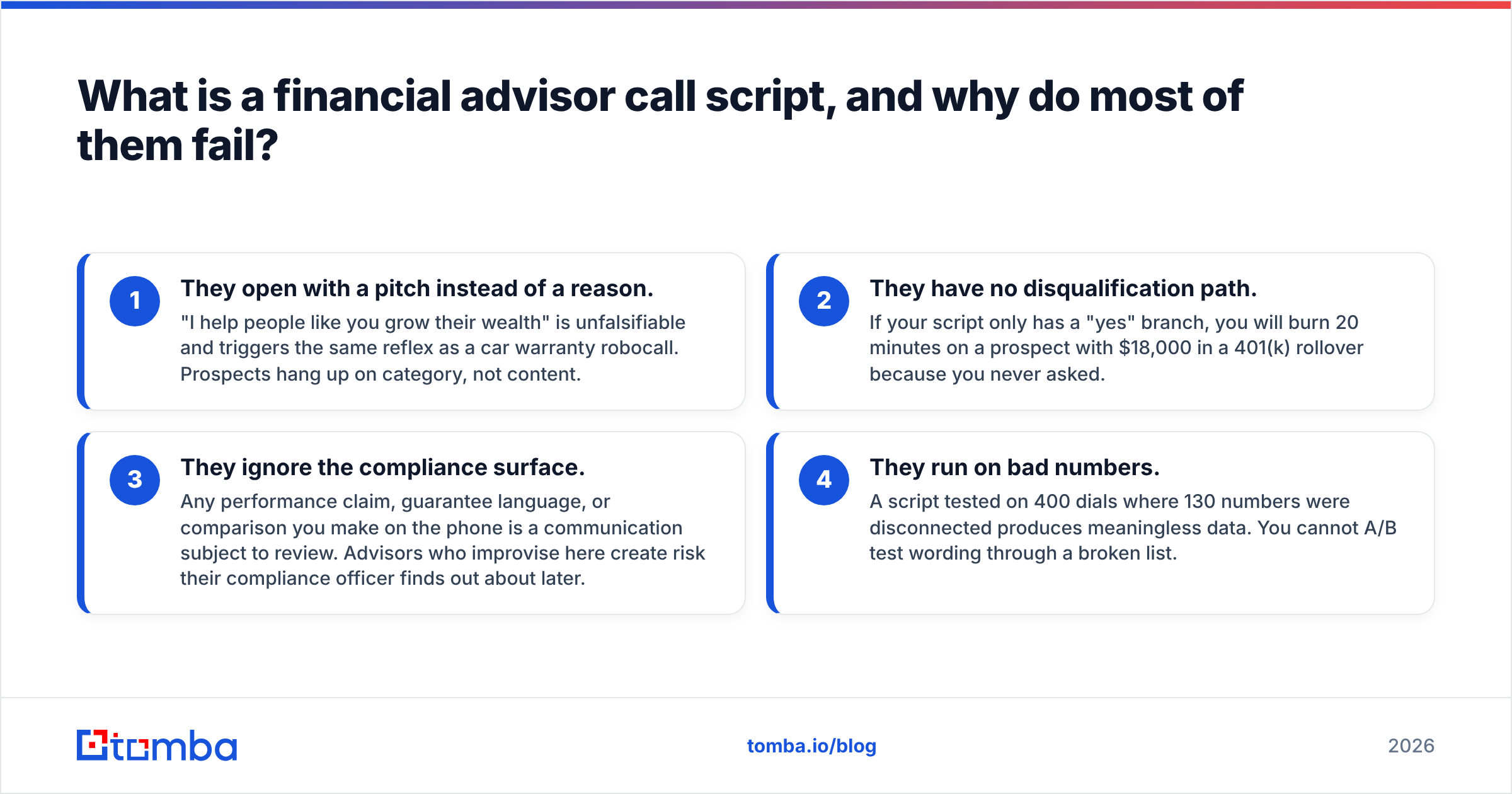
Most scripts fail for one of four reasons, and only one of them is about wording.
- They open with a pitch instead of a reason. "I help people like you grow their wealth" is unfalsifiable and triggers the same reflex as a car warranty robocall. Prospects hang up on category, not content.
- They have no disqualification path. If your script only has a "yes" branch, you will burn 20 minutes on a prospect with $18,000 in a 401(k) rollover because you never asked.
- They ignore the compliance surface. Any performance claim, guarantee language, or comparison you make on the phone is a communication subject to review. Advisors who improvise here create risk their compliance officer finds out about later.
- They run on bad numbers. A script tested on 400 dials where 130 numbers were disconnected produces meaningless data. You cannot A/B test wording through a broken list.
That fourth point is the one nobody puts in the coaching deck. Before you rewrite a single line, audit your list — pull direct dials through a phone finder and run them through a phone validator so your connect-rate math is measuring the script, not the data.
What does the opening 9 seconds actually need?#
Four things, in this order: your name, your firm, a specific reason you are calling this person, and an explicit permission ask.
Here is the structure most top-performing advisor teams converge on:
"Hi [Name], this is [Your Name] with [Firm]. I know I'm calling out of the blue — do you have thirty seconds, or did I catch you mid-something?
[pause — actually wait]
The reason I'm calling: I work with [specific segment — e.g., engineers at Boeing who are within five years of retirement], and the question I keep getting is what to do with the pension election. I don't know if that's relevant to you at all — is that on your radar?"
Three mechanics make this work:
- The upfront "bad time" ask disarms. It signals you are aware you interrupted, which separates you from a dialer bot. Roughly half of prospects say "go ahead" simply because you asked.
- The specific segment does the qualifying for you. "Engineers at Boeing near retirement" is a claim the prospect can immediately confirm or deny. "High-net-worth individuals" is not.
- "I don't know if that's relevant" is a takeaway. It removes the pressure and invites correction. People correct you far more readily than they agree with you.
What does not work: voice-mail-style monologues, "how are you today," and any sentence beginning with "I wanted to reach out."
Which call script do you use for which prospect type?#
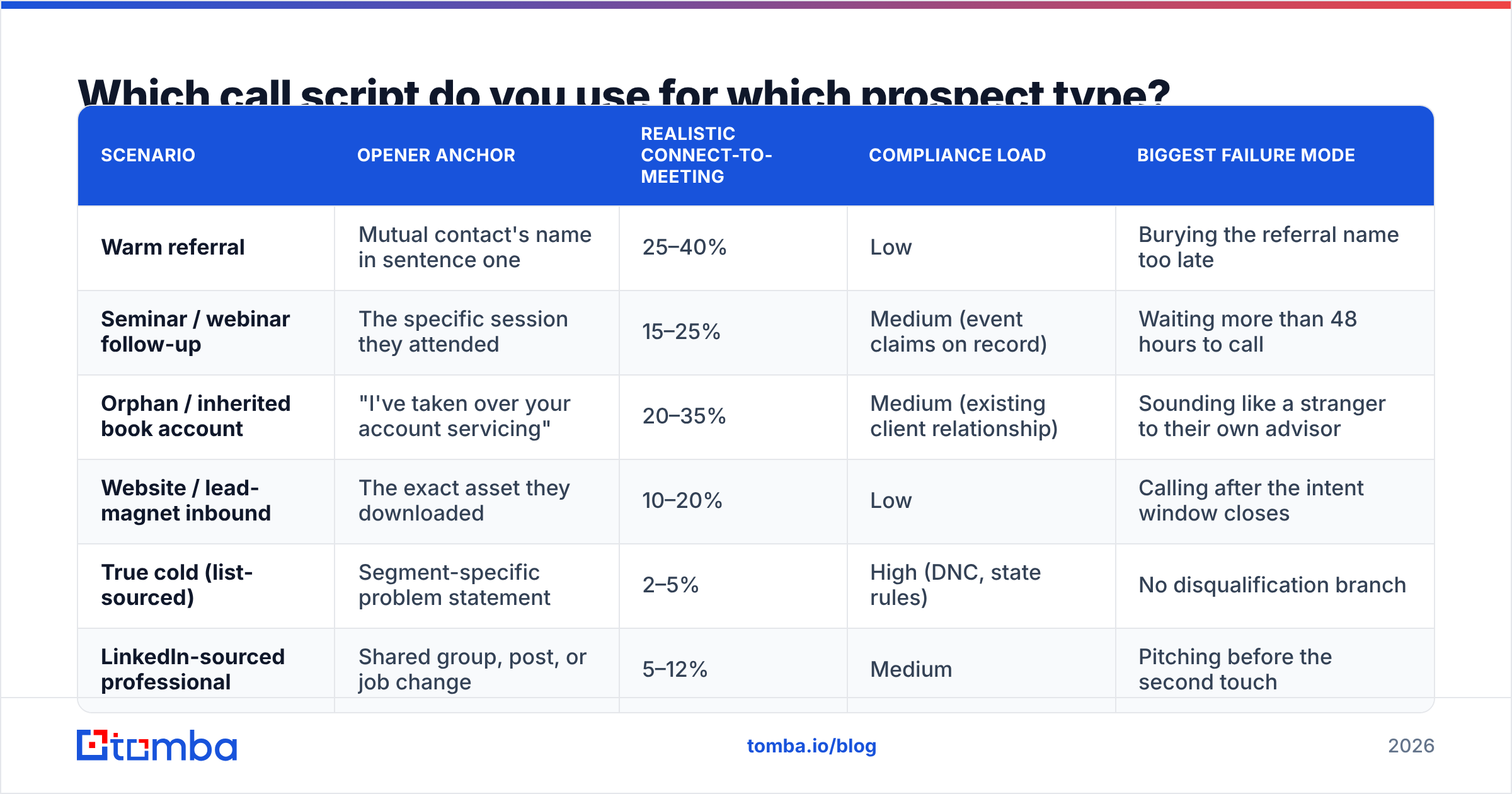
Advisors lose more to script-type mismatch than to bad phrasing. A referral call and a purchased-list cold call are different conversations with different legal footing and different odds.
| Scenario | Opener anchor | Realistic connect-to-meeting | Compliance load | Biggest failure mode |
|---|---|---|---|---|
| Warm referral | Mutual contact's name in sentence one | 25–40% | Low | Burying the referral name too late |
| Seminar / webinar follow-up | The specific session they attended | 15–25% | Medium (event claims on record) | Waiting more than 48 hours to call |
| Orphan / inherited book account | "I've taken over your account servicing" | 20–35% | Medium (existing client relationship) | Sounding like a stranger to their own advisor |
| Website / lead-magnet inbound | The exact asset they downloaded | 10–20% | Low | Calling after the intent window closes |
| True cold (list-sourced) | Segment-specific problem statement | 2–5% | High (DNC, state rules) | No disqualification branch |
| LinkedIn-sourced professional | Shared group, post, or job change | 5–12% | Medium | Pitching before the second touch |
Read the table as a routing rule, not a leaderboard. If 80% of your dials sit in the bottom two rows, your problem is sourcing, not scripting. Advisors who pull contact data from data enrichment — job title, firm, tenure, LinkedIn presence — can push more volume into the higher-converting rows above.
What is the full call script, start to finish?#
Below is a complete cold-call framework for a true cold prospect. Adapt segment language; keep the skeleton.
1. Open (0:00–0:15)
"Hi [Name], [Your Name] with [Firm]. I'm calling out of the blue — do you have thirty seconds or is now bad?"
2. Reason (0:15–0:35)
"I specialize in [segment]. Most of the people I talk to in that group are dealing with [specific, checkable problem — e.g., concentrated stock from a recent IPO and a tax bill they didn't plan for]. I don't know if that's your situation at all."
3. Permission-based discovery (0:35–2:30)
Ask two — never more than three — open questions before you propose anything:
- "How are you handling that today — is someone already helping you with it?"
- "When you look at the next couple of years, what's the thing you'd most want to have figured out?"
Listen for the disqualifiers: no investable assets, an advisor they are happy with, or a decision timeline past 18 months. All three are valid exits.
4. The bridge (2:30–3:00)
"Based on what you're describing, there are probably two or three things worth looking at. I'm not going to try to solve them on a cold call. What I'd suggest is twenty minutes — I'll show you how we've handled this for two or three people in the exact same spot, and if it's not a fit, you'll know quickly."
5. The close (3:00–3:30)
Offer two concrete times. Never "when works for you?" — that transfers the cognitive load to someone with no reason to carry it.
"Does Thursday at 8:15 work, or is Friday afternoon better?"
6. The exit (any point)
If disqualified: "That's fair — sounds like you're in good shape. Mind if I send you the one-page we did on [topic] and check back in six months?" That is a permission close, and it is worth more than a forced meeting.
How do you handle the six objections you will actually hear?#
Every advisor hears the same six. Scripting them is the highest-ROI hour you will spend.
- "I'm not interested." — "Totally fair, you don't know me yet. Can I ask one question and then I'll get off the phone: are you currently working with someone, or handling it yourself?" You are converting a reflex into information.
- "I already have an advisor." — "Good — most people I call do. I'm not asking you to fire anybody. When was the last time they walked you through [specific, high-value thing: tax-loss harvesting, Roth conversion sequencing, beneficiary review]?" Specificity creates doubt where a generic challenge creates defensiveness.
- "Send me some information." — "Happy to. So I don't send you the generic deck — what's the one thing you'd actually want it to answer?" This either produces a real question or exposes the brush-off, and both outcomes are useful.
- "How did you get my number?" — Answer plainly and factually. "Your firm's directory / a public professional database / LinkedIn." Never dodge. Dodging is what confirms you are a scammer.
- "I'm too busy right now." — "Understood. Is the better move a two-minute call Thursday morning, or should I just circle back next quarter?" Give a real out; forcing here converts a maybe into a never.
- "What are your fees?" — Never improvise this. Have a compliance-approved sentence memorized and move to the meeting: "It depends on the structure — for the majority it's a flat percentage of assets managed, and I'll show you the exact number in writing before you decide anything."
Rehearse these out loud. Objection responses that read well silently often sound robotic at speed.
What compliance rules shape what you can say?#
Short answer: more than most new advisors realize, and the constraints belong inside the script.
- Do Not Call. The U.S. National Do Not Call Registry applies to residential numbers. Firms must maintain internal DNC lists and scrub against the federal registry — state registries add their own layers. Check your firm's process before your first dial, not after a complaint.
- Communications with the public. FINRA treats scripted sales material as a communication subject to supervision. Ad-libbed performance claims, guarantees, or "we beat the market" language on a cold call is where advisors get in trouble.
- Recording and consent. Several states require all-party consent to record. If your dialer records by default, your script needs a disclosure line.
- Marketing rule considerations. The SEC's marketing rule for registered investment advisers governs testimonials, endorsements, and performance presentation. "One of my clients doubled his money" is not a casual anecdote — it is a performance claim.
Practical version: keep a one-page approved-language sheet next to the script. Anything about returns, fees, or client outcomes comes off that sheet verbatim.
How do you get the right numbers to call in the first place?#
This is where most advisor prospecting quietly breaks. A script tested against a stale list gives you noise, not signal.
The workable sequence:
- Define the segment narrowly. Not "business owners" — "owners of 15–60 employee manufacturing firms in three counties." Narrow segments produce specific openers, and specific openers survive the first 9 seconds.
- Build the account list. Local business registries, association directories, LinkedIn Sales Navigator, chamber lists, and public filings all work. Aim for named humans with titles, not company switchboards.
- Find and verify contact data. Get the direct line and a working email for each name. Use a phone finder for direct dials and an email verifier so your follow-up sequence does not bounce and damage your domain.
- Multi-thread the touch. Call, then email the same day referencing the call, then connect on LinkedIn. Advisors who only dial cap out at whatever their single-channel connect rate is.
- Log the outcome against the script version. Tag every dial with which opener you used. Without that, "the new script works better" is a feeling, not a finding.
- Re-verify quarterly. B2B contact data decays fast — people change firms, numbers get reassigned. Bulk re-checks through bulk verify keep the list honest.
If you want a benchmark: an advisor making 100 dials on a well-verified list should expect roughly 15–25 live conversations and 2–5 booked meetings on a true cold segment. If your live-conversation count is under 10, your data is the bottleneck — not your opener.
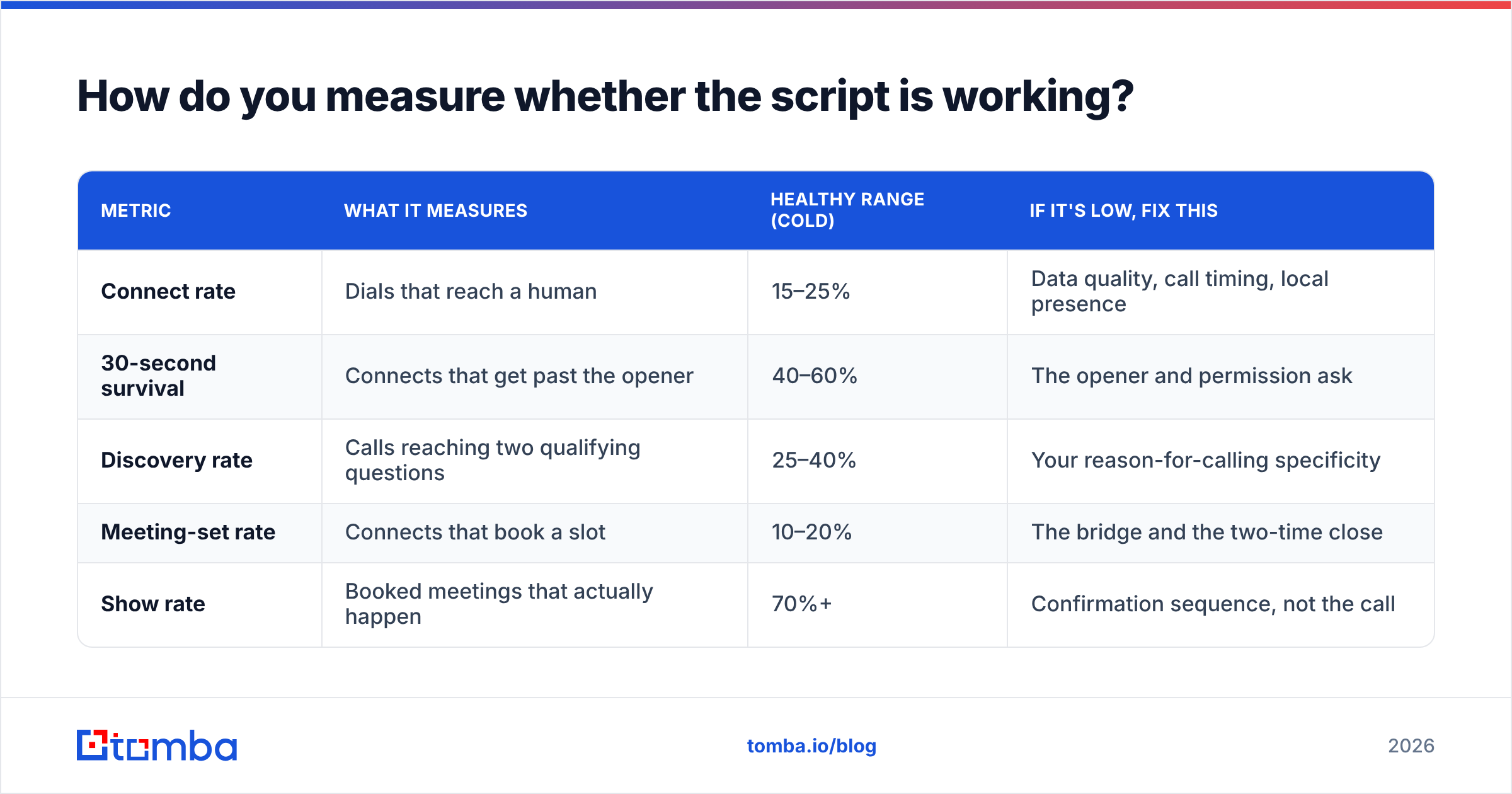
How do you measure whether the script is working?#
Track four numbers per script version, and only change one variable at a time.
| Metric | What it measures | Healthy range (cold) | If it's low, fix this |
|---|---|---|---|
| Connect rate | Dials that reach a human | 15–25% | Data quality, call timing, local presence |
| 30-second survival | Connects that get past the opener | 40–60% | The opener and permission ask |
| Discovery rate | Calls reaching two qualifying questions | 25–40% | Your reason-for-calling specificity |
| Meeting-set rate | Connects that book a slot | 10–20% | The bridge and the two-time close |
| Show rate | Booked meetings that actually happen | 70%+ | Confirmation sequence, not the call |
The most common misdiagnosis: an advisor with a 55% survival rate but an 8% meeting-set rate rewrites the opener. The opener is fine. The bridge and close are the problem.
Best call times still cluster where they always have — early morning before 9, and late afternoon after 4, local time to the prospect. Midday dials to business owners are the least productive block in the day.
What tools support the calling workflow?#
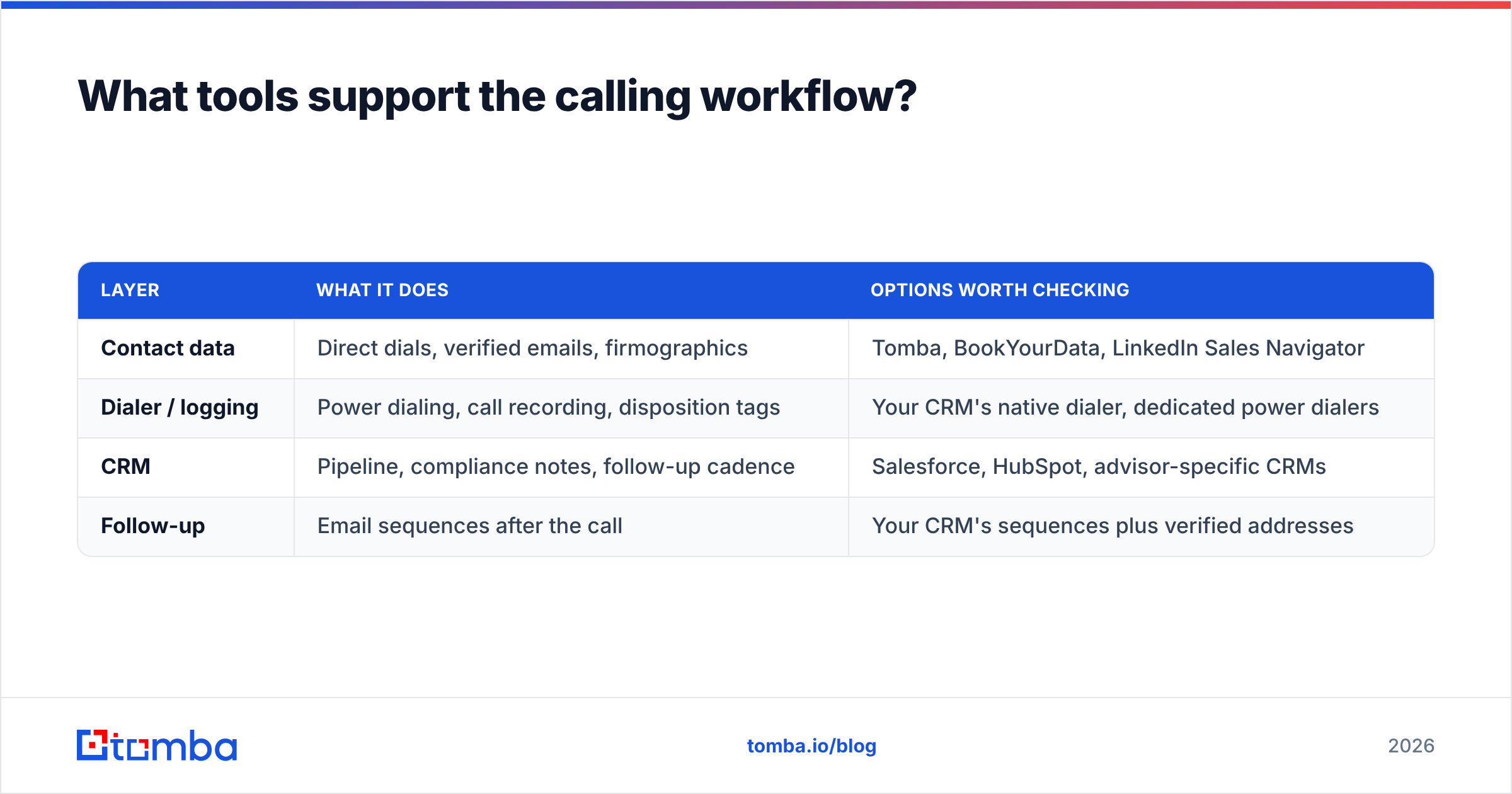
You need three things: a source of accurate contact data, a dialer or CRM to log outcomes, and a way to follow up across channels.
| Layer | What it does | Options worth checking |
|---|---|---|
| Contact data | Direct dials, verified emails, firmographics | Tomba, BookYourData, LinkedIn Sales Navigator |
| Dialer / logging | Power dialing, call recording, disposition tags | Your CRM's native dialer, dedicated power dialers |
| CRM | Pipeline, compliance notes, follow-up cadence | Salesforce, HubSpot, advisor-specific CRMs |
| Follow-up | Email sequences after the call | Your CRM's sequences plus verified addresses |
On data specifically: Tomba pricing starts with a free tier at 25 searches per month, then Starter at $49/mo, Growth at $99/mo, and Pro at $249/mo — useful if you want to test list quality before committing budget. BookYourData is a solid alternative if you prefer buying pre-built lists by industry and title rather than building them yourself; both approaches work, and the right one depends on whether your segment is narrow enough to justify manual sourcing.
Frequently asked questions#
How long should a financial advisor call script be? The full script fits on one page. The part you read aloud should be under 45 seconds before the prospect speaks. Anything longer and you are presenting, not conversing.
Should you leave a voicemail? Yes, but treat it as a 15-second billboard, not a pitch. Name, firm, one specific reason, and a promise to follow up by email. Then actually send the email.
How many touches before you stop? Six to eight across call, email, and LinkedIn over three weeks is standard. After that, move to a quarterly nurture rather than continued outreach.
Is cold calling still viable for advisors in 2026? Yes, at lower volume and higher specificity than a decade ago. What has changed is that the winning advisors pair calls with verified email and social touches instead of dialing blind. Review response rate benchmarks before setting expectations.
Where to start#
Rewrite your opener first — the 9-second block is where the most pipeline leaks. Script your six objection responses second. Then, before you measure anything, fix your list.
If your connect rate is under 15%, that is a data problem no wording change will solve. Build a verified prospect list with the Tomba Email Finder — pull working contact details for your named segment, verify before you dial and before you send, and you will finally be testing the script instead of testing your list. The free tier covers 25 searches, which is enough to check whether your current data is the thing holding your numbers down.
Related guides#
Ready to find emails that actually work?
Join 150,000+ professionals who stopped guessing and started sending. Free credits on signup — no credit card required.
Get the Tomba newsletter
Practical outbound tactics and product updates — once every two weeks.
About the author