Financial Advisor Cold Email Template: 7 Examples for 2026
Seven financial advisor cold email templates you can send without tripping FINRA Rule 2210, plus the structure, subject lines, and follow-up cadence that actually book discovery calls.
TL;DR
- A financial advisor cold email template has two jobs most templates ignore: get a reply, and survive a compliance review. Performance claims, "guaranteed returns," and testimonial language will get your draft killed before it ever gets sent.
- The structure that works is boring on purpose: one specific trigger, one observation about the prospect, one low-commitment ask. No fee schedule, no product pitch, no attachments.
- Referral and trigger-event templates consistently outperform generic "let's talk about your portfolio" emails, because they answer the only question a prospect has: why me, why now.
- Deliverability kills more advisor campaigns than copy does. A 4% bounce rate on a list of business owners will tank your domain before your subject line ever gets a fair test.
- Send 3–4 touches over 12–15 days, then stop. Advisors who send seven aggressive follow-ups generate complaints, and complaints are a compliance problem, not just a marketing one.
Why is a financial advisor cold email template different from a normal sales email?#
Because you are a regulated communicator and a SaaS AE is not.
Anything you send that promotes your advisory services counts as a communication with the public. If you're a broker-dealer rep, FINRA Rule 2210 governs the content: it must be fair and balanced, cannot omit material facts, cannot project performance, and cannot use testimonials without the required disclosures. RIAs fall under the SEC's marketing rule, which has its own testimonial and endorsement requirements. In most firms, that means your cold email template needs pre-approval and archiving, and it means every clever growth-hack line you copied from a B2B SaaS blog is a liability.
The practical consequence: your template has to win on relevance, not on claims. You cannot say "our clients average 11% annually." You can say "I noticed your firm just closed a Series B and three of your co-founders now have concentrated equity positions."
That constraint is actually a gift. It forces you into the exact copy that works anyway — specific, prospect-centered, and short.
What is the anatomy of a cold email that a financial advisor can actually send?#
Five components, in this order. Skip any one and reply rates fall off a cliff.
- The trigger — the verifiable event that makes this email make sense today. A funding round, an acquisition, an executive appointment, a company IPO filing, a partner making equity, a physician group merger. Without a trigger, you are guessing, and prospects can tell.
- The observation — one sentence connecting that trigger to a planning question. Not advice. A question. "Concentrated equity after an acquisition creates a timing problem most people only look at in Q4."
- The credibility marker — who you work with, stated factually, without performance claims. "I work with 40 physician-owners across three practices in Austin" is compliant. "I've beaten the market for them" is not.
- The ask — one low-commitment request. A 15-minute call, or a yes/no question. Never a calendar link in the first email, never an attachment, never a fee schedule.
- The exit — a plain unsubscribe or opt-out line. Required under the CAN-SPAM Act, and it also lowers complaint rates, which protects your domain.
Total length: 70 to 120 words. If your template runs longer, you are explaining instead of asking.
What are the best financial advisor cold email templates?#
Seven templates below. Every bracket is a variable you must actually fill — a template you send unedited is a template that gets ignored. Run each one past your compliance officer before it goes into a sequence; wording that clears at one firm gets rejected at another.
1. The liquidity-event template (business owners)
Subject: [Company]'s acquisition
Hi [First name],
Saw the [acquirer] deal closed last month. Congratulations.
Most owners I work with hit the same question about 60 days after close: what to do with proceeds that are suddenly sitting in one account, before the next tax year forces the decision for them.
I work with [number] founders in [city] on exactly that transition. Worth a 15-minute call to walk through how others have sequenced it?
[Name], [Firm], [CRD/registration line]
Reply "no thanks" and I won't follow up.
2. The concentrated-equity template (tech executives)
Subject: [Company] equity concentration
Hi [First name],
You've been at [Company] through [milestone] — which usually means a large share of your net worth now tracks one ticker.
The people I work with in similar positions usually want to know two things: what a diversification schedule looks like, and what it costs them in tax to start one.
Happy to walk through the framework. 15 minutes next week?
3. The referral-adjacent template (warm-ish cold)
Subject: [Mutual connection] mentioned you
Hi [First name],
[Mutual connection] and I worked together on [context]. Your name came up when we were talking about [topic].
I run a practice focused on [niche]. Not sure it's relevant to you, but if [specific planning question] is on your list for this year, I'd be glad to compare notes.
Should I send over a time, or is this not a fit?
4. The professional-niche template (physicians, attorneys, partners)
Subject: partner-track planning
Hi Dr. [Last name],
Congratulations on making partner at [Practice].
The first two years on the partner track tend to surface the same three items: buy-in financing, entity-level retirement plan design, and disability coverage that survives a change in group structure.
I work with [number] physician-partners in [region] on that sequence. Open to 15 minutes?
5. The retirement-plan template (B2B, HR/finance decision makers)
Subject: [Company]'s 401(k) at [headcount] employees
Hi [First name],
Companies usually outgrow their first 401(k) provider somewhere around [headcount] employees — the fee structure that worked at 20 people starts to show up in participant statements at 100.
I run plan reviews for [number] companies in [industry]. No cost, no obligation, and you get a written comparison either way.
Want me to send the request list?
6. The follow-up bump (touch 2 or 3)
Subject: re: [original subject]
Hi [First name] — moving this to the top of your inbox once.
One question instead of a call: is [specific planning issue] something your current advisor already has covered? If yes, I'll close the loop and stop emailing.
7. The breakup email (final touch)
Subject: closing the file
Hi [First name],
I'll assume the timing isn't right and stop here.
If [trigger event] changes that in the next few months, my details are below. Good luck with [specific thing].
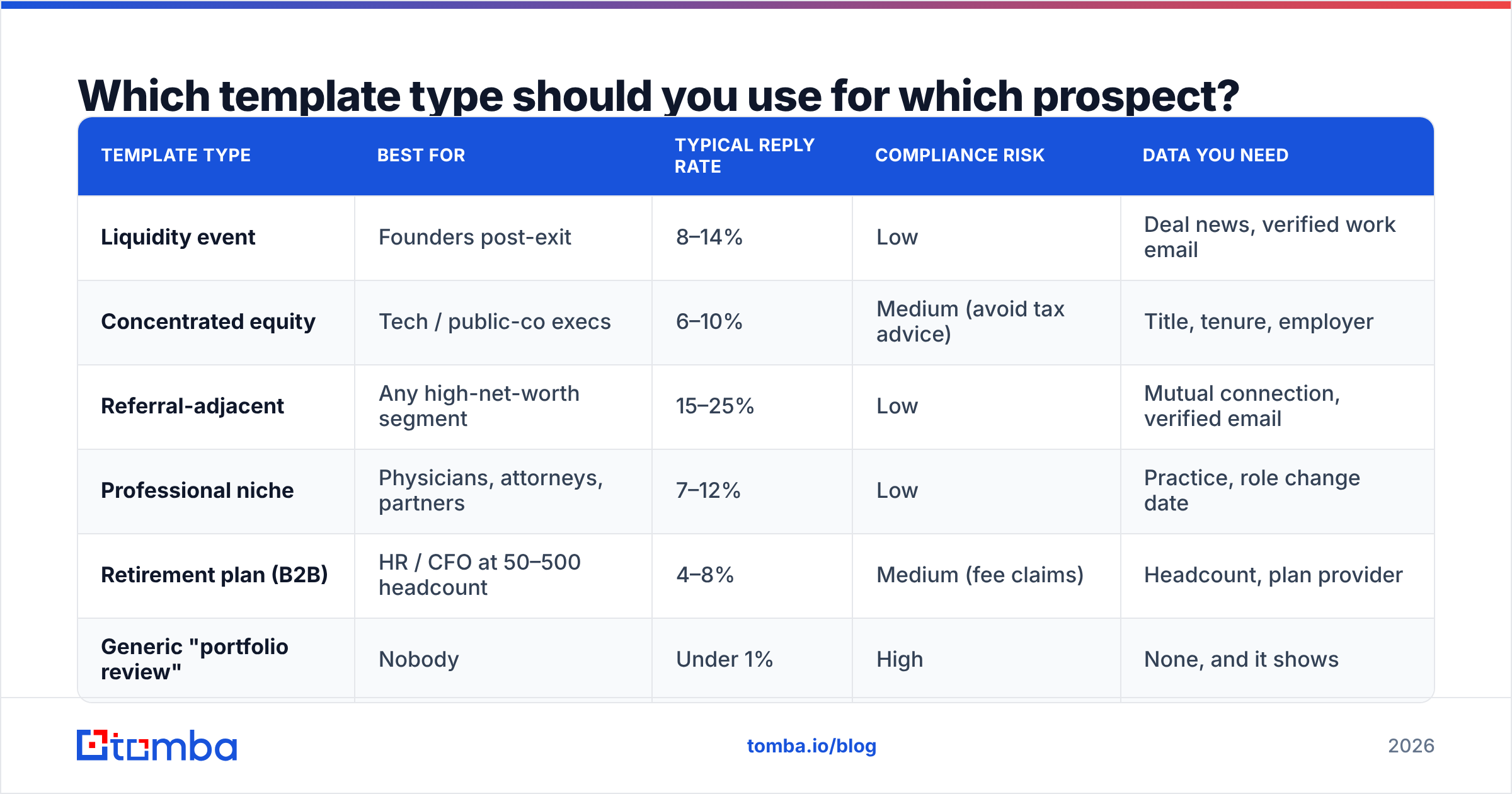
Which template type should you use for which prospect?#
| Template type | Best for | Typical reply rate | Compliance risk | Data you need |
|---|---|---|---|---|
| Liquidity event | Founders post-exit | 8–14% | Low | Deal news, verified work email |
| Concentrated equity | Tech / public-co execs | 6–10% | Medium (avoid tax advice) | Title, tenure, employer |
| Referral-adjacent | Any high-net-worth segment | 15–25% | Low | Mutual connection, verified email |
| Professional niche | Physicians, attorneys, partners | 7–12% | Low | Practice, role change date |
| Retirement plan (B2B) | HR / CFO at 50–500 headcount | 4–8% | Medium (fee claims) | Headcount, plan provider |
| Generic "portfolio review" | Nobody | Under 1% | High | None, and it shows |
Reply rates above are ranges reported across advisor outbound programs and general B2B benchmarks compiled by sources like HubSpot; treat them as directional, not as a promise. Your niche, list quality, and sender reputation move these numbers more than the copy does.
What subject lines get financial advisor emails opened?#
Short, lowercase-feeling, and specific to the recipient. The pattern that works is [their company or event] plus nothing else.
- "Acme's Series B"
- "partner-track planning"
- "[Mutual connection] mentioned you"
- "your 401(k) at 140 employees"
The pattern that fails: anything that sounds like a marketing campaign. "Secure Your Financial Future," "Is Your Portfolio Ready for 2026?," "Quick question" — all three are pattern-matched to spam by both humans and filters. Avoid currency symbols, percentages, and exclamation marks in the subject line entirely; they raise spam scores and they raise compliance flags at the same time. If you want a second opinion before a send, run drafts through a subject line tester and cut anything that scores as promotional.
Why do most advisor cold email campaigns fail before the copy matters?#
Bad data. Not bad writing.
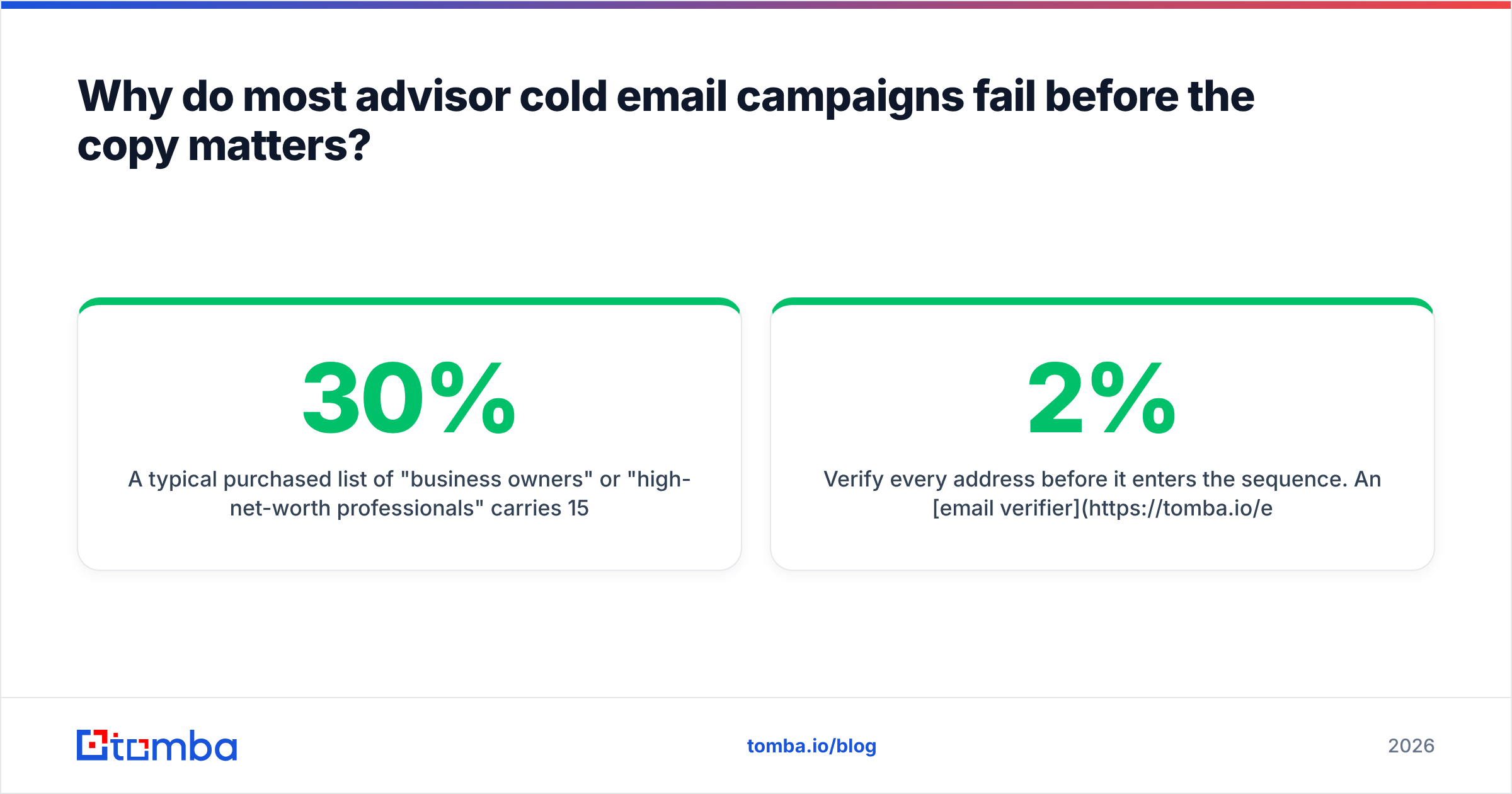
A typical purchased list of "business owners" or "high-net-worth professionals" carries 15–30% invalid addresses. Send 500 of those and you get a bounce rate that mailbox providers read as a spam signal. Your domain reputation drops, your next 500 emails land in Promotions or nowhere, and you conclude the template didn't work.
The fix is unglamorous and it happens before you write a single line:
- Build the list from the trigger, not the other way around. Start with companies that just raised, merged, or hired. Then find the people. A domain search against a target company returns the contacts and the firm's email pattern in one pass.
- Verify every address before it enters the sequence. An email verifier pass should get you under 2% bounce. Anything above 3% and you should pause the campaign, not push through it.
- Handle catch-all domains separately. Many small advisory-adjacent firms and medical groups run catch-all servers that accept everything, so standard verification returns "unknown." Route those to a catch-all verifier and treat the rest as a lower-priority segment.
- Cap daily volume per mailbox. 30–50 sends per inbox per day, ramped over three weeks. Advisors who blast 400 in a morning from a brand-new domain get filtered within 48 hours.
- Archive everything. Your sequences, your replies, your opt-outs. This is a compliance requirement, not an optional nicety, and it's easier to set up on day one than to reconstruct during an exam.
How many follow-ups should a financial advisor send?#
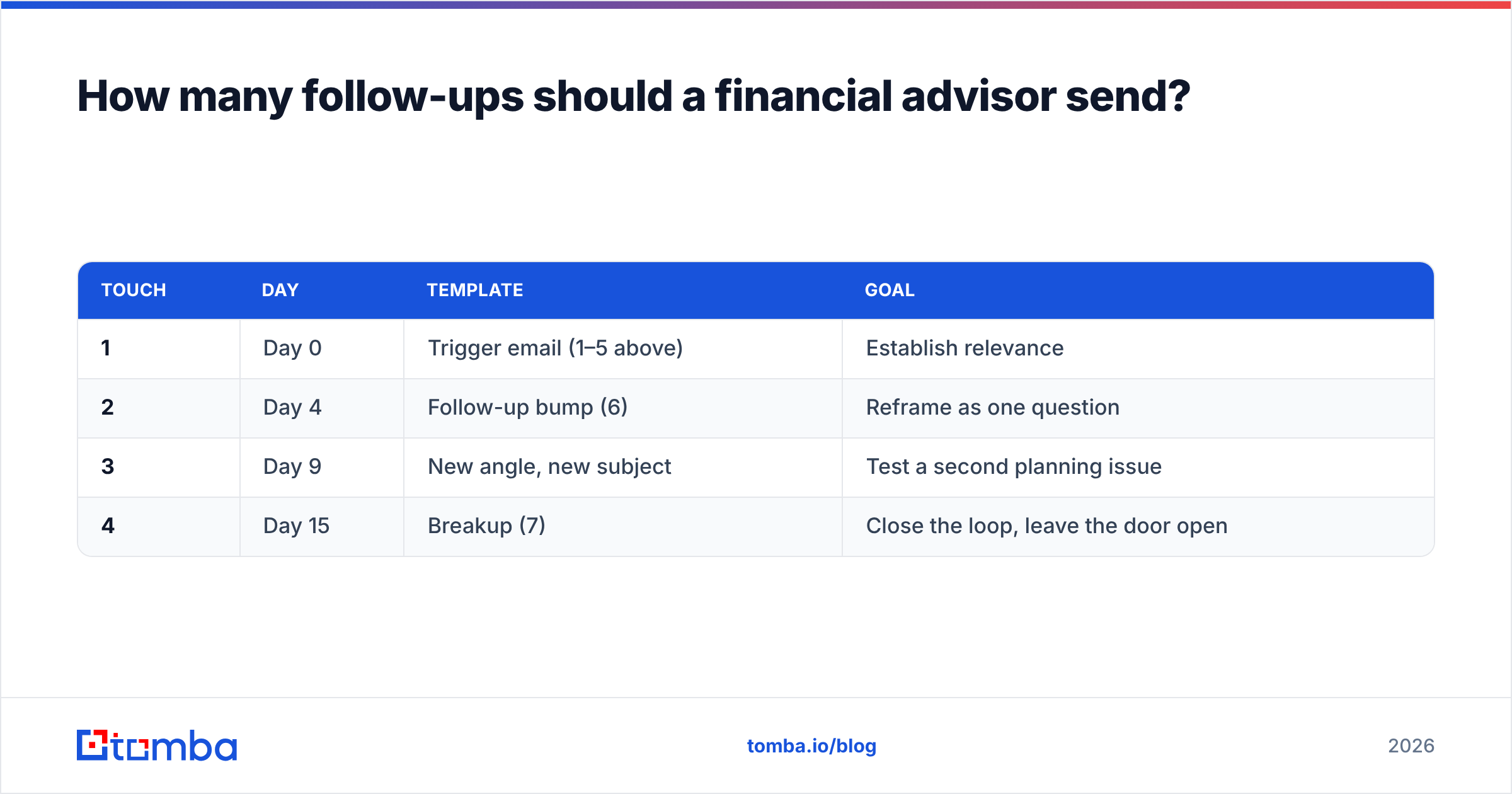
Three to four total touches, then stop. Advisors are not selling a $50/month tool; you are asking someone to consider handing you their financial life. Volume-based persistence reads as desperation and generates complaints.
| Touch | Day | Template | Goal |
|---|---|---|---|
| 1 | Day 0 | Trigger email (1–5 above) | Establish relevance |
| 2 | Day 4 | Follow-up bump (6) | Reframe as one question |
| 3 | Day 9 | New angle, new subject | Test a second planning issue |
| 4 | Day 15 | Breakup (7) | Close the loop, leave the door open |
Two rules that matter more than the cadence. First, change the angle on touch 3 — resending the same pitch louder never works. Second, honor every opt-out inside 10 business days at the outside, and realistically inside 24 hours. Complaint rate is the metric that gets your domain blocked and your compliance officer involved on the same afternoon.
What numbers should you expect from a financial advisor cold email template?#
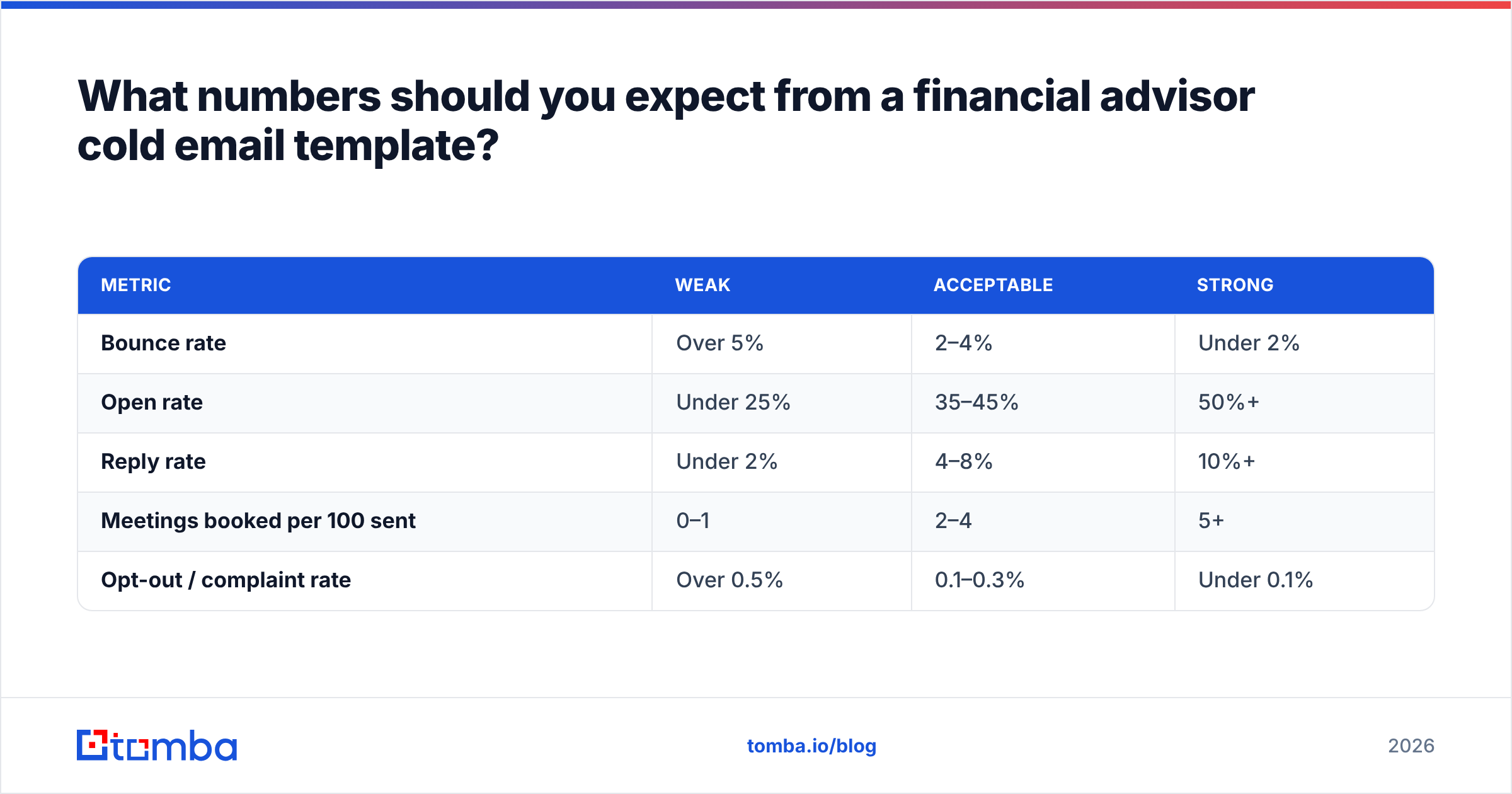
Set the benchmark before you launch so you're not judging a campaign on vibes.
| Metric | Weak | Acceptable | Strong |
|---|---|---|---|
| Bounce rate | Over 5% | 2–4% | Under 2% |
| Open rate | Under 25% | 35–45% | 50%+ |
| Reply rate | Under 2% | 4–8% | 10%+ |
| Meetings booked per 100 sent | 0–1 | 2–4 | 5+ |
| Opt-out / complaint rate | Over 0.5% | 0.1–0.3% | Under 0.1% |
If opens are fine but replies are near zero, your copy is the problem — usually the ask is too big or the trigger is too generic. If opens are low and bounces are high, the list is the problem and no rewrite will save it. Diagnose in that order; most advisors rewrite copy when they should be cleaning data.
What should you do next?#
Pick one niche, one trigger, and one template. Write 25 personalized versions by hand before you automate anything. The 25 manual sends will teach you which observation line makes people reply, and that line becomes the backbone of the sequence you scale.
Then fix the input. A compliant, well-written financial advisor cold email template is worthless if it lands on an address that bounced six months ago. Use the Tomba Email Finder to build verified contact lists from the companies and trigger events you actually care about — search by domain, name, or company, with verification built into the same workflow. The free tier gives you 25 searches a month to test the process on a single niche, and paid plans start at $49/mo on Starter with Growth at $99/mo when you're ready to run a real cadence; full Tomba pricing is on the site.
Get the list right, keep the copy compliant, and stop at four touches. That's the entire playbook.
Related guides#
Ready to find emails that actually work?
Join 150,000+ professionals who stopped guessing and started sending. Free credits on signup — no credit card required.
Get the Tomba newsletter
Practical outbound tactics and product updates — once every two weeks.
About the author