How to Find Accounts by Email in 2026: Tools and Methods
An email address is the most durable identifier a person carries. Here's how to turn one address into a name, a company, a job title, and a set of live accounts — and where every method quietly fails.
TL;DR
- "Find accounts by email" splits into two very different jobs: identity resolution (who is this person, what company, what social profiles) and account mapping (which company record in your CRM does this address belong to).
- Reverse email lookup works by joining an address against pre-built identity graphs — public web crawls, corporate directories, and permissioned data partnerships. Nobody is querying Gmail's user table.
- Match rates in the real world land somewhere around 40–75% for B2B work addresses and much lower for free consumer inboxes. Any vendor quoting 95%+ across the board is quoting coverage, not accuracy.
- The highest-leverage move is usually the cheapest one: extract the domain from the address, run a domain search, and rebuild the account around it.
- Free tools answer "does this address exist?" Paid APIs answer "who owns it and what should I do about it?" Pick based on which question is blocking you.
What does "find accounts by email" actually mean?#
The phrase gets typed into Google by three different people with three different problems.
Person one has a single email address — a form fill, a webinar registrant, a reply from an unknown sender — and wants to know who it belongs to. That's reverse email lookup: address in, person and company out.
Person two works in RevOps and has 8,000 orphaned contact records whose email addresses never got attached to an account object. That's account matching: address in, CRM account ID out.
Person three is checking whether an email address has profiles on LinkedIn, X, GitHub, or a dozen other platforms — often for verification, fraud review, or research. That's account discovery in the OSINT sense.
All three lean on the same underlying asset: an identity graph that has already seen the address somewhere and stored what it was sitting next to. The difference is what you ask the graph to return.
This guide covers all three, but weights toward the B2B version — because that's where the data is denser, the legal footing is clearer, and the ROI is measurable.
Why would you need to find accounts by an email address?#
Concrete situations where this stops being a curiosity and starts being revenue:
- Inbound lead routing. A demo request arrives from
j.torres@nordsigma.iowith no company field filled in. You have about 5 minutes before response-rate decay kicks in. Resolving the address to a company and headcount decides whether it goes to SMB or enterprise. - Re-attaching orphaned CRM records. Contacts imported from an old list, an events export, or a dead marketing tool arrive with nothing but an address. Without an account link they're invisible to territory rules, scoring, and reporting.
- Deduplication before a migration. Two records, two addresses, one human. Resolving both to the same identity prevents you from paying for the same contact twice and emailing them twice.
- Reply triage. Someone replies from a personal address, or from an alias you don't recognize. Knowing it's the same buyer under a different domain changes how you respond.
- Fraud and abuse review. Trial signups from disposable domains, or a "VP of Procurement" whose address resolves to no professional footprint anywhere.
- Reconstructing a buying committee. One known address gives you the domain, the email pattern, and a path to the other seven people on the deal.
The fifth and sixth cases are where the compounding value lives. One resolved address is a lead. One resolved address plus a domain search is an account plan.
What are the main methods for finding accounts by email?#
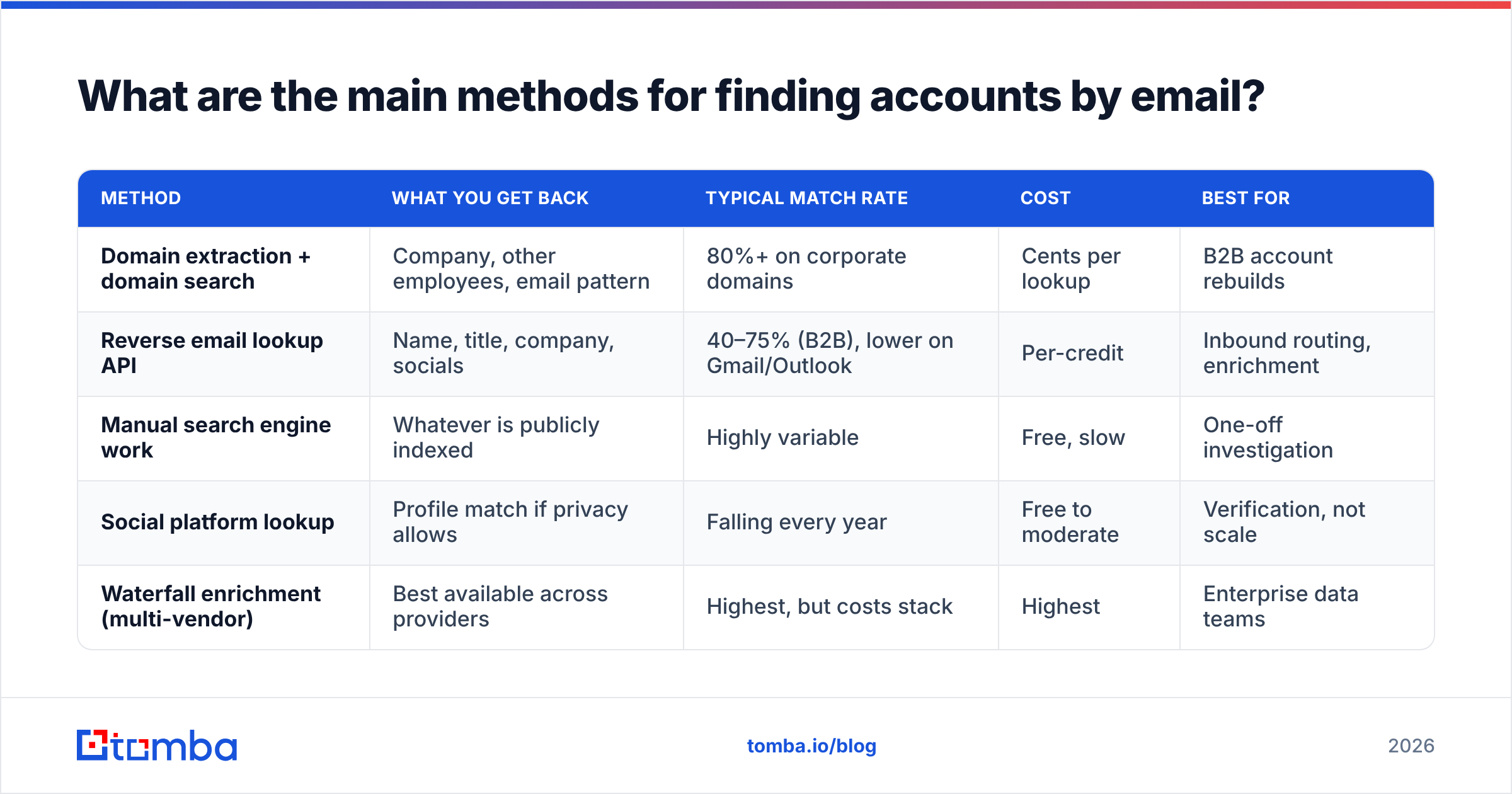
Five approaches, ranked roughly by effort-to-payoff:
| Method | What you get back | Typical match rate | Cost | Best for |
|---|---|---|---|---|
| Domain extraction + domain search | Company, other employees, email pattern | 80%+ on corporate domains | Cents per lookup | B2B account rebuilds |
| Reverse email lookup API | Name, title, company, socials | 40–75% (B2B), lower on Gmail/Outlook | Per-credit | Inbound routing, enrichment |
| Manual search engine work | Whatever is publicly indexed | Highly variable | Free, slow | One-off investigation |
| Social platform lookup | Profile match if privacy allows | Falling every year | Free to moderate | Verification, not scale |
| Waterfall enrichment (multi-vendor) | Best available across providers | Highest, but costs stack | Highest | Enterprise data teams |
Two things people get wrong when reading a table like this.
First, match rate and accuracy are not the same number. A provider can return a result for 90% of your addresses and still be wrong a third of the time. Ask vendors for both, and test on a list where you already know the answers.
Second, the free-inbox penalty is brutal. A @gmail.com address has no domain signal at all — the graph has to have seen that exact string tied to a name somewhere. Corporate addresses carry the company in the string itself, which is why the cheapest method on the list is also the most reliable.
How does reverse email lookup actually work?#
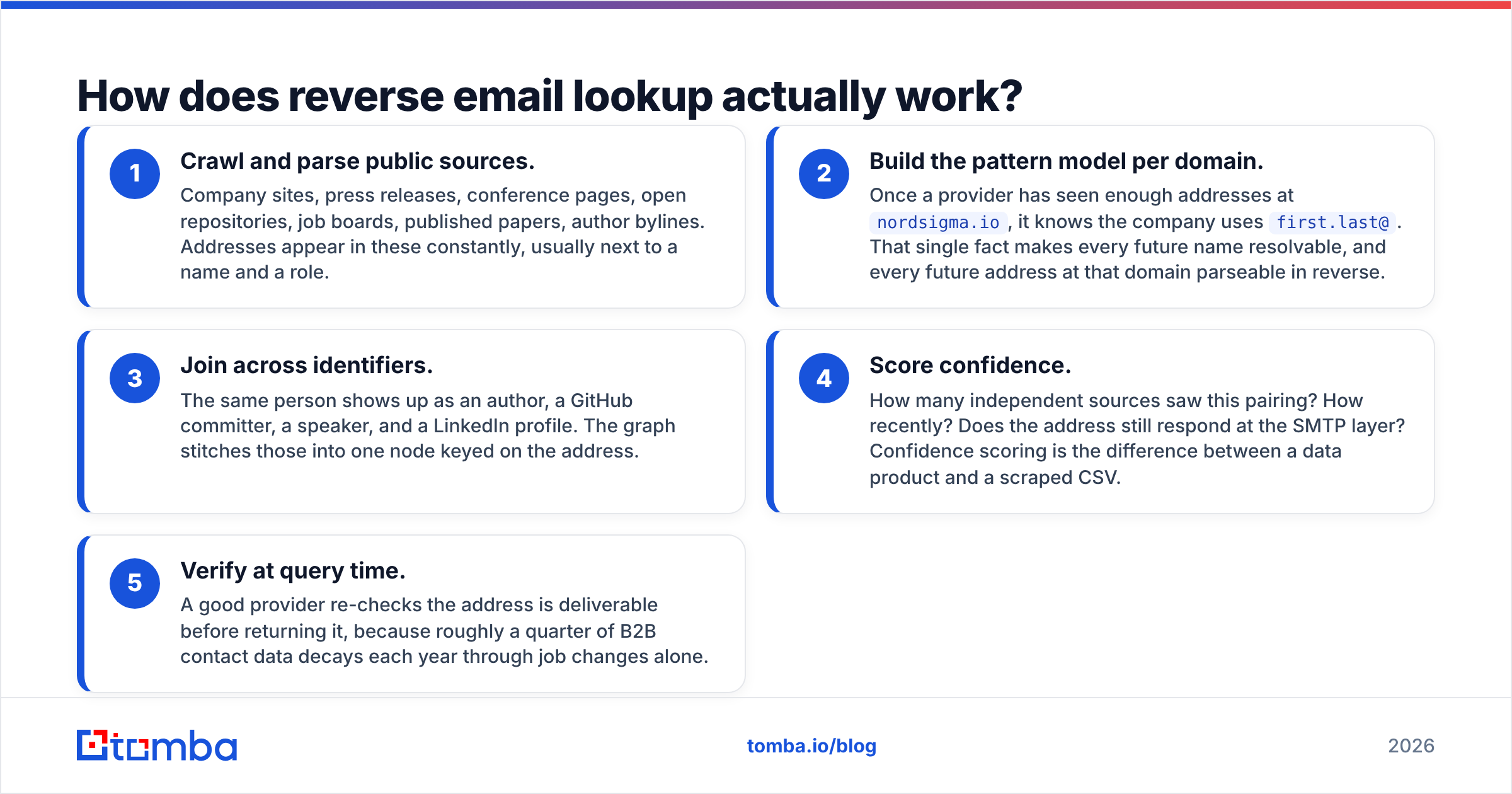
Nobody has a backdoor into inbox providers. What actually happens:
- Crawl and parse public sources. Company sites, press releases, conference pages, open repositories, job boards, published papers, author bylines. Addresses appear in these constantly, usually next to a name and a role.
- Build the pattern model per domain. Once a provider has seen enough addresses at
nordsigma.io, it knows the company usesfirst.last@. That single fact makes every future name resolvable, and every future address at that domain parseable in reverse. - Join across identifiers. The same person shows up as an author, a GitHub committer, a speaker, and a LinkedIn profile. The graph stitches those into one node keyed on the address.
- Score confidence. How many independent sources saw this pairing? How recently? Does the address still respond at the SMTP layer? Confidence scoring is the difference between a data product and a scraped CSV.
- Verify at query time. A good provider re-checks the address is deliverable before returning it, because roughly a quarter of B2B contact data decays each year through job changes alone.
Step 2 is the one most buyers underrate. Pattern inference is why a tool can hand you a colleague's address it has never literally seen. It's also why a company email pattern check is often the fastest single diagnostic you can run on a new domain.

Can you find accounts by email for free?#
Partly. Free methods answer narrow questions well and broad questions badly.
What free actually gets you:
- Syntax and deliverability. A free email checker tells you whether the address is well-formed, whether the domain has MX records, and whether the mailbox is likely to accept mail. That alone kills a lot of junk before it enters your CRM.
- Domain identity. Everything after the
@is free information. WHOIS, the site itself, and its social footprint tell you the company without spending a credit. - Search operators. Wrapping the address in quotes and running it through a search engine surfaces forum posts, commit logs, conference listings, and PDFs. Slow, but occasionally decisive.
- Gravatar-style avatar lookups. Some addresses resolve to a public avatar and display name. Coverage is thin and shrinking.
What free will not get you: title, seniority, department, company size, verified social profile, phone number, or any of it at volume. The moment you have more than about twenty addresses, manual work costs more in salary than an API costs in credits.
The honest framing: use free tools to validate, paid tools to identify. Running an unverified list through a paid enrichment API is how you burn credits on addresses that bounced six months ago. Run the email verifier first, then enrich the survivors.
Which tools find accounts by email best in 2026?#
The market splits into three camps: dedicated lookup/finder platforms, all-in-one sales-intelligence suites, and pure verification services. Most teams end up using one from column A and one from column C.
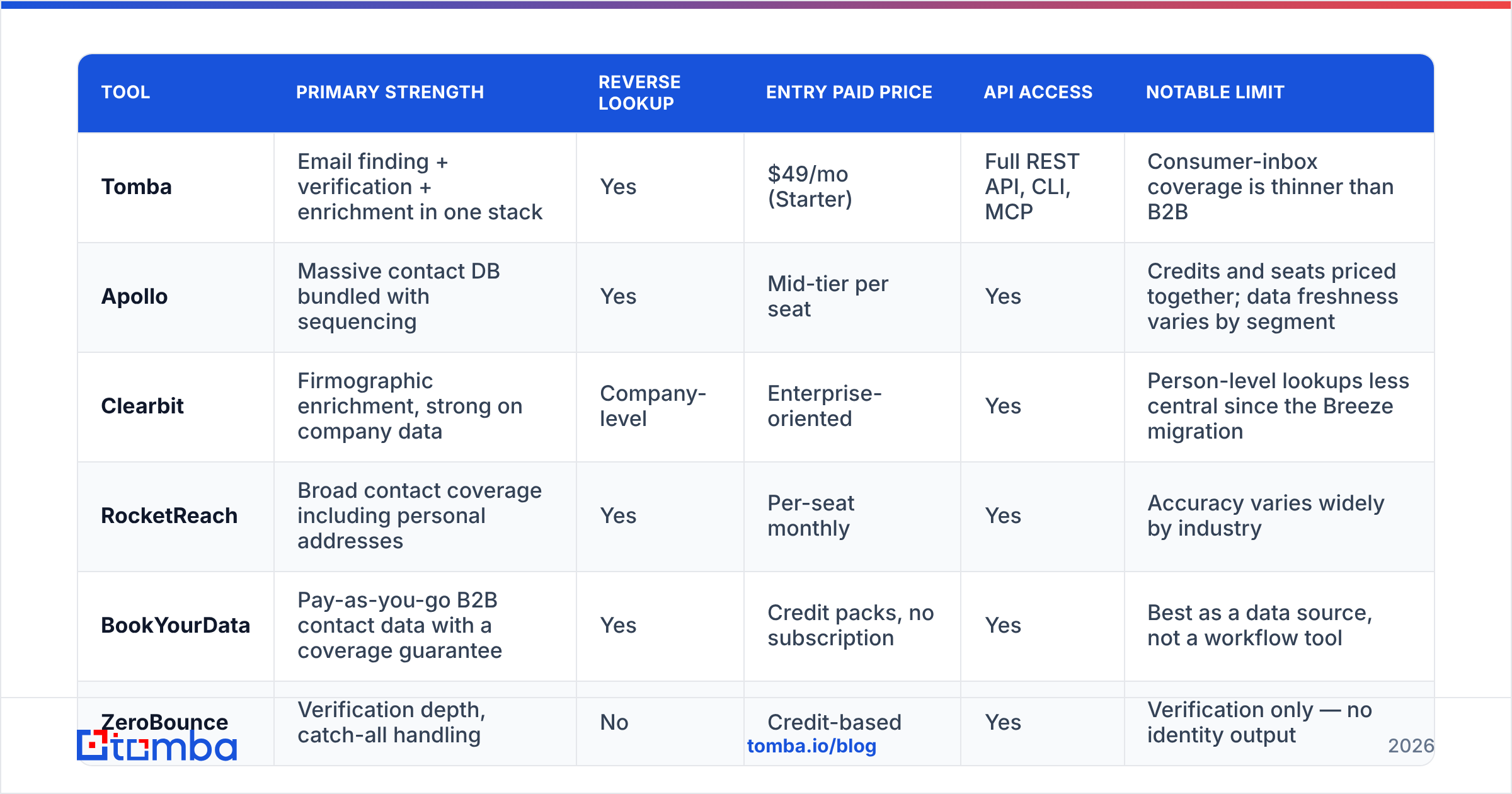
| Tool | Primary strength | Reverse lookup | Entry paid price | API access | Notable limit |
|---|---|---|---|---|---|
| Tomba | Email finding + verification + enrichment in one stack | Yes | $49/mo (Starter) | Full REST API, CLI, MCP | Consumer-inbox coverage is thinner than B2B |
| Apollo | Massive contact DB bundled with sequencing | Yes | Mid-tier per seat | Yes | Credits and seats priced together; data freshness varies by segment |
| Clearbit | Firmographic enrichment, strong on company data | Company-level | Enterprise-oriented | Yes | Person-level lookups less central since the Breeze migration |
| RocketReach | Broad contact coverage including personal addresses | Yes | Per-seat monthly | Yes | Accuracy varies widely by industry |
| BookYourData | Pay-as-you-go B2B contact data with a coverage guarantee | Yes | Credit packs, no subscription | Yes | Best as a data source, not a workflow tool |
| ZeroBounce | Verification depth, catch-all handling | No | Credit-based | Yes | Verification only — no identity output |
Pricing on every row except Tomba moves regularly and is often seat-dependent — check each vendor's own page and cross-reference reviews on G2 before you commit to an annual contract.
For reference, Tomba pricing runs Free (25 searches/mo), Starter $49/mo, Growth $99/mo, Pro $249/mo, and custom Enterprise. The reason it lands well for this specific job is that lookup, verification, and pattern inference sit behind one key — you're not paying three vendors to answer one question, and the Tomba API returns confidence scores rather than a bare string.
BookYourData deserves a fair mention here too: if your constraint is procurement rather than workflow, its pay-as-you-go credit model avoids the subscription commitment entirely, and the coverage guarantee is a genuinely different risk posture from the seat-based suites.
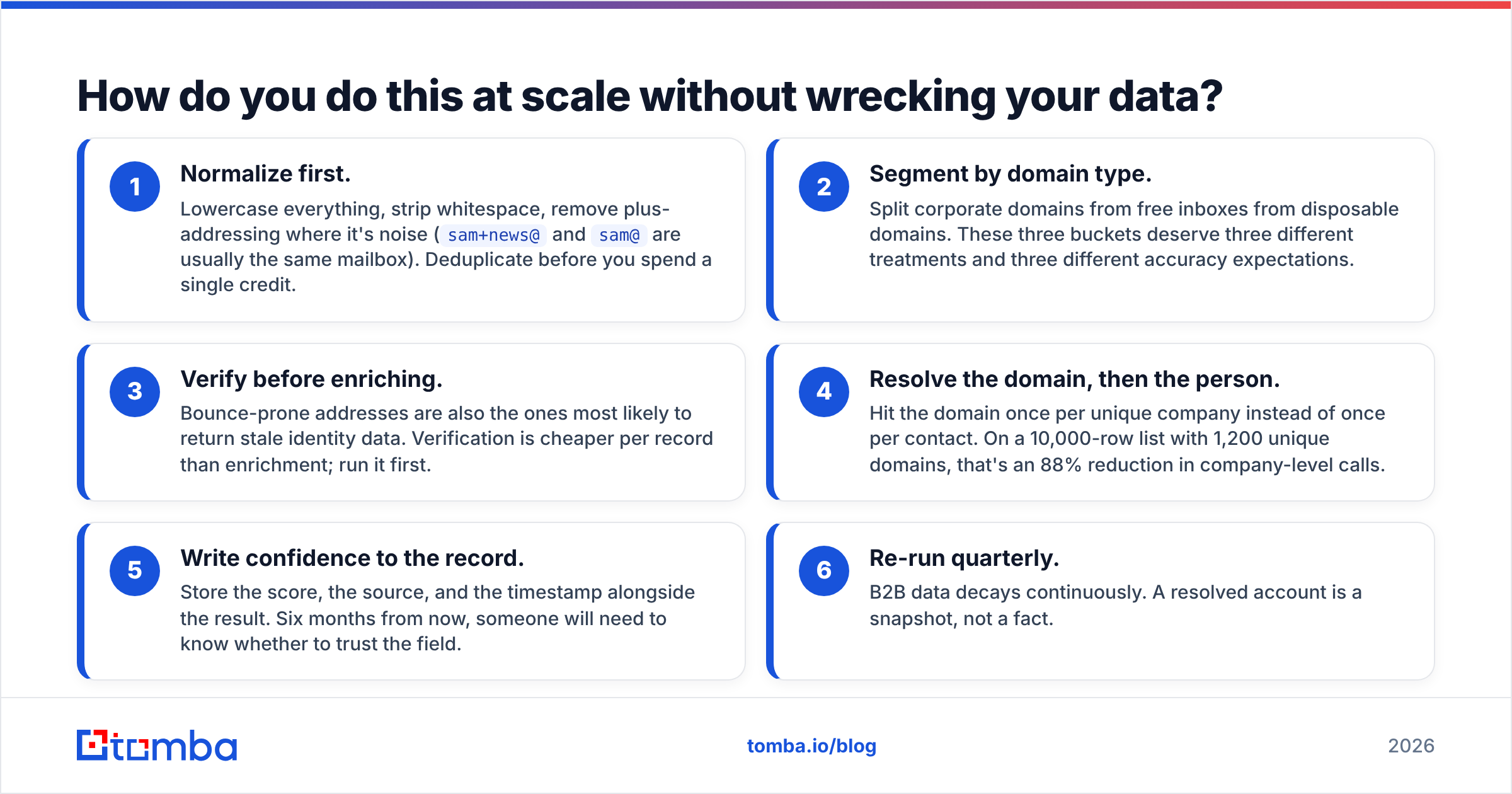
How do you do this at scale without wrecking your data?#
A workflow that survives contact with 10,000 rows:
- Normalize first. Lowercase everything, strip whitespace, remove plus-addressing where it's noise (
sam+news@andsam@are usually the same mailbox). Deduplicate before you spend a single credit. - Segment by domain type. Split corporate domains from free inboxes from disposable domains. These three buckets deserve three different treatments and three different accuracy expectations.
- Verify before enriching. Bounce-prone addresses are also the ones most likely to return stale identity data. Verification is cheaper per record than enrichment; run it first.
- Resolve the domain, then the person. Hit the domain once per unique company instead of once per contact. On a 10,000-row list with 1,200 unique domains, that's an 88% reduction in company-level calls.
- Write confidence to the record. Store the score, the source, and the timestamp alongside the result. Six months from now, someone will need to know whether to trust the field.
- Re-run quarterly. B2B data decays continuously. A resolved account is a snapshot, not a fact.
For batch work, a bulk email finder or a direct API loop beats spreadsheet copy-paste every time. If your team lives in the CRM, wiring enrichment through the HubSpot integration means resolution happens on record creation rather than in a monthly cleanup sprint — and HubSpot's own data-hygiene guidance is worth reading before you design the field mapping.
What are the limits and the legal considerations?#
Four honest constraints, because vendors rarely lead with them.
Consumer addresses are a coin flip. A @gmail.com address carries no domain signal. Unless that exact string has been published somewhere indexable, no provider will resolve it reliably — and any that claims to should be tested hard before you pay.
Catch-all domains break verification. A domain configured to accept all mail returns "valid" for every address you throw at it, including invented ones. This is why a dedicated catch-all verifier exists as a separate step — SMTP alone can't tell you the truth here.
Social platform matching keeps degrading. Every major platform has tightened email-based discovery over the past few years. Any workflow that assumes you can reliably map an address to a social profile at scale is building on sand.
Compliance is jurisdictional and it's on you. Under GDPR, business contact data can be processed under legitimate interest, but that requires a documented balancing test, a working opt-out, and honest sourcing disclosure. CAN-SPAM in the US is looser on collection but strict on what you send. CASL in Canada is stricter than both. Reputable vendors publish where their data comes from — if a provider won't tell you, that opacity is your liability, not theirs.
Practical rule: if you can't explain to a regulator why you hold a given record and where it came from, don't hold it.
What's the fastest path from one address to a full account?#
Compressed to five minutes:
- Extract the domain. Run a domain search on it. You now have the company, the email pattern, and a roster of other addresses.
- Run the original address through verification. Confirm it's live before you build anything on it.
- Reverse-resolve the person for name, title, and seniority.
- Use the pattern to construct and verify the rest of the buying committee.
- Push everything into the CRM with source and confidence attached.
That sequence turns a single anonymous string into a mapped account with a scored contact list — and it costs a handful of credits, not an afternoon.
If you want to run it end to end without stitching four vendors together, start with the Tomba Email Finder. The free tier gives you 25 searches a month to test match quality on addresses where you already know the answer — which is exactly how you should evaluate any provider in this category before your card gets charged.
Related guides#
Ready to find emails that actually work?
Join 150,000+ professionals who stopped guessing and started sending. Free credits on signup — no credit card required.
Get the Tomba newsletter
Practical outbound tactics and product updates — once every two weeks.
About the author