How to Find Email Addresses in the UK: 2026 Working Guide
UK B2B contacts hide behind co.uk domains, catch-all servers and PECR rules that US-built tools ignore. Here is what actually works to find a UK email address in 2026 — methods, accuracy data, tools and the legal line.
TL;DR
- UK email discovery fails more often than US discovery for three structural reasons:
.co.ukdomain fragmentation, a much higher rate of catch-all mail servers, and smaller public data footprints outside London. - The highest-yield method in 2026 is still domain-level pattern discovery (find the company's format, then apply it to the person) — not scraping, not guessing.
- Expect 60–75% hit rates on UK SMEs versus 80–90% on US mid-market. Anyone promising 95% coverage on UK data is measuring something else.
- Under UK GDPR + PECR, B2B email to a limited company or LLP is generally permitted with legitimate interest; sole traders and partnerships are treated like consumers and need consent.
- Verify before you send. UK catch-all domains are common enough that an unverified list will quietly torch your sender reputation.
Why is finding a UK email address harder than finding a US one?#
Because the underlying data is thinner and messier, not because the tools are worse.
Three things make UK contact discovery structurally different:
1. Domain fragmentation. A US company usually lives on one .com. A UK company might use acme.co.uk for the corporate site, acme.com for international, acme.uk as a redirect, and acmegroup.co.uk for the holding entity — with email routing on only one of them. Query the wrong domain and you get zero results even though the data exists.
2. Catch-all servers. UK hosting providers and Microsoft 365 tenants configured by small IT resellers accept mail at any address on the domain. That defeats standard SMTP verification: everything comes back "valid", so you cannot tell a real mailbox from a typo. In our experience testing UK domain lists, roughly one in four small-business domains is catch-all — a meaningfully higher rate than comparable US lists.
3. Smaller public footprint. US professionals publish more: bios, conference speaker pages, GitHub commits, press releases. Outside London tech and financial services, UK employees at a 40-person engineering firm in Sheffield may have zero indexable mentions of their email address anywhere. There is nothing to crawl, so discovery has to be pattern-inferred rather than source-found.
None of this makes UK prospecting impossible. It just means the naive approach — paste a name into a tool, hope for a green checkmark — has a much wider failure band.
What email patterns do UK companies actually use?#
Pattern inference is the workhorse of UK email discovery, so it pays to know the distribution. Across UK business domains, the formats cluster tightly:
first.last@company.co.uk— the dominant pattern, especially in professional services, legal, accounting, and anything with a Microsoft 365 tenant set up by a reseller. If you have to bet blind on one format, bet on this.first@company.co.uk— heavily used by agencies, startups, and firms under ~30 people. Common in creative, marketing, and consultancy sectors where headcount never justified surname disambiguation.finitial+last@company.co.uk(jbloggs@) — the legacy pattern. You see it in manufacturing, logistics, engineering, and any organisation whose mail conventions were set before 2010 and never revisited.first.last@company.com— used when a UK entity sits under a global parent. The website is.co.uk, the mail exchanger is the group.com. This is the single biggest source of false negatives in UK searches.firstlast@company.co.ukandfirst_last@company.co.uk— the long tail. Rare, but worth testing when the top four fail.
The practical rule: find one confirmed address on the domain, then apply its shape to everyone else. One verified sarah.clarke@ tells you more than ten guesses at s.clarke@. A company email pattern check does this in one step, and a domain search surfaces the confirmed addresses that reveal the shape.
Where does UK B2B email data actually come from?#
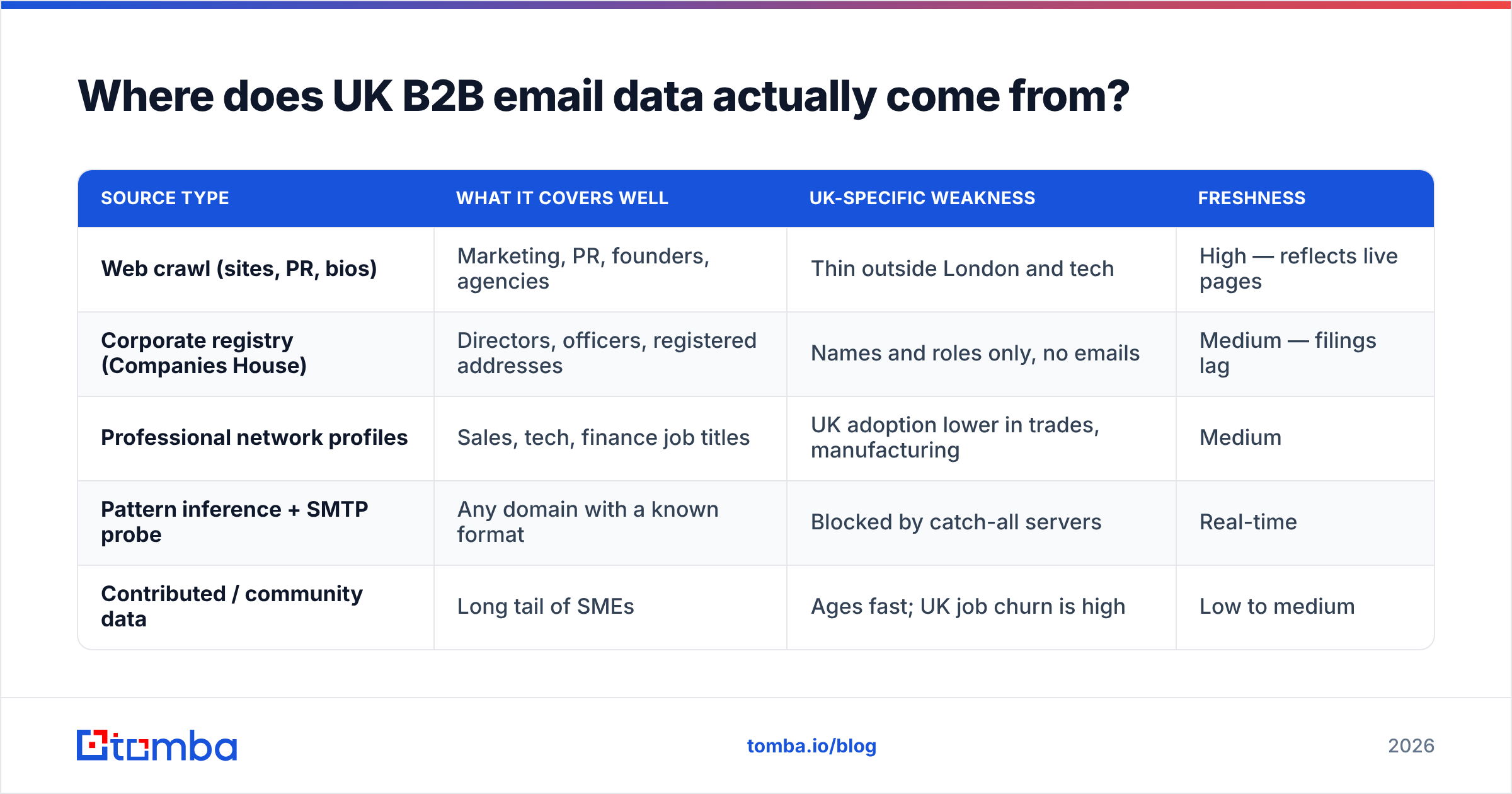
Not from one magic database. Every provider assembles from the same handful of source types, and each has a different failure mode on UK data.
| Source type | What it covers well | UK-specific weakness | Freshness |
|---|---|---|---|
| Web crawl (sites, PR, bios) | Marketing, PR, founders, agencies | Thin outside London and tech | High — reflects live pages |
| Corporate registry (Companies House) | Directors, officers, registered addresses | Names and roles only, no emails | Medium — filings lag |
| Professional network profiles | Sales, tech, finance job titles | UK adoption lower in trades, manufacturing | Medium |
| Pattern inference + SMTP probe | Any domain with a known format | Blocked by catch-all servers | Real-time |
| Contributed / community data | Long tail of SMEs | Ages fast; UK job churn is high | Low to medium |
The strongest UK results come from stacking: registry data for who exists, pattern inference for the address shape, and verification to confirm the mailbox. Companies House is free and authoritative for the "who" half — it will give you directors and officers of every UK limited company, which is exactly the input a pattern-based finder needs.
Which methods work for finding a UK email address?#
Ranked by yield per minute of effort:
- Domain search first, person search second. Pull every known address on the domain, read the format, then target your person. This inverts what most people do and roughly doubles hit rate on UK SMEs.
- Check the
.comwhen.co.ukfails. Look up the MX record for the.co.ukdomain. If it points at a different root domain, run your search there instead. This one check recovers a large chunk of "not found" results on UK subsidiaries. - Use a name-plus-domain email finder. For known individuals at known companies, this is the direct route — pattern matching plus source confirmation in a single call.
- Mine the About / Team / Press pages manually. UK firms under 50 people frequently publish a full team list with addresses. Free, accurate, and completely ignored by most automated pipelines.
- Work backwards from content. Whitepapers, tender responses, planning applications and industry press bylines carry real addresses. An author finder automates the byline route.
- Verify everything, then segment catch-alls separately. Do not delete catch-all hits — route them to a lower-volume, higher-personalisation sequence where a bounce costs less.
How accurate are email finders on UK domains?#
Lower than the numbers on any vendor's homepage, and that is fine as long as you plan for it.
Vendor accuracy claims are usually measured on a blended global sample dominated by large US .com domains, which are the easiest possible case. When you re-run the same tools against a UK-only list — mixed sizes, mixed sectors, heavy .co.uk — hit rates fall by 15–25 percentage points across the board. That is not a defect; it is what happens when the underlying public data is sparser.

What to actually measure before committing budget:
- Hit rate on your list, not theirs. Take 100 real UK prospects you already care about. Run them through each trial. Count found, verified, and bounced separately.
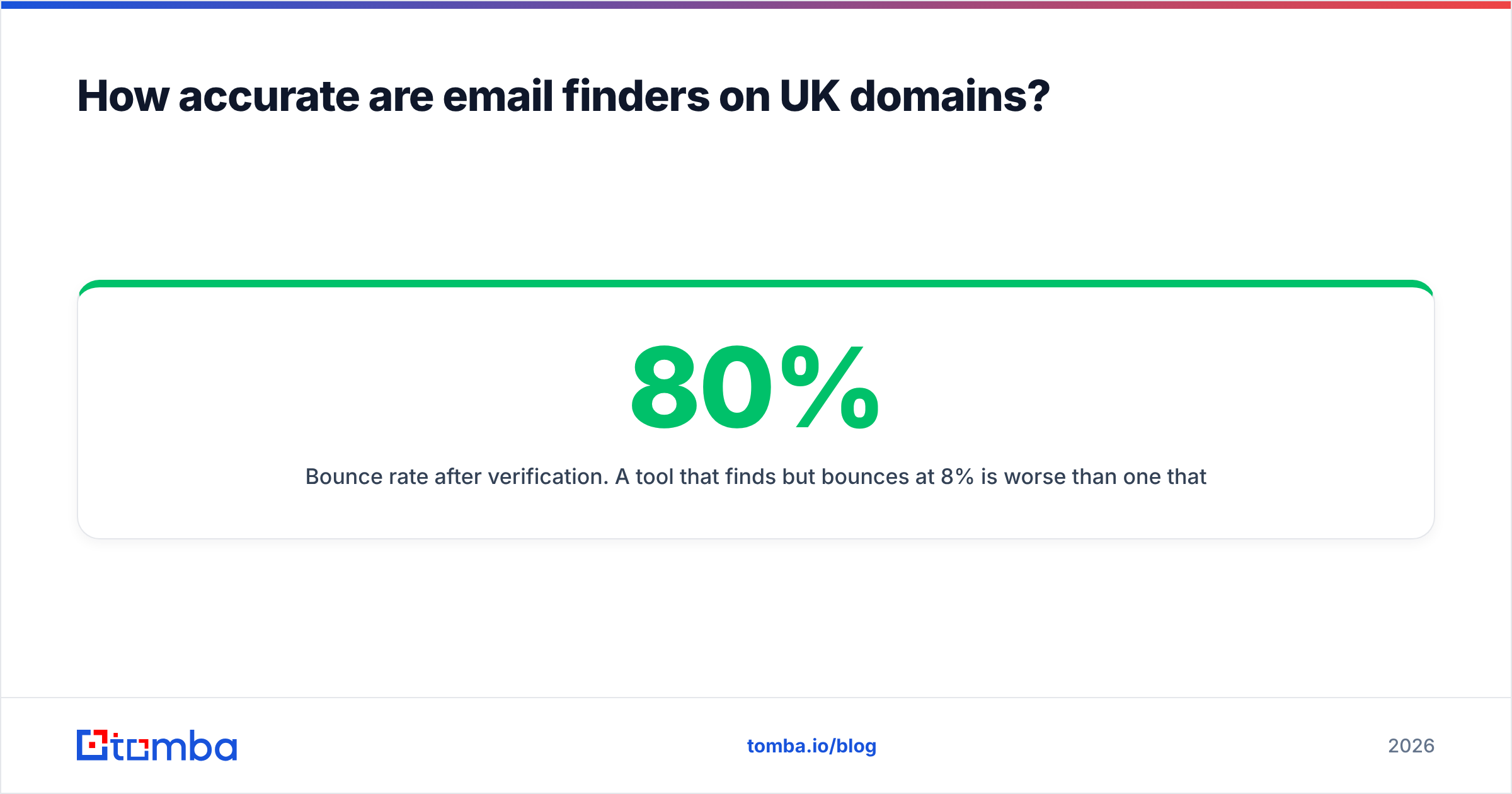
- Bounce rate after verification. A tool that finds 80% but bounces at 8% is worse than one that finds 65% and bounces at 1.5%. Deliverability damage compounds; missing contacts do not.
- Catch-all handling. Ask specifically what happens to catch-all domains. "Valid" as a blanket answer is a red flag. A dedicated catch-all verifier gives you a probability instead of a false certainty.
- Credit burn on failures. Some providers charge for a search that returns nothing. On UK data, where more searches return nothing, that difference is not academic.
Which tools are best for finding UK email addresses in 2026?#
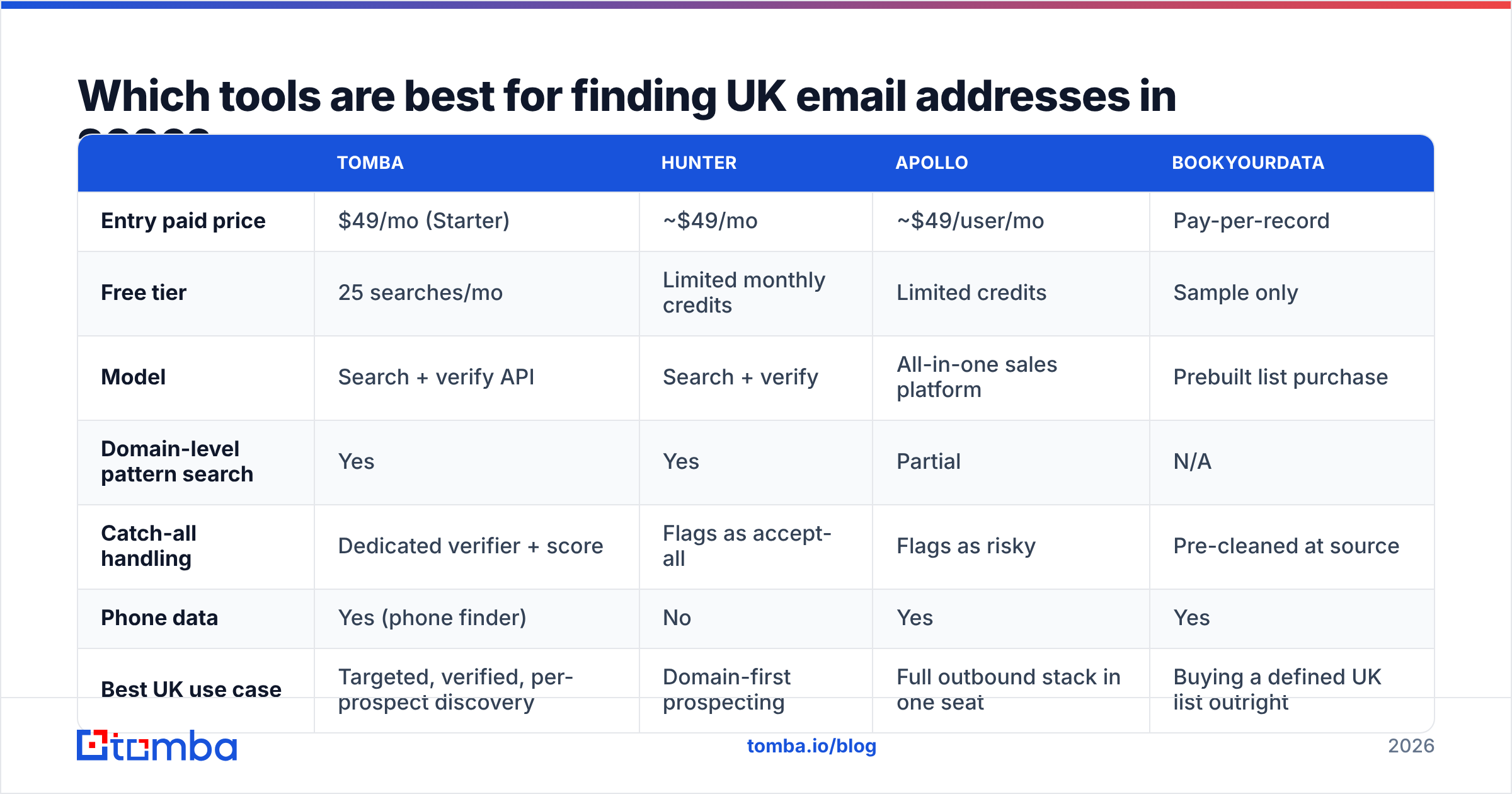
Different tools solve different halves of the problem. Here is the honest split.

| Tomba | Hunter | Apollo | BookYourData | |
|---|---|---|---|---|
| Entry paid price | $49/mo (Starter) | ~$49/mo | ~$49/user/mo | Pay-per-record |
| Free tier | 25 searches/mo | Limited monthly credits | Limited credits | Sample only |
| Model | Search + verify API | Search + verify | All-in-one sales platform | Prebuilt list purchase |
| Domain-level pattern search | Yes | Yes | Partial | N/A |
| Catch-all handling | Dedicated verifier + score | Flags as accept-all | Flags as risky | Pre-cleaned at source |
| Phone data | Yes (phone finder) | No | Yes | Yes |
| Best UK use case | Targeted, verified, per-prospect discovery | Domain-first prospecting | Full outbound stack in one seat | Buying a defined UK list outright |
Read that table as four different jobs rather than a leaderboard:
- Buying a list — if you want 2,000 UK finance directors delivered as a file, a list vendor like BookYourData is the right shape of product. It is a genuinely good option when your ICP is broad and stable, and their per-record model means you are not paying a monthly subscription to sit idle.
- Running an all-in-one outbound motion — Apollo bundles data, sequencing and dialling. You trade per-record UK precision for convenience.
- Domain-first research — Hunter and Tomba both do this well. The differences show up at the margins: catch-all treatment, API ergonomics, and what happens to failed lookups.
- Verified, per-prospect discovery at volume — where accuracy on a specific named list matters more than raw database size, an API-first workflow wins. That is Tomba's centre of gravity, and Tomba pricing runs Free (25 searches/mo), Starter $49/mo, Growth $99/mo, Pro $249/mo, and Enterprise custom.
Cross-check anything you shortlist against real reviewer volume on G2 rather than vendor case studies. Sort by recent reviews only — data quality changes fast, and a 2023 review tells you little about 2026 coverage.

Is it legal to find and email UK business addresses?#
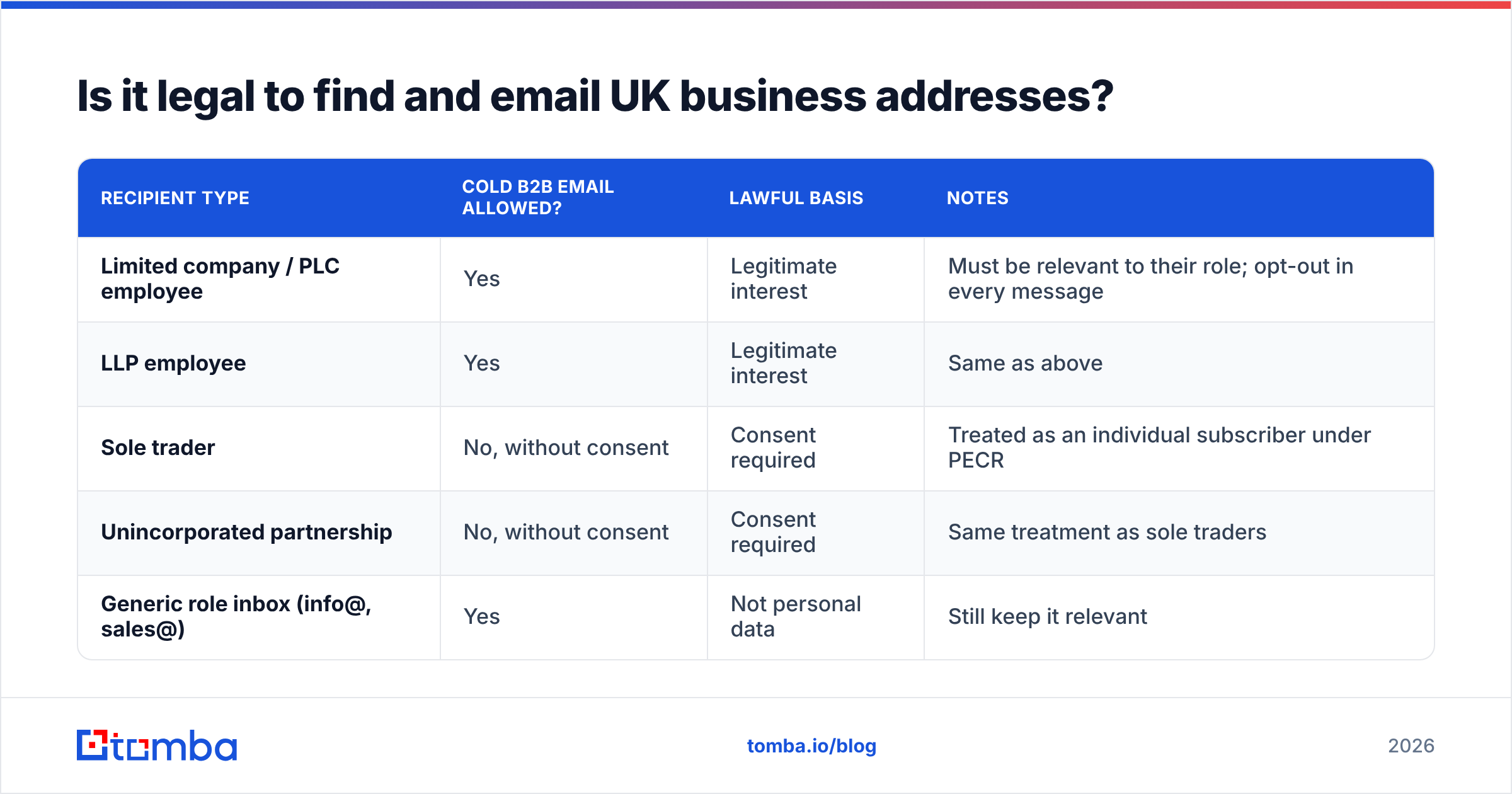
Yes, with real conditions. Two regimes apply simultaneously: UK GDPR governs whether you may process the personal data, and PECR governs whether you may send the electronic message.
The practical breakdown:
| Recipient type | Cold B2B email allowed? | Lawful basis | Notes |
|---|---|---|---|
| Limited company / PLC employee | Yes | Legitimate interest | Must be relevant to their role; opt-out in every message |
| LLP employee | Yes | Legitimate interest | Same as above |
| Sole trader | No, without consent | Consent required | Treated as an individual subscriber under PECR |
| Unincorporated partnership | No, without consent | Consent required | Same treatment as sole traders |
| Generic role inbox (info@, sales@) | Yes | Not personal data | Still keep it relevant |
Three obligations people skip:
Legitimate interest assessment. Write it down once, per campaign type. Three paragraphs: what you are doing, why it is proportionate, why the recipient would reasonably expect it. It takes twenty minutes and it is the document a regulator asks for.
Opt-out in every single message. Not just the first. Not just the newsletter. Every cold email needs a working unsubscribe route.
Source transparency. If someone asks where you got their address, you must be able to answer specifically. "A data provider" is not an answer. Keep the source field on every record — check that whichever tool you choose exposes it, and look at how the provider documents its data sources.
The ICO publishes direct-marketing guidance that is unusually readable for a regulator. Read it once rather than relying on vendor blog summaries — including this one.
How do you verify UK emails before sending?#
Verification is not optional on UK lists; it is the step that decides whether the campaign runs at all.
A workable sequence:
- Syntax and domain checks. Strip malformed addresses and dead domains. Free and instant.
- MX record check. Confirms the domain accepts mail at all. Catches dormant
.co.ukregistrations, which are common. - SMTP probe. Confirms the specific mailbox. This is where a standard email verifier earns its cost.
- Catch-all scoring. For domains that accept everything, fall back on pattern confidence and source strength rather than a binary verdict.
- Segment by confidence. Send to verified addresses at full volume. Send to catch-all addresses in small, highly personalised batches. Never blend them into one blast.
Target thresholds before you press send: bounce rate under 2%, and no more than 20% of any single send going to catch-all-only addresses. Cross those lines regularly and mailbox providers will start filing you as bulk regardless of how good your copy is.
What does a UK prospecting workflow look like end to end?#
Concretely, for a target list of 500 UK contacts:
- Define the account list first. Companies House filters (SIC code, region, incorporation date, filing status) give you a clean, legally-clear universe of limited companies before you touch a single person's name.
- Resolve each company's real mail domain. Website domain, then MX record, then group parent if the MX points elsewhere. Budget five seconds per account; it saves ten minutes of failed lookups later.
- Run domain search per account. Extract every known address, derive the pattern, store it on the account record.
- Find named contacts. Apply the stored pattern to your target people via the finder or API. Bulk mode handles this in one pass.
- Verify in bulk, then segment. Verified / catch-all / invalid. Delete invalid, sequence verified, personalise catch-all.
- Log source and date on every record. For the ICO answer, and because UK job churn will make 15–20% of this list stale within a year.
Two of those steps — pattern discovery and bulk verification — are pure API work. If you are running this monthly, wire it up with the Tomba API rather than clicking through a UI, and let your CRM hold the enrichment.
Where should you start?#
Start with one domain, not one person. Pick a target UK company, pull every address the tool already knows about, read the pattern, then apply it to the people you actually want to reach. That single reordering fixes most of what goes wrong with UK email discovery.
If you want to test it without committing, the Tomba Email Finder includes 25 free searches a month — enough to run a real UK sample list, measure your own hit rate on .co.uk domains, and check the bounce numbers yourself before any card comes out. Measure it against your list, not anyone's marketing page.
Related guides#
Ready to find emails that actually work?
Join 150,000+ professionals who stopped guessing and started sending. Free credits on signup — no credit card required.
Get the Tomba newsletter
Practical outbound tactics and product updates — once every two weeks.
About the author