How to Find Email Addresses in the UK: 2026 Working Guide
UK prospecting has its own rules: Companies House data, GDPR plus PECR, and .co.uk email patterns that break generic tools. Here's what actually works in 2026.
TL;DR
- Finding UK B2B email addresses is legal under GDPR and PECR when you email corporate subscribers (a limited company or LLP) with a legitimate interest, a clear identity, and an easy opt-out — sole traders and partnerships are treated like individuals and need consent.
- UK coverage differs from US coverage. Tools trained mostly on US SaaS data thin out fast on
.co.uk,.org.uk, and.ac.ukdomains — always test your own target list before buying credits. - Companies House is the highest-signal free starting point in the UK: it gives you the exact legal entity, directors, filing history, and registered office for nearly every active UK company.
- The reliable workflow is domain search → pattern inference → verification, not "buy a list". Catch-all domains are common in UK enterprise, so a catch-all-aware verifier matters more here than in the US.
- Budget expectation: a solid UK-capable stack runs roughly $49–$99/month for a one-person outbound motion, far less than a database subscription with a seat minimum.
Why is finding email addresses in the UK different?#
Because the data supply and the law are both different, and most guides only tell you about the tools.
Think of it like driving. The car is the same, the rules of the road are not. A US-based SDR who lifts their exact playbook and drops it into the UK market hits three walls at once: sparser data on UK domains, a stricter consent regime for certain business types, and email patterns that don't follow the first.last@ default nearly as often.
Three concrete differences:
- Data density. Most email-finding databases are built by crawling the public web and processing user contributions. That corpus skews American. A 2,000-employee US software company might have 900 discoverable emails; a comparable UK engineering firm might have 40, because far fewer of its staff publish contact details.
- Domain sprawl. UK organisations spread across
.co.uk,.uk,.com,.org.uk,.ac.uk, and.nhs.uk. Many run their marketing site on one TLD and their mail on another. Searchacme.co.ukand you may find nothing because the MX and the mailboxes live onacme.com. - Legal regime. The UK left the EU but kept UK GDPR, and it layers PECR (Privacy and Electronic Communications Regulations) on top for direct marketing by electronic means. PECR is the part most people miss.
Is it legal to find and email UK business contacts?#
Yes, within limits — and the limits hinge on what kind of entity you're emailing.
Under PECR, unsolicited direct marketing email to corporate subscribers — limited companies, LLPs, government bodies, and Scottish partnerships — does not require prior consent. You may email them, provided you identify yourself, don't disguise the sender, and provide a working opt-out. Under UK GDPR, you still need a lawful basis for processing that person's data; for B2B prospecting that is normally legitimate interests, which requires you to run and document a legitimate interests assessment (LIA).
Unsolicited email to individual subscribers — sole traders, non-LLP partnerships, and consumers — requires consent or the narrow "soft opt-in" exemption. That distinction matters enormously in the UK, where roughly 3.1 million businesses are non-employing sole proprietorships.
Practical compliance checklist:
- Confirm entity type before you email. Companies House tells you instantly whether the target is a limited company, an LLP, or absent (likely a sole trader).
- Document your LIA. One page, dated, stating why your product is relevant to that role and why the impact on the individual is minimal.
- Include a real opt-out in every message plus your registered company name and address.
- Honour suppression forever. Keep an unsubscribe list that survives tool migrations — this is where most teams get complaints.
- Respect the TPS/CTPS if you're also calling. That's a separate register, and screening is mandatory.
- Keep provenance. Record where each address came from so you can answer a subject access request without panicking.
The ICO's direct marketing guidance is the authoritative source; read the corporate-subscriber section rather than relying on vendor blog summaries.
What are the free ways to find UK email addresses?#
Start free, because the UK has unusually good public registries.
Companies House. The official register is free, complete for active UK companies, and gives you the legal name, company number, registered office, SIC codes, incorporation date, directors, and full filing history. It does not give you emails — it gives you the exact entity and people you then need emails for. Use it to confirm you're targeting Acme Engineering Ltd and not the dormant Acme Engineering (Holdings) Ltd.
The company's own site. UK companies must display their registered number and office on their website under the Companies Act. That footer usually sits next to a hello@ or enquiries@ address — useful for confirming the domain and the mail provider, less useful for reaching a decision-maker.
Manual pattern testing. Take three known staff emails from a press release or a job ad and infer the pattern. Our free email permutator generates the candidate set from a name and domain; a free email checker tells you which candidates resolve.
LinkedIn and trade bodies. UK sectors are heavily association-driven — the FSB, CIPD, RICS, IMechE. Member directories often publish names and roles even when they don't publish emails, which is enough to feed a finder.
Free methods work for ten prospects. They collapse at a hundred, which is where tools earn their price.
Which email finder tools work best on UK domains?#
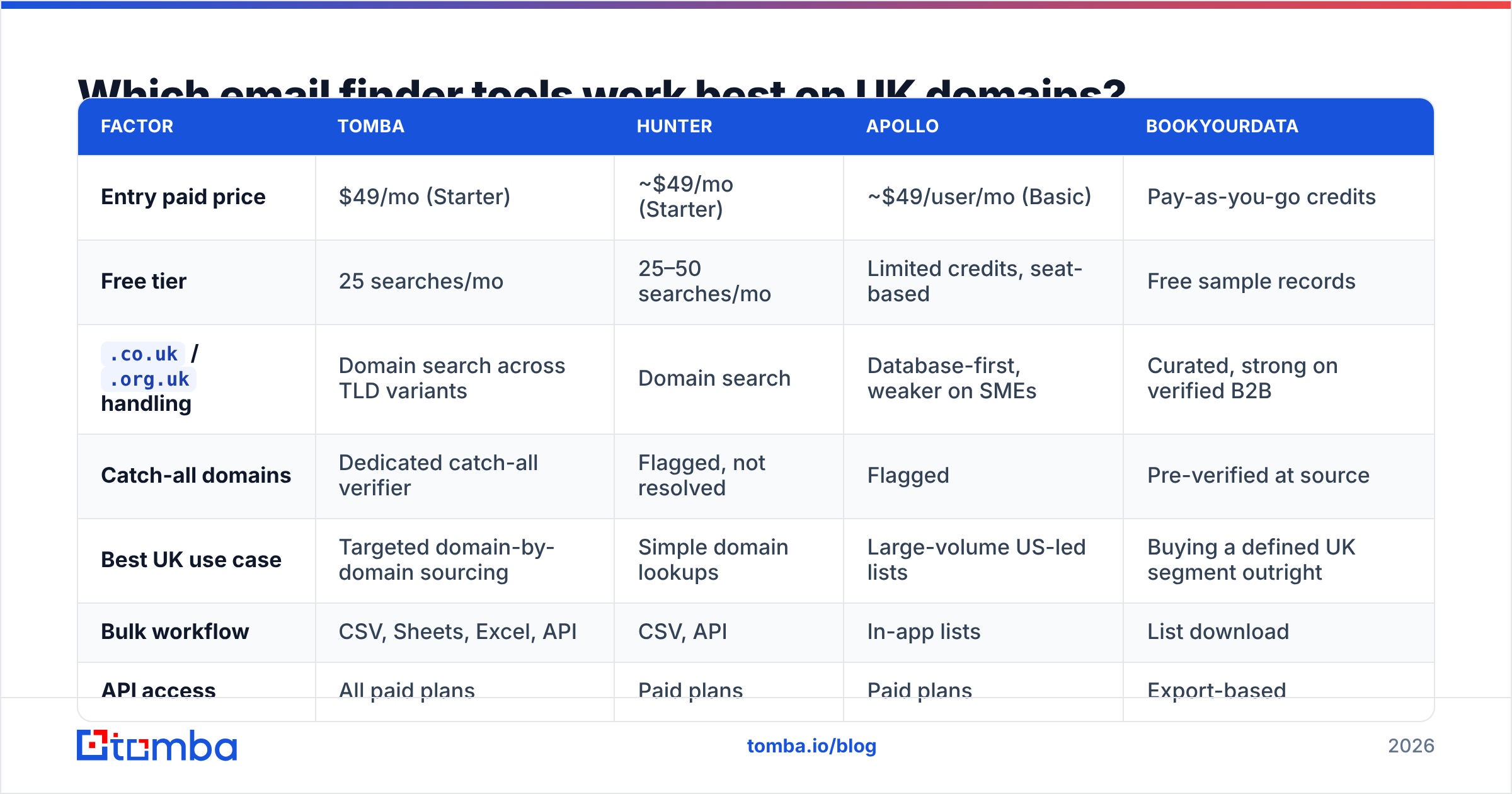
The honest answer: the ones that publish catch-all handling and let you test before you commit. Here's how the main options compare specifically for UK work.
| Factor | Tomba | Hunter | Apollo | BookYourData |
|---|---|---|---|---|
| Entry paid price | $49/mo (Starter) | ~$49/mo (Starter) | ~$49/user/mo (Basic) | Pay-as-you-go credits |
| Free tier | 25 searches/mo | 25–50 searches/mo | Limited credits, seat-based | Free sample records |
.co.uk / .org.uk handling |
Domain search across TLD variants | Domain search | Database-first, weaker on SMEs | Curated, strong on verified B2B |
| Catch-all domains | Dedicated catch-all verifier | Flagged, not resolved | Flagged | Pre-verified at source |
| Best UK use case | Targeted domain-by-domain sourcing | Simple domain lookups | Large-volume US-led lists | Buying a defined UK segment outright |
| Bulk workflow | CSV, Sheets, Excel, API | CSV, API | In-app lists | List download |
| API access | All paid plans | Paid plans | Paid plans | Export-based |
Two caveats before you read that as a scoreboard.
First, BookYourData solves a genuinely different problem. It sells pre-verified contact records by segment, which suits a team that wants 5,000 UK finance-director records this week without running a sourcing motion. Tomba and Hunter suit teams sourcing continuously against an account list they already own. Comparing them on price per credit misses the point.
Second, Apollo's UK coverage is strongest at enterprise and weakest among the sub-50-employee firms that make up the bulk of the UK market. If your ICP is a 30-person manufacturer in the Midlands, a database-first tool will disappoint you regardless of its logo count. Check the G2 category grid for current user-reported coverage rather than trusting any single vendor's claim.

Accuracy claims deserve scepticism generally, and doubly so for UK segments. A vendor quoting "98% accuracy" is usually quoting a global blend dominated by US tech domains. Run 50 of your own UK targets through a free tier and measure hit rate and bounce rate yourself. That number is the only one that predicts your results.

What does a working UK email-sourcing workflow look like?#
Four steps, in order. Skipping step three is the single most common cause of UK bounce problems.
Step 1 — Build the entity list from Companies House. Filter by SIC code, region, and incorporation date to get companies rather than guesses. Export company name, number, and registered office. This anchors everything downstream in a real legal entity, which is also what your LIA needs.
Step 2 — Resolve the true mail domain. For each company, find the website, then check where mail actually lands. A quick MX lookup or an SMTP tester tells you whether acme.co.uk routes to Microsoft 365 on acme.com. Feed the mail domain, not the marketing domain, into your finder.
Step 3 — Run domain search, then targeted finds. Domain search returns everyone already known at that domain along with the dominant pattern. Where your named target isn't in the results, use the pattern plus their name through the email finder. For volume, the bulk email finder processes a CSV of name + domain pairs in one pass.
Step 4 — Verify, including catch-alls. Run everything through an email verifier before it touches your sending tool. UK enterprise and public-sector domains use catch-all configurations at a noticeably higher rate than US SMBs, which means a standard SMTP check returns "accept-all" and tells you nothing. A catch-all verifier applies additional signals to separate real mailboxes from black holes.
Skip step four and you'll learn about UK catch-alls the expensive way: a 14% bounce rate, a damaged sender reputation, and a domain that needs weeks of remediation.

How do UK email patterns differ from US ones?#
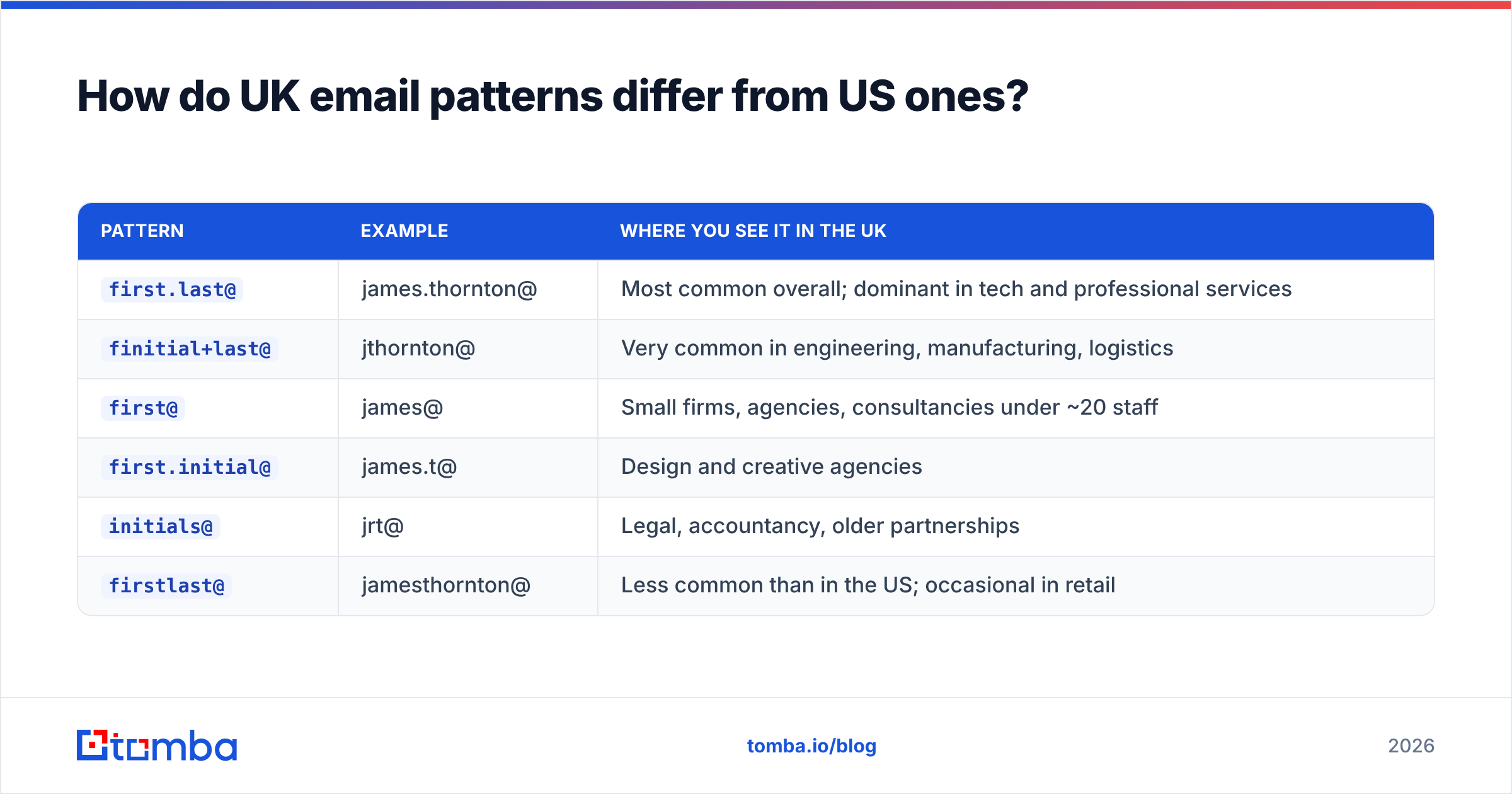
Less standardised, and more likely to include initials.
US corporate email skews heavily to first.last@domain.com — it's close to a default. UK patterns fragment more, partly because a larger share of UK firms are long-established and inherited conventions from earlier mail systems.
| Pattern | Example | Where you see it in the UK |
|---|---|---|
first.last@ |
james.thornton@ | Most common overall; dominant in tech and professional services |
finitial+last@ |
jthornton@ | Very common in engineering, manufacturing, logistics |
first@ |
james@ | Small firms, agencies, consultancies under ~20 staff |
first.initial@ |
james.t@ | Design and creative agencies |
initials@ |
jrt@ | Legal, accountancy, older partnerships |
firstlast@ |
jamesthornton@ | Less common than in the US; occasional in retail |
Two UK-specific traps. First, double-barrelled surnames — sarah.hughes-jones@ may be stored as sarah.hughesjones@ or sarah.hj@, and generic permutators frequently miss both. Second, honorific-heavy sectors: academic and NHS addresses often carry departmental prefixes that no pattern engine will guess, so for .ac.uk and .nhs.uk targets, use published staff directories rather than inference.
A company email pattern check on a domain you already have samples for is quicker than guessing, and it's the right move before you burn credits on a hundred permutations.
How much should you spend on UK email finding?#
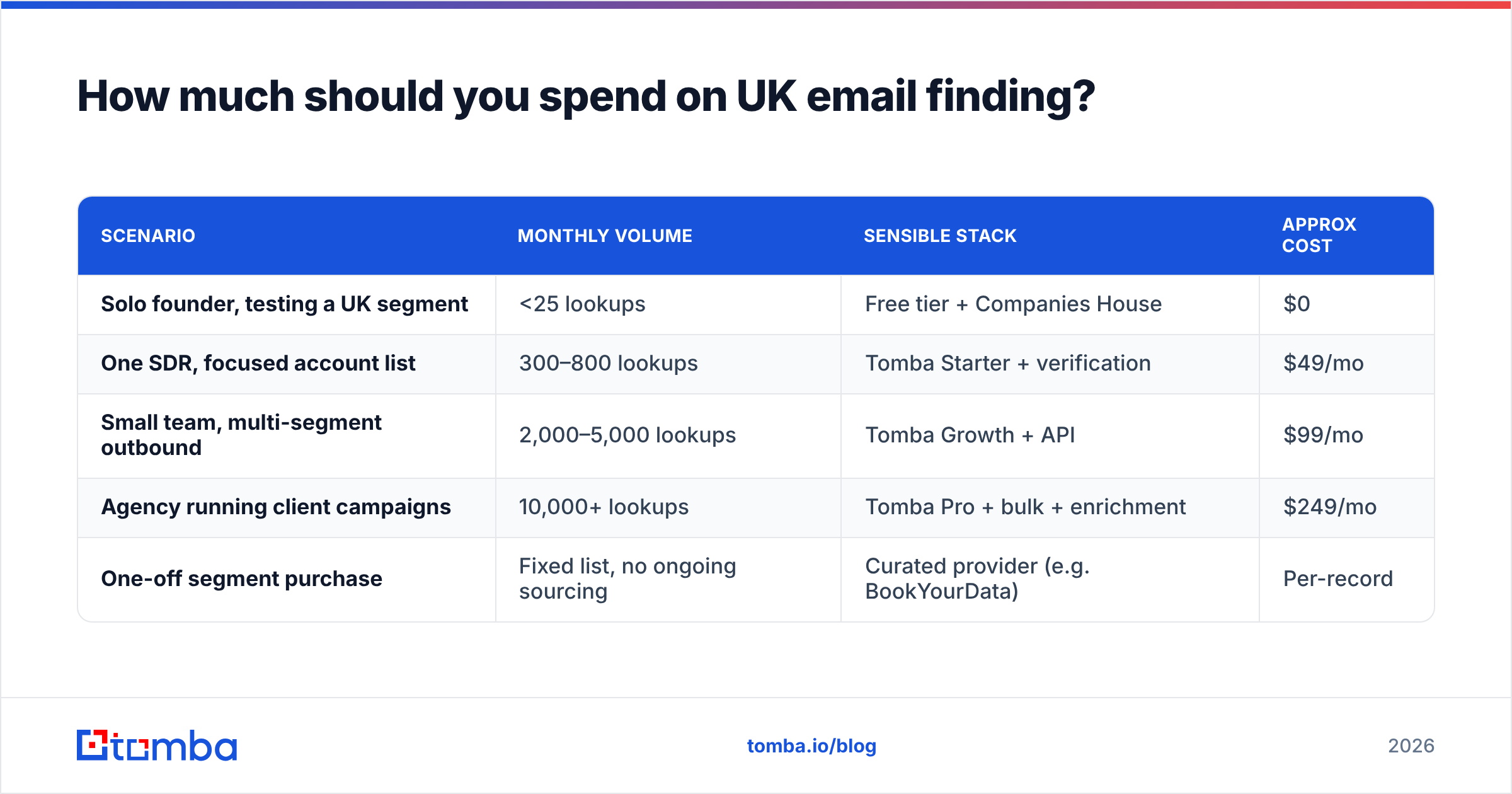
Match spend to how many new companies you touch each month, not how many contacts you have.
| Scenario | Monthly volume | Sensible stack | Approx cost |
|---|---|---|---|
| Solo founder, testing a UK segment | <25 lookups | Free tier + Companies House | $0 |
| One SDR, focused account list | 300–800 lookups | Tomba Starter + verification | $49/mo |
| Small team, multi-segment outbound | 2,000–5,000 lookups | Tomba Growth + API | $99/mo |
| Agency running client campaigns | 10,000+ lookups | Tomba Pro + bulk + enrichment | $249/mo |
| One-off segment purchase | Fixed list, no ongoing sourcing | Curated provider (e.g. BookYourData) | Per-record |
Full Tomba pricing sits at Free (25 searches/month), Starter $49/mo, Growth $99/mo, Pro $249/mo, and custom Enterprise. The cost mistake most UK teams make isn't overpaying for a finder — it's paying for a per-seat database platform at $10k+/year to reach a market where the same platform's SME coverage is thin.
Compare that against the cost of getting it wrong. A 15% bounce rate on 2,000 sends can push your domain into spam foldering for months. Verification credits are the cheapest insurance in outbound.
What about GDPR-safe enrichment and CRM hygiene?#
Enrichment is where compliance quietly improves, not degrades — if you do it right.
Re-verifying and enriching an existing list reduces the number of messages you send to wrong people, which is exactly what a regulator wants to see. Data enrichment fills role, seniority, company size, and location so you can suppress out-of-ICP records rather than emailing them "just in case".
Three habits worth building:
- Re-verify quarterly. UK B2B email decays roughly 2–2.5% per month through job changes. A list built in January is measurably worse by June.
- Store the source field. When someone asks "where did you get my data?", the answer must be specific — "inferred from your company's published email pattern and verified via SMTP" is a defensible answer.
- Sync suppression to your CRM, not just your sending tool. Suppression that lives only in one sequencer breaks the moment you switch vendors.
If you run outbound at any scale, wire this into your stack rather than doing it by hand — the Tomba API and native HubSpot integration let verification run on record creation instead of as a pre-campaign scramble.
What should you do first?#
Pick 20 UK companies you genuinely want as customers. Look each one up on Companies House to confirm the legal entity and the directors. Resolve the real mail domain. Run domain search on all 20 and see what your actual hit rate is before you spend anything. That single hour tells you more about which tool fits your market than any comparison table — including this one.
If your UK targets are limited companies with a public web presence, start with the Tomba Email Finder. The free tier gives you 25 searches a month, which is enough to test 20 target accounts properly, and the catch-all verifier means you'll know which .co.uk results are real mailboxes before you send. When the hit rate holds up on your list, Starter at $49/mo covers a full SDR's sourcing without a seat minimum or an annual commitment.
Related guides#
Ready to find emails that actually work?
Join 150,000+ professionals who stopped guessing and started sending. Free credits on signup — no credit card required.
Get the Tomba newsletter
Practical outbound tactics and product updates — once every two weeks.
About the author