How to Find New Business Listings in 2026: 7 Data Sources
Newly registered companies buy faster and have no incumbent vendor. Here are the seven sources that actually surface new business listings, what each one costs, how fresh the data is, and how to turn a company name into a contact you can email.
TL;DR
- New business listings are records of companies that just registered, just opened, just got licensed, or just got funded — and they are the highest-intent cold segment you can work, because no incumbent vendor is entrenched yet.
- The seven realistic sources are state/national registries, aggregators like OpenCorporates, mapping and place data, permit and license filings, funding databases, job boards, and purchased lists.
- Freshness beats volume. A 48-hour-old registration list of 300 companies outperforms a 90-day-old list of 30,000.
- Registry data gives you a company name and an address — never a decision-maker's email. Enrichment is the missing step, and it's where most teams stall.
- Budget realistically: free registries cost you engineering time, aggregator APIs run $100–$1,000/mo, and contact enrichment runs $49–$249/mo on top.
What counts as a "new business listing"?#
A new business listing is any structured record that says this company did not exist in your dataset last week. That covers more ground than most people assume:
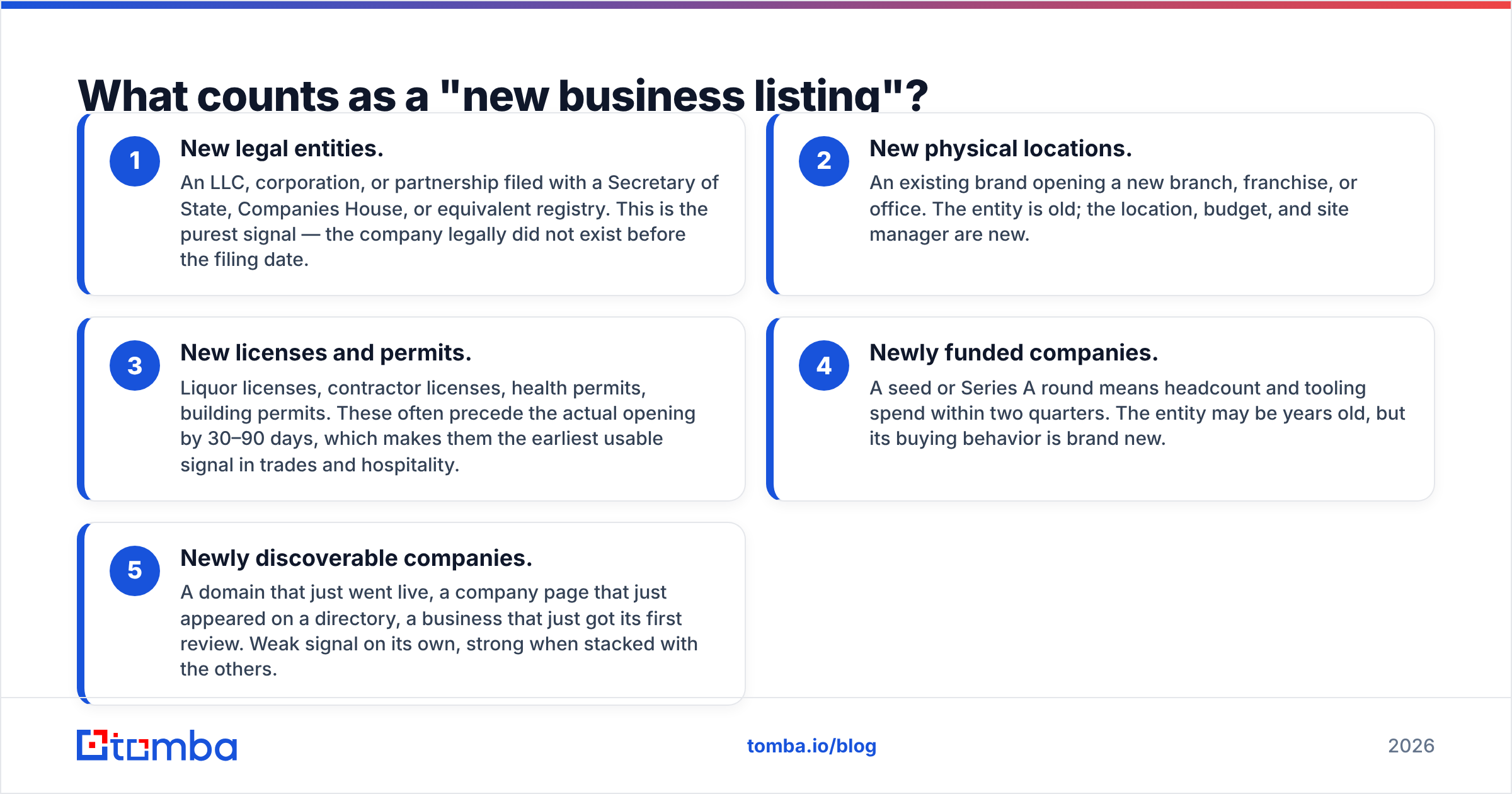
- New legal entities. An LLC, corporation, or partnership filed with a Secretary of State, Companies House, or equivalent registry. This is the purest signal — the company legally did not exist before the filing date.
- New physical locations. An existing brand opening a new branch, franchise, or office. The entity is old; the location, budget, and site manager are new.
- New licenses and permits. Liquor licenses, contractor licenses, health permits, building permits. These often precede the actual opening by 30–90 days, which makes them the earliest usable signal in trades and hospitality.
- Newly funded companies. A seed or Series A round means headcount and tooling spend within two quarters. The entity may be years old, but its buying behavior is brand new.
- Newly discoverable companies. A domain that just went live, a company page that just appeared on a directory, a business that just got its first review. Weak signal on its own, strong when stacked with the others.
Treat these as different products, not one bucket. A roofing supplier wants contractor permits. A payroll SaaS wants entity registrations. A DevTools company wants funding announcements. Building one giant "new businesses" list and spraying it is exactly how teams end up with 0.4% reply rates.
Why do new business listings convert better than a normal prospect list?#
Three structural reasons, and none of them are about the copy.
There's no incumbent. A company incorporated three weeks ago has no accounting software, no CRM, no insurance broker, no payroll provider. You aren't asking someone to rip out a contract — you're asking them to make a first choice. Displacement selling and greenfield selling have completely different win rates, and greenfield wins.
The buying window is short and identifiable. New entities compress a year of purchasing decisions into their first 90 days. You know roughly when the window opens because you have a filing date. That's rare — most intent data tells you something happened, not when the decision cycle started.
Competition is time-gated, not price-gated. Everyone selling to new businesses has access to the same public registries. The differentiator is latency. If you pull filings daily and your competitor buys a quarterly list, you are talking to that founder ten weeks earlier. That's the whole game.
The catch: these lists decay violently. A registration list is worth a lot on day 2, something on day 20, and almost nothing on day 120 — by then the founder has bought, or the entity was a shell that never traded. Any workflow that doesn't run at least weekly is leaving most of the value on the table.

Where do new business listings actually come from?#
Here are the seven sources worth your time, in rough order of signal quality.
- Government business registries. Every US Secretary of State publishes new entity filings; the UK's Companies House publishes a daily bulk file; most EU registries have equivalents. This is primary-source data — the freshest and most accurate you can get. The cost is engineering: 50 US states means up to 50 different formats, portals, and rate limits, and a handful still charge for bulk access or gate it behind a subscription.
- Registry aggregators. OpenCorporates normalizes 200M+ company records from 140+ jurisdictions into one schema with one API. You trade some freshness (aggregation lag varies by jurisdiction, from hours to weeks) for not maintaining 50 scrapers.
- Mapping and place data. Google Maps, Apple Business Connect, and Yelp surface businesses at the moment they become customer-facing. Excellent for local and B2C-adjacent B2B (restaurants, clinics, gyms, retail). Useless for entities that never get a storefront.
- Permits and licensing boards. City building permits, state contractor boards, ABC liquor licenses, health department inspections. The earliest signal available for construction, food service, and regulated trades — often 60+ days before doors open. Fragmented, municipal, and frequently only available as PDF or a clunky search form.
- Funding and startup databases. Crunchbase, PitchBook, and SEC Form D filings via EDGAR. Form D is free, public, and legally required for most private placements — it's the underrated one here. If your ICP is "just raised money," start with Form D and backfill with a paid database.
- Job boards. A company's first job posting is a strong proxy for "we just became real." First sales hire, first ops hire, first office. Scrapable, noisy, but it tells you about spend intent that a registry never will.
- Purchased new-business lists. Vendors package registry and permit data into ready-to-import CSVs, sometimes with contact data attached. BookYourData is a solid option here if you want a pay-as-you-go list without building anything — it's the fastest path from zero to a working segment, and useful as a benchmark against whatever you build in-house.
For macro context on how many new entities you're even competing over, the US Census Bureau publishes weekly Business Formation Statistics — roughly 400–450k new applications per month in recent years, of which a meaningful minority are likely employers. That number sets your realistic TAM before you spend a dollar.
Which source should you use for your ICP?#
| Source | What you get | Typical freshness | Cost | Best for |
|---|---|---|---|---|
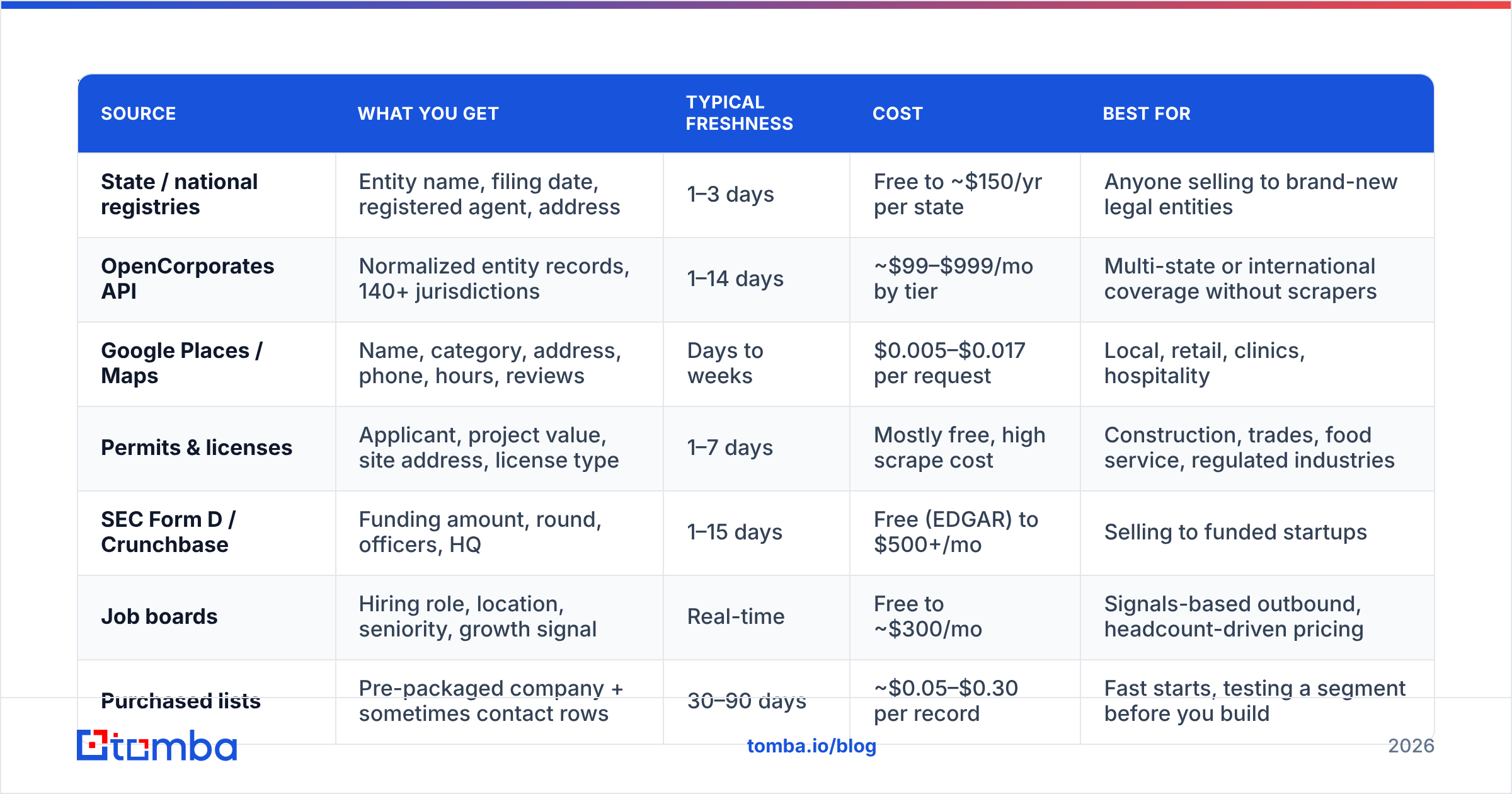
| State / national registries | Entity name, filing date, registered agent, address | 1–3 days | Free to ~$150/yr per state | Anyone selling to brand-new legal entities |
| OpenCorporates API | Normalized entity records, 140+ jurisdictions | 1–14 days | ~$99–$999/mo by tier | Multi-state or international coverage without scrapers |
| Google Places / Maps | Name, category, address, phone, hours, reviews | Days to weeks | $0.005–$0.017 per request | Local, retail, clinics, hospitality |
| Permits & licenses | Applicant, project value, site address, license type | 1–7 days | Mostly free, high scrape cost | Construction, trades, food service, regulated industries |
| SEC Form D / Crunchbase | Funding amount, round, officers, HQ | 1–15 days | Free (EDGAR) to $500+/mo | Selling to funded startups |
| Job boards | Hiring role, location, seniority, growth signal | Real-time | Free to ~$300/mo | Signals-based outbound, headcount-driven pricing |
| Purchased lists | Pre-packaged company + sometimes contact rows | 30–90 days | ~$0.05–$0.30 per record | Fast starts, testing a segment before you build |
Two things fall out of that table. First, no single source covers everything — a working system usually blends a registry feed for volume with one signal source (permits, funding, or hiring) for prioritization. Second, every free source has a hidden cost line labeled "an engineer maintains this forever."
How do you turn a listing into a contact you can actually email?#
This is the step that kills most new-business-listing programs, so be blunt about it: registries give you a company, not a person. A Delaware filing hands you an entity name, a filing date, and a registered agent — which is usually a service company like CSC or Registered Agents Inc., not the founder. Emailing the registered agent is emailing a mailbox that processes legal service, not a buyer.
The enrichment chain looks like this:
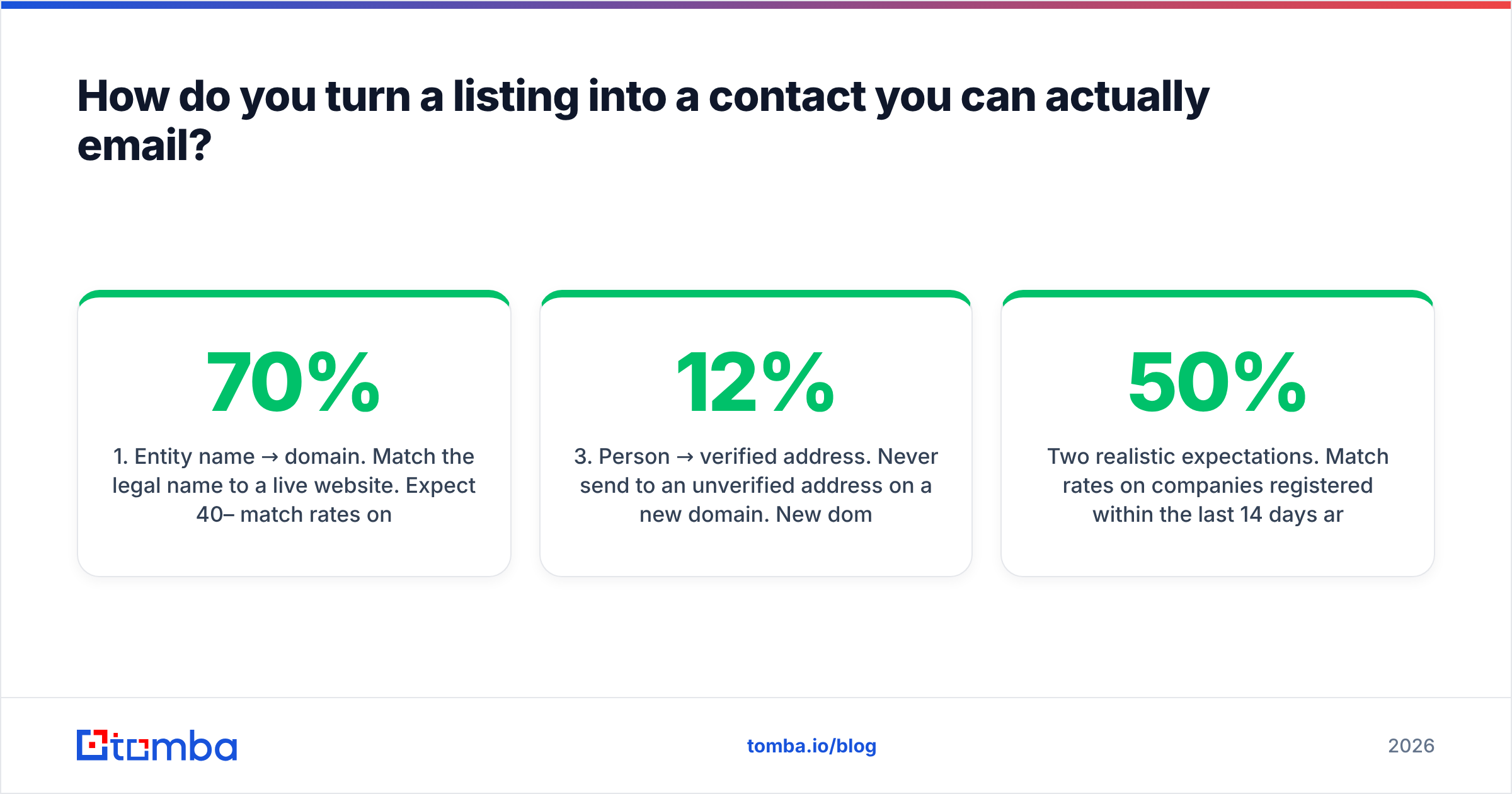
- Entity name → domain. Match the legal name to a live website. Expect 40–70% match rates on brand-new entities, because many haven't launched a site yet. Legal names ("Bright Harbor Holdings LLC") rarely equal brand names ("Harbor"), so fuzzy matching plus a search fallback is required.
- Domain → people. Run a domain search against the matched domain to pull the email addresses and roles published across that company's web presence. For a 4-person startup this is often the entire org chart.
- Person → verified address. Never send to an unverified address on a new domain. New domains have thin reputations, and a 12% bounce rate on your first send to them is how you get your sending domain flagged. Run every address through an email verifier and drop anything that isn't deliverable.
- Contact → context. Layer on company size, tech stack, and location via data enrichment so your first line references something real rather than "congrats on the new venture."
Two realistic expectations. Match rates on companies registered within the last 14 days are structurally lower than on established firms — there is simply less public data about them. And a chunk of new registrations are holding companies, dormant entities, or single-property LLCs with no operations at all; a 30–50% "not a real prospect" rate on raw registry data is normal, not a data-quality failure.
If you're processing thousands of rows a month, do this with a bulk email finder or wire the Tomba API directly into your ingestion job rather than pasting spreadsheets by hand. The whole point of this play is latency, and manual enrichment adds days.

What does a working weekly workflow look like?#
A team of two can run this. Here's the shape:
- Monday: pull. Fetch last week's filings from your target states or jurisdictions. Filter hard by NAICS/SIC code, entity type, and geography before anything else. If your ICP is dental practices in Texas, you want 40 rows, not 4,000.
- Monday: qualify. Drop registered-agent-only addresses, obvious holding companies (names containing "Holdings," "Properties," "Trust" if those aren't your ICP), and duplicate filings from the same principal.
- Tuesday: enrich. Resolve domains, find contacts, verify addresses. Anything that fails domain resolution goes into a 30-day re-check queue — half of them will have a website by then.
- Wednesday: sequence. Send within 72 hours of the filing date. Your opening line should reference the specific event ("saw you filed in Travis County last week"), not a generic congratulation. Keep the ask small; a founder in week two has no budget approval process to navigate, but also no spare hours.
- Ongoing: measure by cohort. Track reply rate by days-since-filing. Almost every team that does this finds a sharp cliff somewhere between day 14 and day 45. That cliff is your real SLA, and it should drive how often you run the pull.
One compliance note that isn't optional. Public registry data being public does not make it lawful to email under every regime. Under GDPR you need a legitimate-interest assessment and a working opt-out; CAN-SPAM requires accurate headers, a physical address, and honored unsubscribes; CASL in Canada is stricter still and generally requires consent. Registry data is also frequently subject to reuse restrictions written into the jurisdiction's terms — read them per source, especially if you plan to resell. And keep suppression tight: new founders get hammered by vendors on day one, so a bad experience compounds fast.
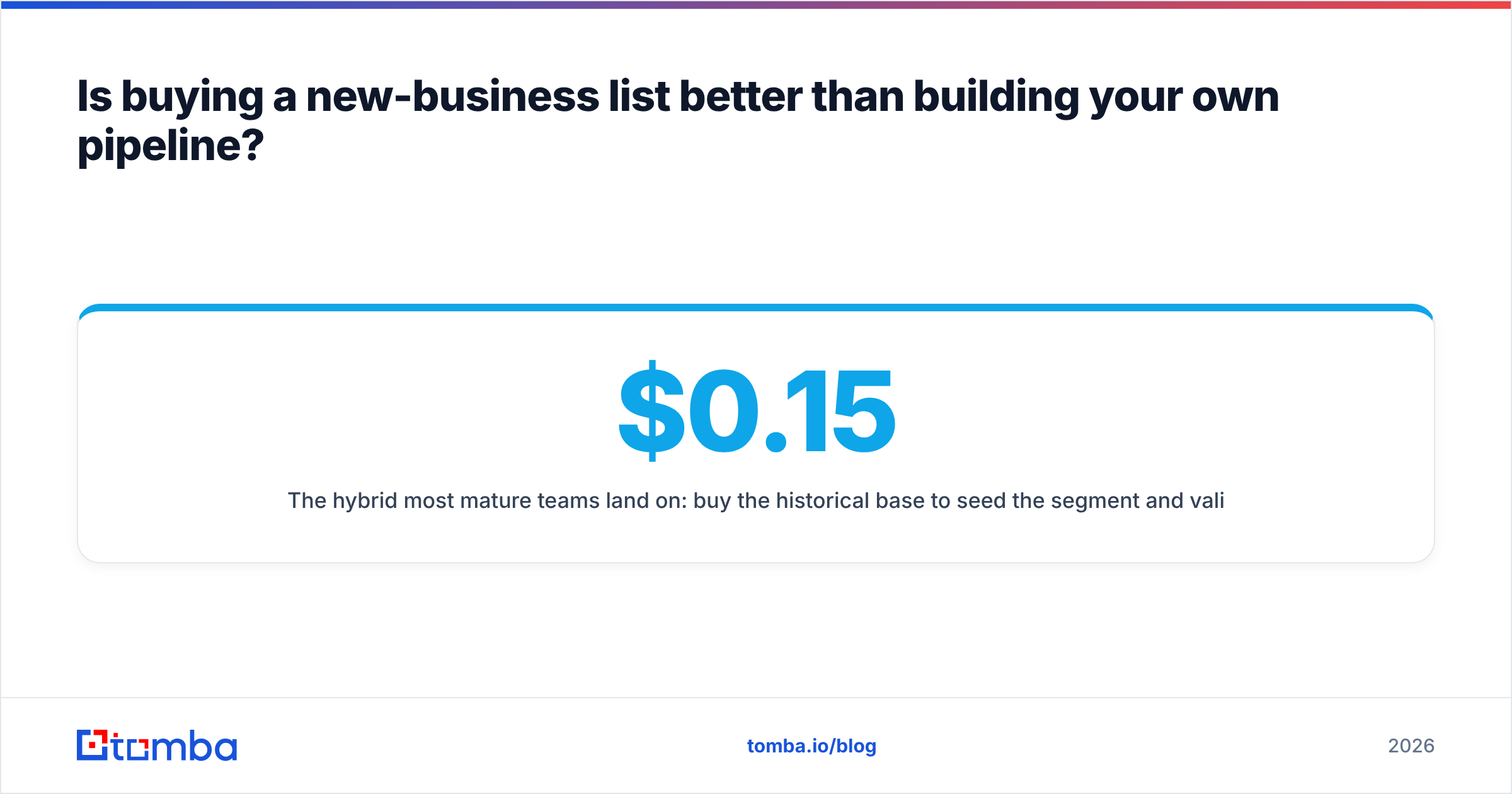
Is buying a new-business list better than building your own pipeline?#
Buy first, build second — and be honest about the crossover point.
Buying wins when you're testing whether the segment converts at all. You get rows in an hour instead of a sprint, and if new-business outbound doesn't work for your offer, you've spent a few hundred dollars finding that out instead of a quarter of engineering. Vendors like BookYourData exist precisely for this, and a purchased list also gives you a useful accuracy baseline to measure any in-house build against.
Building wins when latency is your edge. If your reply-rate-by-cohort chart shows a cliff at day 21, and the best list you can buy is 45 days old, no amount of copy testing fixes that. At that point you own the pull, you own the enrichment, and you compete on being first.
The hybrid most mature teams land on: buy the historical base to seed the segment and validate the offer, then run your own daily or weekly pull for the fresh tier, enriched through an API so the whole thing stays automated. Compare pricing honestly — a purchased list at $0.15/record and an enrichment stack at $49–$249/mo are the same order of magnitude at low volume, and the in-house build only pulls ahead once you're processing thousands of rows a month.
Where should you start this week?#
Pick one jurisdiction and one entity filter. Pull last week's filings. Enrich 100 of them. Send 100 emails inside 72 hours of the filing date. Measure reply rate against your normal outbound. That experiment costs you a day and answers the only question that matters: does your offer land with companies that are two weeks old?
If it does, the bottleneck immediately becomes contact data — because registries will happily hand you ten thousand company names and zero email addresses. That's the gap the Tomba Email Finder fills: point it at the domains you resolved from your new-business listings and get verified, deliverable addresses back, via the app, the bulk uploader, or the API in your ingestion pipeline. Start on the free tier with 25 searches to test match rates on your own registry pull before you commit to a plan — if the match rate holds on brand-new companies, you have a repeatable channel.
Related guides#
Ready to find emails that actually work?
Join 150,000+ professionals who stopped guessing and started sending. Free credits on signup — no credit card required.
Get the Tomba newsletter
Practical outbound tactics and product updates — once every two weeks.
About the author