How to Find Phone Number by Email Address: 2026 Guide
Reverse email-to-phone lookup works, but not the way most vendors imply. Here is how the data is actually assembled, what hit rates to expect, what it costs per connected call, and where the legal line sits.
Want to find phone number by email address? For business contacts, yes — roughly a third to half the time. For consumer addresses, almost never. Here is how the data is assembled, what it costs, and where the legal line sits.
TL;DR
- You cannot reliably reverse a consumer email into a mobile number. You can often resolve a business email into a work line, a direct dial, or (less often) a verified mobile.
- Realistic B2B hit rates in 2026: 30-60% for some phone number, 15-35% for a direct dial or mobile. Any vendor promising 90%+ mobile coverage is quoting matched records, not your list.
- The mechanism is identity resolution, not magic: email → person → company → phone, stitched from company data, opt-in profiles, licensed panels, and call-verified records.
- Cost per connected call matters more than cost per credit. A $0.10 number that never picks up is more expensive than a $0.40 number that does.
- Legal exposure is real: TCPA, DNC lists, and GDPR legitimate-interest documentation. Verify before you dial, and log where every number came from.
What does "find phone number by email address" actually mean?#
It means running an identity resolution chain in reverse. You start with the only identifier you have — an email address — and try to walk it back to a person, then forward to a phone number attached to that person.
Think of it like a library. The email is a catalog number scribbled on a napkin. It does not contain the book. It points to a shelf, and only if the library has indexed that shelf can you retrieve anything. Providers that "find" a phone number by email are querying their index, not decrypting your string.
The chain has four hops, and it can break at any one:
- Email → identity. Parse the address, match it against known contact records.
sarah.chen@acme.comresolves far more often thansc1988@gmail.com, because the domain carries employer context. - Identity → employment. Confirm the person still works where the domain implies. Job-change churn runs roughly 20-30% a year in B2B, so stale employment is the single biggest silent failure.
- Employment → phone record. Pull the company switchboard, the department line, the direct dial, or a mobile the person has attached to a business profile.
- Phone record → validity. Confirm the line is active, correctly formatted for its country, and of the right type (mobile vs landline vs VoIP).
Most tools do hops 1 and 3 well. Hops 2 and 4 are where lists rot, and where the difference between a good and a bad provider shows up in your connect rate.
Why is reverse email-to-phone harder than finding an email?#
Because email addresses are derivable and phone numbers are not.
Finding a work email is largely pattern inference. If you know a company uses first.last@domain.com, you can generate a candidate for anyone on the team and then verify it with an SMTP check. That is why an email finder can hit 90%+ coverage on well-indexed domains — the answer is computable, then confirmable.
Phone numbers have no pattern. Nobody's mobile is +1-555-first-last. Every number must be observed somewhere — a signature block, a licensed opt-in form, a public filing, a company directory, a call-verified record — and then attributed to the right human. There is no generative shortcut and no equivalent of an SMTP ping that confirms "yes, this belongs to Sarah" without actually dialing.
Two consequences follow, and they drive every decision below:
- Coverage is structurally lower. Expect roughly half the hit rate you get on email.
- Verification is probabilistic. A phone validator can confirm a line is active, correctly formatted, and mobile vs landline. It cannot confirm the person still answers it.
How do the main methods compare?#
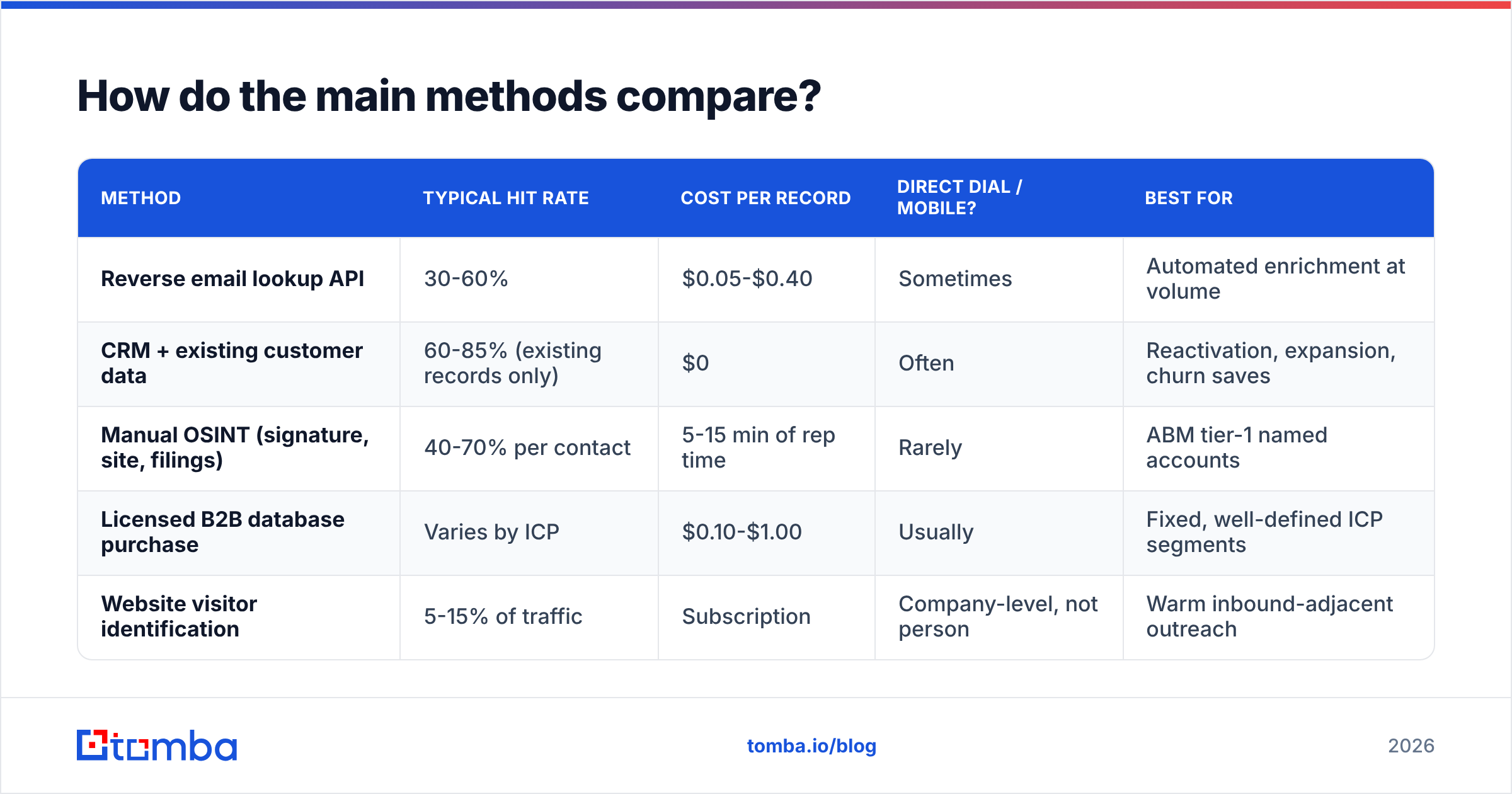
Four methods to find phone number by email address work at scale. They differ in coverage, effort, and how defensible the data is.
| Method | Typical hit rate | Cost per record | Direct dial / mobile? | Best for |
|---|---|---|---|---|
| Reverse email lookup API | 30-60% | $0.05-$0.40 | Sometimes | Automated enrichment at volume |
| CRM + existing customer data | 60-85% (existing records only) | $0 | Often | Reactivation, expansion, churn saves |
| Manual OSINT (signature, site, filings) | 40-70% per contact | 5-15 min of rep time | Rarely | ABM tier-1 named accounts |
| Licensed B2B database purchase | Varies by ICP | $0.10-$1.00 | Usually | Fixed, well-defined ICP segments |
| Website visitor identification | 5-15% of traffic | Subscription | Company-level, not person | Warm inbound-adjacent outreach |
The mistake most teams make is picking one. In practice you layer them: API-enrich the whole list, route the misses on tier-1 accounts to manual OSINT, and never re-buy a number you already have in the CRM.
A note on order of operations. Run reverse email lookup before you buy anything. It tells you who the person is — name, title, company, social profiles — which is what the phone providers actually match on. Feeding a vendor a bare email gives it less to work with than feeding it a resolved identity.
Which tools find phone numbers by email address in 2026?#
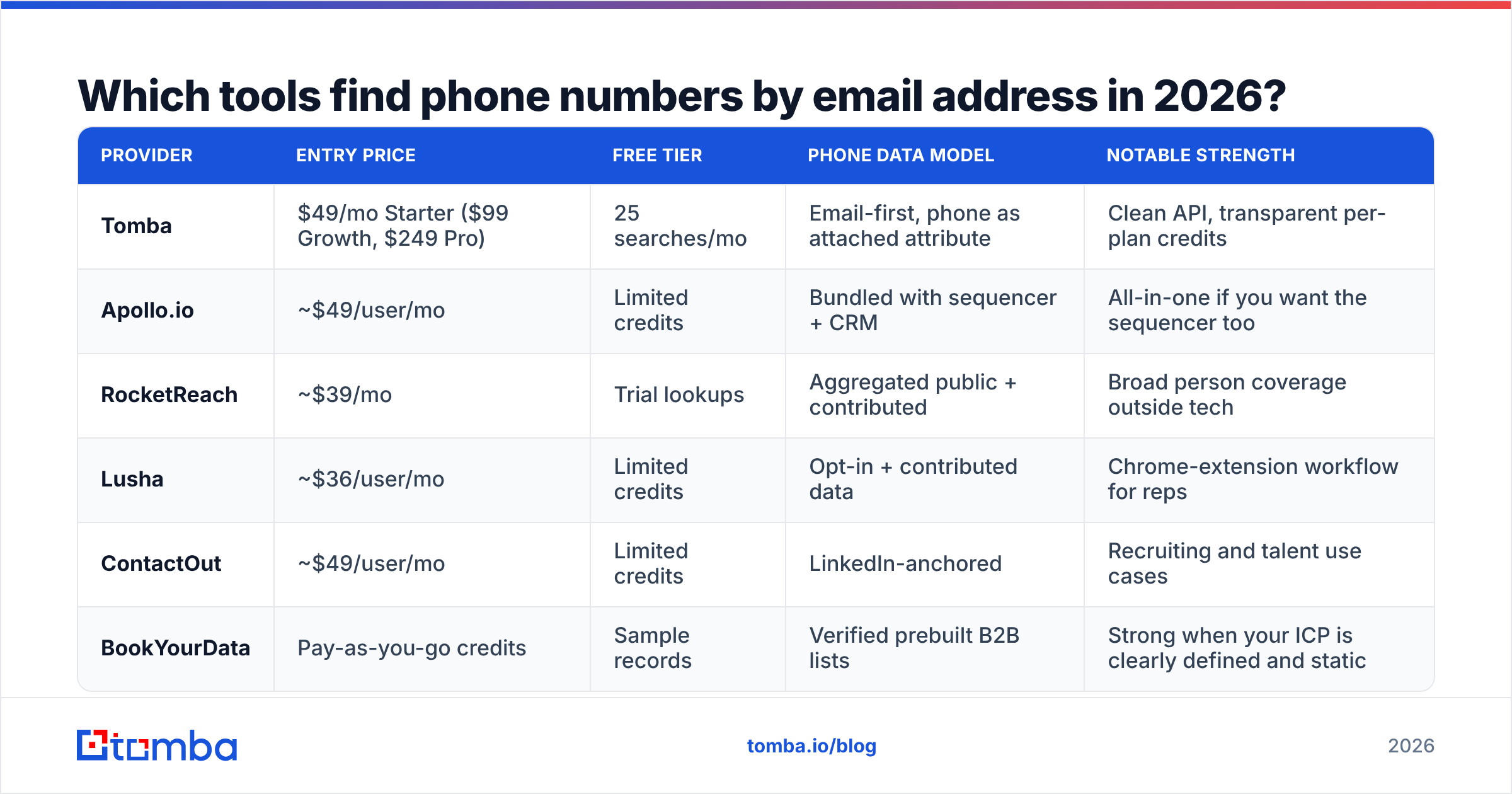
Below is list pricing as published on vendor sites in early 2026. Verify current tiers before you commit — this category re-prices constantly.
| Provider | Entry price | Free tier | Phone data model | Notable strength |
|---|---|---|---|---|
| Tomba | $49/mo Starter ($99 Growth, $249 Pro) | 25 searches/mo | Email-first, phone as attached attribute | Clean API, transparent per-plan credits |
| Apollo.io | ~$49/user/mo | Limited credits | Bundled with sequencer + CRM | All-in-one if you want the sequencer too |
| RocketReach | ~$39/mo | Trial lookups | Aggregated public + contributed | Broad person coverage outside tech |
| Lusha | ~$36/user/mo | Limited credits | Opt-in + contributed data | Chrome-extension workflow for reps |
| ContactOut | ~$49/user/mo | Limited credits | LinkedIn-anchored | Recruiting and talent use cases |
| BookYourData | Pay-as-you-go credits | Sample records | Verified prebuilt B2B lists | Strong when your ICP is clearly defined and static |
Two honest caveats.
Per-user vs per-workspace pricing changes the math. A $36/user tool across eight reps is $288/month; a $99 workspace plan with pooled credits is not. If your enrichment runs server-side through an API rather than through a browser extension, workspace pricing almost always wins.
Bundled tools charge you for the bundle. Apollo's price includes a sequencer and a CRM layer. If you already run Outreach, Salesloft, or Instantly, you are paying twice. Check Tomba pricing against your actual credit consumption rather than against sticker price — most teams over-buy by 3-4x because they size for a one-time backfill instead of steady-state monthly volume. Independent review data on G2's sales intelligence category is useful for support-quality signals, though be aware that self-reported accuracy ratings there track satisfaction, not measured match rates.
What accuracy should you actually expect?#
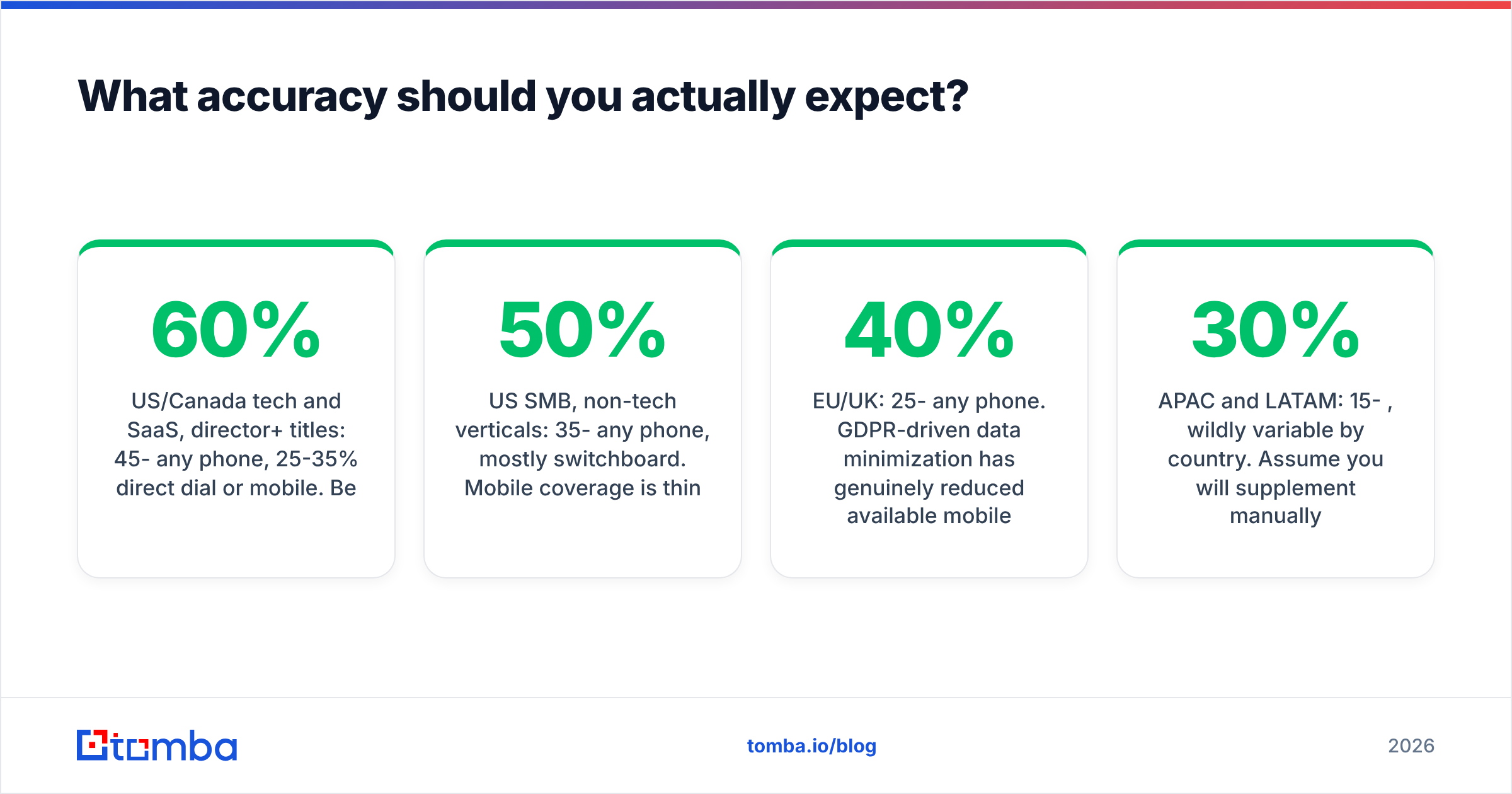
Set the benchmark by segment, not by vendor claim.
- US/Canada tech and SaaS, director+ titles: 45-60% any phone, 25-35% direct dial or mobile. Best-covered segment in the market.
- US SMB, non-tech verticals: 35-50% any phone, mostly switchboard. Mobile coverage is thin.
- EU/UK: 25-40% any phone. GDPR-driven data minimization has genuinely reduced available mobile records since 2023.
- APAC and LATAM: 15-30%, wildly variable by country. Assume you will supplement manually.
- Consumer / free-email addresses: below 10% for anything reliable, and legally the riskiest bucket. Do not build a motion on it.
There is also a definitional trick to watch for. When a vendor advertises "85% phone accuracy," ask accuracy of what. Usually it means: of the records where we returned a number, 85% were correctly formatted and active. That is a validity metric. It is not a coverage metric, and it is not an attribution metric. The number you care about is connect rate on dial, which for a well-enriched B2B list lands around 8-18% for direct dials and 2-5% for switchboard routes.
Run your own test before scaling. Take 200 known-good contacts where you already have verified numbers in the CRM, strip the phones, feed the emails to the vendor, and score the returns against ground truth. It takes an afternoon and it has saved teams five-figure annual commitments.
Is it legal to find a phone number by email address?#
Finding is generally lawful. Dialing is where the rules bite, and they differ by jurisdiction.
United States. The TCPA governs autodialed and prerecorded calls; the FTC's Telemarketing Sales Rule and the National Do Not Call Registry govern telemarketing. B2B calls to a business line have carve-outs, but the safe harbor narrows fast when the number is a personal mobile — and a scrubbed record does not become compliant just because a vendor sold it to you. The FTC's telemarketing compliance guidance is the primary source; read it rather than a vendor's summary of it.
EU/UK. GDPR treats a work mobile as personal data. You need a lawful basis — usually legitimate interest — plus a documented balancing test, a clear privacy notice at first contact, and a working opt-out. Several member states additionally require prior consent for marketing calls to individuals.
Everywhere. Keep provenance. For every number, log the source, the acquisition date, and the lawful basis you are relying on. When a complaint arrives — and at volume, one will — "we bought a list" is not a defense. "This came from provider X on 2026-03-14 under legitimate interest, balancing test on file" is.
For background on how reverse lookup services are structured and regulated, Wikipedia's reverse telephone directory entry is a reasonable neutral primer on the history and the consumer-protection restrictions that shaped it.
How do you build a repeatable email-to-phone workflow?#
Here is the repeatable way to find phone number by email address. Six steps, in this order. Skipping step 1 is the most common and most expensive mistake.
First, clean the list (steps 1-3).
- Dedupe and normalize first. Lowercase every address, strip Gmail dots and plus-aliases, kill role accounts (
info@,sales@,support@) — they will never resolve to a person. On a typical scraped list this removes 15-25% of rows before you spend a single credit. - Verify the email before you enrich it. A bounced address means the person is gone, which means any phone attached to that identity is stale too. Run an email verifier pass and drop hard bounces. This is the highest-ROI filter in the whole chain.
- Resolve identity, then enrich. Turn the email into name, title, company, and seniority. Enrichment endpoints match far better on a full identity than on a bare address. Feed the resolved record into data enrichment rather than the raw email.
Then get the number and prove it works (steps 4-6).
- Query phone in tiers. Ask for direct dial first, mobile second, switchboard third. Store all three with an explicit
phone_typefield so your dialer can route intelligently instead of treating a reception desk like a personal cell. - Validate format and line type. Normalize to E.164, confirm the line is active, and tag mobile vs landline vs VoIP. Countries with strict mobile-marketing rules need this tag before anyone dials.
- Close the loop with call outcomes. Write connect / wrong-number / disconnected back to the record. After 60 days you will know your real per-vendor connect rate, which is the only accuracy number that has ever mattered.
If you run this as a batch job rather than rep-by-rep, a bulk email finder pass plus an API-driven enrichment step will process a 10,000-row list in minutes and cost less than one rep-week of manual research.
What does it actually cost per connected call?#
Work backwards from the conversation, not forwards from the credit.
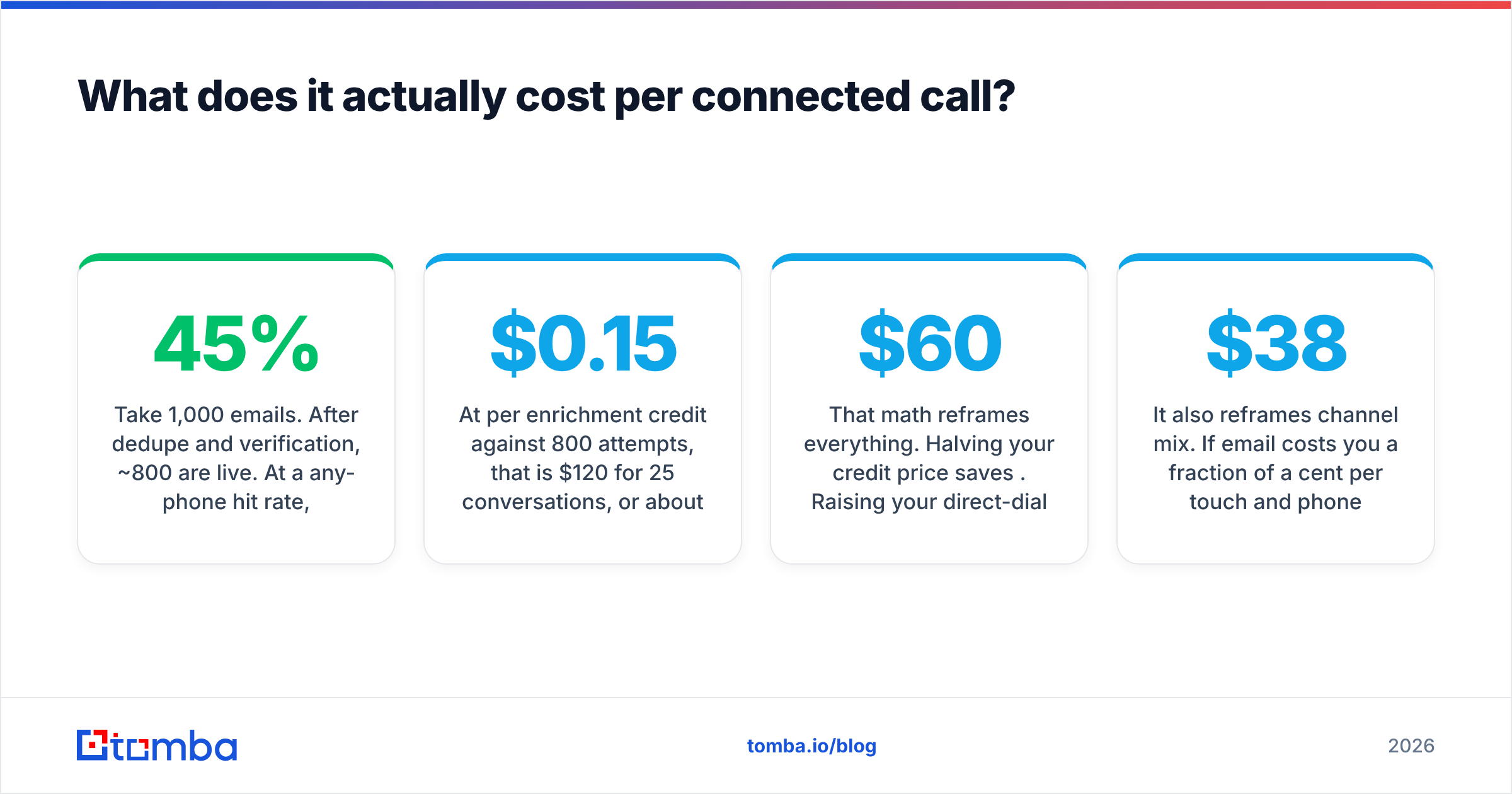
Take 1,000 emails. After dedupe and verification, ~800 are live. At a 45% any-phone hit rate, you get 360 numbers, of which maybe 130 are direct dial or mobile. At a 14% connect rate on direct dials and 3% on switchboard, you get roughly 18 + 7 = 25 live conversations.
At $0.15 per enrichment credit against 800 attempts, that is $120 for 25 conversations, or about $4.80 per connected call — before rep time. Add 4 minutes of dialing per attempt across 360 numbers at a $35/hour loaded rate and you are near $840 in labor, pushing true cost to roughly $38 per conversation.
That math reframes everything. Halving your credit price saves $60. Raising your direct-dial share from 36% to 50% of returned numbers saves hundreds, because rep time dominates. Optimize for direct-dial density and freshness, not for cheap credits.
It also reframes channel mix. If email costs you a fraction of a cent per touch and phone costs $38 per conversation, phone is a tier-1 account channel, not a spray channel. Most teams get better returns pairing a verified email sequence with phone reserved for accounts that showed intent — the pattern HubSpot documents in its sales prospecting research and one that holds up in practice.
When should you skip email-to-phone entirely?#
Three situations where the answer is no:
- Your ICP is EU SMB. Coverage is low, legal overhead is high, and the same budget in verified email plus LinkedIn returns more meetings.
- Your list is mostly free-mail addresses. Sub-10% resolution and the worst compliance profile in the category. Fix your acquisition source instead.
- You have no dialer discipline. If nobody logs call outcomes, you will never learn your real connect rate, and you will re-buy the same dead numbers every quarter.
Conversely, phone enrichment pays for itself fastest when you are chasing a small named-account list, working a renewal or expansion motion where the contact already knows you, or trying to reach a role that ignores email entirely — ops, facilities, field leadership.
Ready to turn emails into contactable people?#
Start with the identity layer, then attach the number. That order is the cheapest way to find phone number by email address at scale. Tomba's phone finder sits directly alongside the email finder, verifier, and enrichment endpoints, so one API call chain takes you from a raw address to a verified, typed, E.164-formatted number with provenance you can defend. The free tier gives you 25 searches a month to run your own ground-truth test before committing to anything; Starter is $49/month and Growth is $99/month with pooled credits rather than per-seat billing.
Test it against 200 contacts you already have numbers for. If the hit rate holds up on your ICP, scale it. If it doesn't, you'll know in an afternoon instead of a quarter.
Related guides#
Ready to find emails that actually work?
Join 150,000+ professionals who stopped guessing and started sending. Free credits on signup — no credit card required.
Get the Tomba newsletter
Practical outbound tactics and product updates — once every two weeks.
About the author